Compare commits
| Author | SHA1 | Date | |
|---|---|---|---|
 Alby96 |
f7b5cfb1bd | ||
 Alby96andClaude Opus 5.5 |
83ef60fce2 | ||
|
Alby96
|
a8f00cbae0 | ||
|
Alby96andClaude Opus 5.5
|
51007d68ca | ||
|
Alby96andClaude Opus 5.5
|
836a316b05 | ||
|
Alby96andClaude Opus 5.5
|
246d6f9357 | ||
|
Alby96andClaude Opus 5.5
|
b78260beb0 | ||
|
Alby96andClaude Opus 5.5
|
9d7cb9e71f | ||
|
Alby96andClaude Opus 5.5
|
fb12411404 | ||
|
Alby96andClaude Opus 5.5
|
709bb13532 | ||
|
Alby96
|
0debd82983 | ||
|
Alby96andClaude Opus 5.5
|
f38b5894ce | ||
|
Alby96andClaude Opus 5.5
|
aef0a0d233 | ||
|
Alby96andClaude Opus 5.5
|
4014373797 | ||
|
Alby96andClaude Opus 5.5
|
5bbc2120a1 | ||
|
Alby96andClaude Opus 5.5
|
562bf98092 | ||
|
Alby96andClaude Opus 5.5
|
5fbbe4d3a4 | ||
|
Alby96andClaude Opus 5.5
|
b12dc79317 | ||
|
Alby96andClaude Opus 5.5
|
88a0c8ce9c | ||
|
Alby96andClaude Opus 5.5
|
cfca29d71c |
No files matched your search
@@ -7,6 +7,173 @@ un'immagine `gitea.encke-hake.ts.net/balbosoft/khaemhat:X.Y.Z`.
|
||||
|
||||
## [Unreleased]
|
||||
|
||||
### Changed
|
||||
- Decisioni del titolare (ADR 0044): le schermate con sola miniatura si disegnano dalla miniatura e dalla grafica del
|
||||
gestionale, senza attendere altri PNG (#35); nessun elenco ABI/CAB precaricato, nome della banca e BIC dal conto
|
||||
dell'azienda o a mano (#45); intermediari reali, accreditamento SdICoop e PEC di prova rimandati (#78). La guida
|
||||
*Fatturazione elettronica* spiega quale canale usare.
|
||||
|
||||
## [0.10.0] - 2026-11-13
|
||||
|
||||
M10 - Cespiti, Intrastat, chiusura, bilancio. I beni ammortizzabili hanno il loro registro con il piano civilistico e
|
||||
fiscale; gli elenchi Intrastat nascono dalle fatture con il file per le Dogane; le dichiarazioni d'intento hanno un
|
||||
registro e il plafond è controllato quando si conferma la fattura; a fine anno ratei, risconti e una chiusura guidata
|
||||
in nove passi portano al bilancio CEE con riclassificato, indici ed export per il commercialista.
|
||||
|
||||
### Added
|
||||
- Cespiti (#82, ADR 0041, mockup 048): categorie con i coefficienti del DM 31/12/1988 (*Categorie standard*), conti e
|
||||
aliquote civilistica e fiscale; registro con piano di ammortamento per anno, movimenti, beni già in uso con i fondi
|
||||
iniziali; ammortamenti dell'anno registrati per categoria e annullabili finché non definitivi; dismissioni totali e
|
||||
parziali con plusvalenza o minusvalenza; stampa del registro dei beni ammortizzabili.
|
||||
- Intrastat (#83, ADR 0042, mockup 049): elenchi di cessioni e acquisti generati da fatture e note confermate (beni
|
||||
raggruppati, servizi per fattura, rettifiche), righe manuali che sopravvivono alla rigenerazione, controlli di
|
||||
nomenclatura, massa, partita IVA e codice CPA, periodicità dovuta dalle soglie dei quattro trimestri precedenti,
|
||||
file `SCAMBI.CEE` e invio registrato con il protocollo.
|
||||
- Dichiarazioni d'intento (#83, ADR 0042, mockup 061): registro cronologico delle dichiarazioni ricevute ed emesse
|
||||
con protocollo telematico, plafond, utilizzato ricalcolato dalle vendite in N3.5, avviso dal 90 %, revoca e stampa;
|
||||
la conferma di una fattura in N3.5 è rifiutata senza dichiarazione valida o oltre il plafond.
|
||||
- Ratei e risconti (#84): inserimento con calcolo per giorni, proposta dei risconti dalle fatture di acquisto sui
|
||||
costi tipicamente a cavallo dell'anno, differenze di cambio al 31/12 sulle partite in valuta.
|
||||
- Chiusura guidata (#85, ADR 0043, mockup 050): controlli, ammortamenti, ratei e risconti, rimanenze al costo medio
|
||||
ponderato, accantonamenti (svalutazione crediti 0,5 %, TFR), chiusura dei conti economici e patrimoniali, apertura
|
||||
dell'esercizio successivo con lo storno dei ratei, stampe definitive (libro giornale, registri IVA, registro
|
||||
cespiti, bilancio); ogni passo si ripete o si annulla fino alle stampe; blocco dell'esercizio.
|
||||
- Bilancio (#86, ADR 0043, mockup 051): schede *CEE*, *Riclassificato* e *Indici* nella pagina *Bilancio*; schema
|
||||
ordinario, abbreviato e micro con l'anno precedente e la variazione, dettaglio dei conti di ogni voce, avviso dei
|
||||
conti senza voce, stato patrimoniale finanziario e conto economico a valore aggiunto, undici indici, stampa PDF ed
|
||||
export ZIP per il commercialista (cinque CSV).
|
||||
- Dati di esempio di fine anno (#87): apertura dei conti al 1° gennaio con cespiti, rimanenze, banca e capitale,
|
||||
quattro cespiti, un risconto, la dichiarazione d'intento in uso e una cessione intracomunitaria; prova di
|
||||
integrazione che chiude l'anno demo dal passo 1 al blocco su SQLite e PostgreSQL.
|
||||
- Permessi `assets.asset.read`, `assets.asset.write`, `assets.depreciation.post`, `intrastat.list.read`,
|
||||
`intrastat.list.write`, `intrastat.list.export`, `sales.intent.read`, `sales.intent.write`, `ledger.year.close`,
|
||||
`reports.accountant.export`.
|
||||
- Tabelle `fixed_asset_categories`, `fixed_assets`, `fixed_asset_movements`, `accruals`, `closing_runs`,
|
||||
`closing_steps`, `closing_prints`, `intrastat_lists`, `intrastat_list_lines`, `intent_declarations` (migrazione
|
||||
`create_year_end`).
|
||||
- ADR 0041, 0042 e 0043; pagine wiki *Cespiti*, *Intrastat*, *Dichiarazioni d'intento* e *Chiusura e bilancio* con
|
||||
le schermate.
|
||||
|
||||
### Changed
|
||||
- Menu *Contabilità* con *Ratei e risconti* e *Chiusura esercizio*; menu *Cespiti* con *Categorie*; *Intrastat* e
|
||||
*Dichiarazioni d'intento* attivi nel menu *Fatturazione elettronica*.
|
||||
- La dichiarazione d'intento nei dati fiscali del cliente è lo specchio di quella corrente del registro; quelle
|
||||
scritte prima della 0.10 entrano nel registro alla prima lettura.
|
||||
- Il pacchetto fiscale espone le regole di cespiti, chiusura, Intrastat, dichiarazioni d'intento e lo schema del
|
||||
bilancio CEE.
|
||||
|
||||
### Known issues
|
||||
- Il file `SCAMBI.CEE` non è ancora stato verificato con il software di controllo delle Dogane: controllarlo prima
|
||||
del primo invio.
|
||||
- Le differenze di cambio usano il residuo attuale della partita; il TFR della chiusura è una stima.
|
||||
|
||||
## [0.9.0] - 2026-11-13
|
||||
|
||||
M9 - Fatturazione elettronica. Le fatture emesse diventano file FatturaPA controllati prima dell'invio con i codici
|
||||
dello SDI e partono dal canale scelto dalle regole di instradamento (PEC, SdICoop o due intermediari); le notifiche
|
||||
aggiornano da sole file e documenti, gli scarti si correggono e si rigenerano, le fatture dei fornitori arrivano in
|
||||
una casella da registrare e i file di un periodo si esportano per la conservazione.
|
||||
|
||||
### Added
|
||||
- File FatturaPA (#74, ADR 0039): `FatturaPaWriter` scrive `FPR12`, `FPA12` e `FSM10` v1.2 con nome
|
||||
`IT<identificativo>_<progressivo>.xml` e progressivo in base 36 mai riusato; il modello del documento viene da
|
||||
`EInvoiceBuilder` (cedente, cessionario, ritenute, cassa, bollo, sconti, riferimenti, DDT, riepilogo IVA,
|
||||
pagamenti, allegati).
|
||||
- Controllo prima dell'invio (#74): `FatturaPaValidator` ripete offline i controlli dello SDI con lo stesso codice
|
||||
(00305-00473) e le tolleranze delle specifiche 1.9.1, più la struttura contro uno schema incorporato;
|
||||
*Controlla senza generare* sul cruscotto.
|
||||
- Notifiche SDI (#75): `SdiReceiptReader` legge RC, NS, MC, NE, DT, AT, SE e MT; ogni notifica è conservata una sola
|
||||
volta, abbinata al file e applicata al file e al documento nella stessa transazione; import manuale di XML, P7M e
|
||||
ZIP del portale; pagina *Notifiche SDI* con filtri e download.
|
||||
- Canali (#76, #77): PEC con SMTP e un client IMAP e un lettore MIME scritti in casa (primo invio a
|
||||
`sdi01@pec.fatturapa.it`, poi l'indirizzo appreso dallo SDI, cartella di archivio), SdICoop SOAP/MTOM con
|
||||
certificato client, Intermediario A (chiave API) e Intermediario B (utente e password) dietro lo stesso contratto
|
||||
`IEInvoiceTransport` (ADR 0040); prova di connessione, pausa, segreti cifrati.
|
||||
- Instradamento (#77): regole *Sempre*, *Cliente PA*, *Cliente specifico*, *Tipo documento* e *Volume giornaliero*
|
||||
con canale di riserva (`SdiRouter`); pagina *Canali di trasmissione* (mockup 059).
|
||||
- Lettura dei canali (#76): attività `einvoice.poll` ogni 15 minuti e *Leggi i canali ora*; un messaggio si conferma
|
||||
solo quando tutti i suoi file sono salvati. Ricezione push di SdICoop su `POST /sdicoop/{azienda}` con la chiave
|
||||
di ricezione nell'intestazione `X-Khaemhat-SdiCoop-Key` e il certificato reciproco sul reverse proxy.
|
||||
- Cruscotto SDI (#74, #75, mockup 058): sei contatori, viste *Emesse*, *Autofatture* e *Da fare*, filtri e
|
||||
ricerca, documenti da generare, *Genera + invia*, *Invia*, *Correggi*, *Segna come inviata*, download dell'XML,
|
||||
storico del file con le versioni sostituite, esito della trasmissione; avvisi sulla Home per scarti e file da
|
||||
inviare (`EInvoiceFeedSource`).
|
||||
- Copia di cortesia (#74): il PDF del documento con il file FatturaPA allegato (`/AF`).
|
||||
- Fatture ricevute (#79): casella delle fatture dei fornitori dai canali o caricate (XML, P7M, metadati, ZIP) senza
|
||||
doppioni, registrazione singola o in blocco con l'import del ciclo passivo, scarto e ripristino, download.
|
||||
- Conservazione (#79): pacchetto ZIP di un periodo (fino a due anni) con `emesse/`, `ricevute/`, `notifiche/`,
|
||||
`indice.csv` con SHA-256 e `LEGGIMI.txt`, e l'elenco dei pacchetti preparati.
|
||||
- Fatturazione elettronica nei dati di esempio con il modulo EINV (#80): canale PEC in pausa, Intermediario A
|
||||
disattivato, tre regole, i file delle fatture demo con consegne, uno scarto corretto, una mancata consegna e file
|
||||
in attesa, tre fatture di fornitori da registrare.
|
||||
- Rimozione dei dati di esempio (#80, ADR 0040): `DemoDataRemover` guidato dallo schema delle migrazioni elimina le
|
||||
righe `is_demo` e quelle che appartengono loro in una transazione e si ferma se dati dell'utente vi fanno
|
||||
riferimento; `scripts/seed.sh --remove-demo [--company CODICE]`; il seed stampa il tempo impiegato.
|
||||
- Permessi `einvoice.document.read`, `einvoice.document.send`, `einvoice.inbox.read`, `einvoice.inbox.import`,
|
||||
`einvoice.channel.manage`; testi in `Resources/it-IT/EInvoicing.json`.
|
||||
- Tabelle `e_invoices`, `e_invoice_notifications`, `e_invoice_inbox`, `e_invoice_channels`, `e_invoice_routing`,
|
||||
`e_invoice_conservation` (migrazione `M20261113_004`).
|
||||
- ADR 0039 e 0040; pagina wiki *Fatturazione elettronica* completa con le schermate (#81).
|
||||
|
||||
### Changed
|
||||
- Il menu *Fatturazione elettronica* ha le voci *Cruscotto SDI*, *Fatture ricevute*, *Notifiche SDI*,
|
||||
*Conservazione* e *Canali di trasmissione*, ognuna con il suo permesso; *Dichiarazioni d'intento* resta in M10.
|
||||
- Una fattura scartata dallo SDI torna modificabile e si rigenera con un nuovo file.
|
||||
- I seeder dimostrativi marcano come demo anche le righe scritte dai servizi per loro (registrazioni, partite,
|
||||
pagamenti, mandati, estratti conto).
|
||||
- Il modello delle fatture ricevute è condiviso con quello delle emesse (`EInvoice*` nelle astrazioni fiscali).
|
||||
|
||||
## [0.8.0] - 2026-11-13
|
||||
|
||||
M8 - Scadenzario e tesoreria. Le partite aperte di clienti e fornitori si chiudono con incassi e pagamenti che si
|
||||
contabilizzano da soli; distinte RiBa, SDD e bonifici SEPA con il file per l'home banking, presentazione, accredito
|
||||
e insoluti; riconciliazione dell'estratto conto con abbinamento automatico; solleciti con interessi di mora e flusso
|
||||
di cassa.
|
||||
|
||||
### Added
|
||||
- Scadenzario (#69, ADR 0038): partite aperte di clienti e fornitori dalla contabilità con stati, aging in cinque
|
||||
fasce, filtri, modifica di scadenza, metodo, banca e contestazione, estratto conto della controparte con gli
|
||||
interessi di mora, export CSV.
|
||||
- Incassi e pagamenti (#69): su più partite della stessa controparte, totali o parziali, con abbuoni, spese bancarie,
|
||||
differenze cambio e note di credito; registrazione `INC` o `PAG` nella stessa transazione; annullamento con storno;
|
||||
la ritenuta d'acconto di una parcella diventa dovuta quando la fattura è saldata. Elenchi *Incassi* e *Pagamenti*.
|
||||
- Distinte (#70): RiBa nel tracciato CBI (`RibaCbiWriter`), SDD core e B2B in `pain.008.001.08` e bonifici SEPA in
|
||||
`pain.001.001.09` (`SepaXmlWriter`); candidati con controllo di IBAN, ABI/CAB e mandato; bozza, file, presentazione
|
||||
su *Effetti all'incasso* o con anticipo *salvo buon fine*, accredito, insoluto con riapertura della partita e
|
||||
spese come nuova partita del cliente.
|
||||
- Mandati SDD (#70) con riferimento univoco, schema core o B2B, firma, revoca, sequenza FRST/RCUR.
|
||||
- Riconciliazione bancaria (#71): import di estratti CSV (colonne riconosciute dall'intestazione), CBI e CAMT.053
|
||||
senza doppioni (impronta dei movimenti); proposte con confidenza da partite, incassi e pagamenti registrati, F24,
|
||||
accrediti e insoluti di distinte e regole salvate (`BankMatcher`); conferma singola o di tutte le proposte dal
|
||||
90%; abbinamento manuale, registrazione su conto con regola, *Ignora*, *Annulla abbinamento*; saldo banca, saldo
|
||||
contabile e differenza.
|
||||
- Solleciti (#72): tre livelli modificabili con giorni, modello, canali (e-mail, PEC, lettera PDF), interessi di
|
||||
mora, avviso all'agente e blocco del cliente; proposta di invio che esclude PA, partite contestate e in distinta;
|
||||
anteprima PDF, invio con la coda di posta, lettere in un PDF unico, registro degli invii; attività programmata
|
||||
`finance.dunning` nei giorni feriali alle 7:00 per i livelli automatici.
|
||||
- Interessi di mora del D.Lgs. 231/2002 nel pacchetto italiano (`LatePaymentRulesIt`): tasso BCE del semestre più
|
||||
8 punti, 10,15% nel primo semestre 2026 e 10,40% nel secondo.
|
||||
- Flusso di cassa (#72) a 30-365 giorni per settimana o mese da partite, effetti presentati, ordini non fatturati,
|
||||
registrazioni ricorrenti e F24, con le fonti selezionabili e il punto più basso.
|
||||
- Scadenze di incassi e pagamenti e crediti scaduti sulla Home (`TreasuryFeedSource`).
|
||||
- Menu *Scadenzario* con otto voci; testi in `Resources/it-IT/Treasury.json`; permessi `finance.schedule.*`,
|
||||
`finance.payment.*`, `finance.bank.reconcile`.
|
||||
- Tesoreria nei dati di esempio con il modulo FIN (#73): banca, versamento dei soci, incassi e pagamenti, distinta
|
||||
accreditata con un insoluto, distinta s.b.f. in bozza, mandato, estratto CSV da riconciliare con una regola, primo
|
||||
sollecito.
|
||||
- Tabelle `payments`, `payment_lines`, `remittances`, `remittance_lines`, `sdd_mandates`, `bank_statements`,
|
||||
`bank_statement_lines`, `bank_match_rules`, `dunning_levels`, `dunning_letters`; nuove colonne di
|
||||
`gl_open_items` e `bank_accounts.creditor_id` (migrazione `M20261113_003`).
|
||||
- Conti *Perdite su cambi*, *Utili su cambi* e *Interessi di mora attivi* nel piano dei conti PMI standard (240 conti).
|
||||
- ADR 0038; pagina wiki *Scadenzario* completa con le schermate.
|
||||
|
||||
### Changed
|
||||
- La rettifica della registrazione di un documento mantiene le partite già incassate o pagate.
|
||||
- Il menu *Fatturazione elettronica* mostra M9 come milestone.
|
||||
|
||||
### Fixed
|
||||
- Le strisce di riepilogo non si schiacciano più nelle pagine più alte della finestra.
|
||||
|
||||
## [0.7.0] - 2026-11-13
|
||||
|
||||
M7 - Contabilità generale e IVA. Ogni fattura, nota e autofattura si contabilizza da sola nella stessa transazione,
|
||||
|
||||
@@ -76,8 +76,9 @@ validi.
|
||||
`docs/mockups/png/` più la galleria completa `000-galleria-mockup.png`; per **tutte le 88** esiste una miniatura
|
||||
401x241 ritagliata dalla galleria in `docs/mockups/thumbs/`. Per le schermate senza PNG ad alta risoluzione si
|
||||
lavora da miniatura + `mockup.css` + descrizione in SPEC §10-§12, scegliendo i mattoni della schermata più simile
|
||||
in alta risoluzione (§10.1 regola 4). I PNG mancanti vanno chiesti all'utente quando servono, senza bloccare il
|
||||
lavoro (issue con etichetta `Status/In attesa utente`).
|
||||
in alta risoluzione (§10.1 regola 4). Il titolare ha confermato il 2026-11-16 che altri PNG non esistono
|
||||
(ADR [0044](docs/adr/0044-schermate-senza-png-banche-e-canali-sdi.md)): la miniatura è la specifica finale e i dettagli
|
||||
che non mostra si decidono seguendo la grafica del gestionale già costruita, senza chiederli.
|
||||
|
||||
**E5 — Avvio dello sviluppo.** La specifica (§0, §23) dice di lavorare in autonomia senza chiedere conferme. Vale,
|
||||
**dopo** il via esplicito dell'utente: la documentazione e la pianificazione su Gitea sono state preparate il
|
||||
|
||||
@@ -732,6 +732,38 @@ Migrazioni applicate in ordine:
|
||||
- `core` 20261112003 `create_documents` (M20261112_003_CreateDocuments)
|
||||
- `core` 20261113001 `create_inventory` (M20261113_001_CreateInventory)
|
||||
- `core` 20261113002 `create_ledger` (M20261113_002_CreateLedger)
|
||||
- `core` 20261113003 `create_treasury` (M20261113_003_CreateTreasury)
|
||||
- `core` 20261113004 `create_einvoicing` (M20261113_004_CreateEInvoicing)
|
||||
- `core` 20261113005 `create_year_end` (M20261113_005_CreateYearEnd)
|
||||
|
||||
#### `accruals`
|
||||
|
||||
| Colonna | Tipo | Null | Default | Note |
|
||||
|---|---|---|---|---|
|
||||
| `id` | Int64 | no | | chiave primaria, identity |
|
||||
| `year` | Int32 | no | | |
|
||||
| `kind` | String(40) | no | | |
|
||||
| `description` | String(200) | no | | |
|
||||
| `account_id` | Int64 | no | | -> `gl_accounts` (Restrict) |
|
||||
| `amount` | Decimal(19,6) | no | `0` | |
|
||||
| `period_start` | Date | no | | |
|
||||
| `period_end` | Date | no | | |
|
||||
| `year_end` | Date | no | | |
|
||||
| `adjustment` | Decimal(19,6) | no | `0` | |
|
||||
| `source_family` | String(40) | sì | | |
|
||||
| `source_document_id` | Int64 | sì | | |
|
||||
| `document_number` | String(40) | sì | | |
|
||||
| `party_id` | Int64 | sì | | |
|
||||
| `gl_entry_id` | Int64 | sì | | -> `gl_entries` (Restrict) |
|
||||
| `reversal_entry_id` | Int64 | sì | | -> `gl_entries` (Restrict) |
|
||||
| `is_demo` | Bool | no | `false` | |
|
||||
| `created_at` | DateTimeUtc | no | | |
|
||||
| `created_by` | String(100) | sì | | |
|
||||
| `updated_at` | DateTimeUtc | sì | | |
|
||||
| `updated_by` | String(100) | sì | | |
|
||||
| `row_version` | Int64 | no | `1` | |
|
||||
|
||||
- indice `ix_accruals_year` su `year`
|
||||
|
||||
#### `attachments`
|
||||
|
||||
@@ -799,9 +831,91 @@ Migrazioni applicate in ordine:
|
||||
| `updated_at` | DateTimeUtc | sì | | |
|
||||
| `updated_by` | String(100) | sì | | |
|
||||
| `row_version` | Int64 | no | `1` | |
|
||||
| `creditor_id` | String(35) | sì | | |
|
||||
|
||||
- indice unico `ux_bank_accounts_code` su `code`
|
||||
|
||||
#### `bank_match_rules`
|
||||
|
||||
| Colonna | Tipo | Null | Default | Note |
|
||||
|---|---|---|---|---|
|
||||
| `id` | Int64 | no | | chiave primaria, identity |
|
||||
| `name` | String(100) | no | | |
|
||||
| `pattern` | String(100) | no | | |
|
||||
| `direction` | String(40) | no | | |
|
||||
| `account_id` | Int64 | no | | -> `gl_accounts` (Restrict) |
|
||||
| `template_code` | String(10) | sì | | |
|
||||
| `entry_description` | String(200) | sì | | |
|
||||
| `disabled` | Bool | no | `false` | |
|
||||
| `uses` | Int32 | no | `0` | |
|
||||
| `is_demo` | Bool | no | `false` | |
|
||||
| `created_at` | DateTimeUtc | no | | |
|
||||
| `created_by` | String(100) | sì | | |
|
||||
| `updated_at` | DateTimeUtc | sì | | |
|
||||
| `updated_by` | String(100) | sì | | |
|
||||
| `row_version` | Int64 | no | `1` | |
|
||||
|
||||
#### `bank_statement_lines`
|
||||
|
||||
| Colonna | Tipo | Null | Default | Note |
|
||||
|---|---|---|---|---|
|
||||
| `id` | Int64 | no | | chiave primaria, identity |
|
||||
| `statement_id` | Int64 | no | | -> `bank_statements` (Cascade) |
|
||||
| `bank_account_id` | Int64 | no | | |
|
||||
| `booking_date` | Date | no | | |
|
||||
| `value_date` | Date | sì | | |
|
||||
| `amount` | Decimal(19,6) | no | `0` | |
|
||||
| `description` | String(500) | no | | |
|
||||
| `reference` | String(60) | sì | | |
|
||||
| `counterparty_name` | String(140) | sì | | |
|
||||
| `counterparty_iban` | String(34) | sì | | |
|
||||
| `bank_code` | String(40) | sì | | |
|
||||
| `fingerprint` | String(64) | no | | |
|
||||
| `status` | String(40) | no | | |
|
||||
| `match_kind` | String(40) | no | | |
|
||||
| `confidence` | Int32 | no | `0` | |
|
||||
| `proposal` | String(300) | sì | | |
|
||||
| `targets` | String(300) | sì | | |
|
||||
| `party_id` | Int64 | sì | | |
|
||||
| `rule_id` | Int64 | sì | | |
|
||||
| `payment_id` | Int64 | sì | | |
|
||||
| `gl_entry_id` | Int64 | sì | | |
|
||||
| `matched_at` | DateTimeUtc | sì | | |
|
||||
| `matched_by` | String(100) | sì | | |
|
||||
| `is_demo` | Bool | no | `false` | |
|
||||
| `created_at` | DateTimeUtc | no | | |
|
||||
| `created_by` | String(100) | sì | | |
|
||||
| `updated_at` | DateTimeUtc | sì | | |
|
||||
| `updated_by` | String(100) | sì | | |
|
||||
| `row_version` | Int64 | no | `1` | |
|
||||
|
||||
- indice `ix_bank_statement_lines_date` su `bank_account_id`, `booking_date`
|
||||
- indice `ix_bank_statement_lines_statement` su `statement_id`
|
||||
- indice unico `ux_bank_statement_lines_fingerprint` su `bank_account_id`, `fingerprint`
|
||||
|
||||
#### `bank_statements`
|
||||
|
||||
| Colonna | Tipo | Null | Default | Note |
|
||||
|---|---|---|---|---|
|
||||
| `id` | Int64 | no | | chiave primaria, identity |
|
||||
| `bank_account_id` | Int64 | no | | -> `bank_accounts` (Restrict) |
|
||||
| `format` | String(40) | no | | |
|
||||
| `file_name` | String(200) | sì | | |
|
||||
| `from_date` | Date | no | | |
|
||||
| `to_date` | Date | no | | |
|
||||
| `opening_balance` | Decimal(19,6) | sì | | |
|
||||
| `closing_balance` | Decimal(19,6) | sì | | |
|
||||
| `movement_count` | Int32 | no | `0` | |
|
||||
| `attachment_id` | Int64 | sì | | |
|
||||
| `is_demo` | Bool | no | `false` | |
|
||||
| `created_at` | DateTimeUtc | no | | |
|
||||
| `created_by` | String(100) | sì | | |
|
||||
| `updated_at` | DateTimeUtc | sì | | |
|
||||
| `updated_by` | String(100) | sì | | |
|
||||
| `row_version` | Int64 | no | `1` | |
|
||||
|
||||
- indice `ix_bank_statements_account` su `bank_account_id`, `to_date`
|
||||
|
||||
#### `carriers`
|
||||
|
||||
| Colonna | Tipo | Null | Default | Note |
|
||||
@@ -825,6 +939,65 @@ Migrazioni applicate in ordine:
|
||||
|
||||
- indice unico `ux_carriers_code` su `code`
|
||||
|
||||
#### `closing_prints`
|
||||
|
||||
| Colonna | Tipo | Null | Default | Note |
|
||||
|---|---|---|---|---|
|
||||
| `id` | Int64 | no | | chiave primaria, identity |
|
||||
| `run_id` | Int64 | no | | -> `closing_runs` (Cascade) |
|
||||
| `kind` | String(20) | no | | |
|
||||
| `file_name` | String(100) | no | | |
|
||||
| `pages` | Int32 | no | `0` | |
|
||||
| `content` | Bytes | no | | |
|
||||
| `created_at` | DateTimeUtc | no | | |
|
||||
| `created_by` | String(100) | sì | | |
|
||||
| `updated_at` | DateTimeUtc | sì | | |
|
||||
| `updated_by` | String(100) | sì | | |
|
||||
| `row_version` | Int64 | no | `1` | |
|
||||
|
||||
- indice `ix_closing_prints_run` su `run_id`
|
||||
|
||||
#### `closing_runs`
|
||||
|
||||
| Colonna | Tipo | Null | Default | Note |
|
||||
|---|---|---|---|---|
|
||||
| `id` | Int64 | no | | chiave primaria, identity |
|
||||
| `fiscal_year_id` | Int64 | no | | -> `fiscal_years` (Restrict) |
|
||||
| `year_code` | String(10) | no | | |
|
||||
| `status` | String(40) | no | | |
|
||||
| `next_fiscal_year_id` | Int64 | sì | | |
|
||||
| `result` | Decimal(19,6) | no | `0` | |
|
||||
| `locked_at` | DateTimeUtc | sì | | |
|
||||
| `locked_by` | String(100) | sì | | |
|
||||
| `created_at` | DateTimeUtc | no | | |
|
||||
| `created_by` | String(100) | sì | | |
|
||||
| `updated_at` | DateTimeUtc | sì | | |
|
||||
| `updated_by` | String(100) | sì | | |
|
||||
| `row_version` | Int64 | no | `1` | |
|
||||
|
||||
- indice unico `ux_closing_runs_year` su `fiscal_year_id`
|
||||
|
||||
#### `closing_steps`
|
||||
|
||||
| Colonna | Tipo | Null | Default | Note |
|
||||
|---|---|---|---|---|
|
||||
| `id` | Int64 | no | | chiave primaria, identity |
|
||||
| `run_id` | Int64 | no | | -> `closing_runs` (Cascade) |
|
||||
| `number` | Int32 | no | | |
|
||||
| `status` | String(40) | no | | |
|
||||
| `entries` | Int32 | no | `0` | |
|
||||
| `amount` | Decimal(19,6) | no | `0` | |
|
||||
| `messages` | Text | sì | | |
|
||||
| `executed_at` | DateTimeUtc | sì | | |
|
||||
| `executed_by` | String(100) | sì | | |
|
||||
| `created_at` | DateTimeUtc | no | | |
|
||||
| `created_by` | String(100) | sì | | |
|
||||
| `updated_at` | DateTimeUtc | sì | | |
|
||||
| `updated_by` | String(100) | sì | | |
|
||||
| `row_version` | Int64 | no | `1` | |
|
||||
|
||||
- indice unico `ux_closing_steps_number` su `run_id`, `number`
|
||||
|
||||
#### `code_sequences`
|
||||
|
||||
| Colonna | Tipo | Null | Default | Note |
|
||||
@@ -1109,6 +1282,229 @@ Migrazioni applicate in ordine:
|
||||
|
||||
- indice unico `ux_document_types_code` su `code`
|
||||
|
||||
#### `dunning_letters`
|
||||
|
||||
| Colonna | Tipo | Null | Default | Note |
|
||||
|---|---|---|---|---|
|
||||
| `id` | Int64 | no | | chiave primaria, identity |
|
||||
| `party_id` | Int64 | no | | -> `parties` (Restrict) |
|
||||
| `level` | Int32 | no | | |
|
||||
| `sent_on` | Date | no | | |
|
||||
| `channel` | String(60) | no | | |
|
||||
| `recipients` | String(300) | sì | | |
|
||||
| `subject` | String(200) | no | | |
|
||||
| `item_count` | Int32 | no | `0` | |
|
||||
| `overdue_amount` | Decimal(19,6) | no | `0` | |
|
||||
| `interest` | Decimal(19,6) | no | `0` | |
|
||||
| `status` | String(40) | no | | |
|
||||
| `attachment_id` | Int64 | sì | | |
|
||||
| `mail_id` | Int64 | sì | | |
|
||||
| `sent_by` | String(100) | sì | | |
|
||||
| `is_demo` | Bool | no | `false` | |
|
||||
| `created_at` | DateTimeUtc | no | | |
|
||||
| `created_by` | String(100) | sì | | |
|
||||
| `updated_at` | DateTimeUtc | sì | | |
|
||||
| `updated_by` | String(100) | sì | | |
|
||||
| `row_version` | Int64 | no | `1` | |
|
||||
|
||||
- indice `ix_dunning_letters_party` su `party_id`, `sent_on`
|
||||
|
||||
#### `dunning_levels`
|
||||
|
||||
| Colonna | Tipo | Null | Default | Note |
|
||||
|---|---|---|---|---|
|
||||
| `id` | Int64 | no | | chiave primaria, identity |
|
||||
| `level` | Int32 | no | | |
|
||||
| `days_after_due` | Int32 | no | | |
|
||||
| `name` | String(100) | no | | |
|
||||
| `subject` | String(200) | no | | |
|
||||
| `body` | Text | no | | |
|
||||
| `channel` | String(60) | no | | |
|
||||
| `charge_interest` | Bool | no | `false` | |
|
||||
| `action` | String(40) | no | | |
|
||||
| `automatic` | Bool | no | `false` | |
|
||||
| `created_at` | DateTimeUtc | no | | |
|
||||
| `created_by` | String(100) | sì | | |
|
||||
| `updated_at` | DateTimeUtc | sì | | |
|
||||
| `updated_by` | String(100) | sì | | |
|
||||
| `row_version` | Int64 | no | `1` | |
|
||||
|
||||
- indice unico `ux_dunning_levels_level` su `level`
|
||||
|
||||
#### `e_invoice_channels`
|
||||
|
||||
| Colonna | Tipo | Null | Default | Note |
|
||||
|---|---|---|---|---|
|
||||
| `id` | Int64 | no | | chiave primaria, identity |
|
||||
| `code` | String(20) | no | | |
|
||||
| `enabled` | Bool | no | `false` | |
|
||||
| `paused` | Bool | no | `false` | |
|
||||
| `mailbox` | String(254) | sì | | |
|
||||
| `smtp_host` | String(200) | sì | | |
|
||||
| `smtp_port` | Int32 | no | `465` | |
|
||||
| `imap_host` | String(200) | sì | | |
|
||||
| `imap_port` | Int32 | no | `993` | |
|
||||
| `tls` | Bool | no | `true` | |
|
||||
| `user_name` | String(254) | sì | | |
|
||||
| `protected_password` | Text | sì | | |
|
||||
| `exchange_address` | String(254) | sì | | |
|
||||
| `archive_folder` | String(100) | sì | | |
|
||||
| `endpoint` | String(300) | sì | | |
|
||||
| `protected_certificate` | Text | sì | | |
|
||||
| `protected_certificate_password` | Text | sì | | |
|
||||
| `protected_api_key` | Text | sì | | |
|
||||
| `test_environment` | Bool | no | `false` | |
|
||||
| `last_check_at` | DateTimeUtc | sì | | |
|
||||
| `last_check_ok` | Bool | sì | | |
|
||||
| `last_check_message` | String(1000) | sì | | |
|
||||
| `last_poll_at` | DateTimeUtc | sì | | |
|
||||
| `last_poll_message` | String(1000) | sì | | |
|
||||
| `last_poll_failed` | Bool | no | `false` | |
|
||||
| `is_demo` | Bool | no | `false` | |
|
||||
| `created_at` | DateTimeUtc | no | | |
|
||||
| `created_by` | String(100) | sì | | |
|
||||
| `updated_at` | DateTimeUtc | sì | | |
|
||||
| `updated_by` | String(100) | sì | | |
|
||||
| `row_version` | Int64 | no | `1` | |
|
||||
|
||||
- indice unico `ux_e_invoice_channels_code` su `code`
|
||||
|
||||
#### `e_invoice_conservation`
|
||||
|
||||
| Colonna | Tipo | Null | Default | Note |
|
||||
|---|---|---|---|---|
|
||||
| `id` | Int64 | no | | chiave primaria, identity |
|
||||
| `from_date` | Date | no | | |
|
||||
| `to_date` | Date | no | | |
|
||||
| `file_count` | Int32 | no | `0` | |
|
||||
| `file_name` | String(100) | no | | |
|
||||
| `hash` | String(64) | no | | |
|
||||
| `size` | Int64 | no | `0` | |
|
||||
| `created_at` | DateTimeUtc | no | | |
|
||||
| `created_by` | String(100) | sì | | |
|
||||
| `updated_at` | DateTimeUtc | sì | | |
|
||||
| `updated_by` | String(100) | sì | | |
|
||||
| `row_version` | Int64 | no | `1` | |
|
||||
|
||||
#### `e_invoice_inbox`
|
||||
|
||||
| Colonna | Tipo | Null | Default | Note |
|
||||
|---|---|---|---|---|
|
||||
| `id` | Int64 | no | | chiave primaria, identity |
|
||||
| `file_name` | String(100) | no | | |
|
||||
| `hash` | String(64) | no | | |
|
||||
| `content` | Bytes | no | | |
|
||||
| `metadata_file_name` | String(100) | sì | | |
|
||||
| `metadata` | Bytes | sì | | |
|
||||
| `exchange_id` | String(40) | sì | | |
|
||||
| `received_at` | DateTimeUtc | no | | |
|
||||
| `channel_code` | String(20) | sì | | |
|
||||
| `supplier_vat` | String(30) | sì | | |
|
||||
| `supplier_name` | String(200) | sì | | |
|
||||
| `document_type` | String(10) | sì | | |
|
||||
| `number` | String(40) | sì | | |
|
||||
| `document_date` | Date | sì | | |
|
||||
| `total_amount` | Decimal(19,6) | sì | | |
|
||||
| `party_id` | Int64 | sì | | |
|
||||
| `status` | String(40) | no | | |
|
||||
| `purchase_document_id` | Int64 | sì | | |
|
||||
| `error` | String(500) | sì | | |
|
||||
| `is_demo` | Bool | no | `false` | |
|
||||
| `created_at` | DateTimeUtc | no | | |
|
||||
| `created_by` | String(100) | sì | | |
|
||||
| `updated_at` | DateTimeUtc | sì | | |
|
||||
| `updated_by` | String(100) | sì | | |
|
||||
| `row_version` | Int64 | no | `1` | |
|
||||
|
||||
- indice `ix_e_invoice_inbox_file` su `file_name`
|
||||
- indice `ix_e_invoice_inbox_status` su `status`, `received_at`
|
||||
- indice unico `ux_e_invoice_inbox_hash` su `hash`
|
||||
|
||||
#### `e_invoice_notifications`
|
||||
|
||||
| Colonna | Tipo | Null | Default | Note |
|
||||
|---|---|---|---|---|
|
||||
| `id` | Int64 | no | | chiave primaria, identity |
|
||||
| `e_invoice_id` | Int64 | sì | | -> `e_invoices` (Cascade) |
|
||||
| `code` | String(4) | no | | |
|
||||
| `file_name` | String(100) | no | | |
|
||||
| `invoice_file_name` | String(100) | sì | | |
|
||||
| `exchange_id` | String(40) | sì | | |
|
||||
| `received_at` | DateTimeUtc | no | | |
|
||||
| `outcome` | String(10) | sì | | |
|
||||
| `description` | String(1000) | sì | | |
|
||||
| `errors` | Text | sì | | |
|
||||
| `channel_code` | String(20) | sì | | |
|
||||
| `content` | Bytes | no | | |
|
||||
| `is_demo` | Bool | no | `false` | |
|
||||
| `created_at` | DateTimeUtc | no | | |
|
||||
| `created_by` | String(100) | sì | | |
|
||||
| `updated_at` | DateTimeUtc | sì | | |
|
||||
| `updated_by` | String(100) | sì | | |
|
||||
| `row_version` | Int64 | no | `1` | |
|
||||
|
||||
- indice `ix_e_invoice_notifications_invoice` su `e_invoice_id`
|
||||
- indice unico `ux_e_invoice_notifications_file` su `file_name`
|
||||
|
||||
#### `e_invoice_routing`
|
||||
|
||||
| Colonna | Tipo | Null | Default | Note |
|
||||
|---|---|---|---|---|
|
||||
| `id` | Int64 | no | | chiave primaria, identity |
|
||||
| `position` | Int32 | no | `0` | |
|
||||
| `condition` | String(40) | no | | |
|
||||
| `value` | String(40) | sì | | |
|
||||
| `channel_code` | String(20) | no | | |
|
||||
| `fallback_channel_code` | String(20) | sì | | |
|
||||
| `disabled` | Bool | no | `false` | |
|
||||
| `is_demo` | Bool | no | `false` | |
|
||||
| `created_at` | DateTimeUtc | no | | |
|
||||
| `created_by` | String(100) | sì | | |
|
||||
| `updated_at` | DateTimeUtc | sì | | |
|
||||
| `updated_by` | String(100) | sì | | |
|
||||
| `row_version` | Int64 | no | `1` | |
|
||||
|
||||
#### `e_invoices`
|
||||
|
||||
| Colonna | Tipo | Null | Default | Note |
|
||||
|---|---|---|---|---|
|
||||
| `id` | Int64 | no | | chiave primaria, identity |
|
||||
| `family` | String(40) | no | | |
|
||||
| `document_id` | Int64 | no | | |
|
||||
| `kind` | String(40) | no | | |
|
||||
| `document_number` | String(40) | sì | | |
|
||||
| `document_date` | Date | no | | |
|
||||
| `party_id` | Int64 | sì | | |
|
||||
| `document_type` | String(10) | no | | |
|
||||
| `file_name` | String(60) | no | | |
|
||||
| `progressive` | Int64 | no | | |
|
||||
| `format` | String(10) | no | | |
|
||||
| `recipient_code` | String(7) | sì | | |
|
||||
| `recipient_pec` | String(254) | sì | | |
|
||||
| `total_amount` | Decimal(19,6) | no | `0` | |
|
||||
| `status` | String(40) | no | | |
|
||||
| `channel_code` | String(20) | sì | | |
|
||||
| `exchange_id` | String(40) | sì | | |
|
||||
| `message_id` | String(200) | sì | | |
|
||||
| `generated_at` | DateTimeUtc | no | | |
|
||||
| `sent_at` | DateTimeUtc | sì | | |
|
||||
| `last_notification_at` | DateTimeUtc | sì | | |
|
||||
| `last_message` | String(1000) | sì | | |
|
||||
| `send_attempts` | Int32 | no | `0` | |
|
||||
| `content` | Bytes | no | | |
|
||||
| `superseded` | Bool | no | `false` | |
|
||||
| `is_demo` | Bool | no | `false` | |
|
||||
| `created_at` | DateTimeUtc | no | | |
|
||||
| `created_by` | String(100) | sì | | |
|
||||
| `updated_at` | DateTimeUtc | sì | | |
|
||||
| `updated_by` | String(100) | sì | | |
|
||||
| `row_version` | Int64 | no | `1` | |
|
||||
|
||||
- indice `ix_e_invoices_document` su `family`, `document_id`
|
||||
- indice `ix_e_invoices_exchange` su `exchange_id`
|
||||
- indice `ix_e_invoices_status` su `superseded`, `status`
|
||||
- indice unico `ux_e_invoices_file` su `file_name`
|
||||
|
||||
#### `exchange_rates`
|
||||
|
||||
| Colonna | Tipo | Null | Default | Note |
|
||||
@@ -1166,6 +1562,95 @@ Migrazioni applicate in ordine:
|
||||
- indice unico `ux_fiscal_years_code` su `code`
|
||||
- indice unico `ux_fiscal_years_start_date` su `start_date`
|
||||
|
||||
#### `fixed_asset_categories`
|
||||
|
||||
| Colonna | Tipo | Null | Default | Note |
|
||||
|---|---|---|---|---|
|
||||
| `id` | Int64 | no | | chiave primaria, identity |
|
||||
| `code` | String(20) | no | | |
|
||||
| `description` | String(100) | no | | |
|
||||
| `disabled` | Bool | no | `false` | |
|
||||
| `class` | String(40) | no | | |
|
||||
| `ministerial_group` | String(20) | sì | | |
|
||||
| `civil_rate` | Decimal(19,6) | no | `0` | |
|
||||
| `fiscal_rate` | Decimal(19,6) | no | `0` | |
|
||||
| `civil_half_first_year` | Bool | no | `true` | |
|
||||
| `asset_account_id` | Int64 | sì | | -> `gl_accounts` (Restrict) |
|
||||
| `fund_account_id` | Int64 | sì | | -> `gl_accounts` (Restrict) |
|
||||
| `depreciation_account_id` | Int64 | sì | | -> `gl_accounts` (Restrict) |
|
||||
| `deductible_percent` | Decimal(19,6) | no | `100` | |
|
||||
| `cost_limit` | Decimal(19,6) | sì | | |
|
||||
| `is_demo` | Bool | no | `false` | |
|
||||
| `created_at` | DateTimeUtc | no | | |
|
||||
| `created_by` | String(100) | sì | | |
|
||||
| `updated_at` | DateTimeUtc | sì | | |
|
||||
| `updated_by` | String(100) | sì | | |
|
||||
| `row_version` | Int64 | no | `1` | |
|
||||
|
||||
- indice unico `ux_fixed_asset_categories_code` su `code`
|
||||
|
||||
#### `fixed_asset_movements`
|
||||
|
||||
| Colonna | Tipo | Null | Default | Note |
|
||||
|---|---|---|---|---|
|
||||
| `id` | Int64 | no | | chiave primaria, identity |
|
||||
| `asset_id` | Int64 | no | | -> `fixed_assets` (Cascade) |
|
||||
| `kind` | String(40) | no | | |
|
||||
| `movement_date` | Date | no | | |
|
||||
| `year` | Int32 | no | | |
|
||||
| `cost_amount` | Decimal(19,6) | no | `0` | |
|
||||
| `civil_amount` | Decimal(19,6) | no | `0` | |
|
||||
| `fiscal_amount` | Decimal(19,6) | no | `0` | |
|
||||
| `proceeds` | Decimal(19,6) | no | `0` | |
|
||||
| `gain_loss` | Decimal(19,6) | no | `0` | |
|
||||
| `description` | String(200) | sì | | |
|
||||
| `gl_entry_id` | Int64 | sì | | -> `gl_entries` (Restrict) |
|
||||
| `is_demo` | Bool | no | `false` | |
|
||||
| `created_at` | DateTimeUtc | no | | |
|
||||
| `created_by` | String(100) | sì | | |
|
||||
| `updated_at` | DateTimeUtc | sì | | |
|
||||
| `updated_by` | String(100) | sì | | |
|
||||
| `row_version` | Int64 | no | `1` | |
|
||||
|
||||
- indice `ix_fixed_asset_movements_asset` su `asset_id`, `movement_date`
|
||||
- indice `ix_fixed_asset_movements_year` su `year`, `kind`
|
||||
|
||||
#### `fixed_assets`
|
||||
|
||||
| Colonna | Tipo | Null | Default | Note |
|
||||
|---|---|---|---|---|
|
||||
| `id` | Int64 | no | | chiave primaria, identity |
|
||||
| `code` | String(20) | no | | |
|
||||
| `description` | String(200) | no | | |
|
||||
| `category_id` | Int64 | no | | -> `fixed_asset_categories` (Restrict) |
|
||||
| `purchase_date` | Date | no | | |
|
||||
| `in_service_date` | Date | no | | |
|
||||
| `supplier_id` | Int64 | sì | | -> `parties` (Restrict) |
|
||||
| `document_reference` | String(60) | sì | | |
|
||||
| `location` | String(100) | sì | | |
|
||||
| `serial_number` | String(60) | sì | | |
|
||||
| `quantity` | Decimal(19,6) | no | `1` | |
|
||||
| `cost` | Decimal(19,6) | no | `0` | |
|
||||
| `civil_fund` | Decimal(19,6) | no | `0` | |
|
||||
| `fiscal_fund` | Decimal(19,6) | no | `0` | |
|
||||
| `civil_rate` | Decimal(19,6) | sì | | |
|
||||
| `fiscal_rate` | Decimal(19,6) | sì | | |
|
||||
| `residual_value` | Decimal(19,6) | no | `0` | |
|
||||
| `low_value` | Bool | no | `false` | |
|
||||
| `status` | String(40) | no | | |
|
||||
| `disposal_date` | Date | sì | | |
|
||||
| `last_depreciation_year` | Int32 | sì | | |
|
||||
| `notes` | String(500) | sì | | |
|
||||
| `is_demo` | Bool | no | `false` | |
|
||||
| `created_at` | DateTimeUtc | no | | |
|
||||
| `created_by` | String(100) | sì | | |
|
||||
| `updated_at` | DateTimeUtc | sì | | |
|
||||
| `updated_by` | String(100) | sì | | |
|
||||
| `row_version` | Int64 | no | `1` | |
|
||||
|
||||
- indice `ix_fixed_assets_category` su `category_id`
|
||||
- indice unico `ux_fixed_assets_code` su `code`
|
||||
|
||||
#### `gl_accounts`
|
||||
|
||||
| Colonna | Tipo | Null | Default | Note |
|
||||
@@ -1232,6 +1717,7 @@ Migrazioni applicate in ordine:
|
||||
| `updated_at` | DateTimeUtc | sì | | |
|
||||
| `updated_by` | String(100) | sì | | |
|
||||
| `row_version` | Int64 | no | `1` | |
|
||||
| `closing_step` | Int32 | sì | | |
|
||||
|
||||
- indice `ix_gl_entries_date` su `entry_date`, `number`
|
||||
- indice `ix_gl_entries_register` su `vat_register_id`, `vat_date`
|
||||
@@ -1359,10 +1845,20 @@ Migrazioni applicate in ordine:
|
||||
| `updated_at` | DateTimeUtc | sì | | |
|
||||
| `updated_by` | String(100) | sì | | |
|
||||
| `row_version` | Int64 | no | `1` | |
|
||||
| `status` | String(40) | no | `'Open'` | |
|
||||
| `disputed` | Bool | no | `false` | |
|
||||
| `bank_account_id` | Int64 | sì | | |
|
||||
| `remittance_id` | Int64 | sì | | |
|
||||
| `unpaid_count` | Int32 | no | `0` | |
|
||||
| `parent_id` | Int64 | sì | | |
|
||||
| `dunning_level` | Int32 | no | `0` | |
|
||||
| `last_dunning_date` | Date | sì | | |
|
||||
| `notes` | String(200) | sì | | |
|
||||
|
||||
- indice `ix_gl_open_items_due` su `closed`, `due_date`
|
||||
- indice `ix_gl_open_items_entry` su `entry_id`
|
||||
- indice `ix_gl_open_items_party` su `party_id`, `closed`, `due_date`
|
||||
- indice `ix_gl_open_items_schedule` su `direction`, `status`, `due_date`
|
||||
|
||||
#### `gl_recurring_entries`
|
||||
|
||||
@@ -1402,6 +1898,104 @@ Migrazioni applicate in ordine:
|
||||
|
||||
- indice unico `ux_goods_appearances_code` su `code`
|
||||
|
||||
#### `intent_declarations`
|
||||
|
||||
| Colonna | Tipo | Null | Default | Note |
|
||||
|---|---|---|---|---|
|
||||
| `id` | Int64 | no | | chiave primaria, identity |
|
||||
| `direction` | String(40) | no | | |
|
||||
| `register_number` | Int32 | no | | |
|
||||
| `year` | Int32 | no | | |
|
||||
| `party_id` | Int64 | no | | -> `parties` (Restrict) |
|
||||
| `number` | String(40) | no | | |
|
||||
| `declaration_date` | Date | no | | |
|
||||
| `protocol` | String(40) | no | | |
|
||||
| `ceiling` | Decimal(19,6) | no | `0` | |
|
||||
| `used` | Decimal(19,6) | no | `0` | |
|
||||
| `valid_from` | Date | no | | |
|
||||
| `valid_to` | Date | no | | |
|
||||
| `tax_code_id` | Int64 | sì | | -> `tax_codes` (Restrict) |
|
||||
| `status` | String(40) | no | | |
|
||||
| `notes` | String(500) | sì | | |
|
||||
| `is_demo` | Bool | no | `false` | |
|
||||
| `created_at` | DateTimeUtc | no | | |
|
||||
| `created_by` | String(100) | sì | | |
|
||||
| `updated_at` | DateTimeUtc | sì | | |
|
||||
| `updated_by` | String(100) | sì | | |
|
||||
| `row_version` | Int64 | no | `1` | |
|
||||
|
||||
- indice `ix_intent_declarations_party` su `party_id`, `valid_from`
|
||||
- indice unico `ux_intent_declarations_register` su `direction`, `year`, `register_number`
|
||||
|
||||
#### `intrastat_list_lines`
|
||||
|
||||
| Colonna | Tipo | Null | Default | Note |
|
||||
|---|---|---|---|---|
|
||||
| `id` | Int64 | no | | chiave primaria, identity |
|
||||
| `list_id` | Int64 | no | | -> `intrastat_lists` (Cascade) |
|
||||
| `section` | String(40) | no | | |
|
||||
| `source_family` | String(40) | sì | | |
|
||||
| `source_document_id` | Int64 | sì | | |
|
||||
| `document_number` | String(40) | sì | | |
|
||||
| `document_date` | Date | sì | | |
|
||||
| `party_id` | Int64 | sì | | |
|
||||
| `country_code` | String(2) | no | | |
|
||||
| `vat_number` | String(20) | sì | | |
|
||||
| `amount` | Decimal(19,6) | no | `0` | |
|
||||
| `currency_amount` | Decimal(19,6) | sì | | |
|
||||
| `statistical_value` | Decimal(19,6) | sì | | |
|
||||
| `nomenclature_code` | String(10) | sì | | |
|
||||
| `description` | String(200) | sì | | |
|
||||
| `transaction_nature` | String(2) | sì | | |
|
||||
| `delivery_terms` | String(3) | sì | | |
|
||||
| `transport_mode` | String(1) | sì | | |
|
||||
| `net_mass` | Decimal(19,6) | sì | | |
|
||||
| `supplementary_units` | Decimal(19,6) | sì | | |
|
||||
| `origin_country` | String(2) | sì | | |
|
||||
| `province` | String(2) | sì | | |
|
||||
| `supply_mode` | String(1) | sì | | |
|
||||
| `payment_mode` | String(1) | sì | | |
|
||||
| `payment_country` | String(2) | sì | | |
|
||||
| `corrected_year` | Int32 | sì | | |
|
||||
| `corrected_period` | Int32 | sì | | |
|
||||
| `correction_sign` | String(1) | sì | | |
|
||||
| `check` | String(40) | no | | |
|
||||
| `manual` | Bool | no | `false` | |
|
||||
| `is_demo` | Bool | no | `false` | |
|
||||
| `created_at` | DateTimeUtc | no | | |
|
||||
| `created_by` | String(100) | sì | | |
|
||||
| `updated_at` | DateTimeUtc | sì | | |
|
||||
| `updated_by` | String(100) | sì | | |
|
||||
| `row_version` | Int64 | no | `1` | |
|
||||
|
||||
- indice `ix_intrastat_list_lines_list` su `list_id`, `section`
|
||||
|
||||
#### `intrastat_lists`
|
||||
|
||||
| Colonna | Tipo | Null | Default | Note |
|
||||
|---|---|---|---|---|
|
||||
| `id` | Int64 | no | | chiave primaria, identity |
|
||||
| `flow` | String(40) | no | | |
|
||||
| `year` | Int32 | no | | |
|
||||
| `period` | Int32 | no | | |
|
||||
| `periodicity` | String(40) | no | | |
|
||||
| `status` | String(40) | no | | |
|
||||
| `progressive` | Int32 | no | `1` | |
|
||||
| `goods_amount` | Decimal(19,6) | no | `0` | |
|
||||
| `services_amount` | Decimal(19,6) | no | `0` | |
|
||||
| `problems` | Int32 | no | `0` | |
|
||||
| `file_name` | String(60) | sì | | |
|
||||
| `protocol` | String(40) | sì | | |
|
||||
| `generated_at` | DateTimeUtc | sì | | |
|
||||
| `is_demo` | Bool | no | `false` | |
|
||||
| `created_at` | DateTimeUtc | no | | |
|
||||
| `created_by` | String(100) | sì | | |
|
||||
| `updated_at` | DateTimeUtc | sì | | |
|
||||
| `updated_by` | String(100) | sì | | |
|
||||
| `row_version` | Int64 | no | `1` | |
|
||||
|
||||
- indice unico `ux_intrastat_lists_period` su `flow`, `year`, `periodicity`, `period`
|
||||
|
||||
#### `inventory_document_lines`
|
||||
|
||||
| Colonna | Tipo | Null | Default | Note |
|
||||
@@ -2107,6 +2701,25 @@ Migrazioni applicate in ordine:
|
||||
|
||||
- indice unico `ux_party_sales_terms_party` su `party_id`
|
||||
|
||||
#### `payment_lines`
|
||||
|
||||
| Colonna | Tipo | Null | Default | Note |
|
||||
|---|---|---|---|---|
|
||||
| `id` | Int64 | no | | chiave primaria, identity |
|
||||
| `payment_id` | Int64 | no | | -> `payments` (Cascade) |
|
||||
| `open_item_id` | Int64 | no | | -> `gl_open_items` (Restrict) |
|
||||
| `amount` | Decimal(19,6) | no | `0` | |
|
||||
| `allowance` | Decimal(19,6) | no | `0` | |
|
||||
| `exchange_difference` | Decimal(19,6) | no | `0` | |
|
||||
| `created_at` | DateTimeUtc | no | | |
|
||||
| `created_by` | String(100) | sì | | |
|
||||
| `updated_at` | DateTimeUtc | sì | | |
|
||||
| `updated_by` | String(100) | sì | | |
|
||||
| `row_version` | Int64 | no | `1` | |
|
||||
|
||||
- indice `ix_payment_lines_item` su `open_item_id`
|
||||
- indice `ix_payment_lines_payment` su `payment_id`
|
||||
|
||||
#### `payment_methods`
|
||||
|
||||
| Colonna | Tipo | Null | Default | Note |
|
||||
@@ -2165,6 +2778,38 @@ Migrazioni applicate in ordine:
|
||||
|
||||
- indice unico `ux_payment_terms_code` su `code`
|
||||
|
||||
#### `payments`
|
||||
|
||||
| Colonna | Tipo | Null | Default | Note |
|
||||
|---|---|---|---|---|
|
||||
| `id` | Int64 | no | | chiave primaria, identity |
|
||||
| `direction` | String(40) | no | | |
|
||||
| `party_id` | Int64 | no | | -> `parties` (Restrict) |
|
||||
| `payment_date` | Date | no | | |
|
||||
| `payment_method_id` | Int64 | sì | | |
|
||||
| `bank_account_id` | Int64 | sì | | |
|
||||
| `account_id` | Int64 | sì | | |
|
||||
| `amount` | Decimal(19,6) | no | `0` | |
|
||||
| `allowance_amount` | Decimal(19,6) | no | `0` | |
|
||||
| `exchange_difference` | Decimal(19,6) | no | `0` | |
|
||||
| `fees` | Decimal(19,6) | no | `0` | |
|
||||
| `reference` | String(60) | sì | | |
|
||||
| `template_code` | String(10) | sì | | |
|
||||
| `notes` | String(500) | sì | | |
|
||||
| `origin` | String(40) | no | | |
|
||||
| `remittance_id` | Int64 | sì | | -> `remittances` (Restrict) |
|
||||
| `statement_line_id` | Int64 | sì | | |
|
||||
| `gl_entry_id` | Int64 | sì | | |
|
||||
| `is_demo` | Bool | no | `false` | |
|
||||
| `created_at` | DateTimeUtc | no | | |
|
||||
| `created_by` | String(100) | sì | | |
|
||||
| `updated_at` | DateTimeUtc | sì | | |
|
||||
| `updated_by` | String(100) | sì | | |
|
||||
| `row_version` | Int64 | no | `1` | |
|
||||
|
||||
- indice `ix_payments_date` su `direction`, `payment_date`
|
||||
- indice `ix_payments_party` su `party_id`, `payment_date`
|
||||
|
||||
#### `price_lists`
|
||||
|
||||
| Colonna | Tipo | Null | Default | Note |
|
||||
@@ -2474,6 +3119,64 @@ Migrazioni applicate in ordine:
|
||||
- indice `ix_purchase_orders_status` su `status`
|
||||
- indice unico `ux_purchase_orders_number` su `numerator_id`, `number`
|
||||
|
||||
#### `remittance_lines`
|
||||
|
||||
| Colonna | Tipo | Null | Default | Note |
|
||||
|---|---|---|---|---|
|
||||
| `id` | Int64 | no | | chiave primaria, identity |
|
||||
| `remittance_id` | Int64 | no | | -> `remittances` (Cascade) |
|
||||
| `open_item_id` | Int64 | no | | -> `gl_open_items` (Restrict) |
|
||||
| `party_id` | Int64 | no | | |
|
||||
| `amount` | Decimal(19,6) | no | `0` | |
|
||||
| `due_date` | Date | no | | |
|
||||
| `iban` | String(34) | sì | | |
|
||||
| `mandate_id` | Int64 | sì | | -> `sdd_mandates` (Restrict) |
|
||||
| `end_to_end_id` | String(35) | sì | | |
|
||||
| `status` | String(40) | no | | |
|
||||
| `unpaid_on` | Date | sì | | |
|
||||
| `unpaid_fees` | Decimal(19,6) | no | `0` | |
|
||||
| `unpaid_entry_id` | Int64 | sì | | |
|
||||
| `payment_id` | Int64 | sì | | |
|
||||
| `created_at` | DateTimeUtc | no | | |
|
||||
| `created_by` | String(100) | sì | | |
|
||||
| `updated_at` | DateTimeUtc | sì | | |
|
||||
| `updated_by` | String(100) | sì | | |
|
||||
| `row_version` | Int64 | no | `1` | |
|
||||
|
||||
- indice `ix_remittance_lines_item` su `open_item_id`
|
||||
- indice `ix_remittance_lines_remittance` su `remittance_id`
|
||||
|
||||
#### `remittances`
|
||||
|
||||
| Colonna | Tipo | Null | Default | Note |
|
||||
|---|---|---|---|---|
|
||||
| `id` | Int64 | no | | chiave primaria, identity |
|
||||
| `year` | Int32 | no | | |
|
||||
| `number` | Int32 | no | | |
|
||||
| `kind` | String(40) | no | | |
|
||||
| `bank_account_id` | Int64 | no | | -> `bank_accounts` (Restrict) |
|
||||
| `presentation_date` | Date | no | | |
|
||||
| `due_until` | Date | no | | |
|
||||
| `advance` | Bool | no | `false` | |
|
||||
| `status` | String(40) | no | | |
|
||||
| `total_amount` | Decimal(19,6) | no | `0` | |
|
||||
| `item_count` | Int32 | no | `0` | |
|
||||
| `message_id` | String(35) | sì | | |
|
||||
| `attachment_id` | Int64 | sì | | |
|
||||
| `file_name` | String(100) | sì | | |
|
||||
| `gl_entry_id` | Int64 | sì | | |
|
||||
| `credited_on` | Date | sì | | |
|
||||
| `credit_entry_id` | Int64 | sì | | |
|
||||
| `notes` | String(500) | sì | | |
|
||||
| `is_demo` | Bool | no | `false` | |
|
||||
| `created_at` | DateTimeUtc | no | | |
|
||||
| `created_by` | String(100) | sì | | |
|
||||
| `updated_at` | DateTimeUtc | sì | | |
|
||||
| `updated_by` | String(100) | sì | | |
|
||||
| `row_version` | Int64 | no | `1` | |
|
||||
|
||||
- indice unico `ux_remittances_number` su `year`, `number`
|
||||
|
||||
#### `role_permissions`
|
||||
|
||||
| Colonna | Tipo | Null | Default | Note |
|
||||
@@ -2939,6 +3642,31 @@ Migrazioni applicate in ordine:
|
||||
|
||||
Chiave primaria: `module`, `version`.
|
||||
|
||||
#### `sdd_mandates`
|
||||
|
||||
| Colonna | Tipo | Null | Default | Note |
|
||||
|---|---|---|---|---|
|
||||
| `id` | Int64 | no | | chiave primaria, identity |
|
||||
| `party_id` | Int64 | no | | -> `parties` (Restrict) |
|
||||
| `reference` | String(35) | no | | |
|
||||
| `signature_date` | Date | no | | |
|
||||
| `scheme` | String(40) | no | | |
|
||||
| `iban` | String(34) | no | | |
|
||||
| `bic` | String(11) | sì | | |
|
||||
| `one_off` | Bool | no | `false` | |
|
||||
| `last_collection_date` | Date | sì | | |
|
||||
| `revoked` | Bool | no | `false` | |
|
||||
| `notes` | String(200) | sì | | |
|
||||
| `is_demo` | Bool | no | `false` | |
|
||||
| `created_at` | DateTimeUtc | no | | |
|
||||
| `created_by` | String(100) | sì | | |
|
||||
| `updated_at` | DateTimeUtc | sì | | |
|
||||
| `updated_by` | String(100) | sì | | |
|
||||
| `row_version` | Int64 | no | `1` | |
|
||||
|
||||
- indice `ix_sdd_mandates_party` su `party_id`
|
||||
- indice unico `ux_sdd_mandates_reference` su `reference`
|
||||
|
||||
#### `shipping_terms`
|
||||
|
||||
| Colonna | Tipo | Null | Default | Note |
|
||||
|
||||
@@ -57,10 +57,11 @@ conservati; ogni accesso residuo risponde `module_not_licensed`.
|
||||
| Purchases | CORE | Documenti | [Acquisti](wiki/Acquisti.md) | M6 |
|
||||
| Inventory | CORE | Magazzino | [Magazzino](wiki/Magazzino.md) | M6 |
|
||||
| Ledger | ACCT | Contabilità | [Contabilita](wiki/Contabilita.md) | M7, M10 |
|
||||
| Vat | ACCT, INTRA | Contabilità | [IVA](wiki/IVA.md), [Intrastat](wiki/Intrastat.md) | M7, M10 |
|
||||
| Vat | ACCT, INTRA | Contabilità | [IVA](wiki/IVA.md), [Intrastat](wiki/Intrastat.md) | M7, M10 (Intrastat) |
|
||||
| YearEnd | ACCT (chiusura, bilancio), INTRA (Intrastat), CORE (dichiarazioni d'intento) | Contabilità | [Chiusura-e-bilancio](wiki/Chiusura-e-bilancio.md), [Dichiarazioni-d-intento](wiki/Dichiarazioni-d-intento.md) | M10 |
|
||||
| Assets | ASSET | Contabilità | [Cespiti](wiki/Cespiti.md) | M10 |
|
||||
| Finance | FIN | Contabilità (proposta) | [Scadenzario](wiki/Scadenzario.md) | M8 |
|
||||
| EInvoicing | EINV | SDI/e-invoicing; E-mail/PEC | [Fatturazione-elettronica](wiki/Fatturazione-elettronica.md) | M9 (dichiarazioni d'intento: M10) |
|
||||
| EInvoicing | EINV | SDI/e-invoicing; E-mail/PEC | [Fatturazione-elettronica](wiki/Fatturazione-elettronica.md) | M9 |
|
||||
| Crm | CRM | CRM | [CRM](wiki/CRM.md) | M11 |
|
||||
| Services | SVC | CRM (proposta) | [Servizi](wiki/Servizi.md) | M14 (fase 2) |
|
||||
| Channels | CHAN | Integrazioni | [Canali-e-commerce](wiki/Canali-e-commerce.md) | M14 (fase 2) |
|
||||
@@ -161,12 +162,12 @@ conservati; ogni accesso residuo risponde `module_not_licensed`.
|
||||
|---|---|
|
||||
| Licenza | `ACCT` |
|
||||
| Responsabilità | piano dei conti (precaricato e importabile CSV/XLSX/JSON), causali, prima nota con quadratura, contabilizzazione automatica, partitari e mastrini, registrazioni ricorrenti e in valuta, ritenute e casse, ratei/risconti, chiusura e apertura, libri definitivi, bilancio di verifica, CEE e riclassificati, export per il commercialista |
|
||||
| Entità | `GlAccount`, `JournalTemplate(+Line)`, `GlEntry`, `GlEntryLine`, `GlEntryVat`, `WithholdingTax`, `SocialSecurityCharge`, `AccrualDeferral`, `ClosingRun(+Step)`, `FinancialStatementLine`, `RecurringEntryTemplate` |
|
||||
| Servizi | `JournalService`, `PostingEngine`, `LedgerPoster`, `PeriodLockService`, `LedgerQueries`, `PartitarioService`, `WithholdingService`, `AccrualDeferralService`, `ClosingProcedure`, `TrialBalanceService`, `FinancialStatementsService`, `RecurringEntriesService`, `ExchangeDifferenceService`, `ChartOfAccountsImportService` |
|
||||
| Entità | `GlAccount`, `JournalTemplate(+Line)`, `GlEntry`, `GlEntryLine`, `GlEntryVat`, `WithholdingTax`, `SocialSecurityCharge`, `RecurringEntryTemplate`; dalla M10 (cartella `YearEnd`) `AccrualDeferral`, `ClosingRun`, `ClosingStep`, `ClosingPrint` |
|
||||
| Servizi | `JournalService`, `PostingEngine`, `LedgerPoster`, `PeriodLockService`, `LedgerQueries`, `PartitarioService`, `WithholdingService`, `TrialBalanceService`, `RecurringEntriesService`, `ChartOfAccountsImportService`; dalla M10 `AccrualService` (ratei, risconti, differenze di cambio), `ClosingService` (nove passi, stampe, blocco), `FinancialStatementsService` (CEE, riclassificati, indici, export); nel pacchetto paese `ClosingRulesIt`, `CeeSchemaIt` |
|
||||
| Maschere e mockup | prima nota (040, 041), piano dei conti e mastrino (042), causali (043), partitario/estratto conto (044), ritenute e F24 (047), chiusura esercizio (050), bilancio CEE (051), esercizi e periodi (052) |
|
||||
| Permessi | **`ledger.entry.finalize`**; proposte: `ledger.entry.read`, `ledger.entry.write`, `ledger.entry.reopen`, `ledger.account.write`, `ledger.closing.run` |
|
||||
| Permessi | **`ledger.entry.finalize`**, `ledger.entry.read`, `ledger.entry.write`, `ledger.account.write`; dalla M10 `ledger.year.close` (ratei e risconti, chiusura, blocco) e `reports.accountant.export` |
|
||||
| Log | Contabilità |
|
||||
| Wiki | [Contabilita](wiki/Contabilita.md) |
|
||||
| Wiki | [Contabilita](wiki/Contabilita.md), [Chiusura-e-bilancio](wiki/Chiusura-e-bilancio.md) |
|
||||
| Milestone | M7 `v0.7.0` (piano dei conti, causali, prima nota, partitari, ritenute, bilancio di verifica); M10 `v0.10.0` (ratei/risconti, chiusura/apertura, libri definitivi, bilancio CEE, export commercialista) |
|
||||
|
||||
### 3.8 Vat — IVA, adempimenti e Intrastat
|
||||
@@ -175,28 +176,29 @@ conservati; ogni accesso residuo risponde `module_not_licensed`.
|
||||
|---|---|
|
||||
| Licenza | `ACCT`; parte Intrastat `INTRA` |
|
||||
| Responsabilità | registri IVA con protocollo e stampe definitive, liquidazione periodica (differita, per cassa, pro-rata, acconto, interessi, minimo), dati F24 e LIPE XML, bollo virtuale (dati per F24), dichiarazioni d'intento, elenchi Intrastat |
|
||||
| Entità | `VatRegister`, `VatSettlement(+Line)`, `StampDutyEntry`, `IntentDeclaration`, `IntrastatDeclaration(+Line)` |
|
||||
| Entità | `VatRegister`, `VatSettlement(+Line)`, `StampDutyEntry`; dalla M10 `IntentDeclaration`, `IntrastatList(+Line)` |
|
||||
| Servizi | `VatRegisterService`, `VatSettlementService`, `StampDutyService`, `IntentDeclarationService`, `IntrastatService`; nel pacchetto paese `VatSettlementRules`, `VatAdvanceCalculator`, `LipeWriter`, `F24Exporter`, `IntrastatExporterIt` |
|
||||
| Maschere e mockup | registri IVA (045, `VatRegistersPage`), liquidazione IVA/F24/LIPE (046, `VatSettlementPage`), Intrastat (049, `IntrastatPage`) |
|
||||
| Permessi | **`vat.settlement.confirm`**; proposte: `vat.register.print`, `vat.register.finalize`, `vat.settlement.read`, `vat.intrastat.export` |
|
||||
| Permessi | **`vat.settlement.confirm`**; proposte: `vat.register.print`, `vat.register.finalize`, `vat.settlement.read`; dalla M10 `intrastat.list.read`, `intrastat.list.write`, `intrastat.list.export`, `sales.intent.read`, `sales.intent.write` |
|
||||
| Log | Contabilità |
|
||||
| Wiki | [IVA](wiki/IVA.md), [Intrastat](wiki/Intrastat.md), [Fiscalita-italiana](wiki/Fiscalita-italiana.md) |
|
||||
| Milestone | M7 `v0.7.0` (registri, liquidazione, F24, LIPE, bollo); M10 `v0.10.0` (Intrastat, dichiarazioni d'intento) |
|
||||
|
||||
Nota: SPEC elenca bollo virtuale e dichiarazioni d'intento sia in `ACCT` sia in `EINV` (§8.1), e le loro maschere
|
||||
(060, 061) sotto *Fatturazione elettronica*. Proposta: i servizi stanno in `Vat`, le maschere sono raggiungibili dal
|
||||
menu *Fatturazione elettronica* se `EINV` è attivo e da *Contabilità* se è attivo solo `ACCT`. Da fissare con ADR.
|
||||
(060, 061) sotto *Fatturazione elettronica*. Deciso in M10 (ADR 0042): le dichiarazioni d'intento sono nel modulo base
|
||||
`CORE` perché riguardano la normale fatturazione, Intrastat in `INTRA`; entrambe le pagine stanno nel menu
|
||||
*Fatturazione elettronica* come nei mockup, i servizi in `Khaemhat.Application/YearEnd`.
|
||||
|
||||
### 3.9 Assets — Cespiti
|
||||
|
||||
| Voce | Contenuto |
|
||||
|---|---|
|
||||
| Licenza | `ASSET` |
|
||||
| Responsabilità | categorie con coefficienti ministeriali, registro beni ammortizzabili, piano di ammortamento (primo anno 50%, limiti autovetture, beni < €516,46), dismissioni con plus/minusvalenza (TD26), rivalutazioni, piano simulato, contabilizzazione annuale |
|
||||
| Responsabilità | categorie con coefficienti ministeriali, registro beni ammortizzabili, piano di ammortamento civilistico e fiscale (primo anno 50%, limiti autovetture, beni < €516,46), dismissioni totali e parziali con plus/minusvalenza, registrazione annuale per categoria annullabile, stampa del registro |
|
||||
| Entità | `FixedAsset`, `FixedAssetCategory`, `FixedAssetMovement` |
|
||||
| Servizi | `FixedAssetService`, `DepreciationService`; `DepreciationCalculator` (Core), `FixedAssetRulesIt`, `MinisterialCoefficients` |
|
||||
| Maschere e mockup | registro cespiti e piano di ammortamento (048, `FixedAssetsPage`) |
|
||||
| Permessi | proposte: `assets.asset.read`, `assets.asset.write`, `assets.depreciation.post` |
|
||||
| Servizi | `FixedAssetService`; `DepreciationCalculator` (Core); nel pacchetto paese le regole dei cespiti e `MinisterialCoefficients` (ADR 0041) |
|
||||
| Maschere e mockup | registro cespiti e piano di ammortamento (048, `AssetsPage`), ammortamenti (`DepreciationPage`), categorie (`CategoriesPage`) |
|
||||
| Permessi | `assets.asset.read`, `assets.asset.write`, `assets.depreciation.post` |
|
||||
| Log | Contabilità |
|
||||
| Wiki | [Cespiti](wiki/Cespiti.md) |
|
||||
| Milestone | M10 `v0.10.0` |
|
||||
@@ -206,28 +208,28 @@ menu *Fatturazione elettronica* se `EINV` è attivo e da *Contabilità* se è at
|
||||
| Voce | Contenuto |
|
||||
|---|---|
|
||||
| Licenza | `FIN` |
|
||||
| Responsabilità | partite aperte e aging, incassi e pagamenti con abbuoni e differenze cambio, insoluti, distinte RiBa (CBI), SDD (`pain.008`), bonifici SEPA (`pain.001`), riconciliazione bancaria (CSV/CBI/CAMT.053), solleciti a livelli con interessi di mora, flusso di cassa 90 giorni |
|
||||
| Entità | `OpenItem`, `Payment(+Line)`, `Remittance(+Line)`, `SddMandate`, `BankStatement(+Line)`, `BankMatchRule`, `DunningRun(+Line)`, `DunningLevel` |
|
||||
| Servizi | `OpenItemService`, `PaymentService`, `RemittanceService`, `SddMandateService`, `BankStatementImportService`, `BankReconciliationService`, `DunningService`, `CashFlowForecastService`, `AgingReportService`, `InstallmentPoster` |
|
||||
| Maschere e mockup | partite e aging (053, `OpenItemsPage`), registra incasso (054, `PaymentDialog`), distinte (055, `RemittancePage`), solleciti (056, `DunningPage`), riconciliazione (057, `BankReconciliationPage`) |
|
||||
| Permessi | proposte: `finance.open_item.read`, `finance.payment.write`, `finance.remittance.write`, `finance.dunning.run`, `finance.reconciliation.write` |
|
||||
| Responsabilità | partite aperte (le `gl_open_items` della contabilità) e aging, incassi e pagamenti con abbuoni, spese e differenze cambio, insoluti, distinte RiBa (CBI), SDD (`pain.008.001.08`), bonifici SEPA (`pain.001.001.09`), mandati, riconciliazione bancaria (CSV/CBI/CAMT.053), solleciti a livelli con interessi di mora, flusso di cassa 30-365 giorni, scadenze sulla Home |
|
||||
| Entità | `OpenItem` (Ledger), `Payment(+Line)`, `Remittance(+Line)`, `SddMandate`, `BankStatement(+Line)`, `BankMatchRule`, `DunningLevel`, `DunningLetter` |
|
||||
| Servizi | `ScheduleService`, `PaymentService`, `RemittanceService`, `MandateService`, `BankReconciliationService`, `DunningService` (+ job `finance.dunning`), `CashFlowService`, `TreasuryFeedSource`, `DemoTreasurySeeder`; nel core `AgingCalculator`, `PaymentAllocator`, `BankMatcher`, `SepaXmlWriter`, `CsvStatementReader`, `Camt053Reader`; nel pacchetto italiano `RibaCbiWriter`, `CbiStatementReader`, `LatePaymentRulesIt` (ADR 0038) |
|
||||
| Maschere e mockup | partite e aging (053, `SchedulePage`), registra incasso (054, `PaymentDialog`), incassi e pagamenti (`PaymentsPage`), distinte (055, `RemittancesPage`), mandati (`MandatesPage`), solleciti (056, `DunningPage`), riconciliazione (057, `ReconciliationPage`), flusso di cassa (`CashFlowPage`) |
|
||||
| Permessi | `finance.schedule.read`, `finance.schedule.write`, `finance.payment.read`, `finance.payment.write`, `finance.bank.reconcile` |
|
||||
| Log | Contabilità (proposta: SPEC §9.5 non ha una sezione "Tesoreria"); invio solleciti in E-mail/PEC |
|
||||
| Wiki | [Scadenzario](wiki/Scadenzario.md) |
|
||||
| Milestone | M8 `v0.8.0` |
|
||||
| Milestone | M8 `v0.8.0` (consegnata) |
|
||||
|
||||
### 3.11 EInvoicing — Fatturazione elettronica
|
||||
|
||||
| Voce | Contenuto |
|
||||
|---|---|
|
||||
| Licenza | `EINV` |
|
||||
| Responsabilità | generazione e validazione XML FatturaPA (`FPR12`/`FPA12`/`FSM10`), lettura passive e P7M, notifiche SDI, quattro canali (PEC integrata, SdICoop, Intermediario A, Intermediario B) con instradamento, cruscotto, inbox, export per la conservazione, autofatture da inviare |
|
||||
| Entità | `EInvoice`, `SdiNotification`, `EInvoiceInboxFile`, `SdiChannel`, `SdiRoutingRule`, `ConservationPackage` |
|
||||
| Servizi | `EInvoiceService`, `EInvoiceExportService`, `SdiChannelService`, `SdiInboxService`, `SdiNotificationImportService`, `PurchaseInvoiceImportService`, `ConservationExportService`; nel pacchetto paese `FatturaPaWriter`, `FatturaPaValidator`, `FatturaPaReader`, `SdiRouter`, i quattro `ISdiTransport` |
|
||||
| Maschere e mockup | cruscotto SDI (058, `EInvoiceDashboard`), canali SDI (059, `SdiChannelsPage`), bollo virtuale (060, `StampDutyPage`), dichiarazioni d'intento e plafond (061, `IntentDeclarationsPage`) |
|
||||
| Permessi | proposte: `einvoicing.invoice.generate`, `einvoicing.invoice.send`, `einvoicing.channel.write`, `einvoicing.inbox.import` |
|
||||
| Responsabilità | file FatturaPA (`FPR12`/`FPA12`/`FSM10`) con controlli offline e codici dello SDI, quattro canali (PEC, SdICoop, Intermediario A, Intermediario B) con instradamento e canale di riserva, lettura dei canali programmata e push SdICoop, notifiche, correzione degli scarti, copia di cortesia PDF con l'XML allegato, fatture ricevute da registrare, pacchetti per la conservazione, autofatture da inviare, rimozione dei dati di esempio |
|
||||
| Entità | `EInvoice` (`e_invoices`), `EInvoiceNotification` (`e_invoice_notifications`), `EInvoiceInboxFile` (`e_invoice_inbox`), `EInvoiceChannelSetting` (`e_invoice_channels`), `SdiRoutingRule` (`e_invoice_routing`), `ConservationExport` (`e_invoice_conservation`) |
|
||||
| Servizi | `EInvoiceService`, `EInvoiceChannelService`, `EInvoicePollingService` (+ job `einvoice.poll`), `SdiPushService` (endpoint `POST /sdicoop/{azienda}`), `SdiInboxService`, `ConservationExportService`, `EInvoiceFeedSource`, `DemoEInvoiceSeeder`, `DemoDataRemover`; nel core `SdiRouter`, `EInvoiceStates`; nel pacchetto italiano `FatturaPaWriter`, `FatturaPaValidator`, `FatturaPaReader`, `SdiReceiptReader`, `PecSdiTransport`, `SdiCoopTransport`, `IntermediaryATransport`, `IntermediaryBTransport`, `SdiCoopPushReader` (ADR 0039, 0040) |
|
||||
| Maschere e mockup | cruscotto SDI (058, `EInvoiceDashboardPage`), canali e instradamento (059, `EInvoiceChannelsPage`), fatture ricevute (`EInvoiceInboxPage`), notifiche (`EInvoiceNotificationsPage`), conservazione (`ConservationPage`); dichiarazioni d'intento e plafond (061) in M10; bollo virtuale (060) in *IVA* dalla 0.7 |
|
||||
| Permessi | `einvoice.document.read`, `einvoice.document.send`, `einvoice.inbox.read`, `einvoice.inbox.import`, `einvoice.channel.manage` |
|
||||
| Log | SDI/e-invoicing; invio e lettura PEC in E-mail/PEC; intermediari in Integrazioni |
|
||||
| Wiki | [Fatturazione-elettronica](wiki/Fatturazione-elettronica.md) |
|
||||
| Milestone | M9 `v0.9.0` (con seed demo completo); dichiarazioni d'intento in M10 |
|
||||
| Milestone | M9 `v0.9.0` (consegnata); dichiarazioni d'intento in M10 |
|
||||
|
||||
### 3.12 Crm — CRM
|
||||
|
||||
|
||||
@@ -2,24 +2,34 @@
|
||||
|
||||
> Punto di ripresa per ogni sessione. Aggiornare a fine sessione.
|
||||
|
||||
**Ultimo aggiornamento:** 2026-11-13
|
||||
**Milestone corrente:** M8 — Scadenzario e tesoreria (issue #69-#73), da iniziare. M7 chiusa: PR in `main`, tag
|
||||
`v0.7.0`, immagine e release.
|
||||
**Prossimo passo:** M8 dall'issue #69. #35 (PNG ad alta risoluzione) resta aperta e non blocca; #45 resta aperta solo
|
||||
per le banche ABI/CAB (manca una fonte con licenza compatibile).
|
||||
**Ultimo aggiornamento:** 2026-11-16
|
||||
**Milestone corrente:** M11 — CRM e servizi (issue #88-#91), da iniziare. M10 chiusa: PR in `main`, tag `v0.10.0`,
|
||||
immagine e release.
|
||||
**Prossimo passo:** M11 dall'issue #88. Decisioni del titolare del 2026-11-16 (ADR 0044): le schermate senza PNG si
|
||||
disegnano dalla miniatura e dalla grafica del gestionale (#35 chiusa); niente elenco banche ABI/CAB precaricato (#45
|
||||
chiusa); intermediari, SdICoop e PEC reale rimandati (#78 nel backlog).
|
||||
Da recuperare: misure di riferimento su PostgreSQL in `docs/DATA-MODEL.md` §6.1; indicatore di robustezza della
|
||||
password (mockup 003); schede *Layout salvati* e *Notifiche* del profilo; rinomina e filtro predefinito nei radar;
|
||||
logo PNG nel PDF (oggi solo JPEG, ADR 0034); coda della posta persistente e modelli e-mail per azienda (M12).
|
||||
Da M6: schermata dell'import fatture con file caricati (serve un caricamento via CDP); nei movimenti di un articolo il
|
||||
numero del fornitore al posto di *DDT fornitore* senza numero; FIFO e LIFO a lotti (dopo la 1.0).
|
||||
Da M7: schermata del bollo virtuale (la demo non ha fatture esenti sopra 77,47 euro); import di causali e voci di
|
||||
bilancio dal file `khaemhat-coa.json`; scritture delle rimanenze e libro inventari (M10); chiusura delle partite con
|
||||
incassi e pagamenti e IVA per cassa (M8).
|
||||
bilancio dal file `khaemhat-coa.json`; libro inventari (M13); IVA per cassa (fase 2).
|
||||
Da M8: tracciati CBI e SEPA da provare con un home banking reale; tabella semestrale dei tassi di mora da aggiornare a
|
||||
gennaio e luglio (ADR 0038); blocco per fido su ordini e documenti; report di tesoreria in *Report* (M12).
|
||||
Da M9: schema XSD ufficiale FatturaPA al posto di quello scritto in casa (serve il permesso di scaricarlo);
|
||||
intermediari reali e accreditamento SdICoop (#78 nel backlog, ADR 0040 e 0044); conformità PDF/A-3 dichiarata della copia di cortesia;
|
||||
pulsanti *Carica* e *Rimuovi dati di esempio* nell'interfaccia (M12).
|
||||
Da M10: file `SCAMBI.CEE` da verificare con il software di controllo delle Dogane prima del primo invio (ADR 0042);
|
||||
differenze di cambio calcolate sul residuo attuale della partita (ADR 0043); TFR stimato (retribuzioni / 13,5);
|
||||
annullare il passo 2 della chiusura toglie tutti gli ammortamenti dell'anno (ADR 0041); il gruppo dichiarazione
|
||||
d'intento nei dati fiscali del cliente è ora uno specchio del registro (si potrebbe renderlo di sola lettura con un
|
||||
collegamento al registro); rivalutazioni senza regole guidate.
|
||||
|
||||
## Fatto
|
||||
|
||||
- Specifica normativa in `docs/SPEC.md`; `CLAUDE.md` con emendamenti E1-E7.
|
||||
- ADR 0001-0037.
|
||||
- ADR 0001-0043.
|
||||
- Mockup in `docs/mockups/` (22 in alta risoluzione + galleria, 88 miniature, `mockup.css`, indice).
|
||||
- Icone in `assets/`; deploy in `deploy/` (compose Unraid, `.env.example`, template Unraid).
|
||||
- Documentazione tecnica: `ARCHITECTURE.md`, `DATA-MODEL.md` (provvisorio, sarà generato), `MODULES.md`, `API.md`,
|
||||
@@ -88,6 +98,29 @@ incassi e pagamenti e IVA per cassa (M8).
|
||||
subite, dati CU, bollo virtuale con soglie, prospetto F24 con pagamento (#66); partitari, mastrini, bilancio di
|
||||
verifica, libro giornale (#67); contabilità nei dati di esempio con la liquidazione verificata a mano in un test,
|
||||
wiki *Contabilità*, *IVA* e *Fiscalità italiana* con le schermate (#68). Test: 754 verdi in locale, 23 di PostgreSQL saltati (girano in CI).
|
||||
- **M8 (chiusa, `v0.8.0`):** scadenzario sulle partite della contabilità con aging, incassi e pagamenti multipli e
|
||||
parziali con abbuoni, spese, cambi e storno (#69, ADR 0038); distinte RiBa CBI, SDD `pain.008` e bonifici
|
||||
`pain.001` con presentazione, anticipo s.b.f., accredito e insoluti, mandati SDD (#70); riconciliazione bancaria
|
||||
CSV/CBI/CAMT.053 senza doppioni con confidenza e regole (#71); solleciti a tre livelli con interessi di mora e job
|
||||
automatico, flusso di cassa, scadenze sulla Home (#72); tesoreria nei dati di esempio con FIN, wiki *Scadenzario*
|
||||
con le schermate (#73). Test: 823 verdi in locale, anche quelli di PostgreSQL (18) con un container locale.
|
||||
- **M9 (chiusa, `v0.9.0`):** file FatturaPA `FPR12`/`FPA12`/`FSM10` con controllo offline dei codici SDI e schema
|
||||
scritto in casa (#74, ADR 0039); notifiche RC/NS/MC/NE/DT/AT/SE/MT senza doppioni che muovono file e documento,
|
||||
correzione degli scarti, copia di cortesia PDF con l'XML allegato (#75); canali PEC (IMAP e MIME in casa),
|
||||
SdICoop SOAP/MTOM e due intermediari generici con instradamento e riserva, job `einvoice.poll` e push SdICoop su
|
||||
`/sdicoop/{azienda}` (#76, #77, ADR 0040); fatture ricevute da registrare e pacchetti di conservazione (#79);
|
||||
fatturazione nei dati di esempio e rimozione dei dati di esempio guidata dallo schema (#80); wiki *Fatturazione
|
||||
elettronica* con le schermate (#81). #78 (scelta degli intermediari, accreditamento SdICoop) resta aperta.
|
||||
Test: 874 verdi in locale, anche quelli di PostgreSQL (18) con un container locale.
|
||||
- **M10 (chiusa, `v0.10.0`):** cespiti con categorie ministeriali, piano civilistico e fiscale, ammortamenti per
|
||||
categoria annullabili, dismissioni e registro (#82, ADR 0041); elenchi Intrastat dai documenti con periodicità dalle
|
||||
soglie e file `SCAMBI.CEE`, registro delle dichiarazioni d'intento con controllo del plafond alla conferma (#83,
|
||||
ADR 0042); ratei e risconti per giorni e differenze di cambio (#84); chiusura guidata in nove passi ripetibili e
|
||||
annullabili con riapertura, stampe definitive e blocco (#85); bilancio CEE ordinario, abbreviato e micro con
|
||||
riclassificato, indici, stampa ed export per il commercialista (#86, ADR 0043); dati di esempio di fine anno e
|
||||
chiusura completa dell'anno demo come prova di accettazione (#87); wiki *Cespiti*, *Intrastat*, *Dichiarazioni
|
||||
d'intento*, *Chiusura e bilancio* con le schermate. Test: 907 verdi in locale, anche quelli di PostgreSQL con un
|
||||
container locale.
|
||||
- Su Gitea: etichette, milestone M0-M14, 114 issue con checklist, progetti *Khaemhat 1.0 — Sviluppo* (M0-M13)
|
||||
e *Khaemhat 1.1+ — Fase 2* (M14). Numerazione: M0 #1-#6 e #114, M1 #7-#14, M2 #15-#24, M3 #25-#36,
|
||||
M4 #37-#46, M5 #47-#54, M6 #55-#61, M7 #62-#68, M8 #69-#73, M9 #74-#81, M10 #82-#87, M11 #88-#91,
|
||||
@@ -106,8 +139,6 @@ Rilevato il 2026-11-11 sulla macchina di sviluppo (Windows 11, Git Bash per gli
|
||||
|
||||
## In attesa del titolare
|
||||
|
||||
- PNG ad alta risoluzione delle 66 schermate disponibili solo come miniatura (issue #35, non bloccante).
|
||||
- Scelta degli intermediari SDI e accreditamento SdICoop (issue #78, non bloccante).
|
||||
- Prova del template su Unraid (issue #106).
|
||||
- Un contatto privato per la segnalazione di vulnerabilità (vedi `SECURITY.md`).
|
||||
|
||||
@@ -137,8 +168,8 @@ Emersi durante la stesura della documentazione. Si decidono con un ADR quando si
|
||||
12. Scadenza IVA di settembre: mockup 046 la mette al 16/10/2026, mockup 047 nell'F24 del 16/11/2026 (corretto: 16/10 per i mensili). **Deciso in M7: ADR 0037, il 16 del mese successivo.**
|
||||
13. Bollo sulle cessioni intracomunitarie: il mockup 060 lo addebita su N3.2, ma cessioni intra-UE ed esportazioni ne sono esenti; la regola del bollo va legata al codice IVA con esclusioni.
|
||||
14. Funzioni di fase 2 nelle schermate di M7: ventilazione dei corrispettivi (046) e IVA per cassa completa sono in M14 per §20. **Confermato in M7: non implementate.**
|
||||
15. Moduli ambigui: bollo e dichiarazioni d'intento sotto ACCT e EINV (§8.1); export commercialista sotto ACCT e REPORT; Intrastat e LIPE nel menu e-fattura nei mockup; §10.2 senza voce Intrastat.
|
||||
16. Stato "Provvisorio" dell'esercizio nel mockup 052, non previsto da SPEC (aperto / in chiusura / chiuso).
|
||||
15. Moduli ambigui: bollo e dichiarazioni d'intento sotto ACCT e EINV (§8.1); export commercialista sotto ACCT e REPORT; Intrastat e LIPE nel menu e-fattura nei mockup; §10.2 senza voce Intrastat. **Deciso in M10: dichiarazioni d'intento in CORE, Intrastat in INTRA nel menu e-fattura, export commercialista in ACCT con il permesso `reports.accountant.export` (ADR 0042, 0043).**
|
||||
16. Stato "Provvisorio" dell'esercizio nel mockup 052, non previsto da SPEC (aperto / in chiusura / chiuso). **Deciso in M10: restano i tre stati di SPEC; "in chiusura" dal passo 6, "chiuso" con il blocco (ADR 0043).**
|
||||
17. Codici conto incoerenti tra mockup (fornitori 05.02.001 in 040/043, 02.03.001 in 042). **Deciso in M7: ADR 0036, piano PMI standard (clienti 05.01.001, fornitori 14.01.001).**
|
||||
18. Regola R-005 del mockup 072 "riapre in bozza" una fattura scartata: contrasta con l'immutabilità della fattura emessa.
|
||||
19. Codice campagne `CMP-…` (068) non presente nelle maschere di §11.12.
|
||||
|
||||
@@ -28,6 +28,7 @@
|
||||
|
||||
- Per le schermate con sola miniatura valgono SPEC §10.1 regola 4 (comporre con i mattoni della più simile) e le
|
||||
descrizioni testuali; se un dettaglio non è ricostruibile si chiede il PNG all'utente con un'issue
|
||||
`Status/In attesa utente`, senza fermare il resto.
|
||||
`Status/In attesa utente`, senza fermare il resto. *Aggiornato dall'ADR 0044:* altri PNG non esistono, i dettagli
|
||||
mancanti si decidono seguendo la grafica del gestionale.
|
||||
- Quando arrivano gli screenshot reali dell'applicazione sostituiscono progressivamente i mockup nella wiki
|
||||
(`docs/wiki/img/`), come da SPEC §17.
|
||||
@@ -37,6 +37,8 @@ grandi (8.000 comuni, decine di migliaia di sportelli) che non sono nel reposito
|
||||
via dell'utente al download. Fino ad allora le tabelle si riempiono a mano o con l'import CSV.
|
||||
*Aggiornato dall'ADR 0028:* province e comuni ISTAT, con i CAP di GeoNames, sono nei dati di base dalla
|
||||
versione `IT 2026.3`; le banche restano fuori.
|
||||
*Aggiornato dall'ADR 0044:* il titolare rinuncia all'elenco precaricato delle banche; nome e BIC si scrivono a mano
|
||||
o vengono da un conto dell'azienda presso la stessa banca.
|
||||
7. **Riga di comando.** `scripts/seed.sh --base [--company CODICE]` esegue la sequenza di avvio senza servire pagine
|
||||
(migrazioni, prima azienda) e aggiunge i dati di base a un'azienda o a tutte quelle attive. Nel container lo
|
||||
script è in `/app/scripts/` e passa da `entrypoint.sh` con il verbo `seed`; in sviluppo usa `dotnet run`.
|
||||
|
||||
@@ -41,6 +41,7 @@ caricati dopo il via dell'utente. Il via è arrivato il 2026-11-12 per due fonti
|
||||
6. **Strumento di rigenerazione.** `tools/Khaemhat.PlacesTool` (non distribuito, solo framework) legge il foglio ISTAT
|
||||
e `IT.zip` e riscrive `Data/province.csv` e `Data/comuni.csv`; i file scaricati restano fuori dal repository.
|
||||
7. **Banche ABI/CAB** restano fuori finché non c'è una fonte aperta con licenza chiara (ADR 0026, ADR 0027 punto 6).
|
||||
Il titolare ha rinunciato ai dati precaricati (ADR 0044).
|
||||
|
||||
## Conseguenze
|
||||
|
||||
|
||||
@@ -0,0 +1,70 @@
|
||||
# ADR 0038 - Scadenzario, distinte, riconciliazione bancaria e solleciti
|
||||
|
||||
- **Stato:** accettata
|
||||
- **Data:** 2026-11-13
|
||||
- **Modifica:** SPEC §11.8, §10.3; milestone M8, issue #69, #70, #71, #72
|
||||
|
||||
## Contesto
|
||||
|
||||
SPEC §11.8 chiede lo scadenzario di clienti e fornitori con incassi e pagamenti (abbuoni, differenze cambio,
|
||||
insoluti), le distinte RiBa, SDD e bonifici SEPA, i mandati, la riconciliazione bancaria con import CSV/CBI/CAMT.053
|
||||
e abbinamento automatico, i solleciti con interessi di mora e il flusso di cassa. Restavano aperti: dove vivono le
|
||||
partite, come si contabilizzano distinte e insoluti, quali versioni dei tracciati produrre senza librerie esterne
|
||||
(SPEC §1), come evitare i doppioni dell'estratto conto, come stimare la confidenza degli abbinamenti, dove stanno i
|
||||
tassi di mora e cosa fa la demo senza licenza FIN.
|
||||
|
||||
## Decisione
|
||||
|
||||
1. **Le partite sono quelle della contabilità.** Lo scadenzario non ha una tabella sua: legge e aggiorna
|
||||
`gl_open_items`, scritte dalla contabilizzazione dei documenti (ADR 0037). Incassi e pagamenti (`payments`,
|
||||
`payment_lines`) chiudono le partite e scrivono **subito** la registrazione INC o PAG nella stessa transazione,
|
||||
con abbuoni, spese e differenze cambio sui conti dei ruoli di registrazione del pacchetto fiscale
|
||||
(`AllowanceIncome`, `AllowanceExpense`, `BankCharges`, `ExchangeGain`, `ExchangeLoss`). La rettifica di una
|
||||
registrazione mantiene le partite già saldate. L'annullamento di un incasso storna la registrazione e riapre le
|
||||
partite; la ritenuta d'acconto di una parcella diventa dovuta quando la fattura è saldata del tutto.
|
||||
2. **Distinte in quattro passi.** Bozza (le partite passano *In distinta*) → file generato → presentazione → accredito.
|
||||
RiBa e SDD alla presentazione spostano il credito da *Clienti* a *Effetti all'incasso* (`BillsForCollection`); con
|
||||
il *salvo buon fine* la banca accredita subito su *Banche c/anticipi* (`BankAdvances`). L'accredito chiude il conto
|
||||
effetti o l'anticipo. I bonifici SEPA pagano i fornitori già alla presentazione. L'**insoluto** riapre la partita
|
||||
come *Insoluta*, riprende l'importo dalla banca e trasforma le spese in una **nuova partita** del cliente, così il
|
||||
recupero passa dallo scadenzario come ogni altra rata.
|
||||
3. **Tracciati scritti in casa.** RiBa nel tracciato CBI a record di 120 caratteri (IB, 14, 20, 30, 40, 50, 51, 70,
|
||||
EF), scritto dal pacchetto italiano (`RibaCbiWriter`); SDD in `pain.008.001.08` e bonifici in `pain.001.001.09`
|
||||
con `XmlWriter` (`SepaXmlWriter`, nel core perché SEPA non è solo italiano). Le specifiche CBI e gli schemi
|
||||
ISO 20022 non si possono scaricare durante lo sviluppo: i tracciati seguono la documentazione pubblica nota e i
|
||||
test controllano lunghezze, posizioni, totali e struttura. Il file va caricato a mano nell'home banking; il
|
||||
collegamento diretto (CBI online, PSD2) è fuori da M8.
|
||||
4. **Estratti conto senza doppioni.** Ogni movimento importato ha un'**impronta** SHA-256 di conto, data contabile,
|
||||
importo, descrizione e riferimento normalizzati e del numero di movimenti uguali che lo precedono nello stesso
|
||||
file; l'impronta è unica per conto, quindi rimportare un file o file sovrapposti salta i movimenti già presenti.
|
||||
Il CSV si riconosce dalla riga di intestazione (separatore, nomi italiani o inglesi, colonne di entrate e uscite
|
||||
o importo con segno); il CBI dai record RH/61-64/EF; CAMT.053 dallo spazio dei nomi.
|
||||
5. **Confidenza a punti.** `BankMatcher` (core) assegna 50 punti all'importo esatto (40 se entro la tolleranza del
|
||||
candidato, per esempio un insoluto con spese), +30 per un numero di documento, CRO o riferimento trovato nella
|
||||
descrizione, +30 per le parole chiave del candidato, +25 per l'IBAN della controparte, +20 per il nome, e +10/+5/0/-10
|
||||
per la distanza fra le date (≤3, ≤15, ≤60, oltre). Una **regola** salvata che riconosce il testo vale 98. La
|
||||
proposta si conferma a mano o in blocco sopra la soglia di **90**: sotto, la scelta resta all'utente.
|
||||
6. **Interessi di mora nel pacchetto.** `ILatePaymentRules` (astrazioni) e `LatePaymentRulesIt` portano il tasso
|
||||
del D.Lgs. 231/2002: tasso BCE di riferimento del semestre più 8 punti, da una **tabella semestrale** nel codice
|
||||
(2,15% nel primo semestre 2026, 2,40% nel secondo) che va aggiornata a ogni comunicato del MEF; dopo l'ultima riga
|
||||
vale l'ultimo tasso. Gli interessi si mostrano nei solleciti e nell'estratto conto, non si contabilizzano.
|
||||
7. **Solleciti.** Tre livelli predefiniti (7, 20 e 45 giorni) modificabili; canali come flag (e-mail, PEC, lettera
|
||||
PDF); esclusi PA, partite contestate e in distinta. L'invio usa la coda di posta dell'invio documenti (ADR 0034); le lettere si
|
||||
scaricano in un PDF unico. L'attività `finance.dunning` (giorni feriali alle 7:00) invia solo i livelli
|
||||
*Automatico* e solo per e-mail e PEC.
|
||||
8. **Permessi.** Cinque codici: `finance.schedule.read`/`write`, `finance.payment.read`/`write`,
|
||||
`finance.bank.reconcile`, tutti nel modulo `FIN`; le registrazioni chiedono anche `ACCT`.
|
||||
9. **Demo solo con FIN.** `DemoTreasurySeeder` usa gli stessi servizi del programma, che controllano la licenza:
|
||||
senza il modulo FIN attivo la demo salta la tesoreria invece di scrivere dati che l'azienda non potrebbe vedere.
|
||||
10. **Flusso di cassa calcolato al momento.** Nessuna tabella: saldo contabile di banche e cassa, partite aperte,
|
||||
effetti presentati senza anticipo, residuo degli ordini (30 giorni dopo la consegna), registrazioni ricorrenti
|
||||
che muovono la banca e F24 non pagati; lo scaduto cade nel primo periodo.
|
||||
|
||||
## Conseguenze
|
||||
|
||||
- Contabilità e scadenzario non possono divergere: c'è una sola fonte delle partite.
|
||||
- La tabella dei tassi di mora è una manutenzione semestrale del pacchetto italiano (gennaio e luglio).
|
||||
- I tracciati vanno provati con l'home banking reale alla prima installazione; le differenze si correggono nel
|
||||
pacchetto senza toccare i servizi.
|
||||
- Il piano dei conti PMI standard guadagna *Perdite su cambi*, *Utili su cambi* e *Interessi di mora attivi*
|
||||
(240 conti).
|
||||
@@ -0,0 +1,81 @@
|
||||
# ADR 0039 - Fatturazione elettronica: file, stati, canali e ricezione
|
||||
|
||||
- **Stato:** accettata
|
||||
- **Data:** 2026-11-13
|
||||
- **Modifica:** SPEC §11.9, §10.3 (mockup 058 e 059); milestone M9, issue #74, #75, #76, #77, #79
|
||||
|
||||
## Contesto
|
||||
|
||||
SPEC §11.9 chiede il file FatturaPA delle fatture emesse con controllo prima dell'invio, la trasmissione allo SDI
|
||||
attraverso quattro canali (PEC integrata, SdICoop, due intermediari) con regole di instradamento, le notifiche che
|
||||
aggiornano lo stato dei documenti, le fatture ricevute, la correzione degli scarti, la copia di cortesia e il
|
||||
pacchetto per la conservazione. Restavano aperti: dove sta il file e come convive con il documento, come si
|
||||
numerano i file, come si controlla il file senza librerie esterne né lo schema ufficiale (SPEC §1, nessun download
|
||||
durante lo sviluppo), come si evitano doppioni di notifiche e fatture ricevute, come si leggono i canali senza perdere
|
||||
messaggi, come riceve SdICoop e come si proteggono le credenziali.
|
||||
|
||||
## Decisione
|
||||
|
||||
1. **Il file sta nel database.** Ogni file è una riga di `e_invoices` con il contenuto XML, nome, progressivo,
|
||||
canale, identificativo SDI e stato. Lo stato del documento di vendita segue quello del file nella stessa
|
||||
transazione, attraverso il motore dei documenti (`AdvanceExchangeAsync`, azioni `GenerateXml`, `Send`,
|
||||
`MarkDelivered`, `MarkRejected`, `MarkNotDelivered`). Un file scartato **non si cancella**: resta come
|
||||
*sostituito* e il documento torna modificabile; la nuova generazione prende un nuovo progressivo. Un file
|
||||
generato e non ancora inviato si riscrive con lo stesso nome.
|
||||
2. **Nome e progressivo.** `IT<identificativo>_<progressivo>.xml`, progressivo di cinque caratteri in base 36 da un
|
||||
contatore dell'azienda, mai riusato (60.466.175 file per trasmittente).
|
||||
3. **Tutto ciò che è italiano nel pacchetto.** Le astrazioni (`IEInvoiceWriter`, `IEInvoiceValidator`,
|
||||
`IEInvoiceReceiptReader`, `IEInvoiceChannels`, `IEInvoicePushReader`) sono in `Khaemhat.Fiscal.Abstractions`;
|
||||
scrittura, controlli, lettura delle ricevute e i quattro trasporti sono in `Khaemhat.Fiscal.Italy`. Il web non
|
||||
dipende dal pacchetto italiano.
|
||||
4. **Controlli con i codici dello SDI e schema scritto in casa.** `FatturaPaValidator` ripete offline i controlli
|
||||
documentati dall'Agenzia con lo **stesso codice di errore** (00400, 00423, 00471…), con le tolleranze delle
|
||||
specifiche (un centesimo su `PrezzoTotale` e `Imposta`, un euro su `ImponibileImporto`); ciò che richiede i
|
||||
registri dell'Agenzia (partita IVA esistente, codice destinatario accreditato, indice IPA) si controlla solo nella
|
||||
forma. La struttura si controlla contro uno schema XSD **scritto per Khaemhat** sulle regole del formato 1.2
|
||||
(risorsa incorporata `FatturaPA_v1.2_khaemhat.xsd`), perché il file ufficiale non si può scaricare durante lo
|
||||
sviluppo; le specifiche seguite sono la 1.9.1 (`FatturaPaCodeLists.SpecVersion`). Sostituire lo schema con
|
||||
quello ufficiale non cambia il codice.
|
||||
5. **Una notifica entra una volta.** Il nome del file della notifica è unico in `e_invoice_notifications`; un
|
||||
doppione è riconosciuto e segnalato, non applicato due volte. La notifica si abbina al file per nome del file
|
||||
fattura o per identificativo SDI; quella non abbinata resta registrata ed evidenziata. MT e SE si conservano
|
||||
senza cambiare stato. Le fatture ricevute entrano in `e_invoice_inbox` una volta sola (impronta SHA-256 del
|
||||
contenuto).
|
||||
6. **Lettura dei canali senza perdite.** L'attività `einvoice.poll` (ogni 15 minuti) legge i canali attivi e non in
|
||||
pausa; ogni messaggio è **confermato** (archiviato in PEC, `ack` o cancellazione presso l'intermediario) solo dopo
|
||||
che tutti i suoi file sono stati salvati, così un arresto a metà rilegge il messaggio e la deduplicazione scarta
|
||||
ciò che c'è già. Per la PEC si leggono solo i messaggi con mittente `fatturapa.it` e gli allegati `.xml`/`.p7m`
|
||||
del messaggio originale; la cartella di archivio è l'impostazione consigliata.
|
||||
7. **Instradamento a regole.** `SdiRouter` (core) sceglie la prima regola attiva che si applica, nell'ordine:
|
||||
*Sempre*, *Cliente PA*, *Cliente specifico*, *Tipo documento*, *Volume giornaliero*. Ogni regola ha un canale di
|
||||
riserva usato se il primo è in pausa, disattivato o fallisce l'invio. Senza regole vale il primo canale attivo.
|
||||
8. **SdICoop in push.** Lo SDI consegna notifiche e fatture con chiamate SOAP verso l'azienda. Khaemhat espone
|
||||
`POST /sdicoop/{azienda}` (anonimo per l'autenticazione dell'applicazione, senza antiforgery, al massimo 16 MB);
|
||||
`SdiPushService` accetta la chiamata solo se il canale SDICOOP è attivo e l'intestazione
|
||||
`X-Khaemhat-SdiCoop-Key` corrisponde alla chiave di ricezione (confronto a tempo costante delle impronte SHA-256).
|
||||
Il certificato reciproco richiesto dall'Agenzia si verifica sul **reverse proxy**, che aggiunge l'intestazione:
|
||||
Kestrel resta senza configurazione TLS speciale. Il pacchetto legge la busta (`IEInvoicePushReader`) e prepara la
|
||||
risposta SOAP. Risposte: 404 azienda sconosciuta o senza modulo, 401 canale non attivo o chiave errata, 400 corpo
|
||||
illeggibile, 200 dopo il salvataggio.
|
||||
9. **Credenziali cifrate.** Password, chiavi API, chiave di ricezione e certificato PKCS#12 sono cifrati con
|
||||
`ISecretProtector` (scopo `einvoice.channel`) e non tornano mai nell'interfaccia: un campo vuoto mantiene il valore.
|
||||
Gli indirizzi dei servizi devono essere `https` (`http` solo verso `localhost`).
|
||||
10. **Copia di cortesia in PDF.** La stampa del documento con il file FatturaPA come file associato (`/AF`,
|
||||
struttura PDF/A-3). Non si dichiara la conformità PDF/A, che richiederebbe profili colore e font incorporati
|
||||
certificati.
|
||||
11. **Conservazione come esportazione.** Khaemhat non è un conservatore: `ConservationExportService` prepara uno ZIP
|
||||
(`emesse/`, `ricevute/`, `notifiche/`, `indice.csv` con SHA-256, `LEGGIMI.txt`) per al massimo 731 giorni e
|
||||
registra in `e_invoice_conservation` periodo, numero di file, dimensione e impronta.
|
||||
12. **Permessi.** `einvoice.document.read`, `einvoice.document.send`, `einvoice.inbox.read`, `einvoice.inbox.import`,
|
||||
`einvoice.channel.manage`, tutti nel modulo `EINV`.
|
||||
|
||||
## Conseguenze
|
||||
|
||||
- La fattura e i suoi file viaggiano insieme in backup e ripristino; il database cresce di qualche kB per fattura.
|
||||
- Gli scarti più comuni si vedono prima dell'invio, con il messaggio che lo SDI darebbe.
|
||||
- Lo schema scritto in casa può essere meno severo di quello ufficiale su dettagli di struttura: quando l'utente
|
||||
autorizza il download, il file ufficiale va messo al posto della risorsa e i test di scrittura rieseguiti.
|
||||
- SdICoop e gli intermediari sono pronti ma vanno attivati solo dopo l'accreditamento e la scelta del fornitore
|
||||
(issue #78, ADR 0040); la PEC funziona da subito.
|
||||
- Le dichiarazioni d'intento (M10) e il formato EN 16931 / UBL arriveranno come altre implementazioni delle stesse
|
||||
astrazioni.
|
||||
@@ -0,0 +1,45 @@
|
||||
# ADR 0040 - Contratti degli intermediari SDI e rimozione dei dati di esempio
|
||||
|
||||
- **Stato:** accettata
|
||||
- **Data:** 2026-11-13
|
||||
- **Modifica:** SPEC §11.9, §14; milestone M9, issue #77, #78, #80
|
||||
|
||||
## Contesto
|
||||
|
||||
SPEC §11.9 prevede due intermediari accreditati come canali verso lo SDI, ma il titolare del progetto non ha ancora
|
||||
scelto i fornitori (issue #78): non ci sono API reali da seguire. SPEC §14 chiede inoltre che i dati di esempio si
|
||||
possano **rimuovere** senza toccare i dati dell'utente; finora ogni milestone aggiungeva tabelle demo e una rimozione
|
||||
scritta a mano avrebbe dovuto essere aggiornata ogni volta.
|
||||
|
||||
## Decisione
|
||||
|
||||
1. **Due contratti generici.** `IntermediaryTransportBase` contiene il ciclo comune (invio, lettura dei file in
|
||||
attesa, conferma, prova); le due classi derivate definiscono solo le richieste:
|
||||
- **Intermediario A** (chiave API, `Authorization: Bearer`): `POST {endpoint}/invoices` con il file e
|
||||
l'intestazione `X-File-Name`, risposta `{ "id", "sdiId" }`; `GET files` per notifiche e fatture in attesa;
|
||||
`POST files/{id}/ack` per confermarle; `GET status` per la prova.
|
||||
- **Intermediario B** (utente e password, `Authorization: Basic`): `POST api/v1/send`, `GET api/v1/inbox`,
|
||||
`DELETE api/v1/inbox/{id}` come conferma, `GET api/v1/ping`.
|
||||
Quando l'utente sceglie i fornitori, ogni contratto diventa l'API reale cambiando solo le richieste della classe
|
||||
derivata; servizi, instradamento, interfaccia e test di integrazione restano uguali.
|
||||
2. **Prima l'accreditamento.** SdICoop e intermediari sono scritti e provati con server finti nei test, ma si
|
||||
attivano in produzione solo dopo accreditamento o contratto (#78). La PEC è il canale che funziona subito.
|
||||
*Aggiornato dall'ADR 0044:* la scelta dei fornitori e l'accreditamento sono rimandati; #78 resta nel backlog.
|
||||
3. **Rimozione guidata dallo schema.** `DemoDataRemover` legge dalle migrazioni le tabelle con la colonna `is_demo`
|
||||
e le chiavi esterne: elimina le righe marcate e quelle delle tabelle senza marca che appartengono loro (righe di
|
||||
documento, giacenze), in ordine di dipendenza e in **una transazione**. Se una riga dell'utente si riferisce a una
|
||||
riga demo (una fattura vera a un cliente demo) non elimina nulla e restituisce le tabelle che lo impediscono.
|
||||
Le entità che possono essere demo implementano `IDemoMarkable`; un nuovo modulo è coperto senza modifiche.
|
||||
4. **Comando.** `scripts/seed.sh --remove-demo [--company CODICE]` (non combinabile con `--base`, `--demo`,
|
||||
`--scale`) stampa le righe rimosse per tabella o le tabelle bloccanti.
|
||||
5. **Demo della fatturazione solo con EINV e senza rete.** `DemoEInvoiceSeeder` usa i servizi del programma, che
|
||||
controllano la licenza; il canale PEC dell'esempio è **in pausa** con credenziali finte e le notifiche sono
|
||||
applicate come se fossero arrivate, così nessun dato dimostrativo raggiunge lo SDI.
|
||||
|
||||
## Conseguenze
|
||||
|
||||
- Il lavoro per un intermediario reale è limitato a una classe e ai suoi test.
|
||||
- Un database creato prima della marca `is_demo` su tutte le tabelle può bloccare la rimozione: è voluto, l'utente
|
||||
vede quali tabelle controllare.
|
||||
- La rimozione resta un'operazione da super utente e da riga di comando; il pulsante nell'interfaccia arriva con le
|
||||
pagine di amministrazione (M12).
|
||||
@@ -0,0 +1,45 @@
|
||||
# ADR 0041 - Cespiti: piani paralleli, registrazione per categoria e dismissioni
|
||||
|
||||
- **Stato:** accettata
|
||||
- **Data:** 2026-11-13
|
||||
- **Modifica:** SPEC §11.7, §21; milestone M10, issue #82; mockup 048
|
||||
|
||||
## Contesto
|
||||
|
||||
SPEC §11.7 chiede il registro dei beni ammortizzabili con piano civilistico e fiscale, il calcolo e la registrazione
|
||||
delle quote di fine anno, le dismissioni con plusvalenza o minusvalenza e la stampa del registro. Le regole italiane
|
||||
(coefficienti del DM 31/12/1988, primo anno al 50 % ai fini fiscali, limiti delle autovetture, beni fino a 516,46 €)
|
||||
devono restare nel pacchetto fiscale. La chiusura dell'esercizio (ADR 0043) deve poter registrare gli ammortamenti
|
||||
come suo passo 2 e annullarli.
|
||||
|
||||
## Decisione
|
||||
|
||||
1. **Categorie con aliquote proprie.** Il pacchetto italiano espone `IFixedAssetRules` con le categorie standard
|
||||
(`MinisterialCoefficients`): materiali con i coefficienti comuni del DM 31/12/1988, immateriali con i limiti
|
||||
dell'art. 103 TUIR. La categoria dell'azienda conserva aliquota civilistica e fiscale, metà aliquota civilistica
|
||||
nel primo anno, limite di costo e deducibilità, conti di cespite, fondo e ammortamento: la tabella dipende dal
|
||||
settore e ogni azienda la adatta.
|
||||
2. **Due piani con la stessa regola.** `DepreciationCalculator` applica le quote costanti al costo, dimezzate nel
|
||||
primo anno quando richiesto, senza superare il residuo; i beni con aliquota 100 % si ammortizzano nel primo anno.
|
||||
Il piano fiscale dimezza sempre il primo anno dei beni materiali. Il bene conserva fondo civilistico e fiscale;
|
||||
l'aliquota del bene vuota segue la categoria.
|
||||
3. **Una registrazione per anno, una riga per categoria.** Gli ammortamenti si registrano al 31/12 con origine
|
||||
`FixedAsset` (quota in Dare, fondo in Avere, per categoria) e un movimento `Depreciation` per bene. L'annullamento
|
||||
toglie movimenti, fondi e registrazione finché la registrazione non è definitiva. Solo la quota civilistica va in
|
||||
contabilità: la differenza con la fiscale è una variazione in dichiarazione.
|
||||
4. **Beni già in uso.** Un bene acquistato prima dell'avvio porta i fondi iniziali e l'ultimo esercizio già
|
||||
ammortizzato con un movimento `Opening`; i fondi entrano in contabilità con la scrittura di apertura dei conti.
|
||||
5. **Dismissioni senza quota dell'anno.** La dismissione (totale o parziale) toglie il costo dismesso e la quota
|
||||
proporzionale del fondo, porta il prezzo sul conto *altri crediti* e la differenza a plusvalenza o minusvalenza.
|
||||
Nell'anno della dismissione **non** si calcola la quota: è la scelta prudente e più semplice da verificare; chi
|
||||
vuole la quota fino alla data la registra prima con una scrittura manuale. Gli ammortamenti di un anno non si
|
||||
registrano se esistono già quelli di un anno successivo (`assets.later-depreciation`).
|
||||
|
||||
## Conseguenze
|
||||
|
||||
- Il registro, gli ammortamenti e la stampa funzionano anche senza la chiusura guidata; il passo 2 della chiusura
|
||||
riusa lo stesso servizio e non duplica le quote.
|
||||
- L'annullamento del passo 2 rimuove tutti gli ammortamenti dell'anno, anche quelli registrati a mano dalla pagina
|
||||
Ammortamenti prima della chiusura.
|
||||
- Le rivalutazioni previste dalle singole leggi restano un movimento `Revaluation` senza regole guidate: si aggiungono
|
||||
quando servono.
|
||||
@@ -0,0 +1,46 @@
|
||||
# ADR 0042 - Intrastat e dichiarazioni d'intento
|
||||
|
||||
- **Stato:** accettata
|
||||
- **Data:** 2026-11-13
|
||||
- **Modifica:** SPEC §11.7, §8.1; milestone M10, issue #83; mockup 049 e 061
|
||||
|
||||
## Contesto
|
||||
|
||||
SPEC §11.7 chiede gli elenchi Intrastat generati dai documenti con il file per le Dogane e le dichiarazioni d'intento
|
||||
degli esportatori abituali con il controllo del plafond. Fino a M9 la dichiarazione d'intento era un gruppo di campi
|
||||
nei dati fiscali del cliente (protocollo, data, plafond) usato solo dal file FatturaPA. Le soglie, il tracciato e il
|
||||
formato del protocollo sono regole italiane.
|
||||
|
||||
## Decisione
|
||||
|
||||
1. **Intrastat dai documenti confermati.** `IntrastatService` legge fatture e note di credito (vendite e acquisti)
|
||||
confermate nel periodo verso soggetti di un altro Stato membro: i beni sono raggruppati per controparte,
|
||||
nomenclatura e natura della transazione, i servizi hanno una riga per fattura, le note di credito diventano
|
||||
rettifiche. Natura `11`, consegna `DAP` e trasporto `3` sono proposti e si correggono sulla riga. Le righe manuali
|
||||
sopravvivono alla rigenerazione.
|
||||
2. **Periodicità e file nel pacchetto.** `IIntrastatExporter` italiano (`IntrastatExporterIt`) calcola la
|
||||
periodicità dai quattro trimestri precedenti con le soglie dal 2022 (cessioni 50.000 € per categoria; acquisti di
|
||||
beni 350.000 € e di servizi 100.000 €, sotto le quali non sono dovuti) e scrive il file `SCAMBI.CEE` a record di
|
||||
lunghezza fissa. Un elenco con righe incomplete non si esporta; dopo l'invio, con il protocollo, è di sola lettura.
|
||||
3. **Il tracciato va validato.** Il file segue le specifiche pubblicate ma non è stato provato con il software di
|
||||
controllo delle Dogane: STATUS lo indica come attività aperta e la wiki chiede il controllo prima del primo invio.
|
||||
4. **Registro delle dichiarazioni.** Le dichiarazioni diventano una tabella (`intent_declarations`) con direzione
|
||||
(ricevute o emesse), numero di registro per anno, protocollo (`IIntentRules`: 17 cifre, trattino o barra, 6
|
||||
cifre), validità, plafond, utilizzato e stato. Il cliente conserva lo **specchio** della dichiarazione corrente
|
||||
nei dati fiscali, così documenti e FatturaPA (`AltriDatiGestionali` tipo `INTENTO`) non cambiano. Le dichiarazioni
|
||||
scritte nei dati fiscali prima della 0.10 vengono adottate nel registro alla prima lettura o al primo controllo.
|
||||
5. **Controllo alla conferma.** `DocumentEngine` chiama `IntentDeclarationService.CheckAsync` quando conferma una
|
||||
vendita con righe di natura N3.5: senza dichiarazione attiva che copre la data la conferma è rifiutata
|
||||
(`intent.no-declaration`), oltre il residuo pure (`intent.ceiling-exceeded`); le note di credito restituiscono
|
||||
plafond e non sono controllate. Dopo ogni conferma, annullamento o eliminazione l'utilizzato si **ricalcola** da
|
||||
tutte le vendite N3.5 del cliente, ognuna sulla dichiarazione più recente che ne copre la data; dal 90 % il
|
||||
registro mostra l'avviso.
|
||||
6. **Moduli.** Intrastat è nel modulo **INTRA**; le dichiarazioni d'intento nel modulo base **CORE**, perché
|
||||
riguardano la normale fatturazione.
|
||||
|
||||
## Conseguenze
|
||||
|
||||
- Il plafond è sempre coerente con le fatture, senza contatori da mantenere a mano; il costo è un ricalcolo per
|
||||
cliente a ogni conferma di una vendita in N3.5.
|
||||
- Il gruppo *dichiarazione d'intento* dei dati fiscali del cliente resta come specchio; il registro è la fonte.
|
||||
- La trasmissione telematica (Dogane, Agenzia delle Entrate) resta fuori da Khaemhat.
|
||||
@@ -0,0 +1,57 @@
|
||||
# ADR 0043 - Ratei e risconti, chiusura guidata e bilancio
|
||||
|
||||
- **Stato:** accettata
|
||||
- **Data:** 2026-11-13
|
||||
- **Modifica:** SPEC §11.7, §14; milestone M10, issue #84, #85, #86, #87; mockup 050 e 051
|
||||
|
||||
## Contesto
|
||||
|
||||
SPEC §11.7 chiede ratei e risconti, differenze di cambio, la chiusura dell'esercizio guidata in passi ripetibili, la
|
||||
riapertura, le stampe definitive, il bilancio CEE con riclassificato e indici e l'esportazione per il commercialista.
|
||||
La chiusura scrive molte registrazioni che devono poter essere tolte finché i libri non sono definitivi; il bilancio
|
||||
deve leggere i saldi dell'anno anche dopo la chiusura dei conti.
|
||||
|
||||
## Decisione
|
||||
|
||||
1. **Ratei e risconti per giorni.** `AccrualDeferral` conserva tipo, conto, importo e periodo di competenza; la
|
||||
rettifica è la parte del periodo fuori dall'esercizio (risconti) o dentro (ratei), in giorni. I risconti si
|
||||
propongono dalle fatture di acquisto registrate sui conti di costi tipicamente a cavallo dell'anno
|
||||
(`IClosingRules.PrepaidCandidates`) con un periodo di un anno dalla data: l'utente controlla il periodo.
|
||||
2. **Differenze di cambio sul residuo.** Le partite aperte in valuta si valutano al cambio dell'ultimo giorno
|
||||
dell'anno sul **residuo** attuale della partita, non su quello al 31/12: per la chiusura fatta a inizio anno nuovo
|
||||
la differenza è un'approssimazione accettata e documentata.
|
||||
3. **Nove passi in ordine.** `ClosingService` esegue controlli, ammortamenti (ADR 0041), ratei e risconti, rimanenze
|
||||
al costo medio ponderato, accantonamenti (svalutazione crediti 0,5 %, art. 106 TUIR; TFR stimato come retribuzioni
|
||||
/ 13,5 meno quanto già accantonato), chiusura dei conti economici con il risultato a patrimonio, chiusura dei conti
|
||||
patrimoniali per conto e soggetto, apertura dell'esercizio successivo con lo storno di ratei e risconti, stampe
|
||||
definitive. Ogni registrazione ha origine `Closing` (o `FixedAsset`, `Accrual`, `ExchangeDifference`) e il numero
|
||||
del passo, così l'ultimo passo eseguito si **ripete** o si **annulla** togliendo esattamente le sue scritture
|
||||
(prima i riferimenti, poi le registrazioni, per le chiavi esterne).
|
||||
4. **Il passo 9 è il punto di non ritorno.** Rende definitive tutte le registrazioni dell'anno (numerazione del
|
||||
libro giornale) e conserva i PDF di libro giornale, registri IVA, registro cespiti e bilancio CEE. Non si annulla.
|
||||
Le stampe dei registri IVA nella chiusura sono quelle dell'anno: vidimazione e numerazione delle pagine restano
|
||||
quelle della pagina IVA. Dopo il passo 9 il **blocco** porta l'esercizio a `Closed` e lo rende di sola lettura.
|
||||
5. **Conti del pacchetto.** I conti usati (rimanenze, ratei e risconti, fondi, conti di chiusura e apertura,
|
||||
risultato) sono in `IClosingRules.Accounts` del pacchetto italiano e corrispondono al piano *PMI standard*. Il
|
||||
risultato si riapre nel conto *utile (perdita) dell'esercizio* (`10.02.002`); la destinazione dell'utile è una
|
||||
registrazione dell'utente dopo l'approvazione.
|
||||
6. **Bilancio dai saldi mappati.** `CeeSchemaIt` (`IFinancialStatementsSchema`) descrive le voci degli art. 2424 e
|
||||
2425 c.c., l'abbreviato (2435-bis) e il micro (2435-ter, con le voci dell'abbreviato), e le riclassificazioni
|
||||
finanziaria e a valore aggiunto. Ogni conto porta la voce ordinaria; la natura del conto dice in quale prospetto
|
||||
va. `FinancialStatementsService` **esclude le scritture dei passi 6 e 7**, così un esercizio chiuso mostra i suoi
|
||||
saldi; segnala i conti con saldo senza voce. Gli indici sono undici, con formula e anno precedente.
|
||||
7. **Esportazione semplice.** L'export per il commercialista è uno ZIP di cinque CSV (piano dei conti, bilancio di
|
||||
verifica, movimenti, stato patrimoniale, conto economico) separati da punto e virgola: nessun formato proprietario
|
||||
di software terzi.
|
||||
8. **Prova di accettazione.** Il test di integrazione chiude l'anno demo su SQLite e PostgreSQL: bilancio quadrato
|
||||
prima e dopo l'assestamento, conti a zero dopo il passo 7, apertura quadrata con il patrimonio uguale all'anno
|
||||
precedente, stampe PDF, blocco ed export.
|
||||
|
||||
## Conseguenze
|
||||
|
||||
- Una correzione dopo un passo avanzato richiede di annullare i passi a ritroso: è più lungo ma ogni stato intermedio
|
||||
resta coerente e verificabile.
|
||||
- L'annullamento del passo 2 toglie tutti gli ammortamenti dell'anno (ADR 0041).
|
||||
- Il TFR è una stima utile solo se le paghe non lo accantonano già; con le paghe esterne la chiusura non aggiunge
|
||||
nulla.
|
||||
- Il libro inventari non è tra le stampe: arriva con i report (M13).
|
||||
@@ -0,0 +1,54 @@
|
||||
# ADR 0044 - Schermate senza PNG, banche senza elenco, canali SDI rimandati
|
||||
|
||||
- **Stato:** accettata
|
||||
- **Data:** 2026-11-16
|
||||
- **Modifica:** emendamento E4 di `CLAUDE.md`; ADR 0011, 0026, 0027 punto 6, 0028 punto 7, 0040; issue #35, #45, #78
|
||||
|
||||
## Contesto
|
||||
|
||||
Tre issue aspettavano qualcosa dal titolare:
|
||||
|
||||
- **#35:** i PNG ad alta risoluzione delle 66 schermate che hanno solo la miniatura.
|
||||
- **#45:** una fonte con licenza compatibile per l'elenco delle banche ABI/CAB.
|
||||
- **#78:** la scelta degli intermediari SDI, l'accreditamento SdICoop e una casella PEC di prova.
|
||||
|
||||
Il 2026-11-16 il titolare ha risposto su tutte e tre:
|
||||
|
||||
- **#35:** il materiale consegnato è tutto quello che esiste. Sono 22 schermate ad alta risoluzione più la galleria,
|
||||
e nessun'altra fonte (repository, cartella privata, allegati delle issue) ne contiene altre.
|
||||
- **#45:** rinuncia ai dati precaricati delle banche. Indicherà una fonte se e quando la troverà.
|
||||
- **#78:** intermediari, SdICoop e PEC reale sono lasciati da parte per ora.
|
||||
|
||||
## Decisione
|
||||
|
||||
1. **Le miniature sono la specifica finale delle schermate senza PNG.** Nessun PNG ad alta risoluzione verrà
|
||||
aggiunto alle 66 schermate *solo miniatura*. Le schermate si disegnano in base a tre fonti:
|
||||
- la miniatura, che fissa disposizione, gruppi e colonne;
|
||||
- SPEC §10-§12;
|
||||
- i componenti dell'applicazione già costruiti, con i token di `mockup.css` e i mattoni della schermata più
|
||||
simile (SPEC §10.1 regola 4).
|
||||
|
||||
Dove la miniatura non basta, decide chi sviluppa seguendo lo stile del gestionale, senza chiedere un PNG.
|
||||
I dettagli scelti così vanno nella pagina wiki della schermata.
|
||||
2. **Banche senza elenco precaricato.** I dati di base non contengono l'elenco ABI/CAB e `ItalianBankDirectory`
|
||||
resta vuoto. Dall'IBAN si leggono sempre ABI e CAB. Nome della banca e BIC vengono da un conto dell'azienda
|
||||
presso la stessa banca, oppure si scrivono a mano (ADR 0027 punto 6). Se il titolare indicherà una fonte con una
|
||||
licenza che permette di ridistribuirla in un repository pubblico, l'elenco entrerà come nuova versione dei dati di
|
||||
base, solo in aggiunta (ADR 0026 punto 3).
|
||||
3. **Canali SDI reali rimandati.** Lo sviluppo continua con i canali simulati dell'ADR 0040. Fino a una scelta del
|
||||
titolare valgono queste regole:
|
||||
- i connettori A e B restano generici;
|
||||
- l'endpoint SdICoop resta disponibile ma non accreditato;
|
||||
- la PEC si prova contro il server di posta finto dei test.
|
||||
|
||||
L'issue #78 resta aperta nel backlog, senza milestone e senza l'etichetta `Status/In attesa utente`.
|
||||
|
||||
## Conseguenze
|
||||
|
||||
- Le issue #35 e #45 si chiudono. L'issue #78 non blocca nessuna milestone.
|
||||
- Le schermate di M11-M14 non aspettano materiale dal titolare. Il rischio è che una di esse si discosti dall'idea
|
||||
originale in un dettaglio che la miniatura non mostra; si corregge con un'issue quando il titolare la vede.
|
||||
- Chi usa più conti presso banche diverse scrive nome e BIC una volta per banca. La compilazione automatica li
|
||||
riprende poi dal conto dell'azienda.
|
||||
- Prima di usare in produzione la fatturazione elettronica serve comunque una PEC o un intermediario reale. La guida
|
||||
*Fatturazione elettronica* della wiki lo dice già.
|
||||
@@ -20,10 +20,10 @@ I mockup sono la **specifica visiva vincolante** dell'interfaccia (SPEC §10.1).
|
||||
| `thumbs/` | Miniature 401x241 di **tutte** le 88 schermate, ritagliate dalla galleria, con lo stesso nome file |
|
||||
| `mockup.css` | Token (`--kh-*`) e classi dei componenti usati per disegnare i mockup |
|
||||
|
||||
Le schermate segnate *solo miniatura* non sono ancora disponibili in alta risoluzione: si lavora con la miniatura,
|
||||
`mockup.css` e le descrizioni di SPEC §10-§12 (regola 4). La richiesta dei PNG mancanti è tracciata da un'issue con
|
||||
etichetta `Status/In attesa utente` nella milestone M3. Quando un PNG arriva va copiato in `png/` con lo stesso nome
|
||||
e questa tabella va aggiornata.
|
||||
Le schermate segnate *solo miniatura* non hanno e non avranno un PNG ad alta risoluzione (ADR 0044, issue #35): si
|
||||
lavora con la miniatura, `mockup.css`, le descrizioni di SPEC §10-§12 e i mattoni della schermata più simile
|
||||
(regola 4). I dettagli che la miniatura non mostra si decidono seguendo la grafica dei componenti già costruiti e si
|
||||
descrivono nella pagina wiki della schermata.
|
||||
|
||||
Alcuni mockup contengono dettagli superati dagli emendamenti di `CLAUDE.md` (ad esempio 085 mostra ancora `ghcr.io`
|
||||
come registro): in quei casi prevale l'emendamento (registro pacchetti di Gitea).
|
||||
|
||||
@@ -11,7 +11,7 @@ per inversione contabile e acquisti dall'estero.
|
||||
> **In questa versione** ci sono ordini, ricevimenti, fatture e note di credito fornitore con protocollo, carico a
|
||||
> magazzino e costo medio, controllo dei prezzi rispetto a ordine e ricevimento, import delle fatture elettroniche e
|
||||
> autofatture in bozza con la loro scadenza. Dalla 0.7 le fatture e le note fornitore **si contabilizzano** da sole
|
||||
> con i registri IVA (vedi [Contabilità](Contabilita) e [IVA](IVA)). Arrivano più avanti: i **pagamenti** e lo scadenzario (M8), il **file XML** delle autofatture e lo scarico dal canale SDI (M9).
|
||||
> con i registri IVA (vedi [Contabilità](Contabilita) e [IVA](IVA)). Dalla 0.8 le fatture fornitore **si pagano** dallo [Scadenzario](Scadenzario), anche con le distinte di bonifici SEPA. Arrivano più avanti: il **file XML** delle autofatture e lo scarico dal canale SDI (M9).
|
||||
|
||||
## Dove si trova
|
||||
|
||||
@@ -87,7 +87,8 @@ fatturato. È un avviso: decidi tu se registrare la fattura o chiedere una nota
|
||||

|
||||
|
||||
**Acquisti → Importa fatture** (o il link nell'elenco delle fatture passive) registra in bozza le fatture ricevute
|
||||
dallo SDI o dal tuo intermediario.
|
||||
dallo SDI o dal tuo intermediario. Dalla 0.9 le fatture che arrivano dai canali SDI si registrano anche da
|
||||
**Fatturazione elettronica → Fatture ricevute**, con lo stesso import.
|
||||
|
||||
1. **Caricamento**: scegli uno o più file: **XML FatturaPA**, file firmati **.p7m** o archivi **ZIP** che li
|
||||
contengono (fino a 50 MB per file). I file che non sono fatture elettroniche leggibili sono elencati a parte con il
|
||||
@@ -136,7 +137,7 @@ ordinario** al posto della natura, il numero e la data della fattura del fornito
|
||||
di oggi. Controllalo ed **emettilo**: prende il numero dal numeratore `AUT` delle autofatture.
|
||||
|
||||
Il **file XML** dell'autofattura (con il fornitore come cedente e l'azienda come cessionario) e l'invio allo SDI
|
||||
arrivano con la [Fatturazione elettronica](Fatturazione-elettronica) (M9); la doppia registrazione nei registri IVA
|
||||
si fanno dalla vista *Autofatture* della [Fatturazione elettronica](Fatturazione-elettronica) (dalla 0.9); la doppia registrazione nei registri IVA
|
||||
vendite e acquisti si fa da sola alla conferma dell'autofattura (dalla 0.7, vedi [IVA](IVA)). Le definizioni ufficiali dei codici TD sono in
|
||||
[Fiscalità italiana](Fiscalita-italiana).
|
||||
|
||||
|
||||
@@ -45,7 +45,8 @@ Il radar elenca le anagrafiche con le colonne **Codice**, **Ragione sociale**, *
|
||||
provincia), **Pagamento**, **Listino** (solo clienti), **Agente** e **Stato**; nei *Contatti* al posto di pagamento e
|
||||
listino c'è il **Tipo** (prospect o lead). Lo stato è un badge: *Attivo*, *Disattivato*, *Bloccato*, *PA · split*,
|
||||
*Privato*, *Impresa UE*, *Impresa extra-UE*, *Anche fornitore* / *Anche cliente*. Le colonne **Fatturato** e
|
||||
**Scaduto** del mockup arrivano con le vendite (M5) e lo scadenzario (M9).
|
||||
**Scaduto** del mockup arrivano con i report dei clienti (M12); lo scaduto di un cliente si vede già nello
|
||||
[Scadenzario](Scadenzario) (*Estratto conto*).
|
||||
|
||||
- Ricerca libera su codice, nome, partita IVA, codice fiscale e città.
|
||||
- Filtri rapidi: **Tipo** (solo contatti), **Soggetto**, **Agente**, **Stato**; all'apertura sono mostrate solo le
|
||||
|
||||
@@ -50,7 +50,7 @@ Esempi presenti nel mockup (dati dimostrativi):
|
||||
| `dunning` | Solleciti di pagamento | Procedura | `0 9 * * 1` |
|
||||
| `vat-reminder` | Promemoria liquidazione IVA | Notifica | mensile |
|
||||
| `ecb-rates` | Aggiornamento cambi BCE | Procedura | nei giorni feriali |
|
||||
| `sdi-inbox` | Lettura inbox e canali SDI | Procedura | ogni 30 minuti |
|
||||
| `einvoice.poll` | Lettura dei canali SDI (notifiche e fatture ricevute) | Procedura | `*/15 * * * *` |
|
||||
| `report-sales-weekly` | Report vendite settimanale a direzione | Report via e-mail | `0 7 * * 1` |
|
||||
| `reorder` | Proposta di riordino | Procedura | `0 6 * * *` |
|
||||
| `stock-check` | Verifica coerenza giacenze | Verifica | settimanale |
|
||||
@@ -148,6 +148,7 @@ Nella versione 0.7.0 i job di sistema sono questi (orari nel fuso `Europe/Rome`)
|
||||
| `system.ecb-rates` | scarica i cambi di riferimento della BCE (richiede la rete) | nei giorni feriali alle 16:30 |
|
||||
| `inventory.rebuild` | ricostruisce il magazzino di ogni azienda attiva dai documenti in vigore (vedi [Magazzino](Magazzino#ricostruzione)) | la domenica alle 02:15 |
|
||||
| `ledger.recurring` | crea le registrazioni ricorrenti arrivate alla loro data in ogni azienda con la contabilità (vedi [Contabilità](Contabilita)) | ogni giorno alle 05:00 |
|
||||
| `finance.dunning` | invia per e-mail e PEC i solleciti dei livelli segnati *Automatico* in ogni azienda con il modulo FIN (vedi [Scadenzario](Scadenzario#solleciti); richiede la rete) | nei giorni feriali alle 07:00 |
|
||||
|
||||
Oltre alle attività degli amministratori, Khaemhat esegue sempre alcuni **job di sistema**: pulizia (log e sessioni
|
||||
secondo la retention), controllo della licenza, aggiornamento dei cambi BCE, lettura dell'inbox e dei canali SDI,
|
||||
|
||||
@@ -1,113 +1,142 @@
|
||||
# Cespiti
|
||||
|
||||
> **Stato:** bozza · **Ultima revisione:** 2026-11-10 · **Versione software:** non ancora rilasciata (milestone M10)
|
||||
> **Modulo di licenza:** ASSET · **Permessi principali:** `assets.asset.write`, `assets.depreciation.post`, `assets.asset.dispose` · **Specifica:** SPEC §11.7, §14
|
||||
> **Stato:** completa per la versione 0.10 · **Ultima revisione:** 2026-11-13 · **Versione software:** 0.10.0 (M10)
|
||||
> **Modulo di licenza:** ASSET · **Permessi principali:** `assets.asset.read` (registro, piano, stampe),
|
||||
> `assets.asset.write` (cespiti, categorie, dismissioni), `assets.depreciation.post` (registrare e annullare gli
|
||||
> ammortamenti) · **Specifica:** SPEC §11.7, §14, ADR 0041
|
||||
|
||||
## A cosa serve
|
||||
|
||||
Il modulo Cespiti tiene il **registro dei beni ammortizzabili**: anagrafica dei beni, categorie con coefficienti,
|
||||
piano di ammortamento civilistico e fiscale, calcolo e contabilizzazione delle quote annuali, dismissioni con
|
||||
plusvalenza o minusvalenza, rivalutazioni e stampa del registro.
|
||||
Il modulo Cespiti tiene il **registro dei beni ammortizzabili**: le categorie con i coefficienti ministeriali, i beni
|
||||
con il piano di ammortamento civilistico e fiscale, la registrazione delle quote di fine anno, le dismissioni con la
|
||||
plusvalenza o la minusvalenza e la stampa del **registro dei beni ammortizzabili** (libro cespiti).
|
||||
|
||||
## Dove si trova
|
||||
|
||||
Menu laterale **Cespiti**, con le voci **Registro cespiti**, **Ammortamenti**, **Categorie**.
|
||||
|
||||
## Schermate
|
||||
|
||||

|
||||
*Mockup 048 — registro dei beni con categoria, coefficiente, data di acquisto, costo storico, fondo, residuo, quota dell'anno e stato; sotto, il piano di ammortamento del cespite selezionato (civilistico e fiscale) e la scheda con conti, fattura di acquisto, deducibilità e ubicazione (anteprima ridotta)*
|
||||
Menu laterale **Cespiti**, con tre voci: **Registro cespiti**, **Ammortamenti**, **Categorie**. Gli ammortamenti si
|
||||
registrano anche dal passo 2 della [chiusura dell'esercizio](Chiusura-e-bilancio).
|
||||
|
||||
## Il registro
|
||||
|
||||
| Colonna | Significato |
|
||||

|
||||
*Il registro dell'azienda demo: quattro beni con categoria, aliquota, entrata in funzione, costo storico, fondo e
|
||||
valore netto; sotto, il piano di ammortamento del furgone selezionato e il dettaglio con i movimenti.*
|
||||
|
||||
La striscia in alto riassume i cespiti **attivi**, il **costo storico**, il **fondo** e il **valore netto**. Si filtra
|
||||
per testo (codice, descrizione, matricola), esercizio, categoria e stato. Un clic sulla riga apre sotto:
|
||||
|
||||
- il **piano di ammortamento**: per ogni esercizio il fondo iniziale, l'aliquota, la quota civilistica e quella
|
||||
fiscale, il fondo e il valore netto a fine anno; l'anno scelto nei filtri è evidenziato;
|
||||
- il **dettaglio**: categoria, data di acquisto, fornitore e documento, ubicazione, fondo fiscale, ultimo esercizio
|
||||
ammortizzato e l'elenco dei **movimenti** (acquisto, apertura, incremento, rivalutazione, ammortamento,
|
||||
dismissione); da qui **Modifica**, **Dismetti** ed **Elimina**.
|
||||
|
||||
| Stato | Significato |
|
||||
|---|---|
|
||||
| **Codice** | automatico, maschera `CESP-{seq:0000}` (es. `CESP-0041`; vedi [Tabelle azienda](Tabelle-azienda)) |
|
||||
| Descrizione, Categoria, Coeff. | il coefficiente viene dalla categoria |
|
||||
| Acquisto | data di entrata in funzione / acquisto |
|
||||
| Costo storico, Fondo, Residuo | valori alla data |
|
||||
| Quota anno | quota di ammortamento dell'esercizio |
|
||||
| Stato | *In uso*, *Primo anno (50 %)*, *Limite fiscale raggiunto*, *Ammortizzato*, *Dismesso* (con plus o minusvalenza) |
|
||||
| **In ammortamento** | il bene ha ancora un valore da ammortizzare |
|
||||
| **Ammortizzato** | il fondo ha raggiunto il costo (meno l'eventuale valore residuo) |
|
||||
| **Dismesso** | il bene è uscito dal patrimonio; resta nel registro con il movimento di dismissione |
|
||||
|
||||
Filtri per esercizio, categoria e stato. In testa un avviso ricorda se gli ammortamenti dell'anno non sono ancora
|
||||
contabilizzati. Il pannello **Dati cespite** mostra categoria e coefficiente, **conto cespite**, **conto fondo**,
|
||||
**conto quota** (ammortamento), fattura di acquisto, percentuale di deducibilità e ubicazione.
|
||||
## Inserire un cespite
|
||||
|
||||
Un cespite nasce di solito dalla **fattura di acquisto** (righe con articolo di tipo *cespite*, vedi
|
||||
[Acquisti](Acquisti)) oppure si inserisce a mano con **+**.
|
||||
1. **Registro cespiti → Nuovo cespite**.
|
||||
2. Scegli la **categoria** (aliquote e conti vengono da lì) e scrivi la descrizione. Il **codice** vuoto prende il
|
||||
prossimo numero; la matricola e l'ubicazione sono facoltative.
|
||||
3. Indica **data di acquisto** e **data di entrata in funzione**: l'ammortamento parte dall'anno di entrata in
|
||||
funzione, che non può precedere l'acquisto.
|
||||
4. Scrivi il **costo** e, se serve, il valore residuo. Le aliquote civilistica e fiscale vuote seguono la categoria;
|
||||
compilale solo per il singolo bene.
|
||||
5. Per un bene acquistato **prima dell'avvio di Khaemhat** indica i **fondi iniziali** (civilistico e fiscale) e
|
||||
l'**ultimo esercizio già ammortizzato** fuori da Khaemhat: i fondi entrano con la scrittura di apertura dei conti.
|
||||
Facoltativi anche quantità, fornitore, documento di acquisto, ubicazione e matricola.
|
||||
6. Salva. Il piano si ricalcola subito.
|
||||
|
||||
Un cespite con ammortamenti già registrati non si elimina: si dismette.
|
||||
|
||||
## Categorie e coefficienti
|
||||
|
||||
Le **categorie** sono caricate con i dati di base e riportano i coefficienti della tabella ministeriale (**DM 31
|
||||
dicembre 1988**), per esempio fabbricati industriali, macchinari, automezzi, autovetture, macchine elettroniche
|
||||
d'ufficio. Per ogni categoria si impostano:
|
||||

|
||||
*Le categorie standard create dal pacchetto fiscale italiano, con le aliquote e i conti di cespite, fondo e quota.*
|
||||
|
||||
- coefficiente fiscale e coefficiente civilistico (possono differire);
|
||||
- conti contabili (cespite, fondo, quota, plus/minusvalenze);
|
||||
- eventuale **limite di costo fiscalmente rilevante** e **percentuale di deducibilità** (vedi autovetture);
|
||||
- se applicare la riduzione al 50 % nel primo esercizio.
|
||||
**Cespiti → Categorie → Categorie standard** crea le categorie più comuni con i coefficienti della tabella allegata
|
||||
al **DM 31/12/1988** (fabbricati, impianti, attrezzature, mobili, macchine d'ufficio elettroniche, autocarri,
|
||||
autovetture, software e altri beni immateriali con i limiti dell'art. 103 TUIR). La tabella dipende dal settore di
|
||||
attività: ogni aliquota si può cambiare sulla propria categoria.
|
||||
|
||||
## Regole di ammortamento
|
||||
| Campo | A cosa serve |
|
||||
|---|---|
|
||||
| **Tipo** | materiale o immateriale (decide la voce di bilancio del fondo) |
|
||||
| **Aliquota civilistica** e **fiscale** | la quota annua in percentuale; la fiscale non supera il coefficiente ministeriale |
|
||||
| **Metà aliquota civilistica nel primo esercizio** | applica la riduzione al 50 % anche al piano civilistico (quello fiscale la applica sempre) |
|
||||
| **Limite di costo** e **deducibilità %** | per le autovetture (art. 164 TUIR): ad esempio 18.075,99 di costo e 20 % di deducibilità |
|
||||
| **Conto del cespite**, **del fondo**, **dell'ammortamento** | i conti della scrittura di fine anno e della dismissione |
|
||||
|
||||
## Regole di calcolo
|
||||
|
||||
| Regola | Come la applica Khaemhat |
|
||||
|---|---|
|
||||
| **Primo anno al 50 %** | nell'esercizio di entrata in funzione la quota fiscale è la metà di quella ordinaria |
|
||||
| **Civilistico e fiscale** | due piani paralleli (quota e fondo civilistici, quota e fondo fiscali); le differenze restano visibili nel piano |
|
||||
| **Autovetture** | limite al costo fiscalmente rilevante e deducibilità ridotta secondo la normativa (art. 164 TUIR); i valori sono parametri della categoria, oggi € 18.075,99 di costo massimo per le autovetture a uso promiscuo, e vanno verificati a ogni aggiornamento normativo |
|
||||
| **Beni di costo non superiore a € 516,46** | possono essere ammortizzati interamente nell'esercizio di acquisto |
|
||||
| **Fine ammortamento** | la quota si azzera quando il residuo arriva a zero (stato *Ammortizzato*) |
|
||||
| **Quote costanti** | aliquota per costo, mai più di quanto resta da ammortizzare |
|
||||
| **Primo anno al 50 %** | nel piano fiscale sempre; nel civilistico se la categoria lo chiede |
|
||||
| **Civilistico e fiscale** | due piani paralleli; la differenza è una variazione in dichiarazione dei redditi e non genera scritture |
|
||||
| **Beni di costo unitario fino a 516,46 €** | si mettono in una categoria con aliquota 100 %: sono ammortizzati per intero nel primo anno |
|
||||
| **Fine ammortamento** | quando il fondo raggiunge il costo il bene passa a *Ammortizzato* |
|
||||
|
||||
Il **piano di ammortamento** (riquadro in basso nel mockup) elenca per ogni esercizio quota e fondo civilistici,
|
||||
quota e fondo fiscali, residuo e stato: *Contabilizzato* per gli anni registrati, *Simulato* per quelli futuri.
|
||||
## Ammortamenti di fine anno
|
||||
|
||||
## Piano simulato
|
||||

|
||||
*Gli ammortamenti 2026 dell'azienda demo prima della registrazione: quote civilistiche e fiscali per cespite e
|
||||
totali.*
|
||||
|
||||
Il piano degli esercizi futuri è sempre una **simulazione**: cambia se si modificano coefficiente, valore o date.
|
||||
Serve a prevedere le quote dei prossimi anni (budget, bilancio previsionale) senza produrre registrazioni.
|
||||
1. **Cespiti → Ammortamenti**, scegli l'esercizio.
|
||||
2. Controlla le quote: la striscia mostra il totale civilistico, quello fiscale e la loro differenza.
|
||||
3. **Registra ammortamenti** scrive una registrazione al 31/12 con una riga per categoria (quota in Dare sul conto di
|
||||
ammortamento, fondo in Avere) e aggiorna fondi e movimenti dei beni.
|
||||
4. Finché le registrazioni non sono definitive, **Annulla registrazione** toglie la scrittura e riporta i fondi
|
||||
indietro.
|
||||
|
||||
## Calcolo e contabilizzazione annuale
|
||||
|
||||
1. **Cespiti → Registro cespiti**, scegli l'esercizio e premi **Calcola ammortamenti AAAA**.
|
||||
2. Controlla le quote calcolate e gli stati (primo anno, limite fiscale raggiunto…).
|
||||
3. Premi **Contabilizza**: viene generata la registrazione con causale **AMM** (quote a costo, fondi in avere).
|
||||
4. Le quote dell'esercizio risultano *Contabilizzate* nel piano.
|
||||
|
||||
Il calcolo è anche il passo 2 della [chiusura dell'esercizio](Contabilita) e la procedura **Ammortamenti** del catalogo
|
||||
([Automazioni](Automazioni)). La procedura è idempotente: rieseguirla non duplica le quote.
|
||||
Il passo 2 della [chiusura](Chiusura-e-bilancio) registra gli ammortamenti se non sono già stati registrati qui.
|
||||
|
||||
## Dismissioni
|
||||
|
||||
1. Apri il cespite e scegli l'azione di dismissione (per esempio vendita o eliminazione; l'elenco dei tipi di
|
||||
movimento sarà fissato in sviluppo).
|
||||
2. Se è una **vendita**, Khaemhat propone la fattura di **cessione cespite (TD26)** in [Vendite](Vendite).
|
||||
3. Alla data di dismissione calcola la quota dell'anno, chiude fondo e costo e rileva la **plusvalenza** o la
|
||||
**minusvalenza** sui conti della categoria.
|
||||
4. Il cespite passa allo stato *Dismesso* e resta nel registro.
|
||||
1. Seleziona il cespite e premi **Dismetti**.
|
||||
2. Indica data e **prezzo** (la contropartita è il conto *altri crediti*, che si chiude con l'incasso o con la
|
||||
fattura). Il **costo dismesso** vuoto significa dismissione totale; un importo minore è una dismissione parziale.
|
||||
3. Khaemhat toglie dai conti il costo e la quota corrispondente del fondo, porta il prezzo sulla contropartita e la
|
||||
differenza a **plusvalenza** o **minusvalenza** (conti del pacchetto fiscale).
|
||||
4. Nell'anno della dismissione non si calcola la quota di ammortamento (scelta prudente spiegata nell'ADR 0041): se
|
||||
serve, registra prima gli ammortamenti fino alla data con una registrazione manuale.
|
||||
|
||||
## Rivalutazioni
|
||||
La fattura di vendita del bene si emette come una normale fattura in [Vendite](Vendite).
|
||||
|
||||
Le **rivalutazioni** aumentano il valore del bene (e, a seconda della norma, il fondo) da una data; il piano di
|
||||
ammortamento si ricalcola da quella data. Le modalità di ogni specifica legge di rivalutazione saranno definite in
|
||||
sviluppo quando servono.
|
||||
## Stampa del registro
|
||||
|
||||
## Registro dei beni ammortizzabili
|
||||
**Stampa registro** (dal registro o dagli ammortamenti) produce il PDF del registro dei beni ammortizzabili
|
||||
dell'esercizio, con costo, fondo, quota e valore netto per categoria. La stampa definitiva è una delle stampe del
|
||||
passo 9 della [chiusura](Chiusura-e-bilancio).
|
||||
|
||||
**Registro cespiti** stampa il registro dei beni ammortizzabili (provvisorio o definitivo). La stampa definitiva è
|
||||
uno dei passi della [chiusura dell'esercizio](Contabilita). Il registro si esporta anche in XLSX e PDF.
|
||||
## Dati di esempio
|
||||
|
||||
I dati dimostrativi creano le categorie standard e quattro beni (un furgone, scaffalature, arredi già in uso con i
|
||||
fondi iniziali, e un server acquistato nell'anno con la sua registrazione), così il registro, gli ammortamenti e la
|
||||
chiusura si possono provare subito. Vedi [Dati di base e di esempio](Dati-di-base-e-esempio).
|
||||
|
||||
## Permessi e licenza
|
||||
|
||||
Serve il modulo **ASSET**; per contabilizzare servono anche ACCT e i permessi di prima nota. I codici dei permessi in
|
||||
testa sono indicativi (convenzione `modulo.entità.azione`, SPEC §7.2) e saranno fissati in sviluppo.
|
||||
| Permesso | Consente |
|
||||
|---|---|
|
||||
| `assets.asset.read` | registro, piano, ammortamenti (sola lettura), stampe |
|
||||
| `assets.asset.write` | inserire, modificare, eliminare e dismettere cespiti; categorie |
|
||||
| `assets.depreciation.post` | registrare e annullare gli ammortamenti |
|
||||
|
||||
Serve il modulo **ASSET**; le registrazioni richiedono anche **ACCT**.
|
||||
|
||||
## Domande frequenti
|
||||
|
||||
**Ho contabilizzato e poi corretto un coefficiente.** Annulla la registrazione AMM (storno) e rilancia il calcolo:
|
||||
la procedura ricalcola le quote dell'esercizio.
|
||||
**Ho registrato gli ammortamenti e poi corretto un'aliquota.** Annulla la registrazione, correggi e registra di nuovo:
|
||||
è possibile finché la registrazione non è definitiva.
|
||||
|
||||
**Il bene è in uso da metà anno: la quota fiscale è ridotta?** Sì, se la categoria applica il primo anno al 50 %.
|
||||
**Perché la quota fiscale è diversa dalla civilistica?** Le aliquote possono differire e il primo anno al 50 % vale
|
||||
sempre per il fiscale; la differenza si gestisce in dichiarazione dei redditi.
|
||||
|
||||
## Pagine correlate
|
||||
|
||||
[Contabilità](Contabilita) · [Acquisti](Acquisti) · [Vendite](Vendite) · [IVA](IVA) · [Automazioni](Automazioni) ·
|
||||
[Report](Report) · [Fiscalità italiana](Fiscalita-italiana)
|
||||
[Chiusura e bilancio](Chiusura-e-bilancio) · [Contabilità](Contabilita) · [Acquisti](Acquisti) · [Vendite](Vendite) ·
|
||||
[Fiscalità italiana](Fiscalita-italiana)
|
||||
@@ -1,6 +1,6 @@
|
||||
# Changelog
|
||||
|
||||
> **Stato:** completa per 0.7.0 · **Ultima revisione:** 2026-11-13
|
||||
> **Stato:** completa per 0.10.0 · **Ultima revisione:** 2026-11-13
|
||||
|
||||
Le novità di ogni versione sono nel file
|
||||
[`CHANGELOG.md`](https://gitea.encke-hake.ts.net/BalboSoft/Khaemhat/src/branch/main/CHANGELOG.md) del repository
|
||||
@@ -11,6 +11,9 @@ Le novità di ogni versione sono nel file
|
||||
|
||||
| Versione | Data | Contenuto |
|
||||
|---|---|---|
|
||||
| 0.10.0 | 2026-11-13 | M10 — Cespiti, Intrastat, chiusura, bilancio: categorie con i coefficienti ministeriali, registro cespiti con piano civilistico e fiscale, ammortamenti e dismissioni; elenchi Intrastat dai documenti con periodicità dalle soglie e file SCAMBI.CEE; registro delle dichiarazioni d'intento con plafond controllato alla conferma della fattura; ratei, risconti e differenze di cambio; chiusura guidata in nove passi con riapertura, stampe definitive e blocco; bilancio CEE ordinario, abbreviato e micro con riclassificato, indici ed export per il commercialista |
|
||||
| 0.9.0 | 2026-11-13 | M9 — Fatturazione elettronica: file FatturaPA con controllo prima dell'invio e i codici dello SDI; canali PEC, SdICoop e due intermediari con regole di instradamento e canale di riserva; lettura dei canali ogni 15 minuti e ricezione push di SdICoop; notifiche che aggiornano file e documenti; correzione degli scarti; copia di cortesia PDF con l'XML allegato; fatture ricevute da registrare; pacchetti per la conservazione; fatturazione elettronica nei dati di esempio e rimozione dei dati di esempio. |
|
||||
| 0.8.0 | 2026-11-13 | M8 — Scadenzario e tesoreria: partite aperte con aging, incassi e pagamenti con abbuoni, spese e differenze cambio; distinte RiBa, SDD e bonifici SEPA con insoluti, mandati SDD; riconciliazione bancaria CSV, CBI e CAMT.053 con abbinamento automatico; solleciti con interessi di mora; flusso di cassa; tesoreria nei dati di esempio. |
|
||||
| 0.7.0 | 2026-11-13 | M7 — Contabilità generale e IVA: piano dei conti PMI a tre livelli, causali, prima nota con registrazioni provvisorie, definitive e storni, ricorrenti; contabilizzazione automatica di fatture, note e autofatture con righe IVA, partite e ritenute; registri IVA con stampa definitiva, liquidazione mensile o trimestrale con acconto, F24 e LIPE; ritenute d'acconto e dati CU; bollo virtuale; partitari, mastrini, bilancio di verifica e libro giornale; contabilità nei dati di esempio. |
|
||||
| 0.6.0 | 2026-11-12 | M6 — Acquisti e Magazzino: ordini fornitori, ricevimenti, fatture e note di credito fornitore con protocollo e controllo dei prezzi; import delle fatture elettroniche XML, P7M e ZIP con fornitore e articoli abbinati; autofatture e integrazioni TD16-TD29 con la loro scadenza; giacenze per deposito con impegnato, ordinato e costo medio ponderato, movimenti e trasferimenti, inventario fisico, proposta di riordino, valorizzazione con classi ABC, ricostruzione; giacenze iniziali da file; acquisti e magazzino nei dati di esempio. |
|
||||
| 0.5.0 | 2026-11-12 | M5 — Motore documenti e Vendite: preventivi, ordini, DDT, fatture, note di credito, pro forma e parcelle con numerazione senza buchi, castelletto IVA, bollo, ritenute e scadenze; documenti collegati riga per riga e *Crea …* per passare dall'uno all'altro; fatturazione differita guidata; anteprima di stampa e PDF salvato tra gli allegati; invio per e-mail con SMTP interno; un anno di vendite nei dati di esempio; [Guida all'uso](Guida-utente) con le schermate. |
|
||||
|
||||
@@ -0,0 +1,157 @@
|
||||
# Chiusura dell'esercizio e bilancio
|
||||
|
||||
> **Stato:** completa per la versione 0.10 · **Ultima revisione:** 2026-11-13 · **Versione software:** 0.10.0 (M10)
|
||||
> **Modulo di licenza:** ACCT · **Permessi principali:** `ledger.year.close` (ratei e risconti, chiusura, blocco),
|
||||
> `ledger.entry.read` (bilancio), `reports.accountant.export` (esportazione per il commercialista) · **Specifica:**
|
||||
> SPEC §11.7, ADR 0043
|
||||
|
||||
A fine anno la contabilità va **assestata** (ammortamenti, ratei e risconti, rimanenze, accantonamenti), **chiusa**
|
||||
(conti economici e patrimoniali) e **riaperta** nell'esercizio successivo; poi si stampano i libri definitivi e si
|
||||
redige il **bilancio**. Khaemhat guida tutto in **nove passi**, ognuno ripetibile e annullabile fino alle stampe
|
||||
definitive, e mostra il bilancio CEE, il riclassificato e gli indici in ogni momento dell'anno.
|
||||
|
||||
## Dove si trova
|
||||
|
||||
Menu **Contabilità**: **Ratei e risconti**, **Chiusura esercizio**, **Bilancio** (schede *Verifica*, *CEE*,
|
||||
*Riclassificato*, *Indici*). Gli ammortamenti stanno in [Cespiti](Cespiti).
|
||||
|
||||
## Ratei e risconti
|
||||
|
||||

|
||||
*I ratei e risconti 2026 dell'azienda demo: il risconto attivo del premio di assicurazione del furgone, pagato il
|
||||
1° ottobre per dodici mesi, di cui 273 giorni su 365 sono di competenza del 2027.*
|
||||
|
||||
I costi e i ricavi che stanno a cavallo di due esercizi si ripartiscono **per giorni**:
|
||||
|
||||
| Tipo | Quando | Scrittura al 31/12 |
|
||||
|---|---|---|
|
||||
| **Rateo attivo** | ricavo di competenza dell'anno che si incasserà dopo | ratei attivi in Dare, ricavo in Avere |
|
||||
| **Rateo passivo** | costo di competenza dell'anno che si pagherà dopo | costo in Dare, ratei passivi in Avere |
|
||||
| **Risconto attivo** | costo già registrato, in parte di competenza dell'anno dopo | risconti attivi in Dare, costo in Avere |
|
||||
| **Risconto passivo** | ricavo già registrato, in parte di competenza dell'anno dopo | ricavo in Dare, risconti passivi in Avere |
|
||||
|
||||
1. **Contabilità → Ratei e risconti**, scegli l'esercizio.
|
||||
2. **Proponi dai documenti** crea i risconti delle fatture di acquisto registrate sui conti di costi che di solito
|
||||
stanno a cavallo dell'anno (assicurazioni, affitti, leasing, noleggi, software, abbonamenti), con un periodo di
|
||||
dodici mesi dalla data del documento: **controlla sempre il periodo**. Un costo già proposto non si ripropone.
|
||||
3. **Nuovo rateo o risconto** per inserirne uno a mano: tipo, conto, descrizione, importo totale e periodo di
|
||||
competenza. La **rettifica** si calcola subito (giorni fuori dall'esercizio su giorni totali).
|
||||
4. Un clic sulla riga la modifica o la elimina, finché la chiusura non l'ha registrata.
|
||||
|
||||
Sotto, **Differenze di cambio al 31/12** elenca le partite aperte in valuta con il residuo in valuta, il cambio del
|
||||
documento, il cambio dell'ultimo giorno dell'anno (da *Tabelle azienda → Valute*, aggiornato anche dai cambi BCE) e
|
||||
l'**utile o perdita su cambi**. Se il cambio manca la riga lo segnala.
|
||||
|
||||
Il **passo 3** della chiusura registra ratei, risconti e differenze di cambio; il **passo 8** li storna il primo giorno
|
||||
dell'esercizio successivo.
|
||||
|
||||
## La chiusura guidata
|
||||
|
||||

|
||||
*La chiusura 2026 dell'azienda demo con i nove passi eseguiti: per ognuno le registrazioni, l'importo, l'esito e chi
|
||||
l'ha eseguito; sotto, le stampe definitive da scaricare.*
|
||||
|
||||
**Contabilità → Chiusura esercizio**, scegli l'esercizio e premi **Esegui passo N**. I passi si eseguono **in
|
||||
ordine**; l'ultimo eseguito si può **ripetere** (dopo una correzione) o **annullare** (le sue registrazioni
|
||||
spariscono) finché non si arriva alle stampe definitive. In alto i badge mostrano lo stato degli esercizi (*aperto*,
|
||||
*in chiusura*, *chiuso*).
|
||||
|
||||
| # | Passo | Cosa fa |
|
||||
|---|---|---|
|
||||
| 1 | **Controlli preliminari** | nessuna registrazione provvisoria, registrazioni quadrate, bilancio di verifica in pareggio; segnala i conti con saldo senza voce di bilancio, l'esercizio non ancora terminato e gli esercizi precedenti ancora aperti. L'importo è il risultato provvisorio |
|
||||
| 2 | **Ammortamenti** | registra le quote civilistiche dei [cespiti](Cespiti), una riga per categoria, se non sono già registrate |
|
||||
| 3 | **Ratei e risconti** | registra ratei, risconti e differenze di cambio al 31/12 |
|
||||
| 4 | **Rimanenze finali** | storna le rimanenze iniziali a costo e carica le rimanenze finali di [magazzino](Magazzino) al **costo medio ponderato** |
|
||||
| 5 | **Accantonamenti** | svalutazione crediti dello **0,5 %** dei crediti verso clienti aperti (limite dell'art. 106 TUIR) e quota **TFR** dell'anno (retribuzioni diviso 13,5, meno quanto già accantonato dalle paghe) |
|
||||
| 6 | **Chiusura conti economici** | gira costi e ricavi a *Conto economico* e porta il **risultato** (utile o perdita) a patrimonio netto; l'esercizio passa a *in chiusura* |
|
||||
| 7 | **Chiusura conti patrimoniali** | chiude attività e passività a *Stato patrimoniale finale*, per conto e per cliente o fornitore |
|
||||
| 8 | **Apertura esercizio successivo** | crea l'esercizio se manca, riapre i conti con *Stato patrimoniale iniziale* (partite di clienti e fornitori comprese) e storna ratei e risconti |
|
||||
| 9 | **Stampe definitive** | rende **definitive** tutte le registrazioni dell'anno, numera il libro giornale e conserva le stampe: libro giornale, registri IVA, registro cespiti, bilancio CEE |
|
||||
|
||||
Accanto a ogni passo compaiono i messaggi: in grigio le informazioni, in arancione ciò che va verificato, in rosso gli
|
||||
errori che bloccano (il passo 1 con un errore non lascia proseguire).
|
||||
|
||||

|
||||
*Il passo 1 eseguito a novembre: tutto quadra, ma l'esercizio non è ancora terminato e la chiusura risulta
|
||||
anticipata (esito «Da verificare»).*
|
||||
|
||||
### Prima del passo 9
|
||||
|
||||
Il passo 9 **non si annulla**: prima controlla il bilancio, i registri IVA (le stampe dei registri dentro la chiusura
|
||||
sono quelle dell'anno; per la vidimazione e la numerazione delle pagine fa fede [IVA](IVA)), i cespiti e i ratei.
|
||||
Le registrazioni del nuovo esercizio si possono fare anche durante la chiusura.
|
||||
|
||||
### Blocco dell'esercizio
|
||||
|
||||
Dopo il passo 9 **Blocca esercizio** chiude definitivamente l'anno: diventa di **sola lettura** e non si può più
|
||||
registrare nulla con data fino al 31/12. L'esercizio passa a *chiuso*.
|
||||
|
||||
## Bilancio CEE
|
||||
|
||||
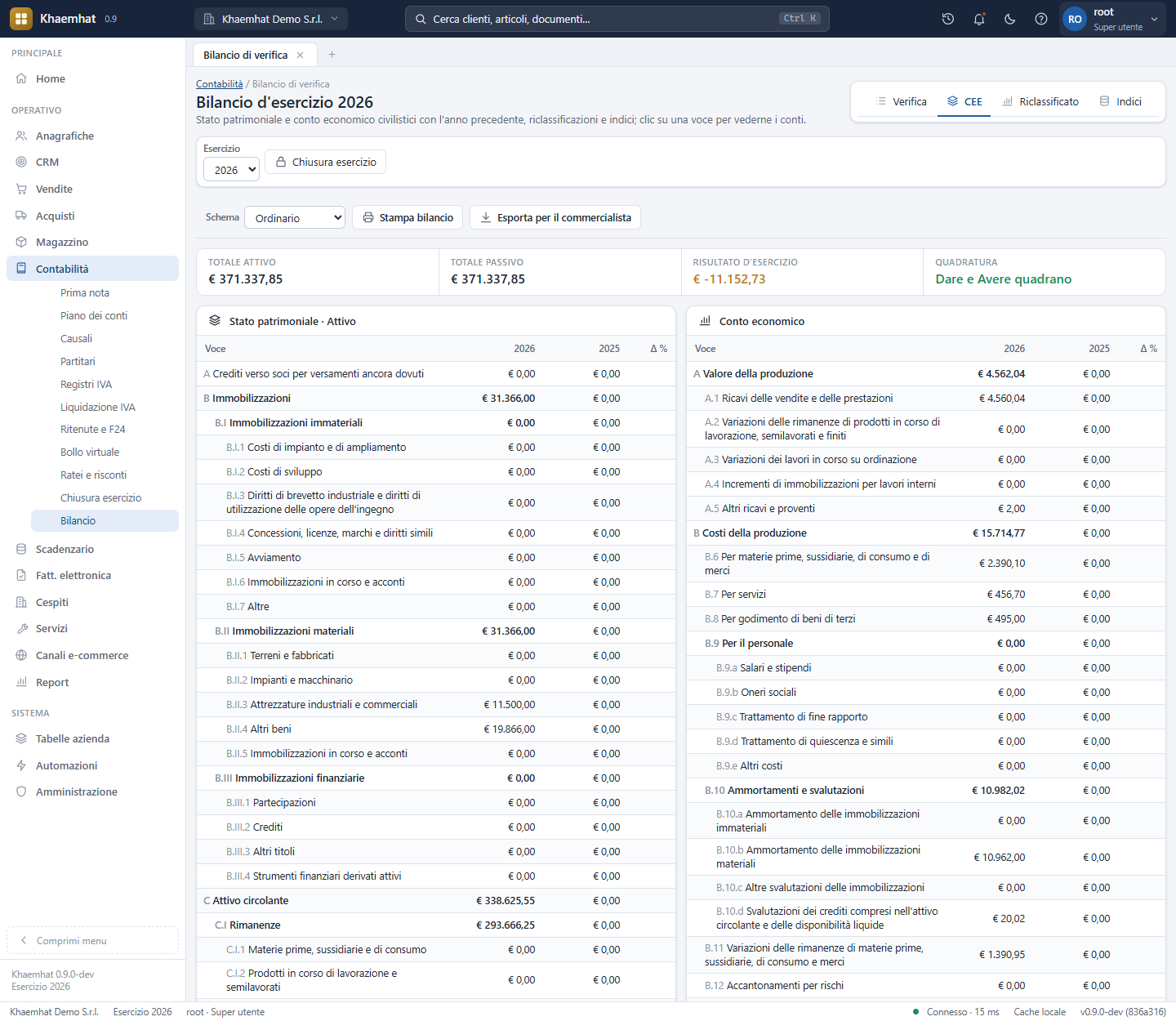
|
||||
*Il bilancio CEE 2026 dell'azienda demo, schema ordinario: stato patrimoniale e conto economico con l'anno
|
||||
precedente e la variazione percentuale.*
|
||||
|
||||
**Contabilità → Bilancio → CEE** costruisce lo **stato patrimoniale** (art. 2424 c.c.) e il **conto economico**
|
||||
(art. 2425 c.c.) dell'esercizio scelto, con l'anno precedente e la variazione, dai saldi dei conti a cui il piano dei
|
||||
conti associa una **voce di bilancio** (vedi [Contabilità](Contabilita#piano-dei-conti)).
|
||||
|
||||
- **Schema**: *Ordinario*, *Abbreviato* (art. 2435-bis) o *Micro-impresa* (art. 2435-ter, stesse voci
|
||||
dell'abbreviato).
|
||||
- La striscia mostra totale attivo e passivo, risultato d'esercizio e quadratura.
|
||||
- Se ci sono conti con saldo **senza voce**, un avviso li elenca: assegna la voce nel piano dei conti.
|
||||
- Un clic su una voce mostra i **conti** che la compongono con i saldi dei due anni.
|
||||
- Le scritture dei passi 6 e 7 della chiusura non entrano nel calcolo: un esercizio chiuso mostra comunque i suoi
|
||||
saldi.
|
||||
- **Stampa bilancio** produce il PDF; **Esporta per il commercialista** scarica uno ZIP con cinque file CSV (piano
|
||||
dei conti, bilancio di verifica, movimenti, stato patrimoniale, conto economico).
|
||||
|
||||
## Riclassificato e indici
|
||||
|
||||

|
||||
*Lo stato patrimoniale riclassificato secondo il criterio finanziario.*
|
||||
|
||||
La scheda **Riclassificato** propone lo **stato patrimoniale finanziario** (attivo per liquidità, passivo per
|
||||
esigibilità) e il **conto economico a valore aggiunto**.
|
||||
|
||||

|
||||
*Gli indici di bilancio con la formula e il valore dei due anni.*
|
||||
|
||||
La scheda **Indici** calcola redditività (ROE, ROI, ROS, rotazione del capitale investito), liquidità (indice di
|
||||
disponibilità e di liquidità), solidità (indipendenza finanziaria, leva, copertura delle immobilizzazioni) e i giorni
|
||||
medi di incasso e di pagamento. Un indice senza denominatore mostra un trattino.
|
||||
|
||||
## Prova con i dati di esempio
|
||||
|
||||
I dati dimostrativi aprono l'anno con una scrittura di apertura (cespiti e fondi, rimanenze, banca, capitale),
|
||||
registrano un premio di assicurazione da riscontare e i cespiti: la chiusura dell'anno demo si può eseguire dal
|
||||
passo 1 al 9 e verificare il bilancio. Le prove automatiche fanno proprio questo, su SQLite e su PostgreSQL.
|
||||
|
||||
## Permessi e licenza
|
||||
|
||||
| Permesso | Consente |
|
||||
|---|---|
|
||||
| `ledger.entry.read` | bilancio CEE, riclassificato, indici, stampa |
|
||||
| `ledger.year.close` | ratei e risconti, chiusura guidata, blocco dell'esercizio |
|
||||
| `reports.accountant.export` | esportazione per il commercialista |
|
||||
|
||||
Serve il modulo **ACCT**; il passo 2 usa i cespiti se è attivo **ASSET**.
|
||||
|
||||
## Domande frequenti
|
||||
|
||||
**Il passo 1 è rosso.** Leggi i messaggi: di solito ci sono registrazioni provvisorie da registrare o eliminare in
|
||||
[Prima nota](Contabilita#prima-nota). Correggi e premi **Ripeti passo 1**.
|
||||
|
||||
**Ho dimenticato una fattura dopo il passo 6.** Annulla i passi dal più recente fino al 5 (uno alla volta), registra
|
||||
la fattura e riesegui i passi.
|
||||
|
||||
**Dove finisce il risultato?** Nel conto *utile (perdita) dell'esercizio* del patrimonio netto; la destinazione
|
||||
dell'utile si registra a mano nel nuovo esercizio dopo l'approvazione del bilancio.
|
||||
|
||||
**Il TFR è giusto?** È una stima (retribuzioni dell'anno diviso 13,5 meno quanto già accantonato): se le paghe sono
|
||||
elaborate fuori, registra la quota del consulente e la chiusura non aggiunge nulla.
|
||||
|
||||
## Pagine correlate
|
||||
|
||||
[Contabilità](Contabilita) · [Cespiti](Cespiti) · [IVA](IVA) · [Magazzino](Magazzino) · [Scadenzario](Scadenzario) ·
|
||||
[Fiscalità italiana](Fiscalita-italiana) · [Report](Report)
|
||||
@@ -1,6 +1,6 @@
|
||||
# Contabilità generale
|
||||
|
||||
> **Stato:** completa per la versione 0.7 · **Ultima revisione:** 2026-11-13 · **Versione software:** 0.7.0 (M7)
|
||||
> **Stato:** completa per la versione 0.10 · **Ultima revisione:** 2026-11-13 · **Versione software:** 0.10.0 (M10)
|
||||
> **Modulo di licenza:** ACCT · **Permessi principali:** `ledger.account.read`/`write` (piano dei conti e causali), `ledger.entry.read`/`write` (prima nota, partitari, bilancio), `ledger.entry.finalize` (registrazioni definitive) · **Specifica:** SPEC §11.7, §14, ADR 0036, ADR 0037
|
||||
|
||||
Il modulo **Contabilità** tiene la **contabilità generale in partita doppia** dell'azienda: piano dei conti, causali,
|
||||
@@ -16,9 +16,10 @@ nella pagina [IVA](IVA); le regole italiane usate (piano dei conti modello, codi
|
||||
> prima nota manuale con castelletto IVA, la **contabilizzazione automatica** di fatture, note e autofatture, le
|
||||
> registrazioni ricorrenti, lo storno, le registrazioni definitive con il numero di libro giornale, i partitari con
|
||||
> estratto conto e partite, i mastrini, il bilancio di verifica e le stampe del bilancio e del libro giornale.
|
||||
> Arrivano più avanti: **scadenzario**, incassi e pagamenti bancari e riconciliazione (M8), **chiusura
|
||||
> dell'esercizio**, ratei e risconti, **bilancio CEE** riclassificato e **cespiti** (M10). Non ci sono ancora
|
||||
> l'import del piano dei conti da file e l'export per il commercialista.
|
||||
> Dalla 0.8 incassi, pagamenti, distinte e riconciliazione bancaria scrivono le loro registrazioni dallo
|
||||
> [Scadenzario](Scadenzario). Dalla 0.10 ci sono la **chiusura guidata dell'esercizio** con ratei e risconti, il
|
||||
> **bilancio CEE** con riclassificato e indici e l'export per il commercialista ([Chiusura e bilancio](Chiusura-e-bilancio)),
|
||||
> e i [Cespiti](Cespiti). Non c'è ancora l'import del piano dei conti da file.
|
||||
|
||||
## Dove si trova
|
||||
|
||||
@@ -170,12 +171,12 @@ copiare; eliminando una ricorrente le registrazioni già generate restano.
|
||||
## Piano dei conti
|
||||
|
||||

|
||||
*L'albero dei 237 conti del modello PMI standard, il dettaglio del sottoconto 05.01.001 Clienti Italia (sottoconto,
|
||||
*L'albero dei 240 conti del modello PMI standard, il dettaglio del sottoconto 05.01.001 Clienti Italia (sottoconto,
|
||||
attività, tipo Clienti, voce CEE C.II.1, con partitario) e il suo mastrino con il saldo progressivo.*
|
||||
|
||||
Il piano dei conti ha tre livelli con codice **`MM.CC.SSS`**: **mastro** (`05` *Crediti verso clienti*), **conto**
|
||||
(`05.01` *Clienti*) e **sottoconto** (`05.01.001` *Clienti Italia*). Si registra solo sui sottoconti. Con le tabelle
|
||||
di base dell'azienda viene caricato il modello **PMI standard** del pacchetto fiscale: 237 conti con le voci di
|
||||
di base dell'azienda viene caricato il modello **PMI standard** del pacchetto fiscale: 240 conti con le voci di
|
||||
bilancio CEE già associate (vedi [Fiscalità italiana](Fiscalita-italiana#piano-dei-conti-modello)).
|
||||
|
||||
| Campo | Significato |
|
||||
@@ -188,7 +189,7 @@ bilancio CEE già associate (vedi [Fiscalità italiana](Fiscalita-italiana#piano
|
||||
| **Riclassificazione** | voce del riclassificato, facoltativa |
|
||||
| **Partitario** | le righe indicano il cliente o il fornitore |
|
||||
| **Rilevante IVA** | il conto entra nelle registrazioni con IVA |
|
||||
| **Chiuso in automatico a fine esercizio** | il conto sarà chiuso dalla procedura di fine esercizio (M10) |
|
||||
| **Chiuso in automatico a fine esercizio** | il conto è chiuso dalla [chiusura dell'esercizio](Chiusura-e-bilancio) |
|
||||
| **Disattivato** | il conto resta nello storico ma non si usa più |
|
||||
|
||||
A sinistra l'**albero** con la ricerca per codice o descrizione; a destra i dati del conto scelto e, per i
|
||||
@@ -244,8 +245,8 @@ Scegliendo un soggetto si vedono:
|
||||
- le **partite**: una per rata di ogni documento, con data documento, numero della rata, **scadenza**, importo,
|
||||
pagato e **residuo**; le scadenze superate sono in rosso. *Mostra anche le partite chiuse* aggiunge quelle saldate.
|
||||
|
||||
In questa versione le partite nascono dai documenti; gli incassi e i pagamenti che le chiudono, i solleciti e lo
|
||||
scadenzario arrivano con lo [Scadenzario](Scadenzario) (M8).
|
||||
Le partite nascono dai documenti e si chiudono con gli incassi e i pagamenti registrati nello
|
||||
[Scadenzario](Scadenzario), dove ci sono anche distinte, solleciti e riconciliazione bancaria.
|
||||
|
||||
## Bilancio di verifica e libro giornale
|
||||
|
||||
@@ -270,8 +271,8 @@ Le stampe sono file PDF da scaricare:
|
||||
| **Libro giornale di prova** | registrazioni registrate e definitive del periodo, in ordine di data, con le righe |
|
||||
| **Libro giornale definitivo** | solo le registrazioni definitive, con il numero di libro giornale e le pagine numerate dall'inizio dell'anno |
|
||||
|
||||
Il bilancio CEE (stato patrimoniale e conto economico civilistici), il riclassificato e gli indici arrivano con la
|
||||
chiusura dell'esercizio (M10).
|
||||
Le altre schede della pagina, **CEE**, **Riclassificato** e **Indici**, mostrano il bilancio d'esercizio: sono
|
||||
spiegate in [Chiusura e bilancio](Chiusura-e-bilancio).
|
||||
|
||||
## Dati demo
|
||||
|
||||
|
||||
@@ -74,7 +74,10 @@ Nella versione 0.3.0 le righe vengono da:
|
||||
| Fatto oggi | attività programmate riuscite oggi, una riga per attività con il numero di esecuzioni e l'ora dell'ultima |
|
||||
| Scadenze 30 giorni | fine della prova o scadenza della licenza (account di istanza) |
|
||||
|
||||
I moduli delle prossime versioni aggiungono le loro righe (scarti SDI, liquidazioni, incassi, ordini da evadere…).
|
||||
Dalla 0.8 lo [Scadenzario](Scadenzario) aggiunge alle **Scadenze** gli incassi e i pagamenti dei prossimi giorni (al
|
||||
massimo 12, area *Tesoreria*) e a **Da fare oggi** il totale dei crediti scaduti, con il link ai solleciti; servono
|
||||
il modulo FIN e il permesso `finance.schedule.read`. I moduli delle prossime versioni aggiungono le loro righe
|
||||
(scarti SDI, ordini da evadere…).
|
||||
Se una fonte non risponde, il widget mostra le altre e l'errore finisce nel [log](Log).
|
||||
|
||||
I **promemoria** si scrivono nel campo in fondo al widget e si aggiungono con Invio (al massimo 20, di 300 caratteri
|
||||
|
||||
@@ -1,6 +1,6 @@
|
||||
# Dati di base e di esempio
|
||||
|
||||
> **Stato:** completa per M5 · **Ultima revisione:** 2026-11-12 · **Versione software:** 0.6.0 (dati di esempio di contabilità con il modulo, completi in M9)
|
||||
> **Stato:** completa per la versione 0.10 · **Ultima revisione:** 2026-11-13 · **Versione software:** 0.10.0 (M10)
|
||||
> **Modulo di licenza:** CORE · **Livello richiesto:** amministratore (rimozione dati di esempio: super utente) · **Specifica:** SPEC §6, §12.11, §14
|
||||
|
||||
## A cosa serve
|
||||
@@ -52,7 +52,6 @@ Il pacchetto italiano fa parte del pacchetto fiscale Italia (vedi [Fiscalità it
|
||||
| **Cespiti** | categorie di beni con i coefficienti di ammortamento ministeriali |
|
||||
| **Codici tributo F24** | IVA, ritenute, bollo, acconti |
|
||||
| **Code list SDI** | tipi documento (TD), modalità di pagamento (MP), regimi fiscali (RF) e altre liste della FatturaPA; regime RF01 predefinito |
|
||||
| **Banche ABI/CAB** | tabella per ricavare banca e BIC dall'IBAN |
|
||||
| **CRM** | pipeline e fasi, modelli e-mail |
|
||||
| **Sistema** | ruoli predefiniti, regole di automazione predefinite, attività programmate di sistema |
|
||||
|
||||
@@ -76,11 +75,13 @@ intervallo come `10121-10156` per le città con più CAP.
|
||||
|
||||
Ai comuni rinominati o nati da fusioni recenti (ad esempio Sanremo) il CAP può mancare: si completa a mano nella
|
||||
tabella *Comuni* o con l'**Importa CSV** (colonne `Code` e `PostalCodes`, più CAP separati da virgola). La
|
||||
compilazione dal CAP propone solo i comuni che hanno il CAP scritto. Le **banche ABI/CAB** non sono ancora incluse: banca e BIC dall'IBAN vengono da un conto
|
||||
dell'azienda presso la stessa banca. Un comune soppresso per fusione resta nella tabella finché non lo disattivi.
|
||||
compilazione dal CAP propone solo i comuni che hanno il CAP scritto. L'**elenco delle banche ABI/CAB** non è incluso: dall'IBAN
|
||||
Khaemhat legge ABI e CAB, mentre nome della banca e BIC vengono da un conto dell'azienda presso la stessa banca o si
|
||||
scrivono a mano la prima volta. Un comune soppresso per fusione resta nella tabella finché non lo disattivi.
|
||||
|
||||
Le altre voci dell'elenco (piano dei conti, causali contabili, registri IVA, cespiti, codici tributo, CRM) arrivano con i
|
||||
moduli che le usano.
|
||||
Le categorie dei cespiti si creano da **Cespiti → Categorie → Categorie standard** (vedi [Cespiti](Cespiti)). Le altre
|
||||
voci dell'elenco (piano dei conti, causali contabili, registri IVA, codici tributo, CRM) arrivano con i moduli che le
|
||||
usano.
|
||||
|
||||
### Aggiorna tabelle di base
|
||||
|
||||
@@ -115,7 +116,7 @@ reale. Contiene:
|
||||
| Articoli | 120 |
|
||||
| Documenti | 12 mesi coerenti: ordini → DDT → fatture differite, fatture immediate e accompagnatorie, note di credito, pro-forma, parcelle; ordini fornitore → carichi → fatture di acquisto; autofatture; inventario, movimenti, trasferimenti |
|
||||
| Contabilità | registrazioni dai documenti, incassi e pagamenti anche parziali, un insoluto RiBa, giroconti, liquidazioni IVA confermate fino al mese precedente, ritenute, 58 cespiti con ammortamenti, esercizio precedente chiuso con bilancio |
|
||||
| Fatturazione elettronica | XML SDI in stati diversi, con notifiche |
|
||||
| Fatturazione elettronica | file FatturaPA in stati diversi con le notifiche, canali e regole di instradamento, fatture ricevute da registrare |
|
||||
| Tesoreria | un estratto conto da riconciliare |
|
||||
| CRM | 23 lead, 18 opportunità, attività, 3 campagne, 2 ticket |
|
||||
| Servizi e canali | 2 contratti di assistenza con interventi, 1 canale e-commerce generico con ordini |
|
||||
@@ -160,7 +161,47 @@ l'azienda ha già documenti di vendita.
|
||||
| 3 fatture fornitore | una dal ricevimento con un prezzo più alto dell'ordine (vedi l'avviso sulle differenze), la parcella del commercialista, la fattura di un fornitore tedesco che aspetta la sua **integrazione AF18** |
|
||||
| 1 inventario aperto | 12 articoli già contati, due con una differenza |
|
||||
|
||||
Il caricamento non si ripete se l'azienda ha già documenti di acquisto o di magazzino. Il resto della tabella arriva con le milestone dei rispettivi moduli.
|
||||
Il caricamento non si ripete se l'azienda ha già documenti di acquisto o di magazzino.
|
||||
|
||||
**Da M7** documenti e fatture sono **contabilizzati** e ci sono un noleggio ricorrente, le liquidazioni IVA
|
||||
confermate fino al mese precedente, le ritenute e il bollo virtuale (vedi [Contabilità](Contabilita) e [IVA](IVA)).
|
||||
|
||||
**Da M8**, se la licenza comprende il modulo **FIN**, c'è anche la **tesoreria** (vedi [Scadenzario](Scadenzario)):
|
||||
|
||||
| Dati | Che cosa mostrano |
|
||||
|---|---|
|
||||
| La banca *Banca Popolare Dimostrativa* | conto predefinito con IBAN, SIA, CUC e identificativo creditore; i versamenti dei soci al 1° gennaio |
|
||||
| Incassi e pagamenti | i fornitori scaduti pagati con le spese, i clienti scaduti incassati (uno solo in parte), con il CRO |
|
||||
| Distinte RiBa | una distinta presentata e accreditata con l'ultimo effetto **insoluto** e le spese; una distinta *salvo buon fine* in bozza con le scadenze dei prossimi 45 giorni |
|
||||
| Mandato SDD | un mandato *Core* firmato da un cliente |
|
||||
| Estratto conto | un CSV di quattro movimenti da riconciliare: il saldo della fattura incassata in parte, un pagamento già registrato, le commissioni riconosciute dalla regola *Canone e commissioni* e una spesa da registrare su conto |
|
||||
| Solleciti | un primo sollecito già inviato al cliente con lo scaduto più vecchio |
|
||||
|
||||
**Da M9**, se la licenza comprende il modulo **EINV**, c'è anche la **fatturazione elettronica** (vedi
|
||||
[Fatturazione elettronica](Fatturazione-elettronica)):
|
||||
|
||||
| Dati | Che cosa mostrano |
|
||||
|---|---|
|
||||
| File FatturaPA | le fatture e le note già emesse hanno il loro file: la maggior parte **consegnata** (RC), una **scartata** (NS 00305) e poi corretta e consegnata, una con **mancata consegna** (MC), le ultime in attesa o ancora da inviare |
|
||||
| Notifiche | le ricevute di ogni file, scaricabili come sono arrivate |
|
||||
| Canali | la PEC configurata ma **in pausa** con credenziali finte, l'Intermediario A abbozzato e disattivato: nessun dato di esempio raggiunge lo SDI |
|
||||
| Instradamento | tre regole: PA su PEC, oltre 200 file al giorno sull'Intermediario A, sempre PEC con l'Intermediario A di riserva |
|
||||
| Fatture ricevute | tre fatture di fornitori da registrare |
|
||||
|
||||
**Da M10** ci sono anche i dati di **fine anno** (vedi [Cespiti](Cespiti), [Intrastat](Intrastat),
|
||||
[Dichiarazioni d'intento](Dichiarazioni-d-intento) e [Chiusura e bilancio](Chiusura-e-bilancio)):
|
||||
|
||||
| Dati | Che cosa mostrano |
|
||||
|---|---|
|
||||
| Apertura dei conti | una registrazione al 1° gennaio con cespiti e fondi, rimanenze di magazzino, banca, capitale sociale e utili portati a nuovo |
|
||||
| Cespiti | le categorie standard e quattro beni: furgone, scaffalature e arredi già in uso con i fondi iniziali, un server acquistato nell'anno con la sua registrazione |
|
||||
| Risconto | il premio di assicurazione del furgone pagato il 1° ottobre per dodici mesi |
|
||||
| Dichiarazione d'intento | quella di Idrotermica Piemonte nel registro, con una fattura in N3.5 che consuma il plafond |
|
||||
| Intrastat | una fattura non imponibile art. 41 a Bergwerk Bau (Austria) con codici doganali e pesi, se la licenza comprende **INTRA** |
|
||||
|
||||
Con questi dati la chiusura dell'anno si esegue dal passo 1 al 9.
|
||||
|
||||
Il resto della tabella arriva con le milestone dei rispettivi moduli.
|
||||
I dati sono costruiti con gli stessi motori del programma (documenti, contabilità): ogni quadratura torna, e lo
|
||||
stesso caricamento è usato come prova automatica di correttezza.
|
||||
|
||||
@@ -175,8 +216,13 @@ alternativa si caricano al primo avvio con `KHAEMHAT_SEED_DEMO=true` (solo se il
|
||||
### Rimuovi dati di esempio
|
||||
|
||||
1. Premi **Rimuovi dati di esempio** (solo **super utente**).
|
||||
2. Khaemhat elimina le righe dimostrative in ordine di dipendenza e **si rifiuta** se esistono dati reali collegati
|
||||
a righe dimostrative (ad esempio una fattura vera intestata a un cliente demo).
|
||||
2. Khaemhat elimina le righe dimostrative (`is_demo`) e quelle che appartengono loro (le righe di un documento demo,
|
||||
le giacenze di un articolo demo) in **una sola transazione**, e **si rifiuta** se esistono dati reali collegati a
|
||||
righe dimostrative (ad esempio una fattura vera intestata a un cliente demo): in quel caso elenca le tabelle
|
||||
coinvolte e non tocca nulla.
|
||||
|
||||
Le tabelle e i loro collegamenti si leggono dalle migrazioni, quindi la rimozione copre anche i moduli aggiunti in
|
||||
seguito. Da riga di comando: `scripts/seed.sh --remove-demo [--company CODICE]` (vedi sotto).
|
||||
|
||||
Usalo quando un'azienda nata come demo diventa l'azienda reale; per partire puliti è comunque preferibile creare
|
||||
un'azienda nuova (vedi [Istanza e database](Istanza-e-database)).
|
||||
@@ -203,6 +249,7 @@ docker compose run --rm --entrypoint /app/scripts/seed.sh khaemhat --base
|
||||
docker compose run --rm --entrypoint /app/scripts/seed.sh khaemhat --base --company DEMO
|
||||
docker compose run --rm --entrypoint /app/scripts/seed.sh khaemhat --demo --company DEMO
|
||||
docker compose run --rm --entrypoint /app/scripts/seed.sh khaemhat --demo --scale 10 --company PROVA
|
||||
docker compose run --rm --entrypoint /app/scripts/seed.sh khaemhat --remove-demo --company DEMO
|
||||
```
|
||||
|
||||
In sviluppo, dalla cartella del repository: `scripts/seed.sh --base|--demo [--scale N] [--company CODICE]`.
|
||||
@@ -212,8 +259,12 @@ In sviluppo, dalla cartella del repository: `scripts/seed.sh --base|--demo [--sc
|
||||
| `--base` | aggiunge i codici di base mancanti |
|
||||
| `--demo` | prima i dati di base, poi i dati di esempio; ogni gruppo (anagrafiche, articoli) si carica solo nell'azienda che non ne ha ancora |
|
||||
| `--scale N` | solo con `--demo`: ripete il catalogo articoli N volte (da 1 a 100), per le prove di prestazione |
|
||||
| `--remove-demo` | rimuove solo i dati di esempio (non si combina con le altre opzioni); stampa le righe rimosse per tabella o le tabelle che lo impediscono |
|
||||
| `--company CODICE` | lavora solo su quell'azienda invece che su tutte quelle attive |
|
||||
|
||||
Il caricamento completo dell'azienda di esempio richiede pochi secondi su SQLite (circa 2,5 s in sviluppo) e stampa
|
||||
il tempo impiegato per ogni azienda.
|
||||
|
||||
I dati di esempio si caricano anche al primo avvio con `KHAEMHAT_SEED_DEMO=true`.
|
||||
|
||||
## Migrazioni
|
||||
|
||||
@@ -0,0 +1,91 @@
|
||||
# Dichiarazioni d'intento
|
||||
|
||||
> **Stato:** completa per la versione 0.10 · **Ultima revisione:** 2026-11-13 · **Versione software:** 0.10.0 (M10)
|
||||
> **Modulo di licenza:** CORE · **Permessi principali:** `sales.intent.read` (registro e stampa), `sales.intent.write`
|
||||
> (inserire, modificare, revocare) · **Specifica:** SPEC §11.7, ADR 0042
|
||||
|
||||
Gli **esportatori abituali** acquistano senza IVA, entro un **plafond**, presentando al fornitore una **dichiarazione
|
||||
d'intento** trasmessa all'Agenzia delle Entrate. Khaemhat tiene il **registro cronologico** delle dichiarazioni
|
||||
ricevute dai clienti (e di quelle emesse verso i fornitori), aggiorna l'**utilizzato** con le fatture emesse,
|
||||
avvisa quando il plafond è quasi esaurito e **rifiuta la conferma** di una fattura senza dichiarazione valida o oltre
|
||||
il plafond.
|
||||
|
||||
## Dove si trova
|
||||
|
||||
**Fatturazione elettronica → Dichiarazioni d'intento** (anche all'indirizzo `/vendite/dichiarazioni-intento`). La
|
||||
funzione è nel modulo base CORE.
|
||||
|
||||

|
||||
*Il registro delle dichiarazioni ricevute nel 2026: la dichiarazione di Idrotermica Piemonte con protocollo
|
||||
telematico, plafond, utilizzato, residuo e percentuale di utilizzo.*
|
||||
|
||||
## Il registro
|
||||
|
||||
Due schede: **Ricevute (clienti)** ed **Emesse (fornitori)**, filtrate per esercizio.
|
||||
|
||||
| Colonna | Significato |
|
||||
|---|---|
|
||||
| **Numero**, **Data** | numero progressivo del registro e data della dichiarazione |
|
||||
| **Cliente** / **Fornitore**, **Codice** | la controparte |
|
||||
| **Protocollo telematico** | protocollo della ricevuta dell'Agenzia: 17 cifre, trattino (o barra) e 6 cifre di progressivo |
|
||||
| **Plafond**, **Utilizzato**, **Residuo** | importo dichiarato, fatture già emesse, quanto resta |
|
||||
| **Esercizio** | anno di riferimento |
|
||||
| **Stato** | *Attiva* (con la percentuale di utilizzo, in arancione dal 90 %), *Esaurita*, *Revocata* |
|
||||
|
||||
**Stampa registro** produce il PDF del registro dell'anno.
|
||||
|
||||
## Registrare una dichiarazione ricevuta
|
||||
|
||||
1. **Nuova dichiarazione**, scheda *Ricevute*.
|
||||
2. Scegli il **cliente**, scrivi numero e data, il **protocollo telematico** e il **plafond**.
|
||||
3. Indica il periodo di validità (**valida dal**, **valida al**): ogni fattura va sulla dichiarazione più recente che ne copre la data.
|
||||
4. L'**utilizzato** si aggiorna da solo con le fatture: compilalo solo se una parte del plafond è già stata usata con
|
||||
fatture emesse fuori da Khaemhat.
|
||||
5. Salva. Il cliente riceve una copia della dichiarazione corrente nei suoi dati fiscali, usata dai documenti e dalla
|
||||
fattura elettronica.
|
||||
|
||||
Una dichiarazione si **revoca** (per esempio quando il cliente la annulla) e da quel momento non copre più le
|
||||
fatture. Il plafond non può scendere sotto l'utilizzato; una dichiarazione mai usata si può eliminare.
|
||||
|
||||
## Fatturare a un esportatore abituale
|
||||
|
||||
1. Nella fattura usa per le righe il codice IVA di **natura N3.5** (*non imponibile a seguito di dichiarazione
|
||||
d'intento*), di solito impostato come codice IVA preferito del cliente.
|
||||
2. Alla **conferma** Khaemhat cerca una dichiarazione attiva del cliente valida alla data della fattura:
|
||||
- se **non c'è**, la conferma è rifiutata con il messaggio *nessuna dichiarazione d'intento valida*;
|
||||
- se l'imponibile in N3.5 **supera il residuo**, la conferma è rifiutata indicando quanto resta;
|
||||
- altrimenti la fattura è confermata e l'importo si aggiunge all'**utilizzato**; dal 90 % compare l'avviso.
|
||||
3. La fattura elettronica riporta gli estremi della dichiarazione nel blocco *AltriDatiGestionali* con tipo
|
||||
`INTENTO` (vedi [Fatturazione elettronica](Fatturazione-elettronica)).
|
||||
|
||||
Le note di credito in N3.5 riducono l'utilizzato; eliminare o annullare una fattura lo ricalcola.
|
||||
|
||||
## Dichiarazioni emesse
|
||||
|
||||
Se l'azienda stessa è esportatore abituale registra nella scheda **Emesse** le dichiarazioni inviate ai propri
|
||||
fornitori, con lo stesso protocollo e plafond: servono come promemoria e per la stampa del registro.
|
||||
|
||||
## Dati di esempio
|
||||
|
||||
I dati dimostrativi registrano la dichiarazione di **Idrotermica Piemonte** (plafond 150.000 €) ed emettono una
|
||||
fattura in N3.5 che ne consuma una parte; una fattura in N3.5 a un cliente senza dichiarazione viene rifiutata.
|
||||
|
||||
## Permessi e licenza
|
||||
|
||||
| Permesso | Consente |
|
||||
|---|---|
|
||||
| `sales.intent.read` | registro e stampa |
|
||||
| `sales.intent.write` | inserire, modificare e revocare le dichiarazioni |
|
||||
|
||||
## Domande frequenti
|
||||
|
||||
**La fattura non si conferma: «plafond superato».** Il residuo della dichiarazione non basta. Chiedi al cliente una
|
||||
nuova dichiarazione (o un'integrazione del plafond) e registrala, oppure fattura la parte eccedente con IVA.
|
||||
|
||||
**Avevo scritto il protocollo nell'anagrafica del cliente.** Le dichiarazioni inserite nei dati fiscali del cliente
|
||||
prima della versione 0.10 diventano automaticamente righe del registro alla prima apertura.
|
||||
|
||||
## Pagine correlate
|
||||
|
||||
[Vendite](Vendite) · [Anagrafiche](Anagrafiche) · [IVA](IVA) · [Fatturazione elettronica](Fatturazione-elettronica) ·
|
||||
[Intrastat](Intrastat) · [Fiscalità italiana](Fiscalita-italiana)
|
||||
@@ -1,200 +1,329 @@
|
||||
# Fatturazione elettronica e canali SDI
|
||||
|
||||
> **Stato:** bozza · **Ultima revisione:** 2026-11-10 · **Versione software:** non ancora rilasciata (milestone M9)
|
||||
> **Modulo di licenza:** EINV · **Permessi principali:** `sales.invoice.issue`, `einvoice.document.send`, `einvoice.channel.manage`, `einvoice.inbox.import` · **Specifica:** SPEC §11.9, §11.3, §11.5, §9.4
|
||||
> **Stato:** completa per la versione 0.10 · **Ultima revisione:** 2026-11-13 · **Versione software:** 0.10.0 (M10)
|
||||
> **Modulo di licenza:** EINV · **Permessi principali:** `einvoice.document.read` (cruscotto, notifiche,
|
||||
> conservazione), `einvoice.document.send` (generare, inviare, importare notifiche), `einvoice.inbox.read` e
|
||||
> `einvoice.inbox.import` (fatture ricevute), `einvoice.channel.manage` (canali e instradamento) · **Specifica:**
|
||||
> SPEC §11.9, ADR 0039 e 0040
|
||||
|
||||
## A cosa serve
|
||||
Il modulo produce il **file FatturaPA** delle fatture emesse, lo **controlla** come farebbe il Sistema di
|
||||
Interscambio (SDI), lo **trasmette** attraverso il canale scelto dalle regole di instradamento e segue le
|
||||
**notifiche** che tornano indietro (consegna, scarto, mancata consegna, esito della pubblica amministrazione). Dalla
|
||||
stessa sezione arrivano le **fatture dei fornitori**, che si registrano come fatture di acquisto, e si prepara il
|
||||
**pacchetto per la conservazione**.
|
||||
|
||||
Il modulo genera l'**XML FatturaPA** delle fatture emesse, lo **valida**, lo **trasmette al Sistema di
|
||||
Interscambio (SDI)** attraverso uno dei canali configurati, importa le **notifiche** e le **fatture passive**,
|
||||
gestisce le **autofatture** da inviare e prepara il **pacchetto per la conservazione**. Il **cruscotto SDI** riunisce
|
||||
tutto in una schermata ordinata per priorità.
|
||||
Lo SDI è il sistema dell'Agenzia delle Entrate e non fa parte di Khaemhat. Per raggiungerlo Khaemhat offre quattro
|
||||
canali con lo stesso modo di lavorare: la **PEC dell'azienda** (nessun servizio esterno), il web service **SdICoop**
|
||||
e **due intermediari** accreditati.
|
||||
|
||||
Lo SDI è il sistema dell'Agenzia delle Entrate e non può essere "inglobato" in un gestionale. Khaemhat include però un
|
||||
**canale proprio via PEC** che non richiede alcun servizio esterno, e supporta con la stessa interfaccia **SdICoop**
|
||||
(web service dell'Agenzia) e **due intermediari**.
|
||||
> **In questa versione** ci sono il file FatturaPA (`FPR12`, `FPA12`, `FSM10`) con controllo prima dell'invio, i
|
||||
> quattro canali con prova di connessione, pausa e regole di instradamento con canale di riserva, la lettura
|
||||
> automatica dei canali ogni 15 minuti, la ricezione push di SdICoop, l'import manuale delle notifiche, la correzione
|
||||
> delle fatture scartate, la copia di cortesia in PDF con l'XML allegato, le fatture ricevute con registrazione in
|
||||
> blocco, l'elenco delle notifiche e i pacchetti per la conservazione. Dalla 0.10 il menu comprende anche
|
||||
> [Intrastat](Intrastat) e le [dichiarazioni d'intento](Dichiarazioni-d-intento), i cui estremi entrano nel file
|
||||
> (`AltriDatiGestionali` di tipo `INTENTO`). Arriva più avanti il formato europeo **EN 16931 / UBL** ([Roadmap](Roadmap)).
|
||||
|
||||
## Dove si trova
|
||||
|
||||
Menu laterale **Fatturazione elettronica**: **Cruscotto SDI**, **Fatture emesse**, **Fatture ricevute**,
|
||||
**Notifiche**, **Bollo virtuale**, **Intrastat**, **LIPE**; la configurazione dei canali è in **Fatturazione
|
||||
elettronica → Canali**. Il contatore accanto alla voce di menu indica i documenti che richiedono attenzione.
|
||||
Bollo virtuale, dichiarazioni d'intento e LIPE sono descritti nella pagina [IVA](IVA), Intrastat in [Intrastat](Intrastat).
|
||||
Menu laterale **Fatturazione elettronica** → *Cruscotto SDI*, *Fatture ricevute*, *Notifiche SDI*,
|
||||
*Conservazione*, *Canali di trasmissione* (e *Dichiarazioni d'intento*, ancora da sviluppare).
|
||||
|
||||
## Schermate
|
||||
Il menu compare solo se la licenza comprende il modulo **EINV** e l'utente ha i permessi (vedi
|
||||
[Licenze e moduli](Licenze-e-moduli) e [Utenti e permessi](Utenti-e-permessi)). Ogni voce chiede il suo permesso:
|
||||
chi non ha `einvoice.channel.manage`, per esempio, non vede i canali.
|
||||
|
||||

|
||||
*Mockup 058 — cruscotto con i contatori per stato (da generare, da inviare, inviate in attesa, consegnate, scartate, mancata consegna), azioni Genera + invia, Correggi, Importa notifiche e l'elenco dei documenti con TD, canale, stato SDI e ultima notifica o errore*
|
||||
Prima di iniziare servono:
|
||||
|
||||

|
||||
*Mockup 059 — i quattro canali (PEC integrata, SdICoop, Intermediario A, Intermediario B) con il loro stato, le regole di instradamento e le impostazioni della casella PEC*
|
||||
- il **profilo dell'azienda** completo in [Impostazioni](Impostazioni): partita IVA, codice fiscale, sede e
|
||||
**regime fiscale** (RF01…). Senza questi dati la generazione si ferma con un messaggio che dice cosa manca;
|
||||
- per ogni cliente il **codice destinatario** o la **PEC**, e per la pubblica amministrazione il **codice
|
||||
ufficio IPA** di sei caratteri ([Anagrafiche](Anagrafiche));
|
||||
- almeno un **canale attivo** (vedi [I canali di trasmissione](#i-canali-di-trasmissione)). Senza canali si può
|
||||
comunque generare il file, caricarlo dal portale *Fatture e Corrispettivi* e segnarlo come inviato.
|
||||
|
||||
## Il ciclo di una fattura
|
||||
|
||||
1. La fattura viene **confermata ed emessa** in [Vendite](Vendite) (numero definitivo, sola lettura).
|
||||
2. **Genera XML**: Khaemhat produce il file FatturaPA e lo allega al documento (bloccato dopo l'invio).
|
||||
3. **Valida**: il validatore controlla il file prima dell'invio.
|
||||
4. **Invia**: il canale scelto dalle regole di instradamento trasmette il file allo SDI.
|
||||
5. **Notifiche**: lo SDI risponde con ricevute e notifiche che aggiornano lo stato del documento.
|
||||
1. La fattura, la nota di credito, la parcella o l'autofattura viene **confermata** in [Vendite](Vendite) o in
|
||||
[Acquisti](Acquisti): da quel momento ha il numero definitivo e compare fra i *documenti da generare*.
|
||||
2. **Genera**: Khaemhat scrive il file FatturaPA e lo controlla. Il documento passa a *XML generato*.
|
||||
3. **Invia**: il canale scelto dalle regole di instradamento trasmette il file. Il documento passa a *Inviato*.
|
||||
4. **Notifiche**: lo SDI risponde e lo stato del file e del documento cambia da solo.
|
||||
|
||||
Il pulsante **Genera + invia** esegue i passi 2-4 sui documenti selezionati.
|
||||
Il pulsante **Genera + invia** fa i passi 2 e 3 in un colpo solo sui documenti selezionati.
|
||||
|
||||
| Stato del documento | Quando |
|
||||
|---|---|
|
||||
| **Bozza** | fattura in lavorazione |
|
||||
| **Emessa** | confermata, senza XML (*Da generare*) |
|
||||
| **XML generato** | XML prodotto e validato (*Da inviare*) |
|
||||
| **Inviata** | trasmessa allo SDI, in attesa di ricevuta |
|
||||
| **Consegnata** | ricevuta di consegna (RC) |
|
||||
| **Scartata** | notifica di scarto (NS): va corretta e rigenerata |
|
||||
| **Mancata consegna** | lo SDI non è riuscito a recapitarla (MC) |
|
||||
| Stato del file | Quando | Stato del documento |
|
||||
|---|---|---|
|
||||
| **Generata** | file scritto e controllato, non ancora trasmesso | XML generato |
|
||||
| **Inviata** | trasmessa allo SDI, in attesa della ricevuta | Inviato |
|
||||
| **Consegnata** | ricevuta di consegna (RC) | Consegnato |
|
||||
| **Scartata** | notifica di scarto (NS): la fattura **non è emessa** e va corretta | Scartato |
|
||||
| **Mancata consegna** | lo SDI non è riuscito a recapitarla (MC): è comunque emessa | Non consegnato |
|
||||
| **Accettata** / **Rifiutata** | esito del committente PA, EC01 o EC02 (NE) | |
|
||||
| **Decorrenza termini** | la PA non ha risposto entro 15 giorni (DT) | |
|
||||
| **Impossibile recapitare** | attestazione di trasmissione verso una PA (AT) | |
|
||||
|
||||
Una fattura emessa non si modifica: se l'XML **non è ancora stato inviato** si può annullare indicando il motivo;
|
||||
altrimenti si emette una nota di credito. Una fattura **scartata** non è emessa ai fini fiscali: con **Correggi** si
|
||||
corregge il dato e si rigenera l'XML (nuova versione dell'allegato).
|
||||
## Cruscotto SDI
|
||||
|
||||
## L'XML FatturaPA
|
||||

|
||||
*Khaemhat 0.9.0 — il cruscotto dell'azienda di esempio: i sei contatori, i documenti emessi senza file e i file
|
||||
trasmessi con stato SDI, canale, ultima notifica e azioni.*
|
||||
|
||||
In alto sei **contatori**: *Da generare* (documenti emessi senza XML), *Da inviare* (file generati e controllati),
|
||||
*Inviate in attesa*, *Consegnate* (RC, esito EC01, decorrenza termini), *Scartate* e *Mancata consegna*. Sopra, a
|
||||
destra, il collegamento alle **fatture ricevute da registrare**, **Importa notifiche** e, per chi gestisce i canali,
|
||||
**Leggi i canali ora**.
|
||||
|
||||
Il pannello ha tre viste:
|
||||
|
||||
- **Emesse**: fatture, note di credito e parcelle verso i clienti;
|
||||
- **Autofatture**: i documenti TD16-TD29 nati dagli [acquisti](Acquisti) (integrazioni del reverse charge,
|
||||
servizi e beni dall'estero, estrazione da deposito IVA, splafonamento…), che vanno trasmessi **entro il 15 del
|
||||
mese successivo**;
|
||||
- **Da fare**: solo ciò che chiede un intervento, cioè documenti da generare, file da inviare, scartati, non
|
||||
consegnati e rifiutati. Gli avvisi della Home su fatture scartate o da inviare portano qui.
|
||||
|
||||
Sotto la vista si filtrano **stato** e **periodo** e si cerca per numero, nome del file, identificativo SDI o
|
||||
controparte.
|
||||
|
||||
### Documenti da generare
|
||||
|
||||
La prima tabella elenca i documenti confermati che non hanno ancora un file. Si selezionano e si preme **Genera +
|
||||
invia**; **Controlla senza generare** (icona a forma di scudo) prova il file senza salvarlo e mostra gli errori,
|
||||
utile per sistemare i dati prima di trasmettere.
|
||||
|
||||

|
||||
*Khaemhat 0.9.0 — Controlla senza generare: il file supera i controlli dello SDI.*
|
||||
|
||||
### File trasmessi
|
||||
|
||||
La seconda tabella ha un file per riga: nome (`IT01234567890_0000A.xml`), documento, cliente, data, totale, tipo
|
||||
documento, **canale**, **stato SDI** e **ultima notifica o errore** con la data. I file *Generata* hanno la casella
|
||||
per **Invia (n)**. Le azioni della riga:
|
||||
|
||||
| Azione | Quando | Cosa fa |
|
||||
|---|---|---|
|
||||
| **Correggi** | file scartato | apre il documento, che torna modificabile; dopo la correzione si genera un **nuovo file** con un nuovo progressivo, il vecchio resta nello storico come *sostituito* |
|
||||
| **Segna come inviata** | file generato | per chi lo ha caricato dal portale *Fatture e Corrispettivi*: si può indicare l'identificativo SDI; le notifiche si importano poi a mano |
|
||||
| **XML** | sempre | scarica il file trasmesso |
|
||||
| **Copia di cortesia (PDF)** | sempre | il PDF del documento con il file FatturaPA **allegato dentro il PDF**, da mandare al cliente: non sostituisce l'invio allo SDI |
|
||||
| **Storico del file** | sempre | tutte le versioni del file con generazione, invio, identificativo SDI e notifiche |
|
||||
|
||||

|
||||
*Khaemhat 0.9.0 — lo storico SDI di una fattura: la prima versione scartata con l'errore dello SDI, sostituita da
|
||||
quella corretta e consegnata.*
|
||||
|
||||
Dopo **Invia** o **Genera + invia** una finestra riassume l'esito file per file: preso in carico da quale canale,
|
||||
oppure il motivo per cui non è partito.
|
||||
|
||||

|
||||
*Khaemhat 0.9.0 — esito della trasmissione di due file.*
|
||||
|
||||

|
||||
*Khaemhat 0.9.0 — la vista Da fare: documenti da generare e file scartati o non consegnati.*
|
||||
|
||||
## Il file FatturaPA
|
||||
|
||||
| Formato | Uso |
|
||||
|---|---|
|
||||
| `FPR12` | fatture verso privati (aziende e consumatori) |
|
||||
| `FPA12` | fatture verso la Pubblica Amministrazione |
|
||||
| `FPA12` | fatture verso la pubblica amministrazione |
|
||||
| `FSM10` | fattura semplificata |
|
||||
|
||||
Khaemhat segue le **specifiche tecniche dell'Agenzia delle Entrate**: alla stesura di questa pagina la **versione
|
||||
1.9, in vigore dal 1° aprile 2025** (con il tipo documento TD29 e il TD20 ridefinito). La versione supportata è
|
||||
indicata nel programma; prima di ogni rilascio va **sempre verificata l'ultima versione pubblicata** dall'Agenzia.
|
||||
Khaemhat segue le **specifiche tecniche 1.9.1** dell'Agenzia delle Entrate (tipi documento fino a TD29). La
|
||||
versione è scritta nel pacchetto fiscale italiano; prima di ogni rilascio va confrontata con l'ultima pubblicata
|
||||
dall'Agenzia.
|
||||
|
||||
L'XML contiene, fra l'altro: dati di trasmissione, cedente e cessionario, dati generali con tipo documento (TD),
|
||||
ritenuta, bollo, cassa previdenziale, sconti e causale; riferimenti a ordine d'acquisto, contratto, convenzione,
|
||||
ricezione e fatture collegate (con CIG e CUP per la PA); DDT, trasporto, righe di dettaglio, riepilogo IVA,
|
||||
pagamento e allegati.
|
||||
Il file contiene i dati di trasmissione, cedente e cessionario (con stabile organizzazione e rappresentante fiscale
|
||||
quando servono), i dati generali con tipo documento, ritenute, bollo virtuale, cassa previdenziale, sconti e
|
||||
causale, i riferimenti a ordine, contratto, convenzione, ricezione e fatture collegate (con CIG e CUP per la PA),
|
||||
DDT e trasporto, le righe, il riepilogo IVA con nature ed esigibilità, i pagamenti e gli allegati.
|
||||
|
||||
**Nome del file**: `IT<identificativo fiscale del trasmittente>_<progressivo>.xml`, con progressivo alfanumerico
|
||||
univoco in base 36 (es. `IT01234567890_00A1Z.xml`).
|
||||
**Nome del file**: `IT` + identificativo fiscale del trasmittente + `_` + progressivo di cinque caratteri in base 36
|
||||
(per esempio `IT01234567890_0000A.xml`). Il progressivo non si ripete mai: un file rigenerato dopo uno scarto ne
|
||||
prende uno nuovo.
|
||||
|
||||
## Validazione e scarti noti
|
||||
### I controlli prima dell'invio
|
||||
|
||||
Prima dell'invio il validatore controlla:
|
||||
Il file viene controllato **prima** di partire, con gli stessi codici di errore dello SDI, così il messaggio è
|
||||
quello che si leggerebbe nello scarto:
|
||||
|
||||
- valori ammessi delle code list (TD, nature, modalità di pagamento, regime fiscale…) e lunghezze dei campi;
|
||||
- totali coerenti con tolleranza di ± 0,01;
|
||||
- **nature IVA** (`N1`…`N7` con sotto-codici) e relativi riferimenti normativi;
|
||||
- codice destinatario o PEC del cliente; per la **PA** codice IPA a 6 caratteri, CIG e CUP quando servono;
|
||||
- codice fiscale dei gruppi IVA;
|
||||
- bollo virtuale.
|
||||
- **struttura** del file contro lo schema del formato;
|
||||
- **totali**: `PrezzoTotale` e imposta con tolleranza di un centesimo, imponibile del riepilogo con tolleranza di un
|
||||
euro (00421, 00422, 00423);
|
||||
- **riepilogo IVA** presente per ogni aliquota e natura (00419);
|
||||
- **nature IVA** e aliquote su righe, cassa previdenziale e riepilogo (00400, 00401, 00413, 00414, 00429, 00430),
|
||||
con i sotto-codici obbligatori al posto delle nature generiche N2, N3 e N6 (00445);
|
||||
- **ritenute** (00411, 00415) e **sconti e maggiorazioni** (00437, 00438);
|
||||
- **cliente**: partita IVA o codice fiscale presenti e ben formati (00305, 00306, 00417), codice destinatario e PEC
|
||||
coerenti con il formato (00311, 00426, 00427);
|
||||
- **autofatture**: cedente e cessionario devono essere diversi o uguali secondo il tipo (00471, 00472, 00473).
|
||||
|
||||
Esempi di scarto dello SDI visti nel cruscotto e usati nei test: **00311** (CodiceDestinatario non valido),
|
||||
**00423** (PrezzoTotale non calcolato correttamente), **00327**. Il messaggio dell'errore compare nella colonna
|
||||
*Ultima notifica / errore*.
|
||||
Alcuni controlli richiedono i registri dell'Agenzia (partita IVA esistente, codice destinatario accreditato, codice
|
||||
IPA presente nell'indice delle PA): Khaemhat ne verifica solo la **forma**.
|
||||
|
||||
## I quattro canali di trasmissione
|
||||
> Lo schema usato per il controllo della struttura è scritto per Khaemhat sulle regole del formato 1.2: non è il file
|
||||
> XSD ufficiale dell'Agenzia, che non è incluso. Gli scarti più comuni sono comunque coperti dai controlli di
|
||||
> contenuto.
|
||||
|
||||
Tutti i canali hanno la stessa interfaccia (invia, stato, notifiche, scarica passive): cambiare canale non cambia il
|
||||
modo di lavorare.
|
||||
## Le notifiche dello SDI
|
||||
|
||||
| Canale | Come funziona | Pro | Contro |
|
||||
|---|---|---|---|
|
||||
| **PEC integrata** | l'XML parte come allegato dalla **PEC aziendale** (SMTP) verso la PEC dello SDI; notifiche e fatture passive si leggono dalla stessa casella con il client **IMAP** interno, filtrando per mittente e oggetto e archiviando in una cartella | nessun servizio esterno, nessun accreditamento, costo della sola casella PEC | più lento; i volumi elevati vanno distribuiti (regola di *throttling*); dipende dalla disponibilità della casella; non include la conservazione |
|
||||
| **SdICoop** | web service dell'Agenzia; richiede l'**accreditamento** e un **certificato** rilasciato all'azienda; Khaemhat costruisce la chiamata SOAP con certificato client | notifiche e fatture passive in tempo reale; adatto ai volumi alti | procedura di accreditamento; certificato da rinnovare (il mockup ne mostra la scadenza); per ricevere, lo SDI deve raggiungere un servizio dell'azienda: i requisiti di rete saranno verificati in sviluppo |
|
||||
| **Intermediario A** | connettore REST verso il servizio di un intermediario accreditato: upload dell'XML, stato, notifiche, download delle passive | semplice da attivare; la **conservazione a norma** può essere inclusa nel servizio | costo del servizio; dipendenza da un terzo; credenziali e token API con scadenza |
|
||||
| **Intermediario B** | secondo connettore REST, stessa interfaccia, con la propria mappatura di stati ed errori | alternativa o riserva al primo | come l'intermediario A |
|
||||

|
||||
*Khaemhat 0.9.0 — Notifiche SDI: ogni ricevuta con il file a cui si riferisce, scaricabile così come è arrivata.*
|
||||
|
||||
Gli intermediari A e B sono i due servizi scelti dal titolare del progetto; le credenziali sono conservate cifrate.
|
||||
| Sigla | Notifica | Effetto |
|
||||
|---|---|---|
|
||||
| **RC** | ricevuta di consegna | *Consegnata* |
|
||||
| **NS** | notifica di scarto, con codice e descrizione degli errori | *Scartata*: correggi e rigenera; l'Agenzia indica di ritrasmettere entro 5 giorni |
|
||||
| **MC** | mancata consegna | la fattura è emessa ma il cliente la trova nel suo cassetto fiscale: conviene mandargli la **copia di cortesia** |
|
||||
| **NE** | esito del committente PA: **EC01** accettazione, **EC02** rifiuto | *Accettata* o *Rifiutata*; un rifiuto richiede una nota di credito |
|
||||
| **DT** | decorrenza termini (PA) | *Decorrenza termini*: vale come consegna |
|
||||
| **AT** | attestazione di avvenuta trasmissione con impossibilità di recapito (PA) | *Impossibile recapitare* |
|
||||
| **SE** | scarto dell'esito inviato dal committente PA | conservata fra le notifiche |
|
||||
| **MT** | file metadati di una fattura ricevuta | tenuto con la fattura in *Fatture ricevute* |
|
||||
|
||||
### Configurare il canale PEC
|
||||
Le notifiche arrivano in tre modi:
|
||||
|
||||
1. **Fatturazione elettronica → Canali**, riquadro **PEC · impostazioni**.
|
||||
2. Inserisci **Casella PEC**, server **SMTP** (es. porta 465) e **IMAP** (es. porta 993), la frequenza del
|
||||
**Controllo notifiche** (es. ogni 15 minuti) e la **Cartella archivio**.
|
||||
3. Premi **Prova connessione**, poi **Salva**. Il riquadro del canale mostra casella, ultimo controllo e notifiche lette.
|
||||
- **dai canali**, con l'attività programmata *Lettura dei canali SDI* (`einvoice.poll`) **ogni 15 minuti**, o subito
|
||||
con **Leggi i canali ora**;
|
||||
- **in push da SdICoop**, appena lo SDI le consegna (vedi sotto);
|
||||
- **a mano** con **Importa notifiche** sul cruscotto: file XML, P7M o lo ZIP scaricato dal portale. La stessa
|
||||
notifica non viene importata due volte.
|
||||
|
||||
Il primo invio via PEC va all'indirizzo `sdi01@pec.fatturapa.it`; con la prima risposta lo SDI indica l'indirizzo
|
||||
PEC da usare per gli invii successivi. La gestione di questo indirizzo sarà verificata in sviluppo.
|
||||
Nella pagina **Notifiche SDI** si filtrano periodo (dal 1° gennaio a oggi in partenza) e tipo. Le righe evidenziate
|
||||
sono notifiche che non corrispondono a nessun file emesso.
|
||||
|
||||
## Fatture ricevute
|
||||
|
||||

|
||||
*Khaemhat 0.9.0 — Fatture ricevute: le fatture dei fornitori da registrare, con fornitore, numero, totale, tipo,
|
||||
canale e identificativo SDI.*
|
||||
|
||||
Le fatture dei fornitori arrivano dai canali o si caricano con **Carica file**: XML, **P7M** firmati CAdES (anche
|
||||
annidati o in base64; l'XML viene estratto dalla busta), il file metadati e lo ZIP del portale. Lo stesso file non
|
||||
entra due volte (impronta SHA-256).
|
||||
|
||||
| Stato | Significato |
|
||||
|---|---|
|
||||
| **Da registrare** | arrivata, da trasformare in fattura di acquisto |
|
||||
| **Registrata** | diventata una fattura o nota di credito di acquisto: **Apri** la porta al documento |
|
||||
| **Scartata** | messa da parte a mano (**Ripristina** la riporta indietro) |
|
||||
| **Illeggibile** | il file non è una FatturaPA leggibile: l'errore è scritto sotto lo stato |
|
||||
|
||||
Si selezionano le fatture e si preme **Registra (n)**, oppure **Registra come fattura di acquisto** sulla riga.
|
||||
La registrazione usa l'import del ciclo passivo ([Acquisti](Acquisti)): il fornitore si riconosce dalla partita
|
||||
IVA e, se manca, viene creato; righe, IVA e scadenze vengono dal file. Gli avvisi dell'import compaiono nel messaggio
|
||||
di esito.
|
||||
|
||||
## I canali di trasmissione
|
||||
|
||||

|
||||
*Khaemhat 0.9.0 — i quattro canali con il loro stato, le impostazioni del canale scelto e le regole di
|
||||
instradamento.*
|
||||
|
||||
Tutti i canali fanno le stesse cose (inviare, leggere notifiche e fatture ricevute, provare la connessione): cambiare
|
||||
canale non cambia il modo di lavorare. Ogni scheda mostra lo stato (*Attivo*, *Configurato · in pausa*, *Non
|
||||
configurato*), l'ultima prova e l'ultima lettura. Password, chiavi e certificati sono **cifrati** nel database; nel
|
||||
modulo un campo segreto lasciato vuoto mantiene il valore memorizzato.
|
||||
|
||||
| Canale | Come funziona | Impostazioni |
|
||||
|---|---|---|
|
||||
| **PEC** | il file parte come allegato dalla PEC dell'azienda (SMTP) verso lo SDI; ricevute e fatture si leggono dalla stessa casella (IMAP) e i messaggi letti vanno nella cartella di archivio | casella, server e porte SMTP e IMAP, TLS, utente, password, indirizzo PEC dello SDI, cartella di archivio |
|
||||
| **SdICoop** | web service dell'Agenzia con **certificato client**; lo SDI consegna notifiche e fatture al servizio di ricezione di Khaemhat | indirizzo del servizio, certificato PKCS#12 (`.p12`) con password, chiave di ricezione, ambiente di prova |
|
||||
| **Intermediario A** | API REST di un intermediario accreditato con **chiave API** | indirizzo del servizio, chiave API, ambiente di prova |
|
||||
| **Intermediario B** | API REST di un intermediario accreditato con **utente e password** | indirizzo del servizio, utente, password, ambiente di prova |
|
||||
|
||||
Per ogni canale: **Prova connessione**, **Metti in pausa** / **Riprendi** e **Salva**. Gli indirizzi dei servizi
|
||||
devono essere `https`.
|
||||
|
||||
> **Quale canale usare.** Per iniziare usa la **PEC**: non richiede accreditamento né contratti. *Intermediario A* e
|
||||
> *Intermediario B* sono connettori generici, provati con servizi simulati: per collegarli a un intermediario reale
|
||||
> servono le sue API, quindi vanno adattati al fornitore scelto. **SdICoop** richiede l'accreditamento dell'azienda
|
||||
> presso l'Agenzia delle Entrate, il certificato client e un reverse proxy con verifica reciproca dei certificati
|
||||
> (mTLS): conviene solo con volumi alti.
|
||||
|
||||
**PEC.** Il primo invio va all'indirizzo `sdi01@pec.fatturapa.it`; con la prima risposta lo SDI comunica la casella
|
||||
da usare da lì in poi, che Khaemhat ricorda e mostra nel campo *Indirizzo PEC dello SDI*. La PEC non richiede
|
||||
accreditamento ma è il canale più lento: per volumi alti conviene una regola che sposti il traffico su un altro
|
||||
canale.
|
||||
|
||||
Della casella si leggono solo i messaggi dello SDI (mittente `fatturapa.it`); le ricevute di accettazione e consegna
|
||||
del gestore PEC restano dove sono. Imposta sempre la **cartella di archivio**: i messaggi elaborati vengono spostati
|
||||
lì. Senza cartella vengono solo segnati come letti, e un messaggio aperto dalla webmail prima della lettura di
|
||||
Khaemhat verrebbe saltato.
|
||||
|
||||
**SdICoop in ricezione.** Lo SDI chiama il servizio `POST /sdicoop/<codice azienda>` di Khaemhat. Il servizio
|
||||
accetta solo le chiamate con l'intestazione `X-Khaemhat-SdiCoop-Key` uguale alla **chiave di ricezione** del canale.
|
||||
Il certificato reciproco (mTLS) richiesto dall'Agenzia si configura sul **reverse proxy** davanti a Khaemhat, che
|
||||
aggiunge l'intestazione: vedi [Installazione con Docker](Installazione-Docker).
|
||||
|
||||
### Instradamento
|
||||
|
||||
Le **regole di instradamento** decidono quale canale usa ogni documento. Esempio del mockup:
|
||||
Le regole decidono quale canale usa ogni file. Vale **la prima regola attiva che si applica**, nell'ordine indicato;
|
||||
il **canale di riserva** si usa se il primo è in pausa, disattivato o non risponde. Senza regole si usa il primo
|
||||
canale attivo.
|
||||
|
||||
| Regola | Canale | Condizione |
|
||||
|---|---|---|
|
||||
| Predefinito | PEC | tutti i documenti |
|
||||
| Clienti PA | SdICoop | cessionario PA (codice IPA) |
|
||||
| Volumi > 50/giorno | SdICoop | throttling della PEC |
|
||||
| Conservazione | Intermediario A | pacchetti trimestrali |
|
||||
| Condizione | Si applica a |
|
||||
|---|---|
|
||||
| **Sempre** | tutti i file |
|
||||
| **Cliente pubblica amministrazione** | i clienti con codice IPA (formato `FPA12`) |
|
||||
| **Cliente specifico** | il cliente con il codice indicato |
|
||||
| **Tipo documento** | un tipo (TD01, TD17…) |
|
||||
| **Volume giornaliero** | i file oltre un numero di invii nella giornata |
|
||||
|
||||
Il canale usato è registrato su ogni documento (colonna *Canale* del cruscotto).
|
||||
|
||||
## Notifiche SDI
|
||||
|
||||
| Sigla | Notifica | Effetto in Khaemhat |
|
||||
|---|---|---|
|
||||
| **RC** | ricevuta di consegna | stato *Consegnata* |
|
||||
| **NS** | notifica di scarto | stato *Scartata*, con codice e descrizione dell'errore; la regola predefinita avvisa l'amministrazione ([Automazioni](Automazioni)) |
|
||||
| **MC** | mancata consegna | la fattura è emessa ma non recapitata: è messa a disposizione del cliente nella sua area riservata dell'Agenzia; conviene inviargli la **copia di cortesia** |
|
||||
| **NE** | notifica di esito del committente PA (**EC01** accettazione, **EC02** rifiuto) | stato *Accettata* o *Rifiutata* |
|
||||
| **DT** | decorrenza termini (PA) | nessun esito del committente nei termini previsti |
|
||||
| **AT** | attestazione di avvenuta trasmissione con impossibilità di recapito (PA) | come la mancata consegna |
|
||||
|
||||
Le notifiche si importano in automatico dal canale (procedura **Import inbox SDI**, pianificata) o con **Importa
|
||||
notifiche**; restano come allegati del documento ([Allegati e file](Allegati-e-file)). Sono letti anche i
|
||||
**metadati** che accompagnano le fatture ricevute.
|
||||
|
||||
## Fatture passive
|
||||
|
||||
Le fatture ricevute arrivano dal canale (PEC, SdICoop o intermediario) o si caricano a mano (anche come file
|
||||
**P7M** firmati CAdES: la firma viene verificata e l'XML estratto). Khaemhat le legge, riconosce il fornitore da
|
||||
P.IVA o codice fiscale e prepara la **fattura di acquisto in bozza** con mappatura delle righe e confronto con
|
||||
l'ordine: il dettaglio è nella pagina [Acquisti](Acquisti) (import XML). La vista **Ricevute** del cruscotto elenca
|
||||
le passive e il loro stato di importazione.
|
||||
|
||||
## Cruscotto SDI
|
||||
|
||||
- **Contatori**: *Da generare* (emesse senza XML), *Da inviare* (XML validati), *Inviate · in attesa*,
|
||||
*Consegnate* (nell'anno), *Scartate* (da correggere), *Mancata consegna*.
|
||||
- **Elenco prioritizzato**: prima le scartate, poi le da inviare, poi quelle in attesa.
|
||||
- **Viste**: **Emesse**, **Ricevute**, **Autofatture**.
|
||||
- **Azioni**: genera, valida, invia, scarica, **Correggi** e rigenera, **Importa notifiche** e passive.
|
||||
- In testa: canali attivi e ora dell'ultima sincronizzazione.
|
||||
|
||||
### Autofatture da inviare
|
||||
|
||||
Le autofatture e integrazioni (TD16 reverse charge interno, TD17 servizi dall'estero, TD18 beni intra-UE, TD19, TD20
|
||||
e TD29, TD21, TD22/TD23, TD28) nascono da [Acquisti](Acquisti) e compaiono nella vista **Autofatture** fino all'invio.
|
||||
L'XML va trasmesso **entro il 15 del mese successivo**; Khaemhat mostra un promemoria.
|
||||
|
||||
## Copia di cortesia
|
||||
|
||||
Da ogni fattura si può generare la **copia di cortesia** (PDF + XML in uno ZIP) da inviare al cliente via e-mail o
|
||||
PEC. Non sostituisce l'invio allo SDI.
|
||||
Le regole dell'azienda di esempio: PA → PEC; oltre 200 file al giorno → Intermediario A con PEC di riserva;
|
||||
sempre → PEC con Intermediario A di riserva. Il canale usato resta scritto su ogni file.
|
||||
|
||||
## Conservazione
|
||||
|
||||
Khaemhat **non è un sistema di conservazione a norma**. Prepara per ogni periodo un **pacchetto di esportazione**
|
||||
(XML, notifiche e indice) da affidare a un **conservatore** o al servizio messo a disposizione dall'Agenzia delle
|
||||
Entrate. Se l'intermediario scelto include la conservazione, la regola di instradamento *Conservazione* gli invia i
|
||||
pacchetti.
|
||||

|
||||
*Khaemhat 0.9.0 — la preparazione di un pacchetto e l'elenco di quelli già preparati con l'impronta.*
|
||||
|
||||
## Sviluppi futuri
|
||||
Khaemhat **non è un sistema di conservazione a norma**: prepara il materiale da consegnare al conservatore (o al
|
||||
servizio gratuito dell'Agenzia). Si sceglie il periodo (in partenza il mese precedente, al massimo due anni) e si
|
||||
preme **Prepara e scarica**: lo ZIP contiene le cartelle `emesse/`, `ricevute/` e `notifiche/`, l'indice
|
||||
`indice.csv` con l'impronta SHA-256 di ogni file e un `LEGGIMI.txt`. L'elenco dei pacchetti preparati ricorda
|
||||
periodo, numero di file, dimensione e impronta dello ZIP.
|
||||
|
||||
Il formato europeo **EN 16931 / UBL (Peppol)** è previsto come implementazione successiva della stessa interfaccia
|
||||
dei formati ([Roadmap](Roadmap)).
|
||||
## Dati di esempio
|
||||
|
||||
L'azienda di esempio ([Dati di base e di esempio](Dati-di-base-e-esempio)) ha i canali, le tre regole di
|
||||
instradamento sopra, alcune fatture già trasmesse con ricevute di consegna,
|
||||
uno scarto (00305) corretto e rigenerato, una mancata consegna e tre fatture di fornitori da registrare. Nessun
|
||||
dato di esempio raggiunge lo SDI: il canale PEC dell'esempio è configurato ma **in pausa**, con credenziali finte,
|
||||
e l'Intermediario A è solo abbozzato e disattivato.
|
||||
|
||||
## Permessi e licenza
|
||||
|
||||
Serve il modulo **EINV**. `sales.invoice.issue` è il permesso di emissione delle fatture (SPEC §7.2); gli altri
|
||||
codici in testa sono indicativi e saranno fissati in sviluppo. La configurazione dei canali e delle credenziali è
|
||||
riservata a chi gestisce le impostazioni dell'azienda.
|
||||
| Permesso | Cosa consente |
|
||||
|---|---|
|
||||
| `einvoice.document.read` | cruscotto, storico, download di XML e copia di cortesia, notifiche, conservazione |
|
||||
| `einvoice.document.send` | generare, inviare, segnare come inviata, importare le notifiche |
|
||||
| `einvoice.inbox.read` | vedere le fatture ricevute |
|
||||
| `einvoice.inbox.import` | caricare, registrare, scartare e ripristinare le fatture ricevute |
|
||||
| `einvoice.channel.manage` | canali, credenziali, regole di instradamento, *Leggi i canali ora* |
|
||||
|
||||
Serve il modulo **EINV**. Le modifiche ai canali e alle regole finiscono nel registro delle modifiche; invii,
|
||||
notifiche e letture dei canali sono scritti nel [log](Log) dell'applicazione.
|
||||
|
||||
## Domande frequenti
|
||||
|
||||
**Una fattura è scartata per codice destinatario non valido (00311).** Correggi il codice destinatario o la PEC
|
||||
nella scheda fiscale del cliente ([Anagrafiche](Anagrafiche)), poi **Correggi** nel cruscotto e reinvia. Secondo le
|
||||
indicazioni dell'Agenzia la fattura corretta va ritrasmessa entro 5 giorni dallo scarto.
|
||||
nella scheda del cliente ([Anagrafiche](Anagrafiche)), poi **Correggi** nel cruscotto, salva il documento e genera
|
||||
di nuovo il file. Secondo l'Agenzia la fattura corretta va ritrasmessa entro 5 giorni dallo scarto, con lo stesso
|
||||
numero e la stessa data.
|
||||
|
||||
**Posso usare più canali insieme?** Sì: le regole di instradamento scelgono il canale per ogni documento.
|
||||
**Ho inviato la fattura dal portale dell'Agenzia.** Usa **Segna come inviata** con l'identificativo SDI e poi
|
||||
**Importa notifiche** con le ricevute scaricate dal portale.
|
||||
|
||||
**Dove trovo la ricevuta di consegna?** Fra gli allegati della fattura e nella voce **Notifiche**.
|
||||
**Posso usare più canali insieme?** Sì: le regole di instradamento scelgono il canale per ogni file e il canale di
|
||||
riserva interviene se il primo non risponde.
|
||||
|
||||
**Il cliente non ha ricevuto la fattura (MC).** È comunque emessa: la trova nel suo cassetto fiscale. Mandagli la
|
||||
**copia di cortesia** dal cruscotto.
|
||||
|
||||
**Una PA ha rifiutato la fattura (EC02).** La fattura resta emessa: va stornata con una nota di credito
|
||||
([Vendite](Vendite)).
|
||||
|
||||
## Pagine correlate
|
||||
|
||||
|
||||
@@ -1,7 +1,7 @@
|
||||
# Fiscalità italiana
|
||||
|
||||
> **Stato:** completa per la versione 0.7 · **Ultima revisione:** 2026-11-13 · **Versione software:** 0.7.0 (M7)
|
||||
> **Modulo di licenza:** CORE, ACCT, EINV, INTRA · **Specifica:** SPEC §11.1, §11.3-§11.9, §14, ADR 0036, ADR 0037
|
||||
> **Stato:** completa per la versione 0.10 · **Ultima revisione:** 2026-11-13 · **Versione software:** 0.10.0 (M10)
|
||||
> **Modulo di licenza:** CORE, ACCT, EINV, INTRA · **Specifica:** SPEC §11.1, §11.3-§11.9, §14, ADR 0036, ADR 0037, ADR 0038, ADR 0039
|
||||
|
||||
Questa pagina raccoglie in un solo posto i **codici e le regole fiscali italiane** che Khaemhat usa: tipi documento
|
||||
SDI, nature IVA, modalità e condizioni di pagamento, regimi fiscali, il **piano dei conti modello**, i **codici
|
||||
@@ -16,14 +16,15 @@ fa fede il testo mostrato dal programma, non questa pagina.
|
||||
|
||||
> **In questa versione** sono in uso i codici dei documenti, delle nature, dei pagamenti e dei regimi (dalla 0.4),
|
||||
> e con la 0.7 il piano dei conti *PMI standard*, i registri IVA, le regole della liquidazione e dell'acconto, i
|
||||
> codici tributo e le scadenze dell'F24, il tracciato LIPE, le ritenute d'acconto e il bollo virtuale. Le parti su
|
||||
> notifiche SDI, dichiarazioni d'intento, Intrastat e cespiti descrivono regole che il programma userà con la
|
||||
> [Fatturazione elettronica](Fatturazione-elettronica) (M9) e con [Cespiti](Cespiti) e [Intrastat](Intrastat) (M10).
|
||||
> codici tributo e le scadenze dell'F24, il tracciato LIPE, le ritenute d'acconto e il bollo virtuale. Con la 0.9 il
|
||||
> file FatturaPA e le notifiche SDI sono in uso nella [Fatturazione elettronica](Fatturazione-elettronica). Con la 0.10
|
||||
> sono in uso anche le regole di [Cespiti](Cespiti), [Intrastat](Intrastat),
|
||||
> [dichiarazioni d'intento](Dichiarazioni-d-intento) e lo schema del bilancio CEE ([Chiusura e bilancio](Chiusura-e-bilancio)).
|
||||
|
||||
> **Attenzione.** Khaemhat calcola e prepara i dati (F24, LIPE, Certificazione Unica, bollo) ma **non sostituisce il
|
||||
> commercialista** né invia F24, LIPE e CU: l'invio telematico avviene con i servizi dell'Agenzia delle Entrate,
|
||||
> l'home banking o l'intermediario, come ricordato nelle maschere. Le norme cambiano: la versione delle specifiche SDI
|
||||
> supportata è indicata nel programma ed è verificata a ogni rilascio.
|
||||
> supportata (oggi la 1.9.1) è scritta nel pacchetto fiscale ed è verificata a ogni rilascio.
|
||||
|
||||
## Dove si trovano questi codici nel programma
|
||||
|
||||
@@ -178,6 +179,9 @@ fatture passive. Il codice RF03 non esiste più nelle specifiche correnti.
|
||||
| MC | Mancata consegna | fattura **non consegnata**: messa a disposizione nell'area riservata del cliente |
|
||||
| NE | Notifica di esito (PA: EC01 accettazione, EC02 rifiuto) | esito del committente pubblico |
|
||||
| DT | Decorrenza termini | la PA non ha risposto nei termini |
|
||||
| AT | Attestazione di avvenuta trasmissione con impossibilità di recapito (PA) | fattura **impossibile da recapitare** |
|
||||
|
||||
Il dettaglio di come Khaemhat usa ogni notifica è nella pagina [Fatturazione elettronica](Fatturazione-elettronica#le-notifiche-dello-sdi).
|
||||
| AT | Attestazione di avvenuta trasmissione con impossibilità di recapito | come mancata consegna, per la PA |
|
||||
|
||||
I dettagli operativi sono in [Fatturazione-elettronica](Fatturazione-elettronica).
|
||||
@@ -185,7 +189,7 @@ I dettagli operativi sono in [Fatturazione-elettronica](Fatturazione-elettronica
|
||||
|
||||
## Piano dei conti modello
|
||||
|
||||
Il pacchetto fiscale porta il piano dei conti **PMI standard**: **237 conti** in tre livelli con codice `MM.CC.SSS`
|
||||
Il pacchetto fiscale porta il piano dei conti **PMI standard**: **240 conti** in tre livelli con codice `MM.CC.SSS`
|
||||
(mastro, conto, sottoconto), ognuno con natura, tipo e voce dello schema di bilancio civilistico (art. 2424 e 2425
|
||||
c.c.). Si carica con le tabelle di base dell'azienda e si modifica liberamente da **Contabilità → Piano dei conti**
|
||||
(vedi [Contabilità](Contabilita#piano-dei-conti)).
|
||||
@@ -312,7 +316,7 @@ si esportano in CSV; la CU si invia con i servizi dell'Agenzia o dall'intermedia
|
||||
| Bollo virtuale | versamento trimestrale (vedi sopra), con la soglia dei 5.000 euro | elenco da confrontare con quello proposto dall'Agenzia |
|
||||
| Autofatture e integrazioni (TD16-TD19) | XML da trasmettere **entro il 15 del mese successivo** | promemoria nelle autofatture |
|
||||
| Fattura differita (TD24) | emissione entro il 15 del mese successivo a quello delle consegne documentate da DDT | procedura **Fatturazione differita** |
|
||||
| Interessi di mora | D.Lgs. 231/2002 per i ritardi nelle transazioni commerciali | con i solleciti dello scadenzario (M8) |
|
||||
| Interessi di mora | D.Lgs. 231/2002 per i ritardi nelle transazioni commerciali: tasso BCE di riferimento del semestre + 8 punti (10,15% nel primo semestre 2026, 10,40% nel secondo) | nei solleciti e nell'estratto conto dello [Scadenzario](Scadenzario); la tabella dei tassi va aggiornata ogni semestre (ADR 0038) |
|
||||
|
||||
## Altri riferimenti usati dal programma
|
||||
|
||||
@@ -320,16 +324,17 @@ si esportano in CSV; la CU si invia con i servizi dell'Agenzia o dall'intermedia
|
||||
|---|---|---|
|
||||
| Split payment | IVA versata dalla PA cessionaria (esigibilità **S**): in contabilità l'IVA viene tolta subito al cliente | [Vendite](Vendite), [Contabilita](Contabilita) |
|
||||
| Reverse charge interno | IVA a carico del cessionario, registri RC vendite e acquisti (IVA neutra) | [Acquisti](Acquisti), [IVA](IVA) |
|
||||
| Dichiarazione d'intento | operazioni non imponibili N3.5 con controllo di plafond, utilizzato e residuo (M10) | [Fatturazione-elettronica](Fatturazione-elettronica) |
|
||||
| Dichiarazione d'intento | operazioni non imponibili N3.5 con controllo di plafond, utilizzato e residuo; protocollo di 17 + 6 cifre; avviso dal 90 % | [Dichiarazioni d'intento](Dichiarazioni-d-intento) |
|
||||
| Ritenuta e cassa previdenza | parcelle TD06: cassa (ad esempio 4%) e ritenuta d'acconto | [IVA](IVA#ritenute-dacconto) |
|
||||
| Cespiti | coefficienti del DM 31/12/1988, primo anno al 50%, limiti per le autovetture, beni sotto € 516,46 (M10) | [Cespiti](Cespiti) |
|
||||
| Intrastat | elenchi INTRA cessioni e acquisti, periodicità da soglie, nomenclatura NC8 (M10) | [Intrastat](Intrastat) |
|
||||
| Bilancio | schemi CEE art. 2424 (stato patrimoniale) e 2425 (conto economico): le voci sono già sui conti, gli schemi arrivano con M10 | [Contabilita](Contabilita) |
|
||||
| Cespiti | coefficienti del DM 31/12/1988, primo anno al 50%, limiti per le autovetture, beni sotto € 516,46 | [Cespiti](Cespiti) |
|
||||
| Intrastat | elenchi INTRA cessioni e acquisti, periodicità dalle soglie (50.000 € per le cessioni, 350.000 e 100.000 € per gli acquisti), nomenclatura NC8, file SCAMBI.CEE | [Intrastat](Intrastat) |
|
||||
| Bilancio | schemi CEE art. 2424 e 2425 c.c., abbreviato (art. 2435-bis) e micro (art. 2435-ter); svalutazione crediti allo 0,5 % (art. 106 TUIR) e TFR nella chiusura | [Chiusura e bilancio](Chiusura-e-bilancio) |
|
||||
|
||||
## Domande frequenti
|
||||
|
||||
**Dove vedo la versione delle specifiche SDI supportata?** In **Amministrazione → Stato sistema** e nel cruscotto
|
||||
SDI: è registrata nel programma e aggiornata con i rilasci.
|
||||
**Quale versione delle specifiche SDI segue Khaemhat?** La 1.9.1 (in Khaemhat 0.9.0): è scritta nel pacchetto
|
||||
fiscale, riportata nelle note di ogni rilascio e aggiornata quando l'Agenzia pubblica una nuova versione. La pagina
|
||||
*Stato sistema* la mostrerà con le pagine di amministrazione (M12).
|
||||
|
||||
**Una natura o un codice non c'è nella tabella.** Lancia **Aggiorna tabelle di base**: il pacchetto dati porta i
|
||||
codici correnti. Se manca ancora, segnalalo: le code list sono parte del pacchetto fiscale italiano.
|
||||
|
||||
@@ -1,6 +1,6 @@
|
||||
# Guida all'uso
|
||||
|
||||
> **Stato:** completa per la versione 0.7 · **Ultima revisione:** 2026-11-13 · **Versione software:** 0.7.0 (M7)
|
||||
> **Stato:** completa per la versione 0.10 · **Ultima revisione:** 2026-11-13 · **Versione software:** 0.10.0 (M10)
|
||||
|
||||
Questa pagina accompagna chi usa Khaemhat ogni giorno: dall'accesso alla fattura inviata al cliente, un passo per
|
||||
volta, con le schermate della versione attuale. Ogni passo rimanda alla pagina che lo spiega per intero. Chi deve
|
||||
@@ -9,20 +9,21 @@ volta, con le schermate della versione attuale. Ogni passo rimanda alla pagina c
|
||||
|
||||
## Che cosa c'è in questa versione
|
||||
|
||||
| Area | In 0.7.0 | Arriva con |
|
||||
| Area | In 0.10.0 | Arriva con |
|
||||
|---|---|---|
|
||||
| Accesso e sicurezza | password, verifica in due passaggi, codici di recupero, blocco dopo i tentativi sbagliati | — |
|
||||
| Interfaccia | menu, schede, ricerca globale, notifiche, aiuto F1, dashboard a widget, temi e colori | — |
|
||||
| Tabelle azienda | profilo azienda, esercizi, cambi, codici IVA, pagamenti, banche, depositi, tipi documento, numeratori e le altre tabelle di base | — |
|
||||
| Anagrafiche | clienti, fornitori, contatti, controlli di partita IVA e codice fiscale, VIES | CRM (lead, opportunità): M11 |
|
||||
| Articoli | articoli, categorie, listini con prezzi a validità, prezzi netti per cliente, costo medio e ultimo costo dai movimenti | — |
|
||||
| Vendite | preventivi, ordini, DDT, fatture, note, pro forma, fatturazione differita, stampa PDF, invio per e-mail, scarico del magazzino e impegno, registrazione contabile automatica | incassi e scadenzario M8, XML SDI M9 |
|
||||
| Acquisti | ordini fornitori, ricevimenti, fatture e note di credito fornitore con protocollo, controllo dei prezzi, import delle fatture elettroniche XML/P7M/ZIP, autofatture e integrazioni in bozza con scadenza, registrazione contabile e registri IVA | pagamenti M8, XML delle autofatture M9 |
|
||||
| Magazzino | giacenze per deposito, impegnato e ordinato, costo medio, movimenti e trasferimenti, inventario fisico, proposta di riordino, valorizzazione con classi ABC, ricostruzione | scritture delle rimanenze e libro inventari con la chiusura dell'esercizio M10 |
|
||||
| Contabilità | piano dei conti, causali, prima nota, contabilizzazione automatica dei documenti, registrazioni ricorrenti e definitive, partitari, mastrini, bilancio di verifica, libro giornale | chiusura dell'esercizio, bilancio CEE e cespiti M10 |
|
||||
| IVA | registri IVA, liquidazione con F24, acconto, file LIPE, ritenute d'acconto con prospetto F24 e dati CU, bollo virtuale | dichiarazioni d'intento M10 |
|
||||
| Scadenzario | partite aperte dai documenti, visibili nei partitari | incassi, pagamenti, banche e solleciti M8 |
|
||||
| Fatturazione elettronica | — | M9 |
|
||||
| Vendite | preventivi, ordini, DDT, fatture, note, pro forma, fatturazione differita, stampa PDF, invio per e-mail, scarico del magazzino e impegno, registrazione contabile automatica, incassi dallo scadenzario, file FatturaPA e invio allo SDI | — |
|
||||
| Acquisti | ordini fornitori, ricevimenti, fatture e note di credito fornitore con protocollo, controllo dei prezzi, import delle fatture elettroniche XML/P7M/ZIP, autofatture e integrazioni in bozza con scadenza, registrazione contabile e registri IVA, pagamenti dallo scadenzario, file e invio delle autofatture | — |
|
||||
| Magazzino | giacenze per deposito, impegnato e ordinato, costo medio, movimenti e trasferimenti, inventario fisico, proposta di riordino, valorizzazione con classi ABC, ricostruzione | libro inventari M13 |
|
||||
| Contabilità | piano dei conti, causali, prima nota, contabilizzazione automatica dei documenti, registrazioni ricorrenti e definitive, partitari, mastrini, bilancio di verifica, libro giornale, ratei e risconti, chiusura guidata dell'esercizio, bilancio CEE con riclassificato e indici, export per il commercialista | — |
|
||||
| IVA | registri IVA, liquidazione con F24, acconto, file LIPE, ritenute d'acconto con prospetto F24 e dati CU, bollo virtuale, dichiarazioni d'intento con plafond, elenchi Intrastat | — |
|
||||
| Cespiti | categorie con i coefficienti ministeriali, registro con piano civilistico e fiscale, ammortamenti registrati e annullabili, dismissioni con plus e minusvalenze, stampa del registro | rivalutazioni guidate più avanti |
|
||||
| Scadenzario | partite aperte con aging, incassi e pagamenti, distinte RiBa/SDD/bonifici SEPA con insoluti, mandati SDD, riconciliazione bancaria CSV/CBI/CAMT.053, solleciti con interessi di mora, flusso di cassa | collegamento diretto con la banca e report di tesoreria M12 |
|
||||
| Fatturazione elettronica | file FatturaPA con controllo prima dell'invio, canali PEC, SdICoop e due intermediari con instradamento, notifiche, correzione degli scarti, copia di cortesia, fatture ricevute da registrare, pacchetti per la conservazione | formato europeo UBL più avanti |
|
||||
| Import ed export | clienti, fornitori, articoli, prezzi e giacenze iniziali da CSV, Excel e JSON; esportazione dai radar | import del piano dei conti: più avanti |
|
||||
| Amministrazione da interfaccia | utenti e licenze da variabili e riga di comando | pagine di amministrazione: M12 |
|
||||
|
||||
@@ -155,14 +156,42 @@ confermati muovono il magazzino da soli: non serve registrare a parte carichi e
|
||||
**Inventario** guida il conteggio fisico (anche dal file del lettore di codici a barre) e registra le rettifiche;
|
||||
**Valorizzazione** calcola il valore del magazzino a una data con le classi ABC. Vedi [Magazzino](Magazzino).
|
||||
|
||||
## 10. Allegati
|
||||
## 10. La contabilità
|
||||
|
||||

|
||||
|
||||
Con il modulo contabile ogni fattura, nota e autofattura confermata scrive da sola la sua **registrazione** in
|
||||
partita doppia, con le righe IVA nel registro giusto e le **partite** da incassare o pagare. **Contabilità → Prima
|
||||
nota** elenca le registrazioni e serve per quelle manuali (giroconti, spese, versamenti); **Liquidazione IVA** calcola
|
||||
l'IVA del periodo e prepara l'F24; **Bilancio** dà il bilancio di verifica e, nelle altre schede, il bilancio CEE,
|
||||
il riclassificato e gli indici. A fine anno **Chiusura esercizio** guida ammortamenti, ratei e risconti, rimanenze,
|
||||
chiusura dei conti, riapertura e stampe definitive in nove passi. Vedi [Contabilità](Contabilita), [IVA](IVA),
|
||||
[Cespiti](Cespiti) e [Chiusura e bilancio](Chiusura-e-bilancio).
|
||||
|
||||
## 11. Incassare, pagare e la banca
|
||||
|
||||

|
||||
|
||||
**Scadenzario → Partite aperte** mostra che cosa devono pagarti i clienti e che cosa devi ai fornitori, con lo scaduto
|
||||
per anzianità. Quando un cliente paga, seleziona le sue partite e premi **Registra incasso**: indichi data, banca e
|
||||
importo (anche parziale, o con un abbuono) e Khaemhat chiude le partite e scrive la registrazione. Per i fornitori
|
||||
passa a **Fornitori** e usa **Registra pagamento**.
|
||||
|
||||

|
||||
|
||||
Le **Distinte RiBa/SDD** raccolgono gli effetti in scadenza e generano il file da caricare nell'home banking (anche i
|
||||
bonifici ai fornitori); **Riconciliazione bancaria** importa l'estratto conto e propone per ogni movimento la partita
|
||||
o la spesa corrispondente; **Solleciti** prepara i promemoria ai clienti in ritardo con gli interessi di mora;
|
||||
**Flusso di cassa** mostra quanto ci sarà in banca nelle prossime settimane. Vedi [Scadenzario](Scadenzario).
|
||||
|
||||
## 12. Allegati
|
||||
|
||||

|
||||
|
||||
Ogni anagrafica e ogni documento ha la scheda **Allegati**: carichi file dal computer, li vedi in anteprima, scarichi tutto in un archivio ZIP. I PDF che Khaemhat genera sono **versionati**: ogni stampa salvata o
|
||||
e-mail inviata aggiunge una versione e le precedenti restano. Vedi [Allegati e file](Allegati-e-file).
|
||||
|
||||
## 11. Importare ed esportare
|
||||
## 13. Importare ed esportare
|
||||
|
||||

|
||||
|
||||
@@ -170,7 +199,7 @@ e-mail inviata aggiunge una versione e le precedenti restano. Vedi [Allegati e f
|
||||
CSV, Excel o JSON: scegli il file, abbini le colonne, guarda l'anteprima con gli errori riga per riga e conferma. Ogni radar
|
||||
esporta le righe visibili. Vedi [Import/Export](Import-Export).
|
||||
|
||||
## 12. Personalizzare
|
||||
## 14. Personalizzare
|
||||
|
||||

|
||||
|
||||
|
||||
@@ -1,6 +1,6 @@
|
||||
# Khaemhat
|
||||
|
||||
> **Stato:** completa per 0.7.0 · **Ultima revisione:** 2026-11-13 · **Versione software:** 0.7.0 (M7; sviluppo in corso)
|
||||
> **Stato:** completa per 0.10.0 · **Ultima revisione:** 2026-11-13 · **Versione software:** 0.10.0 (M10; sviluppo in corso)
|
||||
|
||||

|
||||
|
||||
@@ -37,7 +37,8 @@ Il nome viene da uno scriba dell'antico Egitto che sovrintendeva ai granai del r
|
||||
- **Anagrafiche e tabelle:** [Anagrafiche](Anagrafiche) · [Articoli e listini](Articoli-e-listini) ·
|
||||
[Tabelle azienda](Tabelle-azienda)
|
||||
- **Ciclo attivo e passivo:** [Vendite](Vendite) · [Acquisti](Acquisti) · [Magazzino](Magazzino)
|
||||
- **Amministrazione e fisco:** [Contabilità](Contabilita) · [IVA](IVA) · [Cespiti](Cespiti) · [Intrastat](Intrastat) ·
|
||||
- **Amministrazione e fisco:** [Contabilità](Contabilita) · [Chiusura e bilancio](Chiusura-e-bilancio) · [IVA](IVA) ·
|
||||
[Cespiti](Cespiti) · [Intrastat](Intrastat) · [Dichiarazioni d'intento](Dichiarazioni-d-intento) ·
|
||||
[Scadenzario](Scadenzario) · [Fatturazione elettronica](Fatturazione-elettronica) ·
|
||||
[Fiscalità italiana](Fiscalita-italiana)
|
||||
- **Clienti e servizi:** [CRM](CRM) · [Servizi](Servizi) · [Canali e-commerce](Canali-e-commerce)
|
||||
|
||||
@@ -1,6 +1,6 @@
|
||||
# IVA
|
||||
|
||||
> **Stato:** completa per la versione 0.7 · **Ultima revisione:** 2026-11-13 · **Versione software:** 0.7.0 (M7)
|
||||
> **Stato:** completa per la versione 0.10 · **Ultima revisione:** 2026-11-13 · **Versione software:** 0.10.0 (M10)
|
||||
> **Modulo di licenza:** ACCT · **Permessi principali:** `vat.register.read` (registri IVA), `vat.settlement.read` (liquidazione, ritenute, bollo, F24), `vat.settlement.confirm` (conferme, versamenti, stampe definitive) · **Specifica:** SPEC §11.7, §11.9, §14, ADR 0037
|
||||
|
||||
Questa pagina descrive l'IVA e i versamenti collegati, tutti nel menu **Contabilità**:
|
||||
@@ -17,9 +17,9 @@ Questa pagina descrive l'IVA e i versamenti collegati, tutti nel menu **Contabil
|
||||
|
||||
> **In questa versione** ci sono i cinque registri IVA con stampe di prova e definitive, la liquidazione con la sua
|
||||
> registrazione e il versamento F24, l'acconto IVA, il file LIPE, le ritenute con il prospetto F24 e il pagamento, i
|
||||
> dati della CU e il bollo virtuale. Arrivano più avanti: i **pagamenti delle fatture** dallo scadenzario, che oggi
|
||||
> per le ritenute si registrano a mano (M8), le **dichiarazioni d'intento** e il plafond e l'**Intrastat** (M10),
|
||||
> l'**IVA per cassa** completa (fase 2). Non ci sono ancora la **dichiarazione IVA annuale** e l'**invio
|
||||
> dati della CU e il bollo virtuale. Dalla 0.8 il pagamento di una parcella dallo
|
||||
> [Scadenzario](Scadenzario) rende dovuta la ritenuta da solo. Dalla 0.10 ci sono le [dichiarazioni d'intento](Dichiarazioni-d-intento) con il plafond e gli
|
||||
> elenchi [Intrastat](Intrastat). Arriva più avanti l'**IVA per cassa** completa (fase 2). Non ci sono ancora la **dichiarazione IVA annuale** e l'**invio
|
||||
> telematico** di F24, LIPE e CU.
|
||||
|
||||
## Dove si trova
|
||||
@@ -182,8 +182,9 @@ agenti), importo, data di pagamento della fattura e **stato**:
|
||||
|
||||
### Registrare il pagamento della fattura
|
||||
|
||||
La ritenuta operata diventa dovuta **quando paghi la fattura** del professionista (criterio di cassa). Finché i
|
||||
pagamenti non arrivano con lo [Scadenzario](Scadenzario) (M8), si registra a mano:
|
||||
La ritenuta operata diventa dovuta **quando paghi la fattura** del professionista (criterio di cassa). Se paghi la
|
||||
fattura dallo [Scadenzario](Scadenzario) succede da solo, quando la fattura è saldata del tutto. Se l'hai pagata
|
||||
fuori da Khaemhat, registralo a mano:
|
||||
|
||||
1. Sulla riga della ritenuta premi **Fattura pagata** e indica la data di pagamento.
|
||||
2. Khaemhat scrive la registrazione **RIT** (*fornitore* in Dare, *Erario c/ritenute lavoro autonomo* in Avere) e
|
||||
|
||||
@@ -1,83 +1,105 @@
|
||||
# Intrastat
|
||||
|
||||
> **Stato:** bozza · **Ultima revisione:** 2026-11-10 · **Versione software:** non ancora rilasciata (milestone M10)
|
||||
> **Modulo di licenza:** INTRA · **Permessi principali:** `intrastat.declaration.write`, `intrastat.declaration.export` · **Specifica:** SPEC §11.7, §8.1
|
||||
> **Stato:** completa per la versione 0.10 · **Ultima revisione:** 2026-11-13 · **Versione software:** 0.10.0 (M10)
|
||||
> **Modulo di licenza:** INTRA · **Permessi principali:** `intrastat.list.read` (elenchi), `intrastat.list.write`
|
||||
> (generare e correggere), `intrastat.list.export` (file e invio) · **Specifica:** SPEC §11.7, ADR 0042
|
||||
|
||||
## A cosa serve
|
||||
|
||||
Il modulo Intrastat prepara gli **elenchi riepilogativi delle operazioni intracomunitarie** a partire dalle fatture
|
||||
di vendita e di acquisto già registrate, controlla i dati mancanti e produce il **file nel tracciato dell'Agenzia
|
||||
delle Dogane**, da trasmettere con i canali telematici previsti (la trasmissione avviene fuori da Khaemhat).
|
||||
Gli **elenchi riepilogativi Intrastat** raccolgono le cessioni e gli acquisti di beni e servizi con soggetti di altri
|
||||
Paesi dell'Unione europea. Khaemhat li **genera dalle fatture e note di credito confermate**, controlla i dati di ogni
|
||||
riga, propone la **periodicità** dovuta e produce il file **SCAMBI.CEE** nel tracciato dell'Agenzia delle Dogane, da
|
||||
trasmettere con i servizi telematici (la trasmissione avviene fuori da Khaemhat).
|
||||
|
||||
## Dove si trova
|
||||
|
||||
Nel mockup la voce è **Fatturazione elettronica → Intrastat**; il modulo di licenza è comunque **INTRA**, separato
|
||||
da EINV.
|
||||
**Fatturazione elettronica → Intrastat** (la voce compare con il modulo **INTRA**, separato da EINV).
|
||||
|
||||
## Schermate
|
||||

|
||||
*L'elenco delle cessioni di novembre 2026 dell'azienda demo: la fattura a Bergwerk Bau (Austria) con nomenclatura,
|
||||
natura della transazione, consegna, trasporto, ammontare e massa netta; sotto, gli elenchi dell'anno.*
|
||||
|
||||

|
||||
*Mockup 049 — elenchi di settembre (mensile): riquadri con i totali per sezione e le anomalie, elenco delle operazioni con paese, P.IVA, NC8, natura della transazione, consegna, trasporto, valore, massa e controllo; pulsanti Genera elenco e File SCAMBI.CEE*
|
||||
## Flussi e sezioni
|
||||
|
||||
## Gli elenchi
|
||||
| Flusso | Sezione | Modello |
|
||||
|---|---|---|
|
||||
| **Cessioni** | Beni · Rettifiche beni · Servizi · Rettifiche servizi | INTRA-1 bis, ter, quater, quinquies |
|
||||
| **Acquisti** | Beni · Rettifiche beni · Servizi · Rettifiche servizi | INTRA-2 bis, ter, quater, quinquies |
|
||||
|
||||
| Modello | Contenuto |
|
||||
|---|---|
|
||||
| **INTRA-1 bis** | cessioni di beni verso altri Paesi UE |
|
||||
| **INTRA-1 ter** | rettifiche alle cessioni di beni di periodi precedenti |
|
||||
| **INTRA-1 quater** | servizi resi a soggetti UE |
|
||||
| **INTRA-2 bis** | acquisti di beni da altri Paesi UE |
|
||||
| **INTRA-2 ter** | rettifiche agli acquisti di beni di periodi precedenti |
|
||||
| **INTRA-2 quater** | servizi ricevuti da soggetti UE |
|
||||
|
||||
I riquadri in testa mostrano il periodo e la periodicità, i totali di ogni sezione e il numero di **anomalie**.
|
||||
La striscia in alto riporta il **periodo**, i totali di cessioni e acquisti di beni, dei servizi resi e ricevuti e il
|
||||
numero di righe **da completare**.
|
||||
|
||||
## Periodicità
|
||||
|
||||
La periodicità (**mensile** o **trimestrale**) è determinata dalle **soglie di legge** in base agli importi delle
|
||||
operazioni, separatamente per cessioni e acquisti. Le soglie sono parametri del pacchetto fiscale italiano e vengono
|
||||
aggiornate con esso; Khaemhat propone la periodicità e la mostra nel riquadro *Periodo*.
|
||||
Sotto i filtri Khaemhat indica la **periodicità dovuta** in base agli importi dei quattro trimestri precedenti, per
|
||||
beni e servizi separatamente, con le soglie in vigore dal 2022:
|
||||
|
||||
## Dati richiesti per ogni operazione
|
||||
| Flusso | Mensile se in almeno un trimestre | Altrimenti |
|
||||
|---|---|---|
|
||||
| Cessioni (beni o servizi) | più di 50.000 € | trimestrale |
|
||||
| Acquisti di beni | più di 350.000 € | non dovuto |
|
||||
| Acquisti di servizi | più di 100.000 € | non dovuto |
|
||||
|
||||
| Dato | Da dove viene |
|
||||
La periodicità dell'elenco si sceglie nei filtri (mensile o trimestrale) insieme a esercizio e periodo.
|
||||
|
||||
## Generare l'elenco
|
||||
|
||||
1. Scegli **flusso**, **esercizio**, **periodicità** e **periodo**.
|
||||
2. Premi **Genera** *periodo*. Khaemhat legge le fatture e le note di credito confermate nel periodo verso soggetti con
|
||||
sede in un altro Paese UE:
|
||||
- i **beni** sono raggruppati per controparte, nomenclatura e natura della transazione;
|
||||
- i **servizi** hanno una riga per fattura, con il codice CPA;
|
||||
- le **note di credito** diventano righe di rettifica.
|
||||
3. Le righe aggiunte a mano con **Aggiungi riga** restano quando rigeneri l'elenco.
|
||||
|
||||
| Colonna | Da dove viene |
|
||||
|---|---|
|
||||
| Paese e partita IVA della controparte | anagrafica (P.IVA comunitaria verificata con VIES, vedi [Anagrafiche](Anagrafiche)) |
|
||||
| **NC8** (nomenclatura combinata a 8 cifre) | scheda articolo ([Articoli e listini](Articoli-e-listini)) |
|
||||
| Descrizione | riga del documento |
|
||||
| **Natura della transazione** | causale del documento, modificabile (es. `11` vendita) |
|
||||
| **Condizioni di consegna** | Incoterms del documento (es. DAP, FCA, EXW) |
|
||||
| **Modo di trasporto** | dal documento (es. 1 mare, 3 strada) |
|
||||
| Valore | imponibile in euro |
|
||||
| **Massa netta** e unità supplementare | peso dell'articolo x quantità |
|
||||
| Controparte, Paese, Partita IVA | anagrafica (vedi [Anagrafiche](Anagrafiche)) |
|
||||
| **Nomenclatura / CPA** | codice doganale della scheda articolo ([Articoli e listini](Articoli-e-listini)) |
|
||||
| **Natura** | proposta `11` (vendita o acquisto a titolo definitivo) |
|
||||
| **Consegna**, **Trasporto** | proposti `DAP` e `3` (strada) |
|
||||
| **Ammontare €** | imponibile della riga in euro |
|
||||
| **Massa netta kg** | peso netto dell'articolo per quantità |
|
||||
|
||||
La colonna **Controllo** segnala lo stato di ogni riga: *OK*, *Manca peso netto* (riga evidenziata), *Extra-UE:
|
||||
escluso* (la controparte non è comunitaria e la riga non entra negli elenchi), *INTRA-2 quater* (servizio ricevuto).
|
||||
I dati richiesti dipendono dal modello e dalla periodicità; il tracciato preciso segue le istruzioni dell'Agenzia
|
||||
delle Dogane in vigore.
|
||||
Un clic sulla riga apre la scheda per correggere sezione, paese, partita IVA, codice, descrizione, ammontare,
|
||||
massa, natura, consegna e trasporto; le righe si possono anche eliminare finché l'elenco non è inviato.
|
||||
|
||||
## Come si prepara l'elenco
|
||||
## Controlli
|
||||
|
||||
1. Apri **Intrastat**, scegli **Periodo** e **Sezione**.
|
||||
2. Premi **Genera elenco** del periodo: Khaemhat raccoglie le fatture intracomunitarie registrate.
|
||||
3. Correggi le **anomalie** aprendo l'articolo o il documento (NC8 o peso mancanti, P.IVA non valida…).
|
||||
4. Rigenera e controlla i totali con i registri IVA ([IVA](IVA)).
|
||||
5. Premi **File SCAMBI.CEE** per scaricare il file nel tracciato dell'Agenzia delle Dogane; il file resta come
|
||||
allegato della dichiarazione ([Allegati e file](Allegati-e-file)).
|
||||
6. Trasmetti il file con il servizio telematico e registra l'avvenuto invio.
|
||||
| Controllo | Cosa fare |
|
||||
|---|---|
|
||||
| **Completa** | niente |
|
||||
| **Manca la nomenclatura** | completa il codice doganale sull'articolo e rigenera |
|
||||
| **Manca la massa netta** | completa il peso netto sull'articolo, o la massa sulla riga |
|
||||
| **Manca la partita IVA** | completa la partita IVA comunitaria della controparte |
|
||||
| **Manca il codice CPA** | servizio senza codice: completalo sull'articolo |
|
||||
| **Fuori UE** | la controparte non è comunitaria: la riga non entra nell'elenco |
|
||||
|
||||
## File e invio
|
||||
|
||||
1. **File SCAMBI.CEE** scarica il file a lunghezza fissa (frontespizio e record per beni, servizi e rettifiche).
|
||||
Un elenco con righe da completare non si esporta. L'elenco passa a *File generato*.
|
||||
2. Controlla il file con il software di controllo delle Dogane e trasmettilo.
|
||||
3. **Segna come inviato** chiede il **protocollo di invio**: da quel momento l'elenco è di sola lettura.
|
||||
|
||||
> **Attenzione.** Il tracciato segue le specifiche pubblicate ma non è ancora stato verificato con il software di
|
||||
> controllo delle Dogane: prima del primo invio controlla sempre il file (vedi [Roadmap](Roadmap)).
|
||||
|
||||
## Dati di esempio
|
||||
|
||||
I dati dimostrativi emettono una fattura non imponibile (art. 41) a **Bergwerk Bau GmbH** (Austria) con articoli che
|
||||
hanno codice doganale e peso netto: generando l'elenco del mese corrente si vede una riga completa.
|
||||
|
||||
## Permessi e licenza
|
||||
|
||||
Serve il modulo **INTRA**. I codici dei permessi in testa sono indicativi (convenzione `modulo.entità.azione`, SPEC
|
||||
§7.2) e saranno fissati in sviluppo.
|
||||
| Permesso | Consente |
|
||||
|---|---|
|
||||
| `intrastat.list.read` | consultare gli elenchi |
|
||||
| `intrastat.list.write` | generare, aggiungere e correggere righe |
|
||||
| `intrastat.list.export` | scaricare il file e segnare l'invio |
|
||||
|
||||
## Attenzione
|
||||
|
||||
- Gli elenchi dipendono dalla qualità delle anagrafiche: NC8 e peso netto sugli articoli, P.IVA comunitarie valide.
|
||||
- Soglie, modelli e campi obbligatori cambiano con le determinazioni dell'Agenzia delle Dogane: verificare sempre le
|
||||
istruzioni in vigore prima dell'invio.
|
||||
Serve il modulo **INTRA**.
|
||||
|
||||
## Pagine correlate
|
||||
|
||||
[IVA](IVA) · [Vendite](Vendite) · [Acquisti](Acquisti) · [Articoli e listini](Articoli-e-listini) ·
|
||||
[Fatturazione elettronica](Fatturazione-elettronica) · [Fiscalità italiana](Fiscalita-italiana)
|
||||
[Fatturazione elettronica](Fatturazione-elettronica) · [Dichiarazioni d'intento](Dichiarazioni-d-intento) ·
|
||||
[Fiscalità italiana](Fiscalita-italiana)
|
||||
@@ -1,6 +1,6 @@
|
||||
# Magazzino
|
||||
|
||||
> **Stato:** completa per la versione 0.6 · **Ultima revisione:** 2026-11-12 · **Versione software:** 0.6.0 (M6)
|
||||
> **Stato:** completa per la versione 0.10 · **Ultima revisione:** 2026-11-13 · **Versione software:** 0.10.0 (M10)
|
||||
> **Modulo di licenza:** CORE · **Permessi principali:** `inventory.stock.read` (giacenze), `inventory.entry.*` (movimenti, inventario), `inventory.entry.post` (conferma, rettifiche, ricostruzione), `items.cost.read` (costi e valori) · **Specifica:** SPEC §11.6, ADR 0035
|
||||
|
||||
Il **magazzino** tiene la quantità e il valore di ogni articolo in ogni **deposito**. Le giacenze si aggiornano da
|
||||
@@ -10,8 +10,9 @@ riordino** e calcoli la **valorizzazione** a una data.
|
||||
|
||||
> **In questa versione** ci sono giacenze per deposito, impegnato e ordinato, costo medio ponderato, movimenti per
|
||||
> articolo, movimenti manuali e trasferimenti, inventario fisico con import dei conteggi, proposta di riordino,
|
||||
> valorizzazione con analisi ABC e ricostruzione. Arrivano più avanti: le **scritture contabili** delle rimanenze e il
|
||||
> **libro inventari** con la chiusura dell'esercizio (M10), i report di magazzino stampabili (M13), FIFO e LIFO a lotti (dopo la 1.0).
|
||||
> valorizzazione con analisi ABC e ricostruzione. Dalla 0.10 la [chiusura dell'esercizio](Chiusura-e-bilancio) registra le
|
||||
> rimanenze finali al costo medio ponderato. Arrivano più avanti: il **libro inventari** e i report di magazzino
|
||||
> stampabili (M13), FIFO e LIFO a lotti (dopo la 1.0).
|
||||
|
||||
## Dove si trova
|
||||
|
||||
@@ -149,8 +150,8 @@ fornitore non vengono ordinate.
|
||||
- La **valorizzazione** (pulsante nelle giacenze) calcola quantità e valore **a una data** qualsiasi, anche passata,
|
||||
con il criterio scelto: *costo medio ponderato*, *ultimo costo* o *costo standard*. Divide gli articoli in **classi
|
||||
ABC**: A gli articoli che fanno l'80% del valore, B fino al 95%, C il resto.
|
||||
- FIFO e LIFO sono previsti con la gestione a lotti; le rimanenze alimenteranno la chiusura dell'esercizio e il libro
|
||||
inventari con la chiusura dell'esercizio (M10).
|
||||
- FIFO e LIFO sono previsti con la gestione a lotti. Il passo 4 della [chiusura](Chiusura-e-bilancio) registra le
|
||||
rimanenze finali al costo medio ponderato.
|
||||
|
||||
## Ricostruzione
|
||||
|
||||
|
||||
@@ -30,7 +30,7 @@ volume `/data/files/<azienda>`; nel database c'è la loro scheda (nome, tipo, di
|
||||
| Documenti | `sale_quotations`, `sale_orders`, `sale_documents`, `purchase_orders`, `purchase_documents`, ciascuno con righe, castelletto IVA e rate; `document_links` per l'evasione | [Vendite](Vendite), [Acquisti](Acquisti) |
|
||||
| Magazzino | `inventory_entries` e righe, `item_balances` (giacenza, impegnato, ordinato per articolo e deposito) | [Magazzino](Magazzino) |
|
||||
| Contabilità e IVA | `gl_accounts`, `gl_entries` e righe, `vat_registers`, `vat_settlements` | [Contabilita](Contabilita), [IVA](IVA) |
|
||||
| Scadenzario | `open_items` (partite), `payments` | [Scadenzario](Scadenzario) |
|
||||
| Scadenzario | `gl_open_items` (partite), `payments` e righe, `remittances` e righe, `sdd_mandates`, `bank_statements` e righe, `bank_match_rules`, `dunning_levels`, `dunning_letters` | [Scadenzario](Scadenzario) |
|
||||
| CRM | `crm_leads`, `crm_opportunities`, `crm_activities`, `crm_campaigns`, `crm_tickets` | [CRM](CRM) |
|
||||
| Canali | `sales_channels`, `channel_orders` | [Canali-e-commerce](Canali-e-commerce) |
|
||||
| Utenti e sicurezza | `users`, `roles`, `role_permissions`, `user_sessions`, `api_keys` | [Utenti-e-permessi](Utenti-e-permessi) |
|
||||
|
||||
@@ -13,7 +13,7 @@ Il lavoro di dettaglio è nelle issue di Gitea, raggruppate per
|
||||
Finché il prodotto è in sviluppo le versioni restano **0.x**, anche dopo M13: la **1.0.0** sarà pubblicata solo
|
||||
quando verrà deciso esplicitamente.
|
||||
|
||||
**Completate:** M0 (0.0.1), M1 (0.1.0), M2 (0.2.0), M3 (0.3.0), M4 (0.4.0), M5 (0.5.0), M6 (0.6.0), M7 (0.7.0). **Prossima:** M8.
|
||||
**Completate:** M0 (0.0.1), M1 (0.1.0), M2 (0.2.0), M3 (0.3.0), M4 (0.4.0), M5 (0.5.0), M6 (0.6.0), M7 (0.7.0), M8 (0.8.0), M9 (0.9.0), M10 (0.10.0). **Prossima:** M11.
|
||||
|
||||
| # | Milestone | Contenuto principale | Versione |
|
||||
|---|---|---|---|
|
||||
|
||||
@@ -1,165 +1,312 @@
|
||||
# Scadenzario e tesoreria
|
||||
|
||||
> **Stato:** bozza · **Ultima revisione:** 2026-11-10 · **Versione software:** non ancora rilasciata (milestone M8)
|
||||
> **Modulo di licenza:** FIN · **Permessi principali:** `finance.openitem.read`, `finance.payment.post`, `finance.remittance.write`, `finance.bank.reconcile`, `finance.dunning.send` · **Specifica:** SPEC §11.8
|
||||
> **Stato:** completa per la versione 0.8 · **Ultima revisione:** 2026-11-13 · **Versione software:** 0.8.0 (M8)
|
||||
> **Modulo di licenza:** FIN (con ACCT per le registrazioni) · **Permessi principali:** `finance.schedule.read`/`write`
|
||||
> (scadenzario, distinte, mandati, solleciti, flusso di cassa), `finance.payment.read`/`write` (incassi e pagamenti),
|
||||
> `finance.bank.reconcile` (riconciliazione bancaria) · **Specifica:** SPEC §11.8, ADR 0038
|
||||
|
||||
## A cosa serve
|
||||
Lo **scadenzario** tiene le **partite aperte** di clienti e fornitori, cioè le rate dei documenti ancora da incassare
|
||||
o da pagare. Da qui si registrano **incassi e pagamenti** (con abbuoni, spese e differenze cambio), si preparano le
|
||||
**distinte RiBa, SDD e bonifici SEPA** con il file per l'home banking, si gestiscono gli **insoluti**, si
|
||||
**riconcilia** l'estratto conto della banca, si inviano i **solleciti** con gli interessi di mora e si guarda il
|
||||
**flusso di cassa** dei prossimi mesi. Ogni operazione scrive da sola la sua registrazione in
|
||||
[Contabilità](Contabilita): non serve passare dalla prima nota.
|
||||
|
||||
Lo scadenzario tiene le **partite aperte** di clienti e fornitori (le rate generate dai documenti), registra
|
||||
**incassi e pagamenti** con abbuoni e spese, prepara le **distinte RiBa, SDD e bonifici SEPA**, gestisce gli
|
||||
**insoluti**, **riconcilia** l'estratto conto della banca, invia i **solleciti** e mostra il **flusso di cassa**.
|
||||
Ogni movimento genera da solo la registrazione contabile ([Contabilità](Contabilita)).
|
||||
> **In questa versione** ci sono partite aperte con aging, incassi e pagamenti multipli e parziali, abbuoni, spese e
|
||||
> differenze cambio, storno di un incasso, estratto conto del cliente con gli interessi di mora, distinte RiBa (CBI), SDD core e B2B
|
||||
> (`pain.008`) e bonifici SEPA (`pain.001`) con presentazione, accredito e insoluti, mandati SDD, import
|
||||
> dell'estratto conto CSV, CBI e CAMT.053 con abbinamento automatico e regole, solleciti su tre livelli con
|
||||
> interessi di mora e invio automatico, flusso di cassa a 30-365 giorni e le scadenze sulla Home. Arrivano più
|
||||
> avanti: il **blocco per fido** su ordini e documenti (con le vendite avanzate), il collegamento diretto con la
|
||||
> banca (CBI online, PSD2) e le **stampe** dei report di tesoreria nella sezione [Report](Report) (M12).
|
||||
|
||||
## Dove si trova
|
||||
|
||||
Menu laterale **Scadenzario**: **Partite aperte**, **Incassi**, **Pagamenti**, **Solleciti**, **Distinte RiBa/SDD**,
|
||||
**Riconciliazione bancaria**.
|
||||
Menu laterale **Scadenzario** → *Partite aperte*, *Incassi*, *Pagamenti*, *Solleciti*, *Distinte RiBa/SDD*,
|
||||
*Mandati SDD*, *Riconciliazione bancaria*, *Flusso di cassa*.
|
||||
|
||||
## Schermate
|
||||
Il menu compare solo se la licenza comprende il modulo **FIN** e l'utente ha i permessi (vedi
|
||||
[Licenze e moduli](Licenze-e-moduli) e [Utenti e permessi](Utenti-e-permessi)). Senza ACCT le partite esistono
|
||||
comunque, ma le operazioni che scrivono in contabilità chiedono il modulo.
|
||||
|
||||

|
||||
*Mockup 053 — partite aperte dei clienti con riquadri di aging (non scaduto, 1-30, 31-60, 61-90, oltre 90 giorni), selezione multipla e azioni Registra incasso, Sollecito, Distinta RiBa (anteprima ridotta)*
|
||||
Prima di iniziare servono:
|
||||
|
||||

|
||||
*Mockup 054 — dialogo Registra incasso su due partite: cliente, data, metodo, importo, banca, riferimento CRO, causale INC; abbuono di € 10,00 sulla seconda rata e anteprima della registrazione che verrà generata*
|
||||
- almeno un **conto bancario dell'azienda** in **Tabelle azienda → Banche aziendali** con IBAN, conto contabile e, per le
|
||||
distinte, **codice SIA** (RiBa), **CUC** e **identificativo creditore SEPA** (SDD) — vedi
|
||||
[Tabelle azienda](Tabelle-azienda);
|
||||
- i **metodi di pagamento** con il codice MP della fattura elettronica (MP05 bonifico, MP12 RiBa, MP19-MP21 SDD…);
|
||||
- per RiBa e SDD, le **coordinate bancarie del cliente** nella sua anagrafica ([Anagrafiche](Anagrafiche)).
|
||||
|
||||

|
||||
*Mockup 055 — distinta RiBa con banca di presentazione, date, importo, salvo buon fine e passi guidati; a destra gli effetti con il controllo (OK, IBAN mancante, scaduta da escludere)*
|
||||
## Partite aperte
|
||||
|
||||

|
||||
*Mockup 056 — proposta di invio dei solleciti per cliente con livello, canale e interessi di mora; sotto, la tabella dei tre livelli con giorni, modello, canale e azione*
|
||||

|
||||
*Khaemhat 0.8.0 — partite aperte dei clienti di esempio: i riquadri di aging, i filtri, la selezione per registrare
|
||||
l'incasso e gli stati (parziale, insoluta, scaduta, in distinta con il numero della distinta).*
|
||||
|
||||

|
||||
*Mockup 057 — movimenti dell'estratto conto con stato (abbinato, suggerito, insoluto, da abbinare), abbinamento proposto e confidenza; riquadri con saldo banca, saldo contabile e differenza*
|
||||
Una **partita** è una rata di un documento: controparte, documento, numero della rata, scadenza, metodo, importo,
|
||||
già incassato o pagato, residuo e stato. Le partite nascono dalla registrazione contabile delle fatture e delle note
|
||||
di credito ([Vendite](Vendite), [Acquisti](Acquisti), [Contabilità](Contabilita)) secondo le condizioni di
|
||||
pagamento; si vedono anche nei **partitari**.
|
||||
|
||||
## Partite e stati
|
||||
|
||||
Una **partita** è una rata di un documento: controparte, documento, numero rata, scadenza, importo, pagato, residuo,
|
||||
metodo di pagamento, banca, stato e registrazione collegata. Le partite nascono dalle condizioni di pagamento dei
|
||||
documenti ([Vendite](Vendite), [Acquisti](Acquisti)) o dall'import delle partite di apertura
|
||||
([Import-Export](Import-Export)).
|
||||
In alto cinque **riquadri di aging** sommano il residuo per anzianità: *non scaduto*, *1-30*, *31-60*, *61-90* e
|
||||
*oltre 90 giorni*. I badge accanto al titolo danno il totale aperto e il totale scaduto.
|
||||
|
||||
| Stato | Significato |
|
||||
|---|---|
|
||||
| **Aperta** | non ancora incassata/pagata, non scaduta |
|
||||
| **Parziale** | incassata in parte |
|
||||
| **Aperta** | non ancora incassata o pagata |
|
||||
| **Parziale** | incassata o pagata in parte |
|
||||
| **Chiusa** | saldata |
|
||||
| **Insoluta** | effetto tornato insoluto, riaperta con le spese |
|
||||
| **In distinta** | inserita in una distinta RiBa/SDD presentata |
|
||||
| **Contestata** | esclusa dai solleciti e dalle distinte finché non si risolve |
|
||||
| **Insoluta** | effetto o addebito tornato indietro: la partita è di nuovo da incassare |
|
||||
| **In distinta** | inserita in una distinta RiBa, SDD o bonifici: non si incassa a mano finché resta lì |
|
||||
|
||||
La griglia mostra anche i **giorni** rispetto alla scadenza (positivi se scaduta) e le etichette *Scaduta*,
|
||||
*In scadenza*, *Aperta · split* (fatture in split payment). Il selettore **Clienti / Fornitori** cambia lato.
|
||||
Oltre allo stato la griglia segnala **Scaduta** (in rosso), **In scadenza** entro 7 giorni e **Contestata** (una
|
||||
partita contestata resta fuori da distinte e solleciti). La colonna **Gg** conta i giorni dalla scadenza: positivi
|
||||
se scaduta, negativi se manca ancora tempo.
|
||||
|
||||
**Filtri.** Ricerca per controparte o documento; **Mostra** (*Aperte*, *Scadute*, *Insolute*, *In distinta*,
|
||||
*Contestate*, *Chiuse*, *Tutte*); **Metodo** di pagamento; il selettore **Clienti / Fornitori** cambia lato (dal
|
||||
menu *Pagamenti → Registra pagamento* si arriva direttamente ai fornitori). **Esporta** scarica la griglia in CSV.
|
||||
|
||||

|
||||
*Khaemhat 0.8.0 — Lo stesso elenco sul lato fornitori, con il pulsante Registra pagamento.*
|
||||
|
||||
**Modificare una partita.** La matita apre la scheda della rata: si cambiano **scadenza**, **metodo**, **banca** e
|
||||
**contestazione** (con una nota). L'importo no: si corregge il documento.
|
||||
|
||||
**Estratto conto.** Selezionata una partita, **Estratto conto** mostra per quella controparte le partite aperte con
|
||||
lo scaduto, gli interessi di mora maturati a oggi e gli incassi o pagamenti registrati.
|
||||
|
||||
## Registrare un incasso o un pagamento
|
||||
|
||||
1. In **Partite aperte** seleziona una o più partite dello stesso cliente e premi **Registra incasso**.
|
||||
2. Compila **Data**, **Metodo** (es. bonifico MP05), **Importo**, **Banca azienda**, **Riferimento** (CRO) e
|
||||
**Causale** (INC per gli incassi, PAG per i pagamenti).
|
||||
3. Nella tabella *Partite da chiudere* distribuisci l'importo: per ogni rata **Incassato**, **Abbuono** e
|
||||
**Residuo dopo**.
|
||||
4. Leggi l'anteprima della prima nota che verrà generata (banca in dare, cliente in avere, abbuono sul suo conto).
|
||||

|
||||
*Khaemhat 0.8.0 — Registra incasso su una partita del cliente: data, metodo, banca, riferimento, spese, la tabella
|
||||
delle partite da chiudere e l'anteprima della registrazione.*
|
||||
|
||||
1. In **Partite aperte** seleziona una o più partite della **stessa controparte** (le partite in distinta non si
|
||||
selezionano) e premi **Registra incasso** (o **Registra pagamento** sul lato fornitori).
|
||||
2. Compila **Data**, **Metodo**, **Banca** dell'azienda (o la cassa), **Riferimento** (CRO o TRN), eventuali
|
||||
**Spese** bancarie e **Note**.
|
||||
3. Nella tabella *Partite da chiudere* ogni rata propone tutto il residuo: abbassa l'importo per un incasso
|
||||
**parziale** oppure indica un **abbuono** per chiudere la differenza (es. il cliente arrotonda per difetto).
|
||||
*Residuo dopo* mostra cosa resta aperto.
|
||||
4. Leggi l'anteprima: *Banca (D) / Clienti (A)* per un incasso, *Fornitori (D) / Banca (A)* per un pagamento,
|
||||
con gli abbuoni sul loro conto.
|
||||
5. Premi **Registra e chiudi partite**.
|
||||
|
||||
Regole:
|
||||
Cosa succede:
|
||||
|
||||
- **Abbuoni**: piccola differenza fra dovuto e incassato chiusa come abbuono attivo o passivo.
|
||||
- **Differenze cambio** per le partite in valuta, **spese** bancarie e **storno** dell'incasso sono gestiti nello
|
||||
stesso movimento.
|
||||
- Un pagamento a un professionista rileva la **ritenuta d'acconto** da versare ([IVA](IVA)).
|
||||
- viene scritta la registrazione con causale **INC** (incassi) o **PAG** (pagamenti), collegata al movimento;
|
||||
- gli **abbuoni** vanno su *abbuoni passivi* (concessi al cliente) o *abbuoni attivi* (ottenuti dal fornitore);
|
||||
- le **spese** vanno su *spese bancarie*; per le partite in valuta la **differenza cambio** fra il cambio della
|
||||
fattura e quello dell'incasso va su *utili* o *perdite su cambi*;
|
||||
- le **note di credito** aperte della stessa controparte si possono selezionare insieme alle fatture: riducono
|
||||
l'importo da incassare;
|
||||
- per una fattura di un **professionista** con ritenuta d'acconto, quando la fattura è pagata del tutto la ritenuta
|
||||
diventa **da versare** e compare in *Ritenute e F24* ([IVA](IVA)).
|
||||
|
||||
**Incassi** e **Pagamenti** elencano i movimenti del periodo con controparte, documenti saldati, riferimento, banca,
|
||||
origine (*Manuale*, *Distinta*, *Estratto conto*), importo, abbuoni, spese e la registrazione. La freccia
|
||||
**Annulla** storna il movimento: la registrazione viene annullata e le partite tornano aperte com'erano.
|
||||
|
||||

|
||||
*Khaemhat 0.8.0 — Incassi del periodo con documento saldato, riferimento CRO, banca e registrazione contabile.*
|
||||
|
||||

|
||||
*Khaemhat 0.8.0 — Pagamenti ai fornitori con le spese bancarie e la freccia per annullarli.*
|
||||
|
||||
## Distinte RiBa, SDD e bonifici SEPA
|
||||
|
||||
| Tipo | Uso | File prodotto |
|
||||
|---|---|---|
|
||||
| **RiBa** | incasso di ricevute bancarie dai clienti | file CBI (tracciato standard RiBa) |
|
||||
| **SDD core / B2B** | addebito diretto sul conto del cliente, con **mandati** | `pain.008` |
|
||||
| **Bonifici SEPA** | pagamento dei fornitori | `pain.001` |
|
||||
| MAV / RAV | gestiti come semplici scadenze | — |
|
||||
| **RiBa (CBI)** | incasso delle ricevute bancarie dei clienti | file CBI RiBa a record di 120 caratteri |
|
||||
| **SDD Core** | addebito diretto sul conto di un privato, con mandato | XML SEPA `pain.008.001.08` |
|
||||
| **SDD B2B** | addebito diretto sul conto di un'impresa, con mandato B2B | XML SEPA `pain.008.001.08` |
|
||||
| **Bonifici SEPA** | pagamento dei fornitori | XML SEPA `pain.001.001.09` |
|
||||
|
||||
1. **Distinte RiBa/SDD**, scegli **Tipo**, **Banca di presentazione**, **Data presentazione** e **Scadenze fino al**.
|
||||
2. **Selezione effetti**: Khaemhat propone gli effetti; la colonna **Controllo** segnala *IBAN mancante* o
|
||||
*Scaduta: escludere?*.
|
||||
3. **Controlli**: IBAN, CIN, scadenze.
|
||||
4. **Genera file CBI** (o il file SEPA): il file resta come allegato della distinta.
|
||||
5. **Contabilizza distinta**: effetti attivi presentati in banca, con l'opzione **Salvo buon fine (anticipo)** per gli
|
||||
anticipi s.b.f.
|
||||
6. **Presentazione**: carica il file nell'home banking.
|
||||

|
||||
*Khaemhat 0.8.0 — Nuova distinta: tipo, banca, date, salvo buon fine e i passi; a destra gli effetti candidati con il
|
||||
controllo (qui due effetti scaduti da valutare).*
|
||||
|
||||
**Storico distinte** mostra le distinte precedenti.
|
||||
### Creare una distinta
|
||||
|
||||
### Insoluti
|
||||
1. **Distinte RiBa/SDD → Nuova distinta**: scegli **Tipo**, **Banca di presentazione**, **Data presentazione** e
|
||||
**Scadenze fino al**. Per le RiBa puoi spuntare **Salvo buon fine (anticipo)** se la banca anticipa gli importi.
|
||||
2. A destra compaiono gli effetti candidati (partite con metodo RiBa, SDD o bonifico, non contestate, non già in
|
||||
distinta). La colonna **Controllo** segnala cosa non va: *IBAN mancante* (o ABI/CAB per le RiBa), *mandato mancante* (SDD),
|
||||
*Scaduta: escludere?*. Spunta gli effetti da includere: totale e numero si aggiornano.
|
||||
3. **Crea distinta**: la distinta nasce in **Bozza** con il numero dell'anno (es. 2026/002) e le partite passano
|
||||
*In distinta*.
|
||||
|
||||
Quando un effetto torna insoluto (anche dalla riconciliazione bancaria), la partita viene **riaperta** con le
|
||||
**spese** addebitate e la registrazione con causale **INS**; lo stato diventa *Insoluta*.
|
||||
### Dalla bozza alla chiusura
|
||||
|
||||

|
||||
*Khaemhat 0.8.0 — Storico distinte e dettaglio di una distinta s.b.f. in bozza, con gli effetti e le azioni.*
|
||||
|
||||
Da **Storico distinte** si apre una distinta e si procede:
|
||||
|
||||
| Passo | Azione | Effetto |
|
||||
|---|---|---|
|
||||
| 1 | **Genera file** | crea il file CBI o XML (scaricabile e conservato come allegato); stato *File generato* |
|
||||
| 2 | **Contabilizza presentazione** | RiBa e SDD: i crediti passano da *Clienti* a *Effetti all'incasso* (con anticipo s.b.f. la banca accredita subito su *Banche c/anticipi*); bonifici: i fornitori sono pagati e la distinta si chiude |
|
||||
| 3 | **Accredito** | alla scadenza la banca accredita: *Banca* in dare, *Effetti all'incasso* (o *Banche c/anticipi*) in avere; la distinta si chiude |
|
||||
| — | **Insoluto** su una riga | l'effetto torna indietro: la partita torna *Insoluta*, la banca riprende l'importo e le **spese** dell'insoluto diventano una nuova partita del cliente |
|
||||
|
||||
Finché la distinta è in bozza si può togliere una riga (la ✕) o **eliminarla** del tutto: le partite tornano
|
||||
aperte. Il file va poi caricato nell'home banking: Khaemhat non lo invia alla banca.
|
||||
|
||||
### Mandati SDD
|
||||
|
||||

|
||||
*Khaemhat 0.8.0 — Mandati SDD con riferimento univoco (UMR), data di firma, schema, IBAN, ultimo incasso e stato.*
|
||||
|
||||
Ogni cliente che paga con addebito diretto deve aver firmato un **mandato**. In **Mandati SDD → Nuovo mandato**
|
||||
indica cliente, **riferimento del mandato** (UMR, unico per creditore), data di firma, **schema** (*Core* per i
|
||||
privati, *B2B* per le imprese), IBAN e BIC del debitore. Il primo addebito esce come **FRST**, i successivi come
|
||||
**RCUR**. Un mandato **revocato** (o un mandato *una tantum* già usato) non vale più: la distinta segnala il cliente
|
||||
come *mandato mancante*.
|
||||
|
||||
## Riconciliazione bancaria
|
||||
|
||||
1. **Riconciliazione bancaria**, scegli il conto e premi **Importa estratto conto**: formati **CSV**, **CBI** e
|
||||
**CAMT.053**.
|
||||
2. **Abbina automatico**: Khaemhat cerca l'abbinamento per importo, data, CRO/riferimento e nome, e indica una
|
||||
**confidenza** in percentuale.
|
||||
3. **Conferma suggeriti ≥ 90 %** conferma in blocco gli abbinamenti più sicuri; gli altri si confermano o si
|
||||
correggono riga per riga.
|
||||
4. Le righe senza documento (commissioni, F24, addebiti) si registrano direttamente; con una **regola salvata**
|
||||
(es. "COMMISSIONI" → spese bancarie) i movimenti ricorrenti vengono riconosciuti in automatico.
|
||||
5. I riquadri **Saldo banca**, **Saldo contabile** e **Differenza** mostrano cosa resta da abbinare.
|
||||

|
||||
*Khaemhat 0.8.0 — Movimenti dell'estratto conto con stato, abbinamento proposto e confidenza; in alto saldo banca,
|
||||
saldo contabile e differenza.*
|
||||
|
||||
| Stato riga | Significato |
|
||||
|---|---|
|
||||
| **Abbinato** | collegato a incasso/pagamento registrato |
|
||||
| **Suggerito** | abbinamento proposto, da confermare |
|
||||
| **Da abbinare** | più candidati o nessuno |
|
||||
| **Insoluto** | riapre la partita con le spese |
|
||||
1. Scegli la **Banca** e premi **Importa estratto conto**. Formati accettati:
|
||||
- **CSV** dell'home banking: Khaemhat riconosce da solo separatore e colonne dalla riga di intestazione
|
||||
(*Data contabile*, *Data valuta*, *Descrizione*, *Importo* oppure *Entrate*/*Uscite*, anche in inglese);
|
||||
- **CBI** (rendicontazione movimenti di conto corrente, record RH/61/62/63/64/EF);
|
||||
- **CAMT.053** (XML ISO 20022).
|
||||
I movimenti **già importati** vengono riconosciuti e saltati, anche se carichi due volte lo stesso file o due
|
||||
file che si sovrappongono.
|
||||
2. Khaemhat propone per ogni movimento cosa potrebbe essere, con una **confidenza** in percentuale:
|
||||
|
||||
| Abbinamento | Quando |
|
||||
|---|---|
|
||||
| **Partite** | importo uguale al residuo di una o più partite della stessa controparte |
|
||||
| **Movimento registrato** | un incasso o pagamento già registrato a mano |
|
||||
| **F24** | un versamento di imposte registrato in *Ritenute e F24* |
|
||||
| **Accredito distinta** / **Insoluto** | l'accredito di una distinta presentata o un effetto respinto |
|
||||
| **Regola** | una **regola salvata** riconosce il testo (es. *COMMISSIONI* → spese bancarie) |
|
||||
|
||||
La confidenza parte dall'importo (esatto o entro la tolleranza) e sale con il numero del documento o il CRO
|
||||
nella descrizione, l'IBAN e il nome della controparte e la vicinanza delle date; una regola vale 98%.
|
||||
3. **Conferma suggeriti ≥ 90%** conferma in blocco le proposte più sicure; le altre si confermano con ✓ o si
|
||||
correggono riga per riga:
|
||||
- ☰ **Abbina a partite** — scegli le partite: viene registrato l'incasso o il pagamento;
|
||||
- € **Abbina a incasso o pagamento registrato** — collega un movimento già registrato a mano;
|
||||
- 📖 **Registra su conto** — per le righe senza documento (commissioni, canoni, carburante) scegli il conto e,
|
||||
se vuoi, salva una **regola** per le prossime volte;
|
||||
- **Ignora** — il movimento non va riconciliato.
|
||||
La freccia **Annulla abbinamento** riporta la riga da riconciliare e annulla quello che aveva registrato.
|
||||
4. La striscia in alto mostra **saldo banca** (dall'ultimo estratto), **saldo contabile** del conto, **differenza** e
|
||||
movimenti ancora da riconciliare. Le schede **Regole** ed **Estratti importati** elencano le regole salvate (con
|
||||
quante volte sono state usate) e i file caricati.
|
||||
|
||||
## Solleciti
|
||||
|
||||
**Solleciti** (mockup 056) gestisce tre **livelli**, ciascuno con giorni di ritardo, modello, canale, interessi e
|
||||
azione. Esempio del mockup:
|
||||

|
||||
*Khaemhat 0.8.0 — Proposta di invio per cliente con prossimo livello, canale e interessi di mora; sotto i tre livelli.*
|
||||
|
||||
I solleciti seguono tre **livelli**, ciascuno con i giorni dopo la scadenza, il modello del messaggio, i **canali**
|
||||
(e-mail, PEC, lettera PDF), gli interessi di mora e un'**azione**:
|
||||
|
||||
| Livello | Dopo (gg) | Modello | Canale | Interessi | Azione |
|
||||
|---|---|---|---|---|---|
|
||||
| 1 | 7 | Promemoria cortese | e-mail | no | — |
|
||||
| 2 | 20 | Sollecito formale | PEC + e-mail | sì | notifica agente |
|
||||
| 3 | 45 | Messa in mora | PEC + lettera PDF | sì | blocco cliente, notifica amministrazione |
|
||||
| 2 | 20 | Sollecito | e-mail + PEC | sì | avvisa l'agente (in copia) |
|
||||
| 3 | 45 | Diffida e blocco forniture | PEC + lettera PDF | sì | blocca il cliente |
|
||||
|
||||
- La **proposta di invio** elenca per cliente partite, scaduto, giorni massimi, ultimo sollecito, prossimo livello,
|
||||
canale, interessi di mora e l'interruttore **Includi**. Sono esclusi per regola la PA e i clienti con partite
|
||||
contestate.
|
||||
- Gli **interessi di mora** seguono il D.Lgs. 231/2002 (transazioni commerciali); il tasso è un parametro aggiornato
|
||||
periodicamente.
|
||||
- **Anteprima** mostra i messaggi; **Invia N solleciti** li spedisce e li annota nel **registro invii**.
|
||||
- Il livello 3 può **bloccare il cliente** (ordini e documenti richiedono un override).
|
||||
- I solleciti si eseguono anche da **attività programmata** (riquadro *Prossima esecuzione*), vedi
|
||||
[Automazioni](Automazioni).
|
||||

|
||||
*Khaemhat 0.8.0 — Un livello si modifica con la matita: giorni, azione, canali, interessi, invio automatico, oggetto e
|
||||
testo con i segnaposto.*
|
||||
|
||||
## Flusso di cassa e report
|
||||
Nel testo si usano i **segnaposto** `{cliente}`, `{azienda}`, `{elenco}` (le partite scadute), `{totale}`,
|
||||
`{interessi}`, `{riferimento}` e `{giorni}`.
|
||||
|
||||
| Report | Contenuto |
|
||||
- La **Proposta di invio** elenca i clienti con partite scadute oltre i giorni del livello successivo a quello già
|
||||
inviato: partite, scaduto, giorni massimi, ultimo sollecito, prossimo livello, canale e interessi. Sono esclusi per
|
||||
regola la **pubblica amministrazione**, le partite **contestate** e quelle in distinta. L'interruttore
|
||||
**Includi** toglie un cliente dall'invio.
|
||||
- **Anteprima** scarica il PDF del sollecito del primo cliente incluso; **Invia N solleciti** mette in coda e-mail e
|
||||
PEC con il PDF allegato (vedi [Impostazioni](Impostazioni) per SMTP e PEC) e scarica in un unico PDF le **lettere**
|
||||
da stampare e spedire. Un cliente senza indirizzo e-mail o PEC viene saltato, con un avviso, se il livello non
|
||||
prevede la lettera.
|
||||
- Gli **interessi di mora** seguono il D.Lgs. 231/2002: tasso BCE di riferimento del semestre più 8 punti
|
||||
(10,15% nel primo semestre 2026, 10,40% nel secondo), calcolati giorno per giorno sul residuo di ogni partita.
|
||||
Gli interessi compaiono nel messaggio e nel PDF; non vengono addebitati in contabilità.
|
||||
- Il livello con azione **Blocca il cliente** imposta il blocco nelle condizioni di vendita dell'anagrafica.
|
||||
- Il **Registro invii** conserva ogni sollecito con data, livello, canale, destinatari, importo, interessi e stato
|
||||
dell'invio.
|
||||
- I livelli segnati **Automatico** partono da soli con l'attività programmata *Solleciti* (giorni feriali alle 7:00,
|
||||
vedi [Attività programmate](Attivita-programmate)); solo e-mail e PEC, mai la lettera.
|
||||
|
||||
## Flusso di cassa
|
||||
|
||||

|
||||
*Khaemhat 0.8.0 — Disponibilità di oggi, entrate e uscite previste per settimana con il saldo progressivo e i
|
||||
movimenti che lo compongono.*
|
||||
|
||||
Il **flusso di cassa** parte dalla disponibilità di oggi (saldo contabile di banche e cassa) e aggiunge, periodo per
|
||||
periodo, i movimenti attesi da sei **fonti** che si accendono e spengono con le caselle:
|
||||
|
||||
| Fonte | Da dove |
|
||||
|---|---|
|
||||
| Scadenzario | partite per scadenza, cliente/fornitore, metodo |
|
||||
| Aging | crediti per fasce di ritardo (come i riquadri del mockup 053) |
|
||||
| Estratto conto | per cliente/fornitore, anche in PDF da inviare |
|
||||
| **Flusso di cassa 90 giorni** | entrate e uscite previste da partite, distinte e saldi bancari |
|
||||
| Insoluti | effetti tornati insoluti con spese |
|
||||
| Posizione bancaria | saldi dei conti e effetti presentati |
|
||||
| Incassi da clienti | partite aperte dei clienti e gli effetti presentati senza anticipo, alla loro scadenza |
|
||||
| Pagamenti a fornitori | partite aperte dei fornitori |
|
||||
| Ordini clienti / fornitori | il residuo degli ordini non ancora fatturati, 30 giorni dopo la consegna prevista (o la data dell'ordine) |
|
||||
| Ricorrenti | le registrazioni ricorrenti della contabilità (affitti, noleggi…) che muovono la banca |
|
||||
| Imposte | i versamenti F24 non ancora pagati (IVA, acconto, ritenute) alla loro scadenza |
|
||||
|
||||
Vedi [Report](Report).
|
||||
L'**orizzonte** va da 30 a 365 giorni, il **periodo** è la settimana o il mese. Le partite già scadute cadono nel
|
||||
primo periodo. La striscia riassume disponibilità di oggi, entrate e uscite previste, saldo finale e **punto più
|
||||
basso** (in rosso se il conto andrebbe in negativo).
|
||||
|
||||
## Sulla Home
|
||||
|
||||
Con il permesso `finance.schedule.read` la [Dashboard](Dashboard) mostra:
|
||||
|
||||
- nelle **Scadenze** gli incassi e i pagamenti dei prossimi giorni (al massimo 12), con il link alla partita;
|
||||
- nelle **Cose da fare** il totale dei crediti scaduti, con il link ai solleciti.
|
||||
|
||||
## Dati di esempio
|
||||
|
||||
L'azienda demo (se la licenza comprende FIN) arriva con la banca *Banca Popolare Dimostrativa*, i versamenti dei
|
||||
soci, incassi e pagamenti già registrati (uno parziale), una distinta RiBa accreditata con un **insoluto**, una
|
||||
distinta s.b.f. in bozza, un mandato SDD, un estratto conto CSV da riconciliare con una regola per le commissioni e
|
||||
un primo sollecito già inviato. Vedi [Dati di base e di esempio](Dati-di-base-e-esempio).
|
||||
|
||||
## Permessi e licenza
|
||||
|
||||
Serve il modulo **FIN** (e ACCT per le registrazioni contabili automatiche). I codici dei permessi in testa sono
|
||||
indicativi (convenzione `modulo.entità.azione`, SPEC §7.2) e saranno fissati in sviluppo.
|
||||
| Permesso | Cosa consente |
|
||||
|---|---|
|
||||
| `finance.schedule.read` | vedere partite, distinte, mandati, solleciti, flusso di cassa e le scadenze sulla Home |
|
||||
| `finance.schedule.write` | modificare le partite, creare e presentare le distinte, gestire mandati e solleciti |
|
||||
| `finance.payment.read` | vedere incassi e pagamenti |
|
||||
| `finance.payment.write` | registrare e stornare incassi e pagamenti |
|
||||
| `finance.bank.reconcile` | importare gli estratti conto, riconciliare, gestire le regole |
|
||||
|
||||
Serve il modulo **FIN**; le registrazioni contabili chiedono anche **ACCT**.
|
||||
|
||||
## Domande frequenti
|
||||
|
||||
**Il cliente ha pagato due fatture con un bonifico solo.** Seleziona entrambe le partite e registra un unico incasso,
|
||||
distribuendo l'importo.
|
||||
**Il cliente ha pagato due fatture con un bonifico solo.** Seleziona entrambe le partite e registra un unico incasso:
|
||||
l'importo si distribuisce sulle rate, la più vecchia per prima. Se il bonifico arriva dall'estratto conto, *Abbina a
|
||||
partite* fa la stessa cosa.
|
||||
|
||||
**Ho caricato l'estratto conto due volte.** Il riconoscimento dei movimenti già importati non è ancora definito
|
||||
dalla specifica: sarà stabilito in sviluppo e descritto qui.
|
||||
**Ho caricato l'estratto conto due volte.** Nessun problema: i movimenti già presenti vengono riconosciuti
|
||||
dall'impronta (banca, data, importo, descrizione, riferimento) e saltati; il messaggio dice quanti.
|
||||
|
||||
**Ho registrato un incasso sbagliato.** In *Incassi* premi **Annulla** sulla riga: la registrazione viene stornata e
|
||||
le partite riaperte. Se l'incasso veniva dalla riconciliazione, la riga dell'estratto torna *Da abbinare*.
|
||||
|
||||
**Una RiBa è tornata insoluta.** Apri la distinta in *Storico distinte* e premi **Insoluto** sulla riga (o confermalo
|
||||
dalla riconciliazione): la partita torna aperta e le spese diventano una nuova partita da addebitare al cliente.
|
||||
|
||||
**Perché un cliente non compare tra i solleciti?** È una pubblica amministrazione, ha partite contestate o in
|
||||
distinta, oppure il prossimo livello non è ancora maturato.
|
||||
|
||||
## Pagine correlate
|
||||
|
||||
[Contabilità](Contabilita) · [Vendite](Vendite) · [Acquisti](Acquisti) · [Anagrafiche](Anagrafiche) · [IVA](IVA) ·
|
||||
[Automazioni](Automazioni) · [Report](Report) · [Attività programmate](Attivita-programmate)
|
||||
[Contabilità](Contabilita) · [IVA](IVA) · [Vendite](Vendite) · [Acquisti](Acquisti) · [Anagrafiche](Anagrafiche) ·
|
||||
[Tabelle azienda](Tabelle-azienda) · [Dashboard](Dashboard) · [Attività programmate](Attivita-programmate) ·
|
||||
[Fiscalità italiana](Fiscalita-italiana) · [Report](Report)
|
||||
@@ -98,7 +98,7 @@ periodo (vedi [IVA](IVA)) e la chiusura dell'esercizio lo rende di sola lettura
|
||||
| **Codici IVA** | aliquota, natura SDI, riferimento normativo, esigibilità, tipo, indetraibilità, conti IVA, validità (vedi sotto) |
|
||||
| **Metodi di pagamento** | codici SDI `MP01`…`MP23` (es. MP01 contanti, MP02 assegno, MP05 bonifico, MP08 carta di pagamento, MP12 RiBa, MP19 SEPA Direct Debit) |
|
||||
| **Condizioni di pagamento** | con righe: rata, giorni, fine mese, giorno fisso, percentuale, IVA sulla prima rata; tipo SDI `TP01` (a rate), `TP02` (completo), `TP03` (anticipo) |
|
||||
| **Banche aziendali** | IBAN, BIC, conto contabile, codici SIA/CUC per RiBa e SDD |
|
||||
| **Banche aziendali** | IBAN, BIC, conto contabile, codice SIA (RiBa), CUC e identificativo creditore SEPA (SDD), banca predefinita; usate da incassi, distinte e riconciliazione dello [Scadenzario](Scadenzario) |
|
||||
| **Agenti** | provvigione, iscrizione ENASARCO |
|
||||
| **Vettori** | corrieri e trasportatori |
|
||||
| **Porti** (condizioni di spedizione) | franco, assegnato… |
|
||||
@@ -221,7 +221,7 @@ Ogni opzione si accende o spegne con un interruttore; spenta, i campi restano da
|
||||
| Comune, provincia e regione dal CAP | scrivendo il CAP propone il comune (o i comuni) con provincia e regione; scrivendo il comune propone CAP e provincia | accesa |
|
||||
| Codice fiscale dai dati anagrafici | calcola il codice fiscale delle persone fisiche da cognome, nome, data, sesso e comune di nascita | accesa |
|
||||
| Verifica P.IVA UE (VIES) al salvataggio | interroga il servizio VIES e salva l'esito (*valida*, *non valida*, *servizio non disponibile*) | accesa |
|
||||
| Banca e BIC dall'IBAN | legge ABI e CAB dall'IBAN; banca e BIC vengono dall'elenco ABI o, finché l'elenco non è caricato, da un conto dell'azienda presso la stessa banca | accesa |
|
||||
| Banca e BIC dall'IBAN | legge ABI e CAB dall'IBAN; banca e BIC vengono da un conto dell'azienda presso la stessa banca (l'elenco ABI non è precaricato) | accesa |
|
||||
| Cambi BCE giornalieri | l'attività di sistema scarica i cambi nei giorni lavorativi; spenta, l'azienda usa solo cambi manuali | accesa |
|
||||
| Descrizione articolo nelle righe | copia la descrizione dell'articolo nella riga del documento | accesa |
|
||||
| Ultimo prezzo praticato al cliente | lo mostra come riferimento | accesa |
|
||||
|
||||
@@ -11,9 +11,9 @@ e si inviano per e-mail.
|
||||
> **In questa versione** i documenti hanno numeri, totali, castelletto IVA, bollo, ritenute, scadenze, collegamenti
|
||||
> riga per riga, stampa ed e-mail. Dalla 0.6 i documenti **muovono il magazzino** (DDT e fatture
|
||||
> accompagnatorie scaricano, gli ordini impegnano: vedi [Magazzino](Magazzino)). Dalla 0.7 fatture e note
|
||||
> **si contabilizzano** da sole (vedi [Contabilità](Contabilita)). Arrivano più avanti: gli **incassi** e il controllo
|
||||
> del fido (M8), il **file XML** per lo
|
||||
> SDI (M9) e il collegamento alle opportunità del **CRM** (M11). I pulsanti di queste funzioni compaiono quando la
|
||||
> **si contabilizzano** da sole (vedi [Contabilità](Contabilita)). Dalla 0.8 gli **incassi** si registrano dallo [Scadenzario](Scadenzario).
|
||||
> Dalla 0.9 le fatture emesse diventano **file FatturaPA** e si trasmettono allo SDI dalla
|
||||
> [Fatturazione elettronica](Fatturazione-elettronica). Arrivano più avanti: il controllo del fido e il collegamento alle opportunità del **CRM** (M11). I pulsanti di queste funzioni compaiono quando la
|
||||
> funzione c'è.
|
||||
|
||||
## Dove si trova
|
||||
@@ -277,7 +277,7 @@ Le autofatture e le integrazioni (TD16-TD29) sono negli [Acquisti](Acquisti). L'
|
||||
|---|---|
|
||||
| **Bozza** | modificabile |
|
||||
| **Emessa** | numerata e immutabile |
|
||||
| **XML generato**, **Inviata allo SdI**, **Consegnata**, **Scartata**, **Non consegnata** | gli stati della fatturazione elettronica (M9) |
|
||||
| **XML generato**, **Inviata allo SdI**, **Consegnata**, **Scartata**, **Non consegnata** | gli stati della [fatturazione elettronica](Fatturazione-elettronica) |
|
||||
|
||||
Che cosa si può fare:
|
||||
|
||||
|
||||
@@ -28,9 +28,11 @@
|
||||
|
||||
**Contabilità e fisco**
|
||||
- [Contabilità](Contabilita)
|
||||
- [Chiusura e bilancio](Chiusura-e-bilancio)
|
||||
- [IVA](IVA)
|
||||
- [Cespiti](Cespiti)
|
||||
- [Intrastat](Intrastat)
|
||||
- [Dichiarazioni d'intento](Dichiarazioni-d-intento)
|
||||
- [Scadenzario](Scadenzario)
|
||||
- [Fatturazione elettronica](Fatturazione-elettronica)
|
||||
- [Fiscalità italiana](Fiscalita-italiana)
|
||||
|
||||

|
After Width: | Height: | Size: 211 KiB |

|
After Width: | Height: | Size: 98 KiB |

|
After Width: | Height: | Size: 103 KiB |

|
After Width: | Height: | Size: 106 KiB |

|
After Width: | Height: | Size: 129 KiB |

|
After Width: | Height: | Size: 146 KiB |

|
After Width: | Height: | Size: 138 KiB |

|
After Width: | Height: | Size: 205 KiB |

|
After Width: | Height: | Size: 81 KiB |

|
After Width: | Height: | Size: 133 KiB |

|
After Width: | Height: | Size: 65 KiB |

|
After Width: | Height: | Size: 130 KiB |

|
After Width: | Height: | Size: 172 KiB |

|
After Width: | Height: | Size: 130 KiB |

|
After Width: | Height: | Size: 136 KiB |

|
After Width: | Height: | Size: 75 KiB |

|
After Width: | Height: | Size: 93 KiB |

|
After Width: | Height: | Size: 178 KiB |

|
After Width: | Height: | Size: 121 KiB |

|
After Width: | Height: | Size: 91 KiB |

|
After Width: | Height: | Size: 100 KiB |

|
After Width: | Height: | Size: 117 KiB |

|
After Width: | Height: | Size: 168 KiB |

|
After Width: | Height: | Size: 98 KiB |

|
After Width: | Height: | Size: 62 KiB |

|
After Width: | Height: | Size: 147 KiB |

|
After Width: | Height: | Size: 66 KiB |

|
After Width: | Height: | Size: 69 KiB |

|
After Width: | Height: | Size: 142 KiB |

|
After Width: | Height: | Size: 113 KiB |

|
After Width: | Height: | Size: 108 KiB |

|
After Width: | Height: | Size: 119 KiB |
@@ -3,6 +3,7 @@
|
||||
# tables still empty (--scale N repeats the demo catalogues N times). Rows already there are never changed.
|
||||
# scripts/seed.sh --base [--company CODE]
|
||||
# scripts/seed.sh --demo [--scale N] [--company CODE]
|
||||
# scripts/seed.sh --remove-demo [--company CODE] removes only the rows marked demo (and what belongs to them)
|
||||
# In the container (shipped as /app/scripts/seed.sh, same KHAEMHAT_* variables as the service):
|
||||
# docker compose run --rm --entrypoint /app/scripts/seed.sh khaemhat --base
|
||||
# On a development machine it runs the project with the variables already set in the shell (see scripts/run-dev.sh).
|
||||
|
||||
@@ -33,6 +33,7 @@ public sealed class AuditTrail(TimeProvider clock)
|
||||
{
|
||||
nameof(IAuditable.CreatedAt), nameof(IAuditable.CreatedBy), nameof(IAuditable.UpdatedAt), nameof(IAuditable.UpdatedBy), "RowVersion",
|
||||
"PasswordHash", "PasswordHistory", "TotpSecret", "TotpRecoveryCodes", "RecoveryTokenHash", "TokenHash", "ConnectionString",
|
||||
"ProtectedPassword", "ProtectedCertificate", "ProtectedCertificatePassword", "ProtectedApiKey", "Content", "Metadata",
|
||||
};
|
||||
|
||||
/// <summary>Writes the history row of a change, inside the caller's unit of work.</summary>
|
||||
|
||||
@@ -274,6 +274,7 @@ public sealed partial class DocumentEngine
|
||||
await RefreshFulfillmentAsync(uow, record.Family, id, actor.UserName, cancellationToken).ConfigureAwait(false);
|
||||
await InventoryPoster.SyncAsync(uow, record.Family, id, cancellationToken).ConfigureAwait(false);
|
||||
await _ledger.SyncAsync(uow, record.Family, id, cancellationToken).ConfigureAwait(false);
|
||||
await SyncIntentAsync(uow, pack, record.Family, id, cancellationToken).ConfigureAwait(false);
|
||||
}
|
||||
|
||||
await uow.CommitAsync(cancellationToken).ConfigureAwait(false);
|
||||
@@ -308,6 +309,7 @@ public sealed partial class DocumentEngine
|
||||
await _fiscal.DemandOpenAsync(company, draft.Header.DocumentDate, PeriodUse.Vat, cancellationToken).ConfigureAwait(false);
|
||||
}
|
||||
|
||||
var pack = await _packs.PackOfAsync(company, cancellationToken).ConfigureAwait(false);
|
||||
await uow.BeginAsync(cancellationToken).ConfigureAwait(false);
|
||||
var record = await LoadAsync(uow, family, id, cancellationToken).ConfigureAwait(false) ?? throw new KeyNotFoundException(DocumentErrors.NotFound);
|
||||
var next = DocumentStateMachine.Apply(definition.Lifecycle, record.Header.Status, definition.ConfirmAction);
|
||||
@@ -318,6 +320,11 @@ public sealed partial class DocumentEngine
|
||||
}
|
||||
|
||||
await CheckSupplierDocumentAsync(uow, record, confirming: true, errors, cancellationToken).ConfigureAwait(false);
|
||||
if (pack.GetFeature<Fiscal.Abstractions.IIntentRules>() is { } intent)
|
||||
{
|
||||
// A sale under a declaration of intent needs the declaration and the ceiling left (ADR 0042).
|
||||
await YearEnd.IntentDeclarationService.CheckAsync(uow, intent, definition.Behavior, record, errors, cancellationToken).ConfigureAwait(false);
|
||||
}
|
||||
|
||||
if (definition.Behavior.Has(DocumentEffects.Ledger))
|
||||
{
|
||||
@@ -363,6 +370,7 @@ public sealed partial class DocumentEngine
|
||||
await LinkAsync(uow, definition, record, actor.UserName, cancellationToken).ConfigureAwait(false);
|
||||
await InventoryPoster.SyncAsync(uow, family, id, cancellationToken).ConfigureAwait(false);
|
||||
await _ledger.SyncAsync(uow, family, id, cancellationToken).ConfigureAwait(false);
|
||||
await SyncIntentAsync(uow, pack, family, id, cancellationToken).ConfigureAwait(false);
|
||||
await uow.CommitAsync(cancellationToken).ConfigureAwait(false);
|
||||
LogConfirmed(_logger, header.Kind, header.DocumentNumber ?? id.ToString(System.Globalization.CultureInfo.InvariantCulture), header.Status, company, actor.UserName);
|
||||
}
|
||||
@@ -451,6 +459,48 @@ public sealed partial class DocumentEngine
|
||||
}, null, cancellationToken);
|
||||
}
|
||||
|
||||
/// <summary>
|
||||
/// Moves a document along the steps of the electronic invoice inside the transaction of the caller (the e-invoice
|
||||
/// service and its jobs, ADR 0039), which has already checked the permission. Steps the state does not allow are
|
||||
/// skipped: a late or repeated notification never fails.
|
||||
/// </summary>
|
||||
/// <param name="uow">The open unit of work.</param>
|
||||
/// <param name="family">The family.</param>
|
||||
/// <param name="id">The document.</param>
|
||||
/// <param name="steps">The steps, in order, from the state the document is in.</param>
|
||||
/// <param name="userName">Who, for the history.</param>
|
||||
/// <param name="cancellationToken">Cancellation.</param>
|
||||
/// <returns>The state reached, or <see langword="null"/> when the document does not exist.</returns>
|
||||
internal async Task<DocumentStatus?> AdvanceExchangeAsync(
|
||||
IUnitOfWork uow, DocumentFamily family, long id, Func<DocumentStatus, IReadOnlyList<DocumentAction>> steps, string userName, CancellationToken cancellationToken)
|
||||
{
|
||||
var store = DocumentStores.Of(family);
|
||||
var header = await store.GetAsync(uow, id, cancellationToken).ConfigureAwait(false);
|
||||
if (header is null)
|
||||
{
|
||||
return null;
|
||||
}
|
||||
|
||||
var lifecycle = DocumentBehaviors.Of(header.Kind).Lifecycle;
|
||||
var old = header.Clone();
|
||||
foreach (var step in steps(header.Status))
|
||||
{
|
||||
if (DocumentStateMachine.Allows(lifecycle, header.Status, step))
|
||||
{
|
||||
header.Status = DocumentStateMachine.Apply(lifecycle, header.Status, step);
|
||||
header.XmlGenerated |= step == DocumentAction.GenerateXml;
|
||||
}
|
||||
}
|
||||
|
||||
if (header.Status != old.Status || header.XmlGenerated != old.XmlGenerated)
|
||||
{
|
||||
await store.UpdateAsync(uow, header, cancellationToken).ConfigureAwait(false);
|
||||
await store.RecordAsync(_audit, uow, AuditAction.Update, id, old, header, userName, cancellationToken).ConfigureAwait(false);
|
||||
}
|
||||
|
||||
return header.Status;
|
||||
}
|
||||
|
||||
/// <summary>Records that the document was printed (its PDF kept among the attachments); the state does not change.</summary>
|
||||
/// <param name="actor">Who prints: needs to read the document.</param>
|
||||
/// <param name="companyCode">The company.</param>
|
||||
@@ -686,6 +736,7 @@ public sealed partial class DocumentEngine
|
||||
{
|
||||
var company = Company(actor, companyCode);
|
||||
var store = DocumentStores.Of(family);
|
||||
var pack = await _packs.PackOfAsync(company, cancellationToken).ConfigureAwait(false);
|
||||
await using (var uow = await _factory.CreateAsync(DatabaseScope.Company(company), cancellationToken).ConfigureAwait(false))
|
||||
{
|
||||
await uow.BeginAsync(cancellationToken).ConfigureAwait(false);
|
||||
@@ -710,6 +761,7 @@ public sealed partial class DocumentEngine
|
||||
// A cancelled delivery note gives its stock back; a closed or reopened order its open quantities.
|
||||
await InventoryPoster.SyncAsync(uow, family, id, cancellationToken).ConfigureAwait(false);
|
||||
await _ledger.SyncAsync(uow, family, id, cancellationToken).ConfigureAwait(false);
|
||||
await SyncIntentAsync(uow, pack, family, id, cancellationToken).ConfigureAwait(false);
|
||||
await uow.CommitAsync(cancellationToken).ConfigureAwait(false);
|
||||
LogChanged(_logger, record.Header.Kind, record.Header.DocumentNumber ?? id.ToString(System.Globalization.CultureInfo.InvariantCulture), action, next, company, actor.UserName);
|
||||
}
|
||||
@@ -866,6 +918,11 @@ public sealed partial class DocumentEngine
|
||||
}
|
||||
|
||||
// Supplier invoices and credit notes go to the purchase register with a protocol and a VAT date.
|
||||
private static Task SyncIntentAsync(IUnitOfWork uow, Fiscal.Abstractions.IFiscalPack pack, DocumentFamily family, long id, CancellationToken cancellationToken) =>
|
||||
pack.GetFeature<Fiscal.Abstractions.IIntentRules>() is { } intent
|
||||
? YearEnd.IntentDeclarationService.SyncDocumentAsync(uow, intent, family, id, cancellationToken)
|
||||
: Task.CompletedTask;
|
||||
|
||||
private static bool IsRegistered(DocumentKind kind) => kind is DocumentKind.PurchaseInvoice or DocumentKind.PurchaseCreditNote;
|
||||
|
||||
// The rules of a supplier document (§11.5): its own number and date, the VAT date not before it, no duplicate of
|
||||
|
||||
@@ -52,7 +52,24 @@ public sealed class DocumentPdfGenerator(DocumentPrintService prints, Attachment
|
||||
{
|
||||
ArgumentNullException.ThrowIfNull(context);
|
||||
var model = await ModelAsync(context, cancellationToken).ConfigureAwait(false);
|
||||
await WriteAsync(model, context, output, cancellationToken).ConfigureAwait(false);
|
||||
await WriteAsync(model, context, output, [], cancellationToken).ConfigureAwait(false);
|
||||
}
|
||||
|
||||
/// <summary>
|
||||
/// The courtesy copy of an e-invoice (SPEC §11.9, issue #79): the print of the document with the XML sent to the
|
||||
/// exchange system embedded as an associated file (structure of PDF/A-3, <c>/AF</c>).
|
||||
/// </summary>
|
||||
/// <param name="context">The document.</param>
|
||||
/// <param name="xmlName">The name of the XML file.</param>
|
||||
/// <param name="xml">The XML file.</param>
|
||||
/// <param name="output">The stream that receives the PDF.</param>
|
||||
/// <param name="cancellationToken">Cancellation.</param>
|
||||
/// <returns>A task.</returns>
|
||||
public async Task CourtesyCopyAsync(FileGenerationContext context, string xmlName, byte[] xml, Stream output, CancellationToken cancellationToken)
|
||||
{
|
||||
ArgumentNullException.ThrowIfNull(context);
|
||||
var model = await ModelAsync(context, cancellationToken).ConfigureAwait(false);
|
||||
await WriteAsync(model, context, output, [(xmlName, xml)], cancellationToken).ConfigureAwait(false);
|
||||
}
|
||||
|
||||
// The file name follows the document (number and kind); without the logo, which the name does not need.
|
||||
@@ -95,7 +112,8 @@ public sealed class DocumentPdfGenerator(DocumentPrintService prints, Attachment
|
||||
}
|
||||
}
|
||||
|
||||
private static async Task WriteAsync(DocumentPrintModel model, FileGenerationContext context, Stream output, CancellationToken cancellationToken)
|
||||
private static async Task WriteAsync(
|
||||
DocumentPrintModel model, FileGenerationContext context, Stream output, IReadOnlyList<(string Name, byte[] Content)> embedded, CancellationToken cancellationToken)
|
||||
{
|
||||
var info = new PdfDocumentInfo
|
||||
{
|
||||
@@ -111,6 +129,11 @@ public sealed class DocumentPdfGenerator(DocumentPrintService prints, Attachment
|
||||
await sheet.LinesAsync().ConfigureAwait(false);
|
||||
await sheet.FooterBlocksAsync().ConfigureAwait(false);
|
||||
sheet.Finish();
|
||||
foreach (var (name, content) in embedded)
|
||||
{
|
||||
pdf.AddAttachment(name, "application/xml", content, "Fattura elettronica " + model.Number, "Source");
|
||||
}
|
||||
|
||||
await pdf.CloseAsync(cancellationToken).ConfigureAwait(false);
|
||||
}
|
||||
|
||||
|
||||
@@ -0,0 +1,194 @@
|
||||
using System.Globalization;
|
||||
using System.IO.Compression;
|
||||
using System.Text;
|
||||
using Khaemhat.Application.Security;
|
||||
using Khaemhat.Application.Tables;
|
||||
using Khaemhat.Core.EInvoicing;
|
||||
using Khaemhat.Data;
|
||||
using Khaemhat.Data.Querying;
|
||||
|
||||
namespace Khaemhat.Application.EInvoicing;
|
||||
|
||||
/// <summary>A conservation package made.</summary>
|
||||
/// <param name="Export">The row that records it.</param>
|
||||
/// <param name="Content">The ZIP.</param>
|
||||
public sealed record ConservationPackage(ConservationExport Export, byte[] Content);
|
||||
|
||||
/// <summary>
|
||||
/// The package for the conservation of the e-invoices of a period (issue #79): a ZIP with the files sent
|
||||
/// (<c>emesse/</c>), their notifications (<c>notifiche/</c>) and the files received (<c>ricevute/</c>), each as it
|
||||
/// travelled, an index <c>indice.csv</c> with the SHA-256 of every file and a <c>LEGGIMI.txt</c>. It is what a
|
||||
/// conservation service (or the free service of the AdE) takes in; Khaemhat does not replace the conservation itself.
|
||||
/// </summary>
|
||||
/// <remarks>Permission: <c>einvoice.document.read</c>. Every package made is recorded with its hash.</remarks>
|
||||
public sealed class ConservationExportService
|
||||
{
|
||||
private static readonly DateTimeOffset Stamp = new(2000, 1, 1, 0, 0, 0, TimeSpan.Zero);
|
||||
|
||||
private readonly IUnitOfWorkFactory _factory;
|
||||
private readonly PermissionService _permissions;
|
||||
private readonly TimeProvider _clock;
|
||||
|
||||
/// <summary>Creates the service.</summary>
|
||||
/// <param name="factory">The units of work.</param>
|
||||
/// <param name="permissions">The permissions.</param>
|
||||
/// <param name="clock">The clock.</param>
|
||||
public ConservationExportService(IUnitOfWorkFactory factory, PermissionService permissions, TimeProvider clock)
|
||||
{
|
||||
ArgumentNullException.ThrowIfNull(factory);
|
||||
ArgumentNullException.ThrowIfNull(permissions);
|
||||
ArgumentNullException.ThrowIfNull(clock);
|
||||
_factory = factory;
|
||||
_permissions = permissions;
|
||||
_clock = clock;
|
||||
}
|
||||
|
||||
/// <summary>The packages made, newest first.</summary>
|
||||
/// <param name="actor">Who looks: needs <c>einvoice.document.read</c>.</param>
|
||||
/// <param name="companyCode">The company.</param>
|
||||
/// <param name="cancellationToken">Cancellation.</param>
|
||||
/// <returns>The rows.</returns>
|
||||
public async Task<IReadOnlyList<ConservationExport>> ListAsync(Actor actor, string companyCode, CancellationToken cancellationToken = default)
|
||||
{
|
||||
var company = await CompanyGuard.DemandAsync(_permissions, actor, companyCode, EInvoicePermissions.Read, cancellationToken).ConfigureAwait(false);
|
||||
await using var uow = await _factory.CreateAsync(DatabaseScope.Company(company), cancellationToken).ConfigureAwait(false);
|
||||
return (await uow.Repository<ConservationExport, long>().ListAsync(Query.For<ConservationExport>().OrderByDescending(e => e.Id).Take(50), cancellationToken)
|
||||
.ConfigureAwait(false)).Items;
|
||||
}
|
||||
|
||||
/// <summary>Makes the package of a period: e-invoices sent by date of the document, files received by date of arrival.</summary>
|
||||
/// <param name="actor">Who makes it: needs <c>einvoice.document.read</c>.</param>
|
||||
/// <param name="companyCode">The company.</param>
|
||||
/// <param name="from">First day.</param>
|
||||
/// <param name="to">Last day.</param>
|
||||
/// <param name="cancellationToken">Cancellation.</param>
|
||||
/// <returns>The package.</returns>
|
||||
public async Task<ConservationPackage> ExportAsync(Actor actor, string companyCode, DateOnly from, DateOnly to, CancellationToken cancellationToken = default)
|
||||
{
|
||||
ArgumentNullException.ThrowIfNull(actor);
|
||||
if (to < from || to.DayNumber - from.DayNumber > 731)
|
||||
{
|
||||
throw new ValidationFailedException(["To:" + EInvoiceErrors.PeriodInvalid]);
|
||||
}
|
||||
|
||||
var company = await CompanyGuard.DemandAsync(_permissions, actor, companyCode, EInvoicePermissions.Read, cancellationToken).ConfigureAwait(false);
|
||||
await using var uow = await _factory.CreateAsync(DatabaseScope.Company(company), cancellationToken).ConfigureAwait(false);
|
||||
var sent = (await uow.Repository<EInvoice, long>()
|
||||
.ListAsync(Query.For<EInvoice>().Where(e => e.DocumentDate >= from && e.DocumentDate <= to && e.Status != EInvoiceStatus.Generated).OrderBy(e => e.Progressive), cancellationToken)
|
||||
.ConfigureAwait(false)).Items;
|
||||
var notifications = new List<EInvoiceNotification>();
|
||||
foreach (var chunk in sent.Select(e => e.Id).Chunk(500))
|
||||
{
|
||||
var ids = chunk.Select(id => (long?)id).ToList();
|
||||
notifications.AddRange((await uow.Repository<EInvoiceNotification, long>()
|
||||
.ListAsync(Query.For<EInvoiceNotification>().Where(n => ids.Contains(n.EInvoiceId)).OrderBy(n => n.ReceivedAt), cancellationToken)
|
||||
.ConfigureAwait(false)).Items);
|
||||
}
|
||||
|
||||
var start = from.ToDateTime(TimeOnly.MinValue, DateTimeKind.Utc);
|
||||
var end = to.AddDays(1).ToDateTime(TimeOnly.MinValue, DateTimeKind.Utc);
|
||||
var received = (await uow.Repository<EInvoiceInboxFile, long>()
|
||||
.ListAsync(Query.For<EInvoiceInboxFile>().Where(f => f.ReceivedAt >= start && f.ReceivedAt < end && f.Status != InboxFileStatus.Discarded).OrderBy(f => f.ReceivedAt), cancellationToken)
|
||||
.ConfigureAwait(false)).Items;
|
||||
|
||||
var index = new StringBuilder("cartella;file;tipo;documento;data;controparte;identificativo_sdi;stato;sha256\r\n");
|
||||
var count = 0;
|
||||
using var buffer = new MemoryStream();
|
||||
using (var zip = new ZipArchive(buffer, ZipArchiveMode.Create, leaveOpen: true))
|
||||
{
|
||||
var names = new HashSet<string>(StringComparer.OrdinalIgnoreCase);
|
||||
void Add(string folder, string name, byte[] content, string kind, string? number, string? date, string? party, string? exchange, string state)
|
||||
{
|
||||
var path = Unique(names, folder + "/" + Path.GetFileName(name));
|
||||
var entry = zip.CreateEntry(path, CompressionLevel.Optimal);
|
||||
entry.LastWriteTime = Stamp;
|
||||
using (var stream = entry.Open())
|
||||
{
|
||||
stream.Write(content);
|
||||
}
|
||||
|
||||
index.Append(string.Join(';', folder, Csv(Path.GetFileName(path)), kind, Csv(number), date, Csv(party), Csv(exchange), state, EInvoiceStore.Hash(content))).Append("\r\n");
|
||||
count++;
|
||||
}
|
||||
|
||||
foreach (var e in sent)
|
||||
{
|
||||
Add("emesse", e.FileName, e.Content, e.DocumentType, e.DocumentNumber, Date(e.DocumentDate), e.RecipientCode, e.ExchangeId, e.Status.ToString());
|
||||
}
|
||||
|
||||
foreach (var n in notifications)
|
||||
{
|
||||
Add("notifiche", n.FileName, n.Content, n.Code, n.InvoiceFileName, Date(DateOnly.FromDateTime(n.ReceivedAt)), null, n.ExchangeId, n.Outcome ?? string.Empty);
|
||||
}
|
||||
|
||||
foreach (var f in received)
|
||||
{
|
||||
Add("ricevute", f.FileName, f.Content, f.DocumentType ?? string.Empty, f.Number, f.DocumentDate is { } d ? Date(d) : null, f.SupplierName, f.ExchangeId, f.Status.ToString());
|
||||
if (f.Metadata is { Length: > 0 } metadata && f.MetadataFileName is { } metadataName)
|
||||
{
|
||||
Add("ricevute", metadataName, metadata, "MT", f.Number, null, f.SupplierName, f.ExchangeId, string.Empty);
|
||||
}
|
||||
}
|
||||
|
||||
Write(zip, "indice.csv", Encoding.UTF8.GetPreamble().Concat(Encoding.UTF8.GetBytes(index.ToString())).ToArray());
|
||||
Write(zip, "LEGGIMI.txt", Encoding.UTF8.GetBytes(Readme(company, from, to, sent.Count, notifications.Count, received.Count)));
|
||||
}
|
||||
|
||||
var content = buffer.ToArray();
|
||||
var fileName = string.Create(CultureInfo.InvariantCulture, $"conservazione-{company}-{from:yyyyMMdd}-{to:yyyyMMdd}.zip");
|
||||
var export = new ConservationExport
|
||||
{
|
||||
FromDate = from,
|
||||
ToDate = to,
|
||||
FileCount = count,
|
||||
FileName = fileName,
|
||||
Hash = EInvoiceStore.Hash(content),
|
||||
Size = content.LongLength,
|
||||
};
|
||||
await uow.BeginAsync(cancellationToken).ConfigureAwait(false);
|
||||
export.Id = await uow.Repository<ConservationExport, long>().InsertAsync(export, cancellationToken).ConfigureAwait(false);
|
||||
await uow.CommitAsync(cancellationToken).ConfigureAwait(false);
|
||||
return new ConservationPackage(export, content);
|
||||
}
|
||||
|
||||
private static void Write(ZipArchive zip, string name, byte[] content)
|
||||
{
|
||||
var entry = zip.CreateEntry(name, CompressionLevel.Optimal);
|
||||
entry.LastWriteTime = Stamp;
|
||||
using var stream = entry.Open();
|
||||
stream.Write(content);
|
||||
}
|
||||
|
||||
private static string Unique(HashSet<string> names, string path)
|
||||
{
|
||||
var candidate = path;
|
||||
for (var i = 2; !names.Add(candidate); i++)
|
||||
{
|
||||
candidate = Path.ChangeExtension(path, null) + "-" + i.ToString(CultureInfo.InvariantCulture) + Path.GetExtension(path);
|
||||
}
|
||||
|
||||
return candidate;
|
||||
}
|
||||
|
||||
private static string Date(DateOnly date) => date.ToString("yyyy-MM-dd", CultureInfo.InvariantCulture);
|
||||
|
||||
private static string Csv(string? value) =>
|
||||
string.IsNullOrEmpty(value) ? string.Empty : value.IndexOfAny([';', '"', '\r', '\n']) >= 0 ? "\"" + value.Replace("\"", "\"\"", StringComparison.Ordinal) + "\"" : value;
|
||||
|
||||
private string Readme(string company, DateOnly from, DateOnly to, int sent, int notifications, int received) =>
|
||||
string.Create(CultureInfo.InvariantCulture, $"""
|
||||
Khaemhat - pacchetto per la conservazione delle fatture elettroniche
|
||||
Azienda: {company}
|
||||
Periodo: dal {from:dd/MM/yyyy} al {to:dd/MM/yyyy}
|
||||
Creato il: {_clock.GetUtcNow():yyyy-MM-dd HH:mm} UTC
|
||||
|
||||
emesse/ {sent} fatture inviate al SDI, nel formato in cui sono state trasmesse
|
||||
notifiche/ {notifications} ricevute e notifiche del SDI relative alle fatture emesse
|
||||
ricevute/ {received} fatture ricevute dai fornitori, con i file metadati (MT)
|
||||
indice.csv l'elenco dei file con l'impronta SHA-256 di ciascuno
|
||||
|
||||
I file sono quelli originali: nessuno è stato modificato. Il pacchetto va consegnato al servizio di
|
||||
conservazione (ad esempio il servizio gratuito dell'Agenzia delle Entrate o un conservatore accreditato);
|
||||
Khaemhat non sostituisce la conservazione a norma.
|
||||
""");
|
||||
}
|
||||
@@ -0,0 +1,553 @@
|
||||
using Khaemhat.Application.Documents;
|
||||
using Khaemhat.Application.Security;
|
||||
using Khaemhat.Application.Tables;
|
||||
using Khaemhat.Core.Documents;
|
||||
using Khaemhat.Core.Items;
|
||||
using Khaemhat.Core.Parties;
|
||||
using Khaemhat.Core.Tables;
|
||||
using Khaemhat.Core.Tax;
|
||||
using Khaemhat.Data;
|
||||
using Khaemhat.Data.Querying;
|
||||
using Khaemhat.Fiscal.Abstractions;
|
||||
|
||||
namespace Khaemhat.Application.EInvoicing;
|
||||
|
||||
/// <summary>
|
||||
/// Turns a document into the model of the e-invoice (SPEC §11.9, ADR 0039): the company and the customer (or the
|
||||
/// supplier and the company for a self-invoice), the lines with their codes, units and discounts, the summary by rate
|
||||
/// and nature, stamp duty, withholding, social security fund, the documents referred to (order with CIG and CUP,
|
||||
/// delivery notes, the invoice a credit note corrects) and the installments.
|
||||
/// </summary>
|
||||
/// <remarks>
|
||||
/// <para>Amounts follow the document as computed by Khaemhat: a footer discount becomes one discount line (<c>SC</c>)
|
||||
/// per rate, prices that include tax are taken back to their taxable amount, what is left by rounding goes in
|
||||
/// <c>Arrotondamento</c> of the summary. A stamp duty charged to the customer is a line excluded from VAT (N1).</para>
|
||||
/// <para>The file name is not set here: the service gives it with the progressive.</para>
|
||||
/// </remarks>
|
||||
internal static class EInvoiceBuilder
|
||||
{
|
||||
/// <summary>The country code of foreign customers without a VAT number (FatturaPA: eleven nines).</summary>
|
||||
public const string NoVatNumber = "99999999999";
|
||||
|
||||
/// <summary>The recipient code of a foreign customer.</summary>
|
||||
public const string ForeignRecipient = "XXXXXXX";
|
||||
|
||||
/// <summary>The recipient code when the file goes to a certified mailbox or to the tax drawer.</summary>
|
||||
public const string NoRecipient = "0000000";
|
||||
|
||||
/// <summary>The type of the format of a document: the one of its document type, otherwise the default of its kind.</summary>
|
||||
/// <param name="kind">The kind.</param>
|
||||
/// <param name="type">The document type.</param>
|
||||
/// <returns>The type (TD01 …), or <see langword="null"/> when the kind has no e-invoice.</returns>
|
||||
public static string? DocumentTypeOf(DocumentKind kind, DocumentType? type)
|
||||
{
|
||||
if (!string.IsNullOrWhiteSpace(type?.EInvoiceType))
|
||||
{
|
||||
return type.EInvoiceType.Trim().ToUpperInvariant();
|
||||
}
|
||||
|
||||
return kind switch
|
||||
{
|
||||
DocumentKind.ImmediateInvoice or DocumentKind.AccompanyingInvoice => "TD01",
|
||||
DocumentKind.DeferredInvoice => "TD24",
|
||||
DocumentKind.DownPaymentInvoice => "TD02",
|
||||
DocumentKind.CreditNote => "TD04",
|
||||
DocumentKind.DebitNote => "TD05",
|
||||
DocumentKind.Fee => "TD06",
|
||||
DocumentKind.SelfInvoice when type?.Code is { Length: 4 } code && code.StartsWith("AF", StringComparison.OrdinalIgnoreCase) => "TD" + code[2..],
|
||||
_ => null,
|
||||
};
|
||||
}
|
||||
|
||||
/// <summary>Whether a kind of document goes to the exchange system.</summary>
|
||||
/// <param name="kind">The kind.</param>
|
||||
/// <returns><see langword="true"/> for invoices, credit and debit notes, fees and self-invoices.</returns>
|
||||
public static bool IsElectronic(DocumentKind kind) => DocumentBehaviors.Of(kind).Effects.HasFlag(DocumentEffects.EInvoice);
|
||||
|
||||
/// <summary>Builds the file of a document.</summary>
|
||||
/// <param name="uow">The unit of work of the company.</param>
|
||||
/// <param name="record">The document, with lines and figures.</param>
|
||||
/// <param name="cancellationToken">Cancellation.</param>
|
||||
/// <returns>The model (file name empty), the party and whether it is a public administration.</returns>
|
||||
public static async Task<(EInvoiceFile File, Party Party, bool PublicAdministration)> BuildAsync(IUnitOfWork uow, DocumentRecord record, CancellationToken cancellationToken)
|
||||
{
|
||||
var header = record.Header;
|
||||
var profile = await uow.Repository<CompanyProfile, long>().FindAsync(Query.For<CompanyProfile>(), cancellationToken).ConfigureAwait(false)
|
||||
?? throw new ValidationFailedException([":" + EInvoiceErrors.CompanyProfileMissing]);
|
||||
var party = header.PartyId is { } partyId ? await uow.Repository<Party, long>().GetAsync(partyId, cancellationToken).ConfigureAwait(false) : null;
|
||||
if (party is null)
|
||||
{
|
||||
throw new ValidationFailedException(["PartyId:" + DocumentErrors.PartyRequired]);
|
||||
}
|
||||
|
||||
var fiscal = await uow.Repository<PartyFiscal, long>().FindAsync(Query.For<PartyFiscal>().Where(f => f.PartyId == party.Id), cancellationToken).ConfigureAwait(false);
|
||||
var type = await uow.Repository<DocumentType, long>().GetAsync(header.DocumentTypeId, cancellationToken).ConfigureAwait(false);
|
||||
var documentType = DocumentTypeOf(header.Kind, type) ?? throw new ValidationFailedException([":" + EInvoiceErrors.NotElectronic]);
|
||||
var self = header.Kind == DocumentKind.SelfInvoice;
|
||||
var publicAdministration = !self && party.SubjectType == SubjectType.PublicAdministration;
|
||||
|
||||
var company = CompanyParty(profile);
|
||||
var counterpart = PartyOf(party, fiscal, self);
|
||||
var foreign = !string.Equals(party.CountryCode, "IT", StringComparison.OrdinalIgnoreCase);
|
||||
var (recipientCode, recipientPec) = self
|
||||
? ((string Code, string? Pec))(profile.RecipientCode?.Trim().ToUpperInvariant() is { Length: > 0 } own ? own : NoRecipient, null)
|
||||
: Recipient(party, fiscal, publicAdministration, foreign);
|
||||
|
||||
var body = await BodyAsync(uow, record, documentType, profile, fiscal, cancellationToken).ConfigureAwait(false);
|
||||
var intermediary = !string.IsNullOrWhiteSpace(profile.IntermediaryTaxCode)
|
||||
? new EInvoiceParty("IT", null, profile.IntermediaryTaxCode.Trim().ToUpperInvariant(), profile.IntermediaryName, null, null,
|
||||
null, null, null, null, null, null, null, null, null, null, null)
|
||||
: null;
|
||||
var file = new EInvoiceFile(
|
||||
string.Empty,
|
||||
publicAdministration ? "FPA12" : "FPR12",
|
||||
null,
|
||||
recipientCode,
|
||||
self ? counterpart : company,
|
||||
self ? company with { TaxRegime = null, ReaOffice = null, ReaNumber = null, ShareCapital = null, Shareholders = null, LiquidationStatus = null } : counterpart,
|
||||
[body],
|
||||
null,
|
||||
[])
|
||||
{
|
||||
TransmitterCountry = (profile.TransmitterCountry ?? "IT").Trim().ToUpperInvariant(),
|
||||
TransmitterId = (profile.TransmitterId ?? profile.TaxCode ?? profile.VatNumber)?.Trim().ToUpperInvariant(),
|
||||
RecipientPec = recipientPec,
|
||||
Intermediary = intermediary,
|
||||
IssuedBy = self ? "CC" : intermediary is not null ? "TZ" : null,
|
||||
};
|
||||
return (file, party, publicAdministration);
|
||||
}
|
||||
|
||||
/// <summary>The company as it appears in the file.</summary>
|
||||
/// <param name="profile">The profile.</param>
|
||||
/// <returns>The party.</returns>
|
||||
public static EInvoiceParty CompanyParty(CompanyProfile profile)
|
||||
{
|
||||
ArgumentNullException.ThrowIfNull(profile);
|
||||
var country = (profile.AddressCountry ?? profile.Country ?? "IT").Trim().ToUpperInvariant();
|
||||
return new EInvoiceParty(
|
||||
(profile.Country ?? "IT").Trim().ToUpperInvariant(),
|
||||
Digits(profile.VatNumber, profile.Country),
|
||||
profile.TaxCode?.Trim().ToUpperInvariant(),
|
||||
profile.LegalName,
|
||||
null,
|
||||
null,
|
||||
profile.Address,
|
||||
profile.StreetNumber,
|
||||
profile.PostalCode,
|
||||
profile.City,
|
||||
country == "IT" ? profile.ProvinceCode : null,
|
||||
country,
|
||||
string.IsNullOrWhiteSpace(profile.TaxRegime) ? "RF01" : profile.TaxRegime,
|
||||
profile.Email,
|
||||
profile.Phone,
|
||||
string.IsNullOrWhiteSpace(profile.ReaNumber) ? null : profile.ReaOffice,
|
||||
string.IsNullOrWhiteSpace(profile.ReaOffice) ? null : profile.ReaNumber)
|
||||
{
|
||||
ShareCapital = profile.ShareCapital,
|
||||
Shareholders = profile.Shareholders,
|
||||
LiquidationStatus = string.IsNullOrWhiteSpace(profile.ReaNumber) ? null : profile.LiquidationStatus ?? "LN",
|
||||
};
|
||||
}
|
||||
|
||||
// The customer, or the supplier of a self-invoice.
|
||||
internal static EInvoiceParty PartyOf(Party party, PartyFiscal? fiscal, bool supplier)
|
||||
{
|
||||
var country = (party.CountryCode ?? "IT").Trim().ToUpperInvariant();
|
||||
var italian = country == "IT";
|
||||
var vat = Digits(party.VatNumber, country);
|
||||
var taxCode = italian ? party.TaxCode?.Trim().ToUpperInvariant() : null;
|
||||
if (!italian && vat is null)
|
||||
{
|
||||
vat = NoVatNumber;
|
||||
}
|
||||
|
||||
var person = party.SubjectType == SubjectType.Person && !string.IsNullOrWhiteSpace(party.LastName);
|
||||
return new EInvoiceParty(
|
||||
vat is null ? null : country,
|
||||
vat,
|
||||
taxCode,
|
||||
person ? null : party.Name,
|
||||
person ? party.FirstName : null,
|
||||
person ? party.LastName : null,
|
||||
party.Address,
|
||||
party.StreetNumber,
|
||||
party.PostalCode,
|
||||
party.City,
|
||||
italian ? party.Province : null,
|
||||
country,
|
||||
supplier ? (italian ? "RF01" : "RF18") : null,
|
||||
null,
|
||||
null,
|
||||
null,
|
||||
null)
|
||||
{
|
||||
AdministrationReference = supplier ? null : fiscal?.AdministrationReference,
|
||||
};
|
||||
}
|
||||
|
||||
// The recipient: the code of the party, its certified mailbox, the code of foreign customers, or none.
|
||||
private static (string Code, string? Pec) Recipient(Party party, PartyFiscal? fiscal, bool publicAdministration, bool foreign)
|
||||
{
|
||||
var code = fiscal?.RecipientCode?.Trim().ToUpperInvariant();
|
||||
if (!string.IsNullOrEmpty(code) && (publicAdministration ? code.Length == 6 : code.Length == 7) && code != NoRecipient)
|
||||
{
|
||||
return (code, null);
|
||||
}
|
||||
|
||||
if (foreign && !publicAdministration)
|
||||
{
|
||||
return (ForeignRecipient, null);
|
||||
}
|
||||
|
||||
var pec = fiscal?.RecipientPec ?? party.Pec;
|
||||
return (publicAdministration ? code ?? string.Empty : NoRecipient, string.IsNullOrWhiteSpace(pec) || publicAdministration ? null : pec.Trim());
|
||||
}
|
||||
|
||||
private static async Task<EInvoiceBody> BodyAsync(
|
||||
IUnitOfWork uow, DocumentRecord record, string documentType, CompanyProfile profile, PartyFiscal? fiscal, CancellationToken cancellationToken)
|
||||
{
|
||||
var header = record.Header;
|
||||
var taxIds = record.Lines.Select(l => l.TaxCodeId).Append(header.SocialSecurityTaxCodeId).OfType<long>().Distinct().ToList();
|
||||
var taxCodes = (await uow.Repository<TaxCode, long>().ListAsync(Query.For<TaxCode>().Where(t => taxIds.Contains(t.Id)), cancellationToken).ConfigureAwait(false))
|
||||
.Items.ToDictionary(t => t.Id);
|
||||
var unitIds = record.Lines.Select(l => l.UnitOfMeasureId).OfType<long>().Distinct().ToList();
|
||||
var units = (await uow.Repository<UnitOfMeasure, long>().ListAsync(Query.For<UnitOfMeasure>().Where(u => unitIds.Contains(u.Id)), cancellationToken).ConfigureAwait(false))
|
||||
.Items.ToDictionary(u => u.Id);
|
||||
var itemIds = record.Lines.Select(l => l.ItemId).OfType<long>().Distinct().ToList();
|
||||
var items = itemIds.Count == 0
|
||||
? []
|
||||
: (await uow.Repository<Item, long>().ListAsync(Query.For<Item>().Where(i => itemIds.Contains(i.Id)), cancellationToken).ConfigureAwait(false)).Items.ToDictionary(i => i.Id);
|
||||
|
||||
var summary = record.Figures.Summary;
|
||||
var first = summary.Count > 0 ? summary[0] : null;
|
||||
var withholding = header.WithholdingRate is > 0m && header.WithholdingAmount != 0m;
|
||||
var intent = fiscal is { IntentActive: true } && !string.IsNullOrWhiteSpace(fiscal.IntentProtocol);
|
||||
var lines = new List<EInvoiceLine>();
|
||||
var sourceLines = new Dictionary<int, DocumentLine>();
|
||||
foreach (var line in record.Lines.OrderBy(l => l.LineNumber))
|
||||
{
|
||||
var tax = line.TaxCodeId is { } taxId && taxCodes.TryGetValue(taxId, out var code) ? code : null;
|
||||
var rate = tax?.Rate ?? first?.Rate ?? 0m;
|
||||
var nature = tax is null ? first?.Nature : tax.Nature;
|
||||
var number = lines.Count + 1;
|
||||
var description = string.IsNullOrWhiteSpace(line.Description) ? "-" : line.Description;
|
||||
if (line.Kind == DocumentLineKind.Description)
|
||||
{
|
||||
lines.Add(new EInvoiceLine(number, [], description, null, null, 0m, 0m, rate, rate == 0m ? nature ?? "N2.2" : null, [], false, null, null, null, null));
|
||||
continue;
|
||||
}
|
||||
|
||||
var amount = line.TaxableAmount;
|
||||
var quantity = line.Quantity;
|
||||
var price = line.Price;
|
||||
var discounts = DiscountsOf(line.DiscountFormula);
|
||||
if (header.PricesIncludeTax && rate != 0m)
|
||||
{
|
||||
// The file has taxable amounts: the line becomes its taxable part, discounts included.
|
||||
amount = Math.Round(amount * 100m / (100m + rate), 2, MidpointRounding.AwayFromZero);
|
||||
price = quantity == 0m ? amount : Math.Round(amount / quantity, 8, MidpointRounding.AwayFromZero);
|
||||
discounts = [];
|
||||
if (quantity < 0m)
|
||||
{
|
||||
price = -price;
|
||||
}
|
||||
}
|
||||
|
||||
if (quantity < 0m)
|
||||
{
|
||||
// A negative quantity (a return on the invoice): the sign goes to the price.
|
||||
quantity = -quantity;
|
||||
price = -price;
|
||||
}
|
||||
|
||||
var lineType = line.Kind switch
|
||||
{
|
||||
DocumentLineKind.Discount => "SC",
|
||||
DocumentLineKind.Expense => "AC",
|
||||
_ => null,
|
||||
};
|
||||
if (line.Kind == DocumentLineKind.Discount)
|
||||
{
|
||||
price = -Math.Abs(amount);
|
||||
quantity = 0m;
|
||||
discounts = [];
|
||||
}
|
||||
|
||||
var codes = line.ItemId is { } itemId && items.TryGetValue(itemId, out var item) ? new[] { new EInvoiceItemCode("INTERNO", item.Code) } : [];
|
||||
var unit = line.UnitOfMeasureId is { } unitId && units.TryGetValue(unitId, out var uom) ? uom.EInvoiceCode ?? uom.Code : null;
|
||||
var withheld = withholding && !line.WithholdingExcluded && line.Kind != DocumentLineKind.Discount;
|
||||
sourceLines[number] = line;
|
||||
lines.Add(new EInvoiceLine(
|
||||
number,
|
||||
codes,
|
||||
description,
|
||||
quantity == 0m ? null : quantity,
|
||||
quantity == 0m ? null : unit,
|
||||
quantity == 0m ? amount : price,
|
||||
amount,
|
||||
rate,
|
||||
rate == 0m ? nature : null,
|
||||
discounts,
|
||||
withheld,
|
||||
lineType,
|
||||
null,
|
||||
null,
|
||||
fiscal?.AdministrationReference)
|
||||
{
|
||||
OtherData = intent && nature == "N3.5"
|
||||
? [new EInvoiceOtherData("INTENTO", fiscal!.IntentProtocol, null, fiscal.IntentDate)]
|
||||
: [],
|
||||
});
|
||||
}
|
||||
|
||||
// The social security fund is part of the taxable of its rate, not of a line.
|
||||
EInvoiceSocialSecurity? fund = null;
|
||||
decimal fundRate = 0m;
|
||||
string? fundNature = null;
|
||||
if (header.SocialSecurityAmount != 0m && header.SocialSecurityRate is > 0m and var socialRate)
|
||||
{
|
||||
var fundTax = header.SocialSecurityTaxCodeId is { } fundTaxId && taxCodes.TryGetValue(fundTaxId, out var ft) ? ft : null;
|
||||
fundRate = fundTax?.Rate ?? summary.Where(s => s.Rate > 0m).Select(s => s.Rate).FirstOrDefault();
|
||||
fundNature = fundTax is null ? (fundRate == 0m ? first?.Nature : null) : fundTax.Nature;
|
||||
fund = new EInvoiceSocialSecurity(
|
||||
string.IsNullOrWhiteSpace(header.SocialSecurityFund) ? "TC22" : header.SocialSecurityFund,
|
||||
socialRate,
|
||||
header.SocialSecurityAmount,
|
||||
Math.Round(header.SocialSecurityAmount * 100m / socialRate, 2, MidpointRounding.AwayFromZero),
|
||||
fundRate,
|
||||
withholding && header.SocialSecurityWithheld,
|
||||
fundRate == 0m ? fundNature : null);
|
||||
}
|
||||
|
||||
// The summary; what the lines do not explain becomes a discount line (footer discount) or the rounding.
|
||||
var rows = new List<EInvoiceTaxSummary>();
|
||||
foreach (var row in summary)
|
||||
{
|
||||
var linesSum = lines.Where(l => l.TaxRate == row.Rate && (row.Rate != 0m || l.Nature == row.Nature)).Sum(l => l.TotalPrice);
|
||||
var fundPart = fund is not null && fundRate == row.Rate && (row.Rate != 0m || fundNature == row.Nature) ? fund.Amount : 0m;
|
||||
var rest = row.Taxable - linesSum - fundPart;
|
||||
decimal? rounding = null;
|
||||
if (Math.Abs(rest) >= 0.01m && header.FooterDiscountAmount != 0m)
|
||||
{
|
||||
lines.Add(new EInvoiceLine(
|
||||
lines.Count + 1, [], "Sconto di fine documento" + (string.IsNullOrWhiteSpace(header.FooterDiscount) ? string.Empty : " " + header.FooterDiscount + "%"),
|
||||
null, null, rest, rest, row.Rate, row.Rate == 0m ? row.Nature : null, [], withholding, "SC", null, null, null));
|
||||
}
|
||||
else if (Math.Abs(rest) >= 0.01m)
|
||||
{
|
||||
rounding = rest;
|
||||
}
|
||||
|
||||
rows.Add(new EInvoiceTaxSummary(
|
||||
row.Rate,
|
||||
row.Rate == 0m ? row.Nature : null,
|
||||
row.Taxable,
|
||||
row.Tax,
|
||||
row.Rate == 0m ? null : row.Exigibility switch
|
||||
{
|
||||
TaxExigibility.Deferred => "D",
|
||||
TaxExigibility.SplitPayment => "S",
|
||||
_ => "I",
|
||||
},
|
||||
row.Rate == 0m ? row.LegalReference : null,
|
||||
null,
|
||||
rounding));
|
||||
}
|
||||
|
||||
// Stamp duty charged to the customer: a line excluded from VAT, and its row in the summary.
|
||||
if (header.StampDutyCharged && header.StampDuty > 0m)
|
||||
{
|
||||
lines.Add(new EInvoiceLine(lines.Count + 1, [], "Imposta di bollo", null, null, header.StampDuty, header.StampDuty, 0m, "N1", [], false, "AC", null, null, null));
|
||||
var n1 = rows.FindIndex(r => r.Rate == 0m && r.Nature == "N1");
|
||||
rows = n1 < 0
|
||||
? [.. rows, new EInvoiceTaxSummary(0m, "N1", header.StampDuty, 0m, null, "Escluso art. 15 DPR 633/72", null, null)]
|
||||
: [.. rows.Select((r, i) => i == n1 ? r with { Taxable = r.Taxable + header.StampDuty } : r)];
|
||||
}
|
||||
|
||||
var (orders, related, deliveries) = await ReferencesAsync(uow, record, sourceLines, cancellationToken).ConfigureAwait(false);
|
||||
var payments = await PaymentsAsync(uow, record, profile, cancellationToken).ConfigureAwait(false);
|
||||
return new EInvoiceBody(
|
||||
documentType,
|
||||
header.CurrencyCode,
|
||||
header.DocumentDate,
|
||||
header.DocumentNumber ?? string.Empty,
|
||||
header.TotalAmount,
|
||||
null,
|
||||
string.IsNullOrWhiteSpace(header.Notes) ? [] : [header.Notes.Trim()],
|
||||
false,
|
||||
withholding
|
||||
? [new EInvoiceWithholding(string.IsNullOrWhiteSpace(header.WithholdingType) ? "RT01" : header.WithholdingType, header.WithholdingAmount, header.WithholdingRate!.Value,
|
||||
string.IsNullOrWhiteSpace(header.WithholdingReason) ? "A" : header.WithholdingReason)]
|
||||
: [],
|
||||
header.StampDuty > 0m ? new EInvoiceStampDuty(true, header.StampDuty) : null,
|
||||
fund is null ? [] : [fund],
|
||||
[],
|
||||
orders,
|
||||
[],
|
||||
related,
|
||||
deliveries,
|
||||
lines,
|
||||
rows,
|
||||
payments,
|
||||
[])
|
||||
{
|
||||
Transport = await TransportAsync(uow, header, cancellationToken).ConfigureAwait(false),
|
||||
PaymentConditions = payments.FirstOrDefault()?.Conditions,
|
||||
};
|
||||
}
|
||||
|
||||
// "10+5" gives two discounts in percent, in order.
|
||||
private static IReadOnlyList<EInvoiceDiscount> DiscountsOf(string? formula) =>
|
||||
DiscountFormula.TryParse(formula, out var steps)
|
||||
? [.. steps.Select(s => s < 0m ? new EInvoiceDiscount(true, -s, null) : new EInvoiceDiscount(false, s, null))]
|
||||
: [];
|
||||
|
||||
// The order of the customer (with CIG and CUP), the invoice corrected, the delivery notes of the lines.
|
||||
private static async Task<(List<EInvoiceReference> Orders, List<EInvoiceReference> Related, List<EInvoiceReference> Deliveries)> ReferencesAsync(
|
||||
IUnitOfWork uow, DocumentRecord record, Dictionary<int, DocumentLine> sourceLines, CancellationToken cancellationToken)
|
||||
{
|
||||
var header = record.Header;
|
||||
var orders = new List<EInvoiceReference>();
|
||||
if (!string.IsNullOrWhiteSpace(header.Cig) || !string.IsNullOrWhiteSpace(header.Cup) || !string.IsNullOrWhiteSpace(header.ExternalReference))
|
||||
{
|
||||
orders.Add(new EInvoiceReference(
|
||||
string.IsNullOrWhiteSpace(header.ExternalReference) ? header.DocumentNumber : header.ExternalReference.Trim(),
|
||||
header.ExternalDate,
|
||||
[],
|
||||
string.IsNullOrWhiteSpace(header.Cig) ? null : header.Cig.Trim().ToUpperInvariant(),
|
||||
string.IsNullOrWhiteSpace(header.Cup) ? null : header.Cup.Trim().ToUpperInvariant()));
|
||||
}
|
||||
|
||||
var related = new List<EInvoiceReference>();
|
||||
if (!string.IsNullOrWhiteSpace(header.RelatedNumber))
|
||||
{
|
||||
related.Add(new EInvoiceReference(header.RelatedNumber.Trim(), header.RelatedDate, [], null, null));
|
||||
}
|
||||
else if (header.RelatedDocumentId is { } relatedId)
|
||||
{
|
||||
// A self-invoice integrates the supplier's invoice: its number is the one of the supplier.
|
||||
var family = header.Kind == DocumentKind.SelfInvoice ? DocumentFamily.PurchaseDocument : record.Family;
|
||||
if (await DocumentStores.Of(family).GetAsync(uow, relatedId, cancellationToken).ConfigureAwait(false) is { } other)
|
||||
{
|
||||
related.Add(family == DocumentFamily.PurchaseDocument
|
||||
? new EInvoiceReference(other.ExternalReference ?? other.DocumentNumber, other.ExternalDate ?? other.DocumentDate, [], null, null)
|
||||
: new EInvoiceReference(other.DocumentNumber, other.DocumentDate, [], null, null));
|
||||
}
|
||||
}
|
||||
|
||||
var deliveries = new Dictionary<long, (DocumentHeader Note, List<int> Lines)>();
|
||||
var store = DocumentStores.Of(DocumentFamily.SaleDocument);
|
||||
foreach (var (number, line) in sourceLines)
|
||||
{
|
||||
if (line.SourceFamily != DocumentFamily.SaleDocument || line.SourceLineId is not { } sourceLineId)
|
||||
{
|
||||
continue;
|
||||
}
|
||||
|
||||
var source = await store.GetLineAsync(uow, sourceLineId, cancellationToken).ConfigureAwait(false);
|
||||
if (source is null)
|
||||
{
|
||||
continue;
|
||||
}
|
||||
|
||||
if (!deliveries.TryGetValue(source.DocumentId, out var entry))
|
||||
{
|
||||
if (await store.GetAsync(uow, source.DocumentId, cancellationToken).ConfigureAwait(false) is not { Kind: DocumentKind.DeliveryNote } note)
|
||||
{
|
||||
continue;
|
||||
}
|
||||
|
||||
entry = (note, []);
|
||||
deliveries[source.DocumentId] = entry;
|
||||
}
|
||||
|
||||
entry.Lines.Add(number);
|
||||
}
|
||||
|
||||
return (orders, related, [.. deliveries.Values.Select(d => new EInvoiceReference(d.Note.DocumentNumber, d.Note.DocumentDate, d.Lines, null, null))]);
|
||||
}
|
||||
|
||||
// The installments with the method of each; the IBAN of the company for bank transfers.
|
||||
private static async Task<List<EInvoicePayment>> PaymentsAsync(IUnitOfWork uow, DocumentRecord record, CompanyProfile profile, CancellationToken cancellationToken)
|
||||
{
|
||||
var header = record.Header;
|
||||
var methodIds = record.Figures.Installments.Select(i => i.PaymentMethodId).Append(header.PaymentMethodId).OfType<long>().Distinct().ToList();
|
||||
var methods = methodIds.Count == 0
|
||||
? []
|
||||
: (await uow.Repository<PaymentMethod, long>().ListAsync(Query.For<PaymentMethod>().Where(m => methodIds.Contains(m.Id)), cancellationToken).ConfigureAwait(false))
|
||||
.Items.ToDictionary(m => m.Id);
|
||||
var bankId = header.BankAccountId ?? profile.DefaultBankAccountId;
|
||||
var bank = bankId is { } id ? await uow.Repository<BankAccount, long>().GetAsync(id, cancellationToken).ConfigureAwait(false) : null;
|
||||
string? Code(long? methodId) => methodId is { } m && methods.TryGetValue(m, out var method) && !string.IsNullOrWhiteSpace(method.EInvoiceCode) ? method.EInvoiceCode : null;
|
||||
|
||||
var installments = record.Figures.Installments.OrderBy(i => i.Number).ToList();
|
||||
var conditions = header.Kind == DocumentKind.DownPaymentInvoice ? "TP03" : installments.Count > 1 ? "TP01" : "TP02";
|
||||
var result = new List<EInvoicePayment>();
|
||||
if (installments.Count == 0)
|
||||
{
|
||||
if (Code(header.PaymentMethodId) is { } only)
|
||||
{
|
||||
result.Add(new EInvoicePayment(conditions, only, null, header.NetAmount, only == "MP05" ? bank?.Iban : null, only == "MP05" ? bank?.Bic : null, null));
|
||||
}
|
||||
|
||||
return result;
|
||||
}
|
||||
|
||||
foreach (var installment in installments)
|
||||
{
|
||||
if (Code(installment.PaymentMethodId ?? header.PaymentMethodId) is not { } method)
|
||||
{
|
||||
continue;
|
||||
}
|
||||
|
||||
result.Add(new EInvoicePayment(conditions, method, installment.DueDate, installment.Amount,
|
||||
method == "MP05" ? bank?.Iban?.Replace(" ", string.Empty, StringComparison.Ordinal) : null, method == "MP05" ? bank?.Bic : null, null));
|
||||
}
|
||||
|
||||
return result;
|
||||
}
|
||||
|
||||
// The transport of an accompanying invoice: carrier, packages, weights, start.
|
||||
private static async Task<EInvoiceTransport?> TransportAsync(IUnitOfWork uow, DocumentHeader header, CancellationToken cancellationToken)
|
||||
{
|
||||
if (header.Kind != DocumentKind.AccompanyingInvoice && header.CarrierId is null && header.Packages is null)
|
||||
{
|
||||
return null;
|
||||
}
|
||||
|
||||
var carrier = header.CarrierId is { } carrierId ? await uow.Repository<Carrier, long>().GetAsync(carrierId, cancellationToken).ConfigureAwait(false) : null;
|
||||
var reason = header.TransportReasonId is { } reasonId ? await uow.Repository<TransportReason, long>().GetAsync(reasonId, cancellationToken).ConfigureAwait(false) : null;
|
||||
var vat = carrier?.VatNumber?.Trim();
|
||||
return new EInvoiceTransport(
|
||||
carrier?.Description,
|
||||
string.IsNullOrWhiteSpace(vat) ? null : "IT",
|
||||
string.IsNullOrWhiteSpace(vat) ? null : Digits(vat, "IT"),
|
||||
header.TransportBy switch
|
||||
{
|
||||
TransportResponsibility.Sender => "Mittente",
|
||||
TransportResponsibility.Recipient => "Destinatario",
|
||||
TransportResponsibility.Carrier => "Vettore",
|
||||
_ => null,
|
||||
},
|
||||
reason?.Description,
|
||||
header.Packages,
|
||||
null,
|
||||
header.GrossWeight,
|
||||
header.NetWeight,
|
||||
header.TransportStart,
|
||||
null);
|
||||
}
|
||||
|
||||
// A VAT number without the country prefix and spaces.
|
||||
private static string? Digits(string? vat, string? country)
|
||||
{
|
||||
if (string.IsNullOrWhiteSpace(vat))
|
||||
{
|
||||
return null;
|
||||
}
|
||||
|
||||
var value = vat.Replace(" ", string.Empty, StringComparison.Ordinal).Trim().ToUpperInvariant();
|
||||
return country is { Length: 2 } prefix && value.StartsWith(prefix.ToUpperInvariant(), StringComparison.Ordinal) && value.Length > 2 ? value[2..] : value;
|
||||
}
|
||||
}
|
||||
@@ -0,0 +1,424 @@
|
||||
using System.Globalization;
|
||||
using System.Net.Mail;
|
||||
using Khaemhat.Application.Audit;
|
||||
using Khaemhat.Application.Security;
|
||||
using Khaemhat.Application.Tables;
|
||||
using Khaemhat.Core.EInvoicing;
|
||||
using Khaemhat.Core.Security;
|
||||
using Khaemhat.Data;
|
||||
using Khaemhat.Data.Querying;
|
||||
using Khaemhat.Fiscal.Abstractions;
|
||||
|
||||
namespace Khaemhat.Application.EInvoicing;
|
||||
|
||||
/// <summary>A channel as the configuration page shows it: secrets never leave the service, only whether they are set.</summary>
|
||||
/// <param name="Code">The code of the channel.</param>
|
||||
/// <param name="Name">Its name.</param>
|
||||
/// <param name="Polls">Whether Khaemhat reads it on a schedule (PEC, intermediaries) or receives a push (SdICoop).</param>
|
||||
/// <param name="Setting">The settings, secrets removed (a new row when never saved).</param>
|
||||
/// <param name="HasPassword">Whether a password is stored.</param>
|
||||
/// <param name="HasCertificate">Whether a client certificate is stored.</param>
|
||||
/// <param name="HasApiKey">Whether an API key is stored.</param>
|
||||
public sealed record EInvoiceChannelView(string Code, string Name, bool Polls, EInvoiceChannelSetting Setting, bool HasPassword, bool HasCertificate, bool HasApiKey);
|
||||
|
||||
/// <summary>
|
||||
/// What the user saves for a channel. Secrets: <see langword="null"/> keeps the stored one, an empty value removes it.
|
||||
/// </summary>
|
||||
public sealed record EInvoiceChannelInput
|
||||
{
|
||||
/// <summary>The code of the channel.</summary>
|
||||
public required string Code { get; init; }
|
||||
|
||||
/// <summary>Whether the channel is used.</summary>
|
||||
public bool Enabled { get; init; }
|
||||
|
||||
/// <summary>The certified mailbox.</summary>
|
||||
public string? Mailbox { get; init; }
|
||||
|
||||
/// <summary>The SMTP server.</summary>
|
||||
public string? SmtpHost { get; init; }
|
||||
|
||||
/// <summary>The SMTP port.</summary>
|
||||
public int SmtpPort { get; init; } = 465;
|
||||
|
||||
/// <summary>The IMAP server.</summary>
|
||||
public string? ImapHost { get; init; }
|
||||
|
||||
/// <summary>The IMAP port.</summary>
|
||||
public int ImapPort { get; init; } = 993;
|
||||
|
||||
/// <summary>Whether TLS is used.</summary>
|
||||
public bool Tls { get; init; } = true;
|
||||
|
||||
/// <summary>The user.</summary>
|
||||
public string? UserName { get; init; }
|
||||
|
||||
/// <summary>The password: <see langword="null"/> keeps it, empty removes it.</summary>
|
||||
public string? Password { get; init; }
|
||||
|
||||
/// <summary>The address of the SDI to write to.</summary>
|
||||
public string? ExchangeAddress { get; init; }
|
||||
|
||||
/// <summary>The folder the processed messages go to.</summary>
|
||||
public string? ArchiveFolder { get; init; }
|
||||
|
||||
/// <summary>The address of the web service or of the API.</summary>
|
||||
public string? Endpoint { get; init; }
|
||||
|
||||
/// <summary>The client certificate (PKCS#12): <see langword="null"/> keeps it, empty removes it.</summary>
|
||||
public byte[]? Certificate { get; init; }
|
||||
|
||||
/// <summary>The password of the certificate: <see langword="null"/> keeps it, empty removes it.</summary>
|
||||
public string? CertificatePassword { get; init; }
|
||||
|
||||
/// <summary>The API key: <see langword="null"/> keeps it, empty removes it.</summary>
|
||||
public string? ApiKey { get; init; }
|
||||
|
||||
/// <summary>Whether the test environment is used.</summary>
|
||||
public bool TestEnvironment { get; init; }
|
||||
}
|
||||
|
||||
/// <summary>
|
||||
/// The channels to the SDI and the routing of the files (mockup 059, issues #76-#77): the PEC mailbox, the SdICoop web
|
||||
/// service, the intermediaries; each can be tried, paused and resumed. Secrets are kept protected (SPEC §8.5) and never
|
||||
/// shown again. The routing rules choose the channel of each file, with a fallback.
|
||||
/// </summary>
|
||||
/// <remarks>Permission: <c>einvoice.channel.manage</c>.</remarks>
|
||||
public sealed class EInvoiceChannelService
|
||||
{
|
||||
private readonly IUnitOfWorkFactory _factory;
|
||||
private readonly PermissionService _permissions;
|
||||
private readonly CompanyFiscalContext _packs;
|
||||
private readonly ISecretProtector _secrets;
|
||||
private readonly AuditTrail _audit;
|
||||
private readonly TimeProvider _clock;
|
||||
|
||||
/// <summary>Creates the service.</summary>
|
||||
/// <param name="factory">The units of work.</param>
|
||||
/// <param name="permissions">The permissions.</param>
|
||||
/// <param name="packs">The fiscal pack of each company.</param>
|
||||
/// <param name="secrets">Protects the secrets.</param>
|
||||
/// <param name="audit">The history of the changes.</param>
|
||||
/// <param name="clock">The clock.</param>
|
||||
public EInvoiceChannelService(IUnitOfWorkFactory factory, PermissionService permissions, CompanyFiscalContext packs, ISecretProtector secrets, AuditTrail audit, TimeProvider clock)
|
||||
{
|
||||
ArgumentNullException.ThrowIfNull(factory);
|
||||
ArgumentNullException.ThrowIfNull(permissions);
|
||||
ArgumentNullException.ThrowIfNull(packs);
|
||||
ArgumentNullException.ThrowIfNull(secrets);
|
||||
ArgumentNullException.ThrowIfNull(audit);
|
||||
ArgumentNullException.ThrowIfNull(clock);
|
||||
_factory = factory;
|
||||
_permissions = permissions;
|
||||
_packs = packs;
|
||||
_secrets = secrets;
|
||||
_audit = audit;
|
||||
_clock = clock;
|
||||
}
|
||||
|
||||
/// <summary>The channels of the pack with their settings.</summary>
|
||||
/// <param name="actor">Who looks: needs <c>einvoice.channel.manage</c>.</param>
|
||||
/// <param name="companyCode">The company.</param>
|
||||
/// <param name="cancellationToken">Cancellation.</param>
|
||||
/// <returns>The channels, in the order of the pack.</returns>
|
||||
public async Task<IReadOnlyList<EInvoiceChannelView>> ListAsync(Actor actor, string companyCode, CancellationToken cancellationToken = default)
|
||||
{
|
||||
var company = await CompanyGuard.DemandAsync(_permissions, actor, companyCode, EInvoicePermissions.ChannelManage, cancellationToken).ConfigureAwait(false);
|
||||
var channels = await ChannelsAsync(company, cancellationToken).ConfigureAwait(false);
|
||||
await using var uow = await _factory.CreateAsync(DatabaseScope.Company(company), cancellationToken).ConfigureAwait(false);
|
||||
var rows = (await uow.Repository<EInvoiceChannelSetting, long>().ListAsync(Query.For<EInvoiceChannelSetting>(), cancellationToken).ConfigureAwait(false)).Items
|
||||
.ToDictionary(r => r.Code, StringComparer.OrdinalIgnoreCase);
|
||||
return [.. channels.All.Select(c => View(c, rows.GetValueOrDefault(c.Code) ?? new EInvoiceChannelSetting { Code = c.Code }))];
|
||||
}
|
||||
|
||||
/// <summary>Saves the settings of a channel.</summary>
|
||||
/// <param name="actor">Who saves: needs <c>einvoice.channel.manage</c>.</param>
|
||||
/// <param name="companyCode">The company.</param>
|
||||
/// <param name="input">The settings.</param>
|
||||
/// <param name="cancellationToken">Cancellation.</param>
|
||||
/// <returns>The channel.</returns>
|
||||
public async Task<EInvoiceChannelView> SaveAsync(Actor actor, string companyCode, EInvoiceChannelInput input, CancellationToken cancellationToken = default)
|
||||
{
|
||||
ArgumentNullException.ThrowIfNull(actor);
|
||||
ArgumentNullException.ThrowIfNull(input);
|
||||
var company = await CompanyGuard.DemandAsync(_permissions, actor, companyCode, EInvoicePermissions.ChannelManage, cancellationToken).ConfigureAwait(false);
|
||||
var channel = (await ChannelsAsync(company, cancellationToken).ConfigureAwait(false)).Find(input.Code)
|
||||
?? throw new ValidationFailedException(["Code:" + EInvoiceErrors.ChannelUnknown]);
|
||||
Validate(input);
|
||||
await using var uow = await _factory.CreateAsync(DatabaseScope.Company(company), cancellationToken).ConfigureAwait(false);
|
||||
await uow.BeginAsync(cancellationToken).ConfigureAwait(false);
|
||||
var repository = uow.Repository<EInvoiceChannelSetting, long>();
|
||||
var code = channel.Code;
|
||||
var row = await repository.FindAsync(Query.For<EInvoiceChannelSetting>().Where(c => c.Code == code), cancellationToken).ConfigureAwait(false);
|
||||
var before = row is null ? null : Copy(row);
|
||||
row ??= new EInvoiceChannelSetting { Code = code };
|
||||
row.Enabled = input.Enabled;
|
||||
row.Mailbox = EInvoiceStore.Trim(input.Mailbox, 200);
|
||||
row.SmtpHost = EInvoiceStore.Trim(input.SmtpHost, 200);
|
||||
row.SmtpPort = input.SmtpPort;
|
||||
row.ImapHost = EInvoiceStore.Trim(input.ImapHost, 200);
|
||||
row.ImapPort = input.ImapPort;
|
||||
row.Tls = input.Tls;
|
||||
row.UserName = EInvoiceStore.Trim(input.UserName, 200);
|
||||
row.ExchangeAddress = EInvoiceStore.Trim(input.ExchangeAddress, 200);
|
||||
row.ArchiveFolder = EInvoiceStore.Trim(input.ArchiveFolder, 200);
|
||||
row.Endpoint = EInvoiceStore.Trim(input.Endpoint, 500);
|
||||
row.TestEnvironment = input.TestEnvironment;
|
||||
row.ProtectedPassword = Secret(input.Password, row.ProtectedPassword);
|
||||
row.ProtectedCertificate = input.Certificate is null
|
||||
? row.ProtectedCertificate
|
||||
: input.Certificate.Length == 0 ? null : _secrets.Protect(Convert.ToBase64String(input.Certificate), EInvoiceStore.SecretPurpose);
|
||||
row.ProtectedCertificatePassword = Secret(input.CertificatePassword, row.ProtectedCertificatePassword);
|
||||
row.ProtectedApiKey = Secret(input.ApiKey, row.ProtectedApiKey);
|
||||
if (before is null)
|
||||
{
|
||||
row.Id = await repository.InsertAsync(row, cancellationToken).ConfigureAwait(false);
|
||||
await _audit.RecordAsync<EInvoiceChannelSetting>(uow, AuditAction.Insert, row.Id, null, row, actor.UserName, cancellationToken).ConfigureAwait(false);
|
||||
}
|
||||
else
|
||||
{
|
||||
await repository.UpdateAsync(row, cancellationToken).ConfigureAwait(false);
|
||||
await _audit.RecordAsync(uow, AuditAction.Update, row.Id, before, row, actor.UserName, cancellationToken).ConfigureAwait(false);
|
||||
}
|
||||
|
||||
await uow.CommitAsync(cancellationToken).ConfigureAwait(false);
|
||||
return View(channel, row);
|
||||
}
|
||||
|
||||
/// <summary>Pauses or resumes a channel: a paused channel neither sends nor is read.</summary>
|
||||
/// <param name="actor">Who does it: needs <c>einvoice.channel.manage</c>.</param>
|
||||
/// <param name="companyCode">The company.</param>
|
||||
/// <param name="code">The channel.</param>
|
||||
/// <param name="paused">Whether to pause.</param>
|
||||
/// <param name="cancellationToken">Cancellation.</param>
|
||||
/// <returns>A task.</returns>
|
||||
public async Task PauseAsync(Actor actor, string companyCode, string code, bool paused, CancellationToken cancellationToken = default)
|
||||
{
|
||||
ArgumentNullException.ThrowIfNull(actor);
|
||||
var company = await CompanyGuard.DemandAsync(_permissions, actor, companyCode, EInvoicePermissions.ChannelManage, cancellationToken).ConfigureAwait(false);
|
||||
await using var uow = await _factory.CreateAsync(DatabaseScope.Company(company), cancellationToken).ConfigureAwait(false);
|
||||
await uow.BeginAsync(cancellationToken).ConfigureAwait(false);
|
||||
var repository = uow.Repository<EInvoiceChannelSetting, long>();
|
||||
var row = await repository.FindAsync(Query.For<EInvoiceChannelSetting>().Where(c => c.Code == code), cancellationToken).ConfigureAwait(false)
|
||||
?? throw new ValidationFailedException(["Code:" + EInvoiceErrors.ChannelUnknown]);
|
||||
var before = Copy(row);
|
||||
row.Paused = paused;
|
||||
await repository.UpdateAsync(row, cancellationToken).ConfigureAwait(false);
|
||||
await _audit.RecordAsync(uow, AuditAction.Update, row.Id, before, row, actor.UserName, cancellationToken).ConfigureAwait(false);
|
||||
await uow.CommitAsync(cancellationToken).ConfigureAwait(false);
|
||||
}
|
||||
|
||||
/// <summary>Tries a channel with its saved settings (login to the mailbox, the service or the API) and keeps the outcome.</summary>
|
||||
/// <param name="actor">Who tries: needs <c>einvoice.channel.manage</c>.</param>
|
||||
/// <param name="companyCode">The company.</param>
|
||||
/// <param name="code">The channel.</param>
|
||||
/// <param name="cancellationToken">Cancellation.</param>
|
||||
/// <returns>The outcome.</returns>
|
||||
public async Task<EInvoiceChannelCheck> CheckAsync(Actor actor, string companyCode, string code, CancellationToken cancellationToken = default)
|
||||
{
|
||||
var company = await CompanyGuard.DemandAsync(_permissions, actor, companyCode, EInvoicePermissions.ChannelManage, cancellationToken).ConfigureAwait(false);
|
||||
var channel = (await ChannelsAsync(company, cancellationToken).ConfigureAwait(false)).Find(code)
|
||||
?? throw new ValidationFailedException(["Code:" + EInvoiceErrors.ChannelUnknown]);
|
||||
EInvoiceChannelSetting row;
|
||||
await using (var uow = await _factory.CreateAsync(DatabaseScope.Company(company), cancellationToken).ConfigureAwait(false))
|
||||
{
|
||||
row = await uow.Repository<EInvoiceChannelSetting, long>().FindAsync(Query.For<EInvoiceChannelSetting>().Where(c => c.Code == channel.Code), cancellationToken)
|
||||
.ConfigureAwait(false) ?? throw new ValidationFailedException(["Code:" + EInvoiceErrors.ChannelUnknown]);
|
||||
}
|
||||
|
||||
EInvoiceChannelCheck check;
|
||||
try
|
||||
{
|
||||
check = await channel.Transport.CheckAsync(EInvoiceStore.Settings(row, _secrets), cancellationToken).ConfigureAwait(false);
|
||||
}
|
||||
catch (Exception ex) when (ex is not OperationCanceledException)
|
||||
{
|
||||
check = new EInvoiceChannelCheck(false, ex.Message);
|
||||
}
|
||||
|
||||
await using (var uow = await _factory.CreateAsync(DatabaseScope.Company(company), cancellationToken).ConfigureAwait(false))
|
||||
{
|
||||
await uow.BeginAsync(cancellationToken).ConfigureAwait(false);
|
||||
var current = await uow.Repository<EInvoiceChannelSetting, long>().GetAsync(row.Id, cancellationToken).ConfigureAwait(false)!;
|
||||
if (current is not null)
|
||||
{
|
||||
current.LastCheckAt = _clock.GetUtcNow().UtcDateTime;
|
||||
current.LastCheckOk = check.Success;
|
||||
current.LastCheckMessage = EInvoiceStore.Trim(check.Message, 1000);
|
||||
await uow.Repository<EInvoiceChannelSetting, long>().UpdateAsync(current, cancellationToken).ConfigureAwait(false);
|
||||
}
|
||||
|
||||
await uow.CommitAsync(cancellationToken).ConfigureAwait(false);
|
||||
}
|
||||
|
||||
return check;
|
||||
}
|
||||
|
||||
/// <summary>The routing rules, in order.</summary>
|
||||
/// <param name="actor">Who looks: needs <c>einvoice.channel.manage</c>.</param>
|
||||
/// <param name="companyCode">The company.</param>
|
||||
/// <param name="cancellationToken">Cancellation.</param>
|
||||
/// <returns>The rules.</returns>
|
||||
public async Task<IReadOnlyList<SdiRoutingRule>> RulesAsync(Actor actor, string companyCode, CancellationToken cancellationToken = default)
|
||||
{
|
||||
var company = await CompanyGuard.DemandAsync(_permissions, actor, companyCode, EInvoicePermissions.ChannelManage, cancellationToken).ConfigureAwait(false);
|
||||
await using var uow = await _factory.CreateAsync(DatabaseScope.Company(company), cancellationToken).ConfigureAwait(false);
|
||||
return (await uow.Repository<SdiRoutingRule, long>().ListAsync(Query.For<SdiRoutingRule>().OrderBy(r => r.Position), cancellationToken).ConfigureAwait(false)).Items;
|
||||
}
|
||||
|
||||
/// <summary>Adds or changes a routing rule.</summary>
|
||||
/// <param name="actor">Who saves: needs <c>einvoice.channel.manage</c>.</param>
|
||||
/// <param name="companyCode">The company.</param>
|
||||
/// <param name="rule">The rule (identifier 0 to add).</param>
|
||||
/// <param name="cancellationToken">Cancellation.</param>
|
||||
/// <returns>The rule.</returns>
|
||||
public async Task<SdiRoutingRule> SaveRuleAsync(Actor actor, string companyCode, SdiRoutingRule rule, CancellationToken cancellationToken = default)
|
||||
{
|
||||
ArgumentNullException.ThrowIfNull(actor);
|
||||
ArgumentNullException.ThrowIfNull(rule);
|
||||
var company = await CompanyGuard.DemandAsync(_permissions, actor, companyCode, EInvoicePermissions.ChannelManage, cancellationToken).ConfigureAwait(false);
|
||||
var channels = await ChannelsAsync(company, cancellationToken).ConfigureAwait(false);
|
||||
var errors = new List<string>();
|
||||
if (channels.Find(rule.ChannelCode) is null)
|
||||
{
|
||||
errors.Add(nameof(SdiRoutingRule.ChannelCode) + ":" + EInvoiceErrors.ChannelUnknown);
|
||||
}
|
||||
|
||||
if (!string.IsNullOrWhiteSpace(rule.FallbackChannelCode) && (channels.Find(rule.FallbackChannelCode) is null
|
||||
|| string.Equals(rule.FallbackChannelCode, rule.ChannelCode, StringComparison.OrdinalIgnoreCase)))
|
||||
{
|
||||
errors.Add(nameof(SdiRoutingRule.FallbackChannelCode) + ":" + EInvoiceErrors.ChannelUnknown);
|
||||
}
|
||||
|
||||
var value = rule.Value?.Trim();
|
||||
var valueOk = rule.Condition switch
|
||||
{
|
||||
SdiRoutingCondition.Party or SdiRoutingCondition.DocumentType => !string.IsNullOrEmpty(value),
|
||||
SdiRoutingCondition.DailyVolume => int.TryParse(value, NumberStyles.None, CultureInfo.InvariantCulture, out var limit) && limit > 0,
|
||||
_ => true,
|
||||
};
|
||||
if (!valueOk)
|
||||
{
|
||||
errors.Add(nameof(SdiRoutingRule.Value) + ":" + EInvoiceErrors.RuleValueInvalid);
|
||||
}
|
||||
|
||||
if (errors.Count > 0)
|
||||
{
|
||||
throw new ValidationFailedException(errors);
|
||||
}
|
||||
|
||||
await using var uow = await _factory.CreateAsync(DatabaseScope.Company(company), cancellationToken).ConfigureAwait(false);
|
||||
await uow.BeginAsync(cancellationToken).ConfigureAwait(false);
|
||||
var repository = uow.Repository<SdiRoutingRule, long>();
|
||||
var row = rule.Id == 0 ? new SdiRoutingRule() : await repository.GetAsync(rule.Id, cancellationToken).ConfigureAwait(false) ?? throw new KeyNotFoundException(EInvoiceErrors.NotFound);
|
||||
var before = rule.Id == 0 ? null : CopyRule(row);
|
||||
if (rule.Id == 0 && rule.Position <= 0)
|
||||
{
|
||||
var last = await repository.FindAsync(Query.For<SdiRoutingRule>().OrderByDescending(r => r.Position), cancellationToken).ConfigureAwait(false);
|
||||
row.Position = (last?.Position ?? 0) + 10;
|
||||
}
|
||||
else
|
||||
{
|
||||
row.Position = rule.Position;
|
||||
}
|
||||
|
||||
row.Condition = rule.Condition;
|
||||
row.Value = rule.Condition is SdiRoutingCondition.Default or SdiRoutingCondition.PublicAdministration ? null : value!.ToUpperInvariant();
|
||||
row.ChannelCode = rule.ChannelCode.Trim().ToUpperInvariant();
|
||||
row.FallbackChannelCode = string.IsNullOrWhiteSpace(rule.FallbackChannelCode) ? null : rule.FallbackChannelCode.Trim().ToUpperInvariant();
|
||||
row.Disabled = rule.Disabled;
|
||||
if (before is null)
|
||||
{
|
||||
row.Id = await repository.InsertAsync(row, cancellationToken).ConfigureAwait(false);
|
||||
await _audit.RecordAsync<SdiRoutingRule>(uow, AuditAction.Insert, row.Id, null, row, actor.UserName, cancellationToken).ConfigureAwait(false);
|
||||
}
|
||||
else
|
||||
{
|
||||
await repository.UpdateAsync(row, cancellationToken).ConfigureAwait(false);
|
||||
await _audit.RecordAsync(uow, AuditAction.Update, row.Id, before, row, actor.UserName, cancellationToken).ConfigureAwait(false);
|
||||
}
|
||||
|
||||
await uow.CommitAsync(cancellationToken).ConfigureAwait(false);
|
||||
return row;
|
||||
}
|
||||
|
||||
/// <summary>Removes a routing rule.</summary>
|
||||
/// <param name="actor">Who removes: needs <c>einvoice.channel.manage</c>.</param>
|
||||
/// <param name="companyCode">The company.</param>
|
||||
/// <param name="id">The rule.</param>
|
||||
/// <param name="cancellationToken">Cancellation.</param>
|
||||
/// <returns>A task.</returns>
|
||||
public async Task DeleteRuleAsync(Actor actor, string companyCode, long id, CancellationToken cancellationToken = default)
|
||||
{
|
||||
ArgumentNullException.ThrowIfNull(actor);
|
||||
var company = await CompanyGuard.DemandAsync(_permissions, actor, companyCode, EInvoicePermissions.ChannelManage, cancellationToken).ConfigureAwait(false);
|
||||
await using var uow = await _factory.CreateAsync(DatabaseScope.Company(company), cancellationToken).ConfigureAwait(false);
|
||||
await uow.BeginAsync(cancellationToken).ConfigureAwait(false);
|
||||
var repository = uow.Repository<SdiRoutingRule, long>();
|
||||
var row = await repository.GetAsync(id, cancellationToken).ConfigureAwait(false) ?? throw new KeyNotFoundException(EInvoiceErrors.NotFound);
|
||||
await repository.DeleteAsync(row.Id, cancellationToken).ConfigureAwait(false);
|
||||
await _audit.RecordAsync<SdiRoutingRule>(uow, AuditAction.Delete, row.Id, row, null, actor.UserName, cancellationToken).ConfigureAwait(false);
|
||||
await uow.CommitAsync(cancellationToken).ConfigureAwait(false);
|
||||
}
|
||||
|
||||
private async Task<IEInvoiceChannels> ChannelsAsync(string company, CancellationToken cancellationToken) =>
|
||||
(await _packs.PackOfAsync(company, cancellationToken).ConfigureAwait(false)).GetFeature<IEInvoiceChannels>()
|
||||
?? throw new ValidationFailedException([":" + EInvoiceErrors.NotSupported]);
|
||||
|
||||
private string? Secret(string? input, string? stored) =>
|
||||
input is null ? stored : input.Length == 0 ? null : _secrets.Protect(input, EInvoiceStore.SecretPurpose);
|
||||
|
||||
private static void Validate(EInvoiceChannelInput input)
|
||||
{
|
||||
var errors = new List<string>();
|
||||
if (input.SmtpPort is < 1 or > 65535)
|
||||
{
|
||||
errors.Add(nameof(input.SmtpPort) + ":" + EInvoiceErrors.PortInvalid);
|
||||
}
|
||||
|
||||
if (input.ImapPort is < 1 or > 65535)
|
||||
{
|
||||
errors.Add(nameof(input.ImapPort) + ":" + EInvoiceErrors.PortInvalid);
|
||||
}
|
||||
|
||||
if (!string.IsNullOrWhiteSpace(input.Mailbox) && !MailAddress.TryCreate(input.Mailbox.Trim(), out _))
|
||||
{
|
||||
errors.Add(nameof(input.Mailbox) + ":" + EInvoiceErrors.MailboxInvalid);
|
||||
}
|
||||
|
||||
if (!string.IsNullOrWhiteSpace(input.ExchangeAddress) && !MailAddress.TryCreate(input.ExchangeAddress.Trim(), out _))
|
||||
{
|
||||
errors.Add(nameof(input.ExchangeAddress) + ":" + EInvoiceErrors.MailboxInvalid);
|
||||
}
|
||||
|
||||
if (!string.IsNullOrWhiteSpace(input.Endpoint) && !IsServiceAddress(input.Endpoint.Trim()))
|
||||
{
|
||||
errors.Add(nameof(input.Endpoint) + ":" + EInvoiceErrors.EndpointInvalid);
|
||||
}
|
||||
|
||||
if (errors.Count > 0)
|
||||
{
|
||||
throw new ValidationFailedException(errors);
|
||||
}
|
||||
}
|
||||
|
||||
// https, or http only to this machine (a test service).
|
||||
private static bool IsServiceAddress(string value) =>
|
||||
Uri.TryCreate(value, UriKind.Absolute, out var uri)
|
||||
&& (uri.Scheme == Uri.UriSchemeHttps || (uri.Scheme == Uri.UriSchemeHttp && uri.IsLoopback));
|
||||
|
||||
private static EInvoiceChannelView View(EInvoiceChannel channel, EInvoiceChannelSetting row)
|
||||
{
|
||||
var shown = Copy(row);
|
||||
shown.ProtectedPassword = null;
|
||||
shown.ProtectedCertificate = null;
|
||||
shown.ProtectedCertificatePassword = null;
|
||||
shown.ProtectedApiKey = null;
|
||||
return new EInvoiceChannelView(channel.Code, channel.Name, channel.Transport.Polls, shown,
|
||||
!string.IsNullOrEmpty(row.ProtectedPassword), !string.IsNullOrEmpty(row.ProtectedCertificate), !string.IsNullOrEmpty(row.ProtectedApiKey));
|
||||
}
|
||||
|
||||
private static EInvoiceChannelSetting Copy(EInvoiceChannelSetting row) => EInvoiceStore.Clone(row);
|
||||
|
||||
private static SdiRoutingRule CopyRule(SdiRoutingRule row) => EInvoiceStore.Clone(row);
|
||||
}
|
||||
@@ -0,0 +1,60 @@
|
||||
using Khaemhat.Application.Dashboard;
|
||||
using Khaemhat.Application.Localization;
|
||||
using Khaemhat.Application.Security;
|
||||
|
||||
namespace Khaemhat.Application.EInvoicing;
|
||||
|
||||
/// <summary>
|
||||
/// The electronic invoice on the dashboard (SPEC §10.3): the files rejected by the SDI or refused by a public
|
||||
/// administration, the documents to generate or send, the invoices received to register. Only for who may see them.
|
||||
/// </summary>
|
||||
/// <param name="invoices">The e-invoices.</param>
|
||||
/// <param name="permissions">The permissions, licence included.</param>
|
||||
/// <param name="texts">The texts.</param>
|
||||
public sealed class EInvoiceFeedSource(EInvoiceService invoices, PermissionService permissions, ITexts texts) : ITodoSource
|
||||
{
|
||||
/// <summary>The text key of the area.</summary>
|
||||
public const string Area = "Dashboard.Areas.EInvoicing";
|
||||
|
||||
/// <inheritdoc />
|
||||
public async Task<IReadOnlyList<FeedItem>> GetAsync(FeedContext context, CancellationToken cancellationToken)
|
||||
{
|
||||
ArgumentNullException.ThrowIfNull(context);
|
||||
if (context.Actor.CompanyCode is not { } company
|
||||
|| !(await permissions.CheckAsync(context.Actor, EInvoicePermissions.Read, cancellationToken).ConfigureAwait(false)).Allowed)
|
||||
{
|
||||
return [];
|
||||
}
|
||||
|
||||
var counters = (await invoices.DashboardAsync(context.Actor, company, new EInvoiceFilter(EInvoiceView.ToDo), cancellationToken).ConfigureAwait(false)).Counters;
|
||||
var result = new List<FeedItem>();
|
||||
if (counters.Rejected > 0)
|
||||
{
|
||||
result.Add(new FeedItem("einvoice-rejected", texts.Format("Dashboard.Feed.EInvoiceRejected", counters.Rejected), Area, FeedTone.Error)
|
||||
{
|
||||
Priority = 30,
|
||||
Href = "/fatturazione-elettronica?vista=da-fare",
|
||||
});
|
||||
}
|
||||
|
||||
if (counters.ToGenerate + counters.ToSend > 0)
|
||||
{
|
||||
result.Add(new FeedItem("einvoice-to-send", texts.Format("Dashboard.Feed.EInvoiceToSend", counters.ToGenerate + counters.ToSend), Area, FeedTone.Warning)
|
||||
{
|
||||
Priority = 50,
|
||||
Href = "/fatturazione-elettronica?vista=da-fare",
|
||||
});
|
||||
}
|
||||
|
||||
if (counters.Received > 0 && (await permissions.CheckAsync(context.Actor, EInvoicePermissions.InboxRead, cancellationToken).ConfigureAwait(false)).Allowed)
|
||||
{
|
||||
result.Add(new FeedItem("einvoice-received", texts.Format("Dashboard.Feed.EInvoiceReceived", counters.Received), Area, FeedTone.Info)
|
||||
{
|
||||
Priority = 60,
|
||||
Href = "/fatturazione-elettronica/ricevute",
|
||||
});
|
||||
}
|
||||
|
||||
return result;
|
||||
}
|
||||
}
|
||||
@@ -0,0 +1,302 @@
|
||||
using System.Globalization;
|
||||
using Khaemhat.Application.Jobs;
|
||||
using Khaemhat.Application.Security;
|
||||
using Khaemhat.Application.Tables;
|
||||
using Khaemhat.Core.Instance;
|
||||
using Khaemhat.Core.EInvoicing;
|
||||
using Khaemhat.Application.Licensing;
|
||||
using Khaemhat.Application.Modules;
|
||||
using Khaemhat.Core.Logging;
|
||||
using Khaemhat.Core.Security;
|
||||
using Khaemhat.Data;
|
||||
using Khaemhat.Data.Companies;
|
||||
using Khaemhat.Data.Querying;
|
||||
using Khaemhat.Fiscal.Abstractions;
|
||||
using Microsoft.Extensions.Logging;
|
||||
|
||||
namespace Khaemhat.Application.EInvoicing;
|
||||
|
||||
/// <summary>What reading one channel brought.</summary>
|
||||
/// <param name="Channel">The channel.</param>
|
||||
/// <param name="Messages">Messages read.</param>
|
||||
/// <param name="Invoices">Invoices received and stored.</param>
|
||||
/// <param name="Receipts">Notifications applied.</param>
|
||||
/// <param name="Skipped">Files already known.</param>
|
||||
/// <param name="Error">Why the channel could not be read.</param>
|
||||
public sealed record EInvoicePollOutcome(string Channel, int Messages, int Invoices, int Receipts, int Skipped, string? Error);
|
||||
|
||||
/// <summary>
|
||||
/// Reads the channels of the SDI (issue #76): the PEC mailbox and the intermediaries on a schedule, the SdICoop web
|
||||
/// service when it calls. Every file is sorted: supplier invoices to the inbox, their metadata (MT) with them, the
|
||||
/// notifications to the e-invoices they are about. A message is acknowledged (archived, marked as read) only when all
|
||||
/// its files were kept, so nothing is lost when Khaemhat stops halfway.
|
||||
/// </summary>
|
||||
public sealed partial class EInvoicePollingService
|
||||
{
|
||||
private readonly IUnitOfWorkFactory _factory;
|
||||
private readonly PermissionService _permissions;
|
||||
private readonly CompanyFiscalContext _packs;
|
||||
private readonly EInvoiceService _invoices;
|
||||
private readonly ISecretProtector _secrets;
|
||||
private readonly TimeProvider _clock;
|
||||
private readonly ILogger<EInvoicePollingService> _logger;
|
||||
|
||||
/// <summary>Creates the service.</summary>
|
||||
/// <param name="factory">The units of work.</param>
|
||||
/// <param name="permissions">The permissions.</param>
|
||||
/// <param name="packs">The fiscal pack of each company.</param>
|
||||
/// <param name="invoices">The e-invoices (notifications).</param>
|
||||
/// <param name="secrets">Opens the secrets of the channels.</param>
|
||||
/// <param name="clock">The clock.</param>
|
||||
/// <param name="logger">The log (section SDI).</param>
|
||||
public EInvoicePollingService(
|
||||
IUnitOfWorkFactory factory, PermissionService permissions, CompanyFiscalContext packs, EInvoiceService invoices, ISecretProtector secrets, TimeProvider clock,
|
||||
ILogger<EInvoicePollingService> logger)
|
||||
{
|
||||
ArgumentNullException.ThrowIfNull(factory);
|
||||
ArgumentNullException.ThrowIfNull(permissions);
|
||||
ArgumentNullException.ThrowIfNull(packs);
|
||||
ArgumentNullException.ThrowIfNull(invoices);
|
||||
ArgumentNullException.ThrowIfNull(secrets);
|
||||
ArgumentNullException.ThrowIfNull(clock);
|
||||
ArgumentNullException.ThrowIfNull(logger);
|
||||
_factory = factory;
|
||||
_permissions = permissions;
|
||||
_packs = packs;
|
||||
_invoices = invoices;
|
||||
_secrets = secrets;
|
||||
_clock = clock;
|
||||
_logger = logger;
|
||||
}
|
||||
|
||||
/// <summary>Reads the channels of the company now (the button <i>Leggi ora</i>).</summary>
|
||||
/// <param name="actor">Who asks: needs <c>einvoice.channel.manage</c>.</param>
|
||||
/// <param name="companyCode">The company.</param>
|
||||
/// <param name="cancellationToken">Cancellation.</param>
|
||||
/// <returns>What each channel brought.</returns>
|
||||
public async Task<IReadOnlyList<EInvoicePollOutcome>> PollNowAsync(Actor actor, string companyCode, CancellationToken cancellationToken = default)
|
||||
{
|
||||
var company = await CompanyGuard.DemandAsync(_permissions, actor, companyCode, EInvoicePermissions.ChannelManage, cancellationToken).ConfigureAwait(false);
|
||||
return await PollCompanyAsync(company, cancellationToken).ConfigureAwait(false);
|
||||
}
|
||||
|
||||
/// <summary>Reads every enabled, not paused channel of a company that is read on a schedule.</summary>
|
||||
/// <param name="company">The company.</param>
|
||||
/// <param name="cancellationToken">Cancellation.</param>
|
||||
/// <returns>What each channel brought.</returns>
|
||||
public async Task<IReadOnlyList<EInvoicePollOutcome>> PollCompanyAsync(string company, CancellationToken cancellationToken = default)
|
||||
{
|
||||
var pack = await _packs.PackOfAsync(company, cancellationToken).ConfigureAwait(false);
|
||||
if (pack.GetFeature<IEInvoiceChannels>() is not { } channels)
|
||||
{
|
||||
return [];
|
||||
}
|
||||
|
||||
List<EInvoiceChannelSetting> rows;
|
||||
await using (var uow = await _factory.CreateAsync(DatabaseScope.Company(company), cancellationToken).ConfigureAwait(false))
|
||||
{
|
||||
rows = [.. (await uow.Repository<EInvoiceChannelSetting, long>().ListAsync(Query.For<EInvoiceChannelSetting>().Where(c => c.Enabled && !c.Paused), cancellationToken)
|
||||
.ConfigureAwait(false)).Items];
|
||||
}
|
||||
|
||||
var result = new List<EInvoicePollOutcome>();
|
||||
foreach (var row in rows)
|
||||
{
|
||||
if (channels.Find(row.Code) is not { Transport.Polls: true } channel)
|
||||
{
|
||||
continue;
|
||||
}
|
||||
|
||||
result.Add(await PollChannelAsync(company, pack, channel, row, cancellationToken).ConfigureAwait(false));
|
||||
}
|
||||
|
||||
return result;
|
||||
}
|
||||
|
||||
/// <summary>Takes the files a channel pushed (SdICoop: <c>RiceviFatture</c>, <c>RiceviNotifica</c>) for a company.</summary>
|
||||
/// <param name="company">The company the endpoint belongs to.</param>
|
||||
/// <param name="channel">The channel.</param>
|
||||
/// <param name="files">The files.</param>
|
||||
/// <param name="cancellationToken">Cancellation.</param>
|
||||
/// <returns>What the files brought.</returns>
|
||||
public async Task<EInvoicePollOutcome> ReceivePushedAsync(string company, string channel, IReadOnlyList<EInvoiceIncoming> files, CancellationToken cancellationToken = default)
|
||||
{
|
||||
ArgumentNullException.ThrowIfNull(files);
|
||||
var pack = await _packs.PackOfAsync(company, cancellationToken).ConfigureAwait(false);
|
||||
var (invoices, receipts, skipped, _) = await ProcessAsync(company, pack, channel, files, cancellationToken).ConfigureAwait(false);
|
||||
return new EInvoicePollOutcome(channel, 1, invoices, receipts, skipped, null);
|
||||
}
|
||||
|
||||
private async Task<EInvoicePollOutcome> PollChannelAsync(string company, IFiscalPack pack, EInvoiceChannel channel, EInvoiceChannelSetting row, CancellationToken cancellationToken)
|
||||
{
|
||||
using var scope = _logger.BeginScope(LogSections.Scope(LogSection.EInvoicing));
|
||||
var settings = EInvoiceStore.Settings(row, _secrets);
|
||||
EInvoicePollOutcome outcome;
|
||||
string? learned = null;
|
||||
try
|
||||
{
|
||||
var fetched = await channel.Transport.FetchAsync(settings, cancellationToken).ConfigureAwait(false);
|
||||
learned = fetched.ExchangeAddress;
|
||||
var (invoices, receipts, skipped, done) = await ProcessAsync(company, pack, channel.Code, fetched.Files, cancellationToken).ConfigureAwait(false);
|
||||
var keys = fetched.Files.GroupBy(f => f.MessageKey, StringComparer.Ordinal).Where(g => g.All(done.Contains)).Select(g => g.Key).ToList();
|
||||
if (keys.Count > 0)
|
||||
{
|
||||
await channel.Transport.AcknowledgeAsync(settings, keys, cancellationToken).ConfigureAwait(false);
|
||||
}
|
||||
|
||||
outcome = new EInvoicePollOutcome(channel.Code, fetched.MessagesRead, invoices, receipts, skipped, null);
|
||||
LogPolled(_logger, channel.Code, company, fetched.MessagesRead, invoices, receipts);
|
||||
}
|
||||
catch (Exception ex) when (ex is not OperationCanceledException)
|
||||
{
|
||||
outcome = new EInvoicePollOutcome(channel.Code, 0, 0, 0, 0, ex.Message);
|
||||
LogPollFailed(_logger, ex, channel.Code, company);
|
||||
}
|
||||
|
||||
await using var uow = await _factory.CreateAsync(DatabaseScope.Company(company), cancellationToken).ConfigureAwait(false);
|
||||
await uow.BeginAsync(cancellationToken).ConfigureAwait(false);
|
||||
if (await uow.Repository<EInvoiceChannelSetting, long>().GetAsync(row.Id, cancellationToken).ConfigureAwait(false) is { } current)
|
||||
{
|
||||
current.LastPollAt = _clock.GetUtcNow().UtcDateTime;
|
||||
current.LastPollFailed = outcome.Error is not null;
|
||||
current.LastPollMessage = EInvoiceStore.Trim(
|
||||
outcome.Error ?? string.Create(CultureInfo.InvariantCulture, $"{outcome.Messages} messaggi, {outcome.Invoices} fatture, {outcome.Receipts} notifiche"), 1000);
|
||||
if (!string.IsNullOrWhiteSpace(learned) && !string.Equals(current.ExchangeAddress, learned, StringComparison.OrdinalIgnoreCase))
|
||||
{
|
||||
current.ExchangeAddress = learned;
|
||||
}
|
||||
|
||||
await uow.Repository<EInvoiceChannelSetting, long>().UpdateAsync(current, cancellationToken).ConfigureAwait(false);
|
||||
}
|
||||
|
||||
await uow.CommitAsync(cancellationToken).ConfigureAwait(false);
|
||||
return outcome;
|
||||
}
|
||||
|
||||
// Invoices first, then their metadata, then the notifications: each file in its own transaction.
|
||||
private async Task<(int Invoices, int Receipts, int Skipped, HashSet<EInvoiceIncoming> Done)> ProcessAsync(
|
||||
string company, IFiscalPack pack, string channel, IReadOnlyList<EInvoiceIncoming> files, CancellationToken cancellationToken)
|
||||
{
|
||||
var reader = pack.GetFeature<IIncomingInvoiceReader>();
|
||||
var receiptReader = pack.GetFeature<IEInvoiceReceiptReader>();
|
||||
var sorted = files.Select(f => (File: f, Receipt: ReadReceipt(receiptReader, f)))
|
||||
.OrderBy(x => x.Receipt is null ? 0 : x.Receipt.Kind == EInvoiceReceiptKind.Metadata ? 1 : 2)
|
||||
.ToList();
|
||||
int invoices = 0, receipts = 0, skipped = 0;
|
||||
var done = new HashSet<EInvoiceIncoming>();
|
||||
foreach (var (file, receipt) in sorted)
|
||||
{
|
||||
try
|
||||
{
|
||||
await using var uow = await _factory.CreateAsync(DatabaseScope.Company(company), cancellationToken).ConfigureAwait(false);
|
||||
await uow.BeginAsync(cancellationToken).ConfigureAwait(false);
|
||||
if (receipt is null)
|
||||
{
|
||||
var stored = await SdiInboxService.StoreCoreAsync(uow, reader, file.FileName, file.Content, file.ReceivedAt.UtcDateTime, channel, null, false, cancellationToken)
|
||||
.ConfigureAwait(false);
|
||||
if (stored.Error is null)
|
||||
{
|
||||
invoices++;
|
||||
}
|
||||
else
|
||||
{
|
||||
skipped++;
|
||||
}
|
||||
}
|
||||
else if (receipt.Kind == EInvoiceReceiptKind.Metadata)
|
||||
{
|
||||
await SdiInboxService.AttachMetadataCoreAsync(uow, receipt, cancellationToken).ConfigureAwait(false);
|
||||
}
|
||||
else
|
||||
{
|
||||
var applied = await _invoices.ApplyReceiptCoreAsync(uow, receipt, channel, Actor.System.UserName, false, cancellationToken).ConfigureAwait(false);
|
||||
if (applied.Error == EInvoiceErrors.ReceiptDuplicate)
|
||||
{
|
||||
skipped++;
|
||||
}
|
||||
else
|
||||
{
|
||||
receipts++;
|
||||
}
|
||||
}
|
||||
|
||||
await uow.CommitAsync(cancellationToken).ConfigureAwait(false);
|
||||
done.Add(file);
|
||||
}
|
||||
catch (Exception ex) when (ex is not OperationCanceledException)
|
||||
{
|
||||
LogFileFailed(_logger, ex, file.FileName, channel, company);
|
||||
}
|
||||
}
|
||||
|
||||
return (invoices, receipts, skipped, done);
|
||||
}
|
||||
|
||||
private static EInvoiceReceipt? ReadReceipt(IEInvoiceReceiptReader? reader, EInvoiceIncoming file)
|
||||
{
|
||||
if (reader is null || !reader.IsReceipt(file.FileName, file.Content))
|
||||
{
|
||||
return null;
|
||||
}
|
||||
|
||||
try
|
||||
{
|
||||
return reader.Read(file.FileName, file.Content);
|
||||
}
|
||||
catch (IncomingInvoiceException)
|
||||
{
|
||||
return null;
|
||||
}
|
||||
}
|
||||
|
||||
[LoggerMessage(EventId = 9111, Level = LogLevel.Information, Message = "Channel {Channel} of {Company}: {Messages} messages, {Invoices} invoices, {Receipts} notifications.")]
|
||||
private static partial void LogPolled(ILogger logger, string channel, string company, int messages, int invoices, int receipts);
|
||||
|
||||
[LoggerMessage(EventId = 9112, Level = LogLevel.Warning, Message = "Channel {Channel} of {Company} could not be read.")]
|
||||
private static partial void LogPollFailed(ILogger logger, Exception exception, string channel, string company);
|
||||
|
||||
[LoggerMessage(EventId = 9113, Level = LogLevel.Error, Message = "File {FileName} from channel {Channel} of {Company} was not kept; the message stays to read again.")]
|
||||
private static partial void LogFileFailed(ILogger logger, Exception exception, string fileName, string channel, string company);
|
||||
}
|
||||
|
||||
/// <summary>Reads the channels of the SDI of every company (job <c>einvoice.poll</c>, every 15 minutes).</summary>
|
||||
/// <param name="companies">The companies.</param>
|
||||
/// <param name="service">The reading of the channels.</param>
|
||||
/// <param name="license">The licence.</param>
|
||||
public sealed class EInvoicePollingJob(ICompanyRegistry companies, EInvoicePollingService service, ILicenseGate license) : IScheduledJob
|
||||
{
|
||||
/// <summary>The job type.</summary>
|
||||
public const string JobType = "einvoice.poll";
|
||||
|
||||
/// <inheritdoc />
|
||||
public string Type => JobType;
|
||||
|
||||
/// <inheritdoc />
|
||||
public async Task<string?> RunAsync(JobContext context, CancellationToken cancellationToken)
|
||||
{
|
||||
if (!license.IsModuleActive(ModuleCodes.EInvoicing))
|
||||
{
|
||||
return "Modulo fatturazione elettronica non attivo.";
|
||||
}
|
||||
|
||||
int done = 0, invoices = 0, receipts = 0, failed = 0;
|
||||
foreach (var company in await companies.ListAsync(cancellationToken).ConfigureAwait(false))
|
||||
{
|
||||
if (company.Status is CompanyStatus.Disabled)
|
||||
{
|
||||
continue;
|
||||
}
|
||||
|
||||
foreach (var outcome in await service.PollCompanyAsync(company.Code, cancellationToken).ConfigureAwait(false))
|
||||
{
|
||||
invoices += outcome.Invoices;
|
||||
receipts += outcome.Receipts;
|
||||
failed += outcome.Error is null ? 0 : 1;
|
||||
}
|
||||
|
||||
done++;
|
||||
}
|
||||
|
||||
return string.Create(CultureInfo.InvariantCulture, $"{done} aziende, {invoices} fatture ricevute, {receipts} notifiche, {failed} canali non letti.");
|
||||
}
|
||||
}
|
||||
@@ -0,0 +1,761 @@
|
||||
using System.Globalization;
|
||||
using Khaemhat.Application.Documents;
|
||||
using Khaemhat.Application.Files;
|
||||
using Khaemhat.Application.Security;
|
||||
using Khaemhat.Application.Tables;
|
||||
using Khaemhat.Core.Documents;
|
||||
using Khaemhat.Core.EInvoicing;
|
||||
using Khaemhat.Core.Logging;
|
||||
using Khaemhat.Core.Parties;
|
||||
using Khaemhat.Core.Security;
|
||||
using Khaemhat.Data;
|
||||
using Khaemhat.Data.Querying;
|
||||
using Khaemhat.Fiscal.Abstractions;
|
||||
using Microsoft.Extensions.Logging;
|
||||
|
||||
namespace Khaemhat.Application.EInvoicing;
|
||||
|
||||
/// <summary>
|
||||
/// The electronic invoices of the company (SPEC §11.9, mockup 058, ADR 0039, issues #74-#75): the dashboard, the file
|
||||
/// of each issued document written and checked by the fiscal pack, sending through the channel the router chooses
|
||||
/// (with its fallback), the notifications of the SDI that move the e-invoice and its document, the correction of a
|
||||
/// rejected invoice and the courtesy copy.
|
||||
/// </summary>
|
||||
/// <remarks>
|
||||
/// Permissions: <c>einvoice.document.read</c> to see, <c>einvoice.document.send</c> to generate, send and import
|
||||
/// notifications. The state of the document follows the e-invoice in the same transaction (generated, sent, delivered,
|
||||
/// rejected, not delivered); a rejected invoice can be changed and generated again with a new progressive.
|
||||
/// </remarks>
|
||||
public sealed partial class EInvoiceService
|
||||
{
|
||||
private readonly IUnitOfWorkFactory _factory;
|
||||
private readonly PermissionService _permissions;
|
||||
private readonly CompanyFiscalContext _packs;
|
||||
private readonly DocumentEngine _engine;
|
||||
private readonly ISecretProtector _secrets;
|
||||
private readonly DocumentPdfGenerator _pdf;
|
||||
private readonly TimeProvider _clock;
|
||||
private readonly ILogger<EInvoiceService> _logger;
|
||||
|
||||
/// <summary>Creates the service.</summary>
|
||||
/// <param name="factory">The units of work.</param>
|
||||
/// <param name="permissions">The permissions.</param>
|
||||
/// <param name="packs">The fiscal pack of each company.</param>
|
||||
/// <param name="engine">The document engine.</param>
|
||||
/// <param name="secrets">Opens the secrets of the channels.</param>
|
||||
/// <param name="pdf">The print of the documents (courtesy copy).</param>
|
||||
/// <param name="clock">The clock.</param>
|
||||
/// <param name="logger">The log (section SDI).</param>
|
||||
public EInvoiceService(
|
||||
IUnitOfWorkFactory factory, PermissionService permissions, CompanyFiscalContext packs, DocumentEngine engine, ISecretProtector secrets,
|
||||
DocumentPdfGenerator pdf, TimeProvider clock, ILogger<EInvoiceService> logger)
|
||||
{
|
||||
ArgumentNullException.ThrowIfNull(factory);
|
||||
ArgumentNullException.ThrowIfNull(permissions);
|
||||
ArgumentNullException.ThrowIfNull(packs);
|
||||
ArgumentNullException.ThrowIfNull(engine);
|
||||
ArgumentNullException.ThrowIfNull(secrets);
|
||||
ArgumentNullException.ThrowIfNull(pdf);
|
||||
ArgumentNullException.ThrowIfNull(clock);
|
||||
ArgumentNullException.ThrowIfNull(logger);
|
||||
_factory = factory;
|
||||
_permissions = permissions;
|
||||
_packs = packs;
|
||||
_engine = engine;
|
||||
_secrets = secrets;
|
||||
_pdf = pdf;
|
||||
_clock = clock;
|
||||
_logger = logger;
|
||||
}
|
||||
|
||||
/// <summary>The dashboard: the e-invoices of the view, the documents to generate, the counters.</summary>
|
||||
/// <param name="actor">Who looks: needs <c>einvoice.document.read</c>.</param>
|
||||
/// <param name="companyCode">The company.</param>
|
||||
/// <param name="filter">The filter.</param>
|
||||
/// <param name="cancellationToken">Cancellation.</param>
|
||||
/// <returns>The dashboard.</returns>
|
||||
public async Task<EInvoiceDashboard> DashboardAsync(Actor actor, string companyCode, EInvoiceFilter filter, CancellationToken cancellationToken = default)
|
||||
{
|
||||
ArgumentNullException.ThrowIfNull(filter);
|
||||
var company = await CompanyGuard.DemandAsync(_permissions, actor, companyCode, EInvoicePermissions.Read, cancellationToken).ConfigureAwait(false);
|
||||
await using var uow = await _factory.CreateAsync(DatabaseScope.Company(company), cancellationToken).ConfigureAwait(false);
|
||||
var query = Query.For<EInvoice>().Where(e => !e.Superseded);
|
||||
if (filter.From is { } from)
|
||||
{
|
||||
query = query.Where(e => e.DocumentDate >= from);
|
||||
}
|
||||
|
||||
if (filter.To is { } to)
|
||||
{
|
||||
query = query.Where(e => e.DocumentDate <= to);
|
||||
}
|
||||
|
||||
var all = (await uow.Repository<EInvoice, long>().ListAsync(query.OrderByDescending(e => e.DocumentDate), cancellationToken).ConfigureAwait(false)).Items
|
||||
.Select(EInvoiceStore.Light)
|
||||
.ToList();
|
||||
var pending = await PendingAsync(uow, filter, cancellationToken).ConfigureAwait(false);
|
||||
var received = await uow.Repository<EInvoiceInboxFile, long>().CountAsync(Query.For<EInvoiceInboxFile>().Where(f => f.Status == InboxFileStatus.New), cancellationToken)
|
||||
.ConfigureAwait(false);
|
||||
var counters = new EInvoiceCounters(
|
||||
pending.Count(p => p.Status == DocumentStatus.Issued),
|
||||
all.Count(e => e.Status == EInvoiceStatus.Generated),
|
||||
all.Count(e => e.Status == EInvoiceStatus.Sent),
|
||||
all.Count(e => EInvoiceStates.IsIssued(e.Status) && e.Status is not (EInvoiceStatus.Refused or EInvoiceStatus.NotDelivered or EInvoiceStatus.Undeliverable)),
|
||||
all.Count(e => EInvoiceStates.NeedsAction(e.Status)),
|
||||
all.Count(e => e.Status is EInvoiceStatus.NotDelivered or EInvoiceStatus.Undeliverable),
|
||||
received);
|
||||
|
||||
IEnumerable<EInvoice> rows = filter.View switch
|
||||
{
|
||||
EInvoiceView.SelfInvoices => all.Where(e => e.Kind == DocumentKind.SelfInvoice),
|
||||
EInvoiceView.ToDo => all.Where(e => e.Status == EInvoiceStatus.Generated || EInvoiceStates.NeedsAction(e.Status)),
|
||||
_ => all.Where(e => e.Kind != DocumentKind.SelfInvoice),
|
||||
};
|
||||
if (filter.Status is { } status)
|
||||
{
|
||||
rows = rows.Where(e => e.Status == status);
|
||||
}
|
||||
|
||||
var list = rows.ToList();
|
||||
var parties = await PartiesAsync(uow, list.Select(e => e.PartyId).OfType<long>(), cancellationToken).ConfigureAwait(false);
|
||||
var result = list.Select(e => new EInvoiceRow(e, parties.GetValueOrDefault(e.PartyId ?? 0)?.Code, parties.GetValueOrDefault(e.PartyId ?? 0)?.Name));
|
||||
if (!string.IsNullOrWhiteSpace(filter.Search))
|
||||
{
|
||||
var text = filter.Search.Trim();
|
||||
result = result.Where(r => Contains(r.Invoice.DocumentNumber, text) || Contains(r.Invoice.FileName, text) || Contains(r.Invoice.ExchangeId, text)
|
||||
|| Contains(r.PartyName, text) || Contains(r.PartyCode, text));
|
||||
}
|
||||
|
||||
var visiblePending = filter.View switch
|
||||
{
|
||||
EInvoiceView.SelfInvoices => pending.Where(p => p.Kind == DocumentKind.SelfInvoice),
|
||||
EInvoiceView.ToDo => pending,
|
||||
_ => pending.Where(p => p.Kind != DocumentKind.SelfInvoice),
|
||||
};
|
||||
return new EInvoiceDashboard([.. result], [.. visiblePending], counters);
|
||||
}
|
||||
|
||||
/// <summary>The e-invoices of a document with their notifications, newest first (the page of the document).</summary>
|
||||
/// <param name="actor">Who looks.</param>
|
||||
/// <param name="companyCode">The company.</param>
|
||||
/// <param name="family">The family.</param>
|
||||
/// <param name="documentId">The document.</param>
|
||||
/// <param name="cancellationToken">Cancellation.</param>
|
||||
/// <returns>The files and their notifications.</returns>
|
||||
public async Task<IReadOnlyList<(EInvoice Invoice, IReadOnlyList<EInvoiceNotification> Notifications)>> HistoryAsync(
|
||||
Actor actor, string companyCode, DocumentFamily family, long documentId, CancellationToken cancellationToken = default)
|
||||
{
|
||||
var company = await CompanyGuard.DemandAsync(_permissions, actor, companyCode, EInvoicePermissions.Read, cancellationToken).ConfigureAwait(false);
|
||||
await using var uow = await _factory.CreateAsync(DatabaseScope.Company(company), cancellationToken).ConfigureAwait(false);
|
||||
var invoices = (await uow.Repository<EInvoice, long>()
|
||||
.ListAsync(Query.For<EInvoice>().Where(e => e.Family == family && e.DocumentId == documentId).OrderByDescending(e => e.Id), cancellationToken).ConfigureAwait(false)).Items;
|
||||
var result = new List<(EInvoice, IReadOnlyList<EInvoiceNotification>)>();
|
||||
foreach (var invoice in invoices)
|
||||
{
|
||||
var id = invoice.Id;
|
||||
var notifications = (await uow.Repository<EInvoiceNotification, long>()
|
||||
.ListAsync(Query.For<EInvoiceNotification>().Where(n => n.EInvoiceId == id).OrderBy(n => n.ReceivedAt), cancellationToken).ConfigureAwait(false)).Items;
|
||||
result.Add((EInvoiceStore.Light(invoice), [.. notifications.Select(n => { n.Content = []; return n; })]));
|
||||
}
|
||||
|
||||
return result;
|
||||
}
|
||||
|
||||
/// <summary>The notifications received in a period, newest first (files not loaded).</summary>
|
||||
/// <param name="actor">Who looks: needs <c>einvoice.document.read</c>.</param>
|
||||
/// <param name="companyCode">The company.</param>
|
||||
/// <param name="from">From this day.</param>
|
||||
/// <param name="to">Up to this day.</param>
|
||||
/// <param name="cancellationToken">Cancellation.</param>
|
||||
/// <returns>The notifications.</returns>
|
||||
public async Task<IReadOnlyList<EInvoiceNotification>> NotificationsAsync(Actor actor, string companyCode, DateOnly from, DateOnly to, CancellationToken cancellationToken = default)
|
||||
{
|
||||
var company = await CompanyGuard.DemandAsync(_permissions, actor, companyCode, EInvoicePermissions.Read, cancellationToken).ConfigureAwait(false);
|
||||
await using var uow = await _factory.CreateAsync(DatabaseScope.Company(company), cancellationToken).ConfigureAwait(false);
|
||||
var start = from.ToDateTime(TimeOnly.MinValue, DateTimeKind.Utc);
|
||||
var end = to.AddDays(1).ToDateTime(TimeOnly.MinValue, DateTimeKind.Utc);
|
||||
var rows = (await uow.Repository<EInvoiceNotification, long>()
|
||||
.ListAsync(Query.For<EInvoiceNotification>().Where(n => n.ReceivedAt >= start && n.ReceivedAt < end).OrderByDescending(n => n.ReceivedAt).Take(2000), cancellationToken)
|
||||
.ConfigureAwait(false)).Items;
|
||||
foreach (var row in rows)
|
||||
{
|
||||
row.Content = [];
|
||||
}
|
||||
|
||||
return rows;
|
||||
}
|
||||
|
||||
/// <summary>Checks the file a document would have, without writing it.</summary>
|
||||
/// <param name="actor">Who checks: needs <c>einvoice.document.read</c>.</param>
|
||||
/// <param name="companyCode">The company.</param>
|
||||
/// <param name="family">The family.</param>
|
||||
/// <param name="documentId">The document.</param>
|
||||
/// <param name="cancellationToken">Cancellation.</param>
|
||||
/// <returns>The problems, empty when the file can be sent.</returns>
|
||||
public async Task<IReadOnlyList<EInvoiceProblem>> CheckAsync(Actor actor, string companyCode, DocumentFamily family, long documentId, CancellationToken cancellationToken = default)
|
||||
{
|
||||
var company = await CompanyGuard.DemandAsync(_permissions, actor, companyCode, EInvoicePermissions.Read, cancellationToken).ConfigureAwait(false);
|
||||
var (writer, validator, _) = await FeaturesAsync(company, cancellationToken).ConfigureAwait(false);
|
||||
await using var uow = await _factory.CreateAsync(DatabaseScope.Company(company), cancellationToken).ConfigureAwait(false);
|
||||
var record = await DocumentEngine.LoadAsync(uow, family, documentId, cancellationToken).ConfigureAwait(false) ?? throw new KeyNotFoundException(EInvoiceErrors.NotFound);
|
||||
if (!EInvoiceBuilder.IsElectronic(record.Header.Kind))
|
||||
{
|
||||
return [Problem(EInvoiceErrors.NotElectronic)];
|
||||
}
|
||||
|
||||
var (file, _, _) = await EInvoiceBuilder.BuildAsync(uow, record, cancellationToken).ConfigureAwait(false);
|
||||
file = file with { FileName = writer.FileName(file.TransmitterCountry ?? "IT", file.TransmitterId ?? "0", 1), ProgressiveNumber = writer.Progressive(1) };
|
||||
var problems = validator.Validate(file).ToList();
|
||||
if (problems.All(p => p.Severity != EInvoiceProblemSeverity.Error))
|
||||
{
|
||||
problems.AddRange(validator.ValidateXml(writer.Write(file)));
|
||||
}
|
||||
|
||||
return problems;
|
||||
}
|
||||
|
||||
/// <summary>
|
||||
/// Writes the file of an issued document (or of one rejected by the SDI): built from the document, checked against
|
||||
/// the rules of the pack and its schema; the document goes to <i>XML generato</i>. A file generated and not sent is
|
||||
/// written again with the same name; a rejected one is kept, superseded, and the new file has a new progressive.
|
||||
/// </summary>
|
||||
/// <param name="actor">Who generates: needs <c>einvoice.document.send</c>.</param>
|
||||
/// <param name="companyCode">The company.</param>
|
||||
/// <param name="family">The family.</param>
|
||||
/// <param name="documentId">The document.</param>
|
||||
/// <param name="cancellationToken">Cancellation.</param>
|
||||
/// <returns>The e-invoice, or the errors.</returns>
|
||||
public async Task<EInvoiceGeneration> GenerateAsync(Actor actor, string companyCode, DocumentFamily family, long documentId, CancellationToken cancellationToken = default)
|
||||
{
|
||||
ArgumentNullException.ThrowIfNull(actor);
|
||||
var company = await CompanyGuard.DemandAsync(_permissions, actor, companyCode, EInvoicePermissions.Send, cancellationToken).ConfigureAwait(false);
|
||||
var (writer, validator, _) = await FeaturesAsync(company, cancellationToken).ConfigureAwait(false);
|
||||
await using var uow = await _factory.CreateAsync(DatabaseScope.Company(company), cancellationToken).ConfigureAwait(false);
|
||||
await uow.BeginAsync(cancellationToken).ConfigureAwait(false);
|
||||
var result = await GenerateCoreAsync(uow, writer, validator, family, documentId, actor.UserName, cancellationToken).ConfigureAwait(false);
|
||||
if (result.Success)
|
||||
{
|
||||
await uow.CommitAsync(cancellationToken).ConfigureAwait(false);
|
||||
using (_logger.BeginScope(LogSections.Scope(LogSection.EInvoicing)))
|
||||
{
|
||||
LogGenerated(_logger, result.Invoice!.FileName, result.Invoice.DocumentNumber, company);
|
||||
}
|
||||
}
|
||||
|
||||
return result;
|
||||
}
|
||||
|
||||
/// <summary>Generates the files of several documents and sends them (the button <i>Genera e invia</i>).</summary>
|
||||
/// <param name="actor">Who sends.</param>
|
||||
/// <param name="companyCode">The company.</param>
|
||||
/// <param name="documents">The documents.</param>
|
||||
/// <param name="cancellationToken">Cancellation.</param>
|
||||
/// <returns>For each document, the generation and the sending.</returns>
|
||||
public async Task<IReadOnlyList<(PendingEInvoice? Document, EInvoiceGeneration Generation, EInvoiceSendOutcome? Sending)>> GenerateAndSendAsync(
|
||||
Actor actor, string companyCode, IReadOnlyList<(DocumentFamily Family, long DocumentId)> documents, CancellationToken cancellationToken = default)
|
||||
{
|
||||
ArgumentNullException.ThrowIfNull(documents);
|
||||
var result = new List<(PendingEInvoice?, EInvoiceGeneration, EInvoiceSendOutcome?)>();
|
||||
foreach (var (family, id) in documents)
|
||||
{
|
||||
var generation = await GenerateAsync(actor, companyCode, family, id, cancellationToken).ConfigureAwait(false);
|
||||
EInvoiceSendOutcome? sending = null;
|
||||
if (generation.Invoice is { } invoice)
|
||||
{
|
||||
sending = (await SendAsync(actor, companyCode, [invoice.Id], cancellationToken).ConfigureAwait(false))[0];
|
||||
}
|
||||
|
||||
result.Add((null, generation, sending));
|
||||
}
|
||||
|
||||
return result;
|
||||
}
|
||||
|
||||
/// <summary>
|
||||
/// Sends generated files through the channel the router chooses; when the channel refuses the file the fallback of
|
||||
/// the rule is tried. A file a channel took goes to <i>Inviato</i> with its document; one no channel took keeps its
|
||||
/// state and the error.
|
||||
/// </summary>
|
||||
/// <param name="actor">Who sends: needs <c>einvoice.document.send</c>.</param>
|
||||
/// <param name="companyCode">The company.</param>
|
||||
/// <param name="ids">The e-invoices.</param>
|
||||
/// <param name="cancellationToken">Cancellation.</param>
|
||||
/// <returns>What happened to each.</returns>
|
||||
public async Task<IReadOnlyList<EInvoiceSendOutcome>> SendAsync(Actor actor, string companyCode, IReadOnlyList<long> ids, CancellationToken cancellationToken = default)
|
||||
{
|
||||
ArgumentNullException.ThrowIfNull(actor);
|
||||
ArgumentNullException.ThrowIfNull(ids);
|
||||
var company = await CompanyGuard.DemandAsync(_permissions, actor, companyCode, EInvoicePermissions.Send, cancellationToken).ConfigureAwait(false);
|
||||
var pack = await _packs.PackOfAsync(company, cancellationToken).ConfigureAwait(false);
|
||||
var channels = pack.GetFeature<IEInvoiceChannels>();
|
||||
var result = new List<EInvoiceSendOutcome>();
|
||||
foreach (var id in ids.Distinct())
|
||||
{
|
||||
result.Add(await SendOneAsync(company, channels, id, actor.UserName, cancellationToken).ConfigureAwait(false));
|
||||
}
|
||||
|
||||
return result;
|
||||
}
|
||||
|
||||
/// <summary>Records that a generated file was sent outside Khaemhat (portal of the AdE, another program).</summary>
|
||||
/// <param name="actor">Who records it: needs <c>einvoice.document.send</c>.</param>
|
||||
/// <param name="companyCode">The company.</param>
|
||||
/// <param name="id">The e-invoice.</param>
|
||||
/// <param name="exchangeId">The identifier of the SDI, when known.</param>
|
||||
/// <param name="cancellationToken">Cancellation.</param>
|
||||
/// <returns>The e-invoice.</returns>
|
||||
public async Task<EInvoice> MarkSentAsync(Actor actor, string companyCode, long id, string? exchangeId, CancellationToken cancellationToken = default)
|
||||
{
|
||||
ArgumentNullException.ThrowIfNull(actor);
|
||||
var company = await CompanyGuard.DemandAsync(_permissions, actor, companyCode, EInvoicePermissions.Send, cancellationToken).ConfigureAwait(false);
|
||||
await using var uow = await _factory.CreateAsync(DatabaseScope.Company(company), cancellationToken).ConfigureAwait(false);
|
||||
await uow.BeginAsync(cancellationToken).ConfigureAwait(false);
|
||||
var invoice = await uow.Repository<EInvoice, long>().GetAsync(id, cancellationToken).ConfigureAwait(false) ?? throw new KeyNotFoundException(EInvoiceErrors.NotFound);
|
||||
if (invoice.Superseded || invoice.Status != EInvoiceStatus.Generated)
|
||||
{
|
||||
throw new ValidationFailedException([":" + EInvoiceErrors.AlreadySent]);
|
||||
}
|
||||
|
||||
await MarkSentCoreAsync(uow, invoice, EInvoiceStore.ManualChannel, EInvoiceStore.Trim(exchangeId, 40), null, actor.UserName, cancellationToken).ConfigureAwait(false);
|
||||
await uow.CommitAsync(cancellationToken).ConfigureAwait(false);
|
||||
return EInvoiceStore.Light(invoice);
|
||||
}
|
||||
|
||||
/// <summary>Imports notifications downloaded from the portal of the AdE or from another program.</summary>
|
||||
/// <param name="actor">Who imports: needs <c>einvoice.document.send</c>.</param>
|
||||
/// <param name="companyCode">The company.</param>
|
||||
/// <param name="files">The files.</param>
|
||||
/// <param name="cancellationToken">Cancellation.</param>
|
||||
/// <returns>What happened to each.</returns>
|
||||
public async Task<IReadOnlyList<ReceiptOutcome>> ImportReceiptsAsync(
|
||||
Actor actor, string companyCode, IReadOnlyList<(string FileName, byte[] Content)> files, CancellationToken cancellationToken = default)
|
||||
{
|
||||
ArgumentNullException.ThrowIfNull(actor);
|
||||
ArgumentNullException.ThrowIfNull(files);
|
||||
var company = await CompanyGuard.DemandAsync(_permissions, actor, companyCode, EInvoicePermissions.Send, cancellationToken).ConfigureAwait(false);
|
||||
var reader = (await _packs.PackOfAsync(company, cancellationToken).ConfigureAwait(false)).GetFeature<IEInvoiceReceiptReader>()
|
||||
?? throw new ValidationFailedException([":" + EInvoiceErrors.NotSupported]);
|
||||
var result = new List<ReceiptOutcome>();
|
||||
foreach (var (name, content) in files)
|
||||
{
|
||||
EInvoiceReceipt receipt;
|
||||
try
|
||||
{
|
||||
if (!reader.IsReceipt(name, content))
|
||||
{
|
||||
result.Add(new ReceiptOutcome(name, null, null, null, null, EInvoiceErrors.NotAReceipt));
|
||||
continue;
|
||||
}
|
||||
|
||||
receipt = reader.Read(name, content);
|
||||
}
|
||||
catch (IncomingInvoiceException)
|
||||
{
|
||||
result.Add(new ReceiptOutcome(name, null, null, null, null, EInvoiceErrors.NotAReceipt));
|
||||
continue;
|
||||
}
|
||||
|
||||
await using var uow = await _factory.CreateAsync(DatabaseScope.Company(company), cancellationToken).ConfigureAwait(false);
|
||||
await uow.BeginAsync(cancellationToken).ConfigureAwait(false);
|
||||
var outcome = await ApplyReceiptCoreAsync(uow, receipt, EInvoiceStore.ManualChannel, actor.UserName, false, cancellationToken).ConfigureAwait(false);
|
||||
await uow.CommitAsync(cancellationToken).ConfigureAwait(false);
|
||||
result.Add(outcome);
|
||||
}
|
||||
|
||||
return result;
|
||||
}
|
||||
|
||||
/// <summary>The file of an e-invoice, as sent.</summary>
|
||||
/// <param name="actor">Who downloads: needs <c>einvoice.document.read</c>.</param>
|
||||
/// <param name="companyCode">The company.</param>
|
||||
/// <param name="id">The e-invoice.</param>
|
||||
/// <param name="cancellationToken">Cancellation.</param>
|
||||
/// <returns>Name and content.</returns>
|
||||
public async Task<(string FileName, byte[] Content)> FileAsync(Actor actor, string companyCode, long id, CancellationToken cancellationToken = default)
|
||||
{
|
||||
var company = await CompanyGuard.DemandAsync(_permissions, actor, companyCode, EInvoicePermissions.Read, cancellationToken).ConfigureAwait(false);
|
||||
await using var uow = await _factory.CreateAsync(DatabaseScope.Company(company), cancellationToken).ConfigureAwait(false);
|
||||
var invoice = await uow.Repository<EInvoice, long>().GetAsync(id, cancellationToken).ConfigureAwait(false) ?? throw new KeyNotFoundException(EInvoiceErrors.NotFound);
|
||||
return (invoice.FileName, invoice.Content);
|
||||
}
|
||||
|
||||
/// <summary>The file of a notification.</summary>
|
||||
/// <param name="actor">Who downloads: needs <c>einvoice.document.read</c>.</param>
|
||||
/// <param name="companyCode">The company.</param>
|
||||
/// <param name="id">The notification.</param>
|
||||
/// <param name="cancellationToken">Cancellation.</param>
|
||||
/// <returns>Name and content.</returns>
|
||||
public async Task<(string FileName, byte[] Content)> NotificationFileAsync(Actor actor, string companyCode, long id, CancellationToken cancellationToken = default)
|
||||
{
|
||||
var company = await CompanyGuard.DemandAsync(_permissions, actor, companyCode, EInvoicePermissions.Read, cancellationToken).ConfigureAwait(false);
|
||||
await using var uow = await _factory.CreateAsync(DatabaseScope.Company(company), cancellationToken).ConfigureAwait(false);
|
||||
var notification = await uow.Repository<EInvoiceNotification, long>().GetAsync(id, cancellationToken).ConfigureAwait(false)
|
||||
?? throw new KeyNotFoundException(EInvoiceErrors.NotFound);
|
||||
return (notification.FileName, notification.Content);
|
||||
}
|
||||
|
||||
/// <summary>The courtesy copy: the print of the document with the XML of the e-invoice embedded.</summary>
|
||||
/// <param name="actor">Who downloads: needs <c>einvoice.document.read</c> and to read the document.</param>
|
||||
/// <param name="companyCode">The company.</param>
|
||||
/// <param name="id">The e-invoice.</param>
|
||||
/// <param name="cancellationToken">Cancellation.</param>
|
||||
/// <returns>Name and content of the PDF.</returns>
|
||||
public async Task<(string FileName, byte[] Content)> CourtesyCopyAsync(Actor actor, string companyCode, long id, CancellationToken cancellationToken = default)
|
||||
{
|
||||
var (name, xml) = await FileAsync(actor, companyCode, id, cancellationToken).ConfigureAwait(false);
|
||||
EInvoice invoice;
|
||||
await using (var uow = await _factory.CreateAsync(DatabaseScope.Company(companyCode), cancellationToken).ConfigureAwait(false))
|
||||
{
|
||||
invoice = await uow.Repository<EInvoice, long>().GetAsync(id, cancellationToken).ConfigureAwait(false) ?? throw new KeyNotFoundException(EInvoiceErrors.NotFound);
|
||||
}
|
||||
|
||||
using var output = new MemoryStream();
|
||||
var context = new FileGenerationContext(actor, companyCode, DocumentPrintService.EntityOf(invoice.Family), invoice.DocumentId, CultureInfo.GetCultureInfo("it-IT"), _clock.GetUtcNow().UtcDateTime);
|
||||
await _pdf.CourtesyCopyAsync(context, name, xml, output, cancellationToken).ConfigureAwait(false);
|
||||
return (EInvoiceStore.Stem(name) + ".pdf", output.ToArray());
|
||||
}
|
||||
|
||||
/// <summary>The core of the generation, in the transaction of the caller (also the demo seed).</summary>
|
||||
internal async Task<EInvoiceGeneration> GenerateCoreAsync(
|
||||
IUnitOfWork uow, IEInvoiceWriter writer, IEInvoiceValidator validator, DocumentFamily family, long documentId, string userName, CancellationToken cancellationToken)
|
||||
{
|
||||
var record = await DocumentEngine.LoadAsync(uow, family, documentId, cancellationToken).ConfigureAwait(false) ?? throw new KeyNotFoundException(EInvoiceErrors.NotFound);
|
||||
var header = record.Header;
|
||||
if (!EInvoiceBuilder.IsElectronic(header.Kind))
|
||||
{
|
||||
return new(null, [Problem(EInvoiceErrors.NotElectronic)]);
|
||||
}
|
||||
|
||||
if (header.Status is DocumentStatus.Draft or DocumentStatus.Cancelled)
|
||||
{
|
||||
return new(null, [Problem(EInvoiceErrors.NotIssued)]);
|
||||
}
|
||||
|
||||
var repository = uow.Repository<EInvoice, long>();
|
||||
var active = await repository.FindAsync(Query.For<EInvoice>().Where(e => e.Family == family && e.DocumentId == documentId && !e.Superseded), cancellationToken)
|
||||
.ConfigureAwait(false);
|
||||
if (header.Status is not (DocumentStatus.Issued or DocumentStatus.SdiGenerated or DocumentStatus.SdiRejected)
|
||||
|| active is { Status: not (EInvoiceStatus.Generated or EInvoiceStatus.Rejected) })
|
||||
{
|
||||
return new(null, [Problem(EInvoiceErrors.AlreadySent)]);
|
||||
}
|
||||
|
||||
var (file, party, _) = await EInvoiceBuilder.BuildAsync(uow, record, cancellationToken).ConfigureAwait(false);
|
||||
var problems = validator.Validate(file).ToList();
|
||||
if (problems.Any(p => p.Severity == EInvoiceProblemSeverity.Error))
|
||||
{
|
||||
return new(null, problems);
|
||||
}
|
||||
|
||||
var reuse = active is { Status: EInvoiceStatus.Generated };
|
||||
var progressive = reuse ? active!.Progressive : await NextProgressiveAsync(uow, cancellationToken).ConfigureAwait(false);
|
||||
var fileName = reuse ? active!.FileName : writer.FileName(file.TransmitterCountry ?? "IT", file.TransmitterId ?? string.Empty, progressive);
|
||||
file = file with { FileName = fileName, ProgressiveNumber = writer.Progressive(progressive) };
|
||||
var xml = writer.Write(file);
|
||||
var schema = validator.ValidateXml(xml);
|
||||
if (schema.Any(p => p.Severity == EInvoiceProblemSeverity.Error))
|
||||
{
|
||||
return new(null, [.. problems, .. schema]);
|
||||
}
|
||||
|
||||
var now = _clock.GetUtcNow().UtcDateTime;
|
||||
var invoice = reuse ? active! : new EInvoice();
|
||||
invoice.Family = family;
|
||||
invoice.DocumentId = documentId;
|
||||
invoice.Kind = header.Kind;
|
||||
invoice.DocumentNumber = header.DocumentNumber;
|
||||
invoice.DocumentDate = header.DocumentDate;
|
||||
invoice.PartyId = party.Id;
|
||||
invoice.DocumentType = file.Invoices[0].DocumentType;
|
||||
invoice.FileName = fileName;
|
||||
invoice.Progressive = progressive;
|
||||
invoice.Format = file.TransmissionFormat ?? string.Empty;
|
||||
invoice.RecipientCode = file.RecipientCode;
|
||||
invoice.RecipientPec = file.RecipientPec;
|
||||
invoice.TotalAmount = header.TotalAmount;
|
||||
invoice.Status = EInvoiceStatus.Generated;
|
||||
invoice.GeneratedAt = now;
|
||||
invoice.LastMessage = null;
|
||||
invoice.Content = xml;
|
||||
invoice.IsDemo = header.IsDemo;
|
||||
if (reuse)
|
||||
{
|
||||
await repository.UpdateAsync(invoice, cancellationToken).ConfigureAwait(false);
|
||||
}
|
||||
else
|
||||
{
|
||||
if (active is not null)
|
||||
{
|
||||
active.Superseded = true;
|
||||
await repository.UpdateAsync(active, cancellationToken).ConfigureAwait(false);
|
||||
}
|
||||
|
||||
invoice.Id = await repository.InsertAsync(invoice, cancellationToken).ConfigureAwait(false);
|
||||
}
|
||||
|
||||
await _engine.AdvanceExchangeAsync(uow, family, documentId, s => EInvoiceStates.StepsTo(s, EInvoiceStatus.Generated), userName, cancellationToken).ConfigureAwait(false);
|
||||
return new(invoice, problems);
|
||||
}
|
||||
|
||||
/// <summary>A file taken by a channel: <i>Inviato</i>, with the document.</summary>
|
||||
internal async Task MarkSentCoreAsync(IUnitOfWork uow, EInvoice invoice, string channel, string? exchangeId, string? messageId, string userName, CancellationToken cancellationToken)
|
||||
{
|
||||
invoice.Status = EInvoiceStatus.Sent;
|
||||
invoice.SentAt = _clock.GetUtcNow().UtcDateTime;
|
||||
invoice.ChannelCode = channel;
|
||||
invoice.ExchangeId = exchangeId ?? invoice.ExchangeId;
|
||||
invoice.MessageId = EInvoiceStore.Trim(messageId, 200);
|
||||
invoice.LastMessage = null;
|
||||
await uow.Repository<EInvoice, long>().UpdateAsync(invoice, cancellationToken).ConfigureAwait(false);
|
||||
await _engine.AdvanceExchangeAsync(uow, invoice.Family, invoice.DocumentId, s => EInvoiceStates.StepsTo(s, EInvoiceStatus.Sent), userName, cancellationToken).ConfigureAwait(false);
|
||||
}
|
||||
|
||||
/// <summary>
|
||||
/// Applies a notification in the transaction of the caller: kept as received (once: the file name is unique), the
|
||||
/// e-invoice found by file name or identifier of the SDI gets the new state and its document follows.
|
||||
/// </summary>
|
||||
internal async Task<ReceiptOutcome> ApplyReceiptCoreAsync(
|
||||
IUnitOfWork uow, EInvoiceReceipt receipt, string? channel, string userName, bool demo, CancellationToken cancellationToken)
|
||||
{
|
||||
var notifications = uow.Repository<EInvoiceNotification, long>();
|
||||
var name = receipt.FileName;
|
||||
if (await notifications.FindAsync(Query.For<EInvoiceNotification>().Where(n => n.FileName == name), cancellationToken).ConfigureAwait(false) is { } known)
|
||||
{
|
||||
return new ReceiptOutcome(name, receipt.Code, known.InvoiceFileName, known.EInvoiceId, null, EInvoiceErrors.ReceiptDuplicate);
|
||||
}
|
||||
|
||||
var invoice = await FindInvoiceAsync(uow, receipt, cancellationToken).ConfigureAwait(false);
|
||||
var errors = receipt.Errors.Count == 0 ? null : string.Join('\n', receipt.Errors.Select(e => e.Code + " - " + e.Description + (e.Hint is null ? string.Empty : " (" + e.Hint + ")")));
|
||||
var receivedAt = (receipt.ReceivedAt ?? _clock.GetUtcNow()).UtcDateTime;
|
||||
await notifications.InsertAsync(
|
||||
new EInvoiceNotification
|
||||
{
|
||||
EInvoiceId = invoice?.Id,
|
||||
Code = receipt.Code,
|
||||
FileName = EInvoiceStore.Trim(name, 100)!,
|
||||
InvoiceFileName = EInvoiceStore.Trim(receipt.InvoiceFileName ?? invoice?.FileName, 100),
|
||||
ExchangeId = EInvoiceStore.Trim(receipt.ExchangeId, 40),
|
||||
ReceivedAt = receivedAt,
|
||||
Outcome = EInvoiceStore.Trim(receipt.Outcome, 10),
|
||||
Description = EInvoiceStore.Trim(receipt.Description, 1000),
|
||||
Errors = errors,
|
||||
ChannelCode = channel,
|
||||
Content = receipt.Content,
|
||||
IsDemo = demo || invoice?.IsDemo == true,
|
||||
},
|
||||
cancellationToken).ConfigureAwait(false);
|
||||
|
||||
if (invoice is null)
|
||||
{
|
||||
return new ReceiptOutcome(name, receipt.Code, receipt.InvoiceFileName, null, null, receipt.Code is "MT" or "SE" ? null : EInvoiceErrors.ReceiptUnmatched);
|
||||
}
|
||||
|
||||
var next = EInvoiceStates.After(receipt.Code, receipt.Outcome);
|
||||
if (next is { } status)
|
||||
{
|
||||
if (invoice.Status == EInvoiceStatus.Generated)
|
||||
{
|
||||
invoice.SentAt ??= receivedAt;
|
||||
invoice.ChannelCode ??= channel;
|
||||
}
|
||||
|
||||
invoice.Status = status;
|
||||
invoice.ExchangeId ??= EInvoiceStore.Trim(receipt.ExchangeId, 40);
|
||||
invoice.LastNotificationAt = receivedAt;
|
||||
invoice.LastMessage = EInvoiceStore.Trim(errors ?? receipt.Description, 1000);
|
||||
await uow.Repository<EInvoice, long>().UpdateAsync(invoice, cancellationToken).ConfigureAwait(false);
|
||||
await _engine.AdvanceExchangeAsync(uow, invoice.Family, invoice.DocumentId, s => EInvoiceStates.StepsTo(s, status), userName, cancellationToken).ConfigureAwait(false);
|
||||
using (_logger.BeginScope(LogSections.Scope(LogSection.EInvoicing)))
|
||||
{
|
||||
LogReceipt(_logger, receipt.Code, invoice.FileName, status);
|
||||
}
|
||||
}
|
||||
|
||||
return new ReceiptOutcome(name, receipt.Code, invoice.FileName, invoice.Id, next, null);
|
||||
}
|
||||
|
||||
private static async Task<EInvoice?> FindInvoiceAsync(IUnitOfWork uow, EInvoiceReceipt receipt, CancellationToken cancellationToken)
|
||||
{
|
||||
var repository = uow.Repository<EInvoice, long>();
|
||||
var stem = receipt.InvoiceFileName is { } invoiceName ? EInvoiceStore.Stem(invoiceName) : EInvoiceStore.InvoiceStem(receipt.FileName);
|
||||
if (stem is not null)
|
||||
{
|
||||
foreach (var candidate in new[] { stem + ".xml", stem + ".xml.p7m" })
|
||||
{
|
||||
if (await repository.FindAsync(Query.For<EInvoice>().Where(e => e.FileName == candidate), cancellationToken).ConfigureAwait(false) is { } byName)
|
||||
{
|
||||
return byName;
|
||||
}
|
||||
}
|
||||
}
|
||||
|
||||
if (receipt.ExchangeId is { Length: > 0 } exchange)
|
||||
{
|
||||
return await repository.FindAsync(Query.For<EInvoice>().Where(e => e.ExchangeId == exchange).OrderByDescending(e => e.Id), cancellationToken).ConfigureAwait(false);
|
||||
}
|
||||
|
||||
return null;
|
||||
}
|
||||
|
||||
private async Task<EInvoiceSendOutcome> SendOneAsync(string company, IEInvoiceChannels? channels, long id, string userName, CancellationToken cancellationToken)
|
||||
{
|
||||
EInvoice invoice;
|
||||
List<(string Code, EInvoiceChannelSettings Settings)> route;
|
||||
await using (var uow = await _factory.CreateAsync(DatabaseScope.Company(company), cancellationToken).ConfigureAwait(false))
|
||||
{
|
||||
invoice = await uow.Repository<EInvoice, long>().GetAsync(id, cancellationToken).ConfigureAwait(false) ?? throw new KeyNotFoundException(EInvoiceErrors.NotFound);
|
||||
if (invoice.Superseded || invoice.Status != EInvoiceStatus.Generated)
|
||||
{
|
||||
return new EInvoiceSendOutcome(id, invoice.FileName, invoice.DocumentNumber, false, invoice.ChannelCode, EInvoiceErrors.AlreadySent);
|
||||
}
|
||||
|
||||
route = await RouteAsync(uow, channels, invoice, cancellationToken).ConfigureAwait(false);
|
||||
}
|
||||
|
||||
if (route.Count == 0 || channels is null)
|
||||
{
|
||||
return new EInvoiceSendOutcome(id, invoice.FileName, invoice.DocumentNumber, false, null, EInvoiceErrors.NoChannel);
|
||||
}
|
||||
|
||||
EInvoiceSendResult? result = null;
|
||||
string? used = null;
|
||||
var errors = new List<string>();
|
||||
foreach (var (code, settings) in route)
|
||||
{
|
||||
var transport = channels.Find(code)!.Transport;
|
||||
used = code;
|
||||
result = await transport.SendAsync(settings, new EInvoiceOutgoing(invoice.FileName, invoice.Content, invoice.DocumentNumber), cancellationToken).ConfigureAwait(false);
|
||||
if (result.Accepted)
|
||||
{
|
||||
break;
|
||||
}
|
||||
|
||||
errors.Add(code + ": " + result.Error);
|
||||
using (_logger.BeginScope(LogSections.Scope(LogSection.EInvoicing)))
|
||||
{
|
||||
LogSendFailed(_logger, invoice.FileName, code, result.Error);
|
||||
}
|
||||
}
|
||||
|
||||
await using (var uow = await _factory.CreateAsync(DatabaseScope.Company(company), cancellationToken).ConfigureAwait(false))
|
||||
{
|
||||
await uow.BeginAsync(cancellationToken).ConfigureAwait(false);
|
||||
var current = await uow.Repository<EInvoice, long>().GetAsync(id, cancellationToken).ConfigureAwait(false) ?? throw new KeyNotFoundException(EInvoiceErrors.NotFound);
|
||||
if (result is { Accepted: true })
|
||||
{
|
||||
await MarkSentCoreAsync(uow, current, used!, EInvoiceStore.Trim(result.ExchangeId, 40), result.MessageId, userName, cancellationToken).ConfigureAwait(false);
|
||||
}
|
||||
else
|
||||
{
|
||||
current.SendAttempts++;
|
||||
current.LastMessage = EInvoiceStore.Trim(string.Join(" | ", errors), 1000);
|
||||
await uow.Repository<EInvoice, long>().UpdateAsync(current, cancellationToken).ConfigureAwait(false);
|
||||
}
|
||||
|
||||
await uow.CommitAsync(cancellationToken).ConfigureAwait(false);
|
||||
}
|
||||
|
||||
if (result is { Accepted: true })
|
||||
{
|
||||
using (_logger.BeginScope(LogSections.Scope(LogSection.EInvoicing)))
|
||||
{
|
||||
LogSent(_logger, invoice.FileName, used!, company);
|
||||
}
|
||||
}
|
||||
|
||||
return new EInvoiceSendOutcome(id, invoice.FileName, invoice.DocumentNumber, result?.Accepted == true, used, result?.Accepted == true ? null : string.Join(" | ", errors));
|
||||
}
|
||||
|
||||
// The channels to try, in order: the one of the router, then its fallback; each with its settings.
|
||||
private async Task<List<(string Code, EInvoiceChannelSettings Settings)>> RouteAsync(IUnitOfWork uow, IEInvoiceChannels? channels, EInvoice invoice, CancellationToken cancellationToken)
|
||||
{
|
||||
if (channels is null)
|
||||
{
|
||||
return [];
|
||||
}
|
||||
|
||||
var rows = (await uow.Repository<EInvoiceChannelSetting, long>().ListAsync(Query.For<EInvoiceChannelSetting>().Where(c => c.Enabled && !c.Paused), cancellationToken)
|
||||
.ConfigureAwait(false)).Items.ToDictionary(c => c.Code, StringComparer.OrdinalIgnoreCase);
|
||||
var usable = channels.All.Select(c => c.Code).Where(rows.ContainsKey).ToList();
|
||||
var rules = (await uow.Repository<SdiRoutingRule, long>().ListAsync(Query.For<SdiRoutingRule>(), cancellationToken).ConfigureAwait(false)).Items;
|
||||
var party = invoice.PartyId is { } partyId ? await uow.Repository<Party, long>().GetAsync(partyId, cancellationToken).ConfigureAwait(false) : null;
|
||||
var today = _clock.GetUtcNow().UtcDateTime.Date;
|
||||
var sentToday = await uow.Repository<EInvoice, long>().CountAsync(Query.For<EInvoice>().Where(e => e.SentAt >= today), cancellationToken).ConfigureAwait(false);
|
||||
var choice = SdiRouter.Choose(new SdiRoutingInput(invoice.DocumentType, party?.Code, invoice.Format == "FPA12", sentToday), rules, usable);
|
||||
if (choice is null)
|
||||
{
|
||||
return [];
|
||||
}
|
||||
|
||||
return [.. new[] { choice.Channel, choice.Fallback }.OfType<string>().Distinct(StringComparer.OrdinalIgnoreCase)
|
||||
.Select(code => (code, EInvoiceStore.Settings(rows[code], _secrets)))];
|
||||
}
|
||||
|
||||
private async Task<(IEInvoiceWriter Writer, IEInvoiceValidator Validator, IFiscalPack Pack)> FeaturesAsync(string company, CancellationToken cancellationToken)
|
||||
{
|
||||
var pack = await _packs.PackOfAsync(company, cancellationToken).ConfigureAwait(false);
|
||||
var writer = pack.GetFeature<IEInvoiceWriter>();
|
||||
var validator = pack.GetFeature<IEInvoiceValidator>();
|
||||
return writer is null || validator is null ? throw new ValidationFailedException([":" + EInvoiceErrors.NotSupported]) : (writer, validator, pack);
|
||||
}
|
||||
|
||||
private static async Task<long> NextProgressiveAsync(IUnitOfWork uow, CancellationToken cancellationToken)
|
||||
{
|
||||
var last = await uow.Repository<EInvoice, long>().FindAsync(Query.For<EInvoice>().OrderByDescending(e => e.Progressive), cancellationToken).ConfigureAwait(false);
|
||||
return (last?.Progressive ?? 0L) + 1L;
|
||||
}
|
||||
|
||||
// Issued (or rejected) electronic documents without a file ready to send.
|
||||
private static async Task<List<PendingEInvoice>> PendingAsync(IUnitOfWork uow, EInvoiceFilter filter, CancellationToken cancellationToken)
|
||||
{
|
||||
var query = Query.For<SaleDocument>().Where(d => d.Status == DocumentStatus.Issued || d.Status == DocumentStatus.SdiRejected);
|
||||
if (filter.From is { } from)
|
||||
{
|
||||
query = query.Where(d => d.DocumentDate >= from);
|
||||
}
|
||||
|
||||
if (filter.To is { } to)
|
||||
{
|
||||
query = query.Where(d => d.DocumentDate <= to);
|
||||
}
|
||||
|
||||
var documents = (await uow.Repository<SaleDocument, long>().ListAsync(query.OrderBy(d => d.DocumentDate), cancellationToken).ConfigureAwait(false)).Items
|
||||
.Where(d => EInvoiceBuilder.IsElectronic(d.Kind))
|
||||
.ToList();
|
||||
var parties = await PartiesAsync(uow, documents.Select(d => d.PartyId).OfType<long>(), cancellationToken).ConfigureAwait(false);
|
||||
return [.. documents.Select(d => new PendingEInvoice(DocumentFamily.SaleDocument, d.Id, d.Kind, d.DocumentNumber, d.DocumentDate,
|
||||
parties.GetValueOrDefault(d.PartyId ?? 0)?.Name, d.TotalAmount, d.Status))];
|
||||
}
|
||||
|
||||
private static async Task<Dictionary<long, Party>> PartiesAsync(IUnitOfWork uow, IEnumerable<long> ids, CancellationToken cancellationToken)
|
||||
{
|
||||
var set = ids.Distinct().ToList();
|
||||
var result = new Dictionary<long, Party>();
|
||||
foreach (var chunk in set.Chunk(500))
|
||||
{
|
||||
var list = chunk.ToList();
|
||||
foreach (var party in (await uow.Repository<Party, long>().ListAsync(Query.For<Party>().Where(p => list.Contains(p.Id)), cancellationToken).ConfigureAwait(false)).Items)
|
||||
{
|
||||
result[party.Id] = party;
|
||||
}
|
||||
}
|
||||
|
||||
return result;
|
||||
}
|
||||
|
||||
private static bool Contains(string? value, string text) => value?.Contains(text, StringComparison.CurrentCultureIgnoreCase) == true;
|
||||
|
||||
private static EInvoiceProblem Problem(string code) => new(code, string.Empty, code, EInvoiceProblemSeverity.Error);
|
||||
|
||||
[LoggerMessage(EventId = 9101, Level = LogLevel.Information, Message = "E-invoice {FileName} generated for document {Number} in {Company}.")]
|
||||
private static partial void LogGenerated(ILogger logger, string fileName, string? number, string company);
|
||||
|
||||
[LoggerMessage(EventId = 9102, Level = LogLevel.Information, Message = "E-invoice {FileName} sent through {Channel} in {Company}.")]
|
||||
private static partial void LogSent(ILogger logger, string fileName, string channel, string company);
|
||||
|
||||
[LoggerMessage(EventId = 9103, Level = LogLevel.Warning, Message = "E-invoice {FileName} not taken by channel {Channel}: {Error}")]
|
||||
private static partial void LogSendFailed(ILogger logger, string fileName, string channel, string? error);
|
||||
|
||||
[LoggerMessage(EventId = 9104, Level = LogLevel.Information, Message = "Notification {Code} for {FileName}: now {Status}.")]
|
||||
private static partial void LogReceipt(ILogger logger, string code, string fileName, EInvoiceStatus status);
|
||||
}
|
||||
@@ -0,0 +1,284 @@
|
||||
using System.Security.Cryptography;
|
||||
using Khaemhat.Core.Documents;
|
||||
using Khaemhat.Core.EInvoicing;
|
||||
using Khaemhat.Core.Security;
|
||||
using Khaemhat.Fiscal.Abstractions;
|
||||
|
||||
namespace Khaemhat.Application.EInvoicing;
|
||||
|
||||
/// <summary>The permissions of the electronic invoice (module EINV, <see cref="Modules.BuiltInModules"/>).</summary>
|
||||
public static class EInvoicePermissions
|
||||
{
|
||||
/// <summary>See the e-invoices, their notifications and the conservation packages.</summary>
|
||||
public const string Read = "einvoice.document.read";
|
||||
|
||||
/// <summary>Generate, send and send again; import notifications.</summary>
|
||||
public const string Send = "einvoice.document.send";
|
||||
|
||||
/// <summary>See the invoices received.</summary>
|
||||
public const string InboxRead = "einvoice.inbox.read";
|
||||
|
||||
/// <summary>Register, discard and upload the invoices received.</summary>
|
||||
public const string InboxImport = "einvoice.inbox.import";
|
||||
|
||||
/// <summary>Configure the channels and the routing; read the channels now.</summary>
|
||||
public const string ChannelManage = "einvoice.channel.manage";
|
||||
}
|
||||
|
||||
/// <summary>The error codes of the electronic invoice (texts in <c>EInvoicing.json</c>).</summary>
|
||||
public static class EInvoiceErrors
|
||||
{
|
||||
/// <summary>No e-invoice, notification or file with that identifier.</summary>
|
||||
public const string NotFound = "einvoice.not-found";
|
||||
|
||||
/// <summary>The kind of document does not go to the exchange system.</summary>
|
||||
public const string NotElectronic = "einvoice.not-electronic";
|
||||
|
||||
/// <summary>The document is not issued yet.</summary>
|
||||
public const string NotIssued = "einvoice.not-issued";
|
||||
|
||||
/// <summary>The file was already sent: it can only receive notifications.</summary>
|
||||
public const string AlreadySent = "einvoice.already-sent";
|
||||
|
||||
/// <summary>The profile of the company is missing.</summary>
|
||||
public const string CompanyProfileMissing = "einvoice.profile-missing";
|
||||
|
||||
/// <summary>The fiscal pack of the company does not write e-invoices.</summary>
|
||||
public const string NotSupported = "einvoice.not-supported";
|
||||
|
||||
/// <summary>No channel is enabled.</summary>
|
||||
public const string NoChannel = "einvoice.no-channel";
|
||||
|
||||
/// <summary>The file is not a notification of the exchange system.</summary>
|
||||
public const string NotAReceipt = "einvoice.not-a-receipt";
|
||||
|
||||
/// <summary>The notification is about a file Khaemhat did not send.</summary>
|
||||
public const string ReceiptUnmatched = "einvoice.receipt-unmatched";
|
||||
|
||||
/// <summary>The notification was already imported.</summary>
|
||||
public const string ReceiptDuplicate = "einvoice.receipt-duplicate";
|
||||
|
||||
/// <summary>The channel is not one of the pack.</summary>
|
||||
public const string ChannelUnknown = "einvoice.channel-unknown";
|
||||
|
||||
/// <summary>A port out of range.</summary>
|
||||
public const string PortInvalid = "einvoice.port-invalid";
|
||||
|
||||
/// <summary>The mailbox is not an e-mail address.</summary>
|
||||
public const string MailboxInvalid = "einvoice.mailbox-invalid";
|
||||
|
||||
/// <summary>The address of the service is not an https address.</summary>
|
||||
public const string EndpointInvalid = "einvoice.endpoint-invalid";
|
||||
|
||||
/// <summary>The value of a routing rule is missing or wrong.</summary>
|
||||
public const string RuleValueInvalid = "einvoice.rule-value";
|
||||
|
||||
/// <summary>The received file is already in the inbox.</summary>
|
||||
public const string InboxDuplicate = "einvoice.inbox-duplicate";
|
||||
|
||||
/// <summary>The received file is not in a state that allows the action.</summary>
|
||||
public const string InboxState = "einvoice.inbox-state";
|
||||
|
||||
/// <summary>The period of the conservation package is wrong.</summary>
|
||||
public const string PeriodInvalid = "einvoice.period-invalid";
|
||||
}
|
||||
|
||||
/// <summary>An e-invoice in the lists, with its counterpart.</summary>
|
||||
/// <param name="Invoice">The e-invoice (the file is not loaded for lists).</param>
|
||||
/// <param name="PartyCode">The code of the customer or supplier.</param>
|
||||
/// <param name="PartyName">The name.</param>
|
||||
public sealed record EInvoiceRow(EInvoice Invoice, string? PartyCode, string? PartyName);
|
||||
|
||||
/// <summary>An issued document without its file yet, or whose file was rejected.</summary>
|
||||
/// <param name="Family">The family.</param>
|
||||
/// <param name="DocumentId">The document.</param>
|
||||
/// <param name="Kind">The kind.</param>
|
||||
/// <param name="Number">The number.</param>
|
||||
/// <param name="Date">The date.</param>
|
||||
/// <param name="PartyName">The customer, or the supplier of a self-invoice.</param>
|
||||
/// <param name="Total">The total.</param>
|
||||
/// <param name="Status">The state of the document.</param>
|
||||
public sealed record PendingEInvoice(DocumentFamily Family, long DocumentId, DocumentKind Kind, string? Number, DateOnly Date, string? PartyName, decimal Total, DocumentStatus Status);
|
||||
|
||||
/// <summary>What the dashboard shows.</summary>
|
||||
public enum EInvoiceView
|
||||
{
|
||||
/// <summary>Invoices, notes and fees sent to customers.</summary>
|
||||
Issued = 0,
|
||||
|
||||
/// <summary>Self-invoices and integrations.</summary>
|
||||
SelfInvoices = 1,
|
||||
|
||||
/// <summary>Everything that needs the user: to generate, to send, rejected, refused.</summary>
|
||||
ToDo = 2,
|
||||
}
|
||||
|
||||
/// <summary>The filter of the dashboard.</summary>
|
||||
/// <param name="View">The view.</param>
|
||||
/// <param name="Status">Only this state.</param>
|
||||
/// <param name="From">From this date of the document.</param>
|
||||
/// <param name="To">Up to this date.</param>
|
||||
/// <param name="Search">Number, file name, identifier of the SDI or counterpart.</param>
|
||||
public sealed record EInvoiceFilter(EInvoiceView View = EInvoiceView.Issued, EInvoiceStatus? Status = null, DateOnly? From = null, DateOnly? To = null, string? Search = null);
|
||||
|
||||
/// <summary>The counters of the dashboard (mockup 058).</summary>
|
||||
/// <param name="ToGenerate">Issued documents without a file.</param>
|
||||
/// <param name="ToSend">Files generated and not sent.</param>
|
||||
/// <param name="Waiting">Sent, waiting for the receipt.</param>
|
||||
/// <param name="Delivered">Delivered or accepted (RC, NE EC01, DT).</param>
|
||||
/// <param name="Rejected">Rejected by the SDI or refused by a public administration.</param>
|
||||
/// <param name="NotDelivered">Issued but not delivered: in the reserved area of the customer (MC, AT).</param>
|
||||
/// <param name="Received">Invoices received to register.</param>
|
||||
public sealed record EInvoiceCounters(int ToGenerate, int ToSend, int Waiting, int Delivered, int Rejected, int NotDelivered, int Received);
|
||||
|
||||
/// <summary>The dashboard.</summary>
|
||||
/// <param name="Rows">The e-invoices of the view.</param>
|
||||
/// <param name="Pending">The documents to generate (view <see cref="EInvoiceView.ToDo"/> and the counters).</param>
|
||||
/// <param name="Counters">The counters.</param>
|
||||
public sealed record EInvoiceDashboard(IReadOnlyList<EInvoiceRow> Rows, IReadOnlyList<PendingEInvoice> Pending, EInvoiceCounters Counters);
|
||||
|
||||
/// <summary>The outcome of a generation: the file, or why not.</summary>
|
||||
/// <param name="Invoice">The e-invoice written.</param>
|
||||
/// <param name="Problems">Errors (nothing written) and warnings.</param>
|
||||
public sealed record EInvoiceGeneration(EInvoice? Invoice, IReadOnlyList<EInvoiceProblem> Problems)
|
||||
{
|
||||
/// <summary>Whether the file was written.</summary>
|
||||
public bool Success => Invoice is not null;
|
||||
}
|
||||
|
||||
/// <summary>The outcome of sending one file.</summary>
|
||||
/// <param name="EInvoiceId">The e-invoice.</param>
|
||||
/// <param name="FileName">The file.</param>
|
||||
/// <param name="DocumentNumber">The document.</param>
|
||||
/// <param name="Sent">Whether a channel took it.</param>
|
||||
/// <param name="ChannelCode">The channel that took it, or the last one tried.</param>
|
||||
/// <param name="Error">Why not (a message of the channel, or an error code).</param>
|
||||
public sealed record EInvoiceSendOutcome(long EInvoiceId, string FileName, string? DocumentNumber, bool Sent, string? ChannelCode, string? Error);
|
||||
|
||||
/// <summary>The outcome of a notification imported or received.</summary>
|
||||
/// <param name="FileName">The notification.</param>
|
||||
/// <param name="Code">Its code (RC, NS …).</param>
|
||||
/// <param name="InvoiceFileName">The file it is about.</param>
|
||||
/// <param name="EInvoiceId">The e-invoice updated.</param>
|
||||
/// <param name="Status">The state it reached.</param>
|
||||
/// <param name="Error">Why it was not applied (error code).</param>
|
||||
public sealed record ReceiptOutcome(string FileName, string? Code, string? InvoiceFileName, long? EInvoiceId, EInvoiceStatus? Status, string? Error);
|
||||
|
||||
/// <summary>What the services of the electronic invoice share.</summary>
|
||||
internal static class EInvoiceStore
|
||||
{
|
||||
/// <summary>The channel of what the user uploads or sends from the portal of the AdE.</summary>
|
||||
public const string ManualChannel = "MANUAL";
|
||||
|
||||
/// <summary>The purpose of the protection of the secrets of the channels.</summary>
|
||||
public const string SecretPurpose = "einvoice.channel";
|
||||
|
||||
/// <summary>The SHA-256 of a file in lower-case hexadecimal.</summary>
|
||||
public static string Hash(byte[] content) => Convert.ToHexStringLower(SHA256.HashData(content));
|
||||
|
||||
/// <summary>A text cut to a length.</summary>
|
||||
public static string? Trim(string? text, int length) =>
|
||||
string.IsNullOrWhiteSpace(text) ? null : text.Trim().Length <= length ? text.Trim() : text.Trim()[..length];
|
||||
|
||||
/// <summary>The settings of a channel for its transport, secrets unprotected.</summary>
|
||||
public static EInvoiceChannelSettings Settings(EInvoiceChannelSetting row, ISecretProtector secrets)
|
||||
{
|
||||
string? Open(string? value) => string.IsNullOrEmpty(value) ? null : secrets.Unprotect(value, SecretPurpose);
|
||||
var certificate = Open(row.ProtectedCertificate);
|
||||
return new EInvoiceChannelSettings
|
||||
{
|
||||
Code = row.Code,
|
||||
Mailbox = row.Mailbox,
|
||||
SmtpHost = row.SmtpHost,
|
||||
SmtpPort = row.SmtpPort,
|
||||
ImapHost = row.ImapHost,
|
||||
ImapPort = row.ImapPort,
|
||||
Tls = row.Tls,
|
||||
User = row.UserName,
|
||||
Password = Open(row.ProtectedPassword),
|
||||
ExchangeAddress = row.ExchangeAddress,
|
||||
ArchiveFolder = row.ArchiveFolder,
|
||||
Endpoint = row.Endpoint,
|
||||
Certificate = certificate is null ? null : Convert.FromBase64String(certificate),
|
||||
CertificatePassword = Open(row.ProtectedCertificatePassword),
|
||||
ApiKey = Open(row.ProtectedApiKey),
|
||||
TestEnvironment = row.TestEnvironment,
|
||||
};
|
||||
}
|
||||
|
||||
/// <summary>The name of the invoice file a notification is about, from the name of the notification.</summary>
|
||||
/// <param name="receiptFileName">The notification (<c>IT01234567890_00001_RC_001.xml</c>).</param>
|
||||
/// <returns>The stem of the invoice file (<c>IT01234567890_00001</c>), or <see langword="null"/>.</returns>
|
||||
public static string? InvoiceStem(string receiptFileName)
|
||||
{
|
||||
var name = Path.GetFileName(receiptFileName);
|
||||
var parts = name.Split('_');
|
||||
return parts.Length >= 4 ? string.Join('_', parts[..^2]) : null;
|
||||
}
|
||||
|
||||
/// <summary>The stem of a file name: without <c>.xml</c> and <c>.p7m</c>.</summary>
|
||||
public static string Stem(string fileName)
|
||||
{
|
||||
var name = Path.GetFileName(fileName);
|
||||
foreach (var extension in new[] { ".p7m", ".xml" })
|
||||
{
|
||||
if (name.EndsWith(extension, StringComparison.OrdinalIgnoreCase))
|
||||
{
|
||||
name = name[..^extension.Length];
|
||||
}
|
||||
}
|
||||
|
||||
return name;
|
||||
}
|
||||
|
||||
/// <summary>A shallow copy of a row (public properties that can be written), for the history of a change.</summary>
|
||||
public static T Clone<T>(T row)
|
||||
where T : class, new()
|
||||
{
|
||||
var copy = new T();
|
||||
foreach (var property in typeof(T).GetProperties(System.Reflection.BindingFlags.Public | System.Reflection.BindingFlags.Instance))
|
||||
{
|
||||
if (property is { CanRead: true, CanWrite: true } && property.GetIndexParameters().Length == 0)
|
||||
{
|
||||
property.SetValue(copy, property.GetValue(row));
|
||||
}
|
||||
}
|
||||
|
||||
return copy;
|
||||
}
|
||||
|
||||
/// <summary>A copy without the file, for lists and history.</summary>
|
||||
public static EInvoice Light(EInvoice e) => new()
|
||||
{
|
||||
Id = e.Id,
|
||||
Family = e.Family,
|
||||
DocumentId = e.DocumentId,
|
||||
Kind = e.Kind,
|
||||
DocumentNumber = e.DocumentNumber,
|
||||
DocumentDate = e.DocumentDate,
|
||||
PartyId = e.PartyId,
|
||||
DocumentType = e.DocumentType,
|
||||
FileName = e.FileName,
|
||||
Progressive = e.Progressive,
|
||||
Format = e.Format,
|
||||
RecipientCode = e.RecipientCode,
|
||||
RecipientPec = e.RecipientPec,
|
||||
TotalAmount = e.TotalAmount,
|
||||
Status = e.Status,
|
||||
ChannelCode = e.ChannelCode,
|
||||
ExchangeId = e.ExchangeId,
|
||||
MessageId = e.MessageId,
|
||||
GeneratedAt = e.GeneratedAt,
|
||||
SentAt = e.SentAt,
|
||||
LastNotificationAt = e.LastNotificationAt,
|
||||
LastMessage = e.LastMessage,
|
||||
SendAttempts = e.SendAttempts,
|
||||
Superseded = e.Superseded,
|
||||
IsDemo = e.IsDemo,
|
||||
CreatedAt = e.CreatedAt,
|
||||
CreatedBy = e.CreatedBy,
|
||||
UpdatedAt = e.UpdatedAt,
|
||||
UpdatedBy = e.UpdatedBy,
|
||||
RowVersion = e.RowVersion,
|
||||
};
|
||||
}
|
||||
@@ -0,0 +1,351 @@
|
||||
using Khaemhat.Application.Purchases;
|
||||
using Khaemhat.Application.Security;
|
||||
using Khaemhat.Application.Tables;
|
||||
using Khaemhat.Core.EInvoicing;
|
||||
using Khaemhat.Data;
|
||||
using Khaemhat.Data.Querying;
|
||||
using Khaemhat.Fiscal.Abstractions;
|
||||
|
||||
namespace Khaemhat.Application.EInvoicing;
|
||||
|
||||
/// <summary>The filter of the invoices received.</summary>
|
||||
/// <param name="Status">Only this state.</param>
|
||||
/// <param name="Search">Supplier, VAT number, number or file name.</param>
|
||||
public sealed record InboxFilter(InboxFileStatus? Status = null, string? Search = null);
|
||||
|
||||
/// <summary>A received file stored, or why not.</summary>
|
||||
/// <param name="FileName">The file.</param>
|
||||
/// <param name="Id">The row of the inbox.</param>
|
||||
/// <param name="Status">Its state.</param>
|
||||
/// <param name="Error">Why it was not stored (error code).</param>
|
||||
public sealed record InboxStored(string FileName, long? Id, InboxFileStatus? Status, string? Error);
|
||||
|
||||
/// <summary>A received invoice registered as a supplier document, or why not.</summary>
|
||||
/// <param name="Id">The row of the inbox.</param>
|
||||
/// <param name="FileName">The file.</param>
|
||||
/// <param name="PurchaseDocumentId">The draft supplier document.</param>
|
||||
/// <param name="Error">Why it was not registered (error code).</param>
|
||||
/// <param name="Warnings">What to check on the draft (codes).</param>
|
||||
public sealed record InboxRegistered(long Id, string FileName, long? PurchaseDocumentId, string? Error, IReadOnlyList<string> Warnings);
|
||||
|
||||
/// <summary>
|
||||
/// The invoices received from the SDI (SPEC §11.9, issue #79): every file that arrives through a channel, or that the
|
||||
/// user uploads, is kept as it was received with its metadata file (MT); the user registers it as a draft supplier
|
||||
/// invoice (with the import of mockup 034), or discards it. A file is kept once, by its hash.
|
||||
/// </summary>
|
||||
/// <remarks>Permissions: <c>einvoice.inbox.read</c> to see, <c>einvoice.inbox.import</c> to upload, register and discard
|
||||
/// (registering also needs <c>purchases.invoice.write</c>).</remarks>
|
||||
public sealed class SdiInboxService
|
||||
{
|
||||
private readonly IUnitOfWorkFactory _factory;
|
||||
private readonly PermissionService _permissions;
|
||||
private readonly CompanyFiscalContext _packs;
|
||||
private readonly PurchaseInvoiceImportService _import;
|
||||
private readonly TimeProvider _clock;
|
||||
|
||||
/// <summary>Creates the service.</summary>
|
||||
/// <param name="factory">The units of work.</param>
|
||||
/// <param name="permissions">The permissions.</param>
|
||||
/// <param name="packs">The fiscal pack of each company.</param>
|
||||
/// <param name="import">The import of supplier invoices.</param>
|
||||
/// <param name="clock">The clock.</param>
|
||||
public SdiInboxService(IUnitOfWorkFactory factory, PermissionService permissions, CompanyFiscalContext packs, PurchaseInvoiceImportService import, TimeProvider clock)
|
||||
{
|
||||
ArgumentNullException.ThrowIfNull(factory);
|
||||
ArgumentNullException.ThrowIfNull(permissions);
|
||||
ArgumentNullException.ThrowIfNull(packs);
|
||||
ArgumentNullException.ThrowIfNull(import);
|
||||
ArgumentNullException.ThrowIfNull(clock);
|
||||
_factory = factory;
|
||||
_permissions = permissions;
|
||||
_packs = packs;
|
||||
_import = import;
|
||||
_clock = clock;
|
||||
}
|
||||
|
||||
/// <summary>The invoices received, newest first (files not loaded).</summary>
|
||||
/// <param name="actor">Who looks: needs <c>einvoice.inbox.read</c>.</param>
|
||||
/// <param name="companyCode">The company.</param>
|
||||
/// <param name="filter">The filter.</param>
|
||||
/// <param name="cancellationToken">Cancellation.</param>
|
||||
/// <returns>The rows.</returns>
|
||||
public async Task<IReadOnlyList<EInvoiceInboxFile>> ListAsync(Actor actor, string companyCode, InboxFilter filter, CancellationToken cancellationToken = default)
|
||||
{
|
||||
ArgumentNullException.ThrowIfNull(filter);
|
||||
var company = await CompanyGuard.DemandAsync(_permissions, actor, companyCode, EInvoicePermissions.InboxRead, cancellationToken).ConfigureAwait(false);
|
||||
await using var uow = await _factory.CreateAsync(DatabaseScope.Company(company), cancellationToken).ConfigureAwait(false);
|
||||
var query = Query.For<EInvoiceInboxFile>();
|
||||
if (filter.Status is { } status)
|
||||
{
|
||||
query = query.Where(f => f.Status == status);
|
||||
}
|
||||
|
||||
var rows = (await uow.Repository<EInvoiceInboxFile, long>().ListAsync(query.OrderByDescending(f => f.ReceivedAt), cancellationToken).ConfigureAwait(false)).Items
|
||||
.Select(Light);
|
||||
if (!string.IsNullOrWhiteSpace(filter.Search))
|
||||
{
|
||||
var text = filter.Search.Trim();
|
||||
rows = rows.Where(f => Has(f.SupplierName, text) || Has(f.SupplierVat, text) || Has(f.Number, text) || Has(f.FileName, text) || Has(f.ExchangeId, text));
|
||||
}
|
||||
|
||||
return [.. rows];
|
||||
}
|
||||
|
||||
/// <summary>The received file, as it arrived.</summary>
|
||||
/// <param name="actor">Who downloads: needs <c>einvoice.inbox.read</c>.</param>
|
||||
/// <param name="companyCode">The company.</param>
|
||||
/// <param name="id">The row.</param>
|
||||
/// <param name="metadata">The metadata file (MT) instead of the invoice.</param>
|
||||
/// <param name="cancellationToken">Cancellation.</param>
|
||||
/// <returns>Name and content.</returns>
|
||||
public async Task<(string FileName, byte[] Content)> FileAsync(Actor actor, string companyCode, long id, bool metadata = false, CancellationToken cancellationToken = default)
|
||||
{
|
||||
var company = await CompanyGuard.DemandAsync(_permissions, actor, companyCode, EInvoicePermissions.InboxRead, cancellationToken).ConfigureAwait(false);
|
||||
await using var uow = await _factory.CreateAsync(DatabaseScope.Company(company), cancellationToken).ConfigureAwait(false);
|
||||
var row = await uow.Repository<EInvoiceInboxFile, long>().GetAsync(id, cancellationToken).ConfigureAwait(false) ?? throw new KeyNotFoundException(EInvoiceErrors.NotFound);
|
||||
return metadata
|
||||
? (row.MetadataFileName ?? throw new KeyNotFoundException(EInvoiceErrors.NotFound), row.Metadata ?? [])
|
||||
: (row.FileName, row.Content);
|
||||
}
|
||||
|
||||
/// <summary>Stores files the user uploads (downloaded from the portal of the AdE or received elsewhere).</summary>
|
||||
/// <param name="actor">Who uploads: needs <c>einvoice.inbox.import</c>.</param>
|
||||
/// <param name="companyCode">The company.</param>
|
||||
/// <param name="files">The files.</param>
|
||||
/// <param name="cancellationToken">Cancellation.</param>
|
||||
/// <returns>What happened to each.</returns>
|
||||
public async Task<IReadOnlyList<InboxStored>> UploadAsync(
|
||||
Actor actor, string companyCode, IReadOnlyList<(string FileName, byte[] Content)> files, CancellationToken cancellationToken = default)
|
||||
{
|
||||
ArgumentNullException.ThrowIfNull(files);
|
||||
var company = await CompanyGuard.DemandAsync(_permissions, actor, companyCode, EInvoicePermissions.InboxImport, cancellationToken).ConfigureAwait(false);
|
||||
var pack = await _packs.PackOfAsync(company, cancellationToken).ConfigureAwait(false);
|
||||
var reader = pack.GetFeature<IIncomingInvoiceReader>();
|
||||
var receipts = pack.GetFeature<IEInvoiceReceiptReader>();
|
||||
var result = new List<InboxStored>();
|
||||
foreach (var (name, content) in files)
|
||||
{
|
||||
await using var uow = await _factory.CreateAsync(DatabaseScope.Company(company), cancellationToken).ConfigureAwait(false);
|
||||
await uow.BeginAsync(cancellationToken).ConfigureAwait(false);
|
||||
InboxStored stored;
|
||||
if (receipts is not null && receipts.IsReceipt(name, content) && TryRead(receipts, name, content) is { Kind: EInvoiceReceiptKind.Metadata } meta)
|
||||
{
|
||||
var row = await AttachMetadataCoreAsync(uow, meta, cancellationToken).ConfigureAwait(false);
|
||||
stored = new InboxStored(name, row?.Id, row?.Status, row is null ? EInvoiceErrors.ReceiptUnmatched : null);
|
||||
}
|
||||
else
|
||||
{
|
||||
stored = await StoreCoreAsync(uow, reader, name, content, _clock.GetUtcNow().UtcDateTime, EInvoiceStore.ManualChannel, null, false, cancellationToken)
|
||||
.ConfigureAwait(false);
|
||||
}
|
||||
|
||||
await uow.CommitAsync(cancellationToken).ConfigureAwait(false);
|
||||
result.Add(stored);
|
||||
}
|
||||
|
||||
return result;
|
||||
}
|
||||
|
||||
/// <summary>
|
||||
/// Registers received invoices as draft supplier documents, through the import of supplier invoices: the supplier is
|
||||
/// found or added, the lines take their items and tax codes, the file is attached.
|
||||
/// </summary>
|
||||
/// <param name="actor">Who registers: needs <c>einvoice.inbox.import</c> and <c>purchases.invoice.write</c>.</param>
|
||||
/// <param name="companyCode">The company.</param>
|
||||
/// <param name="ids">The rows.</param>
|
||||
/// <param name="cancellationToken">Cancellation.</param>
|
||||
/// <returns>What happened to each.</returns>
|
||||
public async Task<IReadOnlyList<InboxRegistered>> RegisterAsync(Actor actor, string companyCode, IReadOnlyList<long> ids, CancellationToken cancellationToken = default)
|
||||
{
|
||||
ArgumentNullException.ThrowIfNull(actor);
|
||||
ArgumentNullException.ThrowIfNull(ids);
|
||||
var company = await CompanyGuard.DemandAsync(_permissions, actor, companyCode, EInvoicePermissions.InboxImport, cancellationToken).ConfigureAwait(false);
|
||||
var result = new List<InboxRegistered>();
|
||||
foreach (var id in ids.Distinct())
|
||||
{
|
||||
EInvoiceInboxFile row;
|
||||
await using (var uow = await _factory.CreateAsync(DatabaseScope.Company(company), cancellationToken).ConfigureAwait(false))
|
||||
{
|
||||
row = await uow.Repository<EInvoiceInboxFile, long>().GetAsync(id, cancellationToken).ConfigureAwait(false) ?? throw new KeyNotFoundException(EInvoiceErrors.NotFound);
|
||||
}
|
||||
|
||||
if (row.Status != InboxFileStatus.New)
|
||||
{
|
||||
result.Add(new InboxRegistered(id, row.FileName, row.PurchaseDocumentId, EInvoiceErrors.InboxState, []));
|
||||
continue;
|
||||
}
|
||||
|
||||
var reading = await _import.ReadAsync(actor, company, [(row.FileName, row.Content)], cancellationToken).ConfigureAwait(false);
|
||||
if (reading.Rejected.Count > 0 || reading.Invoices.Count == 0)
|
||||
{
|
||||
result.Add(new InboxRegistered(id, row.FileName, null, (reading.Rejected.Count > 0 ? reading.Rejected[0].Error : PurchaseInvoiceImportService.EmptyArchive), []));
|
||||
continue;
|
||||
}
|
||||
|
||||
var blocked = reading.Invoices.FirstOrDefault(c => !c.CanImport);
|
||||
if (blocked is not null)
|
||||
{
|
||||
result.Add(new InboxRegistered(id, row.FileName, null, (blocked.Problems.Count > 0 ? blocked.Problems[0] : PurchaseInvoiceImportService.UnsupportedType), blocked.Problems));
|
||||
continue;
|
||||
}
|
||||
|
||||
var imported = await _import.ImportAsync(actor, company, reading.Invoices, cancellationToken).ConfigureAwait(false);
|
||||
var failed = imported.FirstOrDefault(i => i.Error is not null);
|
||||
var first = imported.FirstOrDefault(i => i.Record is not null);
|
||||
var documentId = first?.Record?.Header.Id;
|
||||
await using (var uow = await _factory.CreateAsync(DatabaseScope.Company(company), cancellationToken).ConfigureAwait(false))
|
||||
{
|
||||
await uow.BeginAsync(cancellationToken).ConfigureAwait(false);
|
||||
var current = await uow.Repository<EInvoiceInboxFile, long>().GetAsync(id, cancellationToken).ConfigureAwait(false) ?? throw new KeyNotFoundException(EInvoiceErrors.NotFound);
|
||||
if (documentId is not null)
|
||||
{
|
||||
current.Status = InboxFileStatus.Registered;
|
||||
current.PurchaseDocumentId = documentId;
|
||||
current.PartyId = first!.Record!.Header.PartyId ?? current.PartyId;
|
||||
}
|
||||
|
||||
current.Error = failed?.Error;
|
||||
await uow.Repository<EInvoiceInboxFile, long>().UpdateAsync(current, cancellationToken).ConfigureAwait(false);
|
||||
await uow.CommitAsync(cancellationToken).ConfigureAwait(false);
|
||||
}
|
||||
|
||||
result.Add(new InboxRegistered(id, row.FileName, documentId, failed?.Error, [.. imported.SelectMany(i => i.Warnings).Distinct(StringComparer.Ordinal)]));
|
||||
}
|
||||
|
||||
return result;
|
||||
}
|
||||
|
||||
/// <summary>Discards a received invoice (a copy, a file not for the company), or takes it back.</summary>
|
||||
/// <param name="actor">Who does it: needs <c>einvoice.inbox.import</c>.</param>
|
||||
/// <param name="companyCode">The company.</param>
|
||||
/// <param name="id">The row.</param>
|
||||
/// <param name="discard">Discard, or take back.</param>
|
||||
/// <param name="cancellationToken">Cancellation.</param>
|
||||
/// <returns>A task.</returns>
|
||||
public async Task DiscardAsync(Actor actor, string companyCode, long id, bool discard, CancellationToken cancellationToken = default)
|
||||
{
|
||||
var company = await CompanyGuard.DemandAsync(_permissions, actor, companyCode, EInvoicePermissions.InboxImport, cancellationToken).ConfigureAwait(false);
|
||||
await using var uow = await _factory.CreateAsync(DatabaseScope.Company(company), cancellationToken).ConfigureAwait(false);
|
||||
await uow.BeginAsync(cancellationToken).ConfigureAwait(false);
|
||||
var repository = uow.Repository<EInvoiceInboxFile, long>();
|
||||
var row = await repository.GetAsync(id, cancellationToken).ConfigureAwait(false) ?? throw new KeyNotFoundException(EInvoiceErrors.NotFound);
|
||||
var allowed = discard ? row.Status is InboxFileStatus.New or InboxFileStatus.Unreadable : row.Status == InboxFileStatus.Discarded;
|
||||
if (!allowed)
|
||||
{
|
||||
throw new ValidationFailedException([":" + EInvoiceErrors.InboxState]);
|
||||
}
|
||||
|
||||
row.Status = discard ? InboxFileStatus.Discarded : row.SupplierVat is null && row.Number is null ? InboxFileStatus.Unreadable : InboxFileStatus.New;
|
||||
await repository.UpdateAsync(row, cancellationToken).ConfigureAwait(false);
|
||||
await uow.CommitAsync(cancellationToken).ConfigureAwait(false);
|
||||
}
|
||||
|
||||
/// <summary>
|
||||
/// Stores a received file in the transaction of the caller: read by the pack for the list (supplier, number, date,
|
||||
/// total); a file the pack cannot read is kept as unreadable, a file already kept is not stored again.
|
||||
/// </summary>
|
||||
internal static async Task<InboxStored> StoreCoreAsync(
|
||||
IUnitOfWork uow, IIncomingInvoiceReader? reader, string fileName, byte[] content, DateTime receivedAt, string? channel, string? exchangeId, bool demo,
|
||||
CancellationToken cancellationToken)
|
||||
{
|
||||
var repository = uow.Repository<EInvoiceInboxFile, long>();
|
||||
var hash = EInvoiceStore.Hash(content);
|
||||
if (await repository.FindAsync(Query.For<EInvoiceInboxFile>().Where(f => f.Hash == hash), cancellationToken).ConfigureAwait(false) is { } known)
|
||||
{
|
||||
return new InboxStored(fileName, known.Id, known.Status, EInvoiceErrors.InboxDuplicate);
|
||||
}
|
||||
|
||||
var row = new EInvoiceInboxFile
|
||||
{
|
||||
FileName = EInvoiceStore.Trim(Path.GetFileName(fileName), 200) ?? "fattura.xml",
|
||||
Hash = hash,
|
||||
Content = content,
|
||||
ReceivedAt = receivedAt,
|
||||
ChannelCode = channel,
|
||||
ExchangeId = EInvoiceStore.Trim(exchangeId, 40),
|
||||
Status = InboxFileStatus.Unreadable,
|
||||
IsDemo = demo,
|
||||
};
|
||||
try
|
||||
{
|
||||
if (reader is not null && reader.CanRead(fileName, content))
|
||||
{
|
||||
var file = reader.Read(fileName, content);
|
||||
var invoice = file.Invoices[0];
|
||||
row.SupplierVat = EInvoiceStore.Trim((file.Supplier.CountryCode ?? string.Empty) + (file.Supplier.VatNumber ?? file.Supplier.TaxCode), 30);
|
||||
row.SupplierName = EInvoiceStore.Trim(file.Supplier.DisplayName, 200);
|
||||
row.DocumentType = invoice.DocumentType;
|
||||
row.Number = EInvoiceStore.Trim(invoice.Number, 40);
|
||||
row.DocumentDate = invoice.Date;
|
||||
row.TotalAmount = file.Invoices.Count == 1 ? invoice.Total ?? invoice.TaxSummary.Sum(t => t.Taxable + t.Tax) : null;
|
||||
row.PartyId = await PurchaseInvoiceImportService.FindSupplierAsync(uow, file.Supplier, cancellationToken).ConfigureAwait(false);
|
||||
row.Status = InboxFileStatus.New;
|
||||
}
|
||||
else
|
||||
{
|
||||
row.Error = IncomingInvoiceErrors.NotReadable;
|
||||
}
|
||||
}
|
||||
catch (IncomingInvoiceException ex)
|
||||
{
|
||||
row.Error = ex.Code;
|
||||
}
|
||||
|
||||
row.Id = await repository.InsertAsync(row, cancellationToken).ConfigureAwait(false);
|
||||
return new InboxStored(fileName, row.Id, row.Status, null);
|
||||
}
|
||||
|
||||
/// <summary>Keeps the metadata file (MT) with the invoice it describes, by the name of the invoice file.</summary>
|
||||
internal static async Task<EInvoiceInboxFile?> AttachMetadataCoreAsync(IUnitOfWork uow, EInvoiceReceipt metadata, CancellationToken cancellationToken)
|
||||
{
|
||||
var repository = uow.Repository<EInvoiceInboxFile, long>();
|
||||
var stem = metadata.InvoiceFileName is { } name ? EInvoiceStore.Stem(name) : EInvoiceStore.InvoiceStem(metadata.FileName);
|
||||
if (stem is null)
|
||||
{
|
||||
return null;
|
||||
}
|
||||
|
||||
EInvoiceInboxFile? row = null;
|
||||
foreach (var candidate in new[] { stem + ".xml", stem + ".xml.p7m" })
|
||||
{
|
||||
row = await repository.FindAsync(Query.For<EInvoiceInboxFile>().Where(f => f.FileName == candidate).OrderByDescending(f => f.Id), cancellationToken).ConfigureAwait(false);
|
||||
if (row is not null)
|
||||
{
|
||||
break;
|
||||
}
|
||||
}
|
||||
|
||||
if (row is null)
|
||||
{
|
||||
return null;
|
||||
}
|
||||
|
||||
row.MetadataFileName = EInvoiceStore.Trim(metadata.FileName, 200);
|
||||
row.Metadata = metadata.Content;
|
||||
row.ExchangeId ??= EInvoiceStore.Trim(metadata.ExchangeId, 40);
|
||||
await repository.UpdateAsync(row, cancellationToken).ConfigureAwait(false);
|
||||
return row;
|
||||
}
|
||||
|
||||
private static EInvoiceReceipt? TryRead(IEInvoiceReceiptReader reader, string name, byte[] content)
|
||||
{
|
||||
try
|
||||
{
|
||||
return reader.Read(name, content);
|
||||
}
|
||||
catch (IncomingInvoiceException)
|
||||
{
|
||||
return null;
|
||||
}
|
||||
}
|
||||
|
||||
private static EInvoiceInboxFile Light(EInvoiceInboxFile row)
|
||||
{
|
||||
var copy = EInvoiceStore.Clone(row);
|
||||
copy.Content = [];
|
||||
copy.Metadata = null;
|
||||
return copy;
|
||||
}
|
||||
|
||||
private static bool Has(string? value, string text) => value?.Contains(text, StringComparison.CurrentCultureIgnoreCase) == true;
|
||||
}
|
||||
@@ -0,0 +1,138 @@
|
||||
using System.Security.Cryptography;
|
||||
using System.Text;
|
||||
using Khaemhat.Application.Licensing;
|
||||
using Khaemhat.Application.Modules;
|
||||
using Khaemhat.Application.Tables;
|
||||
using Khaemhat.Core.EInvoicing;
|
||||
using Khaemhat.Core.Instance;
|
||||
using Khaemhat.Core.Logging;
|
||||
using Khaemhat.Core.Security;
|
||||
using Khaemhat.Data;
|
||||
using Khaemhat.Data.Companies;
|
||||
using Khaemhat.Data.Querying;
|
||||
using Khaemhat.Fiscal.Abstractions;
|
||||
using Microsoft.Extensions.Logging;
|
||||
|
||||
namespace Khaemhat.Application.EInvoicing;
|
||||
|
||||
/// <summary>The answer to a push of the exchange system.</summary>
|
||||
/// <param name="StatusCode">The HTTP status.</param>
|
||||
/// <param name="ContentType">The content type.</param>
|
||||
/// <param name="Body">The body.</param>
|
||||
public sealed record SdiPushAnswer(int StatusCode, string ContentType, string Body);
|
||||
|
||||
/// <summary>
|
||||
/// Takes what the SDI pushes to the web service of a company (SdICoop, issue #76): invoices of suppliers and
|
||||
/// notifications. The request carries the key stored in the channel (header <c>X-Khaemhat-SdiCoop-Key</c>); the mutual
|
||||
/// TLS with the SDI is the job of the reverse proxy in front of Khaemhat. A disabled company, a channel that is not
|
||||
/// enabled or a wrong key get nothing.
|
||||
/// </summary>
|
||||
public sealed partial class SdiPushService
|
||||
{
|
||||
/// <summary>The header with the key of the channel.</summary>
|
||||
public const string KeyHeader = "X-Khaemhat-SdiCoop-Key";
|
||||
|
||||
private readonly ICompanyRegistry _companies;
|
||||
private readonly ILicenseGate _license;
|
||||
private readonly IUnitOfWorkFactory _factory;
|
||||
private readonly CompanyFiscalContext _packs;
|
||||
private readonly ISecretProtector _secrets;
|
||||
private readonly EInvoicePollingService _polling;
|
||||
private readonly TimeProvider _clock;
|
||||
private readonly ILogger<SdiPushService> _logger;
|
||||
|
||||
/// <summary>Creates the service.</summary>
|
||||
/// <param name="companies">The companies.</param>
|
||||
/// <param name="license">The licence.</param>
|
||||
/// <param name="factory">The units of work.</param>
|
||||
/// <param name="packs">The fiscal pack of each company.</param>
|
||||
/// <param name="secrets">Opens the key of the channel.</param>
|
||||
/// <param name="polling">Sorts the files received.</param>
|
||||
/// <param name="clock">The clock.</param>
|
||||
/// <param name="logger">The log (section SDI).</param>
|
||||
public SdiPushService(
|
||||
ICompanyRegistry companies, ILicenseGate license, IUnitOfWorkFactory factory, CompanyFiscalContext packs, ISecretProtector secrets,
|
||||
EInvoicePollingService polling, TimeProvider clock, ILogger<SdiPushService> logger)
|
||||
{
|
||||
ArgumentNullException.ThrowIfNull(companies);
|
||||
ArgumentNullException.ThrowIfNull(license);
|
||||
ArgumentNullException.ThrowIfNull(factory);
|
||||
ArgumentNullException.ThrowIfNull(packs);
|
||||
ArgumentNullException.ThrowIfNull(secrets);
|
||||
ArgumentNullException.ThrowIfNull(polling);
|
||||
ArgumentNullException.ThrowIfNull(clock);
|
||||
ArgumentNullException.ThrowIfNull(logger);
|
||||
_companies = companies;
|
||||
_license = license;
|
||||
_factory = factory;
|
||||
_packs = packs;
|
||||
_secrets = secrets;
|
||||
_polling = polling;
|
||||
_clock = clock;
|
||||
_logger = logger;
|
||||
}
|
||||
|
||||
/// <summary>Takes a push.</summary>
|
||||
/// <param name="companyCode">The company in the address.</param>
|
||||
/// <param name="key">The key in the header.</param>
|
||||
/// <param name="contentType">The content type.</param>
|
||||
/// <param name="body">The body.</param>
|
||||
/// <param name="cancellationToken">Cancellation.</param>
|
||||
/// <returns>The answer.</returns>
|
||||
public async Task<SdiPushAnswer> ReceiveAsync(string companyCode, string? key, string? contentType, byte[] body, CancellationToken cancellationToken = default)
|
||||
{
|
||||
ArgumentNullException.ThrowIfNull(body);
|
||||
using var scope = _logger.BeginScope(LogSections.Scope(LogSection.EInvoicing));
|
||||
var notFound = new SdiPushAnswer(404, "text/plain", "Not found.");
|
||||
if (!_license.IsModuleActive(ModuleCodes.EInvoicing)
|
||||
|| await _companies.FindAsync(companyCode, cancellationToken).ConfigureAwait(false) is not { } company
|
||||
|| company.Status is CompanyStatus.Disabled)
|
||||
{
|
||||
return notFound;
|
||||
}
|
||||
|
||||
var pack = await _packs.PackOfAsync(company.Code, cancellationToken).ConfigureAwait(false);
|
||||
if (pack.GetFeature<IEInvoicePushReader>() is not { } reader)
|
||||
{
|
||||
return notFound;
|
||||
}
|
||||
|
||||
var channel = reader.Channel;
|
||||
EInvoiceChannelSetting? row;
|
||||
await using (var uow = await _factory.CreateAsync(DatabaseScope.Company(company.Code), cancellationToken).ConfigureAwait(false))
|
||||
{
|
||||
var rows = (await uow.Repository<EInvoiceChannelSetting, long>().ListAsync(Query.For<EInvoiceChannelSetting>().Where(c => c.Code == channel).Take(1), cancellationToken)
|
||||
.ConfigureAwait(false)).Items;
|
||||
row = rows.Count > 0 ? rows[0] : null;
|
||||
}
|
||||
|
||||
var expected = row is { Enabled: true, ProtectedApiKey: { Length: > 0 } stored } ? _secrets.Unprotect(stored, EInvoiceStore.SecretPurpose) : null;
|
||||
if (expected is null || key is null || !SameKey(expected, key))
|
||||
{
|
||||
LogRefused(_logger, company.Code, channel);
|
||||
return new SdiPushAnswer(401, "text/plain", "Unauthorized.");
|
||||
}
|
||||
|
||||
if (reader.Read(contentType, body) is not { } push)
|
||||
{
|
||||
var (type, refusal) = reader.Refusal();
|
||||
return new SdiPushAnswer(400, type, refusal);
|
||||
}
|
||||
|
||||
var now = _clock.GetUtcNow();
|
||||
var messageKey = push.ExchangeId ?? EInvoiceStore.Hash(body);
|
||||
var files = push.Files.Select(f => new EInvoiceIncoming(f.FileName, f.Content, now, messageKey, null)).ToList();
|
||||
var outcome = await _polling.ReceivePushedAsync(company.Code, channel, files, cancellationToken).ConfigureAwait(false);
|
||||
LogReceived(_logger, company.Code, channel, outcome.Invoices, outcome.Receipts);
|
||||
return new SdiPushAnswer(200, push.AnswerContentType, push.Answer);
|
||||
}
|
||||
|
||||
private static bool SameKey(string expected, string given) =>
|
||||
CryptographicOperations.FixedTimeEquals(SHA256.HashData(Encoding.UTF8.GetBytes(expected)), SHA256.HashData(Encoding.UTF8.GetBytes(given)));
|
||||
|
||||
[LoggerMessage(Level = LogLevel.Warning, Message = "Push of channel {Channel} for company {Company} refused: wrong key or channel not enabled.")]
|
||||
private static partial void LogRefused(ILogger logger, string company, string channel);
|
||||
|
||||
[LoggerMessage(Level = LogLevel.Information, Message = "Push of channel {Channel} for company {Company}: {Invoices} invoices, {Receipts} notifications.")]
|
||||
private static partial void LogReceived(ILogger logger, string company, string channel, int invoices, int receipts);
|
||||
}
|
||||
@@ -268,6 +268,13 @@ public sealed class InventoryService
|
||||
var company = await CompanyGuard.DemandAsync(_permissions, actor, companyCode, StockPermission, cancellationToken).ConfigureAwait(false);
|
||||
await _permissions.DemandAsync(actor, ItemService.CostPermission, cancellationToken).ConfigureAwait(false);
|
||||
await using var uow = await _factory.CreateAsync(DatabaseScope.Company(company), cancellationToken).ConfigureAwait(false);
|
||||
return await ValuationAsync(uow, date, warehouseId, method, cancellationToken).ConfigureAwait(false);
|
||||
}
|
||||
|
||||
/// <summary>The value of the stock at a date inside a unit of work (the closing values the inventory with it).</summary>
|
||||
internal static async Task<IReadOnlyList<ValuationRow>> ValuationAsync(
|
||||
IUnitOfWork uow, DateOnly date, long? warehouseId, StockValuationMethod method, CancellationToken cancellationToken)
|
||||
{
|
||||
var lines = (await uow.Repository<InventoryEntryLine, long>().ListAsync(
|
||||
Query.For<InventoryEntryLine>().Where(l => l.EntryDate <= date).OrderBy(l => l.EntryDate).OrderBy(l => l.EntryId).OrderBy(l => l.SortOrder), cancellationToken)
|
||||
.ConfigureAwait(false)).Items;
|
||||
|
||||
@@ -60,6 +60,8 @@ public sealed class JobScheduler
|
||||
new("system.ecb-rates", "Cambi di riferimento BCE", Tables.EcbRatesJob.JobType, "30 16 * * 1-5", 300, UsesNetwork: true),
|
||||
new("inventory.rebuild", "Ricostruzione del magazzino", Inventory.InventoryRebuildJob.JobType, "15 2 * * 0", 3600),
|
||||
new("ledger.recurring", "Registrazioni ricorrenti", Ledger.RecurringEntriesJob.JobType, "0 5 * * *", 1800),
|
||||
new("finance.dunning", "Solleciti automatici", Treasury.DunningJob.JobType, "0 7 * * 1-5", 1800, UsesNetwork: true),
|
||||
new("einvoice.poll", "Lettura dei canali SDI", EInvoicing.EInvoicePollingJob.JobType, "*/15 * * * *", 900, UsesNetwork: true),
|
||||
];
|
||||
|
||||
private readonly IUnitOfWorkFactory _factory;
|
||||
|
||||
@@ -502,7 +502,10 @@ public sealed class JournalEntryService
|
||||
cancellationToken).ConfigureAwait(false);
|
||||
entry.ReversedById = reversal.Id;
|
||||
await uow.Repository<GlEntry, long>().UpdateAsync(entry, cancellationToken).ConfigureAwait(false);
|
||||
await uow.ExecuteAsync(SqlFragment.Of($"DELETE FROM gl_open_items WHERE entry_id = {entry.Id} AND paid_amount = 0"), cancellationToken).ConfigureAwait(false);
|
||||
// Items the treasury touched stay: a new posting of the document takes them over (ADR 0038).
|
||||
await uow.ExecuteAsync(
|
||||
SqlFragment.Of($"DELETE FROM gl_open_items WHERE entry_id = {entry.Id} AND paid_amount = 0 AND remittance_id IS NULL AND unpaid_count = 0 AND NOT EXISTS (SELECT 1 FROM remittance_lines r WHERE r.open_item_id = gl_open_items.id) AND NOT EXISTS (SELECT 1 FROM payment_lines p WHERE p.open_item_id = gl_open_items.id)"),
|
||||
cancellationToken).ConfigureAwait(false);
|
||||
return reversal;
|
||||
}
|
||||
|
||||
|
||||
@@ -108,7 +108,6 @@ public sealed class LedgerPoster
|
||||
{
|
||||
Copy(entry, existing);
|
||||
await LedgerStore.UpdateAsync(uow, existing, lines, vat, cancellationToken).ConfigureAwait(false);
|
||||
await uow.ExecuteAsync(SqlFragment.Of($"DELETE FROM gl_open_items WHERE entry_id = {existing.Id}"), cancellationToken).ConfigureAwait(false);
|
||||
result = existing;
|
||||
}
|
||||
else if (await SameAsync(uow, existing, lines, cancellationToken).ConfigureAwait(false))
|
||||
@@ -150,6 +149,7 @@ public sealed class LedgerPoster
|
||||
return;
|
||||
}
|
||||
|
||||
await LedgerStore.EnsureUnpaidAsync(uow, existing.Id, cancellationToken).ConfigureAwait(false);
|
||||
if (existing.Status == GlEntryStatus.Final)
|
||||
{
|
||||
await JournalEntryService.ReverseAsync(uow, existing, existing.EntryDate, null, cancellationToken).ConfigureAwait(false);
|
||||
@@ -385,25 +385,70 @@ public sealed class LedgerPoster
|
||||
var rows = installments.Count > 0
|
||||
? installments.Select(i => (i.Number, i.DueDate, i.Amount, i.PaymentMethodId)).ToList()
|
||||
: [(1, header.DocumentDate, header.NetAmount != 0m ? header.NetAmount : header.TotalAmount, header.PaymentMethodId)];
|
||||
// The items keep their identity by installment (ADR 0038): collections, payments and remittances point at them,
|
||||
// so a new posting of the document changes them in place and never takes away what was already collected.
|
||||
var repository = uow.Repository<OpenItem, long>();
|
||||
foreach (var (number, due, amount, method) in rows)
|
||||
var current = (await repository.ListAsync(
|
||||
Query.For<OpenItem>().Where(o => o.SourceFamily == family && o.SourceDocumentId == header.Id), cancellationToken).ConfigureAwait(false)).Items
|
||||
.Where(o => o.ParentId is null).ToList();
|
||||
var direction = posting.Kind == PostingKind.Sale ? OpenItemDirection.Receivable : OpenItemDirection.Payable;
|
||||
foreach (var (number, due, value, method) in rows)
|
||||
{
|
||||
await repository.InsertAsync(new OpenItem
|
||||
var amount = sign * value;
|
||||
var item = current.FirstOrDefault(o => o.Installment == number);
|
||||
if (item is null)
|
||||
{
|
||||
Direction = posting.Kind == PostingKind.Sale ? OpenItemDirection.Receivable : OpenItemDirection.Payable,
|
||||
PartyId = partyId,
|
||||
AccountId = accountId,
|
||||
EntryId = entry.Id,
|
||||
SourceFamily = family,
|
||||
SourceDocumentId = header.Id,
|
||||
DocumentNumber = entry.DocumentNumber,
|
||||
DocumentDate = entry.DocumentDate ?? header.DocumentDate,
|
||||
Installment = number,
|
||||
DueDate = due,
|
||||
Amount = sign * amount,
|
||||
PaymentMethodId = method,
|
||||
IsDemo = header.IsDemo,
|
||||
}, cancellationToken).ConfigureAwait(false);
|
||||
await repository.InsertAsync(new OpenItem
|
||||
{
|
||||
Direction = direction,
|
||||
PartyId = partyId,
|
||||
AccountId = accountId,
|
||||
EntryId = entry.Id,
|
||||
SourceFamily = family,
|
||||
SourceDocumentId = header.Id,
|
||||
DocumentNumber = entry.DocumentNumber,
|
||||
DocumentDate = entry.DocumentDate ?? header.DocumentDate,
|
||||
Installment = number,
|
||||
DueDate = due,
|
||||
Amount = amount,
|
||||
PaymentMethodId = method,
|
||||
IsDemo = header.IsDemo,
|
||||
}, cancellationToken).ConfigureAwait(false);
|
||||
continue;
|
||||
}
|
||||
|
||||
current.Remove(item);
|
||||
if (item.PaidAmount != 0m && (Math.Sign(amount) != Math.Sign(item.PaidAmount) || Math.Abs(amount) < Math.Abs(item.PaidAmount)))
|
||||
{
|
||||
throw new ValidationFailedException(["Amount:" + LedgerErrors.OpenItemPaid]);
|
||||
}
|
||||
|
||||
item.Direction = direction;
|
||||
item.PartyId = partyId;
|
||||
item.AccountId = accountId;
|
||||
item.EntryId = entry.Id;
|
||||
item.DocumentNumber = entry.DocumentNumber;
|
||||
item.DocumentDate = entry.DocumentDate ?? header.DocumentDate;
|
||||
item.Amount = amount;
|
||||
if (item.RemittanceId is null)
|
||||
{
|
||||
item.DueDate = due;
|
||||
item.PaymentMethodId = method;
|
||||
}
|
||||
|
||||
item.Status = Core.Treasury.OpenItemStates.Of(item);
|
||||
item.Closed = item.Status == Core.Treasury.OpenItemStatus.Closed;
|
||||
await repository.UpdateAsync(item, cancellationToken).ConfigureAwait(false);
|
||||
}
|
||||
|
||||
foreach (var left in current)
|
||||
{
|
||||
if (left.PaidAmount != 0m || left.RemittanceId is not null || left.UnpaidCount > 0)
|
||||
{
|
||||
throw new ValidationFailedException(["Installments:" + LedgerErrors.OpenItemPaid]);
|
||||
}
|
||||
|
||||
await repository.DeleteAsync(left.Id, cancellationToken).ConfigureAwait(false);
|
||||
}
|
||||
}
|
||||
|
||||
|
||||
@@ -115,12 +115,25 @@ internal static class LedgerStore
|
||||
/// <summary>Removes an entry with its lines, VAT lines and open items.</summary>
|
||||
public static async Task DeleteAsync(IUnitOfWork uow, long entryId, CancellationToken cancellationToken)
|
||||
{
|
||||
await EnsureUnpaidAsync(uow, entryId, cancellationToken).ConfigureAwait(false);
|
||||
await RemoveLinesAsync(uow, entryId, cancellationToken).ConfigureAwait(false);
|
||||
await uow.ExecuteAsync(SqlFragment.Of($"DELETE FROM gl_open_items WHERE entry_id = {entryId}"), cancellationToken).ConfigureAwait(false);
|
||||
await uow.ExecuteAsync(SqlFragment.Of($"UPDATE gl_entries SET reversed_by_id = NULL WHERE reversed_by_id = {entryId}"), cancellationToken).ConfigureAwait(false);
|
||||
await uow.Repository<GlEntry, long>().DeleteAsync(entryId, cancellationToken).ConfigureAwait(false);
|
||||
}
|
||||
|
||||
/// <summary>Refuses when an open item of the entry was collected, paid or put in a remittance (ADR 0038).</summary>
|
||||
public static async Task EnsureUnpaidAsync(IUnitOfWork uow, long entryId, CancellationToken cancellationToken)
|
||||
{
|
||||
var touched = await uow.QuerySingleAsync<long?>(
|
||||
SqlFragment.Of($"SELECT COUNT(*) FROM gl_open_items o WHERE o.entry_id = {entryId} AND (o.paid_amount <> 0 OR o.remittance_id IS NOT NULL OR o.unpaid_count > 0 OR EXISTS (SELECT 1 FROM payment_lines p WHERE p.open_item_id = o.id) OR EXISTS (SELECT 1 FROM remittance_lines r WHERE r.open_item_id = o.id))"),
|
||||
cancellationToken).ConfigureAwait(false) ?? 0L;
|
||||
if (touched > 0)
|
||||
{
|
||||
throw new Security.ValidationFailedException(["Status:" + LedgerErrors.OpenItemPaid]);
|
||||
}
|
||||
}
|
||||
|
||||
/// <summary>The lines of an entry, in order.</summary>
|
||||
public static async Task<IReadOnlyList<GlEntryLine>> LinesAsync(IUnitOfWork uow, long entryId, CancellationToken cancellationToken) =>
|
||||
(await uow.Repository<GlEntryLine, long>().ListAsync(Query.For<GlEntryLine>().Where(l => l.EntryId == entryId).OrderBy(l => l.LineNumber), cancellationToken)
|
||||
|
||||
@@ -425,47 +425,7 @@ public sealed class TaxService
|
||||
}
|
||||
|
||||
var before = Copy(withholding);
|
||||
var operated = withholding.Direction == WithholdingDirection.Operated;
|
||||
var entry = await PostWithholdingAsync(uow, withholding, paidOn, operated ? "RIT" : "RITS", cancellationToken).ConfigureAwait(false);
|
||||
withholding.InvoicePaidOn = paidOn;
|
||||
withholding.GlEntryId = entry?.Id;
|
||||
if (operated)
|
||||
{
|
||||
withholding.Status = WithholdingStatus.Due;
|
||||
withholding.PaymentCode ??= PaymentCodeOf(withholding, withholdingRules);
|
||||
var due = settlementRules.WithholdingDue(paidOn.Year, paidOn.Month);
|
||||
var code = withholding.PaymentCode;
|
||||
var payments = uow.Repository<TaxPayment, long>();
|
||||
var period = paidOn.Month.ToString("00", CultureInfo.InvariantCulture);
|
||||
var year = paidOn.Year;
|
||||
var payment = await payments.FindAsync(
|
||||
Query.For<TaxPayment>().Where(t => t.Source == TaxPaymentSource.Withholding && t.PaymentCode == code && t.ReferenceYear == year
|
||||
&& t.ReferencePeriod == period && t.PaidOn == null),
|
||||
cancellationToken).ConfigureAwait(false);
|
||||
if (payment is null)
|
||||
{
|
||||
payment = new TaxPayment
|
||||
{
|
||||
DueDate = due,
|
||||
PaymentCode = code,
|
||||
ReferenceYear = year,
|
||||
ReferencePeriod = period,
|
||||
Description = LedgerStore.Trim("Ritenute d'acconto " + paidOn.ToString("MMMM yyyy", CultureInfo.GetCultureInfo("it-IT")), 200)!,
|
||||
Amount = withholding.Amount,
|
||||
Source = TaxPaymentSource.Withholding,
|
||||
IsDemo = withholding.IsDemo,
|
||||
};
|
||||
payment.Id = await payments.InsertAsync(payment, cancellationToken).ConfigureAwait(false);
|
||||
}
|
||||
else
|
||||
{
|
||||
payment.Amount += withholding.Amount;
|
||||
await payments.UpdateAsync(payment, cancellationToken).ConfigureAwait(false);
|
||||
}
|
||||
|
||||
withholding.TaxPaymentId = payment.Id;
|
||||
}
|
||||
|
||||
await ApplyInvoicePaidAsync(uow, withholding, paidOn, settlementRules, withholdingRules, cancellationToken).ConfigureAwait(false);
|
||||
await uow.Repository<Withholding, long>().UpdateAsync(withholding, cancellationToken).ConfigureAwait(false);
|
||||
await _audit.RecordAsync(uow, AuditAction.Update, withholding.Id, before, withholding, actor.UserName, cancellationToken).ConfigureAwait(false);
|
||||
await uow.CommitAsync(cancellationToken).ConfigureAwait(false);
|
||||
@@ -491,35 +451,7 @@ public sealed class TaxService
|
||||
}
|
||||
|
||||
var before = Copy(withholding);
|
||||
if (withholding.TaxPaymentId is { } paymentId && await uow.Repository<TaxPayment, long>().GetAsync(paymentId, cancellationToken).ConfigureAwait(false) is { } payment)
|
||||
{
|
||||
payment.Amount -= withholding.Amount;
|
||||
if (payment.Amount == 0m)
|
||||
{
|
||||
await uow.Repository<TaxPayment, long>().DeleteAsync(paymentId, cancellationToken).ConfigureAwait(false);
|
||||
}
|
||||
else
|
||||
{
|
||||
await uow.Repository<TaxPayment, long>().UpdateAsync(payment, cancellationToken).ConfigureAwait(false);
|
||||
}
|
||||
}
|
||||
|
||||
if (withholding.GlEntryId is { } entryId && await uow.Repository<GlEntry, long>().GetAsync(entryId, cancellationToken).ConfigureAwait(false) is { } entry)
|
||||
{
|
||||
if (entry.Status == GlEntryStatus.Final)
|
||||
{
|
||||
await JournalEntryService.ReverseAsync(uow, entry, Today(), actor.UserName, cancellationToken).ConfigureAwait(false);
|
||||
}
|
||||
else
|
||||
{
|
||||
await LedgerStore.DeleteAsync(uow, entryId, cancellationToken).ConfigureAwait(false);
|
||||
}
|
||||
}
|
||||
|
||||
withholding.InvoicePaidOn = null;
|
||||
withholding.GlEntryId = null;
|
||||
withholding.TaxPaymentId = null;
|
||||
withholding.Status = withholding.Direction == WithholdingDirection.Operated ? WithholdingStatus.Waiting : WithholdingStatus.Suffered;
|
||||
await UndoInvoicePaidAsync(uow, withholding, Today(), actor.UserName, cancellationToken).ConfigureAwait(false);
|
||||
await uow.Repository<Withholding, long>().UpdateAsync(withholding, cancellationToken).ConfigureAwait(false);
|
||||
await _audit.RecordAsync(uow, AuditAction.Update, withholding.Id, before, withholding, actor.UserName, cancellationToken).ConfigureAwait(false);
|
||||
await uow.CommitAsync(cancellationToken).ConfigureAwait(false);
|
||||
@@ -751,6 +683,90 @@ public sealed class TaxService
|
||||
|
||||
// The entry of a withholding when its invoice is paid: operated, supplier debit / withholdings payable credit;
|
||||
// suffered, withholdings credit debit / customer credit. The party keeps its own account when it has one.
|
||||
/// <summary>Takes back the payment of the invoice of a withholding: its F24 share and its entry. The caller writes the withholding.</summary>
|
||||
internal static async Task UndoInvoicePaidAsync(IUnitOfWork uow, Withholding withholding, DateOnly date, string? userName, CancellationToken cancellationToken)
|
||||
{
|
||||
if (withholding.TaxPaymentId is { } paymentId && await uow.Repository<TaxPayment, long>().GetAsync(paymentId, cancellationToken).ConfigureAwait(false) is { } payment)
|
||||
{
|
||||
payment.Amount -= withholding.Amount;
|
||||
if (payment.Amount == 0m)
|
||||
{
|
||||
await uow.Repository<TaxPayment, long>().DeleteAsync(paymentId, cancellationToken).ConfigureAwait(false);
|
||||
}
|
||||
else
|
||||
{
|
||||
await uow.Repository<TaxPayment, long>().UpdateAsync(payment, cancellationToken).ConfigureAwait(false);
|
||||
}
|
||||
}
|
||||
|
||||
if (withholding.GlEntryId is { } entryId && await uow.Repository<GlEntry, long>().GetAsync(entryId, cancellationToken).ConfigureAwait(false) is { } entry)
|
||||
{
|
||||
if (entry.Status == GlEntryStatus.Final)
|
||||
{
|
||||
await JournalEntryService.ReverseAsync(uow, entry, date, userName, cancellationToken).ConfigureAwait(false);
|
||||
}
|
||||
else
|
||||
{
|
||||
await LedgerStore.DeleteAsync(uow, entryId, cancellationToken).ConfigureAwait(false);
|
||||
}
|
||||
}
|
||||
|
||||
withholding.InvoicePaidOn = null;
|
||||
withholding.GlEntryId = null;
|
||||
withholding.TaxPaymentId = null;
|
||||
withholding.Status = withholding.Direction == WithholdingDirection.Operated ? WithholdingStatus.Waiting : WithholdingStatus.Suffered;
|
||||
}
|
||||
|
||||
/// <summary>
|
||||
/// Makes a withholding due because its invoice was paid: the entry of the withholding and the F24 line of the month
|
||||
/// (used also by the payments of the schedule, ADR 0038). The caller writes the withholding and the history.
|
||||
/// </summary>
|
||||
internal static async Task ApplyInvoicePaidAsync(
|
||||
IUnitOfWork uow, Withholding withholding, DateOnly paidOn, IVatSettlementRules settlementRules, IWithholdingRules? withholdingRules, CancellationToken cancellationToken)
|
||||
{
|
||||
var operated = withholding.Direction == WithholdingDirection.Operated;
|
||||
var entry = await PostWithholdingAsync(uow, withholding, paidOn, operated ? "RIT" : "RITS", cancellationToken).ConfigureAwait(false);
|
||||
withholding.InvoicePaidOn = paidOn;
|
||||
withholding.GlEntryId = entry?.Id;
|
||||
if (operated)
|
||||
{
|
||||
withholding.Status = WithholdingStatus.Due;
|
||||
withholding.PaymentCode ??= PaymentCodeOf(withholding, withholdingRules);
|
||||
var due = settlementRules.WithholdingDue(paidOn.Year, paidOn.Month);
|
||||
var code = withholding.PaymentCode;
|
||||
var payments = uow.Repository<TaxPayment, long>();
|
||||
var period = paidOn.Month.ToString("00", CultureInfo.InvariantCulture);
|
||||
var year = paidOn.Year;
|
||||
var payment = await payments.FindAsync(
|
||||
Query.For<TaxPayment>().Where(t => t.Source == TaxPaymentSource.Withholding && t.PaymentCode == code && t.ReferenceYear == year
|
||||
&& t.ReferencePeriod == period && t.PaidOn == null),
|
||||
cancellationToken).ConfigureAwait(false);
|
||||
if (payment is null)
|
||||
{
|
||||
payment = new TaxPayment
|
||||
{
|
||||
DueDate = due,
|
||||
PaymentCode = code,
|
||||
ReferenceYear = year,
|
||||
ReferencePeriod = period,
|
||||
Description = LedgerStore.Trim("Ritenute d'acconto " + paidOn.ToString("MMMM yyyy", CultureInfo.GetCultureInfo("it-IT")), 200)!,
|
||||
Amount = withholding.Amount,
|
||||
Source = TaxPaymentSource.Withholding,
|
||||
IsDemo = withholding.IsDemo,
|
||||
};
|
||||
payment.Id = await payments.InsertAsync(payment, cancellationToken).ConfigureAwait(false);
|
||||
}
|
||||
else
|
||||
{
|
||||
payment.Amount += withholding.Amount;
|
||||
await payments.UpdateAsync(payment, cancellationToken).ConfigureAwait(false);
|
||||
}
|
||||
|
||||
withholding.TaxPaymentId = payment.Id;
|
||||
}
|
||||
|
||||
}
|
||||
|
||||
private static async Task<GlEntry?> PostWithholdingAsync(IUnitOfWork uow, Withholding withholding, DateOnly date, string templateCode, CancellationToken cancellationToken)
|
||||
{
|
||||
if (await LedgerStore.TemplateAsync(uow, templateCode, cancellationToken).ConfigureAwait(false) is not { } found)
|
||||
|
||||
@@ -33,6 +33,8 @@ public static class BuiltInModules
|
||||
("sales.invoice.delete", "Eliminare fatture in bozza"),
|
||||
("sales.invoice.print", "Stampare fatture di vendita"),
|
||||
("sales.invoice.export", "Esportare fatture di vendita"),
|
||||
("sales.intent.read", "Vedere le dichiarazioni d'intento"),
|
||||
("sales.intent.write", "Registrare le dichiarazioni d'intento"),
|
||||
("purchases.order.read", "Vedere ordini fornitore"),
|
||||
("purchases.order.write", "Creare e modificare ordini fornitore"),
|
||||
("purchases.invoice.read", "Vedere fatture di acquisto"),
|
||||
@@ -70,7 +72,8 @@ public static class BuiltInModules
|
||||
("einvoice.document.read", "Vedere i documenti elettronici"),
|
||||
("einvoice.document.send", "Inviare documenti allo SDI"),
|
||||
("einvoice.inbox.read", "Vedere le fatture ricevute"),
|
||||
("einvoice.inbox.import", "Importare le fatture ricevute")),
|
||||
("einvoice.inbox.import", "Importare le fatture ricevute"),
|
||||
("einvoice.channel.manage", "Configurare i canali verso lo SDI")),
|
||||
Module(ModuleCodes.Intrastat, "Intrastat",
|
||||
("intrastat.list.read", "Vedere gli elenchi Intrastat"),
|
||||
("intrastat.list.write", "Compilare gli elenchi Intrastat"),
|
||||
@@ -134,7 +137,7 @@ public static class PredefinedRoles
|
||||
[
|
||||
new(Administration, "Amministrazione", "Tutte le funzioni dell'azienda, compresi utenti e impostazioni.", ["*"]),
|
||||
new("ACCOUNTING", "Contabilità", "Contabilità, IVA, cespiti, tesoreria, fatturazione elettronica e Intrastat.",
|
||||
["ledger.*", "vat.*", "assets.*", "finance.*", "einvoice.*", "intrastat.*", "parties.party.read", "sales.invoice.read",
|
||||
["ledger.*", "vat.*", "assets.*", "finance.*", "einvoice.*", "intrastat.*", "parties.party.read", "sales.invoice.read", "sales.intent.*",
|
||||
"purchases.invoice.*", "reports.report.read", "attachments.read", "attachments.write"]),
|
||||
new("SALES", "Vendite", "Preventivi, ordini, DDT e fatture di vendita; anagrafiche clienti.",
|
||||
["sales.*", "parties.*", "items.item.read", "inventory.stock.read", "crm.lead.read", "crm.opportunity.read",
|
||||
|
||||
@@ -26,7 +26,7 @@ namespace Khaemhat.Application.Purchases;
|
||||
/// <param name="ComputedTotal">Taxable plus tax of the summary, plus rounding: what the total should be.</param>
|
||||
/// <param name="Problems">What stops or warns (resource codes).</param>
|
||||
public sealed record IncomingCandidate(
|
||||
string FileName, IncomingInvoiceFile File, IncomingInvoice Invoice, string? DocumentTypeCode, long? SupplierId, bool Duplicate, decimal ComputedTotal,
|
||||
string FileName, EInvoiceFile File, EInvoiceBody Invoice, string? DocumentTypeCode, long? SupplierId, bool Duplicate, decimal ComputedTotal,
|
||||
IReadOnlyList<string> Problems)
|
||||
{
|
||||
/// <summary>Whether it can be registered.</summary>
|
||||
@@ -141,7 +141,7 @@ public sealed class PurchaseInvoiceImportService
|
||||
var pack = await _packs.PackOfAsync(company, cancellationToken).ConfigureAwait(false);
|
||||
var reader = pack.GetFeature<IIncomingInvoiceReader>();
|
||||
var rules = pack.GetFeature<IIncomingInvoiceRules>();
|
||||
var found = new List<(string Name, IncomingInvoiceFile File)>();
|
||||
var found = new List<(string Name, EInvoiceFile File)>();
|
||||
var rejected = new List<IncomingRejected>();
|
||||
foreach (var (name, content) in Expand(files, rejected))
|
||||
{
|
||||
@@ -330,16 +330,16 @@ public sealed class PurchaseInvoiceImportService
|
||||
return result;
|
||||
}
|
||||
|
||||
private static string KeyOf(IncomingParty party) =>
|
||||
private static string KeyOf(EInvoiceParty party) =>
|
||||
(party.VatNumber is { Length: > 0 } vat ? (party.CountryCode ?? "IT") + vat : party.TaxCode ?? string.Empty).ToUpperInvariant();
|
||||
|
||||
// The VAT number as the archive keeps it: digits only for Italy, with the country prefix abroad.
|
||||
private static string? VatOf(IncomingParty party) =>
|
||||
private static string? VatOf(EInvoiceParty party) =>
|
||||
party.VatNumber is not { Length: > 0 } vat ? null
|
||||
: party.CountryCode is null or "IT" ? vat
|
||||
: vat.StartsWith(party.CountryCode, StringComparison.OrdinalIgnoreCase) ? vat : party.CountryCode + vat;
|
||||
|
||||
private static async Task<long?> FindSupplierAsync(IUnitOfWork uow, IncomingParty party, CancellationToken cancellationToken)
|
||||
internal static async Task<long?> FindSupplierAsync(IUnitOfWork uow, EInvoiceParty party, CancellationToken cancellationToken)
|
||||
{
|
||||
var parties = uow.Repository<Party, long>();
|
||||
if (VatOf(party) is { } vat)
|
||||
@@ -365,7 +365,7 @@ public sealed class PurchaseInvoiceImportService
|
||||
.OrderBy(p => p.Disabled).ThenBy(p => p.Kind == PartyKind.Supplier ? 0 : p.IsSupplier ? 1 : 2).ThenBy(p => p.Id).FirstOrDefault()?.Id;
|
||||
}
|
||||
|
||||
private static async Task<bool> IsDuplicateAsync(IUnitOfWork uow, long supplierId, IncomingInvoice invoice, CancellationToken cancellationToken)
|
||||
private static async Task<bool> IsDuplicateAsync(IUnitOfWork uow, long supplierId, EInvoiceBody invoice, CancellationToken cancellationToken)
|
||||
{
|
||||
var number = invoice.Number.Trim();
|
||||
var from = new DateOnly(invoice.Date.Year, 1, 1);
|
||||
@@ -377,7 +377,7 @@ public sealed class PurchaseInvoiceImportService
|
||||
cancellationToken).ConfigureAwait(false) > 0;
|
||||
}
|
||||
|
||||
private async Task<long> CreateSupplierAsync(Actor actor, string company, IncomingParty party, CancellationToken cancellationToken)
|
||||
private async Task<long> CreateSupplierAsync(Actor actor, string company, EInvoiceParty party, CancellationToken cancellationToken)
|
||||
{
|
||||
var record = await _parties.NewAsync(actor, company, PartyKind.Supplier, cancellationToken).ConfigureAwait(false);
|
||||
var p = record.Party;
|
||||
@@ -493,7 +493,7 @@ public sealed class PurchaseInvoiceImportService
|
||||
return (saved, warnings);
|
||||
}
|
||||
|
||||
private static long? ItemOf(IncomingLine line, Dictionary<string, long> bySupplierCode, Dictionary<string, long> byBarcode, Dictionary<string, Item> byCode)
|
||||
private static long? ItemOf(EInvoiceLine line, Dictionary<string, long> bySupplierCode, Dictionary<string, long> byBarcode, Dictionary<string, Item> byCode)
|
||||
{
|
||||
foreach (var code in line.Codes.Select(c => c.Value.Trim()))
|
||||
{
|
||||
|
||||
@@ -0,0 +1,181 @@
|
||||
using Khaemhat.Data;
|
||||
using Khaemhat.Data.Migrations;
|
||||
using Khaemhat.Data.Schema;
|
||||
|
||||
namespace Khaemhat.Application.Seeding;
|
||||
|
||||
/// <summary>What the removal of the demo data did.</summary>
|
||||
/// <param name="Removed">Rows removed, by table.</param>
|
||||
/// <param name="Blockers">Tables whose own rows (not demo) still refer to demo rows: nothing was removed.</param>
|
||||
public sealed record DemoRemoval(IReadOnlyDictionary<string, int> Removed, IReadOnlyList<string> Blockers)
|
||||
{
|
||||
/// <summary>Whether the demo data were removed.</summary>
|
||||
public bool Done => Blockers.Count == 0;
|
||||
|
||||
/// <summary>All the rows removed.</summary>
|
||||
public int Total => Removed.Values.Sum();
|
||||
}
|
||||
|
||||
/// <summary>
|
||||
/// Removes the demo data of a company, and only them (SPEC §14, issue #80): the rows marked <c>is_demo</c> and the rows
|
||||
/// of the tables without the mark that belong to them through a foreign key (the lines of a demo document, the balances
|
||||
/// of a demo item). The tables and their keys come from the migrations, so a new module is covered without changes.
|
||||
/// When a row the user entered refers to a demo row (an invoice to a demo customer) nothing is removed and the tables
|
||||
/// are reported: the user decides what to do. Everything happens in one transaction.
|
||||
/// </summary>
|
||||
/// <param name="factory">The units of work.</param>
|
||||
public sealed class DemoDataRemover(IUnitOfWorkFactory factory)
|
||||
{
|
||||
private const string DemoColumn = "is_demo";
|
||||
|
||||
/// <summary>Removes the demo data of a company.</summary>
|
||||
/// <param name="companyCode">The company.</param>
|
||||
/// <param name="cancellationToken">Cancellation.</param>
|
||||
/// <returns>What was removed, or what stopped it.</returns>
|
||||
public async Task<DemoRemoval> RemoveAsync(string companyCode, CancellationToken cancellationToken = default)
|
||||
{
|
||||
var model = MigrationCatalog.ForCompany().BuildModel();
|
||||
var tables = model.Tables.ToDictionary(t => t.Name, StringComparer.Ordinal);
|
||||
var doomed = new Dictionary<string, SqlFragment?>(StringComparer.Ordinal);
|
||||
foreach (var table in tables.Values)
|
||||
{
|
||||
Predicate(table, tables, doomed, []);
|
||||
}
|
||||
|
||||
await using var uow = await factory.CreateAsync(DatabaseScope.Company(companyCode), cancellationToken).ConfigureAwait(false);
|
||||
await uow.BeginAsync(cancellationToken).ConfigureAwait(false);
|
||||
|
||||
// Rows of the user that point to demo rows through a key that does not follow them.
|
||||
var blockers = new List<string>();
|
||||
foreach (var table in tables.Values.Where(t => t.Column(DemoColumn) is not null))
|
||||
{
|
||||
foreach (var key in table.ForeignKeys.Where(k => k.OnDelete != ReferentialAction.SetNull && k.ReferencedTable != table.Name && k.Columns.Count == 1))
|
||||
{
|
||||
if (doomed.GetValueOrDefault(key.ReferencedTable) is not { } parent)
|
||||
{
|
||||
continue;
|
||||
}
|
||||
|
||||
var count = await uow.QuerySingleAsync<long>(
|
||||
SqlFragment.Literal("SELECT COUNT(*) FROM ") + SqlFragment.Identifier(table.Name) + SqlFragment.Literal(" WHERE ")
|
||||
+ SqlFragment.Identifier(DemoColumn) + SqlFragment.Literal(" = ") + SqlFragment.Parameter(false) + SqlFragment.Literal(" AND ")
|
||||
+ SqlFragment.Identifier(key.Columns[0]) + SqlFragment.Literal(" IN (SELECT ") + SqlFragment.Identifier(key.ReferencedColumns[0]) + SqlFragment.Literal(" FROM ") + SqlFragment.Identifier(key.ReferencedTable)
|
||||
+ SqlFragment.Literal(" WHERE ") + parent + SqlFragment.Literal(")"),
|
||||
cancellationToken).ConfigureAwait(false);
|
||||
if (count > 0 && !blockers.Contains(table.Name))
|
||||
{
|
||||
blockers.Add(table.Name);
|
||||
}
|
||||
}
|
||||
}
|
||||
|
||||
if (blockers.Count > 0)
|
||||
{
|
||||
await uow.RollbackAsync(cancellationToken).ConfigureAwait(false);
|
||||
return new DemoRemoval(new Dictionary<string, int>(), blockers);
|
||||
}
|
||||
|
||||
var removed = new Dictionary<string, int>(StringComparer.Ordinal);
|
||||
foreach (var table in DeleteOrder(tables.Values.Where(t => doomed.GetValueOrDefault(t.Name) is not null).ToList()))
|
||||
{
|
||||
var where = doomed[table.Name]!;
|
||||
|
||||
// A key to the same table (an item and its parent) is cleared first, so the rows can go in one statement.
|
||||
foreach (var key in table.ForeignKeys.Where(k => k.ReferencedTable == table.Name && k.Columns.Count == 1))
|
||||
{
|
||||
if (table.Column(key.Columns[0]) is { IsNullable: true })
|
||||
{
|
||||
await uow.ExecuteAsync(
|
||||
SqlFragment.Literal("UPDATE ") + SqlFragment.Identifier(table.Name) + SqlFragment.Literal(" SET ") + SqlFragment.Identifier(key.Columns[0])
|
||||
+ SqlFragment.Literal(" = NULL WHERE ") + where,
|
||||
cancellationToken).ConfigureAwait(false);
|
||||
}
|
||||
}
|
||||
|
||||
var rows = await uow.ExecuteAsync(SqlFragment.Literal("DELETE FROM ") + SqlFragment.Identifier(table.Name) + SqlFragment.Literal(" WHERE ") + where, cancellationToken)
|
||||
.ConfigureAwait(false);
|
||||
if (rows > 0)
|
||||
{
|
||||
removed[table.Name] = rows;
|
||||
}
|
||||
}
|
||||
|
||||
await uow.CommitAsync(cancellationToken).ConfigureAwait(false);
|
||||
return new DemoRemoval(removed, []);
|
||||
}
|
||||
|
||||
// The rows of a table that go: marked demo, or (for a table without the mark) belonging to a row that goes.
|
||||
private static SqlFragment? Predicate(TableDefinition table, Dictionary<string, TableDefinition> tables, Dictionary<string, SqlFragment?> doomed, HashSet<string> visiting)
|
||||
{
|
||||
if (doomed.TryGetValue(table.Name, out var known))
|
||||
{
|
||||
return known;
|
||||
}
|
||||
|
||||
if (table.Column(DemoColumn) is not null)
|
||||
{
|
||||
var own = SqlFragment.Identifier(DemoColumn) + SqlFragment.Literal(" = ") + SqlFragment.Parameter(true);
|
||||
doomed[table.Name] = own;
|
||||
return own;
|
||||
}
|
||||
|
||||
if (table.ForeignKeys.Count == 0)
|
||||
{
|
||||
doomed[table.Name] = null;
|
||||
return null;
|
||||
}
|
||||
|
||||
if (!visiting.Add(table.Name))
|
||||
{
|
||||
return null;
|
||||
}
|
||||
|
||||
var parts = new List<SqlFragment>();
|
||||
foreach (var key in table.ForeignKeys.Where(k => k.OnDelete != ReferentialAction.SetNull && k.ReferencedTable != table.Name && k.Columns.Count == 1))
|
||||
{
|
||||
if (tables.TryGetValue(key.ReferencedTable, out var parentTable) && Predicate(parentTable, tables, doomed, visiting) is { } parent)
|
||||
{
|
||||
parts.Add(SqlFragment.Identifier(key.Columns[0]) + SqlFragment.Literal(" IN (SELECT ") + SqlFragment.Identifier(key.ReferencedColumns[0]) + SqlFragment.Literal(" FROM ") + SqlFragment.Identifier(key.ReferencedTable)
|
||||
+ SqlFragment.Literal(" WHERE ") + parent + SqlFragment.Literal(")"));
|
||||
}
|
||||
}
|
||||
|
||||
visiting.Remove(table.Name);
|
||||
var result = parts.Count == 0 ? null : SqlFragment.Join(" OR ", parts.Select(p => p.Parenthesize())).Parenthesize();
|
||||
doomed[table.Name] = result;
|
||||
return result;
|
||||
}
|
||||
|
||||
// Children before their parents.
|
||||
private static List<TableDefinition> DeleteOrder(List<TableDefinition> tables)
|
||||
{
|
||||
var names = tables.Select(t => t.Name).ToHashSet(StringComparer.Ordinal);
|
||||
var result = new List<TableDefinition>();
|
||||
var placed = new HashSet<string>(StringComparer.Ordinal);
|
||||
while (result.Count < tables.Count)
|
||||
{
|
||||
var progress = false;
|
||||
foreach (var table in tables.Where(t => !placed.Contains(t.Name)))
|
||||
{
|
||||
// A table goes once no table still to place refers to it.
|
||||
var referenced = tables.Any(other => !placed.Contains(other.Name) && other.Name != table.Name
|
||||
&& other.ForeignKeys.Any(k => k.ReferencedTable == table.Name && names.Contains(other.Name)));
|
||||
if (!referenced)
|
||||
{
|
||||
result.Add(table);
|
||||
placed.Add(table.Name);
|
||||
progress = true;
|
||||
}
|
||||
}
|
||||
|
||||
if (!progress)
|
||||
{
|
||||
// A cycle between tables: the rest in any order (keys that set null resolve it).
|
||||
result.AddRange(tables.Where(t => !placed.Contains(t.Name)));
|
||||
break;
|
||||
}
|
||||
}
|
||||
|
||||
return result;
|
||||
}
|
||||
}
|
||||
@@ -0,0 +1,289 @@
|
||||
using System.Globalization;
|
||||
using System.Text;
|
||||
using Khaemhat.Application.Documents;
|
||||
using Khaemhat.Application.EInvoicing;
|
||||
using Khaemhat.Application.Instance;
|
||||
using Khaemhat.Application.Licensing;
|
||||
using Khaemhat.Application.Modules;
|
||||
using Khaemhat.Application.Security;
|
||||
using Khaemhat.Application.Tables;
|
||||
using Khaemhat.Core.Documents;
|
||||
using Khaemhat.Core.EInvoicing;
|
||||
using Khaemhat.Core.Parties;
|
||||
using Khaemhat.Core.Security;
|
||||
using Khaemhat.Core.Tables;
|
||||
using Khaemhat.Data;
|
||||
using Khaemhat.Data.Querying;
|
||||
using Khaemhat.Fiscal.Abstractions;
|
||||
|
||||
namespace Khaemhat.Application.Seeding;
|
||||
|
||||
/// <summary>
|
||||
/// The demo electronic invoice (SPEC §14, issue #80): the PEC channel (paused, so the demo never writes to a real
|
||||
/// mailbox) and the intermediary, the routing rules, the files of the demo invoices with the notifications the SDI
|
||||
/// would have sent (delivered, one rejected to correct, one not delivered, the last ones still waiting), and three
|
||||
/// supplier invoices received with their metadata. The notifications are written in the layout of the SDI and read by
|
||||
/// the fiscal pack, as real ones. It runs after the demo treasury, only when the electronic invoice (EINV) is licensed
|
||||
/// and only once: when the company has e-invoices it adds nothing.
|
||||
/// </summary>
|
||||
/// <param name="invoices">The e-invoices.</param>
|
||||
/// <param name="packs">The fiscal pack of the company.</param>
|
||||
/// <param name="secrets">Protects the demo password.</param>
|
||||
/// <param name="factory">Reads and writes the company.</param>
|
||||
/// <param name="licenses">Whether the electronic invoice is licensed.</param>
|
||||
public sealed class DemoEInvoiceSeeder(
|
||||
EInvoiceService invoices, CompanyFiscalContext packs, ISecretProtector secrets, IUnitOfWorkFactory factory, ILicenseGate licenses)
|
||||
: ICompanySeeder
|
||||
{
|
||||
/// <summary>The demo certified mailbox.</summary>
|
||||
public const string Mailbox = "fatture@pec.khaemhat-demo.it";
|
||||
|
||||
/// <summary>How many of the last invoices stay without a file (to generate).</summary>
|
||||
public const int LeftToGenerate = 1;
|
||||
|
||||
/// <summary>How many files stay generated and not sent.</summary>
|
||||
public const int LeftToSend = 1;
|
||||
|
||||
/// <summary>How many files sent stay waiting for the receipt.</summary>
|
||||
public const int LeftWaiting = 2;
|
||||
|
||||
private const string Ns = "http://www.fatturapa.gov.it/sdi/messaggi/v1.0";
|
||||
|
||||
/// <inheritdoc />
|
||||
public int Order => 60;
|
||||
|
||||
/// <inheritdoc />
|
||||
public Task SeedAsync(string companyCode, CompanySeedContext context, CancellationToken cancellationToken = default)
|
||||
{
|
||||
ArgumentNullException.ThrowIfNull(context);
|
||||
return context.Demo
|
||||
? DemoMarker.RunAsync(factory, companyCode, () => SeedCoreAsync(companyCode, context, cancellationToken), cancellationToken)
|
||||
: Task.CompletedTask;
|
||||
}
|
||||
|
||||
private async Task SeedCoreAsync(string companyCode, CompanySeedContext context, CancellationToken cancellationToken)
|
||||
{
|
||||
ArgumentNullException.ThrowIfNull(context);
|
||||
if (!context.Demo || !licenses.IsModuleActive(ModuleCodes.EInvoicing))
|
||||
{
|
||||
return;
|
||||
}
|
||||
|
||||
var pack = await packs.PackOfAsync(companyCode, cancellationToken).ConfigureAwait(false);
|
||||
if (pack.GetFeature<IEInvoiceWriter>() is not { } writer || pack.GetFeature<IEInvoiceValidator>() is not { } validator
|
||||
|| pack.GetFeature<IEInvoiceReceiptReader>() is not { } receipts)
|
||||
{
|
||||
return;
|
||||
}
|
||||
|
||||
List<SaleDocument> documents;
|
||||
await using (var uow = await factory.CreateAsync(DatabaseScope.Company(companyCode), cancellationToken).ConfigureAwait(false))
|
||||
{
|
||||
if (await uow.Repository<EInvoice, long>().CountAsync(Query.For<EInvoice>(), cancellationToken).ConfigureAwait(false) > 0
|
||||
|| await uow.Repository<EInvoiceInboxFile, long>().CountAsync(Query.For<EInvoiceInboxFile>(), cancellationToken).ConfigureAwait(false) > 0
|
||||
|| await uow.Repository<CompanyProfile, long>().FindAsync(Query.For<CompanyProfile>(), cancellationToken).ConfigureAwait(false) is null)
|
||||
{
|
||||
return;
|
||||
}
|
||||
|
||||
await uow.BeginAsync(cancellationToken).ConfigureAwait(false);
|
||||
await ChannelsAsync(uow, cancellationToken).ConfigureAwait(false);
|
||||
await uow.CommitAsync(cancellationToken).ConfigureAwait(false);
|
||||
documents = [.. (await uow.Repository<SaleDocument, long>()
|
||||
.ListAsync(Query.For<SaleDocument>().Where(d => d.IsDemo && d.Status == DocumentStatus.Issued).OrderBy(d => d.DocumentDate).OrderBy(d => d.Id), cancellationToken)
|
||||
.ConfigureAwait(false)).Items.Where(d => EInvoiceBuilder.IsElectronic(d.Kind))];
|
||||
}
|
||||
|
||||
var generated = new List<EInvoice>();
|
||||
foreach (var document in documents.Take(Math.Max(0, documents.Count - LeftToGenerate)))
|
||||
{
|
||||
await using var uow = await factory.CreateAsync(DatabaseScope.Company(companyCode), cancellationToken).ConfigureAwait(false);
|
||||
await uow.BeginAsync(cancellationToken).ConfigureAwait(false);
|
||||
var result = await invoices.GenerateCoreAsync(uow, writer, validator, DocumentFamily.SaleDocument, document.Id, Actor.System.UserName, cancellationToken)
|
||||
.ConfigureAwait(false);
|
||||
if (result.Invoice is { } invoice)
|
||||
{
|
||||
await uow.CommitAsync(cancellationToken).ConfigureAwait(false);
|
||||
generated.Add(invoice);
|
||||
}
|
||||
else
|
||||
{
|
||||
await uow.RollbackAsync(cancellationToken).ConfigureAwait(false);
|
||||
}
|
||||
}
|
||||
|
||||
var sent = generated.Take(Math.Max(0, generated.Count - LeftToSend)).ToList();
|
||||
var answered = sent.Count - LeftWaiting;
|
||||
for (var i = 0; i < sent.Count; i++)
|
||||
{
|
||||
var invoice = sent[i];
|
||||
var exchangeId = (4_000_000_000L + invoice.Progressive).ToString(CultureInfo.InvariantCulture);
|
||||
await using var uow = await factory.CreateAsync(DatabaseScope.Company(companyCode), cancellationToken).ConfigureAwait(false);
|
||||
await uow.BeginAsync(cancellationToken).ConfigureAwait(false);
|
||||
var current = await uow.Repository<EInvoice, long>().GetAsync(invoice.Id, cancellationToken).ConfigureAwait(false);
|
||||
if (current is null)
|
||||
{
|
||||
continue;
|
||||
}
|
||||
|
||||
await invoices.MarkSentCoreAsync(uow, current, "PEC", null, "<demo-" + exchangeId + "@pec.khaemhat-demo.it>", Actor.System.UserName, cancellationToken)
|
||||
.ConfigureAwait(false);
|
||||
|
||||
// The file was written and sent the day after the document, not today.
|
||||
var sentAt = new DateTimeOffset(current.DocumentDate.AddDays(1).ToDateTime(new TimeOnly(9, 40)), TimeSpan.FromHours(1)).UtcDateTime;
|
||||
current.GeneratedAt = sentAt.AddMinutes(-5);
|
||||
current.SentAt = sentAt;
|
||||
await uow.Repository<EInvoice, long>().UpdateAsync(current, cancellationToken).ConfigureAwait(false);
|
||||
if (i < answered)
|
||||
{
|
||||
var at = new DateTimeOffset(current.DocumentDate.AddDays(1).ToDateTime(new TimeOnly(10, 15)), TimeSpan.FromHours(1));
|
||||
var stem = EInvoiceStore.Stem(current.FileName);
|
||||
var (code, root, body) = (i % 9) switch
|
||||
{
|
||||
1 when answered >= 3 => ("NS", "NotificaScarto", Rejection(current.FileName, exchangeId, at)),
|
||||
4 when answered >= 5 => ("MC", "NotificaMancataConsegna", Basic(current.FileName, exchangeId, at, "Casella del destinatario piena: fattura messa a disposizione nell'area riservata.")),
|
||||
_ => ("RC", "RicevutaConsegna", Delivery(current.FileName, exchangeId, at)),
|
||||
};
|
||||
var name = stem + "_" + code + "_001.xml";
|
||||
var receipt = receipts.Read(name, Notification(root, body));
|
||||
await invoices.ApplyReceiptCoreAsync(uow, receipt, "PEC", Actor.System.UserName, true, cancellationToken).ConfigureAwait(false);
|
||||
}
|
||||
|
||||
await uow.CommitAsync(cancellationToken).ConfigureAwait(false);
|
||||
}
|
||||
|
||||
await InboxAsync(companyCode, pack, writer, documents.FirstOrDefault(), cancellationToken).ConfigureAwait(false);
|
||||
}
|
||||
|
||||
/// <summary>A notification as the SDI writes it (<c>MessaggiTypes</c> v1.0).</summary>
|
||||
/// <param name="root">The root element.</param>
|
||||
/// <param name="body">The children.</param>
|
||||
/// <returns>The file.</returns>
|
||||
public static byte[] Notification(string root, string body) => Encoding.UTF8.GetBytes(
|
||||
$"""<?xml version="1.0" encoding="UTF-8"?><types:{root} xmlns:types="{Ns}" versione="1.0">{body}</types:{root}>""");
|
||||
|
||||
private static string Stamp(DateTimeOffset at) => at.ToString("yyyy-MM-dd'T'HH:mm:ss.fffzzz", CultureInfo.InvariantCulture);
|
||||
|
||||
private static string Delivery(string file, string exchangeId, DateTimeOffset at) =>
|
||||
$"<IdentificativoSdI>{exchangeId}</IdentificativoSdI><NomeFile>{file}</NomeFile><Hash>demo</Hash><DataOraRicezione>{Stamp(at.AddMinutes(-20))}</DataOraRicezione>"
|
||||
+ $"<DataOraConsegna>{Stamp(at)}</DataOraConsegna><MessageId>{exchangeId}1</MessageId>";
|
||||
|
||||
private static string Basic(string file, string exchangeId, DateTimeOffset at, string note) =>
|
||||
$"<IdentificativoSdI>{exchangeId}</IdentificativoSdI><NomeFile>{file}</NomeFile><Hash>demo</Hash><DataOraRicezione>{Stamp(at.AddMinutes(-20))}</DataOraRicezione>"
|
||||
+ $"<Descrizione>{note}</Descrizione><MessageId>{exchangeId}2</MessageId><Note>{note}</Note>";
|
||||
|
||||
private static string Rejection(string file, string exchangeId, DateTimeOffset at) =>
|
||||
$"<IdentificativoSdI>{exchangeId}</IdentificativoSdI><NomeFile>{file}</NomeFile><Hash>demo</Hash><DataOraRicezione>{Stamp(at.AddMinutes(-20))}</DataOraRicezione>"
|
||||
+ "<ListaErrori><Errore><Codice>00305</Codice><Descrizione>1.4.1.1.2 IdCodice del cessionario/committente non valido</Descrizione>"
|
||||
+ "<Suggerimento>Verificare la partita IVA del cliente in anagrafica</Suggerimento></Errore></ListaErrori>"
|
||||
+ $"<MessageId>{exchangeId}3</MessageId>";
|
||||
|
||||
private async Task ChannelsAsync(IUnitOfWork uow, CancellationToken cancellationToken)
|
||||
{
|
||||
var channels = uow.Repository<EInvoiceChannelSetting, long>();
|
||||
await channels.InsertAsync(
|
||||
new EInvoiceChannelSetting
|
||||
{
|
||||
Code = "PEC",
|
||||
Enabled = true,
|
||||
Paused = true,
|
||||
Mailbox = Mailbox,
|
||||
SmtpHost = "smtps.pec.khaemhat-demo.it",
|
||||
SmtpPort = 465,
|
||||
ImapHost = "imaps.pec.khaemhat-demo.it",
|
||||
ImapPort = 993,
|
||||
Tls = true,
|
||||
UserName = Mailbox,
|
||||
ProtectedPassword = secrets.Protect("demo-non-valida", EInvoiceStore.SecretPurpose),
|
||||
ExchangeAddress = "sdi27@pec.fatturapa.it",
|
||||
ArchiveFolder = "SDI/Archiviati",
|
||||
LastCheckMessage = "Canale dimostrativo in pausa: nessun messaggio viene inviato o letto.",
|
||||
IsDemo = true,
|
||||
},
|
||||
cancellationToken).ConfigureAwait(false);
|
||||
await channels.InsertAsync(
|
||||
new EInvoiceChannelSetting
|
||||
{
|
||||
Code = "INTA",
|
||||
Enabled = false,
|
||||
Endpoint = "https://api.intermediario.khaemhat-demo.it/v1",
|
||||
TestEnvironment = true,
|
||||
IsDemo = true,
|
||||
},
|
||||
cancellationToken).ConfigureAwait(false);
|
||||
var rules = uow.Repository<SdiRoutingRule, long>();
|
||||
await rules.InsertAsync(new SdiRoutingRule { Position = 10, Condition = SdiRoutingCondition.PublicAdministration, ChannelCode = "PEC", IsDemo = true }, cancellationToken)
|
||||
.ConfigureAwait(false);
|
||||
await rules.InsertAsync(new SdiRoutingRule { Position = 20, Condition = SdiRoutingCondition.DailyVolume, Value = "200", ChannelCode = "INTA", FallbackChannelCode = "PEC", IsDemo = true },
|
||||
cancellationToken).ConfigureAwait(false);
|
||||
await rules.InsertAsync(new SdiRoutingRule { Position = 90, Condition = SdiRoutingCondition.Default, ChannelCode = "PEC", FallbackChannelCode = "INTA", IsDemo = true },
|
||||
cancellationToken).ConfigureAwait(false);
|
||||
}
|
||||
|
||||
// Three supplier invoices received through the SDI, with their metadata: made from a demo invoice, turned around.
|
||||
private async Task InboxAsync(string companyCode, IFiscalPack pack, IEInvoiceWriter writer, SaleDocument? model, CancellationToken cancellationToken)
|
||||
{
|
||||
if (model is null || pack.GetFeature<IIncomingInvoiceReader>() is not { } reader)
|
||||
{
|
||||
return;
|
||||
}
|
||||
|
||||
await using var uow = await factory.CreateAsync(DatabaseScope.Company(companyCode), cancellationToken).ConfigureAwait(false);
|
||||
var profile = await uow.Repository<CompanyProfile, long>().FindAsync(Query.For<CompanyProfile>(), cancellationToken).ConfigureAwait(false);
|
||||
var record = await DocumentEngine.LoadAsync(uow, DocumentFamily.SaleDocument, model.Id, cancellationToken).ConfigureAwait(false);
|
||||
if (profile is null || record is null)
|
||||
{
|
||||
return;
|
||||
}
|
||||
|
||||
var suppliers = (await uow.Repository<Party, long>().ListAsync(Query.For<Party>().Where(p => p.IsDemo && p.Kind == PartyKind.Supplier).OrderBy(p => p.Id).Take(3), cancellationToken)
|
||||
.ConfigureAwait(false)).Items;
|
||||
var (file, _, _) = await EInvoiceBuilder.BuildAsync(uow, record, cancellationToken).ConfigureAwait(false);
|
||||
var customer = EInvoiceBuilder.CompanyParty(profile);
|
||||
await uow.BeginAsync(cancellationToken).ConfigureAwait(false);
|
||||
var n = 0;
|
||||
foreach (var supplier in suppliers)
|
||||
{
|
||||
n++;
|
||||
var supplierId = supplier.Id;
|
||||
var fiscal = await uow.Repository<PartyFiscal, long>().FindAsync(Query.For<PartyFiscal>().Where(f => f.PartyId == supplierId), cancellationToken).ConfigureAwait(false);
|
||||
var party = EInvoiceBuilder.PartyOf(supplier, fiscal, supplier: true);
|
||||
var country = party.CountryCode ?? "IT";
|
||||
var id = party.VatNumber ?? party.TaxCode ?? "00000000000";
|
||||
var date = model.DocumentDate.AddDays(-3 * n);
|
||||
var name = writer.FileName(country, id, 100 + n);
|
||||
var number = string.Create(CultureInfo.InvariantCulture, $"{date.Year}/{(40 * n) + 7}");
|
||||
var incoming = file with
|
||||
{
|
||||
FileName = name,
|
||||
ProgressiveNumber = writer.Progressive(100 + n),
|
||||
TransmitterCountry = country,
|
||||
TransmitterId = id,
|
||||
RecipientCode = profile.RecipientCode is { Length: 7 } code ? code : "0000000",
|
||||
RecipientPec = profile.RecipientCode is { Length: 7 } ? null : Mailbox,
|
||||
Supplier = party,
|
||||
Customer = customer,
|
||||
Invoices = [file.Invoices[0] with { Number = number, Date = date, DocumentType = "TD01" }],
|
||||
IssuedBy = null,
|
||||
};
|
||||
var content = writer.Write(incoming);
|
||||
var receivedAt = date.AddDays(1).ToDateTime(new TimeOnly(9, 30 + n), DateTimeKind.Utc);
|
||||
var exchangeId = (5_000_000_000L + n).ToString(CultureInfo.InvariantCulture);
|
||||
var stored = await SdiInboxService.StoreCoreAsync(uow, reader, name, content, receivedAt, "PEC", exchangeId, true, cancellationToken).ConfigureAwait(false);
|
||||
if (stored.Id is { } rowId)
|
||||
{
|
||||
var row = await uow.Repository<EInvoiceInboxFile, long>().GetAsync(rowId, cancellationToken).ConfigureAwait(false);
|
||||
if (row is not null)
|
||||
{
|
||||
row.MetadataFileName = EInvoiceStore.Stem(name) + "_MT_001.xml";
|
||||
row.Metadata = Notification("FileMetadati",
|
||||
$"<IdentificativoSdI>{exchangeId}</IdentificativoSdI><NomeFile>{name}</NomeFile><Hash>demo</Hash><CodiceDestinatario>{incoming.RecipientCode}</CodiceDestinatario>"
|
||||
+ $"<Formato>FPR12</Formato><TentativiInvio>1</TentativiInvio><MessageId>{exchangeId}9</MessageId>");
|
||||
await uow.Repository<EInvoiceInboxFile, long>().UpdateAsync(row, cancellationToken).ConfigureAwait(false);
|
||||
}
|
||||
}
|
||||
}
|
||||
|
||||
await uow.CommitAsync(cancellationToken).ConfigureAwait(false);
|
||||
}
|
||||
}
|
||||
@@ -41,7 +41,15 @@ public sealed class DemoLedgerSeeder(
|
||||
public int Order => 40;
|
||||
|
||||
/// <inheritdoc />
|
||||
public async Task SeedAsync(string companyCode, CompanySeedContext context, CancellationToken cancellationToken = default)
|
||||
public Task SeedAsync(string companyCode, CompanySeedContext context, CancellationToken cancellationToken = default)
|
||||
{
|
||||
ArgumentNullException.ThrowIfNull(context);
|
||||
return context.Demo
|
||||
? DemoMarker.RunAsync(factory, companyCode, () => SeedCoreAsync(companyCode, context, cancellationToken), cancellationToken)
|
||||
: Task.CompletedTask;
|
||||
}
|
||||
|
||||
private async Task SeedCoreAsync(string companyCode, CompanySeedContext context, CancellationToken cancellationToken)
|
||||
{
|
||||
ArgumentNullException.ThrowIfNull(context);
|
||||
if (!context.Demo)
|
||||
|
||||
@@ -0,0 +1,71 @@
|
||||
using Khaemhat.Data;
|
||||
using Khaemhat.Data.Migrations;
|
||||
|
||||
namespace Khaemhat.Application.Seeding;
|
||||
|
||||
/// <summary>
|
||||
/// Marks as demo every row a demo seeder created, also those the services wrote for it (the entries of an issued
|
||||
/// invoice, the open items, the payments): the last identifier of every table with <c>is_demo</c> is taken before the
|
||||
/// seeder runs, and the rows after it are marked when it ends. So <see cref="DemoDataRemover"/> finds them all. A demo
|
||||
/// seed is an administrative operation: rows the users would write meanwhile in the same company would be marked too.
|
||||
/// </summary>
|
||||
internal sealed class DemoMarker
|
||||
{
|
||||
private const string DemoColumn = "is_demo";
|
||||
|
||||
private static readonly Lazy<IReadOnlyList<string>> Tables = new(() =>
|
||||
[.. MigrationCatalog.ForCompany().BuildModel().Tables.Where(t => t.Column(DemoColumn) is not null && t.PrimaryKey is ["id"]).Select(t => t.Name).Order(StringComparer.Ordinal)]);
|
||||
|
||||
private readonly IUnitOfWorkFactory _factory;
|
||||
private readonly string _company;
|
||||
private readonly Dictionary<string, long> _last;
|
||||
|
||||
private DemoMarker(IUnitOfWorkFactory factory, string company, Dictionary<string, long> last)
|
||||
{
|
||||
_factory = factory;
|
||||
_company = company;
|
||||
_last = last;
|
||||
}
|
||||
|
||||
/// <summary>Runs a demo seeder and marks what it created.</summary>
|
||||
/// <param name="factory">The units of work.</param>
|
||||
/// <param name="company">The company.</param>
|
||||
/// <param name="seed">The seeder.</param>
|
||||
/// <param name="cancellationToken">Cancellation.</param>
|
||||
/// <returns>A task.</returns>
|
||||
public static async Task RunAsync(IUnitOfWorkFactory factory, string company, Func<Task> seed, CancellationToken cancellationToken)
|
||||
{
|
||||
var marker = await TakeAsync(factory, company, cancellationToken).ConfigureAwait(false);
|
||||
await seed().ConfigureAwait(false);
|
||||
await marker.MarkAsync(cancellationToken).ConfigureAwait(false);
|
||||
}
|
||||
|
||||
private static async Task<DemoMarker> TakeAsync(IUnitOfWorkFactory factory, string company, CancellationToken cancellationToken)
|
||||
{
|
||||
var last = new Dictionary<string, long>(StringComparer.Ordinal);
|
||||
await using var uow = await factory.CreateAsync(DatabaseScope.Company(company), cancellationToken).ConfigureAwait(false);
|
||||
foreach (var table in Tables.Value)
|
||||
{
|
||||
last[table] = await uow.QuerySingleAsync<long?>(
|
||||
SqlFragment.Literal("SELECT MAX(id) FROM ") + SqlFragment.Identifier(table), cancellationToken).ConfigureAwait(false) ?? 0L;
|
||||
}
|
||||
|
||||
return new DemoMarker(factory, company, last);
|
||||
}
|
||||
|
||||
private async Task MarkAsync(CancellationToken cancellationToken)
|
||||
{
|
||||
await using var uow = await _factory.CreateAsync(DatabaseScope.Company(_company), cancellationToken).ConfigureAwait(false);
|
||||
await uow.BeginAsync(cancellationToken).ConfigureAwait(false);
|
||||
foreach (var (table, last) in _last)
|
||||
{
|
||||
await uow.ExecuteAsync(
|
||||
SqlFragment.Literal("UPDATE ") + SqlFragment.Identifier(table) + SqlFragment.Literal(" SET ") + SqlFragment.Identifier(DemoColumn) + SqlFragment.Literal(" = ")
|
||||
+ SqlFragment.Parameter(true) + SqlFragment.Literal(" WHERE id > ") + SqlFragment.Parameter(last) + SqlFragment.Literal(" AND ") + SqlFragment.Identifier(DemoColumn)
|
||||
+ SqlFragment.Literal(" = ") + SqlFragment.Parameter(false),
|
||||
cancellationToken).ConfigureAwait(false);
|
||||
}
|
||||
|
||||
await uow.CommitAsync(cancellationToken).ConfigureAwait(false);
|
||||
}
|
||||
}
|
||||
@@ -43,7 +43,15 @@ public sealed class DemoPurchasesSeeder(
|
||||
public int Order => 30;
|
||||
|
||||
/// <inheritdoc />
|
||||
public async Task SeedAsync(string companyCode, CompanySeedContext context, CancellationToken cancellationToken = default)
|
||||
public Task SeedAsync(string companyCode, CompanySeedContext context, CancellationToken cancellationToken = default)
|
||||
{
|
||||
ArgumentNullException.ThrowIfNull(context);
|
||||
return context.Demo
|
||||
? DemoMarker.RunAsync(factory, companyCode, () => SeedCoreAsync(companyCode, context, cancellationToken), cancellationToken)
|
||||
: Task.CompletedTask;
|
||||
}
|
||||
|
||||
private async Task SeedCoreAsync(string companyCode, CompanySeedContext context, CancellationToken cancellationToken)
|
||||
{
|
||||
ArgumentNullException.ThrowIfNull(context);
|
||||
if (!context.Demo)
|
||||
|
||||
@@ -43,7 +43,15 @@ public sealed class DemoSalesSeeder(
|
||||
public int Order => 20;
|
||||
|
||||
/// <inheritdoc />
|
||||
public async Task SeedAsync(string companyCode, CompanySeedContext context, CancellationToken cancellationToken = default)
|
||||
public Task SeedAsync(string companyCode, CompanySeedContext context, CancellationToken cancellationToken = default)
|
||||
{
|
||||
ArgumentNullException.ThrowIfNull(context);
|
||||
return context.Demo
|
||||
? DemoMarker.RunAsync(factory, companyCode, () => SeedCoreAsync(companyCode, context, cancellationToken), cancellationToken)
|
||||
: Task.CompletedTask;
|
||||
}
|
||||
|
||||
private async Task SeedCoreAsync(string companyCode, CompanySeedContext context, CancellationToken cancellationToken)
|
||||
{
|
||||
ArgumentNullException.ThrowIfNull(context);
|
||||
if (!context.Demo)
|
||||
|
||||
@@ -0,0 +1,382 @@
|
||||
using System.Globalization;
|
||||
using System.Numerics;
|
||||
using System.Text;
|
||||
using Khaemhat.Application.Instance;
|
||||
using Khaemhat.Application.Ledger;
|
||||
using Khaemhat.Application.Licensing;
|
||||
using Khaemhat.Application.Modules;
|
||||
using Khaemhat.Application.Security;
|
||||
using Khaemhat.Application.Treasury;
|
||||
using Khaemhat.Core.Accounting;
|
||||
using Khaemhat.Core.Parties;
|
||||
using Khaemhat.Core.Tables;
|
||||
using Khaemhat.Core.Treasury;
|
||||
using Khaemhat.Data;
|
||||
using Khaemhat.Data.Querying;
|
||||
|
||||
namespace Khaemhat.Application.Seeding;
|
||||
|
||||
/// <summary>
|
||||
/// The demo treasury (SPEC §14, issues #69-#72): the bank account of the company, the collections of the invoices
|
||||
/// paid by transfer (one only in part), the payments to the suppliers, a RiBa remittance presented and credited with an
|
||||
/// unpaid effect, a direct debit mandate, a bank statement still to reconcile with a saved rule for the fees, and the
|
||||
/// first reminder already sent to a customer. It runs after the demo ledger, only when the treasury (FIN) is licensed and only once: when the company has
|
||||
/// collections or remittances it adds nothing.
|
||||
/// </summary>
|
||||
/// <param name="payments">Collections and payments.</param>
|
||||
/// <param name="remittances">The remittances.</param>
|
||||
/// <param name="mandates">The mandates.</param>
|
||||
/// <param name="reconciliation">The bank statements.</param>
|
||||
/// <param name="factory">Reads and writes the company.</param>
|
||||
/// <param name="licenses">Whether the treasury is licensed.</param>
|
||||
/// <param name="clock">Today.</param>
|
||||
public sealed class DemoTreasurySeeder(
|
||||
PaymentService payments, RemittanceService remittances, MandateService mandates, BankReconciliationService reconciliation, IUnitOfWorkFactory factory,
|
||||
ILicenseGate licenses, TimeProvider clock)
|
||||
: ICompanySeeder
|
||||
{
|
||||
/// <summary>The code of the demo bank account.</summary>
|
||||
public const string BankCode = "BPD";
|
||||
|
||||
/// <summary>The capital paid into the bank on the first day of the year.</summary>
|
||||
public const decimal OpeningBalance = 25000m;
|
||||
|
||||
/// <summary>The account of the capital paid in by the shareholders.</summary>
|
||||
public const string CapitalAccount = "10.01.004";
|
||||
|
||||
/// <summary>The fees of the unpaid effect.</summary>
|
||||
public const decimal UnpaidFees = 6.50m;
|
||||
|
||||
/// <summary>The monthly fee of the bank account, matched by a saved rule.</summary>
|
||||
public const decimal AccountFee = 12.50m;
|
||||
|
||||
private static readonly Actor Seed = Actor.System;
|
||||
|
||||
/// <inheritdoc />
|
||||
public int Order => 50;
|
||||
|
||||
/// <summary>An Italian IBAN with its check digits computed from ABI, CAB and account.</summary>
|
||||
/// <param name="cin">The CIN letter.</param>
|
||||
/// <param name="abi">The ABI code.</param>
|
||||
/// <param name="cab">The CAB code.</param>
|
||||
/// <param name="account">The account number (12 characters).</param>
|
||||
/// <returns>The IBAN.</returns>
|
||||
public static string Iban(char cin, string abi, string cab, string account)
|
||||
{
|
||||
ArgumentNullException.ThrowIfNull(abi);
|
||||
ArgumentNullException.ThrowIfNull(cab);
|
||||
ArgumentNullException.ThrowIfNull(account);
|
||||
var bban = cin + abi + cab + account;
|
||||
var digits = new StringBuilder();
|
||||
foreach (var c in bban + "IT00")
|
||||
{
|
||||
digits.Append(char.IsLetter(c) ? (c - 'A' + 10).ToString(CultureInfo.InvariantCulture) : c.ToString());
|
||||
}
|
||||
|
||||
var check = 98 - (int)(BigInteger.Parse(digits.ToString(), CultureInfo.InvariantCulture) % 97);
|
||||
return "IT" + check.ToString("00", CultureInfo.InvariantCulture) + bban;
|
||||
}
|
||||
|
||||
/// <inheritdoc />
|
||||
public Task SeedAsync(string companyCode, CompanySeedContext context, CancellationToken cancellationToken = default)
|
||||
{
|
||||
ArgumentNullException.ThrowIfNull(context);
|
||||
return context.Demo
|
||||
? DemoMarker.RunAsync(factory, companyCode, () => SeedCoreAsync(companyCode, context, cancellationToken), cancellationToken)
|
||||
: Task.CompletedTask;
|
||||
}
|
||||
|
||||
private async Task SeedCoreAsync(string companyCode, CompanySeedContext context, CancellationToken cancellationToken)
|
||||
{
|
||||
ArgumentNullException.ThrowIfNull(context);
|
||||
if (!context.Demo || !licenses.IsModuleActive(ModuleCodes.Finance))
|
||||
{
|
||||
return;
|
||||
}
|
||||
|
||||
var today = DateOnly.FromDateTime(TimeZoneInfo.ConvertTime(clock.GetUtcNow(), TimeZoneInfo.Local).DateTime);
|
||||
long bankId;
|
||||
await using (var uow = await factory.CreateAsync(DatabaseScope.Company(companyCode), cancellationToken).ConfigureAwait(false))
|
||||
{
|
||||
if (await uow.Repository<GlAccount, long>().CountAsync(Query.For<GlAccount>(), cancellationToken).ConfigureAwait(false) == 0
|
||||
|| await uow.Repository<Payment, long>().CountAsync(Query.For<Payment>(), cancellationToken).ConfigureAwait(false) > 0
|
||||
|| await uow.Repository<Remittance, long>().CountAsync(Query.For<Remittance>(), cancellationToken).ConfigureAwait(false) > 0)
|
||||
{
|
||||
return;
|
||||
}
|
||||
|
||||
await uow.BeginAsync(cancellationToken).ConfigureAwait(false);
|
||||
bankId = await BankAsync(uow, cancellationToken).ConfigureAwait(false);
|
||||
await OpeningAsync(uow, new DateOnly(today.Year, 1, 1), cancellationToken).ConfigureAwait(false);
|
||||
await uow.CommitAsync(cancellationToken).ConfigureAwait(false);
|
||||
}
|
||||
|
||||
await CollectionsAsync(companyCode, bankId, today, cancellationToken).ConfigureAwait(false);
|
||||
await RibaAsync(companyCode, bankId, today, cancellationToken).ConfigureAwait(false);
|
||||
await MandateAsync(companyCode, today, cancellationToken).ConfigureAwait(false);
|
||||
await StatementAsync(companyCode, bankId, today, cancellationToken).ConfigureAwait(false);
|
||||
await RemindersAsync(companyCode, today, cancellationToken).ConfigureAwait(false);
|
||||
}
|
||||
|
||||
private static async Task<long> BankAsync(IUnitOfWork uow, CancellationToken cancellationToken)
|
||||
{
|
||||
var banks = uow.Repository<BankAccount, long>();
|
||||
var bank = await banks.FindAsync(Query.For<BankAccount>().Where(b => b.Code == BankCode), cancellationToken).ConfigureAwait(false);
|
||||
if (bank is null)
|
||||
{
|
||||
bank = new BankAccount
|
||||
{
|
||||
Code = BankCode,
|
||||
Description = "Conto corrente ordinario",
|
||||
BankName = "Banca Popolare Dimostrativa",
|
||||
Iban = Iban('X', "05034", "01000", "000000012345"),
|
||||
Bic = "DEMOITM1XXX",
|
||||
SiaCode = "A1B2C",
|
||||
CucCode = "DEMO1234",
|
||||
CreditorId = "IT66ZZZ00000000000000000",
|
||||
AccountCode = DemoLedgerSeeder.BankAccount,
|
||||
IsDefault = true,
|
||||
IsDemo = true,
|
||||
};
|
||||
bank.Id = await banks.InsertAsync(bank, cancellationToken).ConfigureAwait(false);
|
||||
}
|
||||
|
||||
var profile = await uow.Repository<CompanyProfile, long>().FindAsync(Query.For<CompanyProfile>(), cancellationToken).ConfigureAwait(false);
|
||||
if (profile is not null && profile.DefaultBankAccountId is null)
|
||||
{
|
||||
profile.DefaultBankAccountId = bank.Id;
|
||||
await uow.Repository<CompanyProfile, long>().UpdateAsync(profile, cancellationToken).ConfigureAwait(false);
|
||||
}
|
||||
|
||||
await CustomerBanksAsync(uow, cancellationToken).ConfigureAwait(false);
|
||||
return bank.Id;
|
||||
}
|
||||
|
||||
// The shareholders paid the capital into the bank on the first day of the year, so the account starts in credit.
|
||||
private static async Task OpeningAsync(IUnitOfWork uow, DateOnly day, CancellationToken cancellationToken)
|
||||
{
|
||||
var bank = await LedgerStore.AccountAsync(uow, DemoLedgerSeeder.BankAccount, cancellationToken).ConfigureAwait(false);
|
||||
var capital = await LedgerStore.AccountAsync(uow, CapitalAccount, cancellationToken).ConfigureAwait(false);
|
||||
if (bank is null || capital is null)
|
||||
{
|
||||
return;
|
||||
}
|
||||
|
||||
await TreasuryStore.PostAsync(uow, "GIRO", day, "Versamento soci in conto capitale", null,
|
||||
[new PaymentPostedLine(bank.Id, null, null, null, OpeningBalance, 0m), new PaymentPostedLine(capital.Id, null, null, null, 0m, OpeningBalance)], true, cancellationToken)
|
||||
.ConfigureAwait(false);
|
||||
}
|
||||
|
||||
// The customers who pay by RiBa or direct debit need the coordinates of their bank: the demo parties that have none
|
||||
// get one, so the remittances are complete.
|
||||
private static async Task CustomerBanksAsync(IUnitOfWork uow, CancellationToken cancellationToken)
|
||||
{
|
||||
var collected = (await uow.Repository<PaymentMethod, long>().ListAsync(Query.For<PaymentMethod>(), cancellationToken).ConfigureAwait(false)).Items
|
||||
.Where(m => m.Code is "RIBA" or "SDD" or "SDDB").Select(m => (long?)m.Id).ToList();
|
||||
var receivable = OpenItemDirection.Receivable;
|
||||
var parties = (await uow.Repository<OpenItem, long>().ListAsync(
|
||||
Query.For<OpenItem>().Where(o => o.Direction == receivable && !o.Closed && collected.Contains(o.PaymentMethodId)), cancellationToken).ConfigureAwait(false)).Items
|
||||
.Select(o => o.PartyId).Distinct().Order().ToList();
|
||||
(string Abi, string Cab, string Name)[] branches = [("03069", "01000", "Banca del Territorio"), ("02008", "30330", "Banca Subalpina"), ("05696", "11000", "Credito Cooperativo Demo")];
|
||||
var n = 0;
|
||||
foreach (var partyId in parties)
|
||||
{
|
||||
var accounts = uow.Repository<PartyBankAccount, long>();
|
||||
if (await accounts.CountAsync(Query.For<PartyBankAccount>().Where(a => a.PartyId == partyId), cancellationToken).ConfigureAwait(false) > 0)
|
||||
{
|
||||
continue;
|
||||
}
|
||||
|
||||
var branch = branches[n++ % branches.Length];
|
||||
await accounts.InsertAsync(new PartyBankAccount
|
||||
{
|
||||
PartyId = partyId,
|
||||
Iban = Iban('K', branch.Abi, branch.Cab, (100000 + partyId).ToString("000000000000", CultureInfo.InvariantCulture)),
|
||||
BankName = branch.Name,
|
||||
BankCode = branch.Abi,
|
||||
BranchCode = branch.Cab,
|
||||
IsDefault = true,
|
||||
}, cancellationToken).ConfigureAwait(false);
|
||||
}
|
||||
}
|
||||
|
||||
// The invoices paid by transfer or on the spot are collected on their due date when it is more than three weeks
|
||||
// ago; the oldest of one customer only in half, so the schedule shows a partial item. The suppliers, RiBa included,
|
||||
// are paid on their due date when it is more than a week ago.
|
||||
private async Task CollectionsAsync(string companyCode, long bankId, DateOnly today, CancellationToken cancellationToken)
|
||||
{
|
||||
List<OpenItem> items;
|
||||
Dictionary<long, PaymentMethod> methods;
|
||||
await using (var uow = await factory.CreateAsync(DatabaseScope.Company(companyCode), cancellationToken).ConfigureAwait(false))
|
||||
{
|
||||
var limit = today.AddDays(-7);
|
||||
var customers = today.AddDays(-21);
|
||||
items = [.. (await uow.Repository<OpenItem, long>().ListAsync(
|
||||
Query.For<OpenItem>().Where(o => !o.Closed && o.DueDate <= limit).OrderBy(o => o.DueDate).OrderBy(o => o.Id), cancellationToken).ConfigureAwait(false)).Items
|
||||
.Where(o => o.Direction == OpenItemDirection.Payable || o.DueDate <= customers)];
|
||||
methods = (await uow.Repository<PaymentMethod, long>().ListAsync(Query.For<PaymentMethod>(), cancellationToken).ConfigureAwait(false)).Items.ToDictionary(m => m.Id);
|
||||
}
|
||||
|
||||
var partialDone = false;
|
||||
foreach (var item in items.Where(i => i.Residual > 0m))
|
||||
{
|
||||
var method = item.PaymentMethodId is { } m ? methods.GetValueOrDefault(m) : null;
|
||||
var receivable = item.Direction == OpenItemDirection.Receivable;
|
||||
if (receivable && method?.Code is "RIBA" or "SDD" or "SDDB")
|
||||
{
|
||||
continue;
|
||||
}
|
||||
|
||||
var amount = item.Residual;
|
||||
if (receivable && !partialDone && method?.Code == "BON")
|
||||
{
|
||||
// The first transfer collected only in half: the rest stays overdue for the reminders.
|
||||
amount = Math.Round(item.Residual / 2m, 2, MidpointRounding.AwayFromZero);
|
||||
partialDone = true;
|
||||
}
|
||||
|
||||
await payments.RegisterAsync(Seed, companyCode, new PaymentInput(
|
||||
receivable ? PaymentDirection.Receipt : PaymentDirection.Disbursement, item.PartyId, item.DueDate, item.PaymentMethodId, bankId,
|
||||
receivable ? 0m : 1.50m, "CRO " + item.Id.ToString("000000", CultureInfo.InvariantCulture), null,
|
||||
[new PaymentLineInput(item.Id, amount)]), cancellationToken).ConfigureAwait(false);
|
||||
}
|
||||
}
|
||||
|
||||
// The RiBa due before today in a remittance presented and credited, the effect of one customer back unpaid;
|
||||
// those due in the next 45 days in a draft remittance ready for the file.
|
||||
private async Task RibaAsync(string companyCode, long bankId, DateOnly today, CancellationToken cancellationToken)
|
||||
{
|
||||
var due = (await remittances.CandidatesAsync(Seed, companyCode, RemittanceKind.Riba, today.AddDays(-1), cancellationToken).ConfigureAwait(false))
|
||||
.Where(c => c.Ready).ToList();
|
||||
if (due.Count > 0)
|
||||
{
|
||||
var presentation = due.Min(c => c.Row.Item.DueDate).AddDays(-20);
|
||||
var remittance = await remittances.CreateAsync(Seed, companyCode, new RemittanceInput(
|
||||
RemittanceKind.Riba, bankId, presentation, today.AddDays(-1), false, "Distinta dimostrativa", [.. due.Select(c => c.Row.Item.Id)]), cancellationToken).ConfigureAwait(false);
|
||||
await remittances.PresentAsync(Seed, companyCode, remittance.Id, cancellationToken).ConfigureAwait(false);
|
||||
var latest = due.Max(c => c.Row.Item.DueDate);
|
||||
await remittances.CreditAsync(Seed, companyCode, remittance.Id, latest, cancellationToken).ConfigureAwait(false);
|
||||
var lines = (await remittances.GetAsync(Seed, companyCode, remittance.Id, cancellationToken).ConfigureAwait(false))!.Value.Lines;
|
||||
var unpaid = lines.OrderByDescending(l => l.Line.DueDate).First();
|
||||
var day = unpaid.Line.DueDate.AddDays(5);
|
||||
await remittances.UnpaidAsync(Seed, companyCode, unpaid.Line.Id, day > today ? today : day, UnpaidFees, cancellationToken).ConfigureAwait(false);
|
||||
}
|
||||
|
||||
var next = (await remittances.CandidatesAsync(Seed, companyCode, RemittanceKind.Riba, today.AddDays(45), cancellationToken).ConfigureAwait(false))
|
||||
.Where(c => c.Ready && c.Row.Item.DueDate >= today && c.Row.Item.Status != OpenItemStatus.Unpaid).ToList();
|
||||
if (next.Count > 0)
|
||||
{
|
||||
await remittances.CreateAsync(Seed, companyCode, new RemittanceInput(
|
||||
RemittanceKind.Riba, bankId, today, today.AddDays(45), true, "Da presentare con anticipo s.b.f.", [.. next.Select(c => c.Row.Item.Id)]), cancellationToken).ConfigureAwait(false);
|
||||
}
|
||||
}
|
||||
|
||||
private async Task MandateAsync(string companyCode, DateOnly today, CancellationToken cancellationToken)
|
||||
{
|
||||
await using var uow = await factory.CreateAsync(DatabaseScope.Company(companyCode), cancellationToken).ConfigureAwait(false);
|
||||
var party = await uow.Repository<Party, long>().FindAsync(Query.For<Party>().Where(p => p.Name == "Idrotermica Piemonte S.r.l."), cancellationToken).ConfigureAwait(false);
|
||||
if (party is null)
|
||||
{
|
||||
return;
|
||||
}
|
||||
|
||||
var account = await uow.Repository<PartyBankAccount, long>().FindAsync(Query.For<PartyBankAccount>().Where(a => a.PartyId == party.Id), cancellationToken).ConfigureAwait(false);
|
||||
await mandates.SaveAsync(Seed, companyCode, new MandateInput(
|
||||
null, party.Id, "KH-MND-" + party.Code, new DateOnly(today.Year, 1, 15), SddScheme.Core, account?.Iban ?? Iban('A', "06230", "10000", "000046012345"), null, false,
|
||||
"Mandato firmato in sede"), cancellationToken).ConfigureAwait(false);
|
||||
}
|
||||
|
||||
// A statement of the last days in CSV: a transfer received for an open invoice, a transfer to a supplier
|
||||
// already recorded, the monthly fee of the account (matched by a saved rule) and a movement nobody knows yet.
|
||||
private async Task StatementAsync(string companyCode, long bankId, DateOnly today, CancellationToken cancellationToken)
|
||||
{
|
||||
OpenItem? open;
|
||||
Payment? paid;
|
||||
string? openParty;
|
||||
long? feeAccount;
|
||||
await using (var uow = await factory.CreateAsync(DatabaseScope.Company(companyCode), cancellationToken).ConfigureAwait(false))
|
||||
{
|
||||
var receivable = OpenItemDirection.Receivable;
|
||||
// The customer who paid half pays the rest: the movement matches the item, which names the invoice.
|
||||
open = (await uow.Repository<OpenItem, long>().ListAsync(
|
||||
Query.For<OpenItem>().Where(o => o.Direction == receivable && !o.Closed && (o.Status == OpenItemStatus.Partial || o.Status == OpenItemStatus.Open)).OrderBy(o => o.DueDate),
|
||||
cancellationToken).ConfigureAwait(false)).Items
|
||||
.Where(o => o.Residual > 0m && o.DocumentNumber is not null && o.DueDate <= today)
|
||||
.OrderByDescending(o => o.Status == OpenItemStatus.Partial).FirstOrDefault();
|
||||
openParty = open is null ? null : (await uow.Repository<Party, long>().GetAsync(open.PartyId, cancellationToken).ConfigureAwait(false))?.Name;
|
||||
paid = await uow.Repository<Payment, long>().FindAsync(
|
||||
Query.For<Payment>().Where(p => p.Direction == PaymentDirection.Disbursement).OrderByDescending(p => p.PaymentDate), cancellationToken).ConfigureAwait(false);
|
||||
feeAccount = (await uow.Repository<GlAccount, long>().FindAsync(Query.For<GlAccount>().Where(a => a.Code == "21.03.011"), cancellationToken).ConfigureAwait(false))?.Id;
|
||||
}
|
||||
|
||||
if (feeAccount is { } fees)
|
||||
{
|
||||
await reconciliation.SaveRuleAsync(Seed, companyCode, new BankRuleInput(null, "Canone e commissioni", "COMMISSIONI", BankRuleDirection.Out, fees, "Canone mensile conto corrente", false), cancellationToken)
|
||||
.ConfigureAwait(false);
|
||||
}
|
||||
|
||||
var culture = CultureInfo.GetCultureInfo("it-IT");
|
||||
var csv = new StringBuilder("Data contabile;Data valuta;Descrizione;Importo\r\n");
|
||||
void Row(DateOnly day, string text, decimal amount) =>
|
||||
csv.Append(day.ToString("dd/MM/yyyy", culture)).Append(';').Append(day.ToString("dd/MM/yyyy", culture)).Append(';').Append(text).Append(';')
|
||||
.Append(amount.ToString("0.00", culture)).Append("\r\n");
|
||||
if (open is not null)
|
||||
{
|
||||
Row(today.AddDays(-4), "BONIFICO A VOSTRO FAVORE DA " + (openParty ?? string.Empty).ToUpperInvariant() + " SALDO FT " + open.DocumentNumber, open.Residual);
|
||||
}
|
||||
|
||||
if (paid is not null)
|
||||
{
|
||||
Row(paid.PaymentDate, "BONIFICO SEPA " + paid.Reference, -(paid.Amount + paid.Fees));
|
||||
}
|
||||
|
||||
Row(today.AddDays(-3), "COMMISSIONI E CANONE MENSILE CONTO", -AccountFee);
|
||||
Row(today.AddDays(-2), "PAGAMENTO POS CARBURANTE", -64.20m);
|
||||
await reconciliation.ImportAsync(Seed, companyCode, bankId, "estratto-demo.csv", Encoding.UTF8.GetBytes(csv.ToString()), cancellationToken).ConfigureAwait(false);
|
||||
}
|
||||
|
||||
// The first reminder already sent ten days ago to the customer with the oldest overdue item.
|
||||
private async Task RemindersAsync(string companyCode, DateOnly today, CancellationToken cancellationToken)
|
||||
{
|
||||
await using var uow = await factory.CreateAsync(DatabaseScope.Company(companyCode), cancellationToken).ConfigureAwait(false);
|
||||
await uow.BeginAsync(cancellationToken).ConfigureAwait(false);
|
||||
var receivable = OpenItemDirection.Receivable;
|
||||
var limit = today.AddDays(-20);
|
||||
var overdue = (await uow.Repository<OpenItem, long>().ListAsync(
|
||||
Query.For<OpenItem>().Where(o => o.Direction == receivable && !o.Closed && o.DueDate <= limit && o.Status != OpenItemStatus.InRemittance).OrderBy(o => o.DueDate), cancellationToken)
|
||||
.ConfigureAwait(false)).Items.Where(o => o.Residual > 0m).ToList();
|
||||
var parties = await TreasuryStore.PartiesAsync(uow, overdue.Select(o => o.PartyId), cancellationToken).ConfigureAwait(false);
|
||||
var first = overdue.FirstOrDefault(o => parties.TryGetValue(o.PartyId, out var p) && p.SubjectType != SubjectType.PublicAdministration);
|
||||
if (first is null)
|
||||
{
|
||||
await uow.CommitAsync(cancellationToken).ConfigureAwait(false);
|
||||
return;
|
||||
}
|
||||
|
||||
var party = parties[first.PartyId];
|
||||
var items = overdue.Where(o => o.PartyId == first.PartyId).ToList();
|
||||
var sent = today.AddDays(-10);
|
||||
await uow.Repository<DunningLetter, long>().InsertAsync(new DunningLetter
|
||||
{
|
||||
PartyId = party.Id,
|
||||
Level = 1,
|
||||
SentOn = sent,
|
||||
Channel = DunningChannel.Email,
|
||||
Recipients = party.Email,
|
||||
Subject = "Promemoria scadenze",
|
||||
ItemCount = items.Count,
|
||||
OverdueAmount = items.Sum(i => i.Residual),
|
||||
Status = DunningLetterStatus.Sent,
|
||||
SentBy = "demo",
|
||||
IsDemo = true,
|
||||
}, cancellationToken).ConfigureAwait(false);
|
||||
foreach (var item in items)
|
||||
{
|
||||
item.DunningLevel = 1;
|
||||
item.LastDunningDate = sent;
|
||||
await uow.Repository<OpenItem, long>().UpdateAsync(item, cancellationToken).ConfigureAwait(false);
|
||||
}
|
||||
|
||||
await uow.CommitAsync(cancellationToken).ConfigureAwait(false);
|
||||
}
|
||||
}
|
||||
@@ -0,0 +1,267 @@
|
||||
using Khaemhat.Application.Documents;
|
||||
using Khaemhat.Application.Instance;
|
||||
using Khaemhat.Application.Inventory;
|
||||
using Khaemhat.Application.Ledger;
|
||||
using Khaemhat.Application.Licensing;
|
||||
using Khaemhat.Application.Modules;
|
||||
using Khaemhat.Application.Security;
|
||||
using Khaemhat.Application.Tables;
|
||||
using Khaemhat.Application.YearEnd;
|
||||
using Khaemhat.Core.Accounting;
|
||||
using Khaemhat.Core.Documents;
|
||||
using Khaemhat.Core.Inventory;
|
||||
using Khaemhat.Core.Items;
|
||||
using Khaemhat.Core.Parties;
|
||||
using Khaemhat.Core.Tables;
|
||||
using Khaemhat.Data;
|
||||
using Khaemhat.Data.Querying;
|
||||
using Khaemhat.Fiscal.Abstractions;
|
||||
|
||||
namespace Khaemhat.Application.Seeding;
|
||||
|
||||
/// <summary>
|
||||
/// The demo data of the year end (SPEC §14, issue #87): the opening balances of the year (share capital, retained
|
||||
/// earnings, bank, the opening stock and the fixed assets bought in the years before with their funds), the standard categories and four assets, one of them
|
||||
/// bought this year; the declaration of intent of Idrotermica Piemonte taken into the register and an invoice under it
|
||||
/// (NI8C); an intra-EU sale of goods to Bergwerk Bau (Austria) with nomenclature and mass for the Intrastat list; the
|
||||
/// insurance premium paid in October with its prepaid share. With these the guided closing of the demo year runs from
|
||||
/// the first step to the last. Runs after the demo e-invoices and only once: when the company has fixed assets or
|
||||
/// accruals it adds nothing.
|
||||
/// </summary>
|
||||
/// <param name="engine">The document engine.</param>
|
||||
/// <param name="editor">The document editor.</param>
|
||||
/// <param name="ledger">Posts the new invoices.</param>
|
||||
/// <param name="packs">The fiscal pack of the company.</param>
|
||||
/// <param name="factory">Reads and writes the company.</param>
|
||||
/// <param name="licenses">Which modules are licensed.</param>
|
||||
/// <param name="clock">The clock.</param>
|
||||
public sealed class DemoYearEndSeeder(
|
||||
DocumentEngine engine, DocumentEditor editor, LedgerService ledger, CompanyFiscalContext packs, IUnitOfWorkFactory factory, ILicenseGate licenses, TimeProvider clock)
|
||||
: ICompanySeeder
|
||||
{
|
||||
/// <summary>The share capital of the demo company.</summary>
|
||||
public const decimal ShareCapital = 50_000m;
|
||||
|
||||
/// <summary>The bank balance on the first of January.</summary>
|
||||
public const decimal OpeningBank = 25_000m;
|
||||
|
||||
/// <summary>The yearly insurance premium paid on the first of October.</summary>
|
||||
public const decimal InsurancePremium = 1_800m;
|
||||
|
||||
private const string InsuranceAccount = "21.03.005";
|
||||
|
||||
private const string RetainedEarnings = "10.02.001";
|
||||
|
||||
private static readonly Actor Seed = Actor.System;
|
||||
|
||||
/// <inheritdoc />
|
||||
public int Order => 70;
|
||||
|
||||
/// <inheritdoc />
|
||||
public Task SeedAsync(string companyCode, CompanySeedContext context, CancellationToken cancellationToken = default)
|
||||
{
|
||||
ArgumentNullException.ThrowIfNull(context);
|
||||
return context.Demo
|
||||
? DemoMarker.RunAsync(factory, companyCode, () => SeedCoreAsync(companyCode, cancellationToken), cancellationToken)
|
||||
: Task.CompletedTask;
|
||||
}
|
||||
|
||||
private async Task SeedCoreAsync(string companyCode, CancellationToken cancellationToken)
|
||||
{
|
||||
if (!licenses.IsModuleActive(ModuleCodes.Accounting))
|
||||
{
|
||||
return;
|
||||
}
|
||||
|
||||
var pack = await packs.PackOfAsync(companyCode, cancellationToken).ConfigureAwait(false);
|
||||
var today = DateOnly.FromDateTime(TimeZoneInfo.ConvertTime(clock.GetUtcNow(), TimeZoneInfo.Local).DateTime);
|
||||
var start = new DateOnly(today.Year, 1, 1);
|
||||
await using (var uow = await factory.CreateAsync(DatabaseScope.Company(companyCode), cancellationToken).ConfigureAwait(false))
|
||||
{
|
||||
if (await uow.Repository<GlAccount, long>().CountAsync(Query.For<GlAccount>(), cancellationToken).ConfigureAwait(false) == 0
|
||||
|| await uow.Repository<FixedAsset, long>().CountAsync(Query.For<FixedAsset>(), cancellationToken).ConfigureAwait(false) > 0
|
||||
|| await uow.Repository<AccrualDeferral, long>().CountAsync(Query.For<AccrualDeferral>(), cancellationToken).ConfigureAwait(false) > 0
|
||||
|| await uow.Repository<GlEntry, long>().CountAsync(Query.For<GlEntry>().Where(e => e.EntryDate == start && e.Source == GlEntrySource.Manual), cancellationToken)
|
||||
.ConfigureAwait(false) > 0)
|
||||
{
|
||||
return;
|
||||
}
|
||||
|
||||
await uow.BeginAsync(cancellationToken).ConfigureAwait(false);
|
||||
await OpeningAsync(uow, pack, today, cancellationToken).ConfigureAwait(false);
|
||||
await InsuranceAsync(uow, today, cancellationToken).ConfigureAwait(false);
|
||||
if (pack.GetFeature<IIntentRules>() is { } intent)
|
||||
{
|
||||
await IntentDeclarationService.AdoptAsync(uow, intent, null, cancellationToken).ConfigureAwait(false);
|
||||
}
|
||||
|
||||
await uow.CommitAsync(cancellationToken).ConfigureAwait(false);
|
||||
}
|
||||
|
||||
await InvoicesAsync(companyCode, today, cancellationToken).ConfigureAwait(false);
|
||||
await ledger.PostPendingAsync(Seed, companyCode, start, today, cancellationToken: cancellationToken).ConfigureAwait(false);
|
||||
}
|
||||
|
||||
// The opening entry of the year and the fixed assets: three bought in the years before (cost and funds in the
|
||||
// opening entry) and the computers bought in March and paid by bank transfer.
|
||||
private async Task OpeningAsync(IUnitOfWork uow, IFiscalPack pack, DateOnly today, CancellationToken cancellationToken)
|
||||
{
|
||||
var accounts = await YearEndLedger.AccountsByCodeAsync(uow, cancellationToken).ConfigureAwait(false);
|
||||
if (pack.GetFeature<IClosingRules>() is not { } closing
|
||||
|| !accounts.TryGetValue(closing.Accounts.Capital, out var capital) || !accounts.TryGetValue(DemoLedgerSeeder.BankAccount, out var bank))
|
||||
{
|
||||
return;
|
||||
}
|
||||
|
||||
var year = today.Year;
|
||||
var start = new DateOnly(year, 1, 1);
|
||||
var lines = new List<EntryLineDraft>();
|
||||
var assets = new List<AssetInput>();
|
||||
if (licenses.IsModuleActive(ModuleCodes.Assets) && pack.GetFeature<IFixedAssetRules>() is { } rules)
|
||||
{
|
||||
await FixedAssetService.CreateStandardCategoriesAsync(uow, rules.Coefficients, Seed.UserName, true, cancellationToken).ConfigureAwait(false);
|
||||
var categories = (await FixedAssetService.CategoriesAsync(uow, cancellationToken).ConfigureAwait(false)).ToDictionary(c => c.Code, StringComparer.Ordinal);
|
||||
void Add(string category, string description, int yearsBack, decimal cost, decimal fund, string? serial = null, string? location = null)
|
||||
{
|
||||
if (!categories.TryGetValue(category, out var c) || c.AssetAccountId is not { } asset || c.FundAccountId is not { } fundAccount)
|
||||
{
|
||||
return;
|
||||
}
|
||||
|
||||
var bought = new DateOnly(year - yearsBack, 3, 15);
|
||||
assets.Add(new AssetInput(null, null, description, c.Id, bought, bought, cost)
|
||||
{
|
||||
OpeningCivilFund = fund,
|
||||
OpeningFiscalFund = fund,
|
||||
LastDepreciationYear = yearsBack > 0 ? year - 1 : null,
|
||||
SerialNumber = serial,
|
||||
Location = location,
|
||||
});
|
||||
if (yearsBack > 0)
|
||||
{
|
||||
lines.Add(new EntryLineDraft(asset, null, description, cost, 0m));
|
||||
lines.Add(new EntryLineDraft(fundAccount, null, description, 0m, fund));
|
||||
}
|
||||
}
|
||||
|
||||
// Funds: the civil quotas of the years before, half in the first year.
|
||||
Add("AUC", "Furgone Fiat Ducato 2.3 Multijet", 3, 32_000m, 16_000m, "ZFA25000002K12345", "Sede");
|
||||
Add("ATT", "Scaffalature metalliche magazzino", 2, 18_400m, 4_140m, null, "Magazzino");
|
||||
Add("MOB", "Arredi ufficio commerciale", 4, 9_600m, 4_032m, null, "Uffici");
|
||||
Add("EDP", "Server e personal computer", 0, 6_500m, 0m, "SRV-2026-001", "Sala server");
|
||||
}
|
||||
|
||||
// The opening stock of the demo warehouse (the inventory entry of the first of January) at its cost.
|
||||
var stock = (await InventoryService.ValuationAsync(uow, start, null, StockValuationMethod.WeightedAverage, cancellationToken).ConfigureAwait(false)).Sum(r => r.Value);
|
||||
if (stock > 0m && accounts.TryGetValue(closing.Accounts.Inventory, out var inventory))
|
||||
{
|
||||
lines.Add(new EntryLineDraft(inventory.Id, null, "Rimanenze iniziali", Math.Round(stock, 2, MidpointRounding.AwayFromZero), 0m));
|
||||
}
|
||||
|
||||
lines.Add(new EntryLineDraft(bank.Id, null, null, OpeningBank, 0m));
|
||||
lines.Add(new EntryLineDraft(capital.Id, null, null, 0m, ShareCapital));
|
||||
if (accounts.TryGetValue(RetainedEarnings, out var retained))
|
||||
{
|
||||
var balance = lines.Sum(l => l.Debit - l.Credit);
|
||||
lines.Add(new EntryLineDraft(retained.Id, null, null, balance < 0m ? -balance : 0m, balance > 0m ? balance : 0m));
|
||||
}
|
||||
await YearEndLedger.PostAsync(uow, start, "Apertura conti (dati dimostrativi)", GlEntrySource.Manual, null, lines, true, cancellationToken).ConfigureAwait(false);
|
||||
|
||||
foreach (var input in assets)
|
||||
{
|
||||
await FixedAssetService.SaveAsync(uow, pack.Require<IFixedAssetRules>(), input, Seed.UserName, true, cancellationToken).ConfigureAwait(false);
|
||||
if (input.LastDepreciationYear is null
|
||||
&& (await FixedAssetService.CategoriesAsync(uow, cancellationToken).ConfigureAwait(false)).FirstOrDefault(c => c.Id == input.CategoryId) is { AssetAccountId: { } account })
|
||||
{
|
||||
// Bought this year: the purchase, paid by bank transfer (the invoice of the supplier is not part of the demo).
|
||||
var bought = input.PurchaseDate;
|
||||
await YearEndLedger.PostAsync(uow, bought <= today ? bought : today, "Acquisto " + input.Description.ToLowerInvariant(), GlEntrySource.Manual, null,
|
||||
[new EntryLineDraft(account, null, null, input.Cost, 0m), new EntryLineDraft(bank.Id, null, null, 0m, input.Cost)], true, cancellationToken)
|
||||
.ConfigureAwait(false);
|
||||
}
|
||||
}
|
||||
}
|
||||
|
||||
// The insurance premium of the van, paid on the first of October for a year: three months fall in this year, nine
|
||||
// in the next (prepaid expense).
|
||||
private static async Task InsuranceAsync(IUnitOfWork uow, DateOnly today, CancellationToken cancellationToken)
|
||||
{
|
||||
var accounts = await YearEndLedger.AccountsByCodeAsync(uow, cancellationToken).ConfigureAwait(false);
|
||||
var paid = new DateOnly(today.Year, 10, 1);
|
||||
if (paid > today || !accounts.TryGetValue(InsuranceAccount, out var insurance) || !accounts.TryGetValue(DemoLedgerSeeder.BankAccount, out var bank))
|
||||
{
|
||||
return;
|
||||
}
|
||||
|
||||
const string description = "Premio assicurazione furgone 01/10 - 30/09";
|
||||
await YearEndLedger.PostAsync(uow, paid, description, GlEntrySource.Manual, null,
|
||||
[new EntryLineDraft(insurance.Id, null, null, InsurancePremium, 0m), new EntryLineDraft(bank.Id, null, null, 0m, InsurancePremium)], true, cancellationToken)
|
||||
.ConfigureAwait(false);
|
||||
await AccrualService.SaveAsync(uow, new AccrualDeferral
|
||||
{
|
||||
Year = today.Year,
|
||||
Kind = AccrualKind.PrepaidExpense,
|
||||
Description = description,
|
||||
AccountId = insurance.Id,
|
||||
Amount = InsurancePremium,
|
||||
PeriodStart = paid,
|
||||
PeriodEnd = paid.AddYears(1).AddDays(-1),
|
||||
DocumentNumber = "POL-4471",
|
||||
}, Seed.UserName, true, cancellationToken).ConfigureAwait(false);
|
||||
}
|
||||
|
||||
// An invoice under the declaration of intent of Idrotermica Piemonte (NI8C) and an intra-EU sale of goods to
|
||||
// Bergwerk Bau (NI41), both of today so that the numbering stays in date order.
|
||||
private async Task InvoicesAsync(string company, DateOnly today, CancellationToken cancellationToken)
|
||||
{
|
||||
Dictionary<string, long> parties;
|
||||
List<Item> goods;
|
||||
Dictionary<string, long> taxCodes;
|
||||
await using (var uow = await factory.CreateAsync(DatabaseScope.Company(company), cancellationToken).ConfigureAwait(false))
|
||||
{
|
||||
parties = (await uow.Repository<Party, long>().ListAsync(Query.For<Party>().Where(p => p.IsDemo), cancellationToken).ConfigureAwait(false)).Items
|
||||
.GroupBy(p => p.Name, StringComparer.Ordinal).ToDictionary(g => g.Key, g => g.First().Id, StringComparer.Ordinal);
|
||||
goods = [.. (await uow.Repository<Item, long>().ListAsync(Query.For<Item>().Where(i => i.IsDemo && i.Kind == ItemKind.Goods), cancellationToken).ConfigureAwait(false)).Items
|
||||
.OrderBy(i => i.Id)];
|
||||
taxCodes = (await uow.Repository<TaxCode, long>().ListAsync(Query.For<TaxCode>(), cancellationToken).ConfigureAwait(false)).Items
|
||||
.GroupBy(t => t.Code, StringComparer.Ordinal).ToDictionary(g => g.Key, g => g.First().Id, StringComparer.Ordinal);
|
||||
if (await uow.Repository<SaleDocument, long>().CountAsync(Query.For<SaleDocument>(), cancellationToken).ConfigureAwait(false) == 0)
|
||||
{
|
||||
return; // No demo sales: the documents would open the numbering.
|
||||
}
|
||||
}
|
||||
|
||||
var intrastat = goods.Where(i => !string.IsNullOrEmpty(i.CustomsCode) && i.NetWeight is > 0m).Take(2).ToList();
|
||||
if (parties.TryGetValue("Idrotermica Piemonte S.r.l.", out var idrotermica) && taxCodes.TryGetValue("NI8C", out var ni8c) && goods.Count > 3)
|
||||
{
|
||||
await InvoiceAsync(company, idrotermica, today, [(goods[1], 40m), (goods[3], 25m)], ni8c, "Fornitura in sospensione d'imposta", cancellationToken).ConfigureAwait(false);
|
||||
}
|
||||
|
||||
if (licenses.IsModuleActive(ModuleCodes.Intrastat) && parties.TryGetValue("Bergwerk Bau GmbH", out var bergwerk) && taxCodes.TryGetValue("NI41", out var ni41)
|
||||
&& intrastat.Count > 0)
|
||||
{
|
||||
await InvoiceAsync(company, bergwerk, today, [.. intrastat.Select(i => (i, 30m))], ni41, "Consegna franco destino Innsbruck", cancellationToken).ConfigureAwait(false);
|
||||
}
|
||||
}
|
||||
|
||||
private async Task InvoiceAsync(
|
||||
string company, long partyId, DateOnly date, IReadOnlyList<(Item Item, decimal Quantity)> lines, long taxCodeId, string notes, CancellationToken cancellationToken)
|
||||
{
|
||||
var record = await engine.NewAsync(Seed, company, "FI", cancellationToken).ConfigureAwait(false);
|
||||
record.Header.IsDemo = true;
|
||||
record.Header.DocumentDate = date;
|
||||
record.Header.Notes = notes;
|
||||
await editor.ApplyPartyAsync(Seed, company, record, partyId, cancellationToken).ConfigureAwait(false);
|
||||
foreach (var (item, quantity) in lines)
|
||||
{
|
||||
var line = DocumentStores.Of(record.Family).NewLine();
|
||||
line.Quantity = quantity;
|
||||
await editor.FillLineAsync(Seed, company, record, line, item.Id, cancellationToken).ConfigureAwait(false);
|
||||
line.TaxCodeId = taxCodeId;
|
||||
record.Lines.Add(line);
|
||||
}
|
||||
|
||||
record = await engine.SaveAsync(Seed, company, record, cancellationToken).ConfigureAwait(false);
|
||||
await engine.ConfirmAsync(Seed, company, record.Family, record.Header.Id, cancellationToken).ConfigureAwait(false);
|
||||
}
|
||||
}
|
||||