Compare commits
| Author | SHA1 | Date | |
|---|---|---|---|
  Alby96andClaude Opus 5.5 |
cfca29d71c | ||
|
Alby96andClaude Opus 5.5
|
9e3ba92993 | ||
|
Alby96
|
838362bfe1 | ||
|
Alby96andClaude Opus 5.5
|
7f8cb57a08 | ||
|
Alby96andClaude Opus 5.5
|
4b759ee96e | ||
|
Alby96andClaude Opus 5.5
|
cd4cb85562 | ||
|
Alby96andClaude Opus 5.5
|
ced689b297 | ||
|
Alby96andClaude Opus 5.5
|
eb301fa570 | ||
|
Alby96andClaude Opus 5.5
|
f8b72f4d17 | ||
|
Alby96andClaude Opus 5.5
|
eeabb12f96 | ||
|
Alby96
|
20b2421eea | ||
|
Alby96andClaude Opus 5.5
|
9a40adecfe | ||
|
Alby96
|
2c56c0dff0 | ||
|
Alby96andClaude Opus 5.5
|
cd3e22e8c7 | ||
|
Alby96andClaude Opus 5.5
|
4123ccacb2 | ||
|
Alby96andClaude Opus 5.5
|
826042f828 | ||
|
Alby96andClaude Opus 5.5
|
f12848865d | ||
|
Alby96andClaude Opus 5.5
|
ddd2273f7e | ||
|
Alby96
|
fa9304834a | ||
|
Alby96andClaude Opus 5.5
|
5ba28483a8 | ||
|
Alby96
|
02219df9de | ||
|
Alby96andClaude Opus 5.5
|
11f69b6111 |
No files matched your search
@@ -152,8 +152,12 @@ jobs:
|
||||
curl -fsS --max-time 5 "http://$NAME-app:8080/health"
|
||||
echo
|
||||
test "$(curl -s -o /dev/null -w '%{http_code}' --max-time 5 "http://$NAME-app:8080/")" = "302"
|
||||
curl -fsS --max-time 5 "http://$NAME-app:8080/login" | grep -q "Accedi"
|
||||
curl -fsS -D - -o /dev/null --max-time 5 "http://$NAME-app:8080/login" | grep -qi "content-security-policy"
|
||||
# Read the whole response first: grep -q closes the pipe at the first match, and with pipefail the
|
||||
# write error of curl (exit 23) would fail the step depending on timing.
|
||||
login="$(curl -fsS --max-time 5 "http://$NAME-app:8080/login")"
|
||||
grep -q "Accedi" <<<"$login"
|
||||
headers="$(curl -fsS -D - -o /dev/null --max-time 5 "http://$NAME-app:8080/login")"
|
||||
grep -qi "content-security-policy" <<<"$headers"
|
||||
test "$(docker exec "$NAME-app" sh -c 'stat -c %u:%g /proc/1')" = "99:100"
|
||||
test "$(docker exec "$NAME-app" stat -c %u:%g /data)" = "99:100"
|
||||
docker exec "$NAME-app" pg_dump --version
|
||||
|
||||
@@ -7,6 +7,175 @@ un'immagine `gitea.encke-hake.ts.net/balbosoft/khaemhat:X.Y.Z`.
|
||||
|
||||
## [Unreleased]
|
||||
|
||||
## [0.7.0] - 2026-11-13
|
||||
|
||||
M7 - Contabilità generale e IVA. Ogni fattura, nota e autofattura si contabilizza da sola nella stessa transazione,
|
||||
con le righe IVA nel suo registro, le partite aperte e la ritenuta; la prima nota in partita doppia con registrazioni
|
||||
provvisorie, definitive e storni; registri IVA, liquidazione periodica con F24 e LIPE, ritenute, bollo virtuale,
|
||||
partitari, mastrini e bilancio di verifica.
|
||||
|
||||
### Added
|
||||
- Piano dei conti a tre livelli (#62, ADR 0036): mastro, conto e sottoconto (`MM.CC.SSS`), natura, tipo, voce CEE,
|
||||
partitario, rilevanza IVA; modello italiano *PMI standard* di 237 conti nel pacchetto fiscale
|
||||
(`ItalianLedgerTemplate`), albero con ricerca, scheda e mastrino con saldo progressivo e stampa.
|
||||
- Causali contabili con righe proposte, registro IVA, apertura delle partite e causale di storno (#62): `FV`, `NCV`,
|
||||
`FA`, `NCA`, `AFRC`, `CORR`, `INC`, `PAG`, `RIT`, `RITS`, `LIQ`, `F24`, `GIRO`, `SPB`, `STO` e altre.
|
||||
- Prima nota (#63): registrazioni in partita doppia con cliente o fornitore sui conti con partitario, centro di
|
||||
costo e righe IVA; bozza, registrata (numero per anno) e definitiva (numero del libro giornale) con *Rendi
|
||||
definitive*; storno; *Chiudi lo sbilancio*; filtri e paginazione.
|
||||
- Registrazioni ricorrenti (#63): copia di una registrazione modello mensile, trimestrale, semestrale o annuale fino
|
||||
a una data, job di sistema `ledger.recurring` ogni giorno alle 5:00 e *Genera ora*.
|
||||
- Contabilizzazione automatica dei documenti (#64, ADR 0037): fatture, note di debito, parcelle, note di credito,
|
||||
fatture e note fornitore, autofatture e integrazioni scrivono la registrazione alla conferma (`PostingEngine`,
|
||||
`LedgerPoster`), la riscrivono con lo stesso numero alla modifica e la tolgono o la stornano all'annullamento;
|
||||
scissione dei pagamenti, IVA indetraibile sul costo, rivalsa cassa e bollo; *Contabilizza documenti* per i
|
||||
documenti confermati prima.
|
||||
- Registri IVA vendite, acquisti, autofatture e corrispettivi (#65) con riepilogo per aliquota, stampa di prova e
|
||||
definitiva con numerazione delle pagine.
|
||||
- Liquidazione IVA mensile o trimestrale (#65): IVA a debito e a credito, pro rata, credito e debito riportati,
|
||||
interessi trimestrali, minimo di versamento, acconto di dicembre (storico, previsionale, effettivo); conferma con la
|
||||
registrazione `LIQ`, il blocco dei periodi e il versamento F24; riapertura; file della comunicazione LIPE
|
||||
(`IVP18`) e dati F24. Regole e codici tributo nel pacchetto italiano (`VatSettlementRulesIt`).
|
||||
- Ritenute d'acconto operate e subite (#66): da versare quando la fattura del professionista è pagata, registrazioni
|
||||
`RIT` e `RITS`, codice 1040 al 16 del mese dopo; dati della certificazione unica in CSV.
|
||||
- Bollo virtuale per trimestre (#66) con soglia dei 5.000 euro, codici 2521-2524 e scadenze.
|
||||
- Prospetto F24 per scadenza (#66) con export dei dati e registrazione del pagamento `F24` sulla banca
|
||||
dell'azienda.
|
||||
- Partitari clienti e fornitori con estratto conto e partite aperte, bilancio di verifica per mastri, conti e
|
||||
sottoconti con centro di costo e risultato del periodo, libro giornale di prova e definitivo in PDF (#67).
|
||||
- Menu *Contabilità*; testi in `Resources/it-IT/Ledger.json`; permessi `ledger.account.*`, `ledger.entry.*`,
|
||||
`vat.register.read`, `vat.settlement.*`.
|
||||
- Contabilità nei dati di esempio (#68): documenti contabilizzati, fattura del professionista pagata, noleggio
|
||||
mensile della stampante come ricorrente, liquidazioni dei mesi passati confermate e F24 scaduti pagati.
|
||||
- Tabelle `gl_accounts`, `gl_journal_templates`, `gl_journal_template_lines`, `gl_entries`, `gl_entry_lines`,
|
||||
`gl_entry_vat`, `gl_open_items`, `gl_recurring_entries`, `vat_registers`, `vat_register_prints`,
|
||||
`vat_settlements`, `vat_settlement_lines`, `tax_payments`, `withholdings` (migrazione `M20261113_002`).
|
||||
- ADR 0036 e 0037; pagine wiki *Contabilità*, *IVA* e *Fiscalità italiana* complete con le schermate.
|
||||
|
||||
### Changed
|
||||
- *Bollo virtuale* passa dal menu *Fatturazione elettronica* al menu *Contabilità*.
|
||||
- Il seed di base e *Aggiorna da tabelle base* aggiungono piano dei conti, causali e registri IVA alle aziende
|
||||
esistenti.
|
||||
|
||||
## [0.6.0] - 2026-11-12
|
||||
|
||||
M6 — Acquisti e Magazzino. Il ciclo passivo dall'ordine al fornitore alla fattura protocollata, le fatture
|
||||
elettroniche ricevute importate in bozza, le autofatture con la loro scadenza e un magazzino che si aggiorna da solo
|
||||
con i documenti: giacenze per deposito, costo medio, inventario, riordino e valorizzazione.
|
||||
|
||||
### Added
|
||||
- Movimenti di magazzino dai documenti (#59, ADR 0035): alla conferma DDT, fatture immediate e accompagnatorie, note,
|
||||
DDT e fatture fornitore, note di credito fornitore e movimenti `MM` scrivono i loro movimenti nella stessa
|
||||
transazione (`inventory_entries`, `inventory_entry_lines`); l'annullamento li toglie. La causale del tipo documento
|
||||
decide carico, scarico o trasferimento; la fattura di un DDT non muove di nuovo la merce, la nota di credito la
|
||||
muove all'inverso. Tabella `item_balances` con giacenza per deposito, impegnato (ordini clienti) e ordinato
|
||||
(ordini fornitore).
|
||||
- Costo medio ponderato per articolo ricalcolato dalla storia dei movimenti a ogni modifica, anche per documenti con
|
||||
data passata; ultimo costo e date di ultimo carico e scarico; il prezzo della fattura fornitore corregge il costo
|
||||
dei carichi che fattura.
|
||||
- Documenti del ciclo passivo nelle maschere dei documenti (#55, #56, #58): ordini fornitori, ricevimenti merce (DDT
|
||||
fornitore con il numero e la data del fornitore), fatture e note di credito fornitore con **protocollo** IVA alla
|
||||
conferma e rifiuto del doppio numero del fornitore nello stesso anno, autofatture e movimenti di magazzino con
|
||||
causale e depositi. Menu *Acquisti* e *Magazzino*.
|
||||
- Controllo dei prezzi: sulla fattura fornitore un avviso elenca le righe con un prezzo diverso dall'ordine o dal
|
||||
ricevimento e la differenza totale.
|
||||
- Autofatture e integrazioni: il pacchetto italiano (`SelfInvoiceRulesIt`) riconosce dalla fattura del fornitore
|
||||
l'integrazione dovuta (TD16, TD17, TD18, TD19, TD28) e la scadenza; la fattura lo mostra con **Crea autofattura**,
|
||||
che prepara la bozza con l'aliquota ordinaria; *Acquisti → Autofatture* elenca le integrazioni da emettere. Tipi
|
||||
`AF20`-`AF29` nelle tabelle di base.
|
||||
- Lettura delle fatture elettroniche ricevute (#57): `FatturaPaReader` (FPR12, FPA12, FSM10, lotti, allegati) e
|
||||
lettore CMS/CAdES dei file `.p7m` con verifica dell'impronta e della firma, scritti in casa.
|
||||
- Import delle fatture passive (#57): *Acquisti → Importa fatture* legge XML, P7M e ZIP, trova o crea il fornitore,
|
||||
segnala doppioni, tipi non d'acquisto, totali diversi e firme non verificate, e registra in bozza fatture (TD01,
|
||||
TD02, TD03, TD05, TD06, TD24-TD27) e note di credito (TD04, TD08) con articoli abbinati per codice del fornitore,
|
||||
EAN e codice, codice IVA per aliquota e natura, sconti di riga e file allegato. Le regole TD stanno nel pacchetto
|
||||
fiscale (`IncomingInvoiceRulesIt`).
|
||||
- Giacenze e disponibilità (#60): indicatori, filtri per deposito, categoria e stato (*Disponibile*, *Da riordinare*,
|
||||
*Sottoscorta*, *Esaurito*), movimenti di un articolo con saldo progressivo.
|
||||
- Inventario fisico (#60): apertura per deposito, data e categoria con la giacenza contabile congelata, conteggi
|
||||
scritti o importati dal file del lettore, rettifiche `INVP` e `INVN` alla data del conteggio; tabelle `stock_takes`
|
||||
e `stock_take_lines`.
|
||||
- Proposta di riordino (#60): articoli sotto il punto di riordino o la scorta minima, quantità dal lotto o dalla
|
||||
soglia con il minimo d'ordine del fornitore, fornitore preferito con prezzo e arrivo previsto, ordini fornitore in
|
||||
bozza uno per fornitore.
|
||||
- Valorizzazione a data con costo medio, ultimo costo o costo standard e classi ABC; ricostruzione del magazzino da
|
||||
interfaccia con avanzamento e come job di sistema `inventory.rebuild` ogni domenica alle 2:15.
|
||||
- Widget *Sottoscorta* della dashboard con i dati veri.
|
||||
- Dati di esempio di acquisti e magazzino (#61): esistenze iniziali, ordini ricevuti per intero e in parte, fatture
|
||||
con una differenza di prezzo e una integrazione AF18 da emettere, un inventario in conteggio.
|
||||
- ADR 0035; pagine wiki *Acquisti* e *Magazzino* complete con le schermate, guida all'uso aggiornata.
|
||||
|
||||
### Changed
|
||||
- Import *Giacenze iniziali*: non è più solo verifica, scrive e conferma un movimento `APE` per deposito.
|
||||
- I documenti confermati senza numero interno (DDT fornitore) si presentano come *Senza numero* invece di *Bozza*.
|
||||
- *Tipi documento*: fattura immediata, fattura e nota di credito fornitore ricevono la causale di magazzino (`SCA`,
|
||||
`CAR`, `RESF`); la migrazione la assegna anche nelle aziende esistenti dove manca. I tipi `AF20`-`AF29` mancanti si
|
||||
aggiungono con *Aggiorna da tabelle base* o `scripts/seed.sh --base`.
|
||||
|
||||
## [0.5.0] - 2026-11-12
|
||||
|
||||
M5 — Motore documenti e Vendite. Un solo motore per tutti i documenti, con numerazione, totali, scadenze e
|
||||
collegamenti riga per riga, e le maschere del ciclo attivo: dal preventivo alla fattura stampata e inviata per
|
||||
e-mail, con un anno di vendite nei dati di esempio e una guida all'uso nella wiki.
|
||||
|
||||
### Added
|
||||
- Motore documenti (#47, ADR 0032): un solo motore per vendite, acquisti e magazzino. Ogni tipo documento ha un
|
||||
**genere** (17: preventivo, ordine cliente, DDT, fatture immediate, accompagnatorie, differite e di acconto, note
|
||||
di credito e di debito, parcella, pro forma, autofattura, ordine fornitore, DDT fornitore, fattura e nota di credito
|
||||
fornitore, movimento di magazzino) che ne decide famiglia, ciclo di vita, effetti, righe ammesse, documenti evadibili
|
||||
e permessi. Tabelle `sale_quotations`, `sale_orders`, `sale_documents`, `purchase_orders`, `purchase_documents`,
|
||||
`inventory_documents` con le righe e `document_links`.
|
||||
- Stati e azioni ammesse per stato (`DocumentStateMachine`): ciclo *documento* (bozza, confermato, evaso in parte,
|
||||
evaso, chiuso, annullato), *fattura* (bozza, emessa, XML generato, inviata, consegnata, scartata, non consegnata,
|
||||
annullata) e *semplice*; fattura emessa immutabile, annullamento con motivo solo prima dell'invio allo SDI.
|
||||
- Numerazione alla conferma dentro la transazione e sotto il lock del numeratore (advisory lock su PostgreSQL, lock di
|
||||
scrittura su SQLite): nessun numero doppio, un rollback restituisce il numero, controllo della data fuori sequenza
|
||||
sui numeratori senza buchi, numeratore dell'anno nuovo creato da solo, elenco dei numeri mancanti.
|
||||
- Evasione riga per riga: copia e trasformazione dei documenti con le quantità residue, collegamenti registrati alla
|
||||
conferma e tolti all'annullamento, stato evaso/evaso in parte calcolato dalle righe, chiusura e riapertura del
|
||||
residuo. Servizio generico `DocumentService<THeader, TLine>` per famiglia e `DocumentCopyService`.
|
||||
- Totali dei documenti (#48, ADR 0033): importo di riga con sconti a cascata, spese e righe di sconto, sconto di
|
||||
piede sulle merci, prezzi IVA compresa scorporati per aliquota, castelletto IVA per codice con imposta sul totale del
|
||||
gruppo, esigibilità (immediata, differita, split payment), bollo sopra 77,47 euro di operazioni senza IVA (addebitato
|
||||
al cliente o no), cassa previdenza con la sua IVA, ritenuta d'acconto (anche sul 50% o 20% per gli agenti), ENASARCO,
|
||||
netto a pagare. Scadenze dalle condizioni di pagamento con fine mese, giorno fisso, mesi esclusi del cliente, IVA
|
||||
sulla prima rata e arrotondamento sull'ultima. Tabelle `document_tax_summaries` e `document_installments`,
|
||||
ricalcolate a ogni salvataggio.
|
||||
- Copia di più documenti della stessa controparte in uno solo (`MergeAsync`), con una riga di riferimento per ognuno:
|
||||
la base della fatturazione differita. Le note di credito e di debito ricordano la fattura che correggono.
|
||||
|
||||
- Maschere delle vendite (#49, #50): radar di preventivi, ordini, DDT, fatture e note con ricerca, filtri per tipo,
|
||||
stato e anno; un'unica maschera documento con intestazione, righe (articolo con F4, sconti a cascata, righe
|
||||
descrittive, di spesa e di sconto), Testata, Trasporto per DDT e fatture accompagnatorie, Totali, Scadenze, Note,
|
||||
Allegati, Collegamenti e Storico; azioni Conferma, Emetti, Duplica, Chiudi, Riapri, Annulla con motivo, *Segna come
|
||||
rifiutato* per i preventivi e **Crea …** con la scelta delle righe e delle quantità residue.
|
||||
- Fatturazione differita guidata (#51): DDT confermati e non fatturati del periodo, per tutti i clienti o uno, una
|
||||
fattura differita TD24 per cliente o per DDT, in bozza o già emessa, con i riferimenti ai DDT nelle righe.
|
||||
- Stampa dei documenti (#52, ADR 0034): anteprima di stampa A4 e PDF disegnati dallo stesso modello (dati
|
||||
dell'azienda e logo, controparte, campi, righe, riepilogo IVA, scadenze, totali, trasporto con le firme, diciture e
|
||||
filigrane), generatore *Stampa del documento in PDF* con versioni negli allegati, documento segnato come stampato.
|
||||
- Invio per e-mail (#52, ADR 0034): destinatari, oggetto e testo proposti dal modello con i campi `{{Numero}}`,
|
||||
`{{Cliente}}`…, PDF allegato e salvato come nuova versione, coda in background con tre tentativi, client SMTP
|
||||
scritto in casa (STARTTLS, TLS, AUTH PLAIN e LOGIN) configurato da `KHAEMHAT_SMTP_*`, esito nel log *E-mail/PEC*.
|
||||
- Log, sezione *Documenti* (#53): conferme ed emissioni con il numero, chiusure, riaperture, annullamenti ed
|
||||
eliminazioni delle bozze.
|
||||
- Dati di esempio (#53): profilo dell'azienda demo e un anno di vendite costruite con il motore (6 preventivi, 4
|
||||
ordini, 5 DDT, 8 fatture e pro forma, 1 nota di credito) in tutti gli stati, idempotenti.
|
||||
- Wiki: pagina [Guida all'uso](https://gitea.encke-hake.ts.net/BalboSoft/Khaemhat/wiki/Guida-utente) con il percorso
|
||||
completo e le schermate; [Vendite](https://gitea.encke-hake.ts.net/BalboSoft/Khaemhat/wiki/Vendite) riscritta con
|
||||
le schermate reali; schermate dell'accesso in *Primi passi*.
|
||||
|
||||
### Changed
|
||||
- `README.md` è ora la guida di installazione per chi sviluppa (prerequisiti, avvio, test, migrazioni, immagine).
|
||||
- L'emissione di una fattura o di una nota richiede il codice IVA su ogni riga (non descrittiva).
|
||||
- *Tipi documento*: nuovo campo obbligatorio **Genere** (i tipi di base lo ricevono dalla migrazione); *Numeratori*:
|
||||
nuovo campo **Data dell'ultimo numero**.
|
||||
- *Clienti*, condizioni di vendita: **mesi esclusi** (due mesi senza scadenze e il giorno del mese dopo in cui slittano).
|
||||
|
||||
### Fixed
|
||||
- `scripts/run-dev.sh` sotto Git Bash su Windows scriveva i dati in una cartella `b` sul disco invece che in
|
||||
`.data/dev`.
|
||||
|
||||
## [0.4.0] - 2026-11-12
|
||||
|
||||
M4 — Tabelle, anagrafiche, articoli. Il pacchetto fiscale italiano, il profilo e le tabelle dell'azienda con i dati
|
||||
|
||||
@@ -5,72 +5,195 @@
|
||||
# Khaemhat
|
||||
|
||||
**Gestionale ERP + CRM per piccole e medie imprese italiane**, scritto da zero in C# 14 su .NET 10 con interfaccia
|
||||
Blazor Server, PostgreSQL (o SQLite per demo e test) e **nessuna libreria esterna**. Si installa **solo con Docker**:
|
||||
l'unico artefatto distribuito è l'immagine nel registro pacchetti di Gitea.
|
||||
Blazor Server, PostgreSQL (o SQLite per demo e test) e **nessuna libreria esterna**. Si distribuisce **solo come
|
||||
immagine Docker** nel registro pacchetti di Gitea.
|
||||
|
||||
> **Stato:** sviluppo avviato. M0 (struttura, immagine Docker, CI) consegna la versione 0.0.1 con una pagina
|
||||
> "in costruzione"; le funzioni arrivano milestone dopo milestone. Vedi [`docs/STATUS.md`](docs/STATUS.md) e la
|
||||
Questo file è la **guida di installazione per chi sviluppa**: come preparare il computer, compilare, avviare,
|
||||
provare e pubblicare. Chi **usa** il gestionale parte dalla
|
||||
[Guida all'uso](https://gitea.encke-hake.ts.net/BalboSoft/Khaemhat/wiki/Guida-utente) nella wiki; chi lo **installa**
|
||||
su un server da [Installazione Docker](https://gitea.encke-hake.ts.net/BalboSoft/Khaemhat/wiki/Installazione-Docker)
|
||||
o [Installazione Unraid](https://gitea.encke-hake.ts.net/BalboSoft/Khaemhat/wiki/Installazione-Unraid).
|
||||
|
||||
> **Stato:** sviluppo in corso, versioni 0.x. Ultima milestone chiusa: **M5 — Motore documenti e Vendite** (0.5.0).
|
||||
> Punto di ripresa in [`docs/STATUS.md`](docs/STATUS.md), piano in
|
||||
> [Roadmap](https://gitea.encke-hake.ts.net/BalboSoft/Khaemhat/wiki/Roadmap).
|
||||
|
||||
Il nome viene da Khaemhat (Mahu), scriba reale e sovrintendente al doppio granaio dell'Alto e del Basso Egitto sotto
|
||||
Amenhotep III: un contabile e un magazziniere dell'antichità. Vedi
|
||||
[Origine del nome](https://gitea.encke-hake.ts.net/BalboSoft/Khaemhat/wiki/Origine-del-nome).
|
||||
## 1. Prerequisiti
|
||||
|
||||
## Cosa farà
|
||||
| Strumento | Versione | A cosa serve |
|
||||
|---|---|---|
|
||||
| **.NET SDK** | 10.0.100 o successiva della stessa *feature band* (vedi [`global.json`](global.json)) | compilare, provare, avviare |
|
||||
| **Git** | qualunque recente | il repository; su Windows anche **Git Bash**, che esegue gli script `scripts/*.sh` |
|
||||
| **Docker** | facoltativo | costruire e provare l'immagine; PostgreSQL e Redis per i test sui motori reali |
|
||||
| **PostgreSQL** | 16 o 17, facoltativo | i test di integrazione sul motore di produzione (`KHAEMHAT_TEST_PG`) |
|
||||
|
||||
- Anagrafiche, articoli, listini, tabelle; vendite e acquisti con motore documenti unico; magazzino.
|
||||
- Contabilità generale, IVA, F24, LIPE, ritenute, bollo, cespiti, Intrastat, chiusura e bilancio CEE.
|
||||
- Scadenzario, incassi e pagamenti, RiBa/SDD/SEPA, riconciliazione bancaria, solleciti.
|
||||
- Fatturazione elettronica FatturaPA con canali SDI (PEC integrata, SdICoop, intermediari).
|
||||
- CRM (lead, pipeline, attività, campagne, ticket), automazioni, API REST e server MCP.
|
||||
- Più aziende sulla stessa istanza (un database di sistema + un database per azienda), moduli attivabili con
|
||||
licenza, temi chiaro/scuro, dashboard a widget.
|
||||
Non servono Node.js, npm, bundler, IDE particolari né pacchetti NuGet oltre a quelli ammessi: un editor qualunque
|
||||
va bene (Visual Studio, Rider, VS Code con C# Dev Kit). Lingua dei messaggi del compilatore: per avere gli errori in
|
||||
inglese, `DOTNET_CLI_UI_LANGUAGE=en`.
|
||||
|
||||
## Installazione
|
||||
## 2. Clonare
|
||||
|
||||
```bash
|
||||
docker pull gitea.encke-hake.ts.net/balbosoft/khaemhat:<versione>
|
||||
git clone https://gitea.encke-hake.ts.net/BalboSoft/Khaemhat.git
|
||||
```
|
||||
|
||||
- Qualunque host Docker: [`deploy/docker-compose.yml`](deploy/docker-compose.yml) (con PostgreSQL) e
|
||||
[`deploy/.env.example`](deploy/.env.example); per una prova veloce
|
||||
[`deploy/docker-compose.sqlite.yml`](deploy/docker-compose.sqlite.yml).
|
||||
- Unraid: template [`deploy/unraid/khaemhat.xml`](deploy/unraid/khaemhat.xml) o
|
||||
[`deploy/docker-compose.unraid.yml`](deploy/docker-compose.unraid.yml) con [`deploy/.env.example`](deploy/.env.example).
|
||||
- Guide: [Installazione Unraid](https://gitea.encke-hake.ts.net/BalboSoft/Khaemhat/wiki/Installazione-Unraid) ·
|
||||
[Installazione Docker](https://gitea.encke-hake.ts.net/BalboSoft/Khaemhat/wiki/Installazione-Docker) ·
|
||||
[Primi passi](https://gitea.encke-hake.ts.net/BalboSoft/Khaemhat/wiki/Primi-passi).
|
||||
In rete locale anche `http://192.168.30.23:3000/BalboSoft/Khaemhat.git` o, con una chiave SSH,
|
||||
`ssh://git@192.168.30.23:2222/BalboSoft/Khaemhat.git`. Il ramo principale è `main`; si lavora su rami
|
||||
`feat/<n>-descrizione`, `fix/…`, `docs/…` (vedi [`docs/DEVELOPMENT.md`](docs/DEVELOPMENT.md)).
|
||||
|
||||
## Sviluppo
|
||||
## 3. Com'è fatto il repository
|
||||
|
||||
Serve l'SDK .NET 10 (`global.json`); Docker solo per costruire e provare l'immagine.
|
||||
| Cartella | Contenuto |
|
||||
|---|---|
|
||||
| `src/Khaemhat.Core` | entità, regole, macchine a stati dei documenti, nessuna dipendenza |
|
||||
| `src/Khaemhat.Data`, `.Data.Sqlite`, `.Data.PostgreSql` | micro-ORM, migrazioni, provider dei due motori |
|
||||
| `src/Khaemhat.Application` | servizi applicativi: sicurezza, tabelle, anagrafiche, motore documenti, stampe, seed |
|
||||
| `src/Khaemhat.Infrastructure` | file (PDF, fogli di calcolo, archivi), posta SMTP, cache, licenze, sicurezza: scritti in casa |
|
||||
| `src/Khaemhat.Fiscal.Abstractions`, `.Fiscal.Italy` | il pacchetto paese: tutto ciò che è italiano |
|
||||
| `src/Khaemhat.Web` | host Blazor Server, componenti, pagine, risorse dei testi in `Resources/it-IT/*.json` |
|
||||
| `tests/*` | MSTest, un progetto per strato |
|
||||
| `tools/*` | strumenti di sviluppo: licenze (`LicenseTool`), comuni e CAP (`PlacesTool`), modello dati (`DataModelTool`) |
|
||||
| `docker/`, `deploy/` | Dockerfile ed entrypoint; compose, `.env.example`, template Unraid |
|
||||
| `scripts/` | build, test, avvio, seed, migrazioni, pubblicazione |
|
||||
| `docs/` | specifica, ADR, architettura, mockup e la wiki (`docs/wiki/`) |
|
||||
|
||||
## 4. Compilare
|
||||
|
||||
```bash
|
||||
scripts/build.sh
|
||||
```
|
||||
|
||||
Controlla l'allowlist dei pacchetti (`scripts/check-packages.sh` su `Directory.Packages.props`) e compila
|
||||
`Khaemhat.sln` in Release con **warning come errori** e gli analyzer di piattaforma. L'equivalente a mano:
|
||||
|
||||
```bash
|
||||
dotnet build Khaemhat.sln -c Release -warnaserror
|
||||
```
|
||||
|
||||
## 5. Avviare in locale
|
||||
|
||||
```bash
|
||||
scripts/run-dev.sh
|
||||
```
|
||||
|
||||
Avvia Khaemhat su <http://localhost:5080> con SQLite in `.data/dev` (ignorata da git) e queste impostazioni di
|
||||
sviluppo, ognuna sovrascrivibile esportando la variabile prima di lanciare lo script:
|
||||
|
||||
| Variabile | Valore di sviluppo |
|
||||
|---|---|
|
||||
| `KHAEMHAT_DATA_DIR`, `KHAEMHAT_SYSTEM_DB` | `.data/dev`, `sqlite://…/.data/dev/system.db` |
|
||||
| `KHAEMHAT_SECRET_KEY` | una chiave fissa **solo per lo sviluppo** |
|
||||
| `KHAEMHAT_SUPERUSER`, `KHAEMHAT_SUPERUSER_PASSWORD` | `root` e la password iniziale scritta nello script |
|
||||
| `KHAEMHAT_COMPANY_CODE`, `KHAEMHAT_COMPANY_NAME` | `DEMO`, *Khaemhat Demo S.r.l.* |
|
||||
| `KHAEMHAT_LICENSE_MODE` | `test`: tutti i moduli attivi con i codici di prova |
|
||||
| `KHAEMHAT_SEED_DEMO` | `true`: la prima azienda nasce con i dati di esempio (anagrafiche, articoli, un anno di vendite) |
|
||||
|
||||
Al primo accesso Khaemhat chiede di cambiare la password e di collegare un'app di autenticazione (il super utente
|
||||
ha la verifica in due passaggi obbligatoria): conserva la chiave e i codici di recupero. Per ripartire da zero ferma
|
||||
il server e cancella `.data/dev`.
|
||||
|
||||
Altre cose utili in sviluppo:
|
||||
|
||||
- **Invio di e-mail**: senza `KHAEMHAT_SMTP_HOST` e `KHAEMHAT_SMTP_FROM` l'invio è spento. Per provarlo serve un
|
||||
server SMTP di prova sulla tua macchina, ad esempio
|
||||
`KHAEMHAT_SMTP_HOST=127.0.0.1 KHAEMHAT_SMTP_PORT=2525 KHAEMHAT_SMTP_SECURITY=NONE KHAEMHAT_SMTP_FROM=ufficio@example.com scripts/run-dev.sh`;
|
||||
l'esito di ogni invio è nel log, sezione *E-mail/PEC*.
|
||||
- **Dati di base e di esempio** su un database esistente: `scripts/seed.sh --base` oppure `scripts/seed.sh --demo`
|
||||
(aggiungono solo ciò che manca; meglio con il server fermo).
|
||||
- **Catalogo dei componenti**: <http://localhost:5080/sviluppo/componenti> mostra i mattoni dell'interfaccia.
|
||||
- **Tutte le variabili** `KHAEMHAT_*` sono in
|
||||
[Installazione Docker](https://gitea.encke-hake.ts.net/BalboSoft/Khaemhat/wiki/Installazione-Docker) e
|
||||
[`docs/DEPLOY.md`](docs/DEPLOY.md). Una configurazione non valida ferma l'avvio con l'elenco degli errori.
|
||||
|
||||
Prima di ricompilare ferma il server: su Windows l'eseguibile in esecuzione blocca le DLL e la build ritenta la copia
|
||||
(avviso MSB3026) fino a fallire.
|
||||
|
||||
## 6. Provare
|
||||
|
||||
```bash
|
||||
scripts/test.sh
|
||||
scripts/test.sh --filter "FullyQualifiedName~Documents"
|
||||
```
|
||||
|
||||
Esegue l'allowlist e tutti i test in Release. SQLite è sempre provato; i test che avviano
|
||||
l'applicazione intera usano un'istanza vera su una porta libera. I test sul **PostgreSQL** reale partono quando
|
||||
`KHAEMHAT_TEST_PG` indica un ruolo con `CREATEDB` (ogni test crea e cancella il proprio database):
|
||||
|
||||
```bash
|
||||
docker run -d --name khaemhat-pg-test -e POSTGRES_PASSWORD=prova -p 55432:5432 postgres:17
|
||||
KHAEMHAT_TEST_PG="postgres://postgres:prova@localhost:55432/postgres" scripts/test.sh
|
||||
```
|
||||
|
||||
Senza la variabile quei test risultano *saltati*. In CI (`.gitea/workflows/ci.yml`) i test girano su ogni pull request verso `main`; il job PostgreSQL
|
||||
(16 e 17) sui tag e all'avvio manuale.
|
||||
|
||||
Regole che i test fanno rispettare: nessun pacchetto fuori allowlist, dipendenze tra progetti nel verso giusto,
|
||||
nessun testo italiano scritto nei componenti (vanno nelle risorse `Resources/it-IT/*.json`), chiavi di testo
|
||||
esistenti, sezione del modello dati aggiornata.
|
||||
|
||||
## 7. Database e migrazioni
|
||||
|
||||
```bash
|
||||
scripts/new-migration.sh company create_sales_documents # nuova migrazione numerata
|
||||
scripts/gen-datamodel.sh # rigenera la parte generata di docs/DATA-MODEL.md
|
||||
scripts/gen-datamodel.sh --check # solo verifica (la fa anche un test)
|
||||
```
|
||||
|
||||
Le migrazioni si applicano da sole all'avvio, al database di sistema e a quello di ogni azienda. Il codice non deve
|
||||
dipendere dal motore: ogni query passa dal micro-ORM e gira identica su SQLite e PostgreSQL.
|
||||
|
||||
## 8. Immagine Docker
|
||||
|
||||
```bash
|
||||
scripts/build.sh # allowlist dei pacchetti + build con warning come errori
|
||||
scripts/test.sh # tutti i test (PostgreSQL con KHAEMHAT_TEST_PG, Redis con KHAEMHAT_TEST_REDIS)
|
||||
scripts/run-dev.sh # avvio locale su http://localhost:5080 con SQLite in .data/dev
|
||||
docker build -f docker/Dockerfile -t khaemhat:dev .
|
||||
docker compose -f deploy/docker-compose.sqlite.yml up # prova veloce con SQLite
|
||||
```
|
||||
|
||||
Processo, rami e Definition of Done in [`docs/DEVELOPMENT.md`](docs/DEVELOPMENT.md).
|
||||
L'immagine pubblicata è `gitea.encke-hake.ts.net/balbosoft/khaemhat:<versione>` (e `:latest`, mai in produzione). La
|
||||
costruisce `.gitea/workflows/release.yml` quando si spinge un tag `vX.Y.Z` (segreto `REGISTRY_TOKEN` con
|
||||
`write:package`), che crea anche la release Gitea con le note del [`CHANGELOG.md`](CHANGELOG.md). Se il runner non è
|
||||
disponibile:
|
||||
|
||||
## Documentazione
|
||||
```bash
|
||||
GITEA_TOKEN=… scripts/publish-image.sh v0.5.0
|
||||
```
|
||||
|
||||
Non si producono installer, eseguibili o pacchetti `.msi/.exe/.deb`: l'unico artefatto è l'immagine
|
||||
([ADR 0010](docs/adr/0010-solo-docker-nessun-installer.md)). Le versioni restano **0.x** finché il prodotto è in
|
||||
sviluppo.
|
||||
|
||||
## 9. Documentazione e wiki
|
||||
|
||||
La wiki è in `docs/wiki/` e si aggiorna nella stessa unità di lavoro del codice: una funzione senza documentazione
|
||||
non è finita. Il workflow `wiki.yml` la pubblica nel wiki Gitea a ogni push su `main` che la tocca; a mano:
|
||||
`scripts/publish-wiki.sh`. Le schermate stanno in `docs/wiki/img/` e si fanno sull'applicazione vera con i dati di
|
||||
esempio. La stessa wiki è inclusa nell'immagine e si apre con `F1` dentro il gestionale.
|
||||
|
||||
| Cosa | Dove |
|
||||
|---|---|
|
||||
| Wiki (guida utente e amministratore) | <https://gitea.encke-hake.ts.net/BalboSoft/Khaemhat/wiki> (sorgente in [`docs/wiki/`](docs/wiki/)) |
|
||||
| Specifica normativa | [`docs/SPEC.md`](docs/SPEC.md) |
|
||||
| Regole operative ed emendamenti | [`CLAUDE.md`](CLAUDE.md) |
|
||||
| Processo di sviluppo | [`docs/DEVELOPMENT.md`](docs/DEVELOPMENT.md) |
|
||||
| Processo, rami, Definition of Done | [`docs/DEVELOPMENT.md`](docs/DEVELOPMENT.md) |
|
||||
| Architettura, dati, moduli, API, MCP | [`docs/ARCHITECTURE.md`](docs/ARCHITECTURE.md), [`docs/DATA-MODEL.md`](docs/DATA-MODEL.md), [`docs/MODULES.md`](docs/MODULES.md), [`docs/API.md`](docs/API.md), [`docs/MCP.md`](docs/MCP.md) |
|
||||
| Installazione e sicurezza | [`docs/DEPLOY.md`](docs/DEPLOY.md), [`docs/SECURITY.md`](docs/SECURITY.md) |
|
||||
| Decisioni architetturali | [`docs/adr/`](docs/adr/) |
|
||||
| Mockup | [`docs/mockups/`](docs/mockups/README.md) |
|
||||
| Mockup (specifica visiva) | [`docs/mockups/`](docs/mockups/README.md) |
|
||||
| Novità | [`CHANGELOG.md`](CHANGELOG.md) |
|
||||
| Wiki pubblicata | <https://gitea.encke-hake.ts.net/BalboSoft/Khaemhat/wiki> |
|
||||
|
||||
## Pianificazione
|
||||
## 10. Regole del codice in breve
|
||||
|
||||
Il lavoro è organizzato in [issue](https://gitea.encke-hake.ts.net/BalboSoft/Khaemhat/issues) raggruppate per
|
||||
- C# 14 su .NET 10, `Nullable` attivo, warning come errori, `.editorconfig`; JavaScript solo come interop minimo in
|
||||
`wwwroot/js`.
|
||||
- **Nessuna libreria esterna**: framework Microsoft, `Npgsql`, `Microsoft.Data.Sqlite` e, nei test, MSTest.
|
||||
- Codice, commenti e commit in **inglese**; interfaccia in **italiano** dalle risorse.
|
||||
- Tutto ciò che è fiscale italiano sta in `Khaemhat.Fiscal.Italy`.
|
||||
- Commit *Conventional Commits* che dicono cosa cambia e perché e citano l'issue (`#n`); pull request verso `main`
|
||||
con `Closes #n`.
|
||||
|
||||
Il lavoro è organizzato in [issue](https://gitea.encke-hake.ts.net/BalboSoft/Khaemhat/issues) per
|
||||
[milestone](https://gitea.encke-hake.ts.net/BalboSoft/Khaemhat/milestones) (M0-M14) e nei
|
||||
[progetti](https://gitea.encke-hake.ts.net/BalboSoft/Khaemhat/projects) *Khaemhat 1.0 — Sviluppo* e
|
||||
*Khaemhat 1.1+ — Fase 2*.
|
||||
[progetti](https://gitea.encke-hake.ts.net/BalboSoft/Khaemhat/projects).
|
||||
|
||||
Il nome viene da Khaemhat (Mahu), scriba reale e sovrintendente al doppio granaio dell'Alto e del Basso Egitto sotto
|
||||
Amenhotep III: vedi [Origine del nome](https://gitea.encke-hake.ts.net/BalboSoft/Khaemhat/wiki/Origine-del-nome).
|
||||
@@ -2,19 +2,24 @@
|
||||
|
||||
> Punto di ripresa per ogni sessione. Aggiornare a fine sessione.
|
||||
|
||||
**Ultimo aggiornamento:** 2026-11-12
|
||||
**Milestone corrente:** M4 — Tabelle, anagrafiche, articoli: chiusa sul ramo `feat/37-tabelle-anagrafiche` (#46),
|
||||
in attesa del merge in `main` con l'approvazione del titolare; poi tag `v0.4.0`, immagine e release.
|
||||
**Prossimo passo:** dopo il merge, M5 — Motore documenti e Vendite (#47-#54). #35 (PNG ad alta risoluzione) resta
|
||||
aperta e non blocca; #45 resta aperta solo per le banche ABI/CAB (manca una fonte con licenza compatibile).
|
||||
Da recuperare: profilo dell'azienda demo (indirizzo, partita IVA) prima dei documenti di M5; misure di riferimento su PostgreSQL in `docs/DATA-MODEL.md` §6.1; indicatore di robustezza della
|
||||
password (mockup 003); schede *Layout salvati* e *Notifiche* (con le e-mail, M5) del profilo; rinomina e
|
||||
filtro predefinito nei radar.
|
||||
**Ultimo aggiornamento:** 2026-11-13
|
||||
**Milestone corrente:** M8 — Scadenzario e tesoreria (issue #69-#73), da iniziare. M7 chiusa: PR in `main`, tag
|
||||
`v0.7.0`, immagine e release.
|
||||
**Prossimo passo:** M8 dall'issue #69. #35 (PNG ad alta risoluzione) resta aperta e non blocca; #45 resta aperta solo
|
||||
per le banche ABI/CAB (manca una fonte con licenza compatibile).
|
||||
Da recuperare: misure di riferimento su PostgreSQL in `docs/DATA-MODEL.md` §6.1; indicatore di robustezza della
|
||||
password (mockup 003); schede *Layout salvati* e *Notifiche* del profilo; rinomina e filtro predefinito nei radar;
|
||||
logo PNG nel PDF (oggi solo JPEG, ADR 0034); coda della posta persistente e modelli e-mail per azienda (M12).
|
||||
Da M6: schermata dell'import fatture con file caricati (serve un caricamento via CDP); nei movimenti di un articolo il
|
||||
numero del fornitore al posto di *DDT fornitore* senza numero; FIFO e LIFO a lotti (dopo la 1.0).
|
||||
Da M7: schermata del bollo virtuale (la demo non ha fatture esenti sopra 77,47 euro); import di causali e voci di
|
||||
bilancio dal file `khaemhat-coa.json`; scritture delle rimanenze e libro inventari (M10); chiusura delle partite con
|
||||
incassi e pagamenti e IVA per cassa (M8).
|
||||
|
||||
## Fatto
|
||||
|
||||
- Specifica normativa in `docs/SPEC.md`; `CLAUDE.md` con emendamenti E1-E7.
|
||||
- ADR 0001-0031.
|
||||
- ADR 0001-0037.
|
||||
- Mockup in `docs/mockups/` (22 in alta risoluzione + galleria, 88 miniature, `mockup.css`, indice).
|
||||
- Icone in `assets/`; deploy in `deploy/` (compose Unraid, `.env.example`, template Unraid).
|
||||
- Documentazione tecnica: `ARCHITECTURE.md`, `DATA-MODEL.md` (provvisorio, sarà generato), `MODULES.md`, `API.md`,
|
||||
@@ -50,7 +55,7 @@ filtro predefinito nei radar.
|
||||
cestino e storico; anteprima di stampa A4; catalogo dei componenti e documento di prova per gli sviluppatori;
|
||||
primi screenshot reali in `docs/wiki/img/`; ADR 0020-0024. Test: 368 verdi in locale, 21 di PostgreSQL saltati;
|
||||
immagine costruita in locale e avviata da zero con SQLite.
|
||||
- **M4 (chiusa, `v0.4.0`):** pacchetto fiscale `IT 2026.3` (codici IVA, nature, code list FatturaPA, motore IVA,
|
||||
- **M4 (chiusa, `v0.4.0`, PR #121):** pacchetto fiscale `IT 2026.3` (codici IVA, nature, code list FatturaPA, motore IVA,
|
||||
calendario, ritenute, F24; ADR 0025); validatori e `ViesClient`; 26 tabelle azienda con un'unica maschera, profilo
|
||||
azienda, esercizi e cambi BCE (ADR 0026); dati di base con province e comuni ISTAT e CAP GeoNames (ADR 0028) e
|
||||
`scripts/seed.sh --base|--demo`; codici automatici e compilazione automatica (ADR 0027); clienti, fornitori e
|
||||
@@ -58,6 +63,31 @@ filtro predefinito nei radar.
|
||||
aggiornamento massivo (ADR 0030); import/export guidato CSV/XLSX/JSON con tracciato del piano dei conti (ADR 0031);
|
||||
21 anagrafiche e 120 articoli di esempio; screenshot reali nella wiki. Test: 631 verdi in locale, 21 di PostgreSQL
|
||||
saltati; immagine costruita in locale e avviata da zero con SQLite e dati di esempio.
|
||||
- **M5 (chiusa, `v0.5.0`, PR #124):** motore documenti (#47, ADR 0032): generi e definizioni dei tipi documento, sei famiglie
|
||||
di tabelle con le righe e `document_links`, stati con azioni ammesse, numerazione atomica alla conferma (provata in
|
||||
concorrenza su SQLite e su PostgreSQL 18 in locale), copia e trasformazione con evasione riga per riga; totali,
|
||||
castelletto IVA, bollo, ritenute, cassa e scadenze (#48, ADR 0033); radar e maschera dei documenti di vendita con
|
||||
*Crea …* (#49, #50); fatturazione differita guidata (#51); anteprima di stampa e PDF dallo stesso modello, invio per
|
||||
e-mail con SMTP e coda scritti in casa (#52, ADR 0034); log *Documenti*; profilo e un anno di vendite di esempio;
|
||||
wiki con la *Guida all'uso* e le schermate reali, README come guida per sviluppatori (#53). Test: 660 verdi in
|
||||
locale, 23 di PostgreSQL saltati (girano in CI).
|
||||
- **M6 (chiusa, `v0.6.0`, PR #125):** movimenti di magazzino dai documenti nella
|
||||
stessa transazione, costo medio ponderato ricalcolato dalla storia, impegnato e ordinato, correzione del costo dalla
|
||||
fattura fornitore (#59, ADR 0035); ordini fornitori, ricevimenti, fatture e note di credito fornitore con protocollo,
|
||||
doppioni rifiutati, controllo dei prezzi, autofatture TD16-TD29 consigliate dal pacchetto italiano con scadenza
|
||||
(#55, #56, #58); lettura FatturaPA e `.p7m` (CMS scritto in casa) e import delle fatture passive in bozza (#57);
|
||||
giacenze, movimenti di un articolo, inventario fisico, proposta di riordino, valorizzazione con classi ABC,
|
||||
ricostruzione anche come job settimanale, widget *Sottoscorta* (#60); giacenze iniziali da file con movimento `APE`;
|
||||
acquisti e magazzino nei dati di esempio, wiki *Acquisti* e *Magazzino* con le schermate, guida all'uso (#61).
|
||||
Test: 709 verdi in locale, 23 di PostgreSQL saltati (girano in CI).
|
||||
- **M7 (chiusa, `v0.7.0`):** piano dei conti a tre livelli con il modello *PMI standard* di 237 conti, causali con righe
|
||||
proposte (#62, ADR 0036); prima nota con bozze, registrazioni, definitive con numero del libro giornale e storni,
|
||||
ricorrenti con job giornaliero (#63); contabilizzazione automatica di fatture, note, parcelle e autofatture nella
|
||||
transazione del documento con righe IVA, partite e ritenute (#64, ADR 0037); registri IVA con stampa definitiva,
|
||||
liquidazione mensile o trimestrale con pro rata, interessi, minimo, acconto, F24 e LIPE (#65); ritenute operate e
|
||||
subite, dati CU, bollo virtuale con soglie, prospetto F24 con pagamento (#66); partitari, mastrini, bilancio di
|
||||
verifica, libro giornale (#67); contabilità nei dati di esempio con la liquidazione verificata a mano in un test,
|
||||
wiki *Contabilità*, *IVA* e *Fiscalità italiana* con le schermate (#68). Test: 754 verdi in locale, 23 di PostgreSQL saltati (girano in CI).
|
||||
- Su Gitea: etichette, milestone M0-M14, 114 issue con checklist, progetti *Khaemhat 1.0 — Sviluppo* (M0-M13)
|
||||
e *Khaemhat 1.1+ — Fase 2* (M14). Numerazione: M0 #1-#6 e #114, M1 #7-#14, M2 #15-#24, M3 #25-#36,
|
||||
M4 #37-#46, M5 #47-#54, M6 #55-#61, M7 #62-#68, M8 #69-#73, M9 #74-#81, M10 #82-#87, M11 #88-#91,
|
||||
@@ -104,12 +134,12 @@ Emersi durante la stesura della documentazione. Si decidono con un ADR quando si
|
||||
|
||||
### Contabilità, IVA, e-fattura, CRM (dalla stesura delle pagine funzionali)
|
||||
|
||||
12. Scadenza IVA di settembre: mockup 046 la mette al 16/10/2026, mockup 047 nell'F24 del 16/11/2026 (corretto: 16/10 per i mensili).
|
||||
12. Scadenza IVA di settembre: mockup 046 la mette al 16/10/2026, mockup 047 nell'F24 del 16/11/2026 (corretto: 16/10 per i mensili). **Deciso in M7: ADR 0037, il 16 del mese successivo.**
|
||||
13. Bollo sulle cessioni intracomunitarie: il mockup 060 lo addebita su N3.2, ma cessioni intra-UE ed esportazioni ne sono esenti; la regola del bollo va legata al codice IVA con esclusioni.
|
||||
14. Funzioni di fase 2 nelle schermate di M7: ventilazione dei corrispettivi (046) e IVA per cassa completa sono in M14 per §20.
|
||||
14. Funzioni di fase 2 nelle schermate di M7: ventilazione dei corrispettivi (046) e IVA per cassa completa sono in M14 per §20. **Confermato in M7: non implementate.**
|
||||
15. Moduli ambigui: bollo e dichiarazioni d'intento sotto ACCT e EINV (§8.1); export commercialista sotto ACCT e REPORT; Intrastat e LIPE nel menu e-fattura nei mockup; §10.2 senza voce Intrastat.
|
||||
16. Stato "Provvisorio" dell'esercizio nel mockup 052, non previsto da SPEC (aperto / in chiusura / chiuso).
|
||||
17. Codici conto incoerenti tra mockup (fornitori 05.02.001 in 040/043, 02.03.001 in 042).
|
||||
17. Codici conto incoerenti tra mockup (fornitori 05.02.001 in 040/043, 02.03.001 in 042). **Deciso in M7: ADR 0036, piano PMI standard (clienti 05.01.001, fornitori 14.01.001).**
|
||||
18. Regola R-005 del mockup 072 "riapre in bozza" una fattura scartata: contrasta con l'immutabilità della fattura emessa.
|
||||
19. Codice campagne `CMP-…` (068) non presente nelle maschere di §11.12.
|
||||
20. Codice di scarto 00327 citato in §18 senza descrizione.
|
||||
|
||||
@@ -0,0 +1,65 @@
|
||||
# ADR 0032 - Motore documenti: comportamento per genere, tabelle per famiglia, numerazione alla conferma
|
||||
|
||||
- **Stato:** accettata
|
||||
- **Data:** 2026-11-12
|
||||
- **Modifica:** SPEC §11.3; milestone M5, issue #47
|
||||
|
||||
## Contesto
|
||||
|
||||
SPEC §11.3 vuole un solo motore per tutti i documenti (vendita, acquisto, magazzino), guidato da definizioni
|
||||
dichiarative, con tabelle per famiglia (`sale_quotations`, `sale_orders`, `sale_documents`, `purchase_orders`,
|
||||
`purchase_documents`, `inventory_documents`, ognuna con le righe), `document_links` per l'evasione, gli stati
|
||||
`Draft → Confirmed → (PartiallyFulfilled | Fulfilled) → Closed`, `Cancelled` e per le fatture
|
||||
`Draft → Issued → SdiGenerated → SdiSent → (SdiDelivered | SdiRejected | SdiNotDelivered)`, la numerazione alla
|
||||
conferma con la data non anteriore all'ultimo numero del sezionale. Restavano aperti: dove sta il comportamento di un
|
||||
tipo documento (la tabella `document_types` è modificabile dall'utente e il suo `kind` dice solo la famiglia di
|
||||
numerazione), come si numera per anno quando il numeratore è per anno, quando nasce un legame di evasione, che cosa
|
||||
fa la copia, quali tabelle servono già adesso.
|
||||
|
||||
## Decisione
|
||||
|
||||
1. **Genere e definizione.** Il comportamento sta in codice, per **genere** (`DocumentKind`: preventivo, ordine
|
||||
cliente, DDT, fattura immediata, accompagnatoria, differita, di acconto, nota di credito, nota di debito, parcella,
|
||||
pro forma, autofattura, ordine fornitore, DDT fornitore, fattura fornitore, nota di credito fornitore, movimento di
|
||||
magazzino). `DocumentBehaviors` dà per ogni genere: famiglia (tabella), direzione, ciclo di vita, effetti
|
||||
(magazzino, impegnato, ordinato, contabilità, scadenze, e-fattura), tipi di riga ammessi, generi da cui evade
|
||||
(sorgenti) e permessi. La tabella `document_types` riceve la colonna `document_kind`: ogni tipo dell'utente
|
||||
sceglie un genere e aggiunge numeratore, causale di magazzino, TD SDI, causale contabile, registro IVA, modello di
|
||||
stampa. `DocumentDefinition` è l'unione dei due (tipo + comportamento) e si legge con `DocumentDefinitionService`.
|
||||
I tipi seminati prendono il genere dalla migrazione e dal modello del pacchetto paese.
|
||||
2. **Tre cicli di vita.** `DocumentStateMachine` conosce tre cicli: *ordine* (preventivi, ordini, DDT, pro forma:
|
||||
bozza, confermato, evaso parzialmente, evaso, chiuso, annullato), *fattura* (fatture e autofatture di vendita:
|
||||
bozza, emessa, XML generato, inviata, consegnata, scartata, non consegnata, annullata) e *semplice* (fatture
|
||||
fornitore, movimenti: bozza, confermato, annullato). Per ogni stato dice le azioni ammesse; un'azione non ammessa
|
||||
è rifiutata con `document.action.not-allowed`. Si modifica solo una bozza, oltre a ordini e preventivi confermati
|
||||
non evasi; la fattura emessa è immutabile: si annulla con un motivo finché l'XML non è inviato (o se scartato),
|
||||
altrimenti si fa una nota di credito. Gli stati di evasione non sono azioni: li calcola `FulfillmentCalculator`.
|
||||
3. **Numerazione alla conferma.** `DocumentNumberingService` numera nella stessa transazione della conferma, sotto il
|
||||
lock `numerator:<codice>:<anno>` (advisory lock di transazione su PostgreSQL, lock di scrittura su SQLite): un
|
||||
rollback restituisce il numero, quindi non nascono buchi. Il numeratore del tipo vale per il suo codice; per
|
||||
l'anno della data si usa la riga (codice, anno) e, se manca, si crea copiando formato, prefisso e sezionale
|
||||
dell'ultima. Sui numeratori **senza buchi** (fatture, autofatture, protocollo acquisti) la data non può
|
||||
precedere l'ultima numerata (`document_numerators.last_date`) e la conferma chiede il periodo aperto quando il
|
||||
genere ha effetto contabile. `FindGapsAsync` elenca i numeri mancanti di un numeratore. Un documento numerato non
|
||||
si elimina: si annulla e il numero resta.
|
||||
4. **Tabelle.** Sei testate e sei tabelle di righe con le stesse colonne (classi base `DocumentHeader` e
|
||||
`DocumentLine`), più `document_links` (riga destinazione → riga sorgente, quantità). Le tabelle del castelletto IVA
|
||||
e delle rate arrivano con il calcolo dei totali (#48), i campi di trasporto sono già nella testata.
|
||||
5. **Evasione.** Una riga copiata da un documento evadibile tiene la riga d'origine (`source_family`,
|
||||
`source_line_id`). Il legame in `document_links` nasce alla **conferma** del documento destinazione e sparisce al
|
||||
suo annullamento; dopo ogni cambio `FulfillmentCalculator` ricalcola la quantità evasa delle righe sorgente e lo
|
||||
stato del documento sorgente (confermato, evaso parzialmente, evaso). Le righe con saldo forzato contano come
|
||||
evase; un documento chiuso o annullato non cambia stato.
|
||||
6. **Copia.** `DocumentCopyService` crea una bozza da un documento esistente verso lo stesso tipo (duplicazione) o un
|
||||
altro della stessa direzione (trasformazione). Se il genere destinazione evade il genere sorgente si copiano le
|
||||
quantità residue e le righe tengono l'origine, altrimenti si copiano le quantità intere senza legame.
|
||||
7. **Servizio generico.** `DocumentService<THeader, TLine>` (uno per famiglia) espone crea, leggi, salva, conferma,
|
||||
annulla, chiudi, riapri, elimina e copia; il lavoro su più famiglie (evasione, copia) passa da `DocumentEngine`, che
|
||||
tratta testate e righe tramite le classi base.
|
||||
|
||||
## Conseguenze
|
||||
|
||||
- Un tipo documento nuovo dell'utente funziona senza codice se usa un genere esistente; un genere nuovo è codice.
|
||||
- Gli effetti sono dichiarati ma si applicano con i moduli: magazzino in M6, contabilità in M7, scadenze in M8,
|
||||
e-fattura in M8. Il calcolo dei totali e delle rate è #48, le maschere sono #49-#51.
|
||||
- La numerazione concorrente è provata su SQLite e PostgreSQL (test dei dati, eseguiti su PostgreSQL 16 e 17 ai tag).
|
||||
@@ -0,0 +1,55 @@
|
||||
# ADR 0033 - Totali, castelletto IVA e scadenze dei documenti
|
||||
|
||||
- **Stato:** accettata
|
||||
- **Data:** 2026-11-12
|
||||
- **Modifica:** SPEC §11.3; milestone M5, issue #48
|
||||
|
||||
## Contesto
|
||||
|
||||
SPEC §11.3 chiede un `DocumentTotalsCalculator` (imponibile di riga, sconti a cascata, castelletto per codice IVA,
|
||||
spese, sconto di piede, bollo, ritenuta, cassa previdenza, split payment, reverse charge, IVA per cassa) e un
|
||||
`InstallmentGenerator` (fine mese, giorno fisso, percentuali, IVA sulla prima rata, arrotondamento sull'ultima), con
|
||||
tabelle `_tax_summary` e `_installments` per ogni famiglia. Restavano aperti: dove si applica lo sconto di piede,
|
||||
come si gestiscono i prezzi IVA compresa, che cosa entra nella base della ritenuta e della cassa, dove si salvano
|
||||
castelletto e scadenze, quando si ricalcolano.
|
||||
|
||||
## Decisione
|
||||
|
||||
1. **Calcolo puro.** `DocumentTotalsCalculator` e `InstallmentGenerator` sono funzioni senza database, provate con
|
||||
casi numerici di riferimento. L'arrotondamento e il bollo vengono da `ITaxEngine` del pacchetto paese.
|
||||
2. **Riga.** Importo = quantità × prezzo × (1 − s1)(1 − s2)…, al centesimo con metà lontano da zero. Spese e sconti
|
||||
senza quantità valgono una volta; le righe di sconto sono negative; le righe descrittive non contano.
|
||||
3. **Sconto di piede** (formula come `10+5`): si applica a ogni riga di merce, non alle spese, e solo nel castelletto.
|
||||
La riga conserva il suo importo, il documento registra quanto lo sconto ha tolto (`footer_discount_amount`).
|
||||
4. **Castelletto** per codice IVA, con l'imposta calcolata sul totale del gruppo (come `DatiRiepilogo`). Con i
|
||||
**prezzi IVA compresa** si somma il lordo del gruppo e si scorpora una volta sola. L'esigibilità è quella del
|
||||
codice IVA, del documento (IVA per cassa) o *S* con lo **split payment**. Il reverse charge non ha bisogno di
|
||||
regole: i codici N6.x hanno aliquota zero.
|
||||
5. **Cassa previdenza, ritenuta, ENASARCO.** La base è la somma delle righe non escluse
|
||||
(`withholding_excluded`, ad esempio le spese anticipate in nome del cliente), dopo lo sconto di piede. La cassa
|
||||
entra nel castelletto con l'IVA indicata o con quella della prima riga imponibile; la ritenuta si calcola sulla
|
||||
quota della base (100% per i professionisti, 50% o 20% per gli agenti), con la cassa se è soggetta. Ritenuta,
|
||||
ENASARCO e IVA in split payment si tolgono dal **netto a pagare**, non dal totale.
|
||||
6. **Bollo** sulle fatture e note di vendita quando gli importi senza IVA che lo richiedono superano la soglia del
|
||||
pacchetto paese (77,47 euro): è sempre indicato; entra nel totale solo se addebitato al cliente.
|
||||
7. **Scadenze** dal netto a pagare e dalle rate della condizione di pagamento; con *IVA sulla prima rata* l'IVA
|
||||
effettivamente incassata va tutta sulla prima. Fine mese e giorno fisso: con fine mese il giorno fisso è del mese
|
||||
successivo, senza fine mese è il primo giorno fisso non anteriore. I **mesi esclusi** stanno nelle condizioni di
|
||||
vendita del cliente e spostano la scadenza a un giorno del mese successivo (10 se non indicato). Le scadenze
|
||||
esistono per fatture, note, fatture fornitore e, come previsione, per preventivi, ordini e pro forma.
|
||||
8. **Due tabelle condivise invece di dodici.** Castelletto e scadenze stanno in `document_tax_summaries` e
|
||||
`document_installments` con la colonna `family`, come `document_links`: le righe non hanno vincoli verso una
|
||||
sola tabella e il codice resta unico per tutte le famiglie. Diverge dalla lettera di §11.3 (una coppia di tabelle
|
||||
per famiglia), non dalla sostanza.
|
||||
9. **Quando.** Il motore ricalcola a ogni salvataggio (bozze e righe di documenti ancora aperti) e riscrive
|
||||
castelletto e scadenze nella stessa transazione. Un documento emesso non cambia più, quindi i suoi totali restano
|
||||
quelli dell'emissione. Lo scadenzario vero (partite, incassi) arriva con M8 e parte da queste righe.
|
||||
10. **Revisioni dei preventivi.** Modificare un preventivo confermato aumenta il numero di revisione: il numero
|
||||
del documento resta lo stesso.
|
||||
|
||||
## Conseguenze
|
||||
|
||||
- Le maschere mostrano castelletto, totali e scadenze ricalcolati durante la modifica con lo stesso codice del
|
||||
salvataggio (anteprima senza scrittura).
|
||||
- Il file FatturaPA (M9) troverà lo sconto di piede da ripartire sulle righe e il castelletto già pronto.
|
||||
- Lo sconto cassa resta fuori: si gestirà con gli incassi (M8).
|
||||
@@ -0,0 +1,47 @@
|
||||
# ADR 0034 - Stampa e invio dei documenti
|
||||
|
||||
- **Stato:** accettata
|
||||
- **Data:** 2026-11-12
|
||||
- **Modifica:** SPEC §9.4, §12.6; milestone M5, issue #52
|
||||
|
||||
## Contesto
|
||||
|
||||
SPEC §9.4 chiede l'anteprima di stampa (mockup 025) e il PDF di ogni documento come allegato versionato; §12.6 l'invio
|
||||
per e-mail con modelli, allegati ed esito nel log. Il vincolo di §1 esclude librerie esterne per PDF, posta e modelli.
|
||||
Restavano aperti: come tenere uguali anteprima e PDF, dove stanno le diciture, quali immagini accetta il PDF, come si
|
||||
invia la posta senza una libreria, che cosa succede se il server di posta non risponde.
|
||||
|
||||
## Decisione
|
||||
|
||||
1. **Un solo modello di stampa.** `DocumentPrintService` costruisce un `DocumentPrintModel` (intestazione dell'azienda
|
||||
dal profilo, controparte, campi, righe, riepilogo IVA, scadenze, totali, trasporto, firme, diciture, filigrana) già
|
||||
formattato con la cultura italiana. L'anteprima HTML (`SalesPrintPage`) e il PDF (`DocumentPdfGenerator`, sopra il
|
||||
`PdfWriter` di M3) disegnano lo stesso modello: un campo nuovo compare in tutti e due.
|
||||
2. **Diciture nelle risorse.** Etichette, diciture di legge (split payment, pro forma non valida ai fini fiscali,
|
||||
fattura differita) e filigrane (*Bozza*, *Annullato*, *Dato dimostrativo*) stanno in `Resources/it-IT/Print.json`.
|
||||
I modelli di stampa configurabili per tipo documento di §9.4 restano per M12; fino ad allora il tipo documento
|
||||
sceglie solo quali blocchi compaiono (il trasporto e le firme per DDT e fatture accompagnatorie).
|
||||
3. **Logo.** Nell'anteprima compare qualunque immagine del profilo; nel PDF solo un **JPEG**, perché il `PdfWriter`
|
||||
incorpora i JPEG senza decodificarli (DCTDecode) e un decodificatore PNG scritto in casa non vale il costo ora.
|
||||
Con un PNG il PDF esce senza logo.
|
||||
4. **Il PDF è un allegato.** Il generatore `documents.pdf` è un `IFileGenerator`: *Salva come allegato* e l'invio per
|
||||
e-mail creano una nuova versione, così resta la copia esatta di ciò che è uscito. Il documento registra i flag
|
||||
*stampato* e *inviato* (con la sola permission di lettura, perché non cambiano il contenuto) e lo storico.
|
||||
5. **SMTP scritto in casa.** `SmtpMailSender` parla SMTP su `TcpClient`/`SslStream`: EHLO, STARTTLS o TLS implicito,
|
||||
AUTH PLAIN o LOGIN, un messaggio per connessione, timeout di 60 secondi. `MimeMessageWriter` scrive
|
||||
`multipart/mixed` con testo e allegati in base64 e intestazioni non ASCII come *encoded word*. Configurazione da
|
||||
`KHAEMHAT_SMTP_*` finché non c'è la pagina *Impostazioni* (M12).
|
||||
6. **Coda in memoria.** `MailQueue` è un servizio in background con un canale limitato a 500 messaggi: tre tentativi
|
||||
a 30 e 60 secondi, ogni passo nel log, sezione *E-mail/PEC*. Chi invia non aspetta il server. Un messaggio in coda
|
||||
quando il processo si ferma si perde e il log lo dice; una coda persistente arriva se servirà con le automazioni
|
||||
(M12).
|
||||
7. **Modelli con campi.** Oggetto e testo vengono da `Print.Mail.*` con i campi `{{Documento}}`, `{{Numero}}`,
|
||||
`{{Data}}`, `{{Cliente}}`, `{{Azienda}}`, `{{Totale}}` (`MailTemplateRenderer`; un campo sconosciuto resta
|
||||
com'è, così l'errore si vede). L'utente li modifica prima di inviare; i modelli per azienda arrivano con M12.
|
||||
|
||||
## Conseguenze
|
||||
|
||||
- Anteprima e PDF non divergono e si provano insieme (il modello ha i suoi test).
|
||||
- Nessuna dipendenza nuova; il client SMTP è provato contro un server finto in-process.
|
||||
- Limiti noti: niente PNG nel PDF, niente coda persistente, niente modelli per azienda, niente PEC dedicata (arriva
|
||||
con il canale SDI via PEC in M9).
|
||||
@@ -0,0 +1,80 @@
|
||||
# ADR 0035 - Magazzino e ciclo passivo
|
||||
|
||||
- **Stato:** accettata
|
||||
- **Data:** 2026-11-12
|
||||
- **Modifica:** SPEC §11.5, §11.6, §12.12; milestone M6, issue #55-#61
|
||||
|
||||
## Contesto
|
||||
|
||||
SPEC §11.6 chiede giacenze per deposito con impegnato, ordinato e disponibile aggiornati nella stessa transazione del
|
||||
documento, costo medio ponderato (FIFO e LIFO predisposti), inventario fisico, proposta di riordino, valorizzazione a
|
||||
data e una ricostruzione; §11.5 il ciclo passivo con protocollo IVA, import delle fatture elettroniche ricevute,
|
||||
controllo dei prezzi rispetto all'ordine e autofatture TD16-TD29. Il motore documenti di M5 (ADR 0032) sa già quali
|
||||
generi hanno effetto *Inventory*; restavano aperti: come si registra un movimento, come si calcola il costo quando i
|
||||
documenti arrivano fuori ordine di data, come non contare due volte la merce di una fattura nata da un DDT, come
|
||||
portare le novità nelle aziende create prima, dove stanno le regole italiane di autofatture e import.
|
||||
|
||||
## Decisione
|
||||
|
||||
1. **La causale decide, il genere filtra.** Ogni tipo documento ha una causale di magazzino (`inventory_reasons`:
|
||||
carico, scarico, nessun effetto; flag *trasferimento* e *muove il valore*). `StockEffectMatrix` (in `Khaemhat.Core`)
|
||||
dice quali generi la applicano (DDT, fatture immediate e accompagnatorie, note, DDT e fatture fornitore, note di
|
||||
credito fornitore, movimenti `MM`) e quali hanno costi d'acquisto che muovono la media (DDT fornitore, fattura
|
||||
fornitore, movimento con prezzo). Ordini clienti e fornitori non muovono la giacenza: il loro **residuo** è
|
||||
l'impegnato e l'ordinato. Le causali di base sono 12 (`CAR`, `SCA`, `RESC`, `RESF`, `TRA`, `INVP`, `INVN`, `CVU`,
|
||||
`CVR`, `OMA`, `AUTO`, `APE`).
|
||||
2. **Movimenti come righe derivate.** `InventoryPoster` gira dentro la transazione del motore documenti: alla conferma
|
||||
scrive un `inventory_entries` per documento con una riga per articolo e deposito (`inventory_entry_lines`, quantità
|
||||
nell'unità base, con segno); all'annullamento o alla modifica di un documento in vigore lo riscrive da capo. Le righe
|
||||
che vengono da un documento che ha già mosso la merce nello stesso verso (la fattura di un DDT) sono saltate;
|
||||
la nota di credito di una fattura la muove all'inverso.
|
||||
3. **Storia ricalcolata, non saldi incrementali.** Dopo ogni modifica la storia degli articoli toccati viene
|
||||
ripercorsa per data e ordine di registrazione (`StockCostCalculator`): giacenza per deposito, costo medio ponderato
|
||||
dell'articolo su tutti i depositi, ultimo costo, date di ultimo carico e scarico, e i risultati vanno in
|
||||
`item_balances` e nella scheda articolo. Così un documento con una data passata dà lo stesso risultato di uno
|
||||
inserito in ordine. Ogni carico con valore sposta la media; gli altri movimenti escono alla media del momento; con
|
||||
giacenza a zero o negativa il carico successivo fissa la media. La giacenza negativa non blocca la conferma (non
|
||||
si fermano le consegne), si vede nelle giacenze e nella dashboard.
|
||||
4. **La fattura corregge il costo del carico.** Il prezzo di una fattura fornitore confermata sostituisce, per la quota
|
||||
fatturata, il costo dei carichi dei DDT fornitore che fattura; la differenza di prezzo rispetto a ordine e ricevimento
|
||||
è anche mostrata come avviso sulla fattura (`PurchaseService.PriceDifferencesAsync`), senza bloccare.
|
||||
5. **Ricostruzione.** `InventoryService.RebuildAsync` cancella i movimenti e riposta tutti i documenti in vigore,
|
||||
dal più vecchio e, a parità di data, i DDT prima delle fatture, poi ricalcola ogni articolo; gira a mano (con
|
||||
avanzamento) e ogni domenica come job di sistema `inventory.rebuild`.
|
||||
6. **Inventario come documento a sé.** `stock_takes` e `stock_take_lines` fotografano la giacenza contabile alla
|
||||
data del conteggio; la registrazione crea due movimenti `MM` (`INVP` e `INVN`) alla stessa data. Gli articoli non
|
||||
contati non vengono toccati; non c'è blocco dei movimenti durante il conteggio, perché le rettifiche sono datate
|
||||
e la storia ricalcolata tiene conto dei movimenti successivi.
|
||||
7. **Valorizzazione.** Costo medio ponderato, ultimo costo e costo standard a qualsiasi data, con classi ABC (80% e
|
||||
95% del valore). FIFO e LIFO restano **predisposti**: il criterio è un parametro del calcolo
|
||||
(`StockValuationMethod`) e i movimenti conservano data, quantità e costo di ogni carico, ma i due metodi non sono
|
||||
ancora offerti perché richiedono i lotti di carico, rimandati a dopo la 1.0.
|
||||
8. **Tabelle di base nelle aziende esistenti.** La migrazione `M20261113_001_CreateInventory` crea le tabelle e
|
||||
assegna la causale ai tipi di base che non l'hanno (`FI` → `SCA`, `FF` → `CAR`, `NCF` → `RESF`), senza toccare una
|
||||
causale scelta dall'utente. I tipi nuovi (`AF20`-`AF29`) e le causali mancanti si aggiungono con *Aggiorna da
|
||||
tabelle base* o `scripts/seed.sh --base`, che aggiungono i codici mancanti senza modificare quelli esistenti
|
||||
(ADR 0026). Il tracciato
|
||||
*Giacenze iniziali* scrive un movimento `APE` per deposito.
|
||||
9. **Regole italiane nel pacchetto fiscale.** `ISelfInvoiceRules` (`SelfInvoiceRulesIt`) decide dall'anagrafica del
|
||||
fornitore (paese, UE), dal genere delle righe (beni o servizi) e dalle nature IVA quale autofattura serve (TD16,
|
||||
TD17, TD18, TD19, TD28) e la scadenza (15 del mese successivo; 90 giorni per TD20 e TD29).
|
||||
`IIncomingInvoiceRules` (`IncomingInvoiceRulesIt`) traduce il tipo FatturaPA nel tipo documento d'acquisto (TD01,
|
||||
TD02, TD03, TD05, TD06, TD24-TD27 in `FF`; TD04 e TD08 in `NCF`; gli altri sono rifiutati). L'applicazione non
|
||||
conosce i codici TD.
|
||||
10. **Import delle fatture ricevute.** `PurchaseInvoiceImportService` legge XML, P7M e ZIP con il lettore di #57, trova
|
||||
il fornitore per partita IVA o codice fiscale (o lo crea), rifiuta i doppioni (stesso fornitore, numero, anno),
|
||||
abbina le righe per codice del fornitore, EAN e codice articolo, il codice IVA per aliquota e natura, porta gli
|
||||
sconti percentuali nello sconto di riga e gli altri nel prezzo netto, e salva una bozza con il file allegato.
|
||||
Totale diverso, firma non verificata e sconti sul totale sono avvisi, non errori.
|
||||
|
||||
## Conseguenze
|
||||
|
||||
- Le quantità e i costi sono sempre ricostruibili dai documenti: i movimenti sono un dato derivato e la ricostruzione
|
||||
è anche la verifica di coerenza.
|
||||
- Ricalcolare la storia di un articolo costa più di un aggiornamento incrementale; con le dimensioni di una PMI
|
||||
(migliaia di movimenti per articolo all'anno) resta nell'ordine dei millisecondi, e i documenti toccano pochi
|
||||
articoli alla volta. Se servirà, un punto di partenza annuale (chiusura del magazzino) accorcia la storia.
|
||||
- I documenti fornitore senza numero interno (`DDTF`) si riconoscono dal numero del fornitore; l'interfaccia li mostra
|
||||
come *Senza numero*.
|
||||
- Rimandati: lotti, matricole e ubicazioni; FIFO e LIFO; libro inventari e scritture delle rimanenze (M7); XML delle
|
||||
autofatture e scarico dal canale SDI (M9); report di magazzino stampabili (M13).
|
||||
@@ -0,0 +1,65 @@
|
||||
# ADR 0036 - Contabilità generale
|
||||
|
||||
- **Stato:** accettata
|
||||
- **Data:** 2026-11-13
|
||||
- **Modifica:** SPEC §11.7, §12.11; milestone M7, issue #62, #63, #67, #68
|
||||
|
||||
## Contesto
|
||||
|
||||
SPEC §11.7 chiede un piano dei conti a tre livelli con un modello italiano, causali con righe proposte, prima nota
|
||||
in partita doppia con registrazioni provvisorie e definitive, registrazioni ricorrenti, partitari di clienti e
|
||||
fornitori, mastrini, bilancio di verifica e libro giornale. Restavano aperti: come si numerano le registrazioni,
|
||||
quando una registrazione non si può più toccare, come si correggono gli errori, dove sta il modello del piano dei
|
||||
conti, come si portano piano e causali nelle aziende create prima di M7.
|
||||
|
||||
## Decisione
|
||||
|
||||
1. **Piano dei conti a tre livelli.** `gl_accounts` con codice `MM.CC.SSS` (mastro, conto, sottoconto), padre,
|
||||
natura (attività, passività, costo, ricavo, ordine), tipo (generico, clienti, fornitori, banca, cassa, IVA,
|
||||
tributi), voce del bilancio CEE, flag *partitario*, *rilevante IVA* e *chiusura automatica*. Si registra solo sui
|
||||
sottoconti; i conti con partitario chiedono il cliente o il fornitore sulla riga. Un conto con movimenti o con
|
||||
sottoconti non si elimina (si disattiva). Le regole sui codici stanno in `AccountCodes` (`Khaemhat.Core`).
|
||||
2. **Il modello sta nel pacchetto fiscale.** `ILedgerTemplate` (`ItalianLedgerTemplate`) dà il piano *PMI standard*
|
||||
(237 conti, da `Data/piano-dei-conti.csv`), le causali, i registri IVA, il conto di ogni ruolo contabile
|
||||
(`PostingRole`: clienti, fornitori, IVA vendite e acquisti, erario, ritenute, bollo, arrotondamenti...) e quale
|
||||
causale usa ogni tipo documento. L'applicazione non conosce codici di conto italiani.
|
||||
3. **Causali con righe proposte.** `gl_journal_templates` e `gl_journal_template_lines`: area, registro IVA,
|
||||
*apre partite*, *causale di storno*, righe con ruolo o conto, segno e descrizione. La causale di storno non ha
|
||||
righe: copia quelle della registrazione stornata a segni invertiti. Una causale usata non si elimina.
|
||||
4. **Tre stati e due numeri.** Una registrazione (`gl_entries`, `gl_entry_lines`, `gl_entry_vat`) nasce *Bozza*
|
||||
(può non quadrare, non entra nei saldi se non lo si chiede), diventa *Registrata* quando quadra (numero di
|
||||
registrazione per anno, assegnato alla registrazione) e *Definitiva* con **Rendi definitive** fino a una data: le
|
||||
registrazioni ricevono il numero del libro giornale in ordine di data e non si modificano né si eliminano più. Il
|
||||
comando è rifiutato se prima di quella data restano bozze, e dopo non si registra più con una data anteriore
|
||||
all'ultima definitiva. Gli errori su una definitiva si correggono solo con lo
|
||||
**storno** (registrazione `STO` a segni invertiti, una sola per registrazione). `JournalEntryValidator`
|
||||
(`Khaemhat.Core`) controlla quadratura, sottoconti, partitari, righe IVA.
|
||||
5. **Partite aperte.** Le registrazioni con una causale che *apre partite* scrivono `gl_open_items` (una per rata,
|
||||
con scadenza, importo, pagato); il partitario mostra saldo, estratto conto e partite, con le scadute evidenziate.
|
||||
Incassi e pagamenti che chiudono le partite arrivano con la tesoreria (M8).
|
||||
6. **Ricorrenti come copia di un modello.** `gl_recurring_entries` punta a una registrazione modello e ne crea una
|
||||
copia a ogni data (mensile, trimestrale, semestrale, annuale, con la fine del mese mantenuta) fino alla data di
|
||||
fine; il job di sistema `ledger.recurring` gira ogni giorno alle 05:00 e il pulsante *Genera ora* lo anticipa. Le
|
||||
copie sono *Registrate* con origine *Ricorrente*.
|
||||
7. **Saldi calcolati dalle righe.** Mastrini, partitari e bilancio di verifica (`LedgerQueryService`) sommano le
|
||||
righe del periodo, con saldo di apertura dalle righe precedenti, senza tabelle di saldi: le registrazioni toccano
|
||||
poche righe e i totali restano coerenti per costruzione. Il bilancio di verifica raggruppa per mastro, conto e
|
||||
sottoconto, filtra per centro di costo e mostra il risultato del periodo (ricavi meno costi).
|
||||
8. **Stampe.** Libro giornale di prova o definitivo, mastrini, estratti conto e bilancio di verifica sono PDF di
|
||||
`LedgerReport` sul motore di stampa di M5 (ADR 0034).
|
||||
9. **Aziende esistenti.** La migrazione `M20261113_002_CreateLedger` crea le tabelle; i documenti hanno già la
|
||||
colonna *contabilizzato* da M5. Piano dei conti, causali e registri arrivano da `LedgerSeeder` (seed di base, *Aggiorna da tabelle
|
||||
base* o `scripts/seed.sh --base`), che aggiunge i codici mancanti senza toccare quelli esistenti (ADR 0026). La
|
||||
demo (`DemoLedgerSeeder`) contabilizza i documenti demo, paga la fattura del professionista, crea il noleggio
|
||||
mensile della stampante come ricorrente, conferma le liquidazioni dei mesi passati e paga gli F24 scaduti.
|
||||
10. **Permessi.** `ledger.account.read/write`, `ledger.entry.read/write/finalize`; tutto dietro il modulo `ACCT`.
|
||||
|
||||
## Conseguenze
|
||||
|
||||
- Un errore su una registrazione definitiva lascia sempre traccia (registrazione originale e storno), come chiede il
|
||||
libro giornale.
|
||||
- Sommare le righe a ogni richiesta costa più di un saldo memorizzato; con le dimensioni di una PMI (decine di
|
||||
migliaia di righe l'anno) resta sotto il secondo, e gli indici su conto e data coprono le query. La chiusura
|
||||
dell'esercizio (M10) porta i saldi di apertura e accorcia la storia.
|
||||
- Rimandati: chiusura e riapertura dell'esercizio, bilancio CEE riclassificato, cespiti (M10); incassi, pagamenti e
|
||||
riconciliazione bancaria (M8); budget per centro di costo.
|
||||
@@ -0,0 +1,72 @@
|
||||
# ADR 0037 - Contabilizzazione dei documenti, IVA e F24
|
||||
|
||||
- **Stato:** accettata
|
||||
- **Data:** 2026-11-13
|
||||
- **Modifica:** SPEC §11.7, §11.8, §12.11; milestone M7, issue #64, #65, #66
|
||||
|
||||
## Contesto
|
||||
|
||||
SPEC §11.7 e §11.8 chiedono che fatture, note e autofatture si contabilizzino da sole, con registri IVA,
|
||||
liquidazione periodica, acconto, comunicazione LIPE, ritenute d'acconto, certificazione unica, bollo virtuale e
|
||||
prospetto F24. Restavano aperti: quando si scrive la registrazione di un documento, come si corregge, come si
|
||||
calcola la liquidazione, cosa succede se la si riapre, dove stanno codici tributo e scadenze italiane.
|
||||
|
||||
## Decisione
|
||||
|
||||
1. **Contabilizzazione nella transazione del documento.** `LedgerPoster` gira nel motore documenti, come
|
||||
`InventoryPoster` (ADR 0035), e solo con il modulo `ACCT` attivo. Fatture (immediate, accompagnatorie,
|
||||
differite, di acconto), note di debito e parcelle sono *vendite*; la nota di credito è una vendita a segni
|
||||
invertiti; fattura e nota fornitore sono *acquisti*; autofatture e integrazioni vanno in entrambi i registri. La
|
||||
modifica di un documento in vigore riscrive la sua registrazione **con lo stesso numero**; l'annullamento la
|
||||
elimina o, se è definitiva, la storna. Una registrazione che viene da un documento non si modifica a mano: si
|
||||
corregge il documento. I documenti confermati prima della licenza si contabilizzano in blocco
|
||||
(`LedgerService.PostPendingAsync`, pulsante *Contabilizza documenti*).
|
||||
2. **Regole di registrazione in `PostingEngine`** (`Khaemhat.Core`, senza accesso ai dati): vendita = cliente Dare
|
||||
per il totale, ricavi Avere per conto dell'articolo o della riga, rivalsa cassa e bollo addebitato Avere, IVA
|
||||
vendite Avere; scissione dei pagamenti = l'IVA torna dal cliente al conto dell'erario; acquisto = fornitore Avere,
|
||||
costi Dare con l'IVA indetraibile sommata al costo, IVA acquisti Dare; autofattura = IVA acquisti Dare e IVA
|
||||
vendite Avere. Sconti di testata e arrotondamenti vanno sulla riga più grande, così la registrazione quadra sempre
|
||||
al centesimo. Un conto mancante blocca la conferma con un errore che dice quale ruolo configurare.
|
||||
3. **Righe IVA e partite dal documento.** Il castelletto del documento diventa `gl_entry_vat` nel registro della
|
||||
causale (`VEN1`, `VEN-RC`, `ACQ1`, `ACQ-RC`, `CORR`) con protocollo, data IVA, esigibilità e quota indetraibile;
|
||||
le rate diventano partite aperte; la ritenuta del documento diventa una riga di `withholdings`.
|
||||
4. **Registri e stampa definitiva.** I registri IVA si leggono per periodo con il riepilogo per aliquota; la stampa
|
||||
definitiva (`vat_register_prints`) parte dal giorno dopo l'ultima stampa definitiva e continua la numerazione delle
|
||||
pagine dell'anno. Il blocco del periodo viene dalla liquidazione (punto 5), non dalla stampa.
|
||||
5. **Liquidazione in `VatSettlementCalculator`** (`Khaemhat.Core`): IVA a debito delle vendite e dei corrispettivi
|
||||
esigibili (l'esigibilità differita resta fuori), IVA a credito degli acquisti al netto dell'indetraibile e del pro
|
||||
rata, credito o debito del periodo precedente, acconto di dicembre, interessi dell'1% sul trimestrale (anche sul
|
||||
quarto, versato a marzo con il codice 6099), minimo di versamento sotto il quale il debito passa al periodo dopo. Periodicità dal profilo
|
||||
azienda. La liquidazione si **calcola** quante volte si vuole e si **conferma** in ordine: la conferma scrive la
|
||||
registrazione `LIQ` (IVA vendite Dare, IVA acquisti Avere, interessi Dare, erario c/liquidazione Avere), segna i
|
||||
periodi fiscali come liquidati (da lì documenti e registrazioni con IVA in quelle date sono rifiutati, ADR 0026
|
||||
sui periodi) e crea il versamento F24 se c'è da pagare. La si può **riaprire** finché il suo F24
|
||||
non è pagato e nessuna liquidazione successiva è confermata.
|
||||
6. **Regole italiane nel pacchetto fiscale.** `IVatSettlementRules` (`VatSettlementRulesIt`) dà minimo (25,82),
|
||||
interessi trimestrali, acconto (88%, minimo 103,29, metodi storico, previsionale ed effettivo), codici tributo
|
||||
(6001-6012, 6031-6033, 6099 con rateazione 0101, 6013 e 6035 per l'acconto, 1040 per le ritenute, 2521-2524 per il
|
||||
bollo), scadenze (16 del mese, agosto al 20, acconto al 27 dicembre, giorno lavorativo successivo) e soglie del
|
||||
bollo virtuale (5.000 euro sul primo e secondo trimestre). `IPeriodicVatReturnWriter` (`LipeWriter`) scrive il
|
||||
file LIPE (fornitura `IVP18`); `ITaxPaymentFormExporter` esporta i dati F24 in CSV.
|
||||
7. **Tributi come versamenti.** `tax_payments` raccoglie ogni riga da versare (IVA, acconto, ritenute, bollo) con
|
||||
codice, periodo e scadenza; il prospetto F24 le raggruppa per scadenza. *Registra pagamento* scrive la
|
||||
registrazione `F24` (erario Dare per origine, banca Avere) e segna le righe come pagate; si annulla eliminando o
|
||||
stornando quella registrazione.
|
||||
8. **Ritenute.** Quelle *operate* nascono dalle fatture dei professionisti: in attesa finché la fattura non è
|
||||
pagata, poi da versare (registrazione `RIT`, riga F24 al 16 del mese dopo); quelle *subite* nascono dalle
|
||||
parcelle emesse (registrazione `RITS`, credito per ritenute). I dati della certificazione unica si esportano in
|
||||
CSV per anno e percipiente.
|
||||
9. **Nessun invio telematico.** Khaemhat prepara LIPE, dati F24 e dati CU; l'invio resta all'utente o
|
||||
all'intermediario con i servizi dell'Agenzia delle Entrate.
|
||||
10. **Permessi.** `vat.register.read`, `vat.settlement.read/confirm`, oltre a quelli di ADR 0036.
|
||||
|
||||
## Conseguenze
|
||||
|
||||
- Documenti e contabilità non divergono: la registrazione è un dato derivato, scritto nella stessa transazione, e
|
||||
una contabilizzazione in blocco la ricostruisce.
|
||||
- Correggere un documento di un periodo già liquidato è rifiutato dal blocco dei periodi: si corregge con una nota
|
||||
di variazione, come prevede la norma, oppure si riapre la liquidazione.
|
||||
- La verifica a mano della demo è un test (`DemoLedgerTests`): la prima liquidazione con IVA è ricalcolata dai
|
||||
registri e confrontata con quella confermata.
|
||||
- Rimandati: dichiarazione IVA annuale, Intrastat, F24 telematico, plafond e dichiarazioni d'intento, IVA per cassa
|
||||
con chiusura automatica delle partite (con gli incassi di M8).
|
||||
@@ -1,178 +1,179 @@
|
||||
# Acquisti
|
||||
|
||||
> **Stato:** bozza · **Ultima revisione:** 2026-11-10 · **Versione software:** non ancora rilasciata (milestone M6)
|
||||
> **Modulo di licenza:** CORE (XML delle autofatture e canale SDI con EINV, registrazione con ACCT) · **Permessi principali:** famiglia `purchases.*` (codici esatti definiti in sviluppo) · **Specifica:** SPEC §11.3, §11.5
|
||||
> **Stato:** completa per la versione 0.6 · **Ultima revisione:** 2026-11-12 · **Versione software:** 0.6.0 (M6)
|
||||
> **Modulo di licenza:** CORE (XML delle autofatture con EINV, registrazione contabile con ACCT) · **Permessi principali:** `purchases.order.*` (ordini fornitore), `inventory.entry.*` (DDT fornitore), `purchases.invoice.*` (fatture, note di credito, import, autofatture) · **Specifica:** SPEC §11.3, §11.5, ADR 0035
|
||||
|
||||
Il modulo **Acquisti** copre il ciclo passivo: **ordini ai fornitori** (anche generati dalla proposta di riordino),
|
||||
**DDT di carico** con controllo delle quantità ricevute, **fatture di acquisto** con protocollo IVA e conti per riga,
|
||||
**note di credito** dei fornitori, **import delle fatture passive** XML/P7M ricevute dallo SDI e le **autofatture e
|
||||
integrazioni** (TD16-TD29) per reverse charge e acquisti dall'estero.
|
||||
Il modulo **Acquisti** copre il ciclo passivo: **ordini ai fornitori** (anche dalla proposta di riordino),
|
||||
**ricevimento della merce** con il DDT del fornitore, **fatture e note di credito dei fornitori** con il protocollo
|
||||
IVA, **import delle fatture elettroniche** ricevute (XML, P7M, ZIP) e le **autofatture e integrazioni** (TD16-TD29)
|
||||
per inversione contabile e acquisti dall'estero.
|
||||
|
||||
> **In questa versione** ci sono ordini, ricevimenti, fatture e note di credito fornitore con protocollo, carico a
|
||||
> magazzino e costo medio, controllo dei prezzi rispetto a ordine e ricevimento, import delle fatture elettroniche e
|
||||
> autofatture in bozza con la loro scadenza. Dalla 0.7 le fatture e le note fornitore **si contabilizzano** da sole
|
||||
> con i registri IVA (vedi [Contabilità](Contabilita) e [IVA](IVA)). Arrivano più avanti: i **pagamenti** e lo scadenzario (M8), il **file XML** delle autofatture e lo scarico dal canale SDI (M9).
|
||||
|
||||
## Dove si trova
|
||||
|
||||
Menu **Acquisti** → *Ordini fornitori*, *DDT di carico*, *Fatture di acquisto*, *Import XML SDI*, *Autofatture*.
|
||||
Menu **Acquisti** → *Ordini fornitori*, *Ricevimenti merce*, *Fatture passive*, *Importa fatture*, *Autofatture*.
|
||||
|
||||
Le maschere sono quelle comuni a tutti i documenti (toolbar, intestazione, schede, righe con castelletto e totali):
|
||||
vedi [Interfaccia e scorciatoie](Interfaccia-e-scorciatoie) e [Vendite](Vendite) per il motore documenti.
|
||||
Le maschere sono quelle comuni a tutti i documenti (toolbar, intestazione, schede, righe con castelletto e totali,
|
||||
trasformazioni, stampa, allegati): vedi [Vendite](Vendite) per il funzionamento del motore documenti e
|
||||
[Interfaccia e scorciatoie](Interfaccia-e-scorciatoie) per la tastiera.
|
||||
|
||||
```
|
||||
Proposta di riordino ──► Ordine fornitore ──ricevi merce──► DDT di carico ──registra fattura──► Fattura di acquisto
|
||||
▲
|
||||
Fattura passiva XML/P7M (SDI) ──import──┘ (abbinamento all'ordine o al DDT)
|
||||
Proposta di riordino ──► Ordine fornitore ──Crea DDT fornitore (carico)──► Ricevimento ──Crea Fattura fornitore──► Fattura
|
||||
▲
|
||||
Fattura elettronica XML / P7M / ZIP ──Importa fatture──► Fattura in bozza ─┘
|
||||
Fattura di un fornitore estero o in reverse charge ──Crea autofattura──► Autofattura / integrazione (TD16-TD29)
|
||||
```
|
||||
|
||||
## Ordini fornitori
|
||||
|
||||

|
||||
*Mockup 031 — ordine fornitore confermato, nato dalla proposta di riordino, con il pannello Origine del fabbisogno (anteprima ridotta).*
|
||||
Un **ordine fornitore** (`OF`) dice al fornitore che cosa ti serve; non muove il magazzino ma, una volta
|
||||
**confermato**, aumenta l'**ordinato** degli articoli finché non arriva la merce (vedi [Magazzino](Magazzino)).
|
||||
|
||||
Azioni: **Invia al fornitore** (e-mail con il PDF dell'ordine), **Ricevi merce (DDT carico)**, **Chiudi residuo**.
|
||||
- Scegliendo il fornitore si applicano le sue condizioni (pagamento, banca, porto, valuta).
|
||||
- Scegliendo un articolo, Khaemhat propone il **prezzo del fornitore** dalla scheda articolo (*Fornitori*).
|
||||
- Gli ordini nascono a mano, dalla **proposta di riordino** (un ordine in bozza per fornitore, vedi
|
||||
[Magazzino](Magazzino#proposta-di-riordino)) o copiando un altro documento.
|
||||
- Quando la merce arriva, **Crea DDT fornitore (carico)** porta le righe ancora da ricevere nel ricevimento: puoi scegliere
|
||||
righe e quantità, così un ordine può essere ricevuto in più volte. Lo stato diventa *Evaso in parte* ed *Evaso*;
|
||||
**Chiudi** chiude un residuo che non arriverà più.
|
||||
|
||||
- L'intestazione mostra la **data prevista** di consegna, calcolata come data dell'ordine + **lead time** del
|
||||
fornitore, e lo stato di ricevimento (*Ricevuto 0%*…).
|
||||
- Le righe riportano il **codice del fornitore** per l'articolo; il prezzo proposto è quello del fornitore.
|
||||
- Il pannello **Origine del fabbisogno** spiega perché si ordina: sottoscorta, impegni da ordini clienti, lotto di
|
||||
riordino.
|
||||
- Schede: *Righe*, *Testata*, *Totali*, *Ricevimenti*, *Note*, *Allegati*, *Collegamenti*.
|
||||
- Un ordine confermato aggiorna l'**ordinato** degli articoli (vedi [Magazzino](Magazzino)).
|
||||

|
||||
|
||||
Gli ordini nascono a mano, dalla **proposta di riordino** (un ordine in bozza per fornitore, vedi
|
||||
[Magazzino](Magazzino)) o dall'azione **Ordina a fornitore** di un ordine cliente.
|
||||
## Ricevimenti merce (DDT fornitore)
|
||||
|
||||
## DDT di carico
|
||||
Il **DDT fornitore (carico)** (`DDTF`) registra la merce arrivata. Non ha un numero interno: nella testata scrivi il
|
||||
**numero e la data del DDT del fornitore**, che lo identificano (nell'elenco compare come *Senza numero*).
|
||||
|
||||

|
||||
*Mockup 032 — ricevimento con confronto ordinato/ricevuto, riga con 20 pezzi mancanti e aggiornamento del costo medio (anteprima ridotta).*
|
||||
1. Dall'ordine premi **Crea DDT fornitore (carico)**, oppure crea un ricevimento e richiama l'ordine.
|
||||
2. Controlla le **quantità ricevute** riga per riga e il **deposito** di arrivo.
|
||||
3. **Conferma**: la merce viene **caricata a magazzino** con la causale `CAR` e aggiorna **costo medio** e **ultimo
|
||||
costo** degli articoli; l'ordine segna le quantità evase.
|
||||
|
||||
Il **DDT di carico** registra la merce ricevuta. Azioni: **Registra fattura da questo DDT**, **Stampa etichette**,
|
||||
**Riapri**.
|
||||
Un ricevimento confermato resta modificabile finché non è fatturato; dal ricevimento **Crea Fattura fornitore**
|
||||
prepara la fattura con le stesse righe.
|
||||
|
||||
1. Dall'ordine fornitore premi **Ricevi merce** oppure crea un DDT di carico e usa **Evadi da…** per richiamare
|
||||
l'ordine.
|
||||
2. Indica numero e data del **DDT del fornitore**.
|
||||
3. Conta la merce: per ogni riga inserisci la quantità **ricevuta**; si può **scansionare l'EAN o il codice
|
||||
fornitore** per contare. La colonna *Controllo* segnala le differenze (*OK*, *Mancanti 20*…).
|
||||
4. **Conferma**: la merce viene **caricata a magazzino** (causale *Carico da fornitore*, deposito indicato), si
|
||||
aggiornano **ultimo costo** e **costo medio ponderato** dell'articolo.
|
||||
## Fatture passive
|
||||
|
||||
Se arriva meno del previsto, il **residuo** resta aperto sull'ordine; se non arriverà più si chiude con **Chiudi
|
||||
residuo**. Un messaggio sotto le righe riassume differenze e variazioni del costo medio.
|
||||

|
||||
|
||||
## Fatture di acquisto
|
||||
|
||||

|
||||
*Mockup 033 — fattura di acquisto in bozza nata da XML, con protocollo, flag Verifica prezzi, righe con conto e centro di costo, castelletto con IVA detraibile (anteprima ridotta).*
|
||||
|
||||
Azioni: **Registra (protocolla)**, **Contabilizza**, **Confronta con ordine**, **Apri XML**.
|
||||
La **fattura fornitore** (`FF`) e la **nota di credito fornitore** (`NCF`) registrano i documenti del fornitore.
|
||||
|
||||
| Dato | Descrizione |
|
||||
|---|---|
|
||||
| **Data di registrazione** e **data/numero del documento** del fornitore | la registrazione determina il periodo IVA |
|
||||
| **Protocollo** | numero progressivo del registro IVA acquisti (es. `ACQ/2026/000613`), assegnato alla registrazione |
|
||||
| **Conto e centro di costo per riga** | ogni riga ha il proprio conto di costo e centro di costo (proposti da articolo, categoria o fornitore) |
|
||||
| **Indetraibilità** | codici IVA con indetraibilità parziale o totale (es. telefonia 50%): il castelletto mostra imponibile, imposta e quota **detraibile** |
|
||||
| **Ritenute e cassa** | per i professionisti: ritenuta d'acconto, cassa previdenza; il totale mostra il **netto a pagare** |
|
||||
| **Registrazione contabile** | scheda con l'anteprima della registrazione (con modulo Contabilità) |
|
||||
| **N. documento fornitore** e **data** | numero e data scritti dal fornitore (nella testata) |
|
||||
| **Data** | data di registrazione: decide il periodo IVA |
|
||||
| **Protocollo** | numero progressivo del registro IVA acquisti (numeratore `PRA`), assegnato alla **conferma**; nell'elenco compare nella colonna *Protocollo* |
|
||||
| **Righe** | articoli, righe descrittive e spese con il codice IVA di ogni riga; per i professionisti ritenuta d'acconto e cassa come nelle vendite |
|
||||
| **Scadenze** | calcolate dal pagamento del fornitore |
|
||||
|
||||
Schede: *Righe*, *Testata*, *Totali*, *Scadenze*, *Ritenute e cassa*, *Registrazione contabile*, *Note*,
|
||||
*Allegati*, *Collegamenti*.
|
||||
La fattura nasce dal ricevimento (**Crea Fattura fornitore**), dall'ordine (per servizi o merce senza DDT), dall'**import
|
||||
della fattura elettronica** (vedi sotto) o a mano. **Conferma** assegna il protocollo e la rende definitiva; una
|
||||
fattura confermata si corregge con una **nota di credito fornitore** (**Crea Nota di credito fornitore**).
|
||||
|
||||
**Registra (protocolla)** assegna il protocollo e rende la fattura definitiva; **Contabilizza** crea la registrazione
|
||||
(automatica alla conferma o in batch, secondo le preferenze). La fattura può nascere:
|
||||
**Magazzino.** Una fattura di merce senza DDT carica il magazzino alla conferma; una fattura nata da un ricevimento
|
||||
non carica di nuovo, ma il suo **prezzo corregge il costo** del carico. La nota di credito fornitore scarica la merce
|
||||
resa (causale `RESF`).
|
||||
|
||||
- dal **DDT di carico** (**Registra fattura da questo DDT**), che la collega ai carichi;
|
||||
- dall'**import XML** (vedi sotto);
|
||||
- a mano, ad esempio per fatture cartacee o estere.
|
||||
**Controllo dei prezzi.** Se una riga della fattura ha un prezzo diverso da quello dell'ordine o del ricevimento da
|
||||
cui viene, sopra le righe compare un avviso con la differenza totale e, riga per riga, il prezzo atteso e quello
|
||||
fatturato. È un avviso: decidi tu se registrare la fattura o chiedere una nota di credito.
|
||||
|
||||
Le **note di credito dei fornitori** si registrano allo stesso modo e chiudono le partite collegate.
|
||||
## Importare le fatture elettroniche
|
||||
|
||||
## Import delle fatture passive XML/P7M
|
||||

|
||||
|
||||
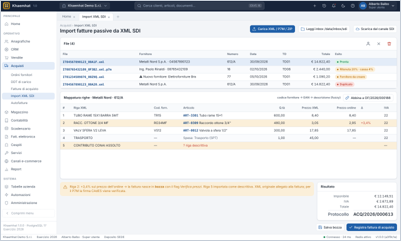
|
||||
*Mockup 034 — quattro file in import (pronto, con ritenuta e cassa, fornitore da creare, duplicato) e mappatura delle righe sull'ordine con differenza di prezzo (anteprima ridotta).*
|
||||
**Acquisti → Importa fatture** (o il link nell'elenco delle fatture passive) registra in bozza le fatture ricevute
|
||||
dallo SDI o dal tuo intermediario.
|
||||
|
||||
1. Carica i file con **Carica XML / P7M / ZIP**, oppure **Leggi inbox** (cartella di ingresso dell'istanza) o
|
||||
**Scarica dal canale SDI** (con il modulo Fatturazione elettronica).
|
||||
2. Per ogni file Khaemhat legge fornitore, numero, data, tipo documento (TD) e totale e mostra un **esito**:
|
||||
*Pronto*, *Fornitore da creare*, *Duplicato*, oppure avvisi (ad esempio *Ritenuta 20% · cassa 4%*).
|
||||
3. Il **fornitore** viene riconosciuto da **partita IVA o codice fiscale**; se non esiste si crea al volo dai dati
|
||||
dell'XML.
|
||||
4. **Mappatura righe**: ogni riga XML viene abbinata a un articolo cercando, in ordine, il **codice del fornitore**,
|
||||
l'**EAN** e la **descrizione** (ricerca approssimata). Le righe non abbinate diventano descrittive o si abbinano a
|
||||
mano.
|
||||
5. **Abbina a ordine**: confronta prezzi e quantità con l'ordine fornitore; le differenze sono evidenziate (es.
|
||||
*+3,4%*).
|
||||
6. **Salva bozza** o **Registra fattura di acquisto**. Se ci sono differenze la fattura nasce **in bozza** con il
|
||||
flag *Verifica prezzi*.
|
||||
1. **Caricamento**: scegli uno o più file: **XML FatturaPA**, file firmati **.p7m** o archivi **ZIP** che li
|
||||
contengono (fino a 50 MB per file). I file che non sono fatture elettroniche leggibili sono elencati a parte con il
|
||||
motivo.
|
||||
2. **Controllo**: per ogni fattura vedi fornitore (nuovo o già in anagrafica), numero, data, tipo, totale e un esito:
|
||||
*Pronta*, oppure *Già registrata* (stesso fornitore, stesso numero, stesso anno), *Non è un acquisto* (per esempio
|
||||
un'autofattura emessa dall'azienda stessa), *Totale diverso* (il totale del file non torna con le righe), *Firma non
|
||||
verificata*, *Sconto sul totale*. **Leggi** mostra righe, riepilogo IVA e pagamento del file.
|
||||
3. **Registrazione**: spunta le fatture e premi **Registra in bozza**. Per ognuna Khaemhat:
|
||||
- trova il **fornitore** dalla partita IVA o dal codice fiscale, o lo **crea** dai dati del file;
|
||||
- crea una **fattura fornitore** (tipi TD01, TD02, TD03, TD05, TD06, TD24-TD27) o una **nota di credito fornitore**
|
||||
(TD04, TD08) in bozza, con numero e data del fornitore e la causale nelle note;
|
||||
- abbina ogni riga a un **articolo** cercando il **codice del fornitore** (scheda articolo, *Fornitori*), poi l'**EAN**,
|
||||
poi il **codice articolo**; le righe non abbinate diventano righe libere con descrizione, prezzo e IVA;
|
||||
- riporta gli **sconti** percentuali come sconto di riga e gli altri nel prezzo netto;
|
||||
- sceglie il **codice IVA** dell'azienda con la stessa aliquota e natura;
|
||||
- **allega il file** originale alla fattura (scheda *Allegati*, tipo *Fattura elettronica*).
|
||||
|
||||
L'**XML originale** viene allegato alla fattura; per i file **P7M** la **firma CAdES** viene verificata. I file già
|
||||
importati sono riconosciuti come duplicati.
|
||||
Le fatture importate restano **in bozza**: controllale e confermale per protocollarle. Se un codice IVA manca (per
|
||||
esempio una natura non usata finora), aggiungilo in [Tabelle azienda](Tabelle-azienda) → *Codici IVA* e ripeti
|
||||
l'import.
|
||||
|
||||
## Autofatture e integrazioni (TD16-TD29)
|
||||
|
||||

|
||||
*Mockup 035 — integrazione TD17 per servizi da un fornitore estero: IVA integrata, effetto neutro, registri RC vendite e acquisti, scadenza di invio allo SDI (anteprima ridotta).*
|
||||

|
||||
|
||||
Quando l'IVA è dovuta dall'acquirente (inversione contabile) l'azienda deve **integrare** la fattura ricevuta o
|
||||
emettere un'**autofattura**, trasmettendola allo SDI. In Khaemhat questi documenti stanno in **Acquisti →
|
||||
Autofatture** e nascono dalla fattura di acquisto d'origine.
|
||||
Quando l'IVA è dovuta da chi compra (inversione contabile, acquisti dall'estero) l'azienda deve **integrare** la
|
||||
fattura ricevuta o emettere un'**autofattura** e trasmetterla allo SDI. Khaemhat lo riconosce da solo dalla fattura
|
||||
fornitore (paese del fornitore, beni o servizi, natura IVA delle righe) e mostra sopra le righe quale documento serve e **entro quando**:
|
||||
|
||||
| Codice | Documento | Quando si usa |
|
||||
| Tipo | Quando | Scadenza |
|
||||
|---|---|---|
|
||||
| **TD16** | Integrazione fattura reverse charge interno | acquisti nazionali in inversione contabile (art. 17 c.6 DPR 633/72, es. subappalto edile) |
|
||||
| **TD17** | Integrazione/autofattura per acquisto di servizi dall'estero | servizi da fornitori UE ed extra-UE |
|
||||
| **TD18** | Integrazione per acquisto di beni intracomunitari | beni da fornitori UE |
|
||||
| **TD19** | Integrazione/autofattura per acquisto di beni ex art. 17 c.2 DPR 633/72 | beni già in Italia acquistati da soggetti non residenti |
|
||||
| **TD20** | Autofattura per regolarizzazione e integrazione delle fatture | regolarizzazione nei casi previsti (definizione aggiornata dalle specifiche v1.9) |
|
||||
| **TD21** | Autofattura per splafonamento | acquisti oltre il plafond dell'esportatore abituale |
|
||||
| **TD22** | Estrazione beni da deposito IVA | |
|
||||
| **TD23** | Estrazione beni da deposito IVA con versamento dell'IVA | |
|
||||
| **TD28** | Acquisti da San Marino con IVA | fatture cartacee con IVA da operatori sammarinesi |
|
||||
| **TD29** | Comunicazione per omessa o irregolare fatturazione | introdotto con le specifiche v1.9 (dal 1° aprile 2025) |
|
||||
| **AF16** (TD16) | inversione contabile interna: righe con natura N6.x (subappalti, rottami, cellulari…) | 15 del mese dopo il ricevimento |
|
||||
| **AF17** (TD17) | servizi da un fornitore estero, UE o extra UE | 15 del mese dopo |
|
||||
| **AF18** (TD18) | beni da un fornitore di un altro Paese UE | 15 del mese dopo |
|
||||
| **AF19** (TD19) | beni già in Italia comprati da un soggetto non residente (art. 17 c.2) | 15 del mese dopo |
|
||||
| **AF28** (TD28) | acquisti da San Marino con IVA in fattura | 15 del mese dopo |
|
||||
| **AF20**, **AF29** | regolarizzazione di una fattura non ricevuta o irregolare | 90 giorni |
|
||||
| AF21, AF22, AF23 | splafonamento, estrazione da deposito IVA | a mano, quando servono |
|
||||
|
||||
Come funziona (esempio TD17, mockup 035):
|
||||

|
||||
|
||||
1. La fattura estera viene registrata negli acquisti.
|
||||
2. Si crea l'integrazione: le righe sono **riprese dalla fattura estera** con imponibile e aliquota; Khaemhat
|
||||
calcola l'**IVA integrata**.
|
||||
3. **Conferma e genera XML**: nell'XML il **fornitore estero** compare come cedente/prestatore e la **nostra azienda**
|
||||
come cessionario/committente.
|
||||
4. La registrazione va contemporaneamente nel **registro IVA vendite RC** e nel **registro IVA acquisti RC**: l'effetto
|
||||
è **neutro** (IVA a debito = IVA a credito, salvo indetraibilità). Il pannello *Effetto contabile* mostra le due
|
||||
righe.
|
||||
5. L'XML va inviato **entro il 15 del mese successivo**: Khaemhat mostra la scadenza nel documento e un promemoria
|
||||
nella dashboard.
|
||||
**Acquisti → Autofatture** elenca in alto le **integrazioni da emettere**, la scadenza più vicina per prima. **Crea
|
||||
autofattura** (qui o nella fattura fornitore) prepara il documento in bozza: le righe della fattura con il **codice IVA
|
||||
ordinario** al posto della natura, il numero e la data della fattura del fornitore come documento collegato, la data
|
||||
di oggi. Controllalo ed **emettilo**: prende il numero dal numeratore `AUT` delle autofatture.
|
||||
|
||||
Schede: *Righe*, *Testata*, *Registrazione IVA*, *XML SDI*, *Collegamenti*. Le definizioni ufficiali dei codici sono
|
||||
in [Fiscalità italiana](Fiscalita-italiana).
|
||||
Il **file XML** dell'autofattura (con il fornitore come cedente e l'azienda come cessionario) e l'invio allo SDI
|
||||
arrivano con la [Fatturazione elettronica](Fatturazione-elettronica) (M9); la doppia registrazione nei registri IVA
|
||||
vendite e acquisti si fa da sola alla conferma dell'autofattura (dalla 0.7, vedi [IVA](IVA)). Le definizioni ufficiali dei codici TD sono in
|
||||
[Fiscalità italiana](Fiscalita-italiana).
|
||||
|
||||
## Fatture da fornitori forfettari
|
||||
|
||||
Le fatture dei fornitori in **regime forfettario** non hanno IVA (natura N2.2 nell'XML del fornitore) e riportano il
|
||||
**bollo** quando dovuto; non sono soggette a ritenuta d'acconto. Nella scheda del fornitore il flag *Regime
|
||||
forfettario* (gruppo *Ritenute e contributi*) indica questa situazione; i controlli automatici sulla fattura
|
||||
importata saranno definiti in sviluppo.
|
||||
Le fatture dei fornitori in **regime forfettario** non hanno IVA (natura N2.2) e riportano il **bollo** quando dovuto;
|
||||
non sono soggette a ritenuta. All'import la riga prende il codice IVA dell'azienda con natura N2.2; non serve
|
||||
nessuna autofattura.
|
||||
|
||||
## Stati
|
||||
|
||||
Ordini e DDT di carico seguono gli stati del motore documenti: *Bozza*, *Confermato*, *Ricevuto parzialmente* /
|
||||
*Ricevuto*, *Chiuso*, *Annullato*. Le fatture di acquisto sono *Bozza* finché non vengono **registrate
|
||||
(protocollate)**; i badge indicano anche *Da XML SDI*, *Verifica prezzi*, *Caricato a magazzino*, *Da fatturare*.
|
||||
| Documento | Stati |
|
||||
|---|---|
|
||||
| Ordine fornitore, ricevimento | *Bozza*, *Confermato*, *Evaso in parte*, *Evaso*, *Chiuso*, *Annullato* |
|
||||
| Fattura e nota di credito fornitore | *Bozza*, *Confermato* (protocollata), *Annullato* |
|
||||
| Autofattura | *Bozza*, *Emessa* e, con la fatturazione elettronica, gli stati dello SDI |
|
||||
|
||||
## Permessi e licenza
|
||||
|
||||
Ordini, carichi, fatture di acquisto e import da file sono nel modulo **CORE**. La generazione e l'invio dell'XML
|
||||
delle autofatture e lo scarico dal canale SDI richiedono **EINV**; la registrazione contabile e i registri IVA
|
||||
**ACCT**; i pagamenti **FIN**. Costi e margini sono visibili solo a chi ha il permesso `items.cost.read`.
|
||||
Ordini, ricevimenti, fatture, import e autofatture sono nel modulo **CORE**. Gli ordini richiedono
|
||||
`purchases.order.read`/`write`; i ricevimenti, che muovono il magazzino, `inventory.entry.read`/`write` (e
|
||||
`inventory.entry.post` per confermarli); fatture, note di credito, import e autofatture `purchases.invoice.read`/`write`.
|
||||
L'XML delle autofatture richiederà **EINV**, la registrazione contabile **ACCT**, i pagamenti **FIN**. Costi e margini
|
||||
sono visibili solo con `items.cost.read`.
|
||||
|
||||
## Domande frequenti
|
||||
|
||||
- **L'import segna "Duplicato".** La fattura risulta già importata: non va registrata una seconda volta (il
|
||||
criterio esatto di riconoscimento sarà definito in sviluppo).
|
||||
- **Una riga dell'XML non trova l'articolo.** Aggiungi il codice del fornitore nella scheda articolo (*Fornitori*):
|
||||
la volta successiva l'abbinamento sarà automatico.
|
||||
- **Ho ricevuto meno merce di quella ordinata.** Conferma il DDT con la quantità ricevuta: il residuo resta aperto
|
||||
sull'ordine.
|
||||
- **L'import dice "Già registrata".** Lo stesso fornitore ha già un documento con quel numero nello stesso anno: non
|
||||
va registrata due volte.
|
||||
- **Una riga dell'XML non trova l'articolo.** Aggiungi il codice che usa il fornitore nella scheda articolo
|
||||
(*Fornitori*, codice fornitore): dalla volta successiva l'abbinamento è automatico.
|
||||
- **Ho ricevuto meno merce di quella ordinata.** Conferma il ricevimento con la quantità arrivata: il residuo resta
|
||||
aperto sull'ordine e l'ordinato degli articoli lo tiene in conto.
|
||||
- **La fattura ha un prezzo diverso dall'ordine.** L'avviso sopra le righe lo segnala; se la fattura è giusta
|
||||
confermala e il costo medio si allinea al prezzo fatturato.
|
||||
- **Non vedo l'avviso dell'autofattura.** Compare sulle fatture di fornitori esteri o con righe in natura N6.x,
|
||||
finché non c'è un'autofattura collegata. L'elenco *Integrazioni da emettere* mostra solo le fatture **confermate**.
|
||||
|
||||
## Pagine correlate
|
||||
|
||||
|
||||
@@ -1,6 +1,6 @@
|
||||
# Allegati e file
|
||||
|
||||
> **Stato:** completa per M3 (invio e-mail e scanner con M5) · **Ultima revisione:** 2026-11-11 · **Versione software:** 0.3.0 (milestone M3)
|
||||
> **Stato:** completa per M5 (acquisizione da scanner con M13) · **Ultima revisione:** 2026-11-12 · **Versione software:** 0.5.0
|
||||
> **Modulo di licenza:** CORE · **Permessi principali:** `attachments.read`, `attachments.write`, `attachments.delete` · **Specifica:** SPEC §9.4
|
||||
|
||||
Ogni documento e ogni anagrafica può avere **allegati**: file caricati dall'utente (l'ordine del cliente in PDF, una
|
||||
@@ -79,6 +79,11 @@ La sezione **Genera file** del pannello elenca le uscite disponibili per il docu
|
||||
|
||||
**Rigenera** non sovrascrive mai: crea la versione successiva (`v2`, `v3`…) e lascia consultabili le precedenti.
|
||||
|
||||
**In 0.5.0** i documenti di vendita (preventivi, ordini, DDT, fatture, note, pro forma) hanno il generatore **Stampa
|
||||
del documento in PDF**: lo stesso disegno dell'anteprima di stampa (vedi [Vendite](Vendite#stampa-e-pdf)). Lo usano
|
||||
anche **Salva come allegato** dell'anteprima e **Invia per e-mail**, che allega al messaggio la versione appena
|
||||
creata: così tra gli allegati resta sempre la copia esatta di ciò che è stato stampato o inviato.
|
||||
|
||||
Anche i **report** producono file (XLSX, CSV, PDF) scaricabili e, se pianificati, inviati per e-mail come allegati.
|
||||
Le **stampe massive** (ad esempio tutte le fatture del mese) producono un unico **ZIP** scaricato direttamente,
|
||||
senza file temporanei.
|
||||
|
||||
@@ -1,6 +1,6 @@
|
||||
# Articoli e listini
|
||||
|
||||
> **Stato:** completa · **Ultima revisione:** 2026-11-12 · **Versione software:** 0.4.0 (milestone M4; giacenze e costi dai movimenti con il magazzino, M6)
|
||||
> **Stato:** completa · **Ultima revisione:** 2026-11-12 · **Versione software:** 0.4.0 (milestone M4; giacenze e costi dai movimenti dalla 0.6.0, M6)
|
||||
> **Modulo di licenza:** CORE · **Permessi principali:** `items.item.read` (consultare), `items.item.write` (inserire, modificare, disattivare, prezzi), `items.item.delete` (eliminare), `items.cost.read` (vedere costi e margini) · **Specifica:** SPEC §11.2, §11.3 (prezzi), §14 · **Decisioni:** ADR 0030
|
||||
|
||||
L'**articolo** descrive ciò che l'azienda vende o compra: merci, servizi, spese, righe descrittive e cespiti. Nella
|
||||
@@ -75,18 +75,20 @@ salvataggio.
|
||||
### Costi
|
||||
|
||||
- **Costo standard**: valore scritto a mano.
|
||||
- **Ultimo costo** e **costo medio**: li aggiornano i carichi di magazzino (DDT di carico, fatture di acquisto) che
|
||||
arrivano con il magazzino (M6); fino ad allora sono valorizzati solo nei dati di esempio. Il costo medio è il
|
||||
criterio di valorizzazione del magazzino (vedi [Magazzino](Magazzino)).
|
||||
- **Ultimo costo** e **costo medio**: li calcolano i carichi di magazzino (DDT fornitore, fatture fornitore, esistenze
|
||||
iniziali, movimenti di carico) dalla versione 0.6.0. Il costo medio è il criterio di valorizzazione del magazzino
|
||||
(vedi [Magazzino](Magazzino#costo-medio-e-valorizzazione)).
|
||||
- Il **margine** è calcolato sul prezzo: (prezzo - costo) / prezzo.
|
||||
- Chi non ha il permesso `items.cost.read` non vede i costi (né nella scheda né nell'elenco né nei listini) e,
|
||||
quando salva, i costi in archivio restano quelli di prima.
|
||||
|
||||
### Giacenze e riordino
|
||||
|
||||
Con **Gestito a magazzino** l'articolo parteciperà a movimenti, giacenze per deposito (*Giacenza, Impegnato,
|
||||
Ordinato, Disponibile, Valore*) e **proposta di riordino**: questi arrivano con il magazzino (M6). Scorta minima,
|
||||
punto e lotto di riordino si possono già compilare.
|
||||
Con **Gestito a magazzino** l'articolo partecipa a movimenti, giacenze per deposito (*Giacenza, Impegnato,
|
||||
Ordinato, Disponibile, Valore*) e **proposta di riordino** (vedi [Magazzino](Magazzino)). **Scorta minima**, **punto
|
||||
di riordino** e **lotto di riordino** decidono lo stato dell'articolo nelle giacenze e la quantità proposta; il
|
||||
**fornitore preferito** della scheda *Fornitori*, con prezzo, minimo d'ordine e lead time, è quello a cui la
|
||||
proposta ordina.
|
||||
|
||||
### Controlli al salvataggio
|
||||
|
||||
|
||||
@@ -137,13 +137,17 @@ il dettaglio dell'ultima. Le esecuzioni sono registrate nel database di sistema.
|
||||
|
||||
## Job di sistema
|
||||
|
||||
Nella versione 0.2.0 i job di sistema sono questi (orari nel fuso `Europe/Rome`):
|
||||
Nella versione 0.7.0 i job di sistema sono questi (orari nel fuso `Europe/Rome`):
|
||||
|
||||
| Codice | Cosa fa | Quando |
|
||||
|---|---|---|
|
||||
| `system.sessions-cleanup` | elimina le sessioni scadute o revocate da più di 30 giorni, nel database di sistema e in ogni azienda non disattivata | al minuto 15 di ogni ora |
|
||||
| `system.license-check` | ricalcola la licenza; avvisa gli amministratori a 30, 14, 7, 3 e 1 giorno dalla scadenza e quando è scaduta | ogni ora |
|
||||
| `system.log-retention` | elimina gli eventi di log più vecchi della retention del loro livello | ogni notte alle 03:30 |
|
||||
| `system.attachments-trash` | svuota il cestino degli allegati oltre i giorni di conservazione | ogni notte alle 03:45 |
|
||||
| `system.ecb-rates` | scarica i cambi di riferimento della BCE (richiede la rete) | nei giorni feriali alle 16:30 |
|
||||
| `inventory.rebuild` | ricostruisce il magazzino di ogni azienda attiva dai documenti in vigore (vedi [Magazzino](Magazzino#ricostruzione)) | la domenica alle 02:15 |
|
||||
| `ledger.recurring` | crea le registrazioni ricorrenti arrivate alla loro data in ogni azienda con la contabilità (vedi [Contabilità](Contabilita)) | ogni giorno alle 05:00 |
|
||||
|
||||
Oltre alle attività degli amministratori, Khaemhat esegue sempre alcuni **job di sistema**: pulizia (log e sessioni
|
||||
secondo la retention), controllo della licenza, aggiornamento dei cambi BCE, lettura dell'inbox e dei canali SDI,
|
||||
|
||||
@@ -1,6 +1,6 @@
|
||||
# Changelog
|
||||
|
||||
> **Stato:** completa per 0.4.0 · **Ultima revisione:** 2026-11-12
|
||||
> **Stato:** completa per 0.7.0 · **Ultima revisione:** 2026-11-13
|
||||
|
||||
Le novità di ogni versione sono nel file
|
||||
[`CHANGELOG.md`](https://gitea.encke-hake.ts.net/BalboSoft/Khaemhat/src/branch/main/CHANGELOG.md) del repository
|
||||
@@ -11,6 +11,9 @@ Le novità di ogni versione sono nel file
|
||||
|
||||
| Versione | Data | Contenuto |
|
||||
|---|---|---|
|
||||
| 0.7.0 | 2026-11-13 | M7 — Contabilità generale e IVA: piano dei conti PMI a tre livelli, causali, prima nota con registrazioni provvisorie, definitive e storni, ricorrenti; contabilizzazione automatica di fatture, note e autofatture con righe IVA, partite e ritenute; registri IVA con stampa definitiva, liquidazione mensile o trimestrale con acconto, F24 e LIPE; ritenute d'acconto e dati CU; bollo virtuale; partitari, mastrini, bilancio di verifica e libro giornale; contabilità nei dati di esempio. |
|
||||
| 0.6.0 | 2026-11-12 | M6 — Acquisti e Magazzino: ordini fornitori, ricevimenti, fatture e note di credito fornitore con protocollo e controllo dei prezzi; import delle fatture elettroniche XML, P7M e ZIP con fornitore e articoli abbinati; autofatture e integrazioni TD16-TD29 con la loro scadenza; giacenze per deposito con impegnato, ordinato e costo medio ponderato, movimenti e trasferimenti, inventario fisico, proposta di riordino, valorizzazione con classi ABC, ricostruzione; giacenze iniziali da file; acquisti e magazzino nei dati di esempio. |
|
||||
| 0.5.0 | 2026-11-12 | M5 — Motore documenti e Vendite: preventivi, ordini, DDT, fatture, note di credito, pro forma e parcelle con numerazione senza buchi, castelletto IVA, bollo, ritenute e scadenze; documenti collegati riga per riga e *Crea …* per passare dall'uno all'altro; fatturazione differita guidata; anteprima di stampa e PDF salvato tra gli allegati; invio per e-mail con SMTP interno; un anno di vendite nei dati di esempio; [Guida all'uso](Guida-utente) con le schermate. |
|
||||
| 0.4.0 | 2026-11-12 | M4 — Tabelle, anagrafiche, articoli: pacchetto fiscale italiano, profilo azienda, esercizi e cambi, 26 tabelle azienda con province, comuni e CAP, clienti, fornitori e contatti con controlli e VIES, articoli e listini con prezzi a validità, codici automatici, import/export guidato (anche del piano dei conti, per ora solo verifica) e dati di esempio. |
|
||||
| 0.3.0 | 2026-11-11 | M3 — Framework UI: la finestra di Khaemhat con menu, schede e barra di stato, la dashboard a widget, *Il mio profilo* con temi e colori, ricerca globale, aiuto in app, notifiche, componenti per maschere e liste, allegati e anteprima di stampa (provati su un documento di prova, le maschere gestionali arrivano da 0.4.0). |
|
||||
| 0.2.0 | 2026-11-11 | M2 — Sistema e sicurezza: avvio da variabili d'ambiente, super utente e prima azienda, accesso con password e verifica in due passaggi, utenti, ruoli e permessi, licenze e moduli con codici di prova, log per sezioni, attività programmate. |
|
||||
|
||||
@@ -1,272 +1,320 @@
|
||||
# Contabilità generale
|
||||
|
||||
> **Stato:** bozza · **Ultima revisione:** 2026-11-10 · **Versione software:** non ancora rilasciata (milestone M7; chiusura esercizio e bilancio CEE in M10)
|
||||
> **Modulo di licenza:** ACCT · **Permessi principali:** `ledger.entry.write`, `ledger.entry.finalize`, `ledger.entry.reopen`, `ledger.account.write`, `ledger.closing.run`, `ledger.export` · **Specifica:** SPEC §11.7, §11.1, §14
|
||||
> **Stato:** completa per la versione 0.7 · **Ultima revisione:** 2026-11-13 · **Versione software:** 0.7.0 (M7)
|
||||
> **Modulo di licenza:** ACCT · **Permessi principali:** `ledger.account.read`/`write` (piano dei conti e causali), `ledger.entry.read`/`write` (prima nota, partitari, bilancio), `ledger.entry.finalize` (registrazioni definitive) · **Specifica:** SPEC §11.7, §14, ADR 0036, ADR 0037
|
||||
|
||||
## A cosa serve
|
||||
Il modulo **Contabilità** tiene la **contabilità generale in partita doppia** dell'azienda: piano dei conti, causali,
|
||||
prima nota, registrazioni ricorrenti, partitari di clienti e fornitori, mastrini, bilancio di verifica e libro
|
||||
giornale. È collegato al resto del gestionale: ogni fattura, nota di credito o autofattura confermata scrive da sola
|
||||
la sua registrazione, con le righe IVA e le partite.
|
||||
|
||||
Il modulo Contabilità tiene la **contabilità generale in partita doppia** dell'azienda: piano dei conti, causali,
|
||||
prima nota, partitari e mastrini, esercizi e periodi, chiusura dell'esercizio e bilancio. È collegato al resto del
|
||||
gestionale: ogni documento confermato (fattura di vendita o di acquisto, nota di credito, incasso, pagamento,
|
||||
ammortamento…) genera da solo la propria registrazione partendo dalla **causale contabile** del tipo di documento.
|
||||
La parte fiscale (registri IVA, liquidazione, acconto, F24, LIPE, ritenute d'acconto, bollo virtuale) è descritta
|
||||
nella pagina [IVA](IVA); le regole italiane usate (piano dei conti modello, codici tributo, scadenze) in
|
||||
[Fiscalità italiana](Fiscalita-italiana).
|
||||
|
||||
La parte IVA (registri, liquidazione, F24, LIPE, ritenute, bollo, dichiarazioni d'intento) è descritta nella pagina
|
||||
[IVA](IVA); i cespiti nella pagina [Cespiti](Cespiti); partite, incassi e banche nello [Scadenzario](Scadenzario).
|
||||
> **In questa versione** ci sono il piano dei conti modello *PMI standard* con voci CEE, le causali contabili, la
|
||||
> prima nota manuale con castelletto IVA, la **contabilizzazione automatica** di fatture, note e autofatture, le
|
||||
> registrazioni ricorrenti, lo storno, le registrazioni definitive con il numero di libro giornale, i partitari con
|
||||
> estratto conto e partite, i mastrini, il bilancio di verifica e le stampe del bilancio e del libro giornale.
|
||||
> Arrivano più avanti: **scadenzario**, incassi e pagamenti bancari e riconciliazione (M8), **chiusura
|
||||
> dell'esercizio**, ratei e risconti, **bilancio CEE** riclassificato e **cespiti** (M10). Non ci sono ancora
|
||||
> l'import del piano dei conti da file e l'export per il commercialista.
|
||||
|
||||
## Dove si trova
|
||||
|
||||
Menu laterale **Contabilità**, con le voci **Prima nota**, **Piano dei conti**, **Causali contabili**, **Registri IVA**,
|
||||
**Liquidazione IVA**, **Ritenute**, **Chiusura esercizio**, **Bilancio**. Esercizi e periodi si gestiscono da
|
||||
**Tabelle azienda → Esercizi** (mockup 052). Le voci compaiono solo se il modulo ACCT è licenziato e l'utente ha i
|
||||
permessi (vedi [Licenze e moduli](Licenze-e-moduli) e [Utenti e permessi](Utenti-e-permessi)).
|
||||
Menu **Contabilità** → *Prima nota*, *Piano dei conti*, *Causali*, *Partitari*, *Registri IVA*, *Liquidazione IVA*,
|
||||
*Ritenute e F24*, *Bollo virtuale*, *Bilancio*. Le ultime quattro voci fiscali sono spiegate in [IVA](IVA).
|
||||
|
||||
## Schermate
|
||||
Il menu compare solo se la licenza dell'azienda comprende il modulo **ACCT** e l'utente ha i permessi (vedi
|
||||
[Licenze e moduli](Licenze-e-moduli) e [Utenti e permessi](Utenti-e-permessi)). Esercizi e periodi si gestiscono da
|
||||
**Tabelle azienda → Esercizi** (vedi [Tabelle azienda](Tabelle-azienda)); periodicità IVA e pro rata sono nel
|
||||
**profilo azienda**.
|
||||
|
||||

|
||||
*Mockup 040 — registrazione di prima nota generata da una fattura di acquisto: intestazione con causale FA, stato *Provvisoria* e *Quadrata*, righe in partita doppia con centro di costo e partita, riquadro delle righe IVA (anteprima ridotta)*
|
||||
|
||||

|
||||
*Mockup 041 — giroconto manuale in bozza con sbilancio di € 300,00 evidenziato e suggerimento "Ctrl+D quadra sull'ultima riga" (anteprima ridotta)*
|
||||
|
||||

|
||||
*Mockup 042 — albero dei conti con saldi, dettaglio del sottoconto (natura, tipo, conto padre, voce CEE, riclassificato, flag) e mastrino sotto (anteprima ridotta)*
|
||||
|
||||

|
||||
*Mockup 043 — elenco delle causali con area, registro IVA e "genera partita"; sotto, il modello righe della causale FA con ruoli, segno e base d'importo (anteprima ridotta)*
|
||||
|
||||

|
||||
*Mockup 044 — partitario di un cliente con saldo iniziale, dare/avere del periodo, saldo e scaduto; movimenti con saldo progressivo e stato della partita (anteprima ridotta)*
|
||||
|
||||

|
||||
*Mockup 050 — procedura guidata di chiusura in nove passi raggruppati in cinque fasi (Controlli, Assestamento, Chiusura, Apertura, Stampe), con esito e autore di ogni passo*
|
||||
|
||||

|
||||
*Mockup 051 — bilancio CEE con stato patrimoniale espandibile e conto economico a confronto con l'esercizio precedente (Δ %); viste Verifica, CEE, Riclassificato, Indici*
|
||||
|
||||

|
||||
*Mockup 052 — elenco degli esercizi con stato, registrazioni e ultimo periodo IVA liquidato; sotto, i periodi mensili con stato (Aperto, Liquidato, Bloccato) e interruttore di blocco*
|
||||
|
||||
## Piano dei conti
|
||||
|
||||
Il piano dei conti ha tre livelli con codice **`MM.CC.SSS`** (mastro, conto, sottoconto; per esempio `01.04.001`
|
||||
*Clienti Italia*). Alla creazione dell'azienda viene **precaricato un piano standard per PMI** con le voci di bilancio
|
||||
CEE già associate (nel mockup 042 l'intestazione mostra la versione del modello caricato).
|
||||
|
||||
| Campo | Significato |
|
||||
|---|---|
|
||||
| **Codice** | `MM.CC.SSS`, gerarchico; il conto padre è il livello superiore |
|
||||
| **Descrizione** | obbligatoria |
|
||||
| **Natura** | patrimoniale (attività/passività), economica (costi/ricavi), d'ordine |
|
||||
| **Tipo** | mastro, conto, sottoconto |
|
||||
| **Voce CEE** | voce dello schema di stato patrimoniale (art. 2424 c.c.) o conto economico (art. 2425 c.c.) |
|
||||
| **Riclassificato** | voce del riclassificato finanziario/gestionale (es. *Crediti commerciali*) |
|
||||
| **Partitario clienti/fornitori** | il conto si articola per controparte (vedi sotto) |
|
||||
| **Rilevante IVA** | il conto entra nei controlli IVA |
|
||||
| **Chiusura automatica** | il conto viene chiuso dalla procedura di fine esercizio |
|
||||
| **Movimentabile** | si possono registrare movimenti (di norma solo i sottoconti) |
|
||||
| **Attivo** | i conti disattivati restano nello storico ma non si propongono |
|
||||
|
||||
Selezionando un conto nell'albero si vedono a destra i suoi dati e sotto il **mastrino** (data, registrazione,
|
||||
descrizione, dare, avere, saldo); il pulsante **Mastrino completo** apre la vista intera con i filtri.
|
||||
|
||||
### Importare un piano dei conti
|
||||
|
||||
Non esiste in Italia un formato standard per scambiare il piano dei conti, quindi Khaemhat accetta tre formati:
|
||||
|
||||
| Formato | Uso | Contenuto |
|
||||
|---|---|---|
|
||||
| **CSV** (separatore `;`) | import da altri gestionali o da foglio di calcolo | colonne `codice;descrizione;livello;padre;natura;tipo;voce_cee;riclassifica;flag` |
|
||||
| **XLSX** | come il CSV | stesso tracciato, una riga per conto |
|
||||
| **JSON** (`khaemhat-coa.json`) | export/import completo fra installazioni Khaemhat | conti, voci di bilancio, causali e mappature |
|
||||
|
||||
1. Apri **Contabilità → Piano dei conti** e premi **Importa piano dei conti** (oppure usa la procedura guidata di
|
||||
[Import-Export](Import-Export)).
|
||||
2. Scegli il file e verifica la **mappatura delle colonne**.
|
||||
3. Controlla l'**anteprima**: Khaemhat verifica la coerenza gerarchica (ogni conto ha un padre esistente, il livello
|
||||
corrisponde al codice, le voci CEE esistono) e segnala le righe errate.
|
||||
4. Conferma. Il risultato e gli eventuali errori restano nel report dell'importazione.
|
||||
|
||||
I valori ammessi nelle colonne `natura`, `tipo` e `flag` saranno fissati in sviluppo e riportati qui.
|
||||
|
||||
## Causali contabili e ruoli
|
||||
|
||||
Una **causale contabile** è il modello di una registrazione. Ogni causale ha **righe modello** che non indicano un
|
||||
conto fisso ma un **ruolo**; il ruolo viene risolto nel conto reale al momento della registrazione (il conto del
|
||||
cliente, il conto di ricavo dell'articolo o della sua categoria, il conto IVA del codice IVA…).
|
||||
|
||||
| Ruolo | Esempio di conto risolto |
|
||||
|---|---|
|
||||
| cliente / fornitore | sottoconto del partitario della controparte |
|
||||
| ricavo / costo | conto della riga, dell'articolo o della categoria |
|
||||
| IVA vendite / IVA acquisti | conti IVA del codice IVA |
|
||||
| banca / cassa | conto collegato al conto bancario o alla cassa |
|
||||
| Erario ritenute, cassa previdenza, bollo | conti configurati per azienda |
|
||||
| abbuoni, contropartita | conti configurati o indicati a mano |
|
||||
|
||||
Per ogni riga si indicano anche **dare/avere**, la base dell'importo (totale documento, imponibile riga, IVA
|
||||
detraibile, IVA indetraibile, ritenuta, cassa…), il **registro IVA** e se la riga **genera una partita** nello
|
||||
scadenzario. Il pulsante **Prova su documento** mostra la registrazione che la causale produrrebbe su un documento
|
||||
esistente, senza salvarla.
|
||||
|
||||
Causali di base precaricate: **FV** fattura di vendita, **NCV** nota di credito a cliente, **FA** fattura di
|
||||
acquisto, **NCA** nota di credito da fornitore, **AFRC** integrazione reverse charge (autofatture TD16-TD19),
|
||||
**CORR** corrispettivi, **INC** incasso, **PAG** pagamento, **INS** insoluto, **GIRO** giroconto, **AMM**
|
||||
ammortamenti, **RAT** ratei e risconti, **RIM** rimanenze, chiusura e apertura, **F24**, ritenute versate, stipendi
|
||||
(da import), interessi e commissioni.
|
||||
```
|
||||
Fattura / nota / autofattura ──Conferma──► Registrazione "Da documento" (righe, castelletto IVA, partite)
|
||||
Registrazione manuale ──Registra──► Registrata ──Rendi definitive──► Definitiva (n. libro giornale) ──Storna──► Storno
|
||||
Ricorrente ──ogni notte alle 5:00──► Registrazione "Ricorrente" alla data prevista
|
||||
```
|
||||
|
||||
## Prima nota
|
||||
|
||||
Ogni registrazione ha un numero per esercizio (es. `2026/001205`), data di registrazione, data di competenza,
|
||||
causale, descrizione, documento d'origine, registro IVA e protocollo, stato, periodo e fonte.
|
||||

|
||||
*La prima nota dell'azienda demo: fatture di vendita (FV) e di acquisto (FA), nota di credito (NCV), liquidazioni IVA
|
||||
(LIQ), versamenti F24, ritenuta (RIT) e il noleggio mensile ricorrente, tutte nello stato* Registrata.
|
||||
|
||||
### Registrare a mano
|
||||
**Contabilità → Prima nota** elenca le registrazioni dell'esercizio, la più recente per prima, con numero, data,
|
||||
causale, descrizione, documento, cliente o fornitore, importo e stato. In alto la ricerca (descrizione, numero o
|
||||
documento) e i filtri **Dal**, **Al** e **Stato**; in fondo la paginazione. Un clic sul numero apre la registrazione.
|
||||
|
||||
1. **Contabilità → Prima nota**, premi **+** (Ctrl+N) e scegli la causale.
|
||||
2. Nella scheda **Righe contabili** inserisci conto (F4 apre il piano dei conti), descrizione, controparte, dare o
|
||||
avere, centro di costo, commessa e partita. Ctrl+↓ aggiunge una riga.
|
||||
3. Se la registrazione ha IVA, compila la scheda **Righe IVA** (codice IVA, imponibile, aliquota, imposta, % di
|
||||
indetraibilità, detraibile, natura).
|
||||
4. Controlla la **quadratura** nell'intestazione: Dare, Avere e **Sbilancio**. Se c'è uno sbilancio, **Ctrl+D**
|
||||
lo assegna all'ultima riga.
|
||||
5. **Salva** (Ctrl+S). La registrazione resta *provvisoria*; quando è corretta premi **Rendi definitiva**.
|
||||
La scheda **Registrazioni** contiene l'elenco; la scheda **Ricorrenti** le registrazioni che si ripetono (vedi
|
||||
[sotto](#registrazioni-ricorrenti)). I pulsanti della barra:
|
||||
|
||||
Una registrazione che non quadra si può salvare **solo come bozza** (mockup 041: badge rosso con lo sbilancio) e non
|
||||
può mai diventare definitiva.
|
||||
|
||||
### Stati e regole
|
||||
|
||||
| Stato | Cosa significa | Cosa si può fare |
|
||||
| Pulsante | Cosa fa | Permesso |
|
||||
|---|---|---|
|
||||
| **Bozza / Provvisoria** | in lavorazione, entra nei saldi ma non sul libro giornale definitivo | modificare, eliminare, rendere definitiva (solo se quadra) |
|
||||
| **Definitiva** | numerata in modo continuo sul libro giornale | **immutabile**: si corregge solo con uno **storno** collegato |
|
||||
| **Nuova registrazione** | apre una registrazione vuota | `ledger.entry.write` |
|
||||
| **Contabilizza documenti** | registra in prima nota i documenti di vendita e acquisto confermati di un periodo che non sono ancora contabilizzati | `ledger.entry.write` |
|
||||
| **Rendi definitive** | rende definitive tutte le registrazioni fino a un giorno | `ledger.entry.finalize` |
|
||||
|
||||
- Le registrazioni **generate da un documento** si modificano solo stornando o correggendo il documento d'origine
|
||||
(pulsante **Documento origine** per aprirlo).
|
||||
- Le date sono ammesse solo in **periodi aperti**: un periodo liquidato o bloccato e un esercizio chiuso rifiutano
|
||||
nuove registrazioni con data interna.
|
||||
- **Storna** crea la registrazione inversa collegata all'originale (campo *storno di*).
|
||||
- **Registrazioni ricorrenti**: da una registrazione manuale **Salva modello ricorrente** crea un modello riusabile
|
||||
(affitti, canoni, stipendi…).
|
||||
- **Valuta**: le righe possono essere in valuta estera con il cambio; le differenze cambio si rilevano alla chiusura
|
||||
della partita (vedi [Scadenzario](Scadenzario)).
|
||||
### Gli stati di una registrazione
|
||||
|
||||
| Stato | Significato | Cosa si può fare |
|
||||
|---|---|---|
|
||||
| **Bozza** | in lavorazione, senza numero; può non quadrare; non entra nei saldi | modificare, registrare, eliminare |
|
||||
| **Registrata** | numerata (per esempio `2026/00011`), quadrata, entra nei saldi e nei registri IVA | modificare ed eliminare (se manuale), stornare, rendere definitiva |
|
||||
| **Definitiva** | ha il numero di **libro giornale** | solo **stornare**: non si modifica né si elimina |
|
||||
|
||||
Ogni registrazione indica anche la sua **origine**: *Manuale*, *Da documento*, *Liquidazione IVA*, *Versamento F24*,
|
||||
*Ricorrente*, *Storno*, *Ritenuta*.
|
||||
|
||||
## Registrare a mano
|
||||
|
||||

|
||||
*La registrazione di una fattura di acquisto intracomunitaria: causale FA, registro ACQ1, fornitore in Avere e merci
|
||||
in Dare; nel castelletto IVA il codice NI41 (natura N3.2). La striscia in alto riassume Dare, Avere, Sbilancio e
|
||||
righe.*
|
||||
|
||||
1. **Contabilità → Prima nota → Nuova registrazione**.
|
||||
2. Nella **Testata** scegli la **data** e la **causale**: la causale propone le righe con conti e segni e il
|
||||
**registro IVA**. Scrivi la **descrizione** e, se serve, **numero** e **data del documento**.
|
||||
3. Nelle **Righe** completa per ogni riga il **conto** (si registra solo sui **sottoconti**), il **cliente o
|
||||
fornitore** (obbligatorio sui conti con partitario, come *Clienti Italia* e *Fornitori Italia*), la descrizione,
|
||||
il **centro di costo** e l'importo in **Dare** oppure in **Avere**. **Aggiungi riga** e il cestino aggiungono e
|
||||
tolgono righe.
|
||||
4. Se la registrazione ha IVA, compila il **Castelletto IVA** con **Aggiungi aliquota**: codice IVA, imponibile,
|
||||
imposta e parte indetraibile. Con righe IVA serve un registro IVA.
|
||||
5. Controlla la striscia in alto: **Dare**, **Avere**, **Sbilancio** e numero di **righe**. **Chiudi lo
|
||||
sbilancio** mette la differenza sull'ultima riga senza importo (o su una nuova riga, a cui dai il conto).
|
||||
6. **Salva bozza** conserva il lavoro anche se non quadra; **Registra** salva la registrazione, che deve quadrare, e
|
||||
le assegna il numero.
|
||||
|
||||
Una registrazione con righe IVA non si può datare in un periodo già **liquidato** (vedi [IVA](IVA#liquidazione-iva));
|
||||
nessuna registrazione si può datare in un periodo **bloccato**, in un esercizio chiuso o **prima dell'ultima
|
||||
registrazione definitiva**.
|
||||
|
||||
### Registrazioni che vengono dai documenti
|
||||
|
||||
Le registrazioni *Da documento* non si modificano né si eliminano dalla prima nota: si corregge il **documento** e
|
||||
Khaemhat riscrive la registrazione con lo stesso numero. Se il documento viene annullato, la registrazione sparisce
|
||||
oppure, se era già definitiva, viene stornata.
|
||||
|
||||
### Stornare ed eliminare
|
||||
|
||||
- **Storna** chiede la **data dello storno** e crea una nuova registrazione con Dare e Avere invertiti, collegata
|
||||
all'originale (che diventa *Stornata*). Si stornano solo le registrazioni registrate o definitive, una volta sola.
|
||||
- **Elimina** toglie una registrazione manuale non definitiva. Una registrazione usata come modello di una ricorrente
|
||||
si elimina solo dopo aver tolto la ricorrente.
|
||||
|
||||
### Rendere definitive le registrazioni
|
||||
|
||||
**Rendi definitive** chiede un giorno e rende definitive tutte le registrazioni registrate fino a quel giorno: ognuna
|
||||
riceve il **numero di libro giornale**, in ordine di data, e da quel momento si corregge solo con uno storno.
|
||||
L'operazione non si annulla ed è rifiutata se nel periodo ci sono ancora **bozze** (registrale o eliminale prima).
|
||||
Dopo, nessuna nuova registrazione può avere una data anteriore all'ultima definitiva.
|
||||
|
||||
## Contabilizzazione automatica dei documenti
|
||||
|
||||
Alla conferma di un documento (o in un secondo momento con la procedura **Contabilizzazione documenti**, vedi
|
||||
[Automazioni](Automazioni)) Khaemhat applica la causale contabile del **tipo documento** e genera la registrazione
|
||||
con le righe IVA e le partite di scadenzario, nella stessa transazione del documento. Il documento mostra il flag
|
||||
*contabilizzato* e il collegamento alla registrazione; la registrazione mostra il documento d'origine.
|
||||
Con il modulo ACCT attivo, quando **confermi** (o emetti) uno di questi documenti Khaemhat scrive la sua registrazione
|
||||
**nella stessa operazione**, con le righe IVA nel suo registro, le **partite** dalle rate di scadenza e l'eventuale
|
||||
**ritenuta d'acconto**:
|
||||
|
||||
## Partitari, mastrini ed estratti conto
|
||||
|
||||
Il **partitario** (mockup 044) mostra per un cliente o fornitore: saldo iniziale, dare e avere del periodo, saldo,
|
||||
di cui scaduto e l'elenco dei movimenti con saldo progressivo e stato della partita. Filtri per periodo, conto,
|
||||
stato e "solo definitive". Da qui:
|
||||
|
||||
- **Estratto conto**: genera il PDF da inviare al cliente (resta come allegato, vedi [Allegati e file](Allegati-e-file));
|
||||
- **Sollecito**: apre i solleciti dello [Scadenzario](Scadenzario).
|
||||
|
||||
Il **drill-down** è completo: dal bilancio al conto, dal conto al mastrino, dal mastrino alla registrazione, dalla
|
||||
registrazione al documento.
|
||||
|
||||
## Esercizi e periodi
|
||||
|
||||
In **Tabelle azienda → Esercizi** (mockup 052) ogni esercizio ha inizio, fine, stato, numero di registrazioni,
|
||||
ultimo periodo IVA liquidato, data di blocco, prima pagina del libro giornale e ultima registrazione definitiva.
|
||||
|
||||
| Esercizio | Periodo (mese o trimestre) |
|
||||
|---|---|
|
||||
| **Aperto** — si registra normalmente | **Aperto** — accetta registrazioni |
|
||||
| **In chiusura** — è in corso la procedura di chiusura | **Liquidato** — la liquidazione IVA è stata confermata |
|
||||
| **Chiuso** — sola lettura | **Bloccato** — rifiuta ogni registrazione con data interna |
|
||||
|
||||
**Nuovo esercizio** crea l'esercizio successivo; di norma lo crea la chiusura stessa, in stato provvisorio, per
|
||||
permettere di registrare nel nuovo anno prima di aver chiuso il vecchio. I periodi si bloccano e sbloccano con
|
||||
l'interruttore **Blocco** (permesso di riapertura richiesto).
|
||||
|
||||
## Chiusura dell'esercizio guidata
|
||||
|
||||
**Contabilità → Chiusura esercizio** (mockup 050) guida la chiusura in nove passi. Ogni passo è **ripetibile e
|
||||
annullabile**; le registrazioni generate sono marcate con la fonte `closing/<passo>` e restano provvisorie fino alle
|
||||
stampe definitive.
|
||||
|
||||
| # | Passo | Cosa fa |
|
||||
| Documento | Causale | Registro IVA |
|
||||
|---|---|---|
|
||||
| 1 | Controlli preliminari | nessuna registrazione provvisoria, partite quadrate, IVA liquidata, numerazioni continue |
|
||||
| 2 | Ammortamenti | quote civilistiche e fiscali dei [Cespiti](Cespiti) |
|
||||
| 3 | Ratei e risconti | da competenze dei documenti e inserimenti manuali (**Verifica ratei/risconti**) |
|
||||
| 4 | Rimanenze finali | valorizzazione del [Magazzino](Magazzino) al 31/12 e storno delle iniziali |
|
||||
| 5 | Accantonamenti | svalutazione crediti, TFR (da import) |
|
||||
| 6 | Chiusura conti economici | giroconto a Conto economico e rilevazione del risultato |
|
||||
| 7 | Chiusura conti patrimoniali | giroconto a Stato patrimoniale finale |
|
||||
| 8 | Apertura nuovo esercizio | riporto dei saldi e delle partite aperte |
|
||||
| 9 | Stampe definitive | libro giornale, libro inventari, registri IVA, registro cespiti |
|
||||
| Fattura immediata, accompagnatoria, differita, di acconto; nota di debito; parcella | `FV` | `VEN1` |
|
||||
| Nota di credito a cliente | `NCV` | `VEN1` |
|
||||
| Fattura fornitore | `FA` | `ACQ1` |
|
||||
| Nota di credito fornitore | `NCA` | `ACQ1` |
|
||||
| Autofatture e integrazioni (AF16-AF29) | `AFRC` | `VEN-RC` e `ACQ-RC` |
|
||||
|
||||
1. Apri la procedura e premi **Esegui passo N**: il passo mostra il numero di registrazioni prodotte e l'esito
|
||||
(*Superato*, *Eseguito*, *Da verificare*, *In attesa*).
|
||||
2. Controlla i risultati con l'icona di anteprima e, se serve, torna indietro di un passo.
|
||||
3. Dopo le stampe definitive premi **Blocca esercizio**: l'esercizio diventa **chiuso**, in sola lettura, e le date
|
||||
precedenti al nuovo esercizio vengono rifiutate.
|
||||
Come si formano le righe:
|
||||
|
||||
La chiusura è anche nel catalogo delle procedure ([Automazioni](Automazioni)).
|
||||
- **Vendita**: il **cliente** in Dare per il totale; i **ricavi** in Avere, raggruppati per conto; la **rivalsa
|
||||
della cassa previdenziale** e il **bollo addebitato** al cliente in Avere; l'**IVA vendite** in Avere. Con lo
|
||||
**split payment** l'IVA viene subito tolta al cliente (il cliente paga solo l'imponibile).
|
||||
- **Acquisto**: il **fornitore** in Avere; i **costi** in Dare, con l'**IVA indetraibile** aggiunta al costo;
|
||||
l'**IVA acquisti** in Dare.
|
||||
- **Autofattura e integrazione**: **IVA acquisti** in Dare e **IVA vendite** in Avere, senza cliente né fornitore;
|
||||
il documento compare in entrambi i registri RC, con effetto neutro sulla liquidazione.
|
||||
- **Note di credito**: le stesse righe con i segni invertiti.
|
||||
- Lo **sconto in calce** e gli **arrotondamenti** si ripartiscono sulle righe; i centesimi di differenza vanno sulla
|
||||
riga più grande.
|
||||
|
||||
## Bilancio
|
||||
**Quale conto.** Per ogni riga Khaemhat usa il **Conto ricavi** o **Conto costi** dell'articolo (scheda articolo),
|
||||
per gli acquisti il **Conto di costo** del fornitore, poi il conto del codice IVA e, se manca, quello della causale
|
||||
(`30.01.001` *Ricavi per vendita di merci*, `20.01.001` *Merci c/acquisti*). Il cliente e il fornitore usano il
|
||||
**Conto cliente** o **Conto fornitore** della loro scheda, altrimenti `05.01.001` *Clienti Italia* e `14.01.001`
|
||||
*Fornitori Italia*. Se manca un conto la conferma del documento si ferma con un messaggio che lo dice.
|
||||
|
||||
**Contabilità → Bilancio** (mockup 051) offre quattro viste:
|
||||
**Contabilizza documenti.** I documenti confermati quando ACCT non era attivo (o prima della versione 0.7) si
|
||||
registrano in blocco: **Prima nota → Contabilizza documenti**, scegli **Dal** e **Al** e premi **Contabilizza**. La
|
||||
casella *Ricontabilizza anche i documenti già registrati* riscrive anche le registrazioni esistenti, purché non
|
||||
siano definitive.
|
||||
|
||||
| Vista | Contenuto |
|
||||
## Registrazioni ricorrenti
|
||||
|
||||

|
||||
*Il noleggio mensile della stampante dei dati demo: frequenza mensile, prossima data, registrazione modello e stato.*
|
||||
|
||||
Affitti, canoni, noleggi: una registrazione **ricorrente** copia una **registrazione modello** alle date previste.
|
||||
|
||||
1. Registra una volta la scrittura da ripetere (per esempio *Noleggi* in Dare e *Banca c/c* in Avere).
|
||||
2. **Prima nota → Ricorrenti → Nuova ricorrente**: descrizione, **numero della registrazione modello** (il numero di
|
||||
prima nota, per esempio `2026/00018`), **frequenza** (*Mensile*, *Trimestrale*, *Semestrale*, *Annuale*),
|
||||
**prossima data**, data **Fino al** facoltativa, casella **Sospesa**.
|
||||
3. Ogni notte alle **5:00** l'attività di sistema *Registrazioni ricorrenti* (vedi
|
||||
[Attività programmate](Attivita-programmate)) scrive le registrazioni arrivate a scadenza, con origine
|
||||
*Ricorrente*, e sposta in avanti la prossima data. **Genera ora** fa lo stesso subito.
|
||||
|
||||
Una data di fine mese resta di fine mese (31/01, poi 28/02, poi 31/03). **Apri il modello** apre la registrazione da
|
||||
copiare; eliminando una ricorrente le registrazioni già generate restano.
|
||||
|
||||
## Piano dei conti
|
||||
|
||||

|
||||
*L'albero dei 237 conti del modello PMI standard, il dettaglio del sottoconto 05.01.001 Clienti Italia (sottoconto,
|
||||
attività, tipo Clienti, voce CEE C.II.1, con partitario) e il suo mastrino con il saldo progressivo.*
|
||||
|
||||
Il piano dei conti ha tre livelli con codice **`MM.CC.SSS`**: **mastro** (`05` *Crediti verso clienti*), **conto**
|
||||
(`05.01` *Clienti*) e **sottoconto** (`05.01.001` *Clienti Italia*). Si registra solo sui sottoconti. Con le tabelle
|
||||
di base dell'azienda viene caricato il modello **PMI standard** del pacchetto fiscale: 237 conti con le voci di
|
||||
bilancio CEE già associate (vedi [Fiscalità italiana](Fiscalita-italiana#piano-dei-conti-modello)).
|
||||
|
||||
| Campo | Significato |
|
||||
|---|---|
|
||||
| **Verifica** | bilancio di verifica per conto (dare, avere, saldo); bilancini per centro di costo e commessa |
|
||||
| **CEE** | schema civilistico **ordinario**, **abbreviato** o **micro**, con confronto con l'esercizio precedente e Δ % |
|
||||
| **Riclassificato** | riclassificato finanziario e gestionale |
|
||||
| **Indici** | indici di bilancio |
|
||||
| **Codice** | mastro, conto e sottoconto separati da punti; il conto padre deve esistere |
|
||||
| **Descrizione** | obbligatoria |
|
||||
| **Natura** | *Attività*, *Passività*, *Costo*, *Ricavo*, *Conto d'ordine* |
|
||||
| **Tipo** | *Generico*, *Clienti*, *Fornitori*, *Banca*, *Cassa*, *IVA*, *Tributi*: dice alle registrazioni automatiche che cosa cercare |
|
||||
| **Voce di bilancio CEE** | voce dello schema civilistico (art. 2424 e 2425 c.c.), per esempio `C.II.1` |
|
||||
| **Riclassificazione** | voce del riclassificato, facoltativa |
|
||||
| **Partitario** | le righe indicano il cliente o il fornitore |
|
||||
| **Rilevante IVA** | il conto entra nelle registrazioni con IVA |
|
||||
| **Chiuso in automatico a fine esercizio** | il conto sarà chiuso dalla procedura di fine esercizio (M10) |
|
||||
| **Disattivato** | il conto resta nello storico ma non si usa più |
|
||||
|
||||
L'intestazione indica la data di situazione (anche **infrannuale**) e se include le registrazioni provvisorie.
|
||||
Doppio clic su una voce apre i conti, poi il mastrino, la registrazione e il documento. Il bilancio si stampa e si
|
||||
esporta in XLSX e PDF; la **nota integrativa** è prodotta in bozza. Il formato XBRL è previsto in fase 2
|
||||
([Roadmap](Roadmap)).
|
||||
A sinistra l'**albero** con la ricerca per codice o descrizione; a destra i dati del conto scelto e, per i
|
||||
sottoconti, il **mastrino**: i movimenti del periodo (**Dal**, **Al**) con saldo iniziale, Dare, Avere, **saldo
|
||||
progressivo**, totali e paginazione. **Stampa** scarica il mastrino in PDF; il numero della registrazione la apre.
|
||||
|
||||
## Export per il commercialista
|
||||
**Nuovo conto**, **Modifica** ed **Elimina** richiedono `ledger.account.write`. Un conto con **movimenti** non si
|
||||
elimina (disattivalo); un conto con **sottoconti** si elimina solo dopo di loro.
|
||||
|
||||
Pacchetto **ZIP mensile** con libro giornale, registri IVA, partitari e bilancio in XLSX, CSV e PDF. Si genera a mano
|
||||
o in automatico con la procedura **Export per il commercialista** pianificata ogni mese (vedi [Automazioni](Automazioni)
|
||||
e [Attività programmate](Attivita-programmate)).
|
||||
## Causali contabili
|
||||
|
||||
## Report del modulo
|
||||

|
||||
*Le causali di base con il loro registro IVA; a destra la causale FA Fattura di acquisto: area Acquisti, registro
|
||||
ACQ1, apre partite, e le righe proposte con ruolo, segno e conto.*
|
||||
|
||||
Libro giornale, mastrini, bilancini per centro di costo e commessa, registri IVA, liquidazioni, scadenzario IVA,
|
||||
elenco clienti e fornitori per fatturato, riepilogo per natura IVA, dati dei quadri VE/VF, estratti conto, export per
|
||||
il commercialista. Vedi [Report](Report).
|
||||
Una **causale** è il modello di una registrazione: propone conti, segni e registro IVA. Ogni causale ha:
|
||||
|
||||
## Scorciatoie
|
||||
|
||||
| Tasto | Azione |
|
||||
| Campo | Significato |
|
||||
|---|---|
|
||||
| Ctrl+N / Ctrl+S | nuova registrazione / salva |
|
||||
| Ctrl+D | quadra la registrazione sull'ultima riga |
|
||||
| F4 | ricerca nel piano dei conti dalla cella *Conto* |
|
||||
| Ctrl+↓ | nuova riga |
|
||||
| Ctrl+↑ / Ctrl+↓ (fuori dalla griglia) | registrazione precedente / successiva |
|
||||
| Alt+1…9 | cambia scheda |
|
||||
| **Codice**, **Descrizione** | per esempio `FA` *Fattura di acquisto* |
|
||||
| **Area** | *Generale*, *Vendite*, *Acquisti*, *Tesoreria*, *Imposte*, *Chiusura esercizio* |
|
||||
| **Registro IVA** | il registro delle registrazioni con IVA |
|
||||
| **Apre partite** | le registrazioni aprono partite di clienti o fornitori |
|
||||
| **Causale di storno** | note di credito: i segni del documento si invertono |
|
||||
| **Disattivato** | la causale non si propone più |
|
||||
| **Righe proposte** | per ogni riga **ruolo** (*Cliente*, *Fornitore*, *Ricavo*, *Costo*, *IVA vendite*, *IVA acquisti*, *Banca*, *Cassa*, *Ritenute da versare*, *Ritenute subite*, *Contributo cassa*, *Bollo*, *Arrotondamenti*, *Erario c/IVA*, *IVA split payment* o *Conto indicato*), **segno** Dare o Avere, **conto** e descrizione |
|
||||
|
||||
Elenco completo in [Interfaccia e scorciatoie](Interfaccia-e-scorciatoie).
|
||||
Causali di base: **FV** fattura di vendita, **NCV** nota di credito a cliente, **FA** fattura di acquisto, **NCA**
|
||||
nota di credito da fornitore, **AFRC** autofattura e integrazione reverse charge, **CORR** corrispettivi giornalieri,
|
||||
**INC** incasso da cliente, **PAG** pagamento a fornitore, **RIT** ritenuta d'acconto operata, **RITS** ritenuta
|
||||
d'acconto subita, **LIQ** liquidazione IVA periodica, **F24** versamento con modello F24, **GIRO** giroconto, **SPB**
|
||||
spese e commissioni bancarie, **STO** storno di scrittura.
|
||||
|
||||
Le causali dei documenti, della liquidazione, delle ritenute e dell'F24 sono usate dalle registrazioni automatiche:
|
||||
cambiarne i conti cambia le registrazioni future. Una causale usata da registrazioni non si elimina: disattivala.
|
||||
Per un'azienda creata con una versione precedente, conti, causali e registri mancanti si aggiungono con
|
||||
`scripts/seed.sh --base` (vedi [Dati di base e di esempio](Dati-di-base-e-esempio)).
|
||||
|
||||
## Partitari ed estratto conto
|
||||
|
||||

|
||||
*Il partitario clienti con Dare, Avere, saldo e partite aperte; a destra l'estratto conto di Edilizia Moderna S.p.A. e
|
||||
le sue partite, con le scadenze passate in rosso.*
|
||||
|
||||
**Contabilità → Partitari** ha due schede, **Clienti** e **Fornitori**. L'elenco mostra per ogni soggetto con
|
||||
movimenti Dare, Avere, **Saldo** e numero di partite **aperte**, con ricerca per nome o codice e il **saldo
|
||||
complessivo**.
|
||||
|
||||
Scegliendo un soggetto si vedono:
|
||||
|
||||
- l'**estratto conto** del periodo (**Dal**, **Al**): saldo iniziale, movimenti con documento e saldo progressivo,
|
||||
totali; **Stampa** lo scarica in PDF;
|
||||
- le **partite**: una per rata di ogni documento, con data documento, numero della rata, **scadenza**, importo,
|
||||
pagato e **residuo**; le scadenze superate sono in rosso. *Mostra anche le partite chiuse* aggiunge quelle saldate.
|
||||
|
||||
In questa versione le partite nascono dai documenti; gli incassi e i pagamenti che le chiudono, i solleciti e lo
|
||||
scadenzario arrivano con lo [Scadenzario](Scadenzario) (M8).
|
||||
|
||||
## Bilancio di verifica e libro giornale
|
||||
|
||||

|
||||
*Il bilancio di verifica dell'azienda demo al livello dei sottoconti, con i totali di conti e mastri; la striscia
|
||||
riassume Dare, Avere, quadratura e risultato del periodo.*
|
||||
|
||||
**Contabilità → Bilancio** mostra i saldi di tutti i conti in un periodo:
|
||||
|
||||
- filtri **Dal** e **Al**, **Centro di costo** (tutti o uno), **Dettaglio** (*Mastri*, *Conti*, *Sottoconti*) e
|
||||
**Comprendi le bozze**;
|
||||
- per ogni conto **saldo iniziale**, **Dare**, **Avere**, **Saldo Dare** o **Saldo Avere**, con i totali di conti e
|
||||
mastri;
|
||||
- la striscia con i totali **Dare** e **Avere**, la **Quadratura** (*Dare e Avere quadrano* o no) e il **Risultato
|
||||
del periodo** (ricavi meno costi: *Utile* o *Perdita*).
|
||||
|
||||
Le stampe sono file PDF da scaricare:
|
||||
|
||||
| Pulsante | Contenuto |
|
||||
|---|---|
|
||||
| **Stampa bilancio** | il bilancio di verifica del periodo e del centro di costo scelti |
|
||||
| **Libro giornale di prova** | registrazioni registrate e definitive del periodo, in ordine di data, con le righe |
|
||||
| **Libro giornale definitivo** | solo le registrazioni definitive, con il numero di libro giornale e le pagine numerate dall'inizio dell'anno |
|
||||
|
||||
Il bilancio CEE (stato patrimoniale e conto economico civilistici), il riclassificato e gli indici arrivano con la
|
||||
chiusura dell'esercizio (M10).
|
||||
|
||||
## Dati demo
|
||||
|
||||
Con i dati di esempio (`scripts/seed.sh --demo`) la contabilità parte già popolata: i documenti demo sono
|
||||
contabilizzati, la fattura del professionista *Studio Rag. Neri Paola* è pagata e la sua ritenuta è da versare, il
|
||||
noleggio mensile della stampante (45 euro, conto `22.01.003` *Noleggi* contro la banca) è una registrazione
|
||||
ricorrente, le liquidazioni IVA dei mesi già finiti sono confermate e gli F24 già scaduti sono pagati. Vedi
|
||||
[Dati di base e di esempio](Dati-di-base-e-esempio).
|
||||
|
||||
## Permessi e licenza
|
||||
|
||||
Serve il modulo **ACCT**. Il permesso `ledger.entry.finalize` è necessario per rendere definitiva una registrazione;
|
||||
gli altri codici indicati in testa seguono la convenzione `modulo.entità.azione` (SPEC §7.2) e saranno fissati in
|
||||
sviluppo. Il ruolo predefinito **Contabilità** li comprende. Senza licenza ACCT le voci del menu non compaiono, ma i
|
||||
dati restano conservati.
|
||||
Serve il modulo **ACCT**: senza, il menu Contabilità non compare, i documenti non vengono contabilizzati (si
|
||||
recuperano dopo con **Contabilizza documenti**) e i dati già registrati restano conservati.
|
||||
|
||||
## Attenzione
|
||||
| Permesso | Cosa consente |
|
||||
|---|---|
|
||||
| `ledger.account.read` | vedere piano dei conti e causali |
|
||||
| `ledger.account.write` | creare, modificare ed eliminare conti e causali |
|
||||
| `ledger.entry.read` | prima nota, mastrini, partitari, bilancio e stampe del libro giornale |
|
||||
| `ledger.entry.write` | registrazioni manuali, storni, ricorrenti, contabilizzazione dei documenti |
|
||||
| `ledger.entry.finalize` | rendere definitive le registrazioni |
|
||||
|
||||
- Una registrazione **definitiva** non si modifica: va stornata. Usa lo stato provvisorio finché non hai controllato.
|
||||
- Confermare una liquidazione IVA blocca il periodo: correzioni successive richiedono la riapertura (permesso
|
||||
dedicato) e vanno ricalcolate.
|
||||
- I numeri del libro giornale definitivo sono continui; la procedura di chiusura verifica che non ci siano buchi.
|
||||
I permessi della parte IVA (`vat.register.read`, `vat.settlement.read`, `vat.settlement.confirm`) sono in [IVA](IVA).
|
||||
|
||||
## Domande frequenti
|
||||
|
||||
- **Il pulsante Registra è spento.** Dare e Avere non quadrano: guarda lo *Sbilancio* nella striscia, correggi gli
|
||||
importi o usa **Chiudi lo sbilancio**. Intanto puoi usare **Salva bozza**.
|
||||
- **"Si registra solo sui sottoconti".** Hai scelto un mastro o un conto: scegli un sottoconto (codice a tre parti).
|
||||
- **"Le righe su clienti e fornitori indicano il soggetto".** Il conto ha il partitario: indica il cliente o il
|
||||
fornitore nella riga.
|
||||
- **Non riesco a modificare la registrazione di una fattura.** Viene dal documento: correggi la fattura e la
|
||||
registrazione si aggiorna. Se è già definitiva, la correzione del documento la storna e la riscrive.
|
||||
- **"Manca un conto per contabilizzare il documento".** Una causale o il piano dei conti non hanno il conto che
|
||||
serve (per esempio dopo aver cancellato un sottoconto): controlla la causale del documento e il conto dell'articolo.
|
||||
- **La data è rifiutata.** Il periodo è liquidato (solo per registrazioni con IVA), bloccato, l'esercizio è chiuso o
|
||||
c'è già una registrazione definitiva successiva.
|
||||
- **La ricorrente non ha generato nulla.** È sospesa, la data *Fino al* è passata o la prossima data è nel futuro;
|
||||
**Genera ora** mostra l'eventuale problema.
|
||||
|
||||
## Pagine correlate
|
||||
|
||||
[IVA](IVA) · [Cespiti](Cespiti) · [Scadenzario](Scadenzario) · [Vendite](Vendite) · [Acquisti](Acquisti) ·
|
||||
[Magazzino](Magazzino) · [Tabelle azienda](Tabelle-azienda) · [Report](Report) · [Automazioni](Automazioni) ·
|
||||
[Import-Export](Import-Export) · [Fiscalità italiana](Fiscalita-italiana) · [Glossario](Glossario)
|
||||
[IVA](IVA) · [Fiscalità italiana](Fiscalita-italiana) · [Vendite](Vendite) · [Acquisti](Acquisti) ·
|
||||
[Scadenzario](Scadenzario) · [Cespiti](Cespiti) · [Tabelle azienda](Tabelle-azienda) ·
|
||||
[Attività programmate](Attivita-programmate) · [Dati di base e di esempio](Dati-di-base-e-esempio) ·
|
||||
[Glossario](Glossario)
|
||||
@@ -56,7 +56,7 @@ magazzino* M6, *CRM* M11), senza numeri finti.
|
||||
| **Attività CRM** | le attività del giorno (chiamate, riunioni, visite) | richiede il modulo CRM |
|
||||
| **Promemoria personali** | note libere, visibili solo a te | |
|
||||
| **Scorciatoie** | pulsanti configurabili verso maschere e azioni frequenti | |
|
||||
| **Sottoscorta** | articoli sotto la scorta minima | |
|
||||
| **Sottoscorta** | gli articoli più urgenti da riordinare (esauriti, sottoscorta, sotto il punto di riordino) con disponibile e scorta; un clic apre i movimenti dell'articolo, **Riordina** la proposta di riordino | dalla 0.6.0 |
|
||||
| **Pipeline CRM** | valore delle opportunità per fase | richiede il modulo CRM |
|
||||
| **Ultimi documenti** | ultimi documenti aperti o creati | |
|
||||
| **Stato del sistema** | versione, database, cache, licenza, aziende aperte, attività programmate di oggi, ognuno con un pallino verde, giallo o rosso | solo account di istanza |
|
||||
|
||||
@@ -1,6 +1,6 @@
|
||||
# Dati di base e di esempio
|
||||
|
||||
> **Stato:** completa per M4 · **Ultima revisione:** 2026-11-12 · **Versione software:** 0.4.0 (dati di esempio di documenti e contabilità con i moduli, completi in M9)
|
||||
> **Stato:** completa per M5 · **Ultima revisione:** 2026-11-12 · **Versione software:** 0.6.0 (dati di esempio di contabilità con il modulo, completi in M9)
|
||||
> **Modulo di licenza:** CORE · **Livello richiesto:** amministratore (rimozione dati di esempio: super utente) · **Specifica:** SPEC §6, §12.11, §14
|
||||
|
||||
## A cosa serve
|
||||
@@ -133,7 +133,34 @@ i controlli; non si verificano sul VIES (ADR 0029). Gli agenti di esempio non so
|
||||
Ci sono poi **120 articoli** in dieci categorie con i listini *Pubblico* e *Rivenditori* derivati dal base, prezzi
|
||||
dell'anno precedente, fornitori abituali, UM e codici alternativi, sostitutivi e i prezzi netti e i codici di un
|
||||
cliente (ADR 0030, vedi [Articoli e listini](Articoli-e-listini)). I codici a barre di esempio iniziano con `200`,
|
||||
prefisso riservato all'uso interno. Il resto della tabella arriva con le milestone dei rispettivi moduli.
|
||||
prefisso riservato all'uso interno.
|
||||
|
||||
**Da M5** l'azienda di esempio ha anche il **profilo** compilato (indirizzo, partita IVA, REA, nota a piè di
|
||||
pagina delle stampe) e **un anno di vendite** costruite con il motore dei documenti, con date dal 1° gennaio a oggi:
|
||||
|
||||
| Documenti | Stati |
|
||||
|---|---|
|
||||
| 6 preventivi | 2 trasformati in ordine, 1 rifiutato, 1 con la validità scaduta, 1 in attesa di risposta, 1 in bozza |
|
||||
| 4 ordini clienti | 3 evasi (uno in due consegne), 1 ancora da consegnare |
|
||||
| 5 DDT | 2 già fatturati in differita, 3 da fatturare (prova la [fatturazione differita](Vendite#fatturazione-differita)) |
|
||||
| 8 fatture | 5 immediate (una in bozza), 2 differite, 1 pro forma |
|
||||
| 1 nota di credito | reso di un articolo difettoso, collegata alla fattura |
|
||||
|
||||
Le fatture e la nota condividono il numeratore (`1/2026` … `7/2026`), senza buchi e in ordine di data. Tutti i
|
||||
documenti sono marcati come dimostrativi e la stampa lo scrive in evidenza. Il caricamento non si ripete se
|
||||
l'azienda ha già documenti di vendita.
|
||||
|
||||
**Da M6** ci sono anche **acquisti e magazzino**, costruiti allo stesso modo:
|
||||
|
||||
| Documenti | Che cosa mostrano |
|
||||
|---|---|
|
||||
| 1 movimento di esistenze iniziali al 1° gennaio (`APE`) | la giacenza di partenza di ogni articolo; un articolo su cinque parte con poca merce, così le vendite lo portano sotto scorta e la [proposta di riordino](Magazzino#proposta-di-riordino) ha qualcosa da proporre |
|
||||
| 2 ordini fornitori | uno ricevuto per intero, uno ricevuto in parte (il resto è nell'*ordinato*) |
|
||||
| 2 ricevimenti merce | i carichi dei due ordini |
|
||||
| 3 fatture fornitore | una dal ricevimento con un prezzo più alto dell'ordine (vedi l'avviso sulle differenze), la parcella del commercialista, la fattura di un fornitore tedesco che aspetta la sua **integrazione AF18** |
|
||||
| 1 inventario aperto | 12 articoli già contati, due con una differenza |
|
||||
|
||||
Il caricamento non si ripete se l'azienda ha già documenti di acquisto o di magazzino. Il resto della tabella arriva con le milestone dei rispettivi moduli.
|
||||
I dati sono costruiti con gli stessi motori del programma (documenti, contabilità): ogni quadratura torna, e lo
|
||||
stesso caricamento è usato come prova automatica di correttezza.
|
||||
|
||||
|
||||
@@ -1,21 +1,29 @@
|
||||
# Fiscalità italiana
|
||||
|
||||
> **Stato:** bozza · **Ultima revisione:** 2026-11-11 · **Versione software:** 0.4.0 (codici e regole di base; il resto con M5-M10)
|
||||
> **Modulo di licenza:** CORE, ACCT, EINV, INTRA · **Specifica:** SPEC §11.1, §11.3-§11.9, §14
|
||||
> **Stato:** completa per la versione 0.7 · **Ultima revisione:** 2026-11-13 · **Versione software:** 0.7.0 (M7)
|
||||
> **Modulo di licenza:** CORE, ACCT, EINV, INTRA · **Specifica:** SPEC §11.1, §11.3-§11.9, §14, ADR 0036, ADR 0037
|
||||
|
||||
Questa pagina raccoglie in un solo posto i **codici e le regole fiscali italiane** che Khaemhat usa: tipi documento
|
||||
SDI, nature IVA, modalità e condizioni di pagamento, regimi fiscali, codici tributo F24 e scadenze. Serve come
|
||||
riferimento rapido mentre si compilano anagrafiche, codici IVA e documenti.
|
||||
SDI, nature IVA, modalità e condizioni di pagamento, regimi fiscali, il **piano dei conti modello**, i **codici
|
||||
tributo F24** con le scadenze, la **LIPE**, le **ritenute d'acconto** e il **bollo virtuale**. Serve come riferimento
|
||||
rapido mentre si compilano anagrafiche, codici IVA e documenti e mentre si liquida l'IVA.
|
||||
|
||||
Tutte queste tabelle sono **caricate dai dati di base** (pacchetto dati, per esempio `IT 2026.3`) e si aggiornano da
|
||||
**Amministrazione → Dati di base e di esempio** con **Aggiorna tabelle di base**. Le descrizioni ufficiali complete
|
||||
sono quelle delle *specifiche tecniche della fattura elettronica* dell'Agenzia delle Entrate, caricate nel seed: in
|
||||
caso di dubbio fa fede il testo mostrato dal programma, non questa pagina.
|
||||
Tutto ciò che è italiano sta nel **pacchetto fiscale Italia** del programma: le tabelle sono **caricate dai dati di
|
||||
base** (pacchetto dati, per esempio `IT 2026.3`) e si aggiornano da **Amministrazione → Dati di base e di esempio**
|
||||
con **Aggiorna tabelle di base** (o con `scripts/seed.sh --base`). Le descrizioni ufficiali complete sono quelle
|
||||
delle *specifiche tecniche della fattura elettronica* dell'Agenzia delle Entrate, caricate nel seed: in caso di dubbio
|
||||
fa fede il testo mostrato dal programma, non questa pagina.
|
||||
|
||||
> **Attenzione.** Khaemhat calcola e prepara i dati (F24, LIPE, Intrastat, bollo) ma **non sostituisce il
|
||||
> commercialista** né invia F24 e LIPE: l'invio telematico avviene tramite intermediario o home banking, come
|
||||
> indicato nella maschera della liquidazione. Le norme cambiano: la versione delle specifiche SDI supportata è
|
||||
> indicata nel programma ed è verificata a ogni rilascio.
|
||||
> **In questa versione** sono in uso i codici dei documenti, delle nature, dei pagamenti e dei regimi (dalla 0.4),
|
||||
> e con la 0.7 il piano dei conti *PMI standard*, i registri IVA, le regole della liquidazione e dell'acconto, i
|
||||
> codici tributo e le scadenze dell'F24, il tracciato LIPE, le ritenute d'acconto e il bollo virtuale. Le parti su
|
||||
> notifiche SDI, dichiarazioni d'intento, Intrastat e cespiti descrivono regole che il programma userà con la
|
||||
> [Fatturazione elettronica](Fatturazione-elettronica) (M9) e con [Cespiti](Cespiti) e [Intrastat](Intrastat) (M10).
|
||||
|
||||
> **Attenzione.** Khaemhat calcola e prepara i dati (F24, LIPE, Certificazione Unica, bollo) ma **non sostituisce il
|
||||
> commercialista** né invia F24, LIPE e CU: l'invio telematico avviene con i servizi dell'Agenzia delle Entrate,
|
||||
> l'home banking o l'intermediario, come ricordato nelle maschere. Le norme cambiano: la versione delle specifiche SDI
|
||||
> supportata è indicata nel programma ed è verificata a ogni rilascio.
|
||||
|
||||
## Dove si trovano questi codici nel programma
|
||||
|
||||
@@ -25,10 +33,12 @@ caso di dubbio fa fede il testo mostrato dal programma, non questa pagina.
|
||||
| Nature IVA (N…) | **Tabelle azienda → Codici IVA** | [Tabelle-azienda](Tabelle-azienda), [IVA](IVA) |
|
||||
| Modalità di pagamento (MP) | **Tabelle azienda → Metodi di pagamento** | [Tabelle-azienda](Tabelle-azienda) |
|
||||
| Regime fiscale (RF) | **Tabelle azienda → Profilo azienda**, scheda fornitore | [Tabelle-azienda](Tabelle-azienda), [Anagrafiche](Anagrafiche) |
|
||||
| Codici tributo F24 | liquidazione IVA, ritenute, bollo virtuale | [IVA](IVA), [Contabilita](Contabilita) |
|
||||
| Piano dei conti, causali, registri IVA | **Contabilità → Piano dei conti**, *Causali*, *Registri IVA* | [Contabilita](Contabilita), [IVA](IVA) |
|
||||
| Codici tributo F24 | liquidazione IVA, acconto, ritenute, bollo virtuale | [IVA](IVA) |
|
||||
| Tipi di ritenuta (RT) e casse (TC) | scheda fiscale del fornitore e del cliente, parcelle, fatture dei professionisti | [Anagrafiche](Anagrafiche), [IVA](IVA#ritenute-dacconto) |
|
||||
|
||||

|
||||
*Mockup 076 — tabella dei codici IVA con aliquota, natura SDI, riferimento normativo ed esigibilità; sotto, il dettaglio del codice selezionato (anteprima ridotta).*
|
||||

|
||||
*La tabella dei codici IVA dell'azienda in Tabelle azienda: ogni codice porta aliquota o natura SDI.*
|
||||
|
||||
## Tipi documento SDI (TD)
|
||||
|
||||
@@ -172,58 +182,149 @@ fatture passive. Il codice RF03 non esiste più nelle specifiche correnti.
|
||||
|
||||
I dettagli operativi sono in [Fatturazione-elettronica](Fatturazione-elettronica).
|
||||
|
||||
|
||||
## Piano dei conti modello
|
||||
|
||||
Il pacchetto fiscale porta il piano dei conti **PMI standard**: **237 conti** in tre livelli con codice `MM.CC.SSS`
|
||||
(mastro, conto, sottoconto), ognuno con natura, tipo e voce dello schema di bilancio civilistico (art. 2424 e 2425
|
||||
c.c.). Si carica con le tabelle di base dell'azienda e si modifica liberamente da **Contabilità → Piano dei conti**
|
||||
(vedi [Contabilità](Contabilita#piano-dei-conti)).
|
||||
|
||||
| Mastri | Natura | Contenuto |
|
||||
|---|---|---|
|
||||
| `01`-`09` | Attività | immobilizzazioni immateriali, materiali e finanziarie, rimanenze, crediti verso clienti, altri crediti (IVA, tributi), disponibilità liquide, ratei e risconti attivi, fondi di ammortamento |
|
||||
| `10`-`17` | Passività | patrimonio netto, fondi rischi, TFR, debiti verso banche, fornitori, debiti tributari e previdenziali, altri debiti, ratei e risconti passivi |
|
||||
| `20`-`29` | Costi | acquisti, servizi, godimento di beni di terzi, personale, ammortamenti, variazioni delle rimanenze, accantonamenti, oneri diversi, oneri finanziari, imposte sul reddito |
|
||||
| `30`-`32` | Ricavi | vendite e prestazioni, altri ricavi e proventi, proventi finanziari |
|
||||
| `90` | Conti d'ordine | conti di apertura e chiusura |
|
||||
|
||||
I conti usati dalle registrazioni automatiche:
|
||||
|
||||
| Conto | Uso |
|
||||
|---|---|
|
||||
| `05.01.001` Clienti Italia | cliente delle fatture di vendita (se la scheda cliente non indica un altro conto) |
|
||||
| `14.01.001` Fornitori Italia | fornitore delle fatture di acquisto |
|
||||
| `30.01.001` Ricavi per vendita di merci, `30.02.001` Resi e sconti su vendite | ricavi delle fatture e delle note di credito senza conto sull'articolo |
|
||||
| `20.01.001` Merci c/acquisti, `20.02.001` Resi e sconti su acquisti | costi delle fatture e note di credito fornitore senza conto sull'articolo o sul fornitore |
|
||||
| `06.02.001` IVA su acquisti, `15.01.001` IVA su vendite | IVA dei registri acquisti e vendite |
|
||||
| `15.01.002` Erario c/liquidazione IVA | saldo della liquidazione periodica e suo versamento |
|
||||
| `15.02.001` Erario c/ritenute lavoro autonomo, `06.03.001` Erario c/ritenute subite | ritenute operate e subite |
|
||||
| `31.01.002` Rimborso spese di bollo, `27.01.002` Imposta di bollo | bollo addebitato al cliente (ricavo) e bollo a carico dell'azienda (costo) |
|
||||
| `31.01.003` Rivalsa contributi previdenziali | rivalsa della cassa previdenziale sulle parcelle |
|
||||
| `27.01.003` IVA indetraibile | IVA indetraibile delle autofatture e del pro rata |
|
||||
| `28.01.003` Interessi sulla liquidazione IVA trimestrale | interessi dei contribuenti IVA trimestrali |
|
||||
| `07.01.001` Banca c/c, `07.02.001` Cassa contanti | banca predefinita per i versamenti F24, cassa dei corrispettivi |
|
||||
|
||||
**Registri IVA di base:** `VEN1` fatture emesse, `ACQ1` fatture acquisti, `CORR` corrispettivi, `VEN-RC` e `ACQ-RC`
|
||||
per autofatture e integrazioni. **Causali di base:** FV, NCV, FA, NCA, AFRC, CORR, INC, PAG, RIT, RITS, LIQ, F24,
|
||||
GIRO, SPB, STO (vedi [Contabilità](Contabilita#causali-contabili)). Fatture, note di debito e parcelle si registrano
|
||||
con FV su VEN1, le note di credito con NCV, le fatture fornitore con FA su ACQ1, le note di credito fornitore con NCA,
|
||||
le autofatture AF16-AF29 con AFRC su VEN-RC e ACQ-RC.
|
||||
|
||||
## Codici tributo F24
|
||||
|
||||
Khaemhat propone il codice tributo e prepara i **dati F24** da passare a intermediario o home banking.
|
||||
Khaemhat propone il codice tributo e prepara i **dati F24** da passare all'home banking o all'intermediario (vedi
|
||||
[IVA](IVA#prospetto-f24-e-pagamento)).
|
||||
|
||||
| Codice | Uso | Maschera |
|
||||
| Codice | Uso | Dove nasce |
|
||||
|---|---|---|
|
||||
| 6001 … 6012 | IVA mensile, da gennaio (6001) a dicembre (6012) | Liquidazione IVA (046) |
|
||||
| 6031 … 6034 | IVA trimestrale, dal 1° (6031) al 4° trimestre (6034, contribuenti trimestrali "speciali") | Liquidazione IVA |
|
||||
| 6013 | Acconto IVA mensili | Liquidazione IVA (acconto di dicembre) |
|
||||
| 6035 | Acconto IVA trimestrali | Liquidazione IVA (acconto di dicembre) |
|
||||
| 6099 | IVA dovuta in base alla dichiarazione annuale | Liquidazione IVA |
|
||||
| 1040 | Ritenute su redditi di lavoro autonomo | Ritenute (047) |
|
||||
| 1038 | Ritenute su provvigioni | Ritenute (047) |
|
||||
| 2521 … 2524 | Imposta di bollo sulle fatture elettroniche, dal 1° (2521) al 4° trimestre (2524) | Bollo virtuale (060) |
|
||||
| 6001 … 6012 | IVA mensile, da gennaio (6001) a dicembre (6012) | Liquidazione IVA |
|
||||
| 6031, 6032, 6033 | IVA trimestrale del 1°, 2° e 3° trimestre | Liquidazione IVA |
|
||||
| 6099, rateazione `0101` | saldo IVA del 4° trimestre dei trimestrali, versato con la dichiarazione annuale | Liquidazione IVA |
|
||||
| 6013 | Acconto IVA mensili | Acconto IVA |
|
||||
| 6035 | Acconto IVA trimestrali | Acconto IVA |
|
||||
| 1040 | Ritenute su redditi di lavoro autonomo | Ritenute |
|
||||
| 1038 | Ritenute su provvigioni | Ritenute |
|
||||
| 1019 | Ritenute del 4% operate dal condominio | tabella dei codici |
|
||||
| 1001 | Ritenute su retribuzioni e pensioni | tabella dei codici |
|
||||
| 2521 … 2524 | Imposta di bollo sulle fatture elettroniche, dal 1° (2521) al 4° trimestre (2524) | Bollo virtuale |
|
||||
|
||||

|
||||
*Mockup 046 — liquidazione periodica: registri del periodo con controlli, calcolo dell'IVA da versare, riquadro Versamento con codice tributo, scadenza e termine della LIPE.*
|
||||
Il codice 6034 (4° trimestre dei trimestrali "speciali") non è usato: per i trimestrali ordinari il saldo del 4°
|
||||
trimestre si versa con il 6099. Il file **Dati F24** è un CSV con separatore `;`: una riga di intestazione (scadenza,
|
||||
codice fiscale e denominazione dell'azienda), poi una riga per codice della sezione Erario con rateazione o mese,
|
||||
anno di riferimento, importo a debito, importo a credito e descrizione, e in fondo il saldo. Il tracciato telematico
|
||||
degli intermediari non viene prodotto.
|
||||
|
||||

|
||||
*Mockup 047 — ritenute operate su parcelle e provvigioni con cassa previdenziale ed ENASARCO; in basso il prospetto F24 con i codici 1040, 1038 e IVA.*
|
||||
## Liquidazione e acconto IVA
|
||||
|
||||
| Regola | Valore in Khaemhat | Riferimento |
|
||||
|---|---|---|
|
||||
| Periodicità | mensile o trimestrale, dal profilo azienda | |
|
||||
| Versamento minimo | se il dovuto (con gli interessi) è sotto **25,82 euro** non si versa e passa al periodo dopo | art. 1 c. 4 DPR 100/1998 |
|
||||
| Interessi dei trimestrali | **1%** sul saldo a debito di ogni trimestre | |
|
||||
| Pro rata | percentuale di detraibilità del profilo azienda, applicata all'IVA detraibile degli acquisti | art. 19-bis DPR 633/72 |
|
||||
| Esigibilità differita e split payment | l'IVA resta fuori dal debito del periodo | |
|
||||
| Acconto di dicembre | **88%** della base con i metodi storico e previsionale, tutto l'importo con il metodo effettivo (operazioni fino al 20 dicembre); non dovuto sotto **103,29 euro**; versamento entro il **27 dicembre** | L. 405/1990 |
|
||||
|
||||
## Comunicazione LIPE
|
||||
|
||||
La **comunicazione delle liquidazioni periodiche IVA** (art. 21-bis DL 78/2010) si prepara come file XML nel
|
||||
tracciato **IVP18** dell'Agenzia delle Entrate: un file per trimestre, con un modulo per ogni mese (o uno per il
|
||||
trimestre). Ogni modulo riporta totale delle operazioni attive e passive, IVA esigibile e detratta, IVA dovuta o a
|
||||
credito, debito e credito del periodo precedente, interessi, acconto e importo da versare o a credito. Gli importi
|
||||
hanno la virgola e due decimali. Il file si chiama `IT<codice fiscale>_LI_<anno>_T<trimestre>.xml`; va firmato e
|
||||
inviato con i servizi dell'Agenzia o dall'intermediario.
|
||||
|
||||
| Trimestre | Scadenza della LIPE |
|
||||
|---|---|
|
||||
| 1° | 31 maggio |
|
||||
| 2° | 16 settembre |
|
||||
| 3° | 30 novembre |
|
||||
| 4° | fine febbraio dell'anno dopo |
|
||||
|
||||
## Ritenute d'acconto e casse previdenziali
|
||||
|
||||
| Tipo | Aliquota | Su | Codice F24 | Tipo e causale nell'XML |
|
||||
|---|---|---|---|---|
|
||||
| Lavoro autonomo professionale | 20% | tutto il compenso | 1040 | RT01, causale A |
|
||||
| Lavoro autonomo occasionale | 20% | tutto il compenso | 1040 | RT01, causale M |
|
||||
| Provvigioni ad agenti e rappresentanti | 23% | 50% della provvigione | 1038 | RT01, causale R |
|
||||
| Provvigioni ad agenti con dipendenti o terzi | 23% | 20% della provvigione | 1038 | RT01, causale R |
|
||||
|
||||
I tipi di ritenuta della fattura elettronica sono **RT01** (persone fisiche), **RT02** (persone giuridiche),
|
||||
**RT03**-**RT06** (contributi INPS, ENASARCO, ENPAM, altri); le casse previdenziali vanno da **TC01** (avvocati) a
|
||||
**TC22** (per esempio **TC04** ingegneri e architetti). La ritenuta operata diventa dovuta quando si **paga** la
|
||||
fattura del professionista (criterio di cassa) e si versa entro il **16 del mese successivo** al pagamento. I dati
|
||||
della **Certificazione Unica** (compenso lordo, somme non soggette, imponibile, ritenute per percipiente e causale)
|
||||
si esportano in CSV; la CU si invia con i servizi dell'Agenzia o dall'intermediario.
|
||||
|
||||
## Imposta di bollo
|
||||
|
||||
| Regola | Valore |
|
||||
|---|---|
|
||||
| Quando | fatture senza IVA (esenti, non imponibili, fuori campo) sopra **77,47 euro** |
|
||||
| Importo | **2,00 euro** per fattura |
|
||||
| Nature che contano | N1, N2.1, N2.2, N3.5, N3.6, N4, N5; non contano esportazioni (N3.1), cessioni intracomunitarie (N3.2), San Marino (N3.3), operazioni assimilate (N3.4), inversione contabile (N6.x) e N7 |
|
||||
| Versamento | per trimestre: 1° entro il **31 maggio** (2521), 2° entro il **30 settembre** (2522), 3° entro il **30 novembre** (2523), 4° entro **fine febbraio** dell'anno dopo (2524) |
|
||||
| Importi bassi | se il bollo del 1° trimestre non supera **5.000 euro** si versa con il 2°; se 1° e 2° insieme non superano 5.000 euro, con il 3° (DM 4/12/2023) |
|
||||
|
||||
## Scadenze e regole principali
|
||||
|
||||
| Adempimento | Regola | Note in Khaemhat |
|
||||
|---|---|---|
|
||||
| Liquidazione IVA mensile | versamento entro il **16 del mese successivo** | la conferma della liquidazione **blocca il periodo** |
|
||||
| Liquidazione IVA trimestrale | versamento entro il 16 del secondo mese successivo al trimestre (per il secondo trimestre vale la proroga estiva di agosto), con **interessi dell'1%**; il quarto trimestre si versa con il saldo annuale entro il 16 marzo | interessi calcolati in automatico |
|
||||
| Liquidazione IVA mensile | versamento entro il **16 del mese successivo** | la conferma della liquidazione segna il periodo come **liquidato** |
|
||||
| Liquidazione IVA trimestrale | 1°-3° trimestre entro il 16 del secondo mese successivo al trimestre, con **interessi dell'1%**; il 4° trimestre entro il **16 marzo** con il codice 6099 | interessi calcolati in automatico |
|
||||
| Scadenze in agosto e nei festivi | i versamenti fra il 1° e il 20 agosto slittano al **20 agosto**; una scadenza di sabato, domenica o festivo slitta al primo giorno lavorativo | festivi nazionali, Pasquetta e, dal 2026, il 4 ottobre |
|
||||
| Versamento minimo | importo fino a **€ 25,82** non versato e riportato al periodo successivo | valore della specifica; da verificare in sviluppo rispetto alla norma vigente |
|
||||
| Acconto IVA | entro il **27 dicembre**; metodo **storico**, **previsionale** o **analitico** | scelta del metodo nella liquidazione di dicembre |
|
||||
| LIPE | 1° trimestre entro 31 maggio, 2° entro 16 settembre, 3° entro 30 novembre, 4° entro fine febbraio (o nella dichiarazione annuale) | XML LIPE generato dalla liquidazione |
|
||||
| Ritenute d'acconto operate | versamento entro il **16 del mese successivo** al pagamento della parcella (1040/1038) | la ritenuta nasce al pagamento della fattura |
|
||||
| Imposta di bollo | **€ 2,00** se le operazioni esenti, non imponibili o fuori campo superano **€ 77,47** | contano le nature N1, N2.1, N2.2, N3.5, N3.6, N4, N5; non contano esportazioni (N3.1), cessioni intracomunitarie (N3.2), San Marino (N3.3), operazioni assimilate (N3.4), inversione contabile (N6.x) e N7 |
|
||||
| Bollo virtuale | versamento trimestrale: 1° trimestre entro 31 maggio, 2° entro 30 settembre, 3° entro 30 novembre, 4° entro fine febbraio; con importi bassi i primi trimestri possono slittare (soglia di € 5.000) | elenco da confrontare con quello proposto dall'Agenzia |
|
||||
| Autofatture e integrazioni (TD16-TD19) | XML da trasmettere **entro il 15 del mese successivo** | promemoria nella dashboard |
|
||||
| Versamento minimo IVA | importo sotto **25,82 euro** non versato e riportato al periodo successivo | *debito sotto la soglia* nella liquidazione |
|
||||
| Acconto IVA | entro il **27 dicembre**; metodo **storico**, **previsionale** o **effettivo**; non dovuto sotto 103,29 euro | riquadro *Acconto IVA* della liquidazione |
|
||||
| LIPE | 1° trimestre entro 31 maggio, 2° entro 16 settembre, 3° entro 30 novembre, 4° entro fine febbraio | file XML dalla liquidazione |
|
||||
| Ritenute d'acconto operate | versamento entro il **16 del mese successivo** al pagamento della fattura (1040/1038) | la ritenuta diventa dovuta con **Fattura pagata** |
|
||||
| Bollo virtuale | versamento trimestrale (vedi sopra), con la soglia dei 5.000 euro | elenco da confrontare con quello proposto dall'Agenzia |
|
||||
| Autofatture e integrazioni (TD16-TD19) | XML da trasmettere **entro il 15 del mese successivo** | promemoria nelle autofatture |
|
||||
| Fattura differita (TD24) | emissione entro il 15 del mese successivo a quello delle consegne documentate da DDT | procedura **Fatturazione differita** |
|
||||
| Interessi di mora | D.Lgs. 231/2002 per i ritardi nelle transazioni commerciali | calcolati nei solleciti |
|
||||
|
||||

|
||||
*Mockup 060 — imposta di bollo del trimestre: fatture con bollo, importo, codice tributo 2524 e scadenza; in fondo la regola dei € 77,47.*
|
||||
| Interessi di mora | D.Lgs. 231/2002 per i ritardi nelle transazioni commerciali | con i solleciti dello scadenzario (M8) |
|
||||
|
||||
## Altri riferimenti usati dal programma
|
||||
|
||||
| Tema | Regola | Pagina |
|
||||
|---|---|---|
|
||||
| Split payment | IVA versata dalla PA cessionaria (esigibilità **S**) | [Vendite](Vendite) |
|
||||
| Split payment | IVA versata dalla PA cessionaria (esigibilità **S**): in contabilità l'IVA viene tolta subito al cliente | [Vendite](Vendite), [Contabilita](Contabilita) |
|
||||
| Reverse charge interno | IVA a carico del cessionario, registri RC vendite e acquisti (IVA neutra) | [Acquisti](Acquisti), [IVA](IVA) |
|
||||
| Dichiarazione d'intento | operazioni non imponibili N3.5 con controllo di plafond, utilizzato e residuo | [Fatturazione-elettronica](Fatturazione-elettronica) |
|
||||
| Ritenuta e cassa previdenza | parcelle TD06: cassa (ad esempio 4%) e ritenuta d'acconto; ENASARCO per gli agenti | [Contabilita](Contabilita) |
|
||||
| Cespiti | coefficienti del DM 31/12/1988, primo anno al 50%, limiti per le autovetture, beni sotto € 516,46 | [Cespiti](Cespiti) |
|
||||
| Intrastat | elenchi INTRA cessioni e acquisti, periodicità da soglie, nomenclatura NC8 | [Intrastat](Intrastat) |
|
||||
| Bilancio | schemi CEE art. 2424 (stato patrimoniale) e 2425 (conto economico), ordinario/abbreviato/micro | [Contabilita](Contabilita) |
|
||||
| Dichiarazione d'intento | operazioni non imponibili N3.5 con controllo di plafond, utilizzato e residuo (M10) | [Fatturazione-elettronica](Fatturazione-elettronica) |
|
||||
| Ritenuta e cassa previdenza | parcelle TD06: cassa (ad esempio 4%) e ritenuta d'acconto | [IVA](IVA#ritenute-dacconto) |
|
||||
| Cespiti | coefficienti del DM 31/12/1988, primo anno al 50%, limiti per le autovetture, beni sotto € 516,46 (M10) | [Cespiti](Cespiti) |
|
||||
| Intrastat | elenchi INTRA cessioni e acquisti, periodicità da soglie, nomenclatura NC8 (M10) | [Intrastat](Intrastat) |
|
||||
| Bilancio | schemi CEE art. 2424 (stato patrimoniale) e 2425 (conto economico): le voci sono già sui conti, gli schemi arrivano con M10 | [Contabilita](Contabilita) |
|
||||
|
||||
## Domande frequenti
|
||||
|
||||
@@ -233,7 +334,10 @@ SDI: è registrata nel programma e aggiornata con i rilasci.
|
||||
**Una natura o un codice non c'è nella tabella.** Lancia **Aggiorna tabelle di base**: il pacchetto dati porta i
|
||||
codici correnti. Se manca ancora, segnalalo: le code list sono parte del pacchetto fiscale italiano.
|
||||
|
||||
**Khaemhat invia l'F24?** No: prepara i dati e la stampa; l'invio passa da intermediario o home banking.
|
||||
**Posso usare un mio piano dei conti?** Sì: il modello *PMI standard* si modifica, si ampliano i sottoconti e si
|
||||
disattivano quelli che non servono. L'import di un piano dei conti da file non c'è ancora.
|
||||
|
||||
**Khaemhat invia l'F24?** No: prepara i dati e il file; l'invio passa da home banking o intermediario.
|
||||
|
||||
## Pagine correlate
|
||||
|
||||
|
||||
@@ -0,0 +1,195 @@
|
||||
# Guida all'uso
|
||||
|
||||
> **Stato:** completa per la versione 0.7 · **Ultima revisione:** 2026-11-13 · **Versione software:** 0.7.0 (M7)
|
||||
|
||||
Questa pagina accompagna chi usa Khaemhat ogni giorno: dall'accesso alla fattura inviata al cliente, un passo per
|
||||
volta, con le schermate della versione attuale. Ogni passo rimanda alla pagina che lo spiega per intero. Chi deve
|
||||
**installare** Khaemhat parte invece da [Installazione con Docker](Installazione-Docker) o
|
||||
[Installazione su Unraid](Installazione-Unraid) e da [Primi passi](Primi-passi).
|
||||
|
||||
## Che cosa c'è in questa versione
|
||||
|
||||
| Area | In 0.7.0 | Arriva con |
|
||||
|---|---|---|
|
||||
| Accesso e sicurezza | password, verifica in due passaggi, codici di recupero, blocco dopo i tentativi sbagliati | — |
|
||||
| Interfaccia | menu, schede, ricerca globale, notifiche, aiuto F1, dashboard a widget, temi e colori | — |
|
||||
| Tabelle azienda | profilo azienda, esercizi, cambi, codici IVA, pagamenti, banche, depositi, tipi documento, numeratori e le altre tabelle di base | — |
|
||||
| Anagrafiche | clienti, fornitori, contatti, controlli di partita IVA e codice fiscale, VIES | CRM (lead, opportunità): M11 |
|
||||
| Articoli | articoli, categorie, listini con prezzi a validità, prezzi netti per cliente, costo medio e ultimo costo dai movimenti | — |
|
||||
| Vendite | preventivi, ordini, DDT, fatture, note, pro forma, fatturazione differita, stampa PDF, invio per e-mail, scarico del magazzino e impegno, registrazione contabile automatica | incassi e scadenzario M8, XML SDI M9 |
|
||||
| Acquisti | ordini fornitori, ricevimenti, fatture e note di credito fornitore con protocollo, controllo dei prezzi, import delle fatture elettroniche XML/P7M/ZIP, autofatture e integrazioni in bozza con scadenza, registrazione contabile e registri IVA | pagamenti M8, XML delle autofatture M9 |
|
||||
| Magazzino | giacenze per deposito, impegnato e ordinato, costo medio, movimenti e trasferimenti, inventario fisico, proposta di riordino, valorizzazione con classi ABC, ricostruzione | scritture delle rimanenze e libro inventari con la chiusura dell'esercizio M10 |
|
||||
| Contabilità | piano dei conti, causali, prima nota, contabilizzazione automatica dei documenti, registrazioni ricorrenti e definitive, partitari, mastrini, bilancio di verifica, libro giornale | chiusura dell'esercizio, bilancio CEE e cespiti M10 |
|
||||
| IVA | registri IVA, liquidazione con F24, acconto, file LIPE, ritenute d'acconto con prospetto F24 e dati CU, bollo virtuale | dichiarazioni d'intento M10 |
|
||||
| Scadenzario | partite aperte dai documenti, visibili nei partitari | incassi, pagamenti, banche e solleciti M8 |
|
||||
| Fatturazione elettronica | — | M9 |
|
||||
| Import ed export | clienti, fornitori, articoli, prezzi e giacenze iniziali da CSV, Excel e JSON; esportazione dai radar | import del piano dei conti: più avanti |
|
||||
| Amministrazione da interfaccia | utenti e licenze da variabili e riga di comando | pagine di amministrazione: M12 |
|
||||
|
||||
Le voci di menu delle aree non ancora pronte aprono una pagina che dice che cosa conterranno.
|
||||
|
||||
## 1. Entrare
|
||||
|
||||
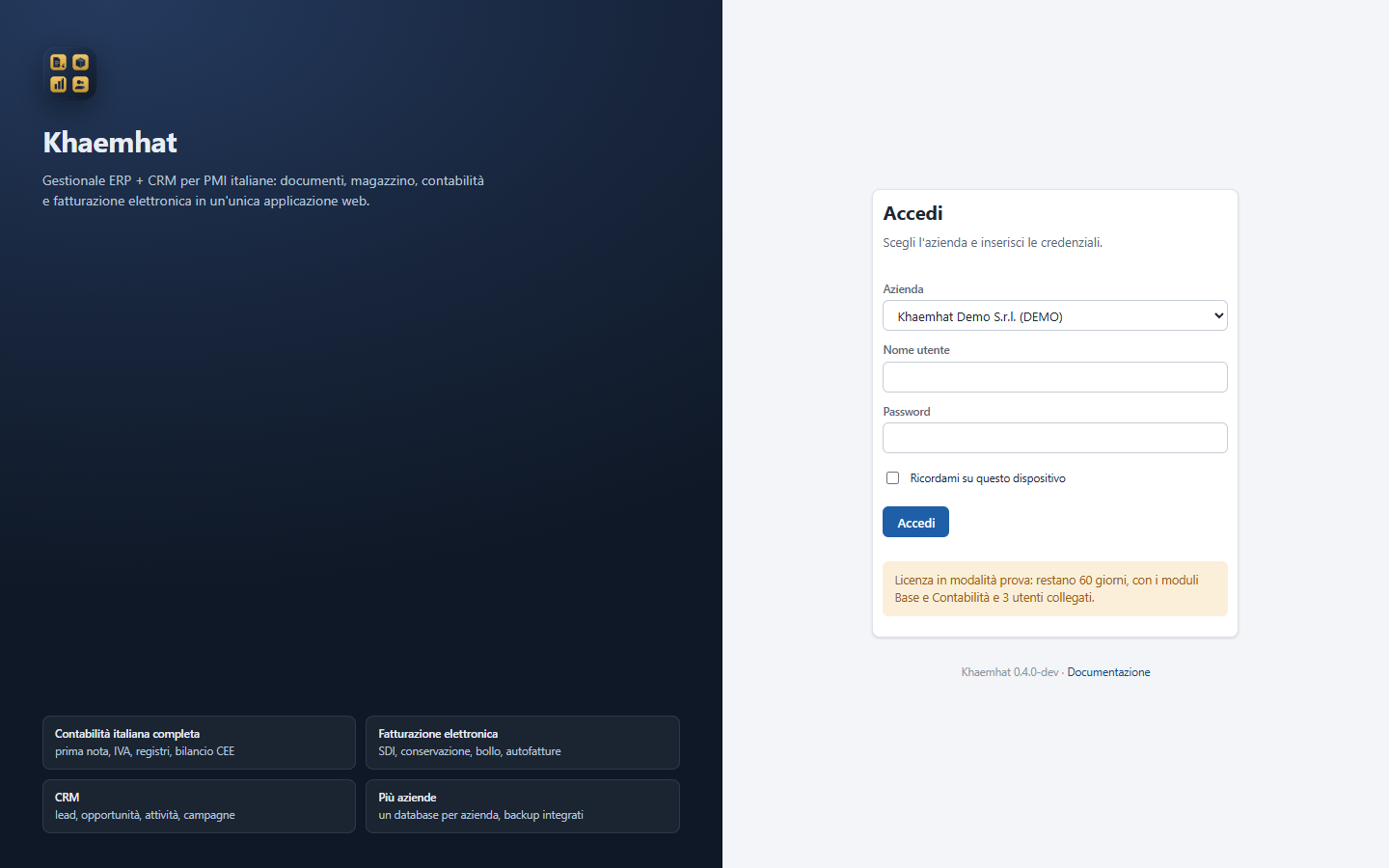
|
||||
|
||||
Scegli l'**azienda**, scrivi **nome utente** e **password** e premi **Accedi**. Se il tuo account ha la verifica in
|
||||
due passaggi, Khaemhat chiede il codice a 6 cifre dell'app di autenticazione (o un codice di recupero). Al primo
|
||||
accesso può chiederti di cambiare la password. Vedi [Primi passi](Primi-passi) e
|
||||
[Utenti e permessi](Utenti-e-permessi).
|
||||
|
||||
## 2. Orientarsi
|
||||
|
||||

|
||||
|
||||
- **Barra superiore**: logo e versione, l'**azienda** su cui lavori (si cambia da qui), la **ricerca globale**
|
||||
(`Ctrl+K`), cronologia, **notifiche**, tema chiaro o scuro, **aiuto** (`F1`) e il menu del tuo profilo.
|
||||
- **Menu a sinistra**: le aree del gestionale; si comprime per avere più spazio.
|
||||
- **Schede**: ogni maschera si apre in una scheda; puoi tenerne aperte più insieme e passare dall'una all'altra.
|
||||
- **Barra di stato** in basso: azienda, esercizio, utente, stato della connessione e versione.
|
||||
|
||||
La **Home** è una dashboard a widget che ognuno personalizza. Le scorciatoie da tastiera sono elencate in
|
||||
[Interfaccia e scorciatoie](Interfaccia-e-scorciatoie#tabella-completa-delle-scorciatoie); la dashboard in
|
||||
[Dashboard](Dashboard).
|
||||
|
||||
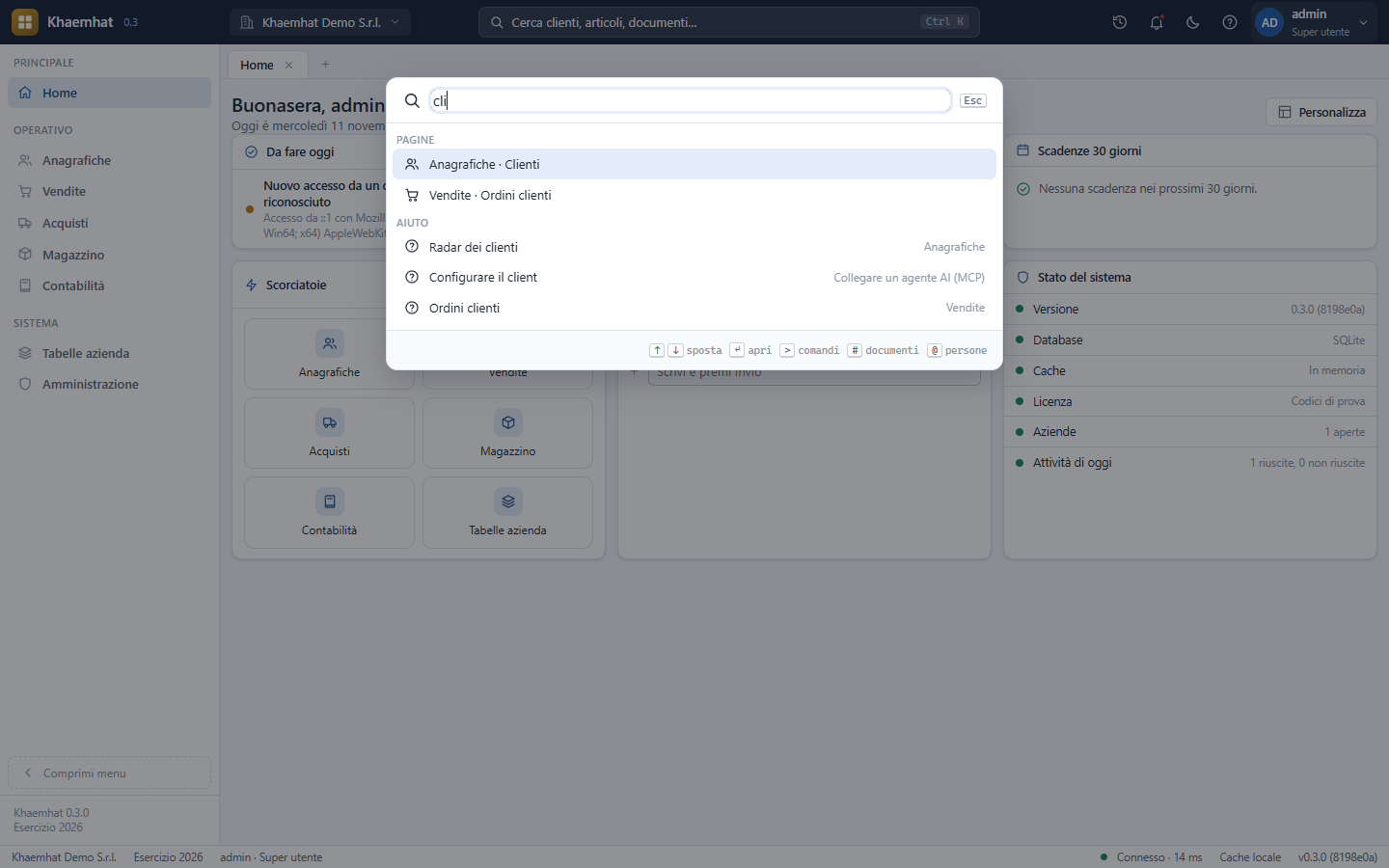
|
||||
|
||||
## 3. Preparare l'azienda
|
||||
|
||||

|
||||
|
||||
Prima dei documenti controlla in **Tabelle azienda**:
|
||||
|
||||
1. **Profilo azienda**: ragione sociale, partita IVA, indirizzo, REA, contatti, logo e la nota a piè di pagina delle
|
||||
stampe. Questi dati compaiono su ogni documento stampato.
|
||||
2. **Esercizi e periodi**: l'esercizio dell'anno deve essere aperto, altrimenti i documenti non si confermano.
|
||||
3. **Pagamenti**, **banche**, **codici IVA**, **depositi**: le tabelle di base sono già caricate; aggiungi le tue.
|
||||
4. **Tipi documento** e **numeratori**: il formato dei numeri (`7/2026`, `OC-2026-0004`) e i sezionali.
|
||||
5. **Codici automatici**: come si numerano clienti, fornitori e articoli.
|
||||
|
||||
Dettagli in [Tabelle azienda](Tabelle-azienda) e [Dati di base e di esempio](Dati-di-base-e-esempio).
|
||||
|
||||
## 4. Clienti e fornitori
|
||||
|
||||

|
||||
|
||||
**Anagrafiche → Clienti** apre il **radar**, l'elenco con ricerca, filtri, colonne a scelta e viste salvate.
|
||||
`Ctrl+N` crea un cliente; un doppio clic apre la scheda.
|
||||
|
||||

|
||||
|
||||
Nella scheda compili i dati anagrafici e fiscali (partita IVA e codice fiscale sono controllati; la partita IVA UE si
|
||||
verifica sul VIES), gli indirizzi di consegna, i contatti e le **condizioni commerciali**: pagamento, listino,
|
||||
agente, banca. I documenti di vendita le propongono da soli. Vedi [Anagrafiche](Anagrafiche).
|
||||
|
||||
## 5. Articoli e prezzi
|
||||
|
||||

|
||||
|
||||
**Anagrafiche → Articoli**: codice, descrizione, categoria, unità di misura, codice IVA, prezzo, codici a barre,
|
||||
fornitori abituali. **Listini** gestisce i prezzi per listino con date di validità; nella scheda del cliente puoi
|
||||
fissare prezzi netti. Vedi [Articoli e listini](Articoli-e-listini).
|
||||
|
||||

|
||||
|
||||
## 6. Vendere
|
||||
|
||||

|
||||
|
||||
Il menu **Vendite** raccoglie preventivi, ordini, DDT, fatture e note di credito. Il percorso tipico:
|
||||
|
||||
1. **Preventivo** → **Crea Ordine cliente** quando il cliente accetta.
|
||||
2. **Ordine** → **Crea DDT** a ogni consegna (anche parziale) oppure **Crea Fattura immediata**.
|
||||
3. **Fatturazione differita** a fine mese: tutti i DDT del periodo diventano fatture, una per cliente.
|
||||
4. **Nota di credito** dalla fattura per un reso o una correzione.
|
||||
|
||||
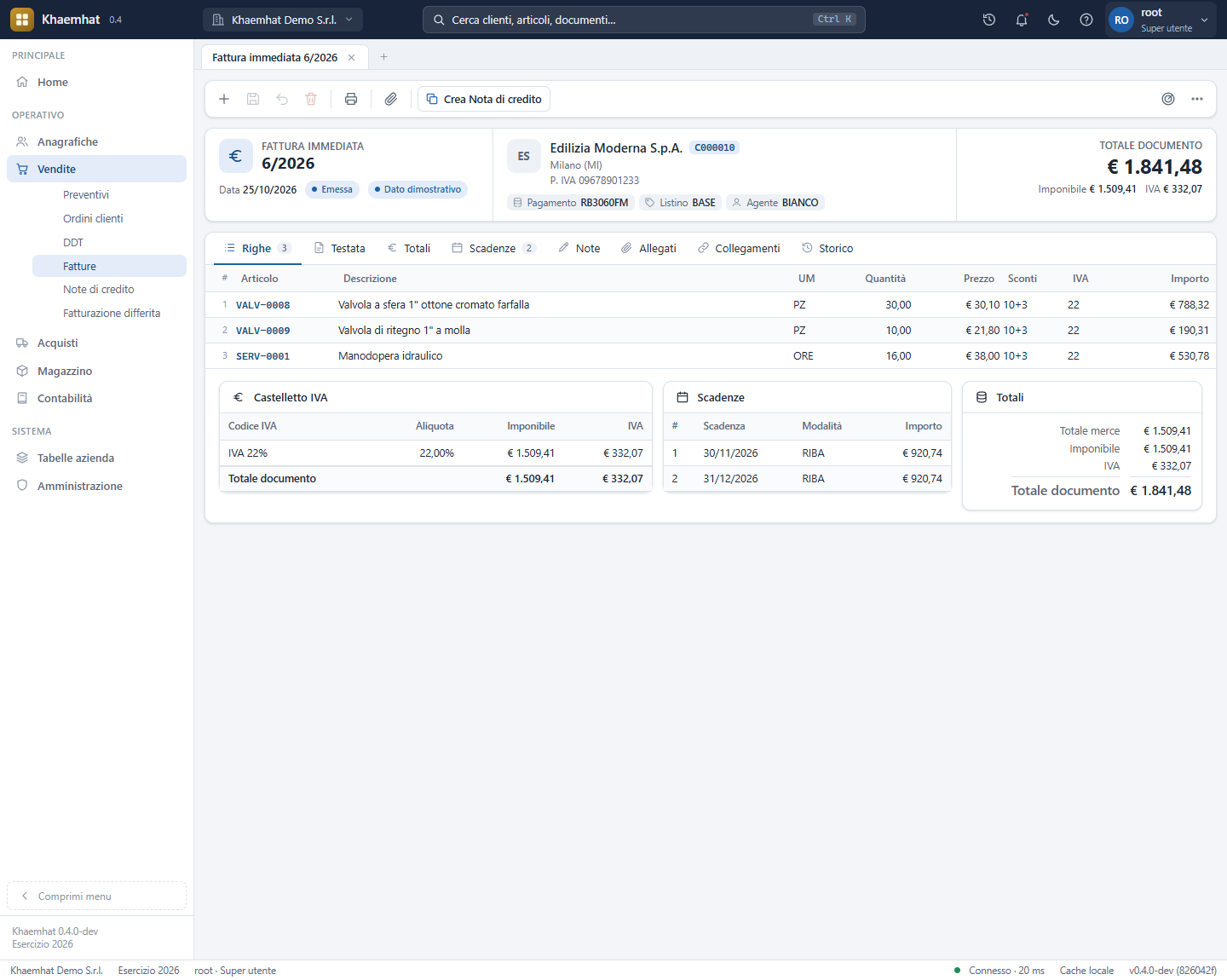
|
||||
|
||||
Nella maschera del documento scegli il cliente, inserisci le righe (`F4` cerca l'articolo) e controlla castelletto
|
||||
IVA, scadenze e totali; **Conferma** (o **Emetti** per le fatture) assegna il numero. I documenti restano collegati
|
||||
riga per riga, così Khaemhat sa che cosa resta da consegnare o da fatturare.
|
||||
|
||||

|
||||
|
||||
Tutto il ciclo è spiegato in [Vendite](Vendite).
|
||||
|
||||
## 7. Stampare e inviare
|
||||
|
||||

|
||||
|
||||
La **stampante** della toolbar (`Ctrl+P`) apre l'anteprima: **Stampa** con la stampante del computer, **Apri PDF** o
|
||||
**Scarica PDF**, **Salva come allegato** per conservarne una copia.
|
||||
|
||||
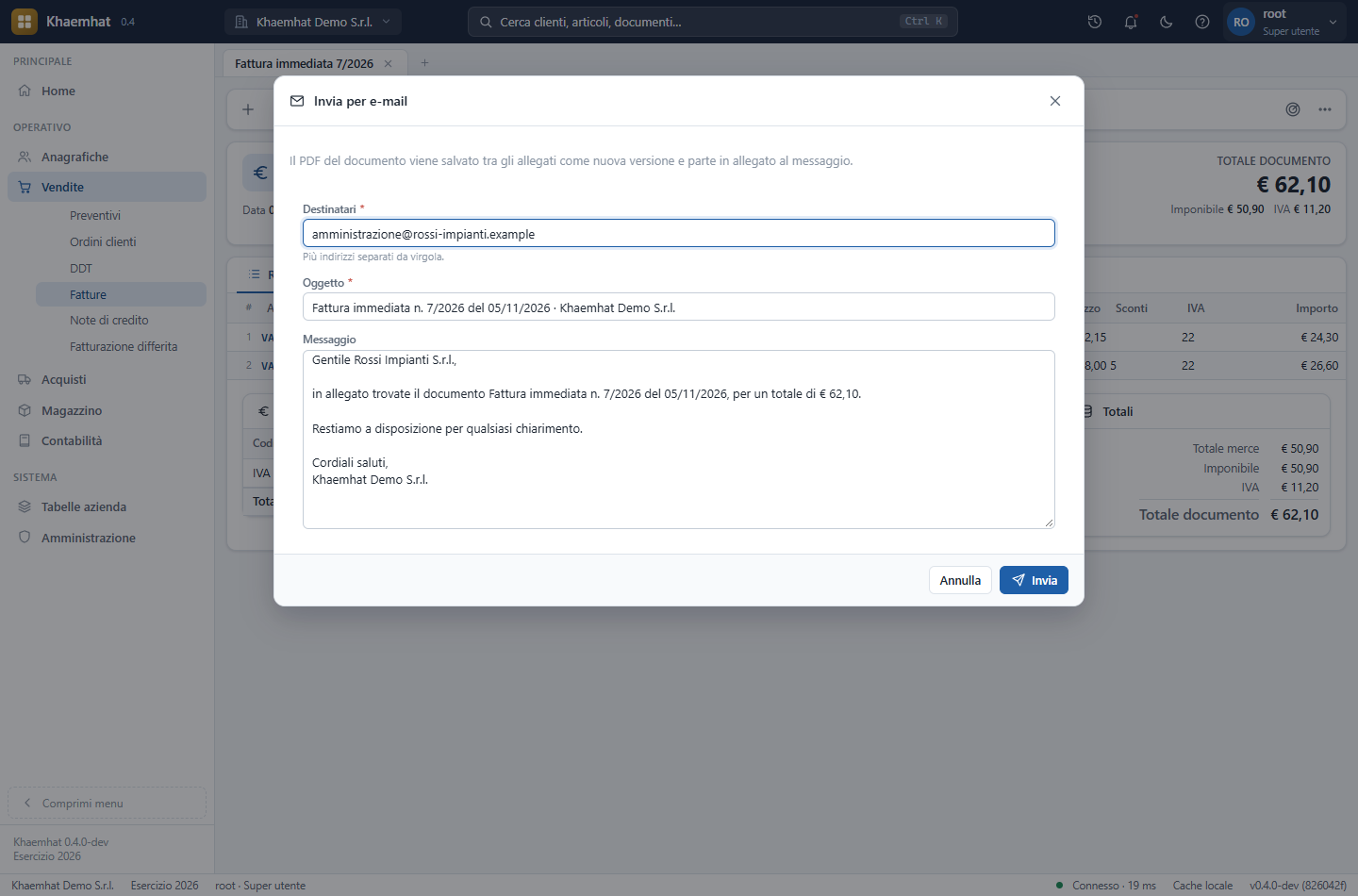
|
||||
|
||||
Dal menu **⋯** del documento, **Invia per e-mail** propone destinatario, oggetto e testo; il PDF parte in allegato e
|
||||
l'esito finisce nel log. Vedi [Vendite](Vendite#invio-per-e-mail).
|
||||
|
||||
## 8. Comprare
|
||||
|
||||

|
||||
|
||||
Il ciclo passivo usa le stesse maschere delle vendite. In **Acquisti → Ordini fornitori** prepari l'ordine (il prezzo
|
||||
è quello del fornitore nella scheda articolo); quando arriva la merce **Crea DDT fornitore (carico)** registra il
|
||||
ricevimento, anche in più volte, e alla conferma carica il magazzino. **Crea Fattura fornitore** prepara la fattura:
|
||||
alla conferma prende il **protocollo** IVA. Se il prezzo fatturato è diverso da quello dell'ordine o del ricevimento,
|
||||
un avviso sopra le righe lo segnala.
|
||||
|
||||

|
||||
|
||||
Le fatture elettroniche ricevute si caricano da **Acquisti → Importa fatture**: XML, P7M o ZIP, anche molti file
|
||||
insieme. Khaemhat trova o crea il fornitore, abbina gli articoli, scarta i doppioni e registra le fatture in bozza con
|
||||
il file allegato. Per le fatture di fornitori esteri o in inversione contabile indica quale **autofattura** serve ed
|
||||
entro quando; **Acquisti → Autofatture** le elenca tutte. Vedi [Acquisti](Acquisti).
|
||||
|
||||
## 9. Il magazzino
|
||||
|
||||

|
||||
|
||||
**Magazzino → Giacenze** mostra per ogni articolo giacenza, impegnato, ordinato, disponibile, costo medio e valore,
|
||||
con lo stato rispetto a scorta minima e punto di riordino; apri una riga per vedere i movimenti. I documenti
|
||||
confermati muovono il magazzino da soli: non serve registrare a parte carichi e scarichi.
|
||||
|
||||

|
||||
|
||||
**Proposte di riordino** calcola che cosa ordinare e a quale fornitore e crea gli ordini in bozza, uno per fornitore.
|
||||
**Inventario** guida il conteggio fisico (anche dal file del lettore di codici a barre) e registra le rettifiche;
|
||||
**Valorizzazione** calcola il valore del magazzino a una data con le classi ABC. Vedi [Magazzino](Magazzino).
|
||||
|
||||
## 10. Allegati
|
||||
|
||||

|
||||
|
||||
Ogni anagrafica e ogni documento ha la scheda **Allegati**: carichi file dal computer, li vedi in anteprima, scarichi tutto in un archivio ZIP. I PDF che Khaemhat genera sono **versionati**: ogni stampa salvata o
|
||||
e-mail inviata aggiunge una versione e le precedenti restano. Vedi [Allegati e file](Allegati-e-file).
|
||||
|
||||
## 11. Importare ed esportare
|
||||
|
||||

|
||||
|
||||
**Amministrazione → Import/Export** porta in Khaemhat clienti, fornitori, articoli, prezzi di listino e giacenze iniziali da un file
|
||||
CSV, Excel o JSON: scegli il file, abbini le colonne, guarda l'anteprima con gli errori riga per riga e conferma. Ogni radar
|
||||
esporta le righe visibili. Vedi [Import/Export](Import-Export).
|
||||
|
||||
## 12. Personalizzare
|
||||
|
||||

|
||||
|
||||
Dal menu del tuo nome, **Il mio profilo**: tema chiaro, scuro o automatico, colore d'accento, densità e carattere,
|
||||
dati personali, password e verifica in due passaggi, sessioni aperte e pagina iniziale. Le preferenze dell'azienda (ad esempio i decimali dei
|
||||
prezzi) sono in **Tabelle azienda → Preferenze**. Vedi [Preferenze utente](Preferenze-utente).
|
||||
|
||||

|
||||
|
||||
## Se qualcosa non va
|
||||
|
||||
- **`F1`** apre l'aiuto della pagina in cui sei: la pagina di questa wiki, anche senza connessione a Gitea.
|
||||
- La pagina di errore riporta un **codice di traccia**: comunicalo all'amministratore, che lo ritrova nel
|
||||
[Log](Log).
|
||||
- Le domande più comuni sono in [FAQ](FAQ); i termini del gestionale nel [Glossario](Glossario).
|
||||
|
||||
## Pagine correlate
|
||||
|
||||
[Primi passi](Primi-passi) · [Interfaccia e scorciatoie](Interfaccia-e-scorciatoie) · [Anagrafiche](Anagrafiche) ·
|
||||
[Articoli e listini](Articoli-e-listini) · [Tabelle azienda](Tabelle-azienda) · [Vendite](Vendite) ·
|
||||
[Acquisti](Acquisti) · [Magazzino](Magazzino) · [Contabilità](Contabilita) · [IVA](IVA) ·
|
||||
[Allegati e file](Allegati-e-file) · [Import/Export](Import-Export) · [Preferenze utente](Preferenze-utente)
|
||||
@@ -1,6 +1,6 @@
|
||||
# Khaemhat
|
||||
|
||||
> **Stato:** bozza · **Ultima revisione:** 2026-11-12 · **Versione software:** 0.4.0 (M4; sviluppo in corso)
|
||||
> **Stato:** completa per 0.7.0 · **Ultima revisione:** 2026-11-13 · **Versione software:** 0.7.0 (M7; sviluppo in corso)
|
||||
|
||||

|
||||
|
||||
@@ -18,8 +18,12 @@ Il nome viene da uno scriba dell'antico Egitto che sovrintendeva ai granai del r
|
||||
|
||||
## Per iniziare
|
||||
|
||||
> **Usi Khaemhat?** Parti dalla **[Guida all'uso](Guida-utente)**: dall'accesso alla fattura inviata al cliente, con
|
||||
> le schermate della versione attuale e che cosa c'è e che cosa arriva.
|
||||
|
||||
| Se vuoi… | Leggi |
|
||||
|---|---|
|
||||
| Imparare a usare il gestionale | [Guida all'uso](Guida-utente) |
|
||||
| Installare Khaemhat su Unraid | [Installazione-Unraid](Installazione-Unraid) |
|
||||
| Installarlo con Docker Compose | [Installazione-Docker](Installazione-Docker) |
|
||||
| Fare il primo accesso e configurare l'azienda | [Primi-passi](Primi-passi) |
|
||||
|
||||
@@ -1,199 +1,287 @@
|
||||
# IVA
|
||||
|
||||
> **Stato:** bozza · **Ultima revisione:** 2026-11-10 · **Versione software:** non ancora rilasciata (milestone M7; dichiarazioni d'intento in M10)
|
||||
> **Modulo di licenza:** ACCT (bollo virtuale e dichiarazioni d'intento anche con EINV) · **Permessi principali:** `vat.settlement.confirm`, `vat.register.print`, `vat.withholding.write`, `vat.intent.write` · **Specifica:** SPEC §11.7, §11.9, §11.3, §14
|
||||
> **Stato:** completa per la versione 0.7 · **Ultima revisione:** 2026-11-13 · **Versione software:** 0.7.0 (M7)
|
||||
> **Modulo di licenza:** ACCT · **Permessi principali:** `vat.register.read` (registri IVA), `vat.settlement.read` (liquidazione, ritenute, bollo, F24), `vat.settlement.confirm` (conferme, versamenti, stampe definitive) · **Specifica:** SPEC §11.7, §11.9, §14, ADR 0037
|
||||
|
||||
## A cosa serve
|
||||
Questa pagina descrive l'IVA e i versamenti collegati, tutti nel menu **Contabilità**:
|
||||
|
||||
Questa pagina descrive tutto ciò che riguarda l'IVA e i versamenti collegati:
|
||||
- **registri IVA** con protocollo, stampa di prova e stampa definitiva;
|
||||
- **liquidazione periodica** mensile o trimestrale, con credito e debito riportati, pro rata, interessi trimestrali e
|
||||
minimo di versamento; **acconto di dicembre**; file della **comunicazione LIPE** e dati del modello **F24**;
|
||||
- **ritenute d'acconto** operate e subite, **prospetto F24** con il suo pagamento e dati per la **Certificazione
|
||||
Unica**;
|
||||
- **imposta di bollo virtuale** sulle fatture elettroniche, per trimestre.
|
||||
|
||||
- **registri IVA** con protocollo e stampe definitive;
|
||||
- **liquidazione periodica** con esigibilità differita, IVA per cassa, pro-rata, acconto di dicembre, interessi,
|
||||
minimo di versamento, **dati F24** e **LIPE**;
|
||||
- **ritenute d'acconto** e **casse previdenziali**, con prospetto F24 e dati per la **CU**;
|
||||
- **imposta di bollo virtuale** sulle fatture elettroniche;
|
||||
- **dichiarazioni d'intento** ricevute ed emesse, con plafond.
|
||||
> **Khaemhat non trasmette nulla.** Prepara i file della LIPE, i dati dell'F24 e i dati della Certificazione Unica;
|
||||
> l'invio telematico si fa con i servizi dell'Agenzia delle Entrate, con l'home banking o tramite l'intermediario.
|
||||
|
||||
Khaemhat **non trasmette** F24, LIPE e CU: prepara i dati, i file e le stampe; l'invio telematico avviene tramite
|
||||
intermediario o home banking (avviso presente nel mockup 046).
|
||||
> **In questa versione** ci sono i cinque registri IVA con stampe di prova e definitive, la liquidazione con la sua
|
||||
> registrazione e il versamento F24, l'acconto IVA, il file LIPE, le ritenute con il prospetto F24 e il pagamento, i
|
||||
> dati della CU e il bollo virtuale. Arrivano più avanti: i **pagamenti delle fatture** dallo scadenzario, che oggi
|
||||
> per le ritenute si registrano a mano (M8), le **dichiarazioni d'intento** e il plafond e l'**Intrastat** (M10),
|
||||
> l'**IVA per cassa** completa (fase 2). Non ci sono ancora la **dichiarazione IVA annuale** e l'**invio
|
||||
> telematico** di F24, LIPE e CU.
|
||||
|
||||
## Dove si trova
|
||||
|
||||
- **Contabilità → Registri IVA**, **Contabilità → Liquidazione IVA**, **Contabilità → Ritenute**.
|
||||
- **Fatturazione elettronica → Bollo virtuale**, **→ Dichiarazioni d'intento**, **→ LIPE**.
|
||||
Menu **Contabilità** → *Registri IVA*, *Liquidazione IVA*, *Ritenute e F24*, *Bollo virtuale*. La **periodicità**
|
||||
IVA (mensile o trimestrale) e la **percentuale di pro rata** si impostano nel **profilo azienda** (vedi
|
||||
[Tabelle azienda](Tabelle-azienda)). Le registrazioni che queste pagine scrivono sono in **Prima nota** (vedi
|
||||
[Contabilità](Contabilita)).
|
||||
|
||||
## Schermate
|
||||
|
||||

|
||||
*Mockup 045 — registro Vendite 1 del mese con protocolli, imponibile, aliquota o natura, imposta ed esigibilità; in alto l'ultima stampa definitiva (anteprima ridotta)*
|
||||
|
||||

|
||||
*Mockup 046 — liquidazione mensile provvisoria: parametri, registri del periodo con i controlli superati, calcolo dell'IVA da versare e riquadro del versamento (codice tributo, scadenza, export F24, scadenza LIPE)*
|
||||
|
||||

|
||||
*Mockup 047 — ritenute operate e subite con cassa previdenziale, periodo e stato del versamento; sotto, il prospetto F24 del 16 del mese con i tributi 1040, 1038 e 6009*
|
||||
|
||||

|
||||
*Mockup 060 — fatture del trimestre soggette a bollo con natura, importo esente e addebito; riquadri con importo, codice tributo, scadenza e trimestre precedente*
|
||||
|
||||

|
||||
*Mockup 061 — dichiarazioni d'intento ricevute con protocollo AdE, plafond, utilizzato, residuo e stato (attiva, avviso al 97 %, esaurita)*
|
||||
```
|
||||
Documenti confermati ──► Registri IVA ──Calcola──► Liquidazione ──Conferma──► registrazione LIQ + riga F24
|
||||
Fattura del professionista ──Fattura pagata──► Ritenuta da versare ──► riga F24 (1040)
|
||||
Fatture con bollo del trimestre ──Metti in F24──► riga F24 (2521-2524)
|
||||
Righe F24 della scadenza ──► Prospetto F24 ──Registra pagamento──► registrazione F24
|
||||
```
|
||||
|
||||
## Registri IVA
|
||||
|
||||
Registri previsti: **vendite**, **acquisti**, **corrispettivi**, **vendite reverse charge**, **acquisti reverse
|
||||
charge** e i **sezionali** che servono (es. `VEN1`, `ACQ1`, `VEN-RC`, `ACQ-RC`, `ACQ-SP` per lo split payment,
|
||||
`CORR`). Ogni documento registrato riceve un **protocollo** progressivo nel suo registro.
|
||||

|
||||
*Il registro VEN1 di ottobre: una scheda per registro, la striscia con tipo, imponibile, imposta, ultima stampa
|
||||
definitiva e ultima pagina, le righe con protocollo e il riepilogo per aliquota.*
|
||||
|
||||
La griglia mostra protocollo, data di registrazione, documento, data del documento, controparte, P.IVA o codice
|
||||
fiscale, imponibile, aliquota o natura, imposta, totale ed **esigibilità** (`I` immediata, `D` differita, `S`
|
||||
scissione dei pagamenti).
|
||||
**Contabilità → Registri IVA** ha una scheda per registro:
|
||||
|
||||
**Stampe**
|
||||
|
||||
| Stampa | Effetto |
|
||||
| Registro | Contenuto |
|
||||
|---|---|
|
||||
| **Provvisoria** | in qualunque momento, senza effetti |
|
||||
| **Stampa definitiva** del periodo | pagine numerate, totali per aliquota e natura; aggiorna "ultima stampa definitiva" |
|
||||
| **Riepilogo aliquote** | totali del periodo per codice IVA e natura |
|
||||
| **VEN1** Registro fatture emesse | fatture, note di debito, parcelle e note di credito di vendita |
|
||||
| **VEN-RC** Registro fatture emesse - autofatture e integrazioni | il lato *vendite* delle autofatture e integrazioni (TD16-TD29) |
|
||||
| **ACQ1** Registro fatture acquisti | fatture e note di credito dei fornitori |
|
||||
| **ACQ-RC** Registro fatture acquisti - autofatture e integrazioni | il lato *acquisti* delle stesse autofatture |
|
||||
| **CORR** Registro dei corrispettivi | le registrazioni dei corrispettivi (causale `CORR`) |
|
||||
|
||||
Le autofatture reverse charge (TD16-TD19) sono annotate sia nel registro vendite RC sia nel registro acquisti RC,
|
||||
Scegli il periodo con **Dal** e **Al**. Ogni riga mostra **protocollo** (il link apre la registrazione), **data di
|
||||
registrazione IVA**, documento e data, cliente o fornitore, **aliquota** o natura, **imponibile**, **imposta**,
|
||||
**indetraibile** ed **esigibilità** (*Immediata*, *Differita*, *Scissione dei pagamenti*). Sotto, il **riepilogo per
|
||||
aliquota** e il totale del registro.
|
||||
|
||||
Le autofatture e integrazioni compaiono in **VEN-RC** e in **ACQ-RC** con la stessa imposta: a debito e a credito,
|
||||
con effetto neutro sulla liquidazione.
|
||||
|
||||
## Liquidazione IVA periodica
|
||||
### Stampe
|
||||
|
||||
| Stampa | Effetto | Permesso |
|
||||
|---|---|---|
|
||||
| **Stampa di prova** | PDF del registro nel periodo scelto, in qualunque momento, senza effetti | `vat.register.read` |
|
||||
| **Stampa definitiva** | PDF dal giorno dopo l'ultima stampa definitiva fino al giorno scelto, con le pagine numerate di seguito all'ultima pagina dell'anno | `vat.settlement.confirm` |
|
||||
|
||||
La stampa definitiva non si annulla: la striscia mostra la data dell'**ultima stampa definitiva** e l'**ultima
|
||||
pagina**, e la stampa successiva riparte da lì (la prima dell'anno parte dal 1° gennaio e dalla pagina 1). La stampa
|
||||
definitiva **non blocca** le registrazioni: a bloccare il periodo è la conferma della liquidazione (vedi sotto).
|
||||
|
||||
## Liquidazione IVA
|
||||
|
||||

|
||||
*La liquidazione mensile di ottobre 2026 confermata: registri del periodo, calcolo con il credito di settembre,
|
||||
riquadro del versamento (codice 6010, scadenza 16/11/2026, trimestre LIPE) e l'elenco delle liquidazioni dell'anno.*
|
||||
|
||||
### Come si fa
|
||||
|
||||
1. **Contabilità → Liquidazione IVA**. Controlla i parametri: **Periodicità** (mensile o trimestrale, dal profilo
|
||||
azienda), **Periodo**, **Data liquidazione**, **Credito precedente**, **Pro-rata**.
|
||||
2. Premi **Calcola**. Khaemhat esegue i **controlli preliminari** (mostrati con il segno di spunta sopra i registri):
|
||||
numerazione continua, nessuna bozza, date coerenti, periodo precedente confermato.
|
||||
3. Controlla la tabella **Registri del periodo** (documenti, imponibile, IVA, indetraibile, note come *neutra* per il
|
||||
reverse charge) e il riquadro **Calcolo**.
|
||||
4. Premi **Conferma**: la liquidazione diventa definitiva e il **periodo viene bloccato** (vedi
|
||||
[Contabilità](Contabilita), esercizi e periodi). Serve il permesso `vat.settlement.confirm`.
|
||||
5. Premi **Dati F24** per esportare i dati del versamento e **LIPE XML** per il file della comunicazione.
|
||||
1. **Contabilità → Liquidazione IVA**. La **periodicità** viene dal profilo azienda; scegli **Anno** e **Periodo**
|
||||
(mese o trimestre).
|
||||
2. Premi **Calcola** (serve `vat.settlement.read`). Khaemhat legge i registri del periodo e mostra la tabella
|
||||
**Registri del periodo** (documenti, imponibile, imposta, indetraibile, esigibilità differita), il riquadro
|
||||
**Calcolo** e il riquadro **Versamento** con codice tributo, anno, importo, scadenza e trimestre LIPE. Puoi
|
||||
ricalcolare quante volte vuoi finché la liquidazione non è confermata.
|
||||
3. Premi **Conferma liquidazione** (serve `vat.settlement.confirm`). Le liquidazioni si confermano in ordine: se un
|
||||
periodo precedente è calcolato ma non confermato, va confermato prima. Alla conferma Khaemhat:
|
||||
- scrive in prima nota la registrazione **LIQ**: *IVA su vendite* in Dare, *IVA su acquisti* in Avere, gli
|
||||
interessi trimestrali in Dare, l'eventuale IVA resa indetraibile dal pro rata a costo, e la differenza su
|
||||
*Erario c/liquidazione IVA*;
|
||||
- segna i periodi dell'esercizio come **liquidati**;
|
||||
- se c'è da versare, aggiunge la riga del modello **F24** con codice tributo e scadenza (vedi
|
||||
[Prospetto F24](#prospetto-f24-e-pagamento)).
|
||||
4. **Dati F24** scarica i dati del modello F24 della scadenza; **Comunicazione LIPE** scarica il file del trimestre
|
||||
(vedi [sotto](#comunicazione-lipe)).
|
||||
|
||||
**Riapri** annulla la conferma: la registrazione LIQ viene eliminata (o stornata, se è già definitiva), la riga F24
|
||||
viene tolta e i periodi tornano aperti. Non si riapre se l'F24 della liquidazione è già **pagato** (annulla prima il
|
||||
pagamento) né se una liquidazione **successiva** è confermata (riapri prima quella).
|
||||
|
||||
**Periodi liquidati.** Dopo la conferma, documenti e registrazioni **con IVA** datati nei periodi liquidati sono
|
||||
rifiutati: per correggere bisogna riaprire la liquidazione. Le registrazioni senza IVA restano libere.
|
||||
|
||||
### Le voci del calcolo
|
||||
|
||||
| Voce | Regola |
|
||||
| Voce | Regola in Khaemhat |
|
||||
|---|---|
|
||||
| IVA a debito | dai registri vendite e corrispettivi del periodo (esigibilità immediata) |
|
||||
| IVA a credito | dai registri acquisti, al netto dell'**indetraibile** e del **pro-rata** |
|
||||
| Esigibilità differita | l'IVA delle fatture a esigibilità differita entra quando si incassa (o alla scadenza di legge) |
|
||||
| IVA per cassa | con il regime dell'IVA per cassa attivo nel profilo azienda, debito e credito seguono incassi e pagamenti; il regime completo è previsto in fase 2 ([Roadmap](Roadmap)) |
|
||||
| Credito del periodo precedente | riportato automaticamente |
|
||||
| Acconto versato | sottratto nella liquidazione di dicembre (o del 4° trimestre) |
|
||||
| Interessi 1 % | maggiorazione dell'1 % per i contribuenti **trimestrali** |
|
||||
| Minimo di versamento | se l'IVA dovuta non supera **€ 25,82** non si versa e si **riporta** al periodo successivo |
|
||||
| **IVA a debito sulle vendite** | imposta dei registri vendite e corrispettivi del periodo, tolta quella a esigibilità differita e in scissione dei pagamenti |
|
||||
| **IVA a credito sugli acquisti** | imposta dei registri acquisti, tolta la parte **indetraibile** dei codici IVA, poi ridotta dal **pro rata** del profilo azienda |
|
||||
| **IVA indetraibile** | indetraibile per codice IVA più la parte tolta dal pro rata |
|
||||
| **IVA a esigibilità differita** | mostrata a parte: non entra nel debito del periodo |
|
||||
| **Credito / debito periodo precedente** | riportati dalla liquidazione confermata precedente |
|
||||
| **Acconto versato** | l'acconto di dicembre registrato, tolto nell'ultima liquidazione dell'anno (dicembre o 4° trimestre) |
|
||||
| **Interessi trimestrali 1%** | per i contribuenti trimestrali, sul saldo a debito |
|
||||
| **Da versare** | se il totale (con gli interessi) è sotto **25,82 euro** non si versa: diventa *debito sotto la soglia* e passa al periodo dopo; se il saldo è a credito diventa *credito da riportare* |
|
||||
|
||||
### Acconto di dicembre
|
||||
### Codici tributo e scadenze
|
||||
|
||||
L'acconto si calcola con uno dei tre metodi: **storico**, **previsionale**, **analitico**. Khaemhat propone gli
|
||||
importi di tutti e tre e l'utente sceglie. Percentuali e scadenza seguono le regole in vigore (al momento della
|
||||
stesura: 88 % per storico e previsionale, liquidazione al 20 dicembre per l'analitico, versamento entro il 27
|
||||
dicembre) e sono aggiornate con il pacchetto fiscale. Codici tributo: **6013** (mensili) e **6035** (trimestrali).
|
||||
| Periodo | Codice | Scadenza |
|
||||
|---|---|---|
|
||||
| Mese (gennaio-dicembre) | **6001**-**6012** | 16 del mese dopo |
|
||||
| 1°, 2°, 3° trimestre | **6031**, **6032**, **6033** | 16 del secondo mese dopo il trimestre (16/5, 20/8, 16/11) |
|
||||
| 4° trimestre | **6099**, rateazione **0101** | 16 marzo dell'anno dopo, con il saldo annuale |
|
||||
|
||||
### Codici tributo F24
|
||||
Le scadenze di sabato, domenica o festivo passano al primo giorno lavorativo; i versamenti dal 1° al 20 agosto
|
||||
passano al **20 agosto**. Codici e calendario sono in [Fiscalità italiana](Fiscalita-italiana#codici-tributo-f24).
|
||||
|
||||
| Codice | Versamento |
|
||||
### Acconto IVA di dicembre
|
||||
|
||||
Il riquadro **Acconto IVA** (sotto l'elenco delle liquidazioni, con `vat.settlement.confirm`) calcola l'acconto da
|
||||
versare entro il **27 dicembre** (primo giorno lavorativo successivo se festivo) con il codice **6013** (mensili) o
|
||||
**6035** (trimestrali).
|
||||
|
||||
| Metodo | Base di calcolo | Acconto |
|
||||
|---|---|---|
|
||||
| **Storico** | l'IVA dell'ultimo periodo dell'anno prima (dicembre o 4° trimestre), al lordo dell'acconto di allora e senza interessi | 88% della base |
|
||||
| **Previsionale** | l'IVA che prevedi per l'ultimo periodo dell'anno: la scrivi tu | 88% della base |
|
||||
| **Effettivo** | l'IVA dall'inizio dell'ultimo periodo al **20 dicembre** | tutta la base |
|
||||
|
||||
1. Scegli il **metodo**: la **base di calcolo** si compila con il valore che Khaemhat conosce (il riquadro *Basi di
|
||||
calcolo* mostra storico ed effettivo; **Ricalcola le basi** le rilegge). Per il previsionale scrivila tu.
|
||||
2. **Registra acconto** aggiunge la riga F24 dell'acconto. Sotto **103,29 euro** l'acconto non è dovuto e non viene
|
||||
registrato. Finché non è pagato puoi registrarlo di nuovo con un altro metodo: la riga si aggiorna.
|
||||
|
||||
L'acconto registrato viene tolto nella liquidazione di dicembre o del 4° trimestre.
|
||||
|
||||
### Comunicazione LIPE
|
||||
|
||||
**Comunicazione LIPE** scarica il file XML della **comunicazione delle liquidazioni periodiche IVA** di un trimestre,
|
||||
nel tracciato **IVP18** dell'Agenzia delle Entrate: un modulo per ogni mese (o per il trimestre), con operazioni
|
||||
attive e passive, IVA esigibile e detratta, debiti e crediti riportati, interessi, acconto e importo da versare o a
|
||||
credito. Il pulsante si accende quando è confermata la liquidazione dell'ultimo mese del trimestre (o del trimestre).
|
||||
Il file si chiama `IT<codice fiscale>_LI_<anno>_T<trimestre>.xml` e va firmato e inviato con i servizi dell'Agenzia
|
||||
o dall'intermediario. Le scadenze sono in [Fiscalità italiana](Fiscalita-italiana#comunicazione-lipe).
|
||||
|
||||
## Ritenute d'acconto
|
||||
|
||||

|
||||
*La ritenuta operata sulla fattura dello Studio Rag. Neri Paola (RT01, causale A, cassa TC04, 20% di 450 euro) già
|
||||
pagata e da versare; sotto, il prospetto F24 della scadenza del 16/11/2026 con l'IVA di ottobre.*
|
||||
|
||||
**Contabilità → Ritenute e F24** elenca le ritenute dei documenti di un **anno**, nelle schede **Operate**, **Subite**
|
||||
e **Tutte**:
|
||||
|
||||
- **operate**: quelle che l'azienda trattiene sulle **fatture dei professionisti** e degli agenti (fatture fornitore
|
||||
con ritenuta);
|
||||
- **subite**: quelle che i clienti trattengono sulle **parcelle** e fatture emesse dall'azienda con ritenuta.
|
||||
|
||||
Le ritenute nascono da sole quando il documento viene contabilizzato. Per ognuna: documento (il link apre la
|
||||
registrazione), data, cliente o fornitore, **tipo** e causale di pagamento (per esempio `RT01 · A`), imponibile,
|
||||
**cassa** previdenziale e contributo, **aliquota** (con la quota dell'imponibile, per esempio *20% su 50%* per gli
|
||||
agenti), importo, data di pagamento della fattura e **stato**:
|
||||
|
||||
| Stato | Significato |
|
||||
|---|---|
|
||||
| 6001 … 6012 | IVA mensile, da gennaio (6001) a dicembre (6012) |
|
||||
| 6031 … 6034 | IVA trimestrale, dal 1° (6031) al 4° trimestre (6034); il 6034 riguarda i trimestrali "speciali", per gli altri il saldo del 4° trimestre si versa con la dichiarazione annuale (6099) |
|
||||
| 6013 / 6035 | acconto IVA mensili / trimestrali |
|
||||
| 6099 | IVA da dichiarazione annuale |
|
||||
| 1040 | ritenute su redditi di lavoro autonomo |
|
||||
| 1038 | ritenute su provvigioni (agenti e rappresentanti) |
|
||||
| *In attesa del pagamento* | ritenuta operata su una fattura non ancora pagata |
|
||||
| *Da versare* | la fattura è pagata: la ritenuta va versata con l'F24 |
|
||||
| *Versata* | l'F24 che la contiene è pagato |
|
||||
| *Subita* | ritenuta trattenuta dal cliente su una fattura dell'azienda |
|
||||
|
||||
I codici sono caricati con i dati di base ([Dati di base e di esempio](Dati-di-base-e-esempio)) e riepilogati in
|
||||
[Fiscalità italiana](Fiscalita-italiana).
|
||||
### Registrare il pagamento della fattura
|
||||
|
||||
### LIPE
|
||||
La ritenuta operata diventa dovuta **quando paghi la fattura** del professionista (criterio di cassa). Finché i
|
||||
pagamenti non arrivano con lo [Scadenzario](Scadenzario) (M8), si registra a mano:
|
||||
|
||||
La **Comunicazione delle liquidazioni periodiche IVA** si genera come file XML nel tracciato dell'Agenzia delle
|
||||
Entrate dalle liquidazioni confermate del trimestre (voce di menu **Fatturazione elettronica → LIPE** o pulsante
|
||||
**LIPE XML**). Il riquadro **Versamento** mostra il trimestre di riferimento e la scadenza.
|
||||
1. Sulla riga della ritenuta premi **Fattura pagata** e indica la data di pagamento.
|
||||
2. Khaemhat scrive la registrazione **RIT** (*fornitore* in Dare, *Erario c/ritenute lavoro autonomo* in Avere) e
|
||||
aggiunge la ritenuta alla riga F24 del suo codice tributo (**1040** lavoro autonomo, **1038** provvigioni) e del
|
||||
mese di pagamento, con scadenza il **16 del mese dopo**. Le ritenute dello stesso codice e mese si sommano.
|
||||
3. Per una ritenuta **subita**, **Fattura pagata** chiede la data in cui il cliente ha pagato e scrive la registrazione
|
||||
**RITS** (*Erario c/ritenute subite* in Dare, *cliente* in Avere): è un credito d'imposta.
|
||||
|
||||
## Ritenute d'acconto e casse previdenziali
|
||||
Il pulsante con la freccia annulla il pagamento della fattura (e la sua registrazione) finché l'F24 non è pagato.
|
||||
|
||||
**Contabilità → Ritenute** (mockup 047) elenca le ritenute **operate** (sulle parcelle e provvigioni che paghiamo) e
|
||||
quelle **subite** (sulle nostre fatture, ad esempio verso la PA), con i filtri **Operate / Subite / Tutte**.
|
||||
### Dati per la Certificazione Unica
|
||||
|
||||
| Colonna | Significato |
|
||||
|---|---|
|
||||
| Tipo | professionista TD06, agente ENASARCO, ritenuta subita… |
|
||||
| Imponibile, Cassa, Importo cassa | contributo previdenziale (es. 4 % INPS di rivalsa, 4 % cassa professionale) |
|
||||
| Ritenuta | aliquota (es. 20 %; per gli agenti l'aliquota si applica a una quota della provvigione) |
|
||||
| Periodo → F24 | mese di pagamento della fattura e data del modello F24 in cui confluisce |
|
||||
| Stato | *Da versare*, *In F24*, *Versata*, *Subita* |
|
||||
**Dati Certificazione Unica** scarica un file CSV con i **percipienti** dell'anno: una riga per professionista e
|
||||
causale con codice fiscale, denominazione, causale, anno, compenso lordo, somme non soggette, imponibile, ritenute,
|
||||
codice tributo e documenti. Contiene le ritenute operate sulle fatture pagate nell'anno. La CU si compila e si invia
|
||||
con i servizi dell'Agenzia delle Entrate o dall'intermediario.
|
||||
|
||||
Regole:
|
||||
## Prospetto F24 e pagamento
|
||||
|
||||
- La ritenuta nasce come **debito verso l'Erario al pagamento** della fattura (criterio di cassa) e confluisce nel
|
||||
prospetto F24 del mese successivo (tributi **1040** e **1038**).
|
||||
- Sulle **parcelle (TD06)** cassa previdenziale, ritenuta e netto a pagare sono calcolati in automatico; **ENASARCO**
|
||||
si applica agli agenti con i relativi massimali.
|
||||
- **Registra versamento** registra il pagamento del modello F24 e chiude le ritenute versate.
|
||||
- **CU export** produce i dati della Certificazione Unica da consegnare all'intermediario.
|
||||
Il riquadro **Prospetto F24** (nella pagina *Ritenute e F24*) raccoglie tutto ciò che va versato con l'F24: IVA della
|
||||
liquidazione, acconto IVA, ritenute operate, bollo virtuale.
|
||||
|
||||
Il **Prospetto F24** del giorno di scadenza riepiloga tributi, periodi e importi (ritenute e IVA) con il totale.
|
||||
1. Scegli la **scadenza** nell'elenco (si apre sulla prima non pagata).
|
||||
2. Il prospetto mostra una riga per **codice tributo** e periodo con descrizione, periodo di riferimento, importo a
|
||||
debito e a credito, e il **saldo** dell'F24.
|
||||
3. **Dati F24** scarica un file CSV (separatore `;`, sezione Erario) con intestazione, una riga per codice tributo e il
|
||||
saldo, da passare all'home banking o all'intermediario.
|
||||
4. Pagato l'F24, **Registra pagamento** chiede la data: Khaemhat scrive la registrazione **F24** (*Erario
|
||||
c/liquidazione IVA*, *Erario c/ritenute* e *imposta di bollo* in Dare secondo le righe, la **banca** in Avere) e
|
||||
segna versate le righe e le ritenute. La banca è quella predefinita dell'azienda (il suo *conto contabile*), o
|
||||
`07.01.001` *Banca c/c*.
|
||||
|
||||
**Annulla pagamento** toglie la registrazione del pagamento (o la storna, se è definitiva) e riporta le righe da
|
||||
versare.
|
||||
|
||||
## Imposta di bollo virtuale
|
||||
|
||||
Sulle fatture con operazioni **esenti, non imponibili o fuori campo IVA** di importo **superiore a € 77,47** si
|
||||
applica il bollo di **€ 2,00**, calcolato in automatico sul documento e indicato nell'XML (`DatiBollo`).
|
||||
Sulle fatture elettroniche **senza IVA** (operazioni esenti, non imponibili o fuori campo) di importo **superiore a
|
||||
77,47 euro** si applica il bollo di **2 euro**. Khaemhat lo calcola già sul documento di vendita (vedi
|
||||
[Vendite](Vendite)), che dice anche se è **addebitato al cliente** o **a carico dell'azienda**.
|
||||
|
||||
**Fatturazione elettronica → Bollo virtuale** (mockup 060) mostra le fatture del trimestre con il bollo, la natura
|
||||
IVA, l'importo esente e l'**addebito** (*addebitato al cliente*, *a carico azienda*; per le fatture ricevute *a
|
||||
carico fornitore*). I riquadri riportano numero di fatture, importo, codice tributo del trimestre (**2521-2524**),
|
||||
scadenza e stato del trimestre precedente.
|
||||
**Contabilità → Bollo virtuale** riepiloga il bollo per **anno** e **trimestre**:
|
||||
|
||||
1. A fine trimestre controlla l'elenco e confrontalo con quello messo a disposizione dall'Agenzia delle Entrate.
|
||||
2. **Esporta per F24** produce i dati del versamento.
|
||||
3. A pagamento avvenuto premi **Segna versato**.
|
||||
- la striscia del trimestre: numero di **fatture**, **importo**, **codice tributo**, **scadenza** e lo stato del
|
||||
**trimestre precedente**;
|
||||
- l'elenco delle fatture del trimestre con il bollo: documento (il link lo apre), data, cliente, imponibile, bollo e
|
||||
**addebito**;
|
||||
- il riepilogo dei quattro trimestri dell'anno con fatture, importo, scadenza e stato (*Da mettere in F24*, *In F24*,
|
||||
*pagato il*).
|
||||
|
||||
> **Attenzione:** alcune operazioni non imponibili sono escluse dal bollo per legge (per esempio le cessioni
|
||||
> intracomunitarie e le esportazioni). L'esclusione sarà gestita sul codice IVA; la regola precisa sarà verificata in
|
||||
> sviluppo con la normativa vigente.
|
||||
| Trimestre | Codice | Scadenza |
|
||||
|---|---|---|
|
||||
| 1° | **2521** | 31 maggio |
|
||||
| 2° | **2522** | 30 settembre |
|
||||
| 3° | **2523** | 30 novembre |
|
||||
| 4° | **2524** | fine febbraio dell'anno dopo |
|
||||
|
||||
## Dichiarazioni d'intento e plafond
|
||||
Se il bollo del **1° trimestre** non supera **5.000 euro** si versa con il 2° (30 settembre); se quello del 1° e del
|
||||
2° insieme non supera 5.000 euro si versa con il 3° (30 novembre). Le scadenze festive passano al primo giorno
|
||||
lavorativo.
|
||||
|
||||
**Fatturazione elettronica → Dichiarazioni d'intento** (mockup 061) gestisce:
|
||||
|
||||
- **Ricevute**: dichiarazioni degli esportatori abituali nostri clienti (numero, data, cliente, **protocollo AdE**,
|
||||
plafond, utilizzato, residuo, anno, stato);
|
||||
- **Emesse (plafond nostro)**: dichiarazioni che l'azienda presenta ai propri fornitori.
|
||||
|
||||
Regole:
|
||||
|
||||
- Il plafond si aggiorna a ogni fattura con codice IVA **N3.5** (non imponibile a seguito di dichiarazione d'intento).
|
||||
- Al **90 %** di utilizzo compare un avviso (e la regola di automazione predefinita *Avviso plafond* avvisa
|
||||
l'amministrazione, vedi [Automazioni](Automazioni)); al **100 %** la fattura è bloccata.
|
||||
- Il protocollo della dichiarazione è riportato nell'XML della fattura (blocco `AltriDatiGestionali`).
|
||||
- **Registro cronologico** stampa il registro delle dichiarazioni.
|
||||
|
||||
La dichiarazione è collegata alla scheda fiscale del cliente ([Anagrafiche](Anagrafiche)).
|
||||
1. Scegli il trimestre e confronta l'elenco con quello che l'Agenzia delle Entrate mette a disposizione nell'area
|
||||
riservata.
|
||||
2. **Metti in F24** (serve `vat.settlement.confirm`) aggiunge la riga del bollo al prospetto F24 della scadenza. Se
|
||||
il bollo del trimestre cambia (una fattura in più), premilo di nuovo: finché non è pagata la riga si aggiorna.
|
||||
3. **Dati F24** scarica i dati dell'F24 di quella scadenza; il pagamento si registra dal
|
||||
[Prospetto F24](#prospetto-f24-e-pagamento).
|
||||
|
||||
## Permessi e licenza
|
||||
|
||||
- Registri, liquidazione, F24, LIPE, ritenute: modulo **ACCT**.
|
||||
- Bollo virtuale e dichiarazioni d'intento: compaiono nel menu Fatturazione elettronica e la specifica li elenca sia
|
||||
in ACCT sia in EINV; l'abbinamento definitivo sarà fissato in sviluppo.
|
||||
- `vat.settlement.confirm` è richiesto per confermare la liquidazione; gli altri codici in testa sono indicativi
|
||||
(convenzione `modulo.entità.azione`, SPEC §7.2).
|
||||
Tutto è nel modulo **ACCT**.
|
||||
|
||||
| Permesso | Cosa consente |
|
||||
|---|---|
|
||||
| `vat.register.read` | vedere i registri IVA e farne la stampa di prova |
|
||||
| `vat.settlement.read` | calcolare e vedere le liquidazioni, ritenute, bollo, prospetto F24; scaricare LIPE, dati F24 e CU |
|
||||
| `vat.settlement.confirm` | confermare e riaprire le liquidazioni, registrare acconto, pagamenti delle fatture, pagamenti F24, bollo in F24, stampa definitiva dei registri |
|
||||
|
||||
## Domande frequenti
|
||||
|
||||
**Ho trovato un errore in un periodo già liquidato.** Il periodo è bloccato: un utente con il permesso di
|
||||
riapertura sblocca il periodo, si corregge, si ricalcola e si conferma di nuovo. Se l'F24 è già stato versato, la
|
||||
differenza va gestita nella liquidazione successiva o con ravvedimento (fuori da Khaemhat).
|
||||
|
||||
**Khaemhat invia l'F24?** No. Prepara dati e stampe; l'invio è dell'intermediario o dell'home banking.
|
||||
|
||||
**Dove imposto la periodicità IVA e il pro-rata?** Nel profilo azienda ([Tabelle azienda](Tabelle-azienda)).
|
||||
- **"Conferma prima la liquidazione del periodo precedente".** Un mese (o trimestre) precedente è calcolato ma non
|
||||
confermato: confermalo prima. Il credito e il debito si riportano solo da una liquidazione confermata.
|
||||
- **Ho trovato un errore in un periodo già liquidato.** Riapri la liquidazione (e prima quelle successive, se
|
||||
confermate), correggi il documento, ricalcola e conferma di nuovo. Se l'F24 è già pagato, annulla prima il
|
||||
pagamento; se l'hai davvero versato, la differenza va gestita nella liquidazione successiva o con il ravvedimento,
|
||||
fuori da Khaemhat.
|
||||
- **Il pulsante Comunicazione LIPE è spento.** Il trimestre non è finito o la liquidazione del suo ultimo mese non è
|
||||
confermata.
|
||||
- **La ritenuta non compare nel prospetto F24.** È *In attesa del pagamento*: registra **Fattura pagata**. La ritenuta
|
||||
va nella scadenza del 16 del mese dopo il pagamento.
|
||||
- **La stampa definitiva del registro è rifiutata.** Deve partire dal giorno dopo l'ultima stampa definitiva: la
|
||||
striscia del registro mostra quale.
|
||||
- **Khaemhat invia F24, LIPE o CU?** No: prepara i dati e i file; l'invio è dell'home banking, dei servizi
|
||||
dell'Agenzia delle Entrate o dell'intermediario.
|
||||
- **Dove imposto periodicità e pro rata?** Nel profilo azienda, in [Tabelle azienda](Tabelle-azienda).
|
||||
|
||||
## Pagine correlate
|
||||
|
||||
[Contabilità](Contabilita) · [Fatturazione elettronica](Fatturazione-elettronica) · [Vendite](Vendite) ·
|
||||
[Acquisti](Acquisti) · [Intrastat](Intrastat) · [Scadenzario](Scadenzario) · [Fiscalità italiana](Fiscalita-italiana) ·
|
||||
[Automazioni](Automazioni) · [Report](Report)
|
||||
[Contabilità](Contabilita) · [Fiscalità italiana](Fiscalita-italiana) · [Vendite](Vendite) · [Acquisti](Acquisti) ·
|
||||
[Scadenzario](Scadenzario) · [Fatturazione elettronica](Fatturazione-elettronica) · [Tabelle azienda](Tabelle-azienda) ·
|
||||
[Glossario](Glossario)
|
||||
@@ -1,6 +1,6 @@
|
||||
# Import/Export
|
||||
|
||||
> **Stato:** completa per M4 · **Ultima revisione:** 2026-11-12 · **Versione software:** 0.4.0 (scrittura di giacenze iniziali in M6, piano dei conti in M7; saldi e partite di apertura in M7 e M9)
|
||||
> **Stato:** completa per M4 · **Ultima revisione:** 2026-11-12 · **Versione software:** 0.4.0 (giacenze iniziali dalla 0.6.0, piano dei conti dalla 0.7.0; saldi e partite di apertura più avanti)
|
||||
> **Modulo di licenza:** CORE (piano dei conti: ACCT) · **Livello richiesto:** amministratore, oppure permesso di scrittura o di export dell'entità · **Specifica:** SPEC §11.7, §12.12 · **Decisione:** ADR 0031
|
||||
|
||||
## A cosa serve
|
||||
@@ -94,13 +94,16 @@ obbligatoria. Unità alternative, codici alternativi, fornitori e sostitutivi re
|
||||
netto), non entrambi. Stesso articolo, listino o cliente e data: il prezzo si sostituisce; una data nuova aggiunge
|
||||
un prezzo che vale da quel giorno, come nella griglia dei listini. Le righe senza errori si scrivono tutte insieme.
|
||||
|
||||
### Giacenze iniziali (solo verifica fino a M6)
|
||||
### Giacenze iniziali
|
||||
|
||||
`articolo`\*, `deposito` (vuoto: il deposito dell'articolo), `quantita`\* (maggiore di zero), `costo_unitario`.
|
||||
L'articolo deve essere merce gestita a magazzino. Il controllo serve a preparare il file: la scrittura del movimento
|
||||
di apertura arriva con il [Magazzino](Magazzino).
|
||||
`articolo`\*, `deposito` (vuoto: il deposito dell'articolo, poi quello predefinito), `quantita`\* (maggiore di zero),
|
||||
`costo_unitario` (vuoto: costo medio, standard o ultimo costo dell'articolo). L'articolo deve essere merce gestita a
|
||||
magazzino e non può comparire due volte nello stesso deposito. Dalla 0.6.0 l'import scrive **un movimento di
|
||||
magazzino per deposito** con la causale `APE` (esistenza iniziale) alla data dell'import e lo conferma: giacenze e
|
||||
costo medio partono da lì (vedi [Magazzino](Magazzino#esistenze-iniziali)). Se la causale `APE` manca, le righe sono
|
||||
saltate con un messaggio: aggiungila con *Aggiorna da tabelle base*.
|
||||
|
||||
### Piano dei conti (solo verifica fino a M7)
|
||||
### Piano dei conti
|
||||
|
||||
Vedi il tracciato più sotto.
|
||||
|
||||
@@ -113,7 +116,7 @@ Vedi il tracciato più sotto.
|
||||
|
||||
| Opzione | Valori | Entità |
|
||||
|---|---|---|
|
||||
| **Se il codice esiste** | *Aggiorna* (le celle piene cambiano il record, le vuote lasciano ciò che c'è) oppure *Salta la riga* (avviso) | clienti, fornitori, articoli, prezzi |
|
||||
| **Se il codice esiste** | *Aggiorna* (le celle piene cambiano il record, le vuote lasciano ciò che c'è) oppure *Salta la riga* (avviso) | clienti, fornitori, articoli, prezzi, piano dei conti |
|
||||
| **Codice mancante** | *Genera automatico* con le regole dei codici automatici (vedi [Tabelle azienda](Tabelle-azienda)) oppure *Errore sulla riga* | clienti, fornitori, articoli |
|
||||
| **Verifica P.IVA su VIES (UE)** | controlla su VIES le partite IVA dei soggetti UE durante l'import (più lento) | clienti, fornitori |
|
||||
| **Completa comune da CAP** | completa comune e provincia da un CAP con un solo comune, o il CAP da un comune con un solo CAP (avviso) | clienti, fornitori |
|
||||
@@ -158,8 +161,10 @@ farla sull'azienda reale.
|
||||
## Tracciato del piano dei conti
|
||||
|
||||
In Italia non esiste uno standard per lo scambio del piano dei conti, perciò Khaemhat definisce il proprio
|
||||
tracciato. Il piano standard per PMI sarà **precaricato** con la contabilità (M7); l'importazione serve a chi vuole
|
||||
usare il piano del proprio commercialista o del gestionale precedente. Fino a M7 il file si **verifica** soltanto.
|
||||
tracciato. Il piano standard per PMI è **precaricato** con la contabilità (dalla 0.7, vedi [Contabilità](Contabilita));
|
||||
l'importazione serve a chi vuole usare il piano del proprio commercialista o del gestionale precedente. I conti nuovi
|
||||
si aggiungono; quelli che esistono si aggiornano se l'opzione **Se il codice esiste** è *Aggiorna*, altrimenti si
|
||||
saltano. Lo stesso tracciato si usa per esportare il piano dell'azienda.
|
||||
|
||||
### CSV e XLSX
|
||||
|
||||
@@ -210,7 +215,8 @@ Per lo scambio **completo** fra installazioni Khaemhat:
|
||||
```
|
||||
|
||||
`accounts` ha le stesse colonne del CSV. Voci di bilancio (`statementLines`), causali (`journalTemplates`) e
|
||||
mappature (`mappings`) si contano già nella mappatura e si importano con la contabilità (M7).
|
||||
mappature (`mappings`) si contano nella mappatura ma non si importano ancora: le causali si gestiscono in
|
||||
*Contabilità → Causali*.
|
||||
|
||||
### Controlli
|
||||
|
||||
@@ -231,8 +237,8 @@ Il riquadro **Esporta e modelli** usa l'entità scelta in alto:
|
||||
(nome `clienti-2026-11-12.csv`). I codici delle tabelle sono esportati come codici.
|
||||
|
||||
L'export richiede il flag utente **Può esportare dati** e il permesso di export dell'entità (per le anagrafiche
|
||||
*Esportare anagrafiche*) (vedi [Utenti e permessi](Utenti-e-permessi)). Giacenze e piano dei conti hanno per ora solo
|
||||
il modello. Le griglie esportano anche dal proprio menu (CSV/XLSX).
|
||||
*Esportare anagrafiche*) (vedi [Utenti e permessi](Utenti-e-permessi)). Le giacenze hanno per ora solo il
|
||||
modello; il piano dei conti si esporta per intero. Le griglie esportano anche dal proprio menu (CSV/XLSX).
|
||||
|
||||
## Domande frequenti
|
||||
|
||||
|
||||
@@ -55,6 +55,20 @@ Khaemhat invia e-mail (inviti, recupero password, documenti, report, avvisi) tra
|
||||
I valori iniziali possono arrivare dalle variabili `KHAEMHAT_SMTP_HOST`, `_PORT`, `_USER`, `_PASSWORD`, `_FROM`,
|
||||
`_SECURITY`; quelli salvati qui li sovrascrivono.
|
||||
|
||||
> **In 0.5.0** la pagina *Impostazioni* non c'è ancora (arriva con M12): il server SMTP si configura **solo con le
|
||||
> variabili d'ambiente** e serve all'invio dei documenti per e-mail (vedi [Vendite](Vendite#invio-per-e-mail)).
|
||||
>
|
||||
> | Variabile | Valore |
|
||||
> |---|---|
|
||||
> | `KHAEMHAT_SMTP_HOST` | nome del server; senza, l'invio è spento |
|
||||
> | `KHAEMHAT_SMTP_FROM` | indirizzo del mittente (solo l'indirizzo, ad esempio `ufficio@azienda.it`); obbligatorio insieme all'host |
|
||||
> | `KHAEMHAT_SMTP_SECURITY` | `STARTTLS` (predefinito), `SSL` (o `TLS`, connessione cifrata dall'inizio) oppure `NONE` (solo su reti fidate) |
|
||||
> | `KHAEMHAT_SMTP_PORT` | predefinita 587, oppure 465 con `SSL` |
|
||||
> | `KHAEMHAT_SMTP_USER`, `KHAEMHAT_SMTP_PASSWORD` | credenziali, se il server le chiede (AUTH PLAIN o LOGIN); la password anche come `KHAEMHAT_SMTP_PASSWORD_FILE` |
|
||||
>
|
||||
> Il client SMTP è scritto in Khaemhat, senza librerie esterne: un messaggio per connessione, tre tentativi, l'esito
|
||||
> nel [Log](Log), sezione *E-mail / PEC*.
|
||||
|
||||
**Prova:** premi **Invia e-mail di prova** dopo aver salvato: arriva un messaggio all'indirizzo indicato. L'esito
|
||||
compare anche in [Stato sistema](Stato-sistema) (controllo *SMTP*) e nel [Log](Log), sezione *E-mail / PEC*.
|
||||
|
||||
|
||||
@@ -59,7 +59,7 @@ Ogni modulo scrive nella **propria sezione**. Il pannello a sinistra le elenca c
|
||||
| **Autenticazione** | accessi, errori di password, blocchi, 2FA, nuovi dispositivi |
|
||||
| **Database** | connessioni, manutenzione |
|
||||
| **Migrazioni** | migrazioni applicate e loro esito |
|
||||
| **Documenti** | creazione, emissione, annullamento di documenti |
|
||||
| **Documenti** | conferma ed emissione con il numero assegnato, chiusura, riapertura, annullamento, eliminazione delle bozze (da 0.5.0) |
|
||||
| **Contabilità** | registrazioni, liquidazioni, chiusure |
|
||||
| **Magazzino** | movimenti, ricostruzioni |
|
||||
| **SDI / e-invoicing** | generazione XML, invii, notifiche, scarti |
|
||||
@@ -68,7 +68,7 @@ Ogni modulo scrive nella **propria sezione**. Il pannello a sinistra le elenca c
|
||||
| **Attività programmate** | inizio, fine, durata, esito di ogni esecuzione |
|
||||
| **Backup** | backup, copie remote, verifiche, ripristini |
|
||||
| **API / MCP** | chiamate API e strumenti MCP |
|
||||
| **E-mail / PEC** | invii e letture di posta |
|
||||
| **E-mail / PEC** | invii e letture di posta: da 0.5.0 ogni messaggio messo in coda, inviato, ritentato o fallito, con la risposta del server SMTP |
|
||||
| **Integrazioni** | VIES, cambi BCE, intermediari SDI |
|
||||
| **UI / circuiti** | errori dell'interfaccia con lo stack completo |
|
||||
| **Prestazioni** | query oltre 500 ms, richieste lente, garbage collection |
|
||||
|
||||
@@ -1,148 +1,194 @@
|
||||
# Magazzino
|
||||
|
||||
> **Stato:** bozza · **Ultima revisione:** 2026-11-10 · **Versione software:** non ancora rilasciata (milestone M6)
|
||||
> **Modulo di licenza:** CORE · **Permessi principali:** `inventory.entry.post`, `items.cost.read`, famiglia `inventory.*` · **Specifica:** SPEC §11.6, §22
|
||||
> **Stato:** completa per la versione 0.6 · **Ultima revisione:** 2026-11-12 · **Versione software:** 0.6.0 (M6)
|
||||
> **Modulo di licenza:** CORE · **Permessi principali:** `inventory.stock.read` (giacenze), `inventory.entry.*` (movimenti, inventario), `inventory.entry.post` (conferma, rettifiche, ricostruzione), `items.cost.read` (costi e valori) · **Specifica:** SPEC §11.6, ADR 0035
|
||||
|
||||
Il **magazzino** tiene la quantità e il valore di ogni articolo in ogni **deposito**. Le giacenze si aggiornano da
|
||||
sole con i documenti (DDT, fatture accompagnatorie, carichi, resi) e con i movimenti manuali; da qui si fanno
|
||||
trasferimenti tra depositi, inventari fisici, la proposta di riordino e la valorizzazione.
|
||||
sole quando confermi un documento che muove la merce (DDT, fatture accompagnatorie, carichi dai fornitori, resi,
|
||||
movimenti manuali); da qui consulti giacenze e movimenti, fai l'**inventario fisico**, generi la **proposta di
|
||||
riordino** e calcoli la **valorizzazione** a una data.
|
||||
|
||||
> **In questa versione** ci sono giacenze per deposito, impegnato e ordinato, costo medio ponderato, movimenti per
|
||||
> articolo, movimenti manuali e trasferimenti, inventario fisico con import dei conteggi, proposta di riordino,
|
||||
> valorizzazione con analisi ABC e ricostruzione. Arrivano più avanti: le **scritture contabili** delle rimanenze e il
|
||||
> **libro inventari** con la chiusura dell'esercizio (M10), i report di magazzino stampabili (M13), FIFO e LIFO a lotti (dopo la 1.0).
|
||||
|
||||
## Dove si trova
|
||||
|
||||
Menu **Magazzino** → *Giacenze*, *Movimenti*, *Inventario fisico*, *Sottoscorta* (proposta di riordino),
|
||||
*Trasferimenti*. I depositi e le causali di magazzino sono in [Tabelle azienda](Tabelle-azienda).
|
||||
Menu **Magazzino** → *Giacenze*, *Movimenti*, *Inventario*, *Proposte di riordino*. I **depositi** e le **causali
|
||||
di magazzino** sono in [Tabelle azienda](Tabelle-azienda); scorta minima, punto e lotto di riordino e fornitori
|
||||
abituali sono nella scheda dell'articolo (vedi [Articoli e listini](Articoli-e-listini)).
|
||||
|
||||
## Le quattro quantità
|
||||
## Le quantità
|
||||
|
||||
| Quantità | Significato | Da dove nasce |
|
||||
|---|---|---|
|
||||
| **Giacenza** | merce fisicamente presente nel deposito | carichi e scarichi confermati |
|
||||
| **Impegnato** | merce riservata a ordini clienti confermati e non ancora evasi | ordini clienti, trasferimenti in bozza |
|
||||
| **Ordinato** | merce in arrivo dai fornitori | ordini fornitore confermati e non ancora ricevuti |
|
||||
| **Disponibile** | **giacenza - impegnato** | calcolata |
|
||||
| **Giacenza** | merce presente nel deposito | movimenti dei documenti confermati |
|
||||
| **Impegnato** | merce riservata a ordini clienti confermati e non ancora evasi | residuo degli ordini clienti |
|
||||
| **Ordinato** | merce in arrivo dai fornitori | residuo degli ordini fornitore confermati |
|
||||
| **Disponibile** | giacenza meno impegnato | calcolata |
|
||||
|
||||
Il sistema registra anche la merce **in transito** e il **valore medio** per articolo e deposito. Tutte queste
|
||||
quantità sono aggiornate **nella stessa transazione** del documento che le muove: non c'è mai un momento in cui il
|
||||
documento è confermato e la giacenza no.
|
||||
Tutte si aggiornano **nella stessa operazione** che conferma il documento: non c'è mai un momento in cui il documento
|
||||
è confermato e la giacenza no. Se annulli il documento, i suoi movimenti spariscono e le quantità tornano come prima.
|
||||
|
||||
## Quali documenti muovono il magazzino
|
||||
|
||||
Ogni tipo documento ha una **causale di magazzino** (in *Tabelle azienda → Tipi documento*) che decide se carica,
|
||||
scarica o trasferisce. Con i tipi di base:
|
||||
|
||||
| Documento | Causale | Effetto |
|
||||
|---|---|---|
|
||||
| DDT, fattura immediata, fattura accompagnatoria | `SCA` scarico per vendita | scarica al costo medio |
|
||||
| DDT fornitore (carico), fattura fornitore | `CAR` carico da acquisto | carica e aggiorna il costo medio |
|
||||
| Nota di credito fornitore | `RESF` reso a fornitore | scarica |
|
||||
| Movimento di magazzino (`MM`) | quella scelta nel movimento | carico, scarico o trasferimento |
|
||||
| Ordini clienti e fornitori, preventivi, fatture differite | nessuna | solo impegnato e ordinato |
|
||||
|
||||
Una fattura nata da un DDT **non muove di nuovo** la merce: le sue righe trovano il carico o lo scarico già fatto
|
||||
dal DDT. Il prezzo della fattura fornitore però **corregge il costo** del carico: se il fornitore fattura a un prezzo
|
||||
diverso da quello del DDT, il costo medio viene ricalcolato con il prezzo fatturato.
|
||||
|
||||
Le causali di base sono: `CAR` carico da acquisto, `SCA` scarico per vendita, `RESC` reso da cliente, `RESF` reso a
|
||||
fornitore, `TRA` trasferimento tra depositi, `INVP` e `INVN` rettifiche inventariali, `CVU` e `CVR` uscita e rientro
|
||||
in conto visione (solo quantità), `OMA` omaggio, `AUTO` autoconsumo, `APE` esistenza iniziale. Per un'azienda creata
|
||||
con una versione precedente le causali e i tipi documento mancanti si aggiungono con **Aggiorna da tabelle base** nel
|
||||
menu `…` della tabella (vedi [Tabelle azienda](Tabelle-azienda)) o, per tutte le tabelle, con `scripts/seed.sh --base`.
|
||||
|
||||
## Giacenze e disponibilità
|
||||
|
||||

|
||||
*Mockup 036 — striscia di indicatori (valore magazzino, articoli gestiti, sottoscorta, sotto riordino, in arrivo) e griglia giacenze con stato (anteprima ridotta).*
|
||||

|
||||
|
||||
In alto una **striscia di indicatori**: valore del magazzino, articoli gestiti, articoli **sottoscorta**, articoli
|
||||
**sotto il punto di riordino**, valore **in arrivo** (ordinato).
|
||||
In alto la striscia degli indicatori: **articoli in giacenza**, **sottoscorta**, **esauriti**, **articoli in
|
||||
arrivo** (con ordini fornitore aperti) e **valore di magazzino** (visibile solo con `items.cost.read`).
|
||||
|
||||
La griglia mostra per ogni articolo: categoria, UM, **giacenza**, **impegnato**, **ordinato**, **disponibile**,
|
||||
**scorta minima**, **punto di riordino**, **costo medio**, **valore** e uno **stato**:
|
||||
Sotto, il filtro **Deposito** (tutti o uno solo) e la casella **Anche gli articoli senza giacenza**; poi il radar
|
||||
con ricerca per codice o descrizione e i filtri rapidi **Categoria** e **Stato**. Per ogni articolo: categoria, unità,
|
||||
giacenza, impegnato, ordinato, disponibile, scorta minima, costo medio, valore e uno **stato**:
|
||||
|
||||
| Stato | Quando |
|
||||
|---|---|
|
||||
| *OK* | disponibilità sopra il punto di riordino |
|
||||
| *Sotto riordino* | disponibilità sotto il punto di riordino |
|
||||
| *Sottoscorta* | disponibilità sotto la scorta minima (riga evidenziata) |
|
||||
| *Esaurito · in arrivo* | giacenza a zero con ordini fornitore aperti |
|
||||
| *Disponibile* | il disponibile più l'ordinato supera il punto di riordino |
|
||||
| *Da riordinare* | disponibile più ordinato pari o sotto il punto di riordino |
|
||||
| *Sottoscorta* | disponibile sotto la scorta minima |
|
||||
| *Esaurito* | disponibile sotto zero, o a zero per un articolo con scorta minima o punto di riordino |
|
||||
|
||||
Filtri: ricerca (articolo, EAN, descrizione), **Deposito**, **Categoria**, **Mostra** (*Solo gestiti a magazzino*),
|
||||
chip *Evidenzia sottoscorta*. Azioni: **Proposta di riordino**, **Inventario**. Il dettaglio per deposito di un
|
||||
singolo articolo è anche nella scheda articolo (vedi [Articoli e listini](Articoli-e-listini)).
|
||||
Le colonne *Ultimo carico* e *Ultimo scarico* si aggiungono dal selettore delle colonne del radar. I pulsanti
|
||||
portano alla **proposta di riordino** e all'**inventario**, aprono la **valorizzazione** e la **ricostruzione**.
|
||||
|
||||
## Movimenti e trasferimenti
|
||||
## Movimenti di un articolo
|
||||
|
||||

|
||||
*Mockup 037 — trasferimento in bozza dal deposito SEDE al deposito furgone, con disponibilità all'origine e valore (anteprima ridotta).*
|
||||

|
||||
|
||||
I **movimenti manuali** servono per tutto ciò che non passa da un documento di vendita o acquisto: carichi e scarichi
|
||||
rettificativi, omaggi interni, consumi, **trasferimenti** tra depositi. Ogni movimento ha una **causale di
|
||||
magazzino** che ne stabilisce l'effetto (carico, scarico, trasferimento).
|
||||
Apri una riga delle giacenze (doppio clic o **Invio**) per vedere i movimenti dell'articolo in ordine di data: il
|
||||
documento che li ha generati (il link lo apre), la causale, il cliente o fornitore, il deposito, la quantità, il
|
||||
costo unitario e il **saldo progressivo**. **Apri l'articolo** porta alla scheda. Il widget *Sottoscorta* della
|
||||
[Dashboard](Dashboard) apre direttamente questa finestra sull'articolo scelto.
|
||||
|
||||
Per un trasferimento:
|
||||
## Movimenti manuali e trasferimenti
|
||||
|
||||
1. **Magazzino → Trasferimenti** (o *Movimenti*), **Nuovo**.
|
||||
2. Scegli la causale di trasferimento, il **deposito di origine** e quello di **destinazione**.
|
||||
3. Inserisci le righe: la colonna *Disp. origine* mostra quanto è disponibile nel deposito di partenza.
|
||||
4. Se serve, **Stampa lista prelievo** per chi prepara la merce.
|
||||
5. **Conferma**.
|
||||
Per tutto ciò che non passa da un documento di vendita o acquisto (rettifiche, omaggi, autoconsumi, conto visione,
|
||||
trasferimenti) usa **Magazzino → Movimenti** e crea un **Movimento di magazzino**: è un documento come gli altri
|
||||
(vedi [Vendite](Vendite) per la maschera), con in più la **causale** e il **deposito**.
|
||||
|
||||
Un trasferimento genera **due movimenti collegati** (scarico dall'origine e carico nella destinazione) nella stessa
|
||||
transazione. Finché il movimento è in bozza la merce dell'origine risulta **impegnata**.
|
||||
1. Scegli la **causale**: decide se il movimento carica, scarica o trasferisce.
|
||||
2. Indica il **deposito**; per un trasferimento anche il **deposito di destinazione**, diverso dall'origine.
|
||||
3. Inserisci le righe con articolo e quantità; nei carichi il prezzo è il costo unitario.
|
||||
4. **Conferma**: il magazzino si aggiorna. Un trasferimento scarica l'origine e carica la destinazione al costo medio,
|
||||
senza cambiare il valore complessivo.
|
||||
|
||||
Un movimento confermato si può annullare: i suoi movimenti vengono tolti e le giacenze ricalcolate.
|
||||
|
||||
## Inventario fisico
|
||||
|
||||

|
||||
*Mockup 038 — inventario guidato in cinque passi, griglia con giacenza teorica, contato, differenza, valore e rettifica (anteprima ridotta).*
|
||||

|
||||
|
||||
L'inventario è una procedura guidata:
|
||||
L'inventario confronta la merce contata con la **giacenza contabile** e trasforma le differenze in rettifiche.
|
||||
|
||||
1. **Preparazione**: scegli il **deposito**, la **data** e il criterio di **valorizzazione** (es. costo medio);
|
||||
l'opzione **Blocca movimenti durante il conteggio** congela le giacenze del deposito.
|
||||
2. **Conteggio**: **Stampa liste di conteggio** (anche per ubicazione e squadra) e inserisci i quantitativi contati
|
||||
nella griglia oppure **Importa conteggi CSV**.
|
||||
3. **Verifica differenze**: la griglia confronta **giacenza teorica** e **contato** e mostra differenza e valore;
|
||||
il filtro *Solo differenze e da contare* aiuta a chiudere il lavoro.
|
||||
4. **Rettifiche**: **Genera rettifiche** crea i movimenti di carico o scarico per allineare la giacenza al contato.
|
||||
5. **Chiusura**: sblocca il deposito.
|
||||
1. **Apertura**: in **Magazzino → Inventario** scegli il **deposito**, la **data del conteggio**, se vuoi una
|
||||
**categoria** e una descrizione, poi **Apri inventario**. Khaemhat fotografa la giacenza contabile di ogni articolo
|
||||
gestito a magazzino a quella data.
|
||||
2. **Conteggio**: scrivi le quantità contate nella colonna *Contato* e premi **Salva conteggi**, oppure **Importa
|
||||
conteggi** da un file CSV o di testo del lettore di codici a barre: una riga per articolo con *codice articolo* e
|
||||
*quantità*, separati da punto e virgola, tabulazione o virgola (con la virgola la quantità usa il punto decimale).
|
||||
Una riga di intestazione viene saltata; i codici non in lista sono segnalati.
|
||||
3. **Verifica differenze**: il filtro **Mostra** (*Tutti*, *Da contare*, *Con differenze*) aiuta a chiudere il
|
||||
lavoro; le righe con differenza sono evidenziate e la striscia in alto riassume articoli contati, differenze e
|
||||
valore delle differenze.
|
||||
4. **Registrazione**: **Registra rettifiche** crea alla data del conteggio un movimento `INVP` per le eccedenze e uno
|
||||
`INVN` per gli ammanchi, e chiude l'inventario. Gli articoli **non contati restano come sono**.
|
||||
|
||||
**Annulla inventario** lo chiude senza muovere il magazzino; i conteggi restano consultabili. I movimenti successivi
|
||||
alla data del conteggio non disturbano: le rettifiche sono alla data del conteggio e la giacenza di oggi tiene conto
|
||||
di entrambi.
|
||||
|
||||
## Proposta di riordino
|
||||
|
||||

|
||||
*Mockup 039 — proposta di riordino: indicatori, criterio di calcolo, quantità proposta modificabile e fornitore per riga (anteprima ridotta).*
|
||||

|
||||
|
||||
La proposta elenca gli articoli sotto il punto di riordino con giacenza, impegnato, ordinato, disponibile, scorta
|
||||
minima, punto e **lotto** di riordino, **quantità proposta** (modificabile), **fornitore** abituale, lead time,
|
||||
prezzo e valore. In alto gli indicatori: articoli sotto riordino, proposte, valore, fornitori coinvolti, articoli
|
||||
già coperti da ordini.
|
||||
La proposta elenca gli articoli il cui **disponibile più ordinato** non copre più il **punto di riordino** (o, se manca,
|
||||
la **scorta minima**). Per ogni articolo propone:
|
||||
|
||||
1. Scegli **deposito**, **fornitore** (o tutti) e il **criterio di calcolo** (es. *disponibile + ordinato < punto
|
||||
di riordino*, con o senza l'impegnato).
|
||||
2. **Ricalcola**, controlla e correggi le quantità proposte, togli la spunta alle righe da non ordinare.
|
||||
3. **Genera ordini fornitore**: Khaemhat crea **un ordine in bozza per fornitore** (vedi [Acquisti](Acquisti)).
|
||||
- la **quantità**: il **lotto di riordino** dell'articolo se c'è, altrimenti quanto riporta al punto di riordino (o
|
||||
alla scorta minima); mai meno del **minimo d'ordine** del fornitore;
|
||||
- il **fornitore abituale** (il preferito nella scheda articolo, *Fornitori*) con il suo prezzo e la **data di arrivo
|
||||
prevista** dal lead time.
|
||||
|
||||
Il mockup indica come fabbisogno il maggiore tra il lotto e la differenza fra punto di riordino e disponibile più
|
||||
ordinato; la formula definitiva (compresi gli arrotondamenti al lotto) sarà fissata in sviluppo. La proposta può
|
||||
anche essere eseguita da una procedura pianificata o alimentata da una regola di automazione (evento *articolo sotto
|
||||
il punto di riordino*, vedi [Automazioni](Automazioni)).
|
||||
Correggi le quantità, cambia il fornitore di una riga o togli la spunta alle righe da non ordinare; **Ricalcola**
|
||||
rilegge le giacenze. **Genera ordini fornitore** crea **un ordine in bozza per fornitore** con prezzi e condizioni del
|
||||
fornitore: controllali e confermali da **Acquisti → Ordini fornitori** (vedi [Acquisti](Acquisti)). Le righe senza
|
||||
fornitore non vengono ordinate.
|
||||
|
||||
## Costo medio e valorizzazione
|
||||
|
||||
- Il criterio di valorizzazione è il **costo medio ponderato**: a ogni carico il nuovo costo medio è
|
||||
(valore della giacenza esistente + valore del carico) / (giacenza esistente + quantità caricata). FIFO e LIFO sono
|
||||
predisposti ma non attivi.
|
||||
- Il **valore** di una giacenza è quantità x costo medio.
|
||||
- La **valorizzazione a data** ricostruisce quantità e valore a una data passata (ad esempio al 31 dicembre).
|
||||
- Le **rimanenze finali** valorizzate alimentano la chiusura dell'esercizio e il **libro inventari** (vedi
|
||||
[Contabilità](Contabilita)); sono disponibili le **scritture ausiliarie di magazzino** e l'**analisi ABC**.
|
||||

|
||||
|
||||
- Il criterio è il **costo medio ponderato** per articolo, su tutti i depositi: a ogni carico con valore il nuovo
|
||||
costo medio è (valore della giacenza + valore del carico) / (giacenza + quantità caricata). Scarichi, trasferimenti
|
||||
e conto visione escono al costo medio del momento e non lo cambiano.
|
||||
- La scheda articolo mostra **costo medio** e **ultimo costo** calcolati dai movimenti.
|
||||
- La **valorizzazione** (pulsante nelle giacenze) calcola quantità e valore **a una data** qualsiasi, anche passata,
|
||||
con il criterio scelto: *costo medio ponderato*, *ultimo costo* o *costo standard*. Divide gli articoli in **classi
|
||||
ABC**: A gli articoli che fanno l'80% del valore, B fino al 95%, C il resto.
|
||||
- FIFO e LIFO sono previsti con la gestione a lotti; le rimanenze alimenteranno la chiusura dell'esercizio e il libro
|
||||
inventari con la chiusura dell'esercizio (M10).
|
||||
|
||||
## Ricostruzione
|
||||
|
||||
Se le giacenze risultassero non allineate (ad esempio dopo un ripristino o un import), la **ricostruzione** ricalcola
|
||||
giacenze, impegnato, ordinato e costi medi ripercorrendo tutti i movimenti. È una procedura eseguibile a mano o da
|
||||
attività programmata e non modifica i documenti. Vedi [Automazioni](Automazioni) e
|
||||
[Attività programmate](Attivita-programmate).
|
||||
Se le giacenze sembrano non tornare (dopo un ripristino, un import diretto nel database, un cambio di causale su un
|
||||
tipo documento), **Ricostruisci** nelle giacenze riscrive tutti i movimenti dai documenti in vigore, dal più vecchio,
|
||||
e ricalcola giacenze, impegnato, ordinato e costi. I documenti non cambiano e i dati restano consultabili durante il
|
||||
lavoro, che mostra l'avanzamento. Richiede `inventory.entry.post`.
|
||||
|
||||
## Stati dei movimenti
|
||||
La stessa ricostruzione gira ogni **domenica alle 2:15** come attività di sistema *Ricostruzione del magazzino* (vedi
|
||||
[Attività programmate](Attivita-programmate)), su tutte le aziende attive.
|
||||
|
||||
| Stato | Effetto |
|
||||
|---|---|
|
||||
| **Bozza** | nessun effetto sulla giacenza (nei trasferimenti l'origine è impegnata) |
|
||||
| **Confermato** | giacenze aggiornate; righe non più modificabili |
|
||||
| **Annullato** | movimenti stornati |
|
||||
## Esistenze iniziali
|
||||
|
||||
Per partire con le giacenze di un altro gestionale importa il tracciato **Giacenze iniziali** da
|
||||
[Import ed export](Import-Export): articolo, deposito, quantità e costo unitario. Khaemhat crea e conferma un
|
||||
movimento con causale `APE` per deposito, alla data dell'import.
|
||||
|
||||
## Permessi e licenza
|
||||
|
||||
Il magazzino è nel modulo **CORE**. Confermare un movimento richiede `inventory.entry.post`; vedere costi e valori
|
||||
richiede `items.cost.read`.
|
||||
Il magazzino è nel modulo **CORE**. Vedere giacenze e movimenti richiede `inventory.stock.read`; scrivere movimenti
|
||||
e conteggi `inventory.entry.write`; confermare i movimenti, registrare le rettifiche e ricostruire
|
||||
`inventory.entry.post`. Costi, valori e valorizzazione sono visibili solo con `items.cost.read`.
|
||||
|
||||
## Domande frequenti
|
||||
|
||||
- **Il disponibile è negativo.** Gli ordini clienti confermati impegnano più merce di quella in giacenza: ordina al
|
||||
fornitore o rivedi le consegne.
|
||||
- **Il costo medio è cambiato dopo un carico.** È il comportamento previsto del costo medio ponderato; il messaggio
|
||||
sul DDT di carico indica il vecchio e il nuovo valore.
|
||||
- **Durante l'inventario non riesco a scaricare merce dal deposito.** È attivo il blocco dei movimenti: termina la
|
||||
procedura o disattiva il blocco.
|
||||
- **La giacenza è negativa.** È stato confermato uno scarico senza merce a sufficienza (Khaemhat non lo blocca, per
|
||||
non fermare le consegne): registra il carico mancante o fai un inventario.
|
||||
- **Il costo medio è cambiato dopo una fattura fornitore.** Il prezzo fatturato era diverso da quello del DDT di
|
||||
carico: il costo del carico viene corretto con il prezzo della fattura.
|
||||
- **Un articolo non compare nelle giacenze.** Non ha movimenti: spunta *Anche gli articoli senza giacenza*. Se non
|
||||
compare comunque, nella scheda non è *gestito a magazzino* o non è un bene.
|
||||
- **L'articolo non è nella proposta di riordino.** Non ha punto di riordino né scorta minima, oppure l'ordinato già
|
||||
lo copre.
|
||||
|
||||
## Pagine correlate
|
||||
|
||||
[Articoli e listini](Articoli-e-listini) · [Acquisti](Acquisti) · [Vendite](Vendite) ·
|
||||
[Tabelle azienda](Tabelle-azienda) · [Report](Report) · [Contabilità](Contabilita) · [Automazioni](Automazioni)
|
||||
[Tabelle azienda](Tabelle-azienda) · [Import ed export](Import-Export) · [Dashboard](Dashboard) ·
|
||||
[Attività programmate](Attivita-programmate)
|
||||
@@ -1,6 +1,6 @@
|
||||
# Primi passi
|
||||
|
||||
> **Stato:** parziale (passi 1-4 completi) · **Ultima revisione:** 2026-11-11 · **Versione software:** 0.2.0 (passi 1-4), passi successivi M3-M5
|
||||
> **Stato:** parziale (passi 1-4, 7, 10 e 12 completi; amministrazione da interfaccia con M12) · **Ultima revisione:** 2026-11-12 · **Versione software:** 0.5.0
|
||||
> **Modulo di licenza:** CORE · **Livello richiesto:** super utente, poi amministratore · **Specifica:** SPEC §5.4, §7, §8, §12, §14
|
||||
|
||||
Questa pagina accompagna chi ha appena installato Khaemhat dal primo avvio del container fino alla prima fattura
|
||||
@@ -57,6 +57,10 @@ disattivata al primo cambio password.
|
||||
*Mockup 001 — pagina di accesso: a sinistra marca e funzioni principali, a destra il modulo con azienda, nome utente,
|
||||
password e l'avviso della modalità Trial (anteprima ridotta).*
|
||||
|
||||

|
||||
|
||||
*La pagina di accesso di Khaemhat 0.5.0.*
|
||||
|
||||
1. Nel campo **Azienda** lascia la prima azienda, già proposta (quella creata dal container, ad esempio
|
||||
*Khaemhat Demo S.r.l.*). Il super utente e gli amministratori possono anche scegliere **Nessuna (account di
|
||||
istanza)** per lavorare solo sulle pagine di amministrazione dell'istanza.
|
||||
@@ -111,6 +115,10 @@ telefono. Non c'è un codice QR, perché generarlo richiederebbe una libreria es
|
||||
*Mockup 002 — verifica in due passaggi: sei caselle per il codice, pulsante Verifica e nota sul codice che cambia
|
||||
ogni 30 secondi (anteprima ridotta).*
|
||||
|
||||
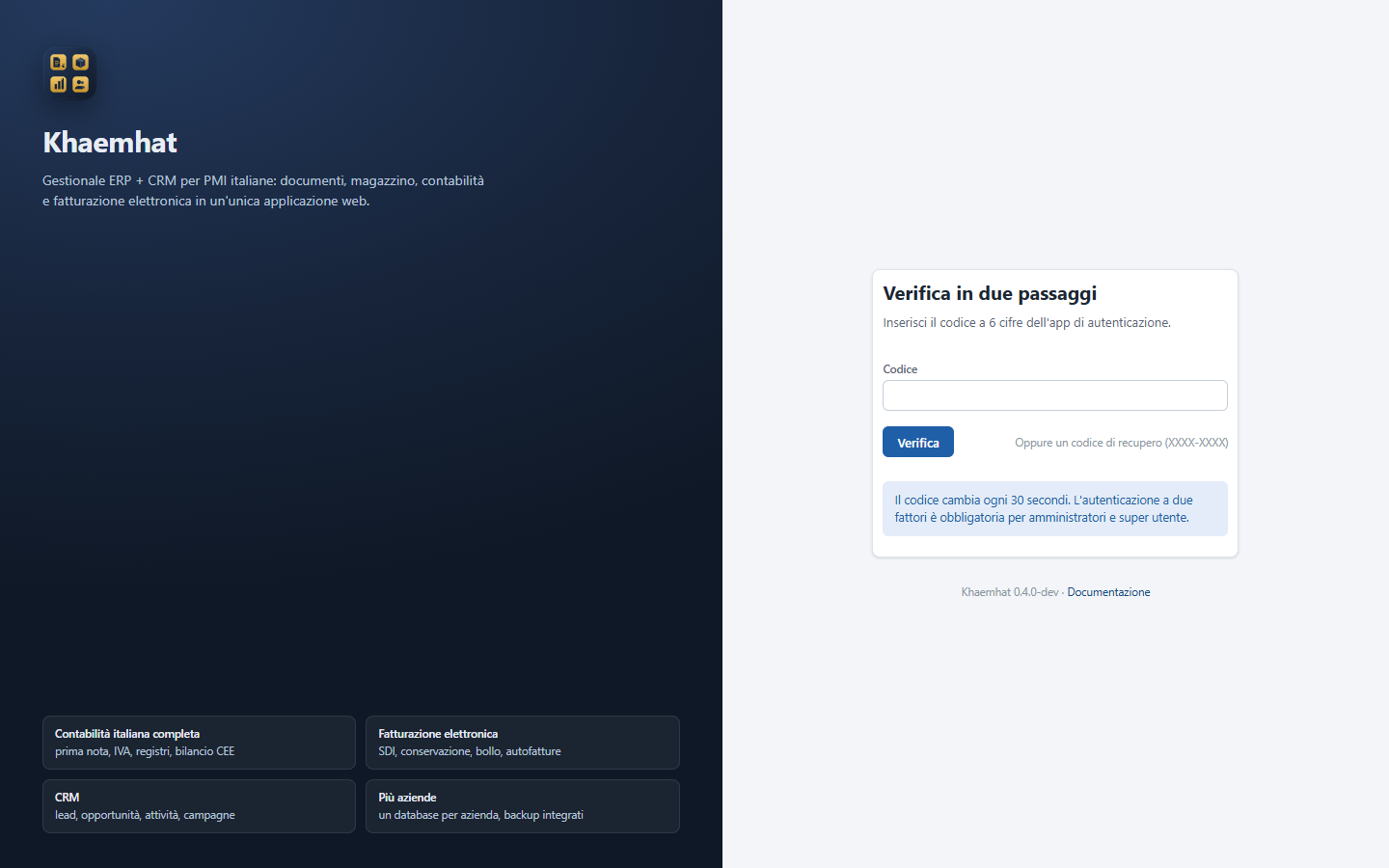
|
||||
|
||||
*La verifica in due passaggi di Khaemhat 0.5.0: il codice dell'app oppure un codice di recupero.*
|
||||
|
||||
Agli accessi successivi, dopo la password, compare la schermata **Verifica in due passaggi**: scrivi le 6 cifre
|
||||
mostrate dall'app e premi **Verifica**. Il codice cambia ogni 30 secondi.
|
||||
|
||||
@@ -275,12 +283,14 @@ Con l'azienda configurata puoi emettere la prima fattura:
|
||||
4. Scegli il cliente: pagamento, listino e agente vengono proposti dalla sua scheda.
|
||||
5. Nella scheda **Righe** aggiungi l'articolo (`F4` apre la ricerca), la quantità e controlla prezzo e IVA.
|
||||
6. Premi **Salva** (`Ctrl+S`): la fattura è in *bozza*.
|
||||
7. Premi **Conferma ed emetti**: la fattura riceve il numero, diventa immutabile e, con il modulo ACCT attivo,
|
||||
viene contabilizzata.
|
||||
8. Dalla toolbar genera il PDF o l'XML FatturaPA: ogni file generato diventa un allegato della fattura.
|
||||
7. Premi **Emetti**: la fattura riceve il numero e diventa immutabile.
|
||||
8. Premi la **stampante** (`Ctrl+P`): l'anteprima di stampa offre il PDF e **Salva come allegato**; dal menu **⋯**
|
||||
**Invia per e-mail** manda il PDF al cliente (serve il server SMTP, vedi [Impostazioni](Impostazioni#e-mail-smtp)).
|
||||
|
||||
La guida completa è in [Vendite](Vendite); l'invio allo SDI richiede il modulo EINV (vedi
|
||||
[Fatturazione elettronica](Fatturazione-elettronica)).
|
||||

|
||||
|
||||
La guida completa è in [Vendite](Vendite). Dalla 0.7 la fattura confermata è già in [Contabilità](Contabilita); l'XML FatturaPA per lo SDI con M9
|
||||
(modulo EINV, vedi [Fatturazione elettronica](Fatturazione-elettronica)).
|
||||
|
||||
## Domande frequenti
|
||||
|
||||
|
||||
@@ -13,7 +13,7 @@ Il lavoro di dettaglio è nelle issue di Gitea, raggruppate per
|
||||
Finché il prodotto è in sviluppo le versioni restano **0.x**, anche dopo M13: la **1.0.0** sarà pubblicata solo
|
||||
quando verrà deciso esplicitamente.
|
||||
|
||||
**Completate:** M0 (0.0.1), M1 (0.1.0), M2 (0.2.0), M3 (0.3.0), M4 (0.4.0). **In corso:** M5.
|
||||
**Completate:** M0 (0.0.1), M1 (0.1.0), M2 (0.2.0), M3 (0.3.0), M4 (0.4.0), M5 (0.5.0), M6 (0.6.0), M7 (0.7.0). **Prossima:** M8.
|
||||
|
||||
| # | Milestone | Contenuto principale | Versione |
|
||||
|---|---|---|---|
|
||||
|
||||
@@ -81,7 +81,7 @@ liquidazione IVA (*provvisoria*, *confermata*), registrazioni, interruttore **Bl
|
||||
|
||||
Indirizzo: `/tabelle/esercizi`. **Nuovo esercizio** crea l'anno successivo all'ultimo con i suoi dodici mesi. Il
|
||||
pulsante **Blocca** di un mese impedisce nuove registrazioni con date in quel mese; **Sblocca** chiede conferma. Un
|
||||
mese *liquidato* si sblocca solo annullando la liquidazione IVA (M7).
|
||||
mese *liquidato* si sblocca solo riaprendo la liquidazione IVA (vedi [IVA](IVA)).
|
||||
|
||||
Regola fondamentale: **si possono registrare documenti e movimenti contabili solo con data in un periodo aperto**. Un
|
||||
periodo bloccato rifiuta ogni registrazione con data al suo interno; la conferma della liquidazione IVA blocca il
|
||||
@@ -113,7 +113,7 @@ periodo (vedi [IVA](IVA)) e la chiusura dell'esercizio lo rende di sola lettura
|
||||
| **Categorie controparte** | classificazione di clienti e fornitori |
|
||||
| **Listini** | intestazioni dei listini: valuta, IVA inclusa, validità, **Listino base** (uno solo, in partenza `BASE`), **Derivato da** con ricarico % e arrotondamento (i prezzi sono in [Articoli e listini](Articoli-e-listini)) |
|
||||
| **Politiche di sconto** | sconti in cascata con un codice, come formula (`10+5`), da richiamare nelle condizioni |
|
||||
| **Tipi documento** | catalogo dei documenti con numeratore, causale di magazzino, causale contabile, registro IVA, codice TD, modello di stampa |
|
||||
| **Tipi documento** | catalogo dei documenti con **genere** (obbligatorio), numeratore, causale di magazzino, causale contabile, registro IVA, codice TD, modello di stampa |
|
||||
| **Centri di costo** | per l'analisi dei costi e dei ricavi |
|
||||
| **Commesse** | progetti o cantieri a cui imputare costi e ricavi |
|
||||
|
||||
@@ -156,7 +156,14 @@ clienti `OC-{year}-{number:D4}` (`OC-2026-0042`), autofatture `{number}/AF/{year
|
||||
|
||||
Il numero è assegnato in modo atomico **alla conferma** del documento (da M5); per fatture, note di credito,
|
||||
protocollo acquisti e registrazioni contabili **non sono ammessi buchi** nella numerazione (opzione *Ammessi buchi di numerazione*
|
||||
spenta). I numeratori sono per anno: il caricamento di base crea quelli dell'anno in corso.
|
||||
spenta) e la data di un documento non può precedere la **data dell'ultimo numero** del numeratore. I numeratori sono
|
||||
per anno: il caricamento di base crea quelli dell'anno in corso e il primo documento di un anno nuovo crea da solo il
|
||||
numeratore di quell'anno, con le stesse regole e dal numero 1.
|
||||
|
||||
Il **genere** di un tipo documento dice come si comportano i suoi documenti: famiglia, ciclo di vita, effetti, righe
|
||||
ammesse e documenti che può evadere (vedi [Vendite](Vendite#il-motore-dei-documenti-in-sintesi)). I tipi di base hanno
|
||||
già il genere; un tipo nuovo dell'azienda (ad esempio una seconda fattura immediata con un altro sezionale) sceglie uno
|
||||
dei generi esistenti e funziona senza altre impostazioni.
|
||||
|
||||
## Preferenze e codici automatici
|
||||
|
||||
|
||||
@@ -1,288 +1,352 @@
|
||||
# Vendite
|
||||
|
||||
> **Stato:** bozza · **Ultima revisione:** 2026-11-10 · **Versione software:** non ancora rilasciata (milestone M5)
|
||||
> **Modulo di licenza:** CORE (XML SDI con EINV, contabilizzazione con ACCT, partite con FIN) · **Permessi principali:** `sales.invoice.issue`, `sales.deliverynote.reopen`, famiglia `sales.*` · **Specifica:** SPEC §11.3, §11.4
|
||||
> **Stato:** completa per la versione 0.5 · **Ultima revisione:** 2026-11-12 · **Versione software:** 0.5.0 (M5)
|
||||
> **Modulo di licenza:** CORE (XML SDI con EINV, contabilizzazione con ACCT, partite con FIN) · **Permessi principali:** `sales.quote.*`, `sales.order.*`, `sales.delivery.*`, `sales.invoice.*` (emissione `sales.invoice.issue`) · **Specifica:** SPEC §9.4, §11.3, §11.4, §12.6
|
||||
|
||||
Il modulo **Vendite** gestisce l'intero ciclo attivo: **preventivi**, **ordini clienti**, **DDT**, **fatture**
|
||||
(immediate, accompagnatorie, differite, acconti, semplificate), **note di credito e di debito**, **pro-forma**,
|
||||
**parcelle**, la **fatturazione differita** guidata e i corrispettivi registrati a mano. Tutti i documenti usano lo
|
||||
stesso motore e la stessa maschera.
|
||||
Il modulo **Vendite** gestisce il ciclo attivo: **preventivi**, **ordini clienti**, **DDT**, **fatture** (immediate,
|
||||
accompagnatorie, differite, di acconto, parcelle), **note di credito e di debito**, **pro forma** e la
|
||||
**fatturazione differita** dei DDT. Tutti i documenti usano lo stesso motore e la stessa maschera, si stampano in PDF
|
||||
e si inviano per e-mail.
|
||||
|
||||
> **In questa versione** i documenti hanno numeri, totali, castelletto IVA, bollo, ritenute, scadenze, collegamenti
|
||||
> riga per riga, stampa ed e-mail. Dalla 0.6 i documenti **muovono il magazzino** (DDT e fatture
|
||||
> accompagnatorie scaricano, gli ordini impegnano: vedi [Magazzino](Magazzino)). Dalla 0.7 fatture e note
|
||||
> **si contabilizzano** da sole (vedi [Contabilità](Contabilita)). Arrivano più avanti: gli **incassi** e il controllo
|
||||
> del fido (M8), il **file XML** per lo
|
||||
> SDI (M9) e il collegamento alle opportunità del **CRM** (M11). I pulsanti di queste funzioni compaiono quando la
|
||||
> funzione c'è.
|
||||
|
||||
## Dove si trova
|
||||
|
||||
Menu **Vendite** → *Preventivi*, *Ordini clienti*, *DDT*, *Fatture*, *Note di credito*, *Fatturazione differita*.
|
||||
Le pro forma, le fatture di acconto e le parcelle stanno nell'elenco *Fatture*; le note di debito in *Note di credito*.
|
||||
|
||||
## Il motore dei documenti in sintesi
|
||||
## Un giro completo in cinque minuti
|
||||
|
||||
Ogni tipo di documento è descritto da una definizione che stabilisce: numeratore e sezionale, causale di magazzino
|
||||
(se il documento carica o scarica merce), **effetti** (impegno, scarico, partite, registrazione contabile), da quali
|
||||
documenti può essere **evaso** (ad esempio un DDT da un ordine), tipo documento SDI (TD), causale contabile, registro
|
||||
IVA e modello di stampa.
|
||||
Con l'azienda di esempio (vedi [Dati di base e di esempio](Dati-di-base-e-esempio)) trovi già un anno di vendite in
|
||||
tutti gli stati. Per provare il ciclo da zero:
|
||||
|
||||
1. **Vendite → Preventivi → Nuovo preventivo** (`Ctrl+N`): scegli il cliente, aggiungi due righe, **Conferma**.
|
||||
2. Sul preventivo premi **Crea Ordine cliente**: le righe passano all'ordine, collegate al preventivo.
|
||||
3. Sull'ordine confermato premi **Crea DDT**: puoi consegnare solo una parte delle quantità.
|
||||
4. **Vendite → Fatturazione differita**: indica il mese, **Cerca i DDT**, **Genera fatture**.
|
||||
5. Apri la fattura, premi la **stampante** (`Ctrl+P`) per l'anteprima e il PDF, poi **⋯ → Invia per e-mail**.
|
||||
|
||||
## Gli elenchi (radar)
|
||||
|
||||

|
||||
*Le fatture dell'azienda di esempio: numero, data, tipo, cliente, riferimento, imponibile, totale e stato. Le bozze
|
||||
non hanno ancora un numero.*
|
||||
|
||||
Ogni voce del menu apre un **radar** (vedi [Interfaccia e scorciatoie](Interfaccia-e-scorciatoie#radar)): cerca per
|
||||
numero, riferimento o cliente, filtra per **tipo**, **stato** e **anno**, ordina, scegli le colonne e salva la vista.
|
||||
Un doppio clic (o `Invio`) apre il documento in una nuova scheda.
|
||||
|
||||

|
||||
*I preventivi: quelli evasi sono diventati ordini, uno è stato rifiutato, uno è in bozza.*
|
||||
|
||||
**Nuovo** chiede il tipo quando l'elenco ne raccoglie più d'uno (ad esempio fattura immediata, accompagnatoria,
|
||||
differita, di acconto, parcella o pro forma):
|
||||
|
||||

|
||||
|
||||
## La maschera del documento
|
||||
|
||||

|
||||
*Una fattura emessa: toolbar, intestazione con tipo, numero, stato, cliente e totale; righe; castelletto IVA,
|
||||
scadenze e totali.*
|
||||
|
||||
- **Toolbar**: nuovo, salva (`Ctrl+S`), annulla le modifiche, elimina (solo bozze), **stampa** (`Ctrl+P`),
|
||||
**allegati**, le azioni del documento (*Conferma*, *Emetti*, *Crea …*) e il menu **⋯** con *Duplica*, *Chiudi*,
|
||||
*Riapri*, *Annulla documento*, *Invia per e-mail*. A destra il **radar** e i pulsanti per il documento precedente e
|
||||
successivo.
|
||||
- **Intestazione**: tipo e numero (in bozza *Numero alla conferma*), data, stato, badge *Dato dimostrativo* per i dati
|
||||
di esempio; cliente con codice, località e partita IVA, condizioni proposte (pagamento, listino, agente); il totale
|
||||
del documento con imponibile e IVA.
|
||||
- **Schede**: *Righe* (si apre lì), *Testata*, *Trasporto* (DDT e fatture accompagnatorie), *Totali*, *Scadenze*,
|
||||
*Note*, *Allegati*, *Collegamenti*, *Storico*. Il numero accanto al nome della scheda conta righe, rate o
|
||||
collegamenti.
|
||||
|
||||
### Righe
|
||||
|
||||
Ogni riga ha articolo (`F4` per cercarlo), descrizione, unità di misura, quantità, prezzo, sconti a cascata (`10+3`),
|
||||
codice IVA e importo. Scegliendo l'articolo Khaemhat propone descrizione, unità, codice IVA e prezzo secondo l'ordine
|
||||
*prezzo netto del cliente → listino del cliente → listino base → prezzo dell'articolo* (vedi
|
||||
[Articoli e listini](Articoli-e-listini)). Oltre alle righe di merce ci sono le righe **descrittive** (solo testo),
|
||||
le righe di **spesa** (trasporto, incasso) e le righe di **sconto**; i DDT non accettano spese né sconti.
|
||||
|
||||
Sotto le righe: **castelletto IVA** (imponibile e imposta per codice IVA), **scadenze** (le rate della condizione di
|
||||
pagamento) e **totali**.
|
||||
|
||||
### Testata
|
||||
|
||||
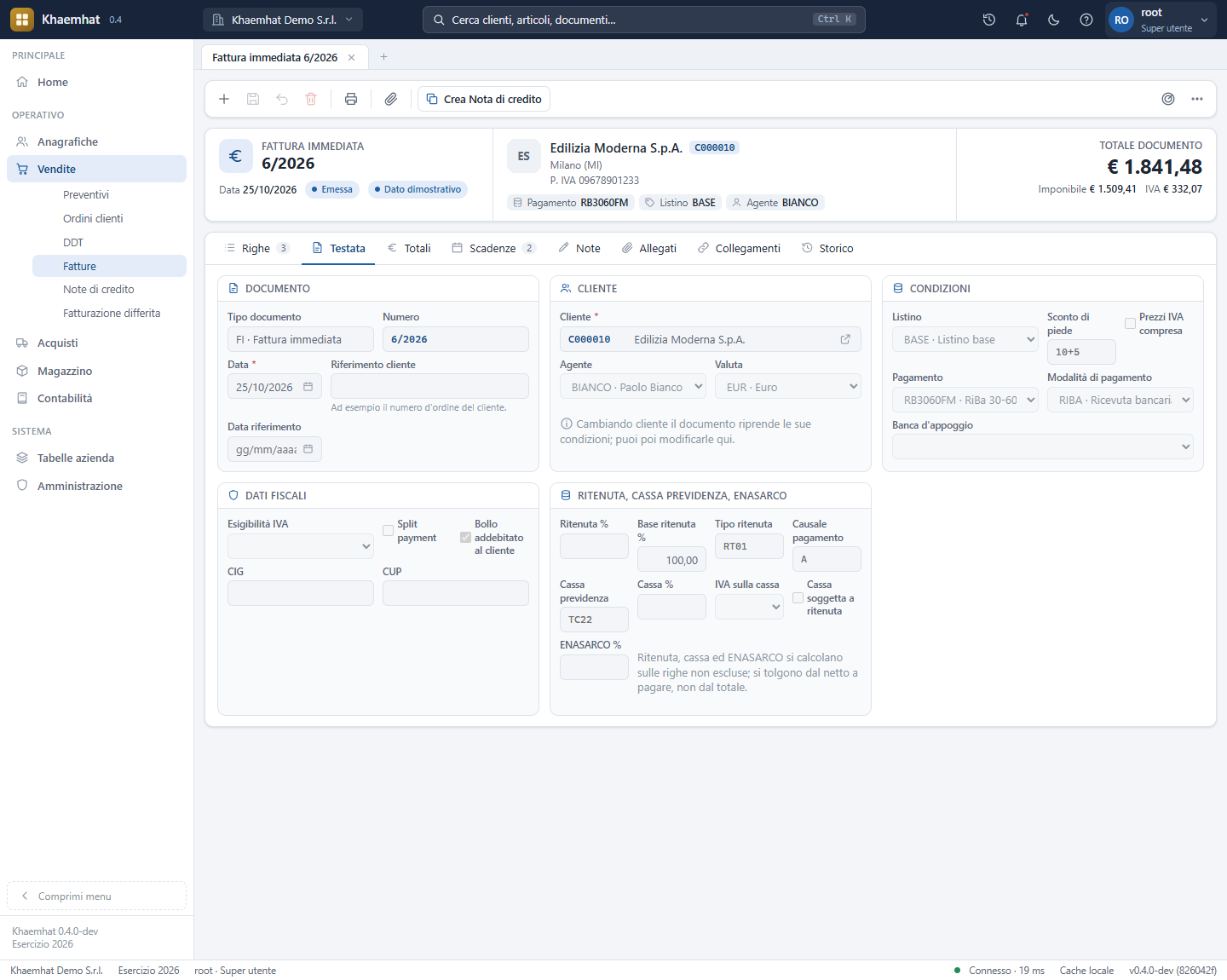
|
||||
*La Testata con i gruppi Documento, Cliente, Condizioni e Dati fiscali.*
|
||||
|
||||
| Gruppo | Campi |
|
||||
|---|---|
|
||||
| **Documento** | tipo, numero (alla conferma), **data** *, validità (preventivi), data di consegna (ordini), revisione, riferimento e data del cliente, documento rettificato (note) |
|
||||
| **Cliente** | **cliente** *, agente, valuta, listino |
|
||||
| **Condizioni** | pagamento, modalità, banca, sconto di piede, prezzi IVA inclusa |
|
||||
| **Dati fiscali** | esigibilità IVA, split payment, bollo a carico del cliente, CIG e CUP per la PA |
|
||||
| **Ritenuta, cassa previdenza, ENASARCO** | per parcelle e provvigioni: aliquote, base, tipo e causale della ritenuta, cassa |
|
||||
| **Note** | note stampate sul documento |
|
||||
|
||||
Scegliendo il cliente Khaemhat propone destinazione, listino, pagamento, agente e banca dalle sue **condizioni
|
||||
commerciali** (vedi [Anagrafiche](Anagrafiche)). Per emettere una fattura ogni riga (tranne le descrittive) deve
|
||||
avere il codice IVA.
|
||||
|
||||
### Trasporto (DDT e fatture accompagnatorie)
|
||||
|
||||

|
||||
*Causale del trasporto, trasporto a cura del mittente, del destinatario o del vettore, porto, aspetto dei beni,
|
||||
colli, pesi, inizio del trasporto.*
|
||||
|
||||
I dati di trasporto finiscono nella stampa insieme agli spazi per le **firme** del conducente, del vettore e del
|
||||
destinatario.
|
||||
|
||||
### Collegamenti
|
||||
|
||||

|
||||
*Un ordine evaso: da quale preventivo nasce e quali DDT lo hanno evaso, con le quantità.*
|
||||
|
||||
I documenti sono **collegati riga per riga**: quando un DDT evade un ordine, ogni riga del DDT ricorda la riga
|
||||
d'ordine di origine e la quantità evasa. Così Khaemhat calcola i **residui**, permette di riaprirli e scrive nel file
|
||||
XML della fattura i riferimenti all'ordine (*DatiOrdineAcquisto*) e ai DDT (*DatiDDT*).
|
||||
d'ordine e la quantità evasa. Così Khaemhat calcola i **residui** e lo stato (*Evaso in parte*, *Evaso*). Il
|
||||
collegamento vale dalla **conferma** del documento che evade: una bozza non toglie nulla al residuo, un documento
|
||||
annullato lo restituisce. Una nota di credito mostra qui la fattura che rettifica.
|
||||
|
||||
## Dal preventivo alla fattura: Crea …
|
||||
|
||||
```
|
||||
Preventivo ──trasforma──► Ordine cliente ──evadi──► DDT ──fattura differita──► Fattura TD24
|
||||
└────────────── evadi ──────────────► Fattura immediata TD01
|
||||
Preventivo ──Crea Ordine──► Ordine cliente ──Crea DDT──► DDT ──Fatturazione differita──► Fattura differita (TD24)
|
||||
└──────────── Crea Fattura immediata ─────────────► Fattura immediata (TD01)
|
||||
Fattura ──Crea Nota di credito──► Nota di credito (TD04)
|
||||
```
|
||||
|
||||
Alla **conferma**, in un'unica operazione indivisibile, il documento riceve il numero, muove il magazzino, genera
|
||||
le scadenze e le partite, crea la registrazione contabile e gli allegati: o riesce tutto o non cambia nulla.
|
||||
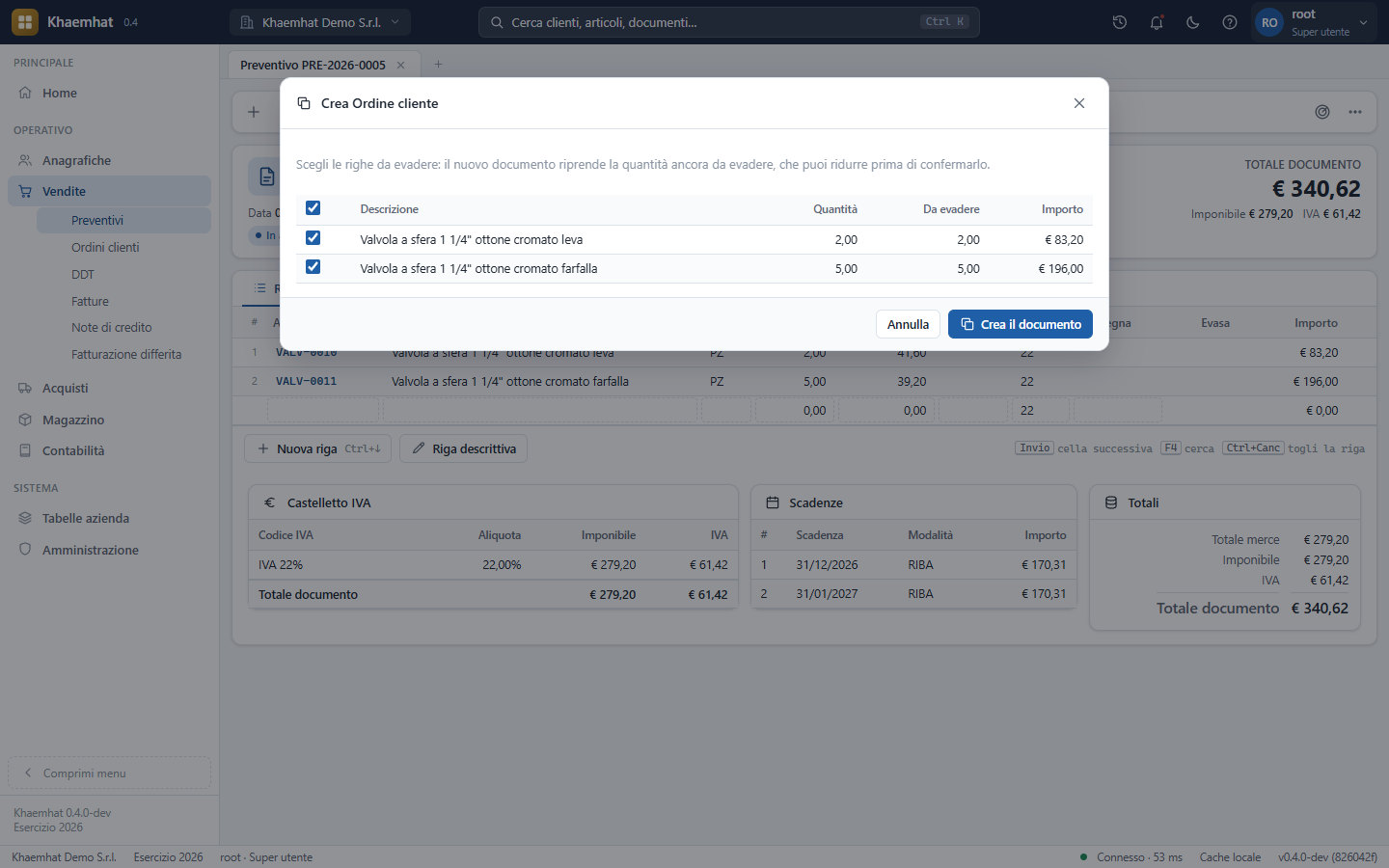
|
||||
*Crea Ordine cliente da un preventivo: si scelgono le righe; per un documento che evade, la quantità proposta è
|
||||
quella ancora da evadere.*
|
||||
|
||||
## La maschera di un documento di vendita
|
||||
I pulsanti **Crea …** della toolbar elencano i documenti che si possono generare da quello aperto. Se il nuovo tipo
|
||||
**evade** il vecchio (preventivo → ordine, ordine → DDT o fattura, DDT → fattura differita) le righe prendono solo le
|
||||
**quantità residue**, che puoi ridurre, e restano collegate; altrimenti (ad esempio fattura → nota di credito) le
|
||||
righe si **copiano**. Il nuovo documento nasce in **bozza** e si apre in una nuova scheda. **Duplica** crea invece un
|
||||
documento dello stesso tipo con la data di oggi.
|
||||
|
||||

|
||||
*Mockup 020 — fattura in bozza: toolbar con Conferma ed emetti, XML SDI, Contabilizza, Evadi da…; intestazione; righe con riga descrittiva; castelletto IVA, scadenze e totali (anteprima ridotta).*
|
||||
## Preventivi
|
||||
|
||||

|
||||
*Mockup 021 — scheda Testata con i gruppi Documento, Controparte, Condizioni, Magazzino e trasporto (anteprima ridotta).*
|
||||
Il preventivo ha una **validità** (giorni o data) che compare nella stampa. Quando il cliente accetta, **Crea Ordine
|
||||
cliente**; se rifiuta, **⋯ → Segna come rifiutato** (il preventivo passa a *Chiuso*). Un preventivo trasformato in
|
||||
ordine risulta *Evaso*.
|
||||
|
||||

|
||||
*Mockup 022 — la stessa fattura in tema scuro con accento Malachite (anteprima ridotta).*
|
||||
## Ordini clienti
|
||||
|
||||
La struttura è quella descritta in [Interfaccia e scorciatoie](Interfaccia-e-scorciatoie): toolbar, intestazione a
|
||||
tre blocchi, schede **Righe** (si apre lì), *Testata*, *Totali*, *Trasporto*, *Scadenze*, *Dati SDI/PA*, *Note*,
|
||||
*Allegati*, *Collegamenti*, *Storico*.
|
||||
L'ordine raccoglie gli impegni presi con il cliente. Da un ordine confermato si creano **DDT** o **fatture
|
||||
immediate**, anche più di uno, finché resta un residuo; la scheda *Collegamenti* mostra chi ha evaso cosa. **⋯ →
|
||||
Chiudi** chiude il residuo che non verrà consegnato, **Riapri** lo riporta aperto. Per la PA la Testata raccoglie CIG
|
||||
e CUP, riportati nella stampa.
|
||||
|
||||
| Gruppo della Testata | Campi |
|
||||
## DDT (documenti di trasporto)
|
||||
|
||||
Il DDT accompagna la merce: si compila la scheda *Trasporto* e si stampa con gli spazi per le firme. Un DDT confermato
|
||||
non ancora fatturato compare nella **fatturazione differita**; un DDT fatturato risulta *Evaso*. Finché non è
|
||||
fatturato le righe si possono ancora correggere; **Annulla documento** lo annulla con un motivo. Alla conferma il DDT
|
||||
**scarica il magazzino** (causale `SCA`); la fattura differita che lo fattura non scarica di nuovo.
|
||||
|
||||
## Fatture
|
||||
|
||||
1. **Vendite → Fatture → Nuova fattura**, scegli il tipo, oppure parti da un ordine con **Crea Fattura immediata**.
|
||||
2. Scegli il cliente: condizioni, listino, agente e destinazione vengono proposti.
|
||||
3. Inserisci le righe e controlla castelletto IVA, scadenze e totali.
|
||||
4. **Emetti** (permesso `sales.invoice.issue`): assegna il numero e blocca il documento.
|
||||
|
||||
Una fattura **emessa non si modifica**. Per correggerla si emette una **nota di credito**; finché il file XML non è
|
||||
stato inviato allo SDI si può **annullare** indicando il motivo (il numero resta usato).
|
||||
|
||||
## Note di credito (TD04) e di debito (TD05)
|
||||
|
||||

|
||||
*Una nota di credito che storna un articolo difettoso: l'intestazione indica la fattura rettificata.*
|
||||
|
||||
Si crea dalla fattura con **Crea Nota di credito** (le righe si copiano e si tolgono quelle che non vanno stornate) o
|
||||
da **Vendite → Note di credito → Nuova nota**. Usa lo stesso numeratore delle fatture.
|
||||
|
||||
## Pro forma e parcelle
|
||||
|
||||
La **pro forma** è un documento **non fiscale** (ad esempio per chiedere un anticipo): stessa maschera della fattura,
|
||||
numerazione propria (`PF-2026-0001`), nessun file XML e nessun effetto contabile; si trasforma in fattura quando
|
||||
serve. La **parcella** (TD06) calcola la **cassa previdenza** e la **ritenuta d'acconto** e mostra il **netto a
|
||||
pagare**; gli acconti su parcella usano TD03.
|
||||
|
||||
## Fatturazione differita
|
||||
|
||||

|
||||
*Ottobre: tre DDT da fatturare, uno per cliente; a destra la fattura in cui finirà ciascuno.*
|
||||
|
||||
1. **Periodo e cliente**: *DDT dal* e *DDT al*, un cliente (vuoto per tutti), la **data delle fatture** e il
|
||||
**raggruppamento** (*una fattura per cliente* o *una fattura per DDT*). Spunta *Emetti subito le fatture* per
|
||||
numerarle subito; altrimenti restano in bozza da controllare. Premi **Cerca i DDT**.
|
||||
2. **Scelta dei DDT**: l'elenco mostra i DDT confermati e non ancora fatturati con la fattura che verrà generata;
|
||||
togli la spunta a quelli da fatturare più avanti.
|
||||
3. **Genera fatture**: crea una fattura differita (TD24) per gruppo, con i riferimenti ai DDT nelle righe; i DDT
|
||||
diventano *Evasi*. Il riepilogo indica quante fatture sono state create; un clic le apre.
|
||||
|
||||
Con *una fattura per cliente* i DDT dello stesso cliente finiscono in una sola fattura, che prende pagamento,
|
||||
banca e condizioni dal primo DDT; se un cliente ha DDT con condizioni diverse scegli *una fattura per DDT*. La fattura differita va emessa entro il giorno 15 del mese successivo a quello delle consegne.
|
||||
|
||||
## Stampa e PDF
|
||||
|
||||

|
||||
*L'anteprima di stampa: intestazione dell'azienda, cliente, righe, riepilogo IVA, scadenze e totali.*
|
||||
|
||||
La **stampante** della toolbar (`Ctrl+P`) salva il documento se serve e apre l'**anteprima di stampa**:
|
||||
|
||||
| Pulsante | Che cosa fa |
|
||||
|---|---|
|
||||
| **Documento** | Tipo documento, Sezionale/Numero, **Data** *, Registro IVA, Competenza IVA, Valuta, Cambio, Vostro riferimento |
|
||||
| **Controparte** | **Cliente** *, Destinazione, Fatturare a, Agente, Listino |
|
||||
| **Condizioni** | Pagamento, Inizio rate (es. fine mese), Banca azienda, Sconto piede %, Spese incasso, Bollo (automatico) |
|
||||
| **Magazzino e trasporto** | Causale magazzino, Deposito, Vettore, Porto, Colli |
|
||||
| **Stampa** | la stampa del browser (scegli la stampante o *Salva come PDF*) |
|
||||
| **Apri PDF** / **Scarica PDF** | il PDF disegnato da Khaemhat, identico all'anteprima |
|
||||
| **Salva come allegato** | conserva il PDF tra gli **allegati** del documento come nuova versione e segna il documento come *stampato* |
|
||||
| 75% · 100% · 125% | lo zoom dell'anteprima |
|
||||
|
||||
Scegliendo il cliente, Khaemhat propone destinazione, listino, pagamento, agente e banca dalle sue condizioni
|
||||
commerciali; dal tipo documento propone causale e deposito.
|
||||
La stampa riporta i dati dell'azienda dal **profilo azienda** (ragione sociale, indirizzo, partita IVA, REA, capitale
|
||||
sociale, contatti e la nota a piè di pagina; vedi [Tabelle azienda](Tabelle-azienda)), il logo (nel PDF se è un
|
||||
JPEG), il cliente, i campi utili (pagamento, banca, riferimento, validità, agente, CIG e CUP), le righe, il
|
||||
**riepilogo IVA**, le **scadenze**, i totali con bollo e ritenuta e le diciture previste (split payment, pro forma non
|
||||
valida ai fini fiscali, fattura differita con i DDT). Le bozze, i documenti annullati e i dati dimostrativi portano
|
||||
una scritta in evidenza. Il DDT ha in più il riquadro del trasporto e le firme:
|
||||
|
||||
Le **righe** hanno: articolo, descrizione, UM, quantità, prezzo, sconti (anche `5+2`), codice IVA, importo, deposito,
|
||||
data di consegna. Le righe descrittive (solo testo) servono per riferimenti e note. Sotto la griglia: **castelletto
|
||||
IVA** (imponibile e imposta per codice IVA, esigibilità), **scadenze** (rate con data, metodo e importo) e
|
||||
**totali**.
|
||||

|
||||
|
||||
Ogni PDF salvato diventa un **allegato versionato** (vedi [Allegati e file](Allegati-e-file)): nella scheda
|
||||
*Allegati* si vedono tutte le versioni, con chi le ha create e quando. Il generatore si chiama *Stampa del documento
|
||||
in PDF*.
|
||||
|
||||
## Invio per e-mail
|
||||
|
||||

|
||||
*Destinatario dall'anagrafica del cliente, oggetto e testo dal modello; il PDF parte in allegato.*
|
||||
|
||||
**⋯ → Invia per e-mail** (su un documento salvato) propone:
|
||||
|
||||
- **Destinatari**: l'e-mail del cliente; più indirizzi separati da virgola o punto e virgola.
|
||||
- **Oggetto** e **Messaggio** dal modello, con i campi `{{Documento}}`, `{{Numero}}`, `{{Data}}`, `{{Cliente}}`,
|
||||
`{{Azienda}}` e `{{Totale}}` già compilati. Puoi cambiare tutto prima di inviare.
|
||||
|
||||
**Invia** salva il PDF tra gli allegati come nuova versione, lo allega al messaggio, mette il messaggio **in coda** e
|
||||
segna il documento come *inviato*. Il messaggio parte in background: tre tentativi a distanza crescente; l'esito (o
|
||||
l'errore del server) è nel [Log](Log), sezione **E-mail/PEC**. La coda vive in memoria: un messaggio ancora in attesa
|
||||
quando Khaemhat si ferma non parte, e il log lo dice.
|
||||
|
||||
L'invio richiede un **server SMTP** configurato dall'amministratore con le variabili `KHAEMHAT_SMTP_*` (vedi
|
||||
[Impostazioni](Impostazioni#e-mail-smtp)); senza, la finestra lo segnala e il pulsante *Invia* è spento.
|
||||
|
||||
## Tipi di documento e codici TD
|
||||
|
||||
| Documento | Codice TD (SDI) | Note |
|
||||
|---|---|---|
|
||||
| Fattura immediata | **TD01** | emessa contestualmente alla cessione o prestazione |
|
||||
| Fattura accompagnatoria | **TD01** | fattura con i dati di trasporto, fa anche da documento di trasporto e scarica il magazzino |
|
||||
| Fattura accompagnatoria | **TD01** | fattura con i dati di trasporto, fa anche da documento di trasporto |
|
||||
| Fattura di acconto/anticipo su fattura | **TD02** | |
|
||||
| Fattura di acconto/anticipo su parcella | **TD03** | |
|
||||
| Nota di credito | **TD04** | riferita alla fattura da stornare |
|
||||
| Nota di debito | **TD05** | |
|
||||
| Parcella | **TD06** | con ritenuta d'acconto e cassa previdenza |
|
||||
| Fattura semplificata | **TD07** | per importi fino a 400 euro |
|
||||
| Nota di credito semplificata | **TD08** | |
|
||||
| Nota di debito semplificata | **TD09** | |
|
||||
| Nota di credito / di debito semplificata | **TD08** / **TD09** | |
|
||||
| Fattura differita (beni con DDT, servizi documentati) | **TD24** | art. 21, comma 4, lett. a) DPR 633/72 |
|
||||
| Fattura differita (triangolazioni interne) | **TD25** | art. 21, comma 4, terzo periodo, lett. b) |
|
||||
| Cessione di beni ammortizzabili e passaggi interni | **TD26** | anche dalle dismissioni dei cespiti |
|
||||
| Cessione di beni ammortizzabili e passaggi interni | **TD26** | |
|
||||
| Autoconsumo o cessioni gratuite senza rivalsa (omaggi) | **TD27** | |
|
||||
| Pro-forma | — | non è un documento fiscale: niente numerazione fiscale né XML |
|
||||
| Pro forma | — | non è un documento fiscale: niente numerazione fiscale né XML |
|
||||
|
||||
Le autofatture e le integrazioni (TD16-TD29) sono negli [Acquisti](Acquisti). L'elenco completo dei codici è in
|
||||
[Fiscalità italiana](Fiscalita-italiana).
|
||||
|
||||
## Preventivi
|
||||
|
||||

|
||||
*Mockup 026 — preventivo inviato, revisione 2 di 2, collegato a un'opportunità CRM; azioni Trasforma in ordine, Nuova revisione, Accettato, Rifiutato (anteprima ridotta).*
|
||||
|
||||
Il preventivo (offerta) ha una **validità** (es. 30 giorni, con data di scadenza) e uno stato (*Bozza*, *Inviato*,
|
||||
*Accettato*, *Rifiutato*). Le schede sono *Righe*, *Testata*, *Totali*, *Condizioni e note*, *Revisioni*, *Allegati*,
|
||||
*CRM*; sotto le righe il pannello **Revisioni** elenca le versioni con data, totale ed esito (*Superata*, *Inviata*).
|
||||
|
||||
1. Crea il preventivo, inserisci le righe e invialo per e-mail.
|
||||
2. Se il cliente chiede modifiche usa **Nuova revisione**: la versione precedente resta consultabile come
|
||||
*superata*.
|
||||
3. Segna l'esito con **Accettato** o **Rifiutato**.
|
||||
4. **Trasforma in ordine** crea l'ordine cliente con le stesse righe e collega i due documenti.
|
||||
|
||||
Con il modulo CRM il preventivo è collegato all'**opportunità** e ne aggiorna valore e fase (vedi [CRM](CRM)).
|
||||
L'intestazione mostra anche il **margine** a chi può vedere i costi.
|
||||
|
||||
## Ordini clienti
|
||||
|
||||

|
||||
*Mockup 027 — ordine di una PA con split payment, evaso al 38%: righe con ordinato, evaso, residuo, disponibile e stato; documenti collegati (anteprima ridotta).*
|
||||
|
||||
Azioni contestuali: **Genera DDT**, **Genera fattura**, **Impegna**, **Ordina a fornitore**, **Chiudi residuo**.
|
||||
|
||||
- **Evasione**: la griglia *Righe e stato di evasione* mostra per ogni riga quantità ordinata, evasa, residua e
|
||||
disponibile, con uno stato (*Evaso*, *Parziale*, *Impegnato*, *Da ordinare*, *Aperto*) e una barra di avanzamento.
|
||||
Il pannello **Documenti collegati** elenca DDT e fatture già generati e gli ordini fornitore nati dall'ordine.
|
||||
- **Impegnato**: un ordine confermato **impegna** la merce, che resta in giacenza ma non è più disponibile per altri.
|
||||
- **Residui**: le quantità non evase restano aperte finché non vengono consegnate o chiuse con **Chiudi residuo**.
|
||||
- **Ordina a fornitore**: per le righe non disponibili crea un ordine fornitore.
|
||||
- **Fido e scaduto**: se il cliente supera il fido o ha pagamenti scaduti, la conferma è bloccata; chi ha il
|
||||
permesso di forzatura può procedere indicando il motivo.
|
||||
- **Dati PA**: per la pubblica amministrazione la scheda *Dati PA (CIG/CUP)* raccoglie CIG, CUP e riferimenti alla
|
||||
determina, riportati poi nell'XML della fattura.
|
||||
|
||||
## DDT (documenti di trasporto)
|
||||
|
||||

|
||||
*Mockup 028 — DDT confermato e scaricato, da fatturare: scheda Trasporto con causale, vettore, porto, colli e pesi, firme (anteprima ridotta).*
|
||||
|
||||
Il DDT accompagna la merce e **scarica il magazzino** alla conferma. Azioni: **Stampa 3 copie**, **Fattura questo
|
||||
DDT**, **Etichette colli**, **Riapri**.
|
||||
|
||||
| Gruppo (scheda Trasporto) | Campi |
|
||||
|---|---|
|
||||
| **Trasporto** | Causale del trasporto (vendita, reso, conto visione…), Trasporto a mezzo (mittente, destinatario, vettore), Vettore, Porto, resa (Incoterms), Inizio trasporto (data e ora), Targa, Annotazioni |
|
||||
| **Colli e pesi** | Aspetto esteriore dei beni, Numero colli, Peso lordo, Peso netto, Volume, Pallet, Tracking |
|
||||
| **Firme** | Conducente, Vettore, Destinatario (firme sulla stampa) |
|
||||
|
||||
Il DDT si stampa in **tre copie**. Un DDT confermato ha le righe non modificabili; **Riapri** (permesso
|
||||
`sales.deliverynote.reopen`) storna lo scarico e lo rigenera alla nuova conferma. I **resi** da cliente si
|
||||
registrano con un DDT con causale di reso, che ricarica il magazzino.
|
||||
|
||||
## Fatture
|
||||
|
||||
1. **Vendite → Fatture**, **Nuovo** (`Ctrl+N`) oppure parti da un ordine o da un DDT con **Evadi da…**.
|
||||
2. Scegli il cliente (F4 per cercare): condizioni, listino, agente e destinazione vengono proposti.
|
||||
3. Inserisci le righe: il prezzo segue l'ordine *netto cliente → listino cliente → listino base → prezzo articolo*
|
||||
(vedi [Articoli e listini](Articoli-e-listini)).
|
||||
4. Controlla castelletto IVA, scadenze e totali.
|
||||
5. **Conferma ed emetti**: assegna il numero, blocca il documento, scarica il magazzino (accompagnatoria), genera
|
||||
scadenze e registrazione contabile.
|
||||
6. **XML SDI** genera il file FatturaPA, che si invia dal canale configurato (vedi
|
||||
[Fatturazione elettronica](Fatturazione-elettronica)).
|
||||
|
||||
Una fattura **emessa non si modifica**. Per correggerla si emette una **nota di credito**; se l'XML non è ancora
|
||||
stato inviato allo SDI si può **annullare** indicando il motivo.
|
||||
|
||||
## Note di credito (TD04)
|
||||
|
||||

|
||||
*Mockup 029 — nota di credito che storna una riga della fattura per reso merce difettosa, con rientro a magazzino e compensazione della partita (anteprima ridotta).*
|
||||
|
||||
La nota di credito indica la **fattura stornata**, il **motivo** e la causale (ad esempio *reso da cliente*); se
|
||||
c'è un reso la merce **rientra a magazzino**. Il pannello **Partite** mostra l'effetto sulla partita della fattura
|
||||
(ad esempio *chiude parzialmente la rata 1/1*). L'XML è di tipo TD04 e riporta il riferimento alla fattura
|
||||
d'origine. La nota di debito (TD05) funziona allo stesso modo per gli addebiti integrativi.
|
||||
|
||||
## Pro-forma
|
||||
|
||||
Documento **non fiscale** (ad esempio per chiedere un anticipo): stessa maschera della fattura, senza numerazione
|
||||
fiscale, senza XML e senza registrazione contabile. Si trasforma in fattura quando serve.
|
||||
|
||||
## Parcelle (TD06)
|
||||
|
||||
Per le aziende o gli studi che emettono parcelle: la parcella calcola la **cassa previdenza** (contributo
|
||||
integrativo, con IVA propria) e la **ritenuta d'acconto** che il cliente tratterrà, e mostra il **netto a pagare**.
|
||||
Gli acconti su parcella usano TD03.
|
||||
|
||||
## Fatturazione differita guidata
|
||||
|
||||

|
||||
*Mockup 030 — procedura in quattro passi: parametri, selezione dei DDT non fatturati nel periodo, anteprima delle fatture, generazione (anteprima ridotta).*
|
||||
|
||||
1. **Parametri**: DDT dal… al…, **data fattura**, **sezionale**, tipo (*Fattura differita TD24*), **raggruppa**
|
||||
(*per cliente, rispettando la preferenza* di raggruppamento del cliente), *Genera XML SDI*, *Invia e-mail al
|
||||
cliente*.
|
||||
2. **Selezione DDT**: elenco dei DDT non fatturati nel periodo con la fattura che verrà generata; togli la spunta
|
||||
ai DDT da escludere.
|
||||
3. **Anteprima fatture**: numero di fatture e totale.
|
||||
4. **Generazione**: numera le fatture, le contabilizza e, se richiesto, genera l'XML. I riferimenti ai DDT sono
|
||||
riportati in riga e nell'XML (*DatiDDT*).
|
||||
|
||||
La fattura differita va emessa entro il giorno 15 del mese successivo a quello delle consegne. La stessa procedura
|
||||
è eseguibile da attività programmata (vedi [Automazioni](Automazioni)).
|
||||
[Fiscalità italiana](Fiscalita-italiana). I tipi, i numeratori e i sezionali si configurano in *Tipi documento* (vedi
|
||||
[Tabelle azienda](Tabelle-azienda)).
|
||||
|
||||
## Stati
|
||||
|
||||
| Documenti (preventivi, ordini, DDT) | Significato |
|
||||
| Preventivi, ordini, DDT, pro forma | Significato |
|
||||
|---|---|
|
||||
| **Bozza** | modificabile, senza numero definitivo, nessun effetto |
|
||||
| **Confermato** | numerato, effetti applicati (impegno, scarico) |
|
||||
| **Evaso parzialmente** / **Evaso** | una parte o tutto è passato al documento successivo |
|
||||
| **Chiuso** | concluso (anche con residuo chiuso a mano) |
|
||||
| **Annullato** | annullato con motivo |
|
||||
| **Bozza** | modificabile, senza numero, nessun effetto |
|
||||
| **Confermato** | numerato; le righe si possono ancora cambiare finché non sono evase |
|
||||
| **Evaso in parte** / **Evaso** | una parte o tutto è passato al documento successivo |
|
||||
| **Chiuso** | concluso, anche con residuo chiuso a mano (o preventivo rifiutato) |
|
||||
| **Annullato** | annullato con motivo; il numero resta usato |
|
||||
|
||||
| Fatture e note | Significato |
|
||||
|---|---|
|
||||
| **Bozza** | modificabile |
|
||||
| **Emessa** | numerata, contabilizzata, immutabile |
|
||||
| **XML generato** | file FatturaPA pronto |
|
||||
| **Inviata allo SDI** | in attesa di esito |
|
||||
| **Consegnata** | recapitata al cliente |
|
||||
| **Scartata** | rifiutata dallo SDI: va corretta e rigenerata |
|
||||
| **Non consegnata** | impossibile recapitarla: è disponibile nell'area riservata del cliente |
|
||||
| **Emessa** | numerata e immutabile |
|
||||
| **XML generato**, **Inviata allo SdI**, **Consegnata**, **Scartata**, **Non consegnata** | gli stati della fatturazione elettronica (M9) |
|
||||
|
||||
Altri badge indicano lo stato contabile (*Non contabilizzata*), del magazzino (*Scaricato*) o della fatturazione
|
||||
(*Da fatturare*).
|
||||
Che cosa si può fare:
|
||||
|
||||
- Si **modifica** una bozza; di ordini, preventivi, DDT e pro forma confermati si possono ancora cambiare le righe
|
||||
finché non sono evasi del tutto, ma una quantità non scende sotto quella già evasa e una riga evasa non si toglie.
|
||||
- Si **elimina** solo una bozza, che non ha mai avuto un numero.
|
||||
- Si **annulla** un documento confermato non ancora evaso: il numero resta e le quantità che aveva evaso tornano ai
|
||||
documenti d'origine. Una fattura si annulla **con un motivo** finché il file non è stato inviato allo SDI; dopo, si
|
||||
fa una nota di credito.
|
||||
- Si **chiude** il residuo di un documento evaso in parte; **Riapri** lo riporta allo stato che dicono le sue righe.
|
||||
- Si **duplica** o si **crea** un altro documento da uno in qualunque stato.
|
||||
|
||||
## Numerazione
|
||||
|
||||
- Formato `{prefisso}/{anno}/{numero a 6 cifre}`, ad esempio `FT/2026/000418`, per **sezionale** (FT, NC, DDT…) e
|
||||
anno, configurato nei numeratori (vedi [Tabelle azienda](Tabelle-azienda)).
|
||||
- Il numero è assegnato **alla conferma**, in modo atomico: le bozze non consumano numeri.
|
||||
- Per fatture e note di credito **non sono ammessi buchi** e la data non può essere anteriore a quella dell'ultimo
|
||||
documento numerato nello stesso sezionale.
|
||||
- La data deve cadere in un **periodo fiscale aperto** (vedi esercizi e periodi in [Tabelle azienda](Tabelle-azienda)).
|
||||
- Il formato è quello del numeratore del tipo documento, per **sezionale** e anno: ad esempio `{number}/{year}` per
|
||||
fatture, note e DDT (`7/2026`), `OC-{year}-{number:D4}` per gli ordini (`OC-2026-0004`), `PRE-{year}-{number:D4}`
|
||||
per i preventivi.
|
||||
- Il numero è assegnato **alla conferma**, in modo atomico: le bozze non consumano numeri, due conferme contemporanee
|
||||
non ricevono mai lo stesso numero e una conferma non riuscita restituisce il numero. Fatture, note di credito e note
|
||||
di debito condividono il numeratore delle fatture.
|
||||
- Per fatture e note **non sono ammessi buchi** e la data non può essere anteriore a quella dell'ultimo documento
|
||||
numerato nello stesso numeratore.
|
||||
- La data deve cadere in un **esercizio aperto** (vedi [Tabelle azienda](Tabelle-azienda)); con il primo documento
|
||||
di un anno nuovo la numerazione riparte da 1.
|
||||
|
||||
## Calcolo dei totali
|
||||
|
||||
| Elemento | Regola |
|
||||
|---|---|
|
||||
| **Imponibile di riga** | quantità x prezzo x (1 - sconto 1) x (1 - sconto 2)…, arrotondato a 2 decimali (arrotondamento commerciale) |
|
||||
| **Imponibile di riga** | quantità × prezzo × (1 − sconto 1) × (1 − sconto 2)…, arrotondato a 2 decimali (arrotondamento commerciale) |
|
||||
| **Castelletto IVA** | imponibili raggruppati per codice IVA; imposta calcolata per aliquota sul totale del gruppo |
|
||||
| **Spese** | trasporto, incasso ecc. con il proprio codice IVA |
|
||||
| **Sconto piede** | ripartito sulle righe |
|
||||
| **Bollo** | 2,00 euro automatici se le operazioni esenti, non imponibili o fuori campo IVA superano 77,47 euro; la scheda del cliente indica se è a carico del cliente |
|
||||
| **Sconto di piede** | ripartito sulle righe |
|
||||
| **Bollo** | 2,00 euro automatici se le operazioni esenti, non imponibili o fuori campo IVA superano 77,47 euro; la scheda del cliente indica se è a suo carico |
|
||||
| **Ritenuta d'acconto** | sulle parcelle, calcolata sull'imponibile previsto; il netto a pagare la esclude |
|
||||
| **Cassa previdenza** | contributo sulle parcelle, con IVA propria |
|
||||
| **Split payment** | per PA e soggetti obbligati: l'IVA è esposta ma versata dal cliente all'Erario; il totale *da versare* è il solo imponibile (esigibilità **S**) |
|
||||
| **Split payment** | per PA e soggetti obbligati: l'IVA è esposta ma versata dal cliente all'Erario (esigibilità **S**) |
|
||||
| **Reverse charge** | fattura senza IVA con natura N6.x: l'imposta la integra il cliente |
|
||||
| **IVA per cassa** | esigibilità differita al pagamento per chi ha aderito al regime (gestione completa prevista in fase 2) |
|
||||
|
||||
**Scadenze**: generate dalla condizione di pagamento (rate, giorni, fine mese, giorno fisso, percentuali, IVA sulla
|
||||
prima rata, sconto cassa); l'eventuale differenza di arrotondamento va sull'ultima rata.
|
||||
|
||||
## Stampa, PDF ed e-mail
|
||||
|
||||

|
||||
*Mockup 025 — anteprima di stampa della fattura: modello, copie, lingua, zoom (anteprima ridotta).*
|
||||
|
||||
`Ctrl+P` apre l'**anteprima di stampa** in una nuova scheda: si scelgono **modello**, numero di **copie** e
|
||||
**lingua**, si ingrandisce (50%, 100%, adatta) e si stampa, si scarica il PDF o lo si invia. La stampa contiene le
|
||||
diciture di legge previste ed è sempre in tema chiaro. Ogni PDF generato diventa un **allegato versionato** del
|
||||
documento (vedi [Allegati e file](Allegati-e-file)).
|
||||
|
||||
L'invio per **e-mail o PEC** allega il PDF (e, se richiesto, l'XML o la copia di cortesia ZIP) usando i modelli
|
||||
e-mail dell'azienda; il canale preferito è nelle condizioni del cliente.
|
||||
|
||||
## Collegamenti, duplicazione e corrispettivi
|
||||
|
||||
- **Collegamenti**: la scheda omonima mostra i documenti di origine e quelli generati (ordine → DDT → fattura) con
|
||||
le quantità; l'icona *Collegamenti* della toolbar apre lo stesso elenco.
|
||||
- **Duplica** crea un nuovo documento in bozza con le stesse righe; la **trasformazione** cambia tipo mantenendo i
|
||||
collegamenti (preventivo → ordine).
|
||||
- **Corrispettivi**: le vendite al dettaglio si registrano a mano come corrispettivi giornalieri.
|
||||
|
||||
## Report
|
||||
|
||||
Giornale vendite, fatturato per cliente, agente, categoria e articolo (vedi [Report](Report)), DDT da fatturare,
|
||||
ordini aperti, provvigioni agenti, margini (con il modulo REPORT).
|
||||
prima rata); l'eventuale differenza di arrotondamento va sull'ultima rata.
|
||||
|
||||
## Permessi e licenza
|
||||
|
||||
Le vendite sono nel modulo **CORE**. Emettere una fattura richiede `sales.invoice.issue`; riaprire un DDT
|
||||
`sales.deliverynote.reopen`; forzare un blocco di fido un permesso di tipo `override`. La generazione e l'invio
|
||||
dell'XML richiedono **EINV**, la registrazione contabile **ACCT**, partite e incassi **FIN**.
|
||||
Le vendite sono nel modulo **CORE**. Ogni famiglia ha due permessi, lettura (`.read`) e scrittura (`.write`):
|
||||
`sales.quote`, `sales.order`, `sales.delivery`, `sales.invoice` (fatture, note e pro forma). La scrittura vale per
|
||||
creare, modificare, confermare, chiudere, riaprire e annullare; per le fatture e le note **emettere** e annullare
|
||||
richiede in più `sales.invoice.issue` ed eliminare una bozza `sales.invoice.delete`. Stampare richiede la sola
|
||||
lettura. Vedi [Utenti e permessi](Utenti-e-permessi).
|
||||
|
||||
## Domande frequenti
|
||||
|
||||
- **Non riesco a confermare la fattura: "data anteriore all'ultima numerata".** Nello stesso sezionale esiste una
|
||||
fattura con data successiva: correggi la data o usa un altro sezionale.
|
||||
- **Il bollo non viene calcolato.** Il bollo è automatico solo se la parte esente, non imponibile o fuori campo
|
||||
supera 77,47 euro; controlla i codici IVA delle righe.
|
||||
- **Devo correggere una fattura già inviata.** Emetti una nota di credito (TD04) e una nuova fattura.
|
||||
- **"Indica il codice IVA" su una riga.** Fatture e note si emettono solo con il codice IVA su ogni riga di merce,
|
||||
spesa o sconto: sceglilo nella riga o nella scheda dell'articolo.
|
||||
- **Il bollo non viene calcolato.** È automatico solo se la parte esente, non imponibile o fuori campo supera 77,47
|
||||
euro; controlla i codici IVA delle righe.
|
||||
- **Un DDT non compare nella fatturazione differita.** Deve essere *Confermato*, non già fatturato e con data nel
|
||||
periodo; se hai indicato un cliente, deve essere suo.
|
||||
- **"Invia per e-mail" è spento.** Il documento ha modifiche non salvate: salvalo. Se la finestra dice che manca il
|
||||
server SMTP, chiedi all'amministratore di configurarlo.
|
||||
- **Ho inviato l'e-mail ma il cliente non l'ha ricevuta.** Guarda il [Log](Log), sezione *E-mail/PEC*: c'è la
|
||||
risposta del server per ogni tentativo.
|
||||
- **Devo correggere una fattura già inviata allo SDI.** Emetti una nota di credito (TD04) e una nuova fattura.
|
||||
|
||||
## Pagine correlate
|
||||
|
||||
[Anagrafiche](Anagrafiche) · [Articoli e listini](Articoli-e-listini) · [Magazzino](Magazzino) ·
|
||||
[Allegati e file](Allegati-e-file) · [Fatturazione elettronica](Fatturazione-elettronica) ·
|
||||
[Contabilità](Contabilita) · [Scadenzario](Scadenzario) · [CRM](CRM) · [Fiscalità italiana](Fiscalita-italiana)
|
||||
[Anagrafiche](Anagrafiche) · [Articoli e listini](Articoli-e-listini) · [Tabelle azienda](Tabelle-azienda) ·
|
||||
[Allegati e file](Allegati-e-file) · [Log](Log) · [Magazzino](Magazzino) ·
|
||||
[Fatturazione elettronica](Fatturazione-elettronica) · [Contabilità](Contabilita) · [Scadenzario](Scadenzario) ·
|
||||
[Fiscalità italiana](Fiscalita-italiana)
|
||||
@@ -1,5 +1,8 @@
|
||||
**[Khaemhat](Home)**
|
||||
|
||||
**Guida**
|
||||
- [Guida all'uso](Guida-utente)
|
||||
|
||||
**Installazione**
|
||||
- [Primi passi](Primi-passi)
|
||||
- [Unraid](Installazione-Unraid)
|
||||
|
||||

|
After Width: | Height: | Size: 188 KiB |

|
After Width: | Height: | Size: 182 KiB |

|
After Width: | Height: | Size: 74 KiB |

|
After Width: | Height: | Size: 113 KiB |

|
After Width: | Height: | Size: 121 KiB |

|
After Width: | Height: | Size: 69 KiB |

|
After Width: | Height: | Size: 119 KiB |

|
After Width: | Height: | Size: 165 KiB |

|
After Width: | Height: | Size: 118 KiB |

|
After Width: | Height: | Size: 174 KiB |

|
After Width: | Height: | Size: 115 KiB |

|
After Width: | Height: | Size: 149 KiB |

|
After Width: | Height: | Size: 190 KiB |

|
After Width: | Height: | Size: 100 KiB |

|
After Width: | Height: | Size: 97 KiB |

|
After Width: | Height: | Size: 73 KiB |

|
After Width: | Height: | Size: 97 KiB |

|
After Width: | Height: | Size: 177 KiB |

|
After Width: | Height: | Size: 178 KiB |

|
After Width: | Height: | Size: 199 KiB |

|
After Width: | Height: | Size: 166 KiB |

|
After Width: | Height: | Size: 220 KiB |

|
After Width: | Height: | Size: 90 KiB |

|
After Width: | Height: | Size: 99 KiB |

|
After Width: | Height: | Size: 145 KiB |

|
After Width: | Height: | Size: 118 KiB |

|
After Width: | Height: | Size: 102 KiB |

|
After Width: | Height: | Size: 92 KiB |

|
After Width: | Height: | Size: 99 KiB |

|
After Width: | Height: | Size: 105 KiB |

|
After Width: | Height: | Size: 109 KiB |

|
After Width: | Height: | Size: 87 KiB |

|
After Width: | Height: | Size: 115 KiB |

|
After Width: | Height: | Size: 124 KiB |

|
After Width: | Height: | Size: 121 KiB |
@@ -3,7 +3,8 @@
|
||||
# Any KHAEMHAT_* variable already set in the shell wins over the defaults below.
|
||||
set -euo pipefail
|
||||
|
||||
root="$(cd "$(dirname "${BASH_SOURCE[0]}")/.." && pwd)"
|
||||
# Under Git Bash on Windows, pwd -W gives B:/... instead of /b/..., which .NET would read as a folder b on the drive.
|
||||
root="$(cd "$(dirname "${BASH_SOURCE[0]}")/.." && (pwd -W 2>/dev/null || pwd))"
|
||||
cd "$root"
|
||||
|
||||
data_dir="$root/.data/dev"
|
||||
@@ -11,7 +12,10 @@ mkdir -p "$data_dir"
|
||||
|
||||
export ASPNETCORE_ENVIRONMENT="${ASPNETCORE_ENVIRONMENT:-Development}"
|
||||
export KHAEMHAT_DATA_DIR="${KHAEMHAT_DATA_DIR:-$data_dir}"
|
||||
export KHAEMHAT_SYSTEM_DB="${KHAEMHAT_SYSTEM_DB:-sqlite://$data_dir/system.db}"
|
||||
# sqlite:///home/... on Linux and macOS, sqlite:///B:/... on Windows.
|
||||
db_path="$data_dir"
|
||||
[[ "$db_path" == /* ]] || db_path="/$db_path"
|
||||
export KHAEMHAT_SYSTEM_DB="${KHAEMHAT_SYSTEM_DB:-sqlite://$db_path/system.db}"
|
||||
# Development-only key: never use it outside this script.
|
||||
export KHAEMHAT_SECRET_KEY="${KHAEMHAT_SECRET_KEY:-a2hhZW1oYXQtZGV2ZWxvcG1lbnQtb25seS1ub3QtYS1zZWNyZXQ=}"
|
||||
export KHAEMHAT_SUPERUSER="${KHAEMHAT_SUPERUSER:-root}"
|
||||
|
||||
@@ -105,7 +105,7 @@ public static class WidgetCatalog
|
||||
new(WidgetIds.CrmActivities, "Dashboard.Widgets.CrmActivities.Title", "target", 6, ModuleCodes.Crm, "crm.lead.read", Milestone: "M11"),
|
||||
new(WidgetIds.Notes, "Dashboard.Widgets.Notes.Title", "edit", 4, ModuleCodes.Core),
|
||||
new(WidgetIds.Shortcuts, "Dashboard.Widgets.Shortcuts.Title", "zap", 4, ModuleCodes.Core),
|
||||
new(WidgetIds.Understock, "Dashboard.Widgets.Understock.Title", "box", 6, ModuleCodes.Core, "inventory.stock.read", Milestone: "M6"),
|
||||
new(WidgetIds.Understock, "Dashboard.Widgets.Understock.Title", "box", 6, ModuleCodes.Core, "inventory.stock.read"),
|
||||
new(WidgetIds.Pipeline, "Dashboard.Widgets.Pipeline.Title", "target", 6, ModuleCodes.Crm, "crm.lead.read", Milestone: "M11"),
|
||||
new(WidgetIds.RecentDocuments, "Dashboard.Widgets.RecentDocuments.Title", "file", 6, ModuleCodes.Core, "sales.invoice.read", Milestone: "M5"),
|
||||
new(WidgetIds.SystemStatus, "Dashboard.Widgets.System.Title", "shield", 4, ModuleCodes.Core, InstanceOnly: true),
|
||||
|
||||
@@ -0,0 +1,201 @@
|
||||
using Khaemhat.Core.Documents;
|
||||
using Khaemhat.Core.Parties;
|
||||
using Khaemhat.Core.Tables;
|
||||
using Khaemhat.Data;
|
||||
using Khaemhat.Data.Querying;
|
||||
using Khaemhat.Fiscal.Abstractions;
|
||||
|
||||
namespace Khaemhat.Application.Documents;
|
||||
|
||||
/// <summary>The totals of a stored document: its tax summary and installments, as written by the last save.</summary>
|
||||
/// <param name="Summary">The tax summary.</param>
|
||||
/// <param name="Installments">The installments.</param>
|
||||
public sealed record DocumentFigures(IReadOnlyList<DocumentTaxSummary> Summary, IReadOnlyList<DocumentInstallment> Installments)
|
||||
{
|
||||
/// <summary>No figures.</summary>
|
||||
public static DocumentFigures Empty { get; } = new([], []);
|
||||
}
|
||||
|
||||
/// <summary>
|
||||
/// Applies <see cref="DocumentTotalsCalculator"/> and <see cref="InstallmentGenerator"/> to a document being saved:
|
||||
/// writes the line amounts and header totals, then replaces its tax summary and installments (issue #48).
|
||||
/// </summary>
|
||||
internal static class DocumentCalculation
|
||||
{
|
||||
/// <summary>Computes the totals of a document in place.</summary>
|
||||
/// <param name="uow">The unit of work.</param>
|
||||
/// <param name="engine">The country's tax engine.</param>
|
||||
/// <param name="behavior">The behaviour of the document.</param>
|
||||
/// <param name="record">The document.</param>
|
||||
/// <param name="cancellationToken">Cancellation.</param>
|
||||
/// <returns>The tax summary and installments to write once the document has its id.</returns>
|
||||
public static async Task<DocumentFigures> ApplyAsync(IUnitOfWork uow, ITaxEngine engine, DocumentBehavior behavior, DocumentRecord record, CancellationToken cancellationToken)
|
||||
{
|
||||
var header = record.Header;
|
||||
var taxCodes = await TaxCodesAsync(uow, record, cancellationToken).ConfigureAwait(false);
|
||||
var options = new TotalsOptions
|
||||
{
|
||||
PricesIncludeTax = header.PricesIncludeTax,
|
||||
FooterDiscount = header.FooterDiscount,
|
||||
Exigibility = header.Exigibility,
|
||||
SplitPayment = header.SplitPayment,
|
||||
StampDutyApplies = behavior.Direction == DocumentDirection.Sale && behavior.Has(DocumentEffects.EInvoice),
|
||||
StampDutyCharged = header.StampDutyCharged,
|
||||
WithholdingRate = header.WithholdingRate,
|
||||
WithholdingBasePercent = header.WithholdingBasePercent <= 0m ? 100m : header.WithholdingBasePercent,
|
||||
SocialSecurityRate = header.SocialSecurityRate,
|
||||
SocialSecurityTax = header.SocialSecurityTaxCodeId is { } id && taxCodes.TryGetValue(id, out var own) ? own : null,
|
||||
SocialSecurityWithheld = header.SocialSecurityWithheld,
|
||||
EnasarcoRate = header.EnasarcoRate,
|
||||
};
|
||||
var lines = record.Lines
|
||||
.Select(l => new TotalsLine(l.Kind, l.Quantity, l.Price, l.DiscountFormula,
|
||||
l.TaxCodeId is { } t && taxCodes.TryGetValue(t, out var tax) ? tax : null, l.WithholdingExcluded))
|
||||
.ToList();
|
||||
var totals = DocumentTotalsCalculator.Compute(lines, options, engine);
|
||||
for (var i = 0; i < record.Lines.Count; i++)
|
||||
{
|
||||
record.Lines[i].TaxableAmount = totals.LineAmounts[i];
|
||||
}
|
||||
|
||||
header.TaxableAmount = totals.Taxable;
|
||||
header.TaxAmount = totals.Tax;
|
||||
header.TotalAmount = totals.Total;
|
||||
header.ExpensesAmount = totals.Expenses;
|
||||
header.FooterDiscountAmount = totals.FooterDiscountAmount;
|
||||
header.StampDuty = totals.StampDuty;
|
||||
header.WithholdingAmount = totals.Withholding;
|
||||
header.SocialSecurityAmount = totals.SocialSecurity;
|
||||
header.EnasarcoAmount = totals.Enasarco;
|
||||
header.NetAmount = totals.Net;
|
||||
|
||||
var summary = totals.Summary.Select(s => new DocumentTaxSummary
|
||||
{
|
||||
Family = record.Family,
|
||||
TaxCodeId = s.Tax.TaxCodeId,
|
||||
Rate = s.Tax.Rate,
|
||||
Nature = s.Tax.Nature,
|
||||
Exigibility = s.Tax.Exigibility,
|
||||
NonDeductiblePercent = s.Tax.NonDeductiblePercent,
|
||||
LegalReference = s.Tax.LegalReference,
|
||||
Taxable = s.Taxable,
|
||||
Tax = s.TaxAmount,
|
||||
NonDeductibleTax = s.NonDeductibleTax,
|
||||
}).ToList();
|
||||
|
||||
var installments = new List<DocumentInstallment>();
|
||||
if (behavior.Has(DocumentEffects.Installments) || behavior.Kind is DocumentKind.ProForma or DocumentKind.SalesOrder or DocumentKind.Quotation)
|
||||
{
|
||||
installments = await InstallmentsAsync(uow, engine, behavior, record, totals, cancellationToken).ConfigureAwait(false);
|
||||
}
|
||||
|
||||
return new DocumentFigures(summary, installments);
|
||||
}
|
||||
|
||||
/// <summary>Replaces the tax summary and installments of a document.</summary>
|
||||
/// <param name="uow">The unit of work.</param>
|
||||
/// <param name="family">The family.</param>
|
||||
/// <param name="documentId">The document.</param>
|
||||
/// <param name="figures">The new rows.</param>
|
||||
/// <param name="cancellationToken">Cancellation.</param>
|
||||
/// <returns>A task.</returns>
|
||||
public static async Task WriteAsync(IUnitOfWork uow, DocumentFamily family, long documentId, DocumentFigures figures, CancellationToken cancellationToken)
|
||||
{
|
||||
var summaries = uow.Repository<DocumentTaxSummary, long>();
|
||||
var installments = uow.Repository<DocumentInstallment, long>();
|
||||
var where = SqlFragment.Of($"family = {family.ToString()} AND document_id = {documentId}");
|
||||
foreach (var old in (await summaries.ListAsync(Query.For<DocumentTaxSummary>().Where(where), cancellationToken).ConfigureAwait(false)).Items)
|
||||
{
|
||||
await summaries.DeleteAsync(old.Id, cancellationToken).ConfigureAwait(false);
|
||||
}
|
||||
|
||||
foreach (var old in (await installments.ListAsync(Query.For<DocumentInstallment>().Where(where), cancellationToken).ConfigureAwait(false)).Items)
|
||||
{
|
||||
await installments.DeleteAsync(old.Id, cancellationToken).ConfigureAwait(false);
|
||||
}
|
||||
|
||||
foreach (var row in figures.Summary)
|
||||
{
|
||||
row.Id = 0;
|
||||
row.Family = family;
|
||||
row.DocumentId = documentId;
|
||||
await summaries.InsertAsync(row, cancellationToken).ConfigureAwait(false);
|
||||
}
|
||||
|
||||
foreach (var row in figures.Installments)
|
||||
{
|
||||
row.Id = 0;
|
||||
row.Family = family;
|
||||
row.DocumentId = documentId;
|
||||
await installments.InsertAsync(row, cancellationToken).ConfigureAwait(false);
|
||||
}
|
||||
}
|
||||
|
||||
/// <summary>Reads the tax summary and installments of a document.</summary>
|
||||
/// <param name="uow">The unit of work.</param>
|
||||
/// <param name="family">The family.</param>
|
||||
/// <param name="documentId">The document.</param>
|
||||
/// <param name="cancellationToken">Cancellation.</param>
|
||||
/// <returns>The rows.</returns>
|
||||
public static async Task<DocumentFigures> ReadAsync(IUnitOfWork uow, DocumentFamily family, long documentId, CancellationToken cancellationToken)
|
||||
{
|
||||
var where = SqlFragment.Of($"family = {family.ToString()} AND document_id = {documentId}");
|
||||
var summary = await uow.Repository<DocumentTaxSummary, long>()
|
||||
.ListAsync(Query.For<DocumentTaxSummary>().Where(where).OrderByDescending(s => s.Rate), cancellationToken).ConfigureAwait(false);
|
||||
var installments = await uow.Repository<DocumentInstallment, long>()
|
||||
.ListAsync(Query.For<DocumentInstallment>().Where(where).OrderBy(s => s.Number), cancellationToken).ConfigureAwait(false);
|
||||
return new DocumentFigures(summary.Items, installments.Items);
|
||||
}
|
||||
|
||||
private static async Task<Dictionary<long, TotalsTax>> TaxCodesAsync(IUnitOfWork uow, DocumentRecord record, CancellationToken cancellationToken)
|
||||
{
|
||||
var ids = record.Lines.Where(l => l.TaxCodeId is not null).Select(l => l.TaxCodeId!.Value).ToHashSet();
|
||||
if (record.Header.SocialSecurityTaxCodeId is { } own)
|
||||
{
|
||||
ids.Add(own);
|
||||
}
|
||||
|
||||
if (ids.Count == 0)
|
||||
{
|
||||
return [];
|
||||
}
|
||||
|
||||
var list = ids.ToList();
|
||||
var codes = await uow.Repository<TaxCode, long>().ListAsync(Query.For<TaxCode>().Where(c => list.Contains(c.Id)), cancellationToken).ConfigureAwait(false);
|
||||
return codes.Items.ToDictionary(c => c.Id, c => new TotalsTax(c.Id, c.Rate, string.IsNullOrWhiteSpace(c.Nature) ? null : c.Nature,
|
||||
c.Exigibility, c.NonDeductiblePercent, c.LegalReference));
|
||||
}
|
||||
|
||||
private static async Task<List<DocumentInstallment>> InstallmentsAsync(
|
||||
IUnitOfWork uow, ITaxEngine engine, DocumentBehavior behavior, DocumentRecord record, DocumentTotals totals, CancellationToken cancellationToken)
|
||||
{
|
||||
var header = record.Header;
|
||||
PaymentTerm? term = null;
|
||||
IReadOnlyList<PaymentTermLine> termLines = [];
|
||||
if (header.PaymentTermId is { } termId)
|
||||
{
|
||||
term = await uow.Repository<PaymentTerm, long>().GetAsync(termId, cancellationToken).ConfigureAwait(false);
|
||||
termLines = (await uow.Repository<PaymentTermLine, long>()
|
||||
.ListAsync(Query.For<PaymentTermLine>().Where(l => l.PaymentTermId == termId).OrderBy(l => l.Number), cancellationToken).ConfigureAwait(false)).Items;
|
||||
}
|
||||
|
||||
ExcludedMonths? excluded = null;
|
||||
if (behavior.Direction == DocumentDirection.Sale && header.PartyId is { } partyId)
|
||||
{
|
||||
var terms = await uow.Repository<PartySalesTerms, long>()
|
||||
.FindAsync(Query.For<PartySalesTerms>().Where(t => t.PartyId == partyId), cancellationToken).ConfigureAwait(false);
|
||||
if (terms is { } t && (t.ExcludedMonth1 is not null || t.ExcludedMonth2 is not null))
|
||||
{
|
||||
excluded = new ExcludedMonths(t.ExcludedMonth1, t.ExcludedMonth2, t.ExcludedMonthsDay ?? 10);
|
||||
}
|
||||
}
|
||||
|
||||
var paidTax = totals.Tax - totals.SplitPaymentTax;
|
||||
var dues = InstallmentGenerator.Generate(
|
||||
header.DocumentDate, totals.Net, paidTax,
|
||||
[.. termLines.Select(l => new InstallmentRule(l.Days, l.EndOfMonth, l.FixedDay, l.Percent))],
|
||||
term?.VatOnFirstInstallment ?? false, excluded, engine.Round);
|
||||
var method = header.PaymentMethodId ?? term?.PaymentMethodId;
|
||||
return [.. dues.Select(d => new DocumentInstallment { Number = d.Number, DueDate = d.DueDate, Amount = d.Amount, PaymentMethodId = method })];
|
||||
}
|
||||
}
|
||||
@@ -0,0 +1,257 @@
|
||||
using System.Globalization;
|
||||
using Khaemhat.Application.Security;
|
||||
using Khaemhat.Core.Documents;
|
||||
using Khaemhat.Data;
|
||||
|
||||
namespace Khaemhat.Application.Documents;
|
||||
|
||||
/// <summary>
|
||||
/// Makes a new draft from an existing document (SPEC §11.3, ADR 0032): a duplicate of the same type, or a
|
||||
/// transformation to another type of the same direction. When the new kind fulfils the old one (order to delivery note,
|
||||
/// delivery note to deferred invoice) the lines take what is left to fulfil and remember where they come from; the
|
||||
/// link is recorded when the new document is confirmed.
|
||||
/// </summary>
|
||||
public sealed class DocumentCopyService
|
||||
{
|
||||
private readonly DocumentEngine _engine;
|
||||
private readonly PermissionService _permissions;
|
||||
private readonly TimeProvider _clock;
|
||||
|
||||
/// <summary>Creates the service.</summary>
|
||||
/// <param name="engine">The engine.</param>
|
||||
/// <param name="permissions">The permissions.</param>
|
||||
/// <param name="clock">The clock.</param>
|
||||
public DocumentCopyService(DocumentEngine engine, PermissionService permissions, TimeProvider clock)
|
||||
{
|
||||
ArgumentNullException.ThrowIfNull(engine);
|
||||
ArgumentNullException.ThrowIfNull(permissions);
|
||||
ArgumentNullException.ThrowIfNull(clock);
|
||||
_engine = engine;
|
||||
_permissions = permissions;
|
||||
_clock = clock;
|
||||
}
|
||||
|
||||
/// <summary>Copies a document into a new draft and saves it.</summary>
|
||||
/// <param name="actor">Who copies.</param>
|
||||
/// <param name="companyCode">The company.</param>
|
||||
/// <param name="family">The family of the source.</param>
|
||||
/// <param name="id">The source.</param>
|
||||
/// <param name="targetTypeCode">The type of the new document, such as <c>DDT</c>.</param>
|
||||
/// <param name="lineIds">The lines to copy; all when empty.</param>
|
||||
/// <param name="cancellationToken">Cancellation.</param>
|
||||
/// <returns>The new draft.</returns>
|
||||
/// <exception cref="ValidationFailedException">The copy is not possible.</exception>
|
||||
public Task<DocumentRecord> CopyAsync(
|
||||
Actor actor, string companyCode, DocumentFamily family, long id, string targetTypeCode, IReadOnlyCollection<long>? lineIds = null,
|
||||
CancellationToken cancellationToken = default) =>
|
||||
MergeAsync(actor, companyCode, family, [id], targetTypeCode, null, lineIds, cancellationToken);
|
||||
|
||||
/// <summary>
|
||||
/// Copies several documents of the same party into one new draft and saves it (deferred invoice from delivery
|
||||
/// notes, delivery note from several orders): the header comes from the first, each source adds a reference line
|
||||
/// and its lines.
|
||||
/// </summary>
|
||||
/// <param name="actor">Who copies.</param>
|
||||
/// <param name="companyCode">The company.</param>
|
||||
/// <param name="family">The family of the sources.</param>
|
||||
/// <param name="ids">The sources, in order.</param>
|
||||
/// <param name="targetTypeCode">The type of the new document.</param>
|
||||
/// <param name="date">The date of the new document; today when empty.</param>
|
||||
/// <param name="lineIds">The lines to copy; all when empty.</param>
|
||||
/// <param name="cancellationToken">Cancellation.</param>
|
||||
/// <returns>The new draft.</returns>
|
||||
/// <exception cref="ValidationFailedException">The copy is not possible.</exception>
|
||||
public async Task<DocumentRecord> MergeAsync(
|
||||
Actor actor, string companyCode, DocumentFamily family, IReadOnlyList<long> ids, string targetTypeCode, DateOnly? date = null,
|
||||
IReadOnlyCollection<long>? lineIds = null, CancellationToken cancellationToken = default)
|
||||
{
|
||||
ArgumentNullException.ThrowIfNull(actor);
|
||||
ArgumentNullException.ThrowIfNull(ids);
|
||||
if (ids.Count == 0)
|
||||
{
|
||||
throw new ValidationFailedException([":" + DocumentErrors.CopyNothingLeft]);
|
||||
}
|
||||
|
||||
var sources = new List<DocumentRecord>();
|
||||
foreach (var id in ids)
|
||||
{
|
||||
sources.Add(await _engine.GetAsync(actor, companyCode, family, id, cancellationToken).ConfigureAwait(false)
|
||||
?? throw new KeyNotFoundException(DocumentErrors.NotFound));
|
||||
}
|
||||
|
||||
var company = CompanyCodes.Normalize(companyCode);
|
||||
DocumentDefinition target;
|
||||
await using (var uow = await _engine.Factory.CreateAsync(DatabaseScope.Company(company), cancellationToken).ConfigureAwait(false))
|
||||
{
|
||||
target = await DocumentDefinitionService.GetAsync(uow, targetTypeCode, cancellationToken).ConfigureAwait(false);
|
||||
}
|
||||
|
||||
await _permissions.DemandAsync(actor, target.Behavior.WritePermission, cancellationToken).ConfigureAwait(false);
|
||||
if (sources.Select(s => s.Header.PartyId).Distinct().Count() > 1)
|
||||
{
|
||||
throw new ValidationFailedException([":" + DocumentErrors.CopyParties]);
|
||||
}
|
||||
|
||||
var copy = new DocumentRecord
|
||||
{
|
||||
Family = target.Family,
|
||||
Header = Header(sources[0], target, date ?? DateOnly.FromDateTime(_clock.GetLocalNow().DateTime)),
|
||||
};
|
||||
var wanted = lineIds is { Count: > 0 } ? lineIds.ToHashSet() : null;
|
||||
var anyFulfils = false;
|
||||
foreach (var source in sources)
|
||||
{
|
||||
var sourceBehavior = DocumentBehaviors.Of(source.Header.Kind);
|
||||
DocumentStateMachine.Apply(sourceBehavior.Lifecycle, source.Header.Status, DocumentAction.Copy);
|
||||
if (sourceBehavior.Direction != target.Behavior.Direction)
|
||||
{
|
||||
throw new ValidationFailedException([nameof(DocumentHeader.DocumentTypeId) + ":" + DocumentErrors.CopyDirection]);
|
||||
}
|
||||
|
||||
var fulfils = target.Behavior.Fulfils(source.Header.Kind);
|
||||
anyFulfils |= fulfils;
|
||||
if (fulfils && (source.Header.Status is DocumentStatus.Draft or DocumentStatus.Closed or DocumentStatus.Cancelled))
|
||||
{
|
||||
throw new ValidationFailedException([":" + DocumentErrors.CopySourceNotOpen]);
|
||||
}
|
||||
|
||||
var lines = new List<DocumentLine>();
|
||||
foreach (var line in source.Lines.Where(l => wanted is null || wanted.Contains(l.Id)))
|
||||
{
|
||||
if (!target.Behavior.Lines.Contains(line.Kind))
|
||||
{
|
||||
continue;
|
||||
}
|
||||
|
||||
var quantity = line.Quantity;
|
||||
if (fulfils && DocumentLine.CarriesQuantity(line.Kind))
|
||||
{
|
||||
quantity = line.Residual;
|
||||
if (quantity <= 0)
|
||||
{
|
||||
continue;
|
||||
}
|
||||
}
|
||||
|
||||
lines.Add(Line(line, target.Family, quantity, fulfils ? source.Family : null));
|
||||
}
|
||||
|
||||
if (sources.Count > 1 && lines.Count > 0 && source.Header.DocumentNumber is { } number
|
||||
&& target.Behavior.Lines.Contains(DocumentLineKind.Description))
|
||||
{
|
||||
var reference = DocumentStores.Of(target.Family).NewLine();
|
||||
reference.Kind = DocumentLineKind.Description;
|
||||
reference.Description = ReferenceLabel(source.Header.Kind) + " " + number + " del "
|
||||
+ source.Header.DocumentDate.ToString("dd/MM/yyyy", CultureInfo.InvariantCulture);
|
||||
copy.Lines.Add(reference);
|
||||
}
|
||||
|
||||
copy.Lines.AddRange(lines);
|
||||
}
|
||||
|
||||
if (anyFulfils && !copy.Lines.Any(l => l.SourceLineId is not null))
|
||||
{
|
||||
throw new ValidationFailedException([":" + DocumentErrors.CopyNothingLeft]);
|
||||
}
|
||||
|
||||
return await _engine.SaveAsync(actor, company, copy, cancellationToken).ConfigureAwait(false);
|
||||
}
|
||||
|
||||
// The reference printed before the lines of each source (the documents are written in Italian).
|
||||
private static string ReferenceLabel(DocumentKind kind) => kind switch
|
||||
{
|
||||
DocumentKind.DeliveryNote or DocumentKind.PurchaseDeliveryNote => "Rif. DDT n.",
|
||||
DocumentKind.SalesOrder or DocumentKind.PurchaseOrder => "Rif. ordine n.",
|
||||
DocumentKind.Quotation => "Rif. preventivo n.",
|
||||
_ => "Rif. documento n.",
|
||||
};
|
||||
|
||||
private static DocumentHeader Header(DocumentRecord record, DocumentDefinition target, DateOnly today)
|
||||
{
|
||||
var source = record.Header;
|
||||
var header = DocumentStores.Of(target.Family).NewHeader();
|
||||
header.DocumentTypeId = target.Type.Id;
|
||||
header.Kind = target.Kind;
|
||||
header.Status = DocumentStatus.Draft;
|
||||
header.IsDemo = source.IsDemo;
|
||||
header.DocumentDate = today;
|
||||
header.Year = today.Year;
|
||||
header.PartyId = source.PartyId;
|
||||
header.DestinationId = source.DestinationId;
|
||||
header.CurrencyCode = source.CurrencyCode;
|
||||
header.ExchangeRate = source.ExchangeRate;
|
||||
header.PriceListId = source.PriceListId;
|
||||
header.PaymentTermId = source.PaymentTermId;
|
||||
header.PaymentMethodId = source.PaymentMethodId;
|
||||
header.BankAccountId = source.BankAccountId;
|
||||
header.SalespersonId = source.SalespersonId;
|
||||
header.WarehouseId = source.WarehouseId;
|
||||
header.InventoryReasonId = target.Type.InventoryReasonId ?? source.InventoryReasonId;
|
||||
header.TransportReasonId = source.TransportReasonId;
|
||||
header.ShippingTermId = source.ShippingTermId;
|
||||
header.CarrierId = source.CarrierId;
|
||||
header.GoodsAppearanceId = source.GoodsAppearanceId;
|
||||
header.DeliveryDate = source.DeliveryDate;
|
||||
header.FooterDiscount = source.FooterDiscount;
|
||||
header.Notes = source.Notes;
|
||||
header.ExternalReference = source.ExternalReference;
|
||||
header.ExternalDate = source.ExternalDate;
|
||||
header.PricesIncludeTax = source.PricesIncludeTax;
|
||||
header.Exigibility = source.Exigibility;
|
||||
header.SplitPayment = source.SplitPayment;
|
||||
header.StampDutyCharged = source.StampDutyCharged;
|
||||
header.WithholdingRate = source.WithholdingRate;
|
||||
header.WithholdingBasePercent = source.WithholdingBasePercent;
|
||||
header.WithholdingType = source.WithholdingType;
|
||||
header.WithholdingReason = source.WithholdingReason;
|
||||
header.SocialSecurityFund = source.SocialSecurityFund;
|
||||
header.SocialSecurityRate = source.SocialSecurityRate;
|
||||
header.SocialSecurityTaxCodeId = source.SocialSecurityTaxCodeId;
|
||||
header.SocialSecurityWithheld = source.SocialSecurityWithheld;
|
||||
header.EnasarcoRate = source.EnasarcoRate;
|
||||
header.Cig = source.Cig;
|
||||
header.Cup = source.Cup;
|
||||
header.TransportBy = source.TransportBy;
|
||||
if (target.Kind is DocumentKind.CreditNote or DocumentKind.DebitNote or DocumentKind.PurchaseCreditNote
|
||||
&& DocumentBehaviors.Of(source.Kind).Lifecycle != DocumentLifecycle.Order && record.Family == target.Family)
|
||||
{
|
||||
// A note refers to the invoice it corrects (DatiFattureCollegate).
|
||||
header.RelatedDocumentId = source.Id;
|
||||
header.RelatedNumber = source.DocumentNumber;
|
||||
header.RelatedDate = source.DocumentDate;
|
||||
}
|
||||
|
||||
return header;
|
||||
}
|
||||
|
||||
private static DocumentLine Line(DocumentLine source, DocumentFamily family, decimal quantity, DocumentFamily? sourceFamily)
|
||||
{
|
||||
var line = DocumentStores.Of(family).NewLine();
|
||||
line.Kind = source.Kind;
|
||||
line.ItemId = source.ItemId;
|
||||
line.Description = source.Description;
|
||||
line.UnitOfMeasureId = source.UnitOfMeasureId;
|
||||
line.Quantity = quantity;
|
||||
line.Price = source.Price;
|
||||
line.PriceSource = source.PriceSource;
|
||||
line.DiscountFormula = source.DiscountFormula;
|
||||
line.TaxCodeId = source.TaxCodeId;
|
||||
line.TaxableAmount = source.Quantity == 0 || quantity == source.Quantity
|
||||
? source.TaxableAmount
|
||||
: Math.Round(source.TaxableAmount * quantity / source.Quantity, 2, MidpointRounding.AwayFromZero);
|
||||
line.WarehouseId = source.WarehouseId;
|
||||
line.DeliveryDate = source.DeliveryDate;
|
||||
line.AccountCode = source.AccountCode;
|
||||
line.CostCenterId = source.CostCenterId;
|
||||
line.JobId = source.JobId;
|
||||
line.Notes = source.Notes;
|
||||
line.WithholdingExcluded = source.WithholdingExcluded;
|
||||
if (sourceFamily is not null && DocumentLine.CarriesQuantity(source.Kind))
|
||||
{
|
||||
line.SourceFamily = sourceFamily;
|
||||
line.SourceLineId = source.Id;
|
||||
}
|
||||
|
||||
return line;
|
||||
}
|
||||
}
|
||||
@@ -0,0 +1,97 @@
|
||||
using Khaemhat.Application.Security;
|
||||
using Khaemhat.Core.Documents;
|
||||
using Khaemhat.Core.Tables;
|
||||
using Khaemhat.Data;
|
||||
using Khaemhat.Data.Querying;
|
||||
|
||||
namespace Khaemhat.Application.Documents;
|
||||
|
||||
/// <summary>
|
||||
/// A document type of the company with the behaviour of its kind (SPEC §11.3, ADR 0032): code, kind, direction,
|
||||
/// numerator, warehouse reason, effects, sources for fulfilment, SDI type, journal template, VAT register, print
|
||||
/// template.
|
||||
/// </summary>
|
||||
/// <param name="Type">The row of <c>document_types</c>.</param>
|
||||
/// <param name="Behavior">The behaviour of its kind.</param>
|
||||
public sealed record DocumentDefinition(DocumentType Type, DocumentBehavior Behavior)
|
||||
{
|
||||
/// <summary>The code of the type.</summary>
|
||||
public string Code => Type.Code;
|
||||
|
||||
/// <summary>The kind.</summary>
|
||||
public DocumentKind Kind => Behavior.Kind;
|
||||
|
||||
/// <summary>The family (tables).</summary>
|
||||
public DocumentFamily Family => Behavior.Family;
|
||||
|
||||
/// <summary>The life cycle.</summary>
|
||||
public DocumentLifecycle Lifecycle => Behavior.Lifecycle;
|
||||
|
||||
/// <summary>The action that confirms the documents: issue for invoices, confirm for the others.</summary>
|
||||
public DocumentAction ConfirmAction => Lifecycle == DocumentLifecycle.Invoice ? DocumentAction.Issue : DocumentAction.Confirm;
|
||||
}
|
||||
|
||||
/// <summary>Reads the definitions of the company's document types.</summary>
|
||||
public static class DocumentDefinitionService
|
||||
{
|
||||
/// <summary>Error: the document type does not exist.</summary>
|
||||
public const string TypeMissing = "document.type.missing";
|
||||
|
||||
/// <summary>Error: the document type has no kind.</summary>
|
||||
public const string TypeWithoutKind = "document.type.no-kind";
|
||||
|
||||
/// <summary>Error: the document type is disabled.</summary>
|
||||
public const string TypeDisabled = "document.type.disabled";
|
||||
|
||||
/// <summary>The definition of a document type.</summary>
|
||||
/// <param name="uow">A company unit of work.</param>
|
||||
/// <param name="typeId">The type.</param>
|
||||
/// <param name="cancellationToken">Cancellation.</param>
|
||||
/// <returns>The definition.</returns>
|
||||
/// <exception cref="ValidationFailedException">The type is missing or has no kind.</exception>
|
||||
public static async Task<DocumentDefinition> GetAsync(IUnitOfWork uow, long typeId, CancellationToken cancellationToken = default)
|
||||
{
|
||||
ArgumentNullException.ThrowIfNull(uow);
|
||||
var type = await uow.Repository<DocumentType, long>().GetAsync(typeId, cancellationToken).ConfigureAwait(false)
|
||||
?? throw new ValidationFailedException([nameof(DocumentHeader.DocumentTypeId) + ":" + TypeMissing]);
|
||||
return Of(type);
|
||||
}
|
||||
|
||||
/// <summary>The definition of a document type by code.</summary>
|
||||
/// <param name="uow">A company unit of work.</param>
|
||||
/// <param name="code">The code, such as <c>FI</c>.</param>
|
||||
/// <param name="cancellationToken">Cancellation.</param>
|
||||
/// <returns>The definition.</returns>
|
||||
/// <exception cref="ValidationFailedException">The type is missing or has no kind.</exception>
|
||||
public static async Task<DocumentDefinition> GetAsync(IUnitOfWork uow, string code, CancellationToken cancellationToken = default)
|
||||
{
|
||||
ArgumentNullException.ThrowIfNull(uow);
|
||||
var normalized = (code ?? string.Empty).Trim().ToUpperInvariant();
|
||||
var type = await uow.Repository<DocumentType, long>().FindAsync(Query.For<DocumentType>().Where(t => t.Code == normalized), cancellationToken).ConfigureAwait(false)
|
||||
?? throw new ValidationFailedException([nameof(DocumentHeader.DocumentTypeId) + ":" + TypeMissing]);
|
||||
return Of(type);
|
||||
}
|
||||
|
||||
/// <summary>The definitions of every usable type (enabled, with a kind), by code.</summary>
|
||||
/// <param name="uow">A company unit of work.</param>
|
||||
/// <param name="cancellationToken">Cancellation.</param>
|
||||
/// <returns>The definitions.</returns>
|
||||
public static async Task<IReadOnlyList<DocumentDefinition>> ListAsync(IUnitOfWork uow, CancellationToken cancellationToken = default)
|
||||
{
|
||||
ArgumentNullException.ThrowIfNull(uow);
|
||||
var types = await uow.Repository<DocumentType, long>().ListAsync(Query.For<DocumentType>().OrderBy(t => t.Code), cancellationToken).ConfigureAwait(false);
|
||||
return [.. types.Items.Where(t => !t.Disabled && t.DocumentKind is not null).Select(Of)];
|
||||
}
|
||||
|
||||
/// <summary>The definition of a type row.</summary>
|
||||
/// <param name="type">The row.</param>
|
||||
/// <returns>The definition.</returns>
|
||||
/// <exception cref="ValidationFailedException">The type has no kind.</exception>
|
||||
public static DocumentDefinition Of(DocumentType type)
|
||||
{
|
||||
ArgumentNullException.ThrowIfNull(type);
|
||||
return type.DocumentKind is { } kind
|
||||
? new DocumentDefinition(type, DocumentBehaviors.Of(kind))
|
||||
: throw new ValidationFailedException([nameof(DocumentHeader.DocumentTypeId) + ":" + TypeWithoutKind]);
|
||||
}
|
||||
}
|
||||
@@ -0,0 +1,445 @@
|
||||
using Khaemhat.Application.Items;
|
||||
using Khaemhat.Application.Querying;
|
||||
using Khaemhat.Application.Security;
|
||||
using Khaemhat.Application.Tables;
|
||||
using Khaemhat.Core.Documents;
|
||||
using Khaemhat.Core.Items;
|
||||
using Khaemhat.Core.Parties;
|
||||
using Khaemhat.Core.Tables;
|
||||
using Khaemhat.Core.Tax;
|
||||
using Khaemhat.Data;
|
||||
using Khaemhat.Data.Querying;
|
||||
|
||||
namespace Khaemhat.Application.Documents;
|
||||
|
||||
/// <summary>A document in a radar.</summary>
|
||||
/// <param name="Id">The document.</param>
|
||||
/// <param name="Family">The family.</param>
|
||||
/// <param name="Kind">The kind.</param>
|
||||
/// <param name="TypeCode">The code of the document type.</param>
|
||||
/// <param name="DocumentNumber">The number as printed; empty for drafts.</param>
|
||||
/// <param name="Date">The date.</param>
|
||||
/// <param name="PartyId">The party.</param>
|
||||
/// <param name="PartyCode">The code of the party.</param>
|
||||
/// <param name="PartyName">The name of the party.</param>
|
||||
/// <param name="Status">The state.</param>
|
||||
/// <param name="Taxable">The taxable amount.</param>
|
||||
/// <param name="Total">The total.</param>
|
||||
/// <param name="Net">The amount to pay.</param>
|
||||
/// <param name="Reference">The reference of the other side.</param>
|
||||
/// <param name="DeliveryDate">The delivery date.</param>
|
||||
/// <param name="ValidUntil">Until when a quotation is valid.</param>
|
||||
/// <param name="Revision">The revision of a quotation.</param>
|
||||
/// <param name="IsDemo">Demo data.</param>
|
||||
public sealed record DocumentRow(
|
||||
long Id, DocumentFamily Family, DocumentKind Kind, string TypeCode, string? DocumentNumber, DateOnly Date, long? PartyId, string? PartyCode,
|
||||
string? PartyName, DocumentStatus Status, decimal Taxable, decimal Total, decimal Net, string? Reference, DateOnly? DeliveryDate,
|
||||
DateOnly? ValidUntil, int Revision, bool IsDemo);
|
||||
|
||||
/// <summary>A document linked to another one.</summary>
|
||||
/// <param name="Family">The family.</param>
|
||||
/// <param name="Id">The document.</param>
|
||||
/// <param name="Kind">The kind.</param>
|
||||
/// <param name="DocumentNumber">The number.</param>
|
||||
/// <param name="Date">The date.</param>
|
||||
/// <param name="Status">The state.</param>
|
||||
/// <param name="Total">The total.</param>
|
||||
/// <param name="Direction">Where it stands: before (source), after (fulfils it) or corrected (note).</param>
|
||||
/// <param name="Quantity">The quantity fulfilled between the two.</param>
|
||||
public sealed record LinkedDocument(
|
||||
DocumentFamily Family, long Id, DocumentKind Kind, string? DocumentNumber, DateOnly Date, DocumentStatus Status, decimal Total,
|
||||
LinkDirection Direction, decimal Quantity);
|
||||
|
||||
/// <summary>How a linked document relates to the one shown.</summary>
|
||||
public enum LinkDirection
|
||||
{
|
||||
/// <summary>The document shown fulfils it (an order of a delivery note).</summary>
|
||||
Source = 0,
|
||||
|
||||
/// <summary>It fulfils the document shown (a delivery note of an order).</summary>
|
||||
Target = 1,
|
||||
|
||||
/// <summary>The invoice a note corrects, or a note that corrects the invoice shown.</summary>
|
||||
Related = 2,
|
||||
}
|
||||
|
||||
/// <summary>An open document with something left to fulfil, for the guided fulfilment and the deferred invoicing.</summary>
|
||||
/// <param name="Row">The document.</param>
|
||||
/// <param name="Lines">The lines with a residual.</param>
|
||||
public sealed record OpenDocument(DocumentRow Row, IReadOnlyList<DocumentLine> Lines);
|
||||
|
||||
/// <summary>
|
||||
/// What the document screens need besides the engine (SPEC §11.3-§11.4): radars, the values proposed by the party and
|
||||
/// by the item, totals computed while editing, the documents linked and the open documents to fulfil.
|
||||
/// </summary>
|
||||
public sealed class DocumentEditor
|
||||
{
|
||||
private readonly IUnitOfWorkFactory _factory;
|
||||
private readonly PermissionService _permissions;
|
||||
private readonly CompanyFiscalContext _packs;
|
||||
|
||||
/// <summary>Creates the service.</summary>
|
||||
/// <param name="factory">The units of work.</param>
|
||||
/// <param name="permissions">The permissions.</param>
|
||||
/// <param name="packs">The fiscal packs.</param>
|
||||
public DocumentEditor(IUnitOfWorkFactory factory, PermissionService permissions, CompanyFiscalContext packs)
|
||||
{
|
||||
ArgumentNullException.ThrowIfNull(factory);
|
||||
ArgumentNullException.ThrowIfNull(permissions);
|
||||
ArgumentNullException.ThrowIfNull(packs);
|
||||
_factory = factory;
|
||||
_permissions = permissions;
|
||||
_packs = packs;
|
||||
}
|
||||
|
||||
/// <summary>A page of documents of some kinds of a family.</summary>
|
||||
/// <param name="actor">Who reads.</param>
|
||||
/// <param name="companyCode">The company.</param>
|
||||
/// <param name="family">The family.</param>
|
||||
/// <param name="kinds">The kinds; all of the family when empty.</param>
|
||||
/// <param name="query">The request; the search also looks at the code and name of the party.</param>
|
||||
/// <param name="cancellationToken">Cancellation.</param>
|
||||
/// <returns>The page.</returns>
|
||||
public async Task<ListPage<DocumentRow>> ListAsync(
|
||||
Actor actor, string companyCode, DocumentFamily family, IReadOnlyCollection<DocumentKind> kinds, ListQuery query, CancellationToken cancellationToken = default)
|
||||
{
|
||||
ArgumentNullException.ThrowIfNull(kinds);
|
||||
ArgumentNullException.ThrowIfNull(query);
|
||||
var wanted = kinds.Count > 0 ? kinds : DocumentBehaviors.KindsOf(family);
|
||||
var company = await CompanyGuard.DemandAsync(_permissions, actor, companyCode, DocumentBehaviors.Of(wanted.First()).ReadPermission, cancellationToken).ConfigureAwait(false);
|
||||
await using var uow = await _factory.CreateAsync(DatabaseScope.Company(company), cancellationToken).ConfigureAwait(false);
|
||||
var conditions = new List<SqlFragment>
|
||||
{
|
||||
SqlFragment.Literal("kind IN (") + SqlFragment.Join(", ", wanted.Select(k => SqlFragment.Parameter(k.ToString()))) + SqlFragment.Literal(")"),
|
||||
};
|
||||
var list = query;
|
||||
if (!string.IsNullOrWhiteSpace(query.Search))
|
||||
{
|
||||
var pattern = "%" + query.Search.Trim().ToLowerInvariant() + "%";
|
||||
var parties = await uow.Repository<Party, long>().ListAsync(
|
||||
Query.For<Party>().Where(SqlFragment.Of($"(LOWER(name) LIKE {pattern} OR LOWER(code) LIKE {pattern})")).Take(500), cancellationToken).ConfigureAwait(false);
|
||||
var any = new List<SqlFragment>
|
||||
{
|
||||
SqlFragment.Of($"LOWER(document_number) LIKE {pattern}"),
|
||||
SqlFragment.Of($"LOWER(external_reference) LIKE {pattern}"),
|
||||
};
|
||||
if (parties.Items.Count > 0)
|
||||
{
|
||||
any.Add(SqlFragment.Literal("party_id IN (") + SqlFragment.Join(", ", parties.Items.Select(p => SqlFragment.Parameter(p.Id))) + SqlFragment.Literal(")"));
|
||||
}
|
||||
|
||||
conditions.Add(SqlFragment.Join(" OR ", any).Parenthesize());
|
||||
list = query with { Search = null };
|
||||
}
|
||||
|
||||
var page = await DocumentStores.Of(family).ListAsync(uow, list, conditions, cancellationToken).ConfigureAwait(false);
|
||||
return new ListPage<DocumentRow>(await RowsAsync(uow, family, page.Items, cancellationToken).ConfigureAwait(false), page.Total, page.Totals);
|
||||
}
|
||||
|
||||
/// <summary>
|
||||
/// Proposes the values of a party on a draft (SPEC §11.3): destination, price list, payment, bank, agent, carrier,
|
||||
/// warehouse, currency, split payment, stamp duty, withholding and social security; the VAT code of the lines when
|
||||
/// the party has its own (declaration of intent, exemption).
|
||||
/// </summary>
|
||||
/// <param name="actor">Who edits.</param>
|
||||
/// <param name="companyCode">The company.</param>
|
||||
/// <param name="record">The document, changed in place.</param>
|
||||
/// <param name="partyId">The party; none clears it.</param>
|
||||
/// <param name="cancellationToken">Cancellation.</param>
|
||||
/// <returns>A task.</returns>
|
||||
public async Task ApplyPartyAsync(Actor actor, string companyCode, DocumentRecord record, long? partyId, CancellationToken cancellationToken = default)
|
||||
{
|
||||
ArgumentNullException.ThrowIfNull(record);
|
||||
var behavior = DocumentBehaviors.Of(record.Header.Kind);
|
||||
var company = await CompanyGuard.DemandAsync(_permissions, actor, companyCode, behavior.WritePermission, cancellationToken).ConfigureAwait(false);
|
||||
var header = record.Header;
|
||||
header.PartyId = partyId;
|
||||
header.DestinationId = null;
|
||||
if (partyId is not { } id)
|
||||
{
|
||||
return;
|
||||
}
|
||||
|
||||
await using var uow = await _factory.CreateAsync(DatabaseScope.Company(company), cancellationToken).ConfigureAwait(false);
|
||||
var party = await uow.Repository<Party, long>().GetAsync(id, cancellationToken).ConfigureAwait(false) ?? throw new KeyNotFoundException("party.not-found");
|
||||
var fiscal = await uow.Repository<PartyFiscal, long>().FindAsync(Query.For<PartyFiscal>().Where(f => f.PartyId == id), cancellationToken).ConfigureAwait(false);
|
||||
header.CurrencyCode = party.CurrencyCode;
|
||||
header.SalespersonId = party.SalespersonId ?? header.SalespersonId;
|
||||
if (behavior.Direction == DocumentDirection.Sale)
|
||||
{
|
||||
var terms = await uow.Repository<PartySalesTerms, long>().FindAsync(Query.For<PartySalesTerms>().Where(t => t.PartyId == id), cancellationToken).ConfigureAwait(false);
|
||||
header.PriceListId = terms?.PriceListId;
|
||||
header.PaymentTermId = terms?.PaymentTermId ?? header.PaymentTermId;
|
||||
header.BankAccountId = terms?.CompanyBankAccountId ?? header.BankAccountId;
|
||||
header.CarrierId = terms?.CarrierId ?? header.CarrierId;
|
||||
header.ShippingTermId = terms?.ShippingTermId ?? header.ShippingTermId;
|
||||
header.WarehouseId = terms?.WarehouseId ?? header.WarehouseId;
|
||||
var addresses = await uow.Repository<PartyAddress, long>()
|
||||
.ListAsync(Query.For<PartyAddress>().Where(a => a.PartyId == id && a.Kind == PartyAddressKind.Delivery), cancellationToken).ConfigureAwait(false);
|
||||
header.DestinationId = (addresses.Items.FirstOrDefault(a => a.IsDefault) ?? (addresses.Items.Count == 1 ? addresses.Items[0] : null))?.Id;
|
||||
if (header.BankAccountId is null)
|
||||
{
|
||||
var profile = await uow.Repository<CompanyProfile, long>().FindAsync(Query.For<CompanyProfile>(), cancellationToken).ConfigureAwait(false);
|
||||
header.BankAccountId = profile?.DefaultBankAccountId;
|
||||
}
|
||||
}
|
||||
else
|
||||
{
|
||||
var terms = await uow.Repository<PartyPurchaseTerms, long>().FindAsync(Query.For<PartyPurchaseTerms>().Where(t => t.PartyId == id), cancellationToken).ConfigureAwait(false);
|
||||
header.PaymentTermId = terms?.PaymentTermId ?? header.PaymentTermId;
|
||||
header.ShippingTermId = terms?.ShippingTermId ?? header.ShippingTermId;
|
||||
}
|
||||
|
||||
header.PaymentMethodId = header.PaymentTermId is { } termId
|
||||
? (await uow.Repository<PaymentTerm, long>().GetAsync(termId, cancellationToken).ConfigureAwait(false))?.PaymentMethodId
|
||||
: null;
|
||||
header.SplitPayment = fiscal?.SplitPayment ?? false;
|
||||
header.StampDutyCharged = fiscal?.StampDutyCharged ?? true;
|
||||
header.Exigibility = fiscal?.Exigibility?.Trim().ToUpperInvariant() switch
|
||||
{
|
||||
"D" => TaxExigibility.Deferred,
|
||||
"S" => TaxExigibility.SplitPayment,
|
||||
_ => null,
|
||||
};
|
||||
var withholding = fiscal is { Withholding: true } && behavior.Kind != DocumentKind.DeliveryNote;
|
||||
header.WithholdingRate = withholding ? fiscal!.WithholdingRate ?? 20m : null;
|
||||
header.WithholdingBasePercent = 100m;
|
||||
header.WithholdingType = withholding ? "RT01" : null;
|
||||
header.WithholdingReason = withholding ? fiscal!.WithholdingReason ?? "A" : null;
|
||||
header.SocialSecurityFund = string.IsNullOrWhiteSpace(fiscal?.PensionFund) ? null : fiscal.PensionFund;
|
||||
header.SocialSecurityRate = header.SocialSecurityFund is null ? null : fiscal!.PensionFundRate;
|
||||
header.SocialSecurityWithheld = header.SocialSecurityFund == "TC22";
|
||||
header.EnasarcoRate = behavior.Direction == DocumentDirection.Purchase && fiscal is { Enasarco: true } ? 8.5m : null;
|
||||
|
||||
if (PartyTaxCode(fiscal, header.DocumentDate) is { } taxCode)
|
||||
{
|
||||
foreach (var line in record.Lines.Where(l => l.Kind != DocumentLineKind.Description))
|
||||
{
|
||||
line.TaxCodeId = taxCode;
|
||||
}
|
||||
}
|
||||
}
|
||||
|
||||
/// <summary>
|
||||
/// Fills a line from an item: description, unit, VAT, price and discounts (net price of the party, list, base list,
|
||||
/// item) and quantity one when empty.
|
||||
/// </summary>
|
||||
/// <param name="actor">Who edits.</param>
|
||||
/// <param name="companyCode">The company.</param>
|
||||
/// <param name="record">The document.</param>
|
||||
/// <param name="line">The line, changed in place.</param>
|
||||
/// <param name="itemId">The item.</param>
|
||||
/// <param name="cancellationToken">Cancellation.</param>
|
||||
/// <returns>A task.</returns>
|
||||
public async Task FillLineAsync(Actor actor, string companyCode, DocumentRecord record, DocumentLine line, long itemId, CancellationToken cancellationToken = default)
|
||||
{
|
||||
ArgumentNullException.ThrowIfNull(record);
|
||||
ArgumentNullException.ThrowIfNull(line);
|
||||
var behavior = DocumentBehaviors.Of(record.Header.Kind);
|
||||
var company = await CompanyGuard.DemandAsync(_permissions, actor, companyCode, behavior.WritePermission, cancellationToken).ConfigureAwait(false);
|
||||
await using var uow = await _factory.CreateAsync(DatabaseScope.Company(company), cancellationToken).ConfigureAwait(false);
|
||||
var item = await uow.Repository<Item, long>().GetAsync(itemId, cancellationToken).ConfigureAwait(false) ?? throw new KeyNotFoundException(ItemService.NotFound);
|
||||
line.Kind = DocumentLineKind.Item;
|
||||
line.ItemId = item.Id;
|
||||
line.Description = item.Description;
|
||||
line.UnitOfMeasureId = item.UnitOfMeasureId;
|
||||
if (line.Quantity == 0m)
|
||||
{
|
||||
line.Quantity = 1m;
|
||||
}
|
||||
|
||||
PartyFiscal? fiscal = null;
|
||||
if (record.Header.PartyId is { } partyId)
|
||||
{
|
||||
fiscal = await uow.Repository<PartyFiscal, long>().FindAsync(Query.For<PartyFiscal>().Where(f => f.PartyId == partyId), cancellationToken).ConfigureAwait(false);
|
||||
}
|
||||
|
||||
if (behavior.Direction == DocumentDirection.Purchase)
|
||||
{
|
||||
line.TaxCodeId = PartyTaxCode(fiscal, record.Header.DocumentDate) ?? item.PurchaseTaxCodeId;
|
||||
var supplier = record.Header.PartyId is { } supplierId
|
||||
? await uow.Repository<ItemSupplier, long>().FindAsync(Query.For<ItemSupplier>().Where(s => s.ItemId == item.Id && s.PartyId == supplierId), cancellationToken).ConfigureAwait(false)
|
||||
: null;
|
||||
line.Price = supplier?.Price ?? item.LastCost ?? item.StandardCost ?? 0m;
|
||||
line.PriceSource = supplier?.Price is not null ? PriceSource.PartyNet : PriceSource.Item;
|
||||
line.DiscountFormula = null;
|
||||
return;
|
||||
}
|
||||
|
||||
line.TaxCodeId = PartyTaxCode(fiscal, record.Header.DocumentDate) ?? item.SalesTaxCodeId;
|
||||
var (price, discounts) = await PriceListService.QuoteAsync(uow, item.Id, record.Header.PartyId, record.Header.PriceListId, record.Header.DocumentDate, cancellationToken)
|
||||
.ConfigureAwait(false);
|
||||
line.Price = price.Price ?? 0m;
|
||||
line.PriceSource = price.Source;
|
||||
line.DiscountFormula = discounts.Formula;
|
||||
if (price.VatIncluded && !record.Header.PricesIncludeTax && line.TaxCodeId is { } taxId
|
||||
&& await uow.Repository<TaxCode, long>().GetAsync(taxId, cancellationToken).ConfigureAwait(false) is { Rate: > 0m } tax)
|
||||
{
|
||||
// A list with VAT on a document without: the net price, to four decimals like the lists.
|
||||
line.Price = Math.Round(line.Price * 100m / (100m + tax.Rate), 4, MidpointRounding.AwayFromZero);
|
||||
}
|
||||
}
|
||||
|
||||
/// <summary>
|
||||
/// Computes the totals of a document being edited, without saving: line amounts and header totals change in place.
|
||||
/// </summary>
|
||||
/// <param name="actor">Who edits.</param>
|
||||
/// <param name="companyCode">The company.</param>
|
||||
/// <param name="record">The document.</param>
|
||||
/// <param name="cancellationToken">Cancellation.</param>
|
||||
/// <returns>The tax summary and installments the save would write.</returns>
|
||||
public async Task<DocumentFigures> PreviewAsync(Actor actor, string companyCode, DocumentRecord record, CancellationToken cancellationToken = default)
|
||||
{
|
||||
ArgumentNullException.ThrowIfNull(record);
|
||||
var behavior = DocumentBehaviors.Of(record.Header.Kind);
|
||||
var company = await CompanyGuard.DemandAsync(_permissions, actor, companyCode, behavior.ReadPermission, cancellationToken).ConfigureAwait(false);
|
||||
var pack = await _packs.PackOfAsync(company, cancellationToken).ConfigureAwait(false);
|
||||
await using var uow = await _factory.CreateAsync(DatabaseScope.Company(company), cancellationToken).ConfigureAwait(false);
|
||||
return await DocumentCalculation.ApplyAsync(uow, pack.TaxEngine, behavior, record, cancellationToken).ConfigureAwait(false);
|
||||
}
|
||||
|
||||
/// <summary>The documents linked to one: the ones it fulfils, the ones that fulfil it, the invoice a note corrects.</summary>
|
||||
/// <param name="actor">Who reads.</param>
|
||||
/// <param name="companyCode">The company.</param>
|
||||
/// <param name="record">The document.</param>
|
||||
/// <param name="cancellationToken">Cancellation.</param>
|
||||
/// <returns>The linked documents.</returns>
|
||||
public async Task<IReadOnlyList<LinkedDocument>> LinksAsync(Actor actor, string companyCode, DocumentRecord record, CancellationToken cancellationToken = default)
|
||||
{
|
||||
ArgumentNullException.ThrowIfNull(record);
|
||||
var company = await CompanyGuard.DemandAsync(_permissions, actor, companyCode, DocumentBehaviors.Of(record.Header.Kind).ReadPermission, cancellationToken)
|
||||
.ConfigureAwait(false);
|
||||
if (record.Header.Id == 0)
|
||||
{
|
||||
return [];
|
||||
}
|
||||
|
||||
await using var uow = await _factory.CreateAsync(DatabaseScope.Company(company), cancellationToken).ConfigureAwait(false);
|
||||
var family = record.Family.ToString();
|
||||
var id = record.Header.Id;
|
||||
var links = (await uow.Repository<DocumentLink, long>().ListAsync(
|
||||
Query.For<DocumentLink>().Where(SqlFragment.Of(
|
||||
$"((target_family = {family} AND target_document_id = {id}) OR (source_family = {family} AND source_document_id = {id}))")),
|
||||
cancellationToken).ConfigureAwait(false)).Items;
|
||||
var wanted = new Dictionary<(DocumentFamily, long), (LinkDirection Direction, decimal Quantity)>();
|
||||
foreach (var link in links)
|
||||
{
|
||||
var (key, direction) = link.TargetFamily == record.Family && link.TargetDocumentId == id
|
||||
? ((link.SourceFamily, link.SourceDocumentId), LinkDirection.Source)
|
||||
: ((link.TargetFamily, link.TargetDocumentId), LinkDirection.Target);
|
||||
wanted[key] = (direction, wanted.GetValueOrDefault(key).Quantity + link.Quantity);
|
||||
}
|
||||
|
||||
if (record.Header.RelatedDocumentId is { } related)
|
||||
{
|
||||
wanted.TryAdd((record.Family, related), (LinkDirection.Related, 0m));
|
||||
}
|
||||
|
||||
var notes = await DocumentStores.Of(record.Family).ListAsync(uow, new ListQuery { Limit = 100 },
|
||||
[SqlFragment.Of($"related_document_id = {id}")], cancellationToken).ConfigureAwait(false);
|
||||
foreach (var note in notes.Items)
|
||||
{
|
||||
wanted.TryAdd((record.Family, note.Id), (LinkDirection.Related, 0m));
|
||||
}
|
||||
|
||||
var result = new List<LinkedDocument>();
|
||||
foreach (var group in wanted.GroupBy(w => w.Key.Item1))
|
||||
{
|
||||
var headers = await DocumentStores.Of(group.Key).ManyAsync(uow, [.. group.Select(g => g.Key.Item2)], cancellationToken).ConfigureAwait(false);
|
||||
foreach (var header in headers)
|
||||
{
|
||||
var (direction, quantity) = wanted[(group.Key, header.Id)];
|
||||
result.Add(new LinkedDocument(group.Key, header.Id, header.Kind, header.DocumentNumber, header.DocumentDate, header.Status, header.TotalAmount,
|
||||
direction, quantity));
|
||||
}
|
||||
}
|
||||
|
||||
return [.. result.OrderBy(r => r.Direction).ThenBy(r => r.Date).ThenBy(r => r.DocumentNumber, StringComparer.Ordinal)];
|
||||
}
|
||||
|
||||
/// <summary>
|
||||
/// The confirmed documents of some kinds with something left to fulfil, for a party or for all, up to a date: what
|
||||
/// a new delivery note can take from the orders, or a deferred invoice from the delivery notes.
|
||||
/// </summary>
|
||||
/// <param name="actor">Who reads.</param>
|
||||
/// <param name="companyCode">The company.</param>
|
||||
/// <param name="family">The family of the sources.</param>
|
||||
/// <param name="kinds">The kinds of the sources.</param>
|
||||
/// <param name="partyId">The party; all when empty.</param>
|
||||
/// <param name="from">The first date; none when empty.</param>
|
||||
/// <param name="to">The last date; none when empty.</param>
|
||||
/// <param name="cancellationToken">Cancellation.</param>
|
||||
/// <returns>The documents, by party and date.</returns>
|
||||
public async Task<IReadOnlyList<OpenDocument>> OpenAsync(
|
||||
Actor actor, string companyCode, DocumentFamily family, IReadOnlyCollection<DocumentKind> kinds, long? partyId, DateOnly? from, DateOnly? to,
|
||||
CancellationToken cancellationToken = default)
|
||||
{
|
||||
ArgumentNullException.ThrowIfNull(kinds);
|
||||
var company = await CompanyGuard.DemandAsync(_permissions, actor, companyCode, DocumentBehaviors.Of(kinds.First()).ReadPermission, cancellationToken).ConfigureAwait(false);
|
||||
await using var uow = await _factory.CreateAsync(DatabaseScope.Company(company), cancellationToken).ConfigureAwait(false);
|
||||
var conditions = new List<SqlFragment>
|
||||
{
|
||||
SqlFragment.Literal("kind IN (") + SqlFragment.Join(", ", kinds.Select(k => SqlFragment.Parameter(k.ToString()))) + SqlFragment.Literal(")"),
|
||||
SqlFragment.Of($"status IN ({nameof(DocumentStatus.Confirmed)}, {nameof(DocumentStatus.PartiallyFulfilled)})"),
|
||||
};
|
||||
if (partyId is { } party)
|
||||
{
|
||||
conditions.Add(SqlFragment.Of($"party_id = {party}"));
|
||||
}
|
||||
|
||||
if (from is { } first)
|
||||
{
|
||||
conditions.Add(SqlFragment.Of($"document_date >= {first}"));
|
||||
}
|
||||
|
||||
if (to is { } last)
|
||||
{
|
||||
conditions.Add(SqlFragment.Of($"document_date <= {last}"));
|
||||
}
|
||||
|
||||
var store = DocumentStores.Of(family);
|
||||
var page = await store.ListAsync(uow, new ListQuery { Limit = ListQuery.MaxLimit, Sort = [new ListSort("date"), new ListSort("number")] }, conditions, cancellationToken)
|
||||
.ConfigureAwait(false);
|
||||
var rows = await RowsAsync(uow, family, page.Items, cancellationToken).ConfigureAwait(false);
|
||||
var result = new List<OpenDocument>();
|
||||
foreach (var row in rows)
|
||||
{
|
||||
var lines = (await store.LinesAsync(uow, row.Id, cancellationToken).ConfigureAwait(false)).Where(l => l.Residual > 0m).ToList();
|
||||
if (lines.Count > 0)
|
||||
{
|
||||
result.Add(new OpenDocument(row, lines));
|
||||
}
|
||||
}
|
||||
|
||||
return [.. result.OrderBy(r => r.Row.PartyName, StringComparer.CurrentCulture).ThenBy(r => r.Row.Date).ThenBy(r => r.Row.DocumentNumber, StringComparer.Ordinal)];
|
||||
}
|
||||
|
||||
private static long? PartyTaxCode(PartyFiscal? fiscal, DateOnly date) =>
|
||||
fiscal switch
|
||||
{
|
||||
{ IntentActive: true, IntentTaxCodeId: { } intent } when (fiscal.IntentFrom is null || fiscal.IntentFrom <= date) && (fiscal.IntentTo is null || fiscal.IntentTo >= date) => intent,
|
||||
{ TaxCodeId: { } own } => own,
|
||||
_ => null,
|
||||
};
|
||||
|
||||
private static async Task<IReadOnlyList<DocumentRow>> RowsAsync(IUnitOfWork uow, DocumentFamily family, IReadOnlyList<DocumentHeader> headers, CancellationToken cancellationToken)
|
||||
{
|
||||
var partyIds = headers.Where(h => h.PartyId is not null).Select(h => h.PartyId!.Value).Distinct().ToList();
|
||||
var parties = partyIds.Count == 0
|
||||
? new Dictionary<long, Party>()
|
||||
: (await uow.Repository<Party, long>().ListAsync(Query.For<Party>().Where(p => partyIds.Contains(p.Id)), cancellationToken).ConfigureAwait(false)).Items.ToDictionary(p => p.Id);
|
||||
var typeIds = headers.Select(h => h.DocumentTypeId).Distinct().ToList();
|
||||
var types = typeIds.Count == 0
|
||||
? new Dictionary<long, DocumentType>()
|
||||
: (await uow.Repository<DocumentType, long>().ListAsync(Query.For<DocumentType>().Where(t => typeIds.Contains(t.Id)), cancellationToken).ConfigureAwait(false)).Items.ToDictionary(t => t.Id);
|
||||
return
|
||||
[
|
||||
.. headers.Select(h =>
|
||||
{
|
||||
var party = h.PartyId is { } p ? parties.GetValueOrDefault(p) : null;
|
||||
return new DocumentRow(h.Id, family, h.Kind, types.GetValueOrDefault(h.DocumentTypeId)?.Code ?? string.Empty, h.DocumentNumber, h.DocumentDate, h.PartyId,
|
||||
party?.Code, party?.Name, h.Status, h.TaxableAmount, h.TotalAmount, h.NetAmount, h.ExternalReference, h.DeliveryDate, h.ValidUntil, h.Revision, h.IsDemo);
|
||||
}),
|
||||
];
|
||||
}
|
||||
}
|
||||
@@ -0,0 +1,936 @@
|
||||
using Khaemhat.Application.Audit;
|
||||
using Khaemhat.Application.Inventory;
|
||||
using Khaemhat.Application.Security;
|
||||
using Khaemhat.Application.Tables;
|
||||
using Khaemhat.Core.Documents;
|
||||
using Khaemhat.Data;
|
||||
using Khaemhat.Data.Querying;
|
||||
using Microsoft.Extensions.Logging;
|
||||
|
||||
namespace Khaemhat.Application.Documents;
|
||||
|
||||
/// <summary>A document with its lines, whatever the family.</summary>
|
||||
public sealed class DocumentRecord
|
||||
{
|
||||
/// <summary>The family.</summary>
|
||||
public DocumentFamily Family { get; init; }
|
||||
|
||||
/// <summary>The header.</summary>
|
||||
public required DocumentHeader Header { get; init; }
|
||||
|
||||
/// <summary>The lines, in order.</summary>
|
||||
public List<DocumentLine> Lines { get; init; } = [];
|
||||
|
||||
/// <summary>The tax summary and installments written by the last save.</summary>
|
||||
public DocumentFigures Figures { get; init; } = DocumentFigures.Empty;
|
||||
}
|
||||
|
||||
/// <summary>The error codes of the document engine; the interface translates them (<c>Documents.json</c>).</summary>
|
||||
public static class DocumentErrors
|
||||
{
|
||||
/// <summary>The document does not exist.</summary>
|
||||
public const string NotFound = "document.not-found";
|
||||
|
||||
/// <summary>A customer or supplier is needed.</summary>
|
||||
public const string PartyRequired = "document.party.required";
|
||||
|
||||
/// <summary>The date is missing.</summary>
|
||||
public const string DateRequired = "document.date.required";
|
||||
|
||||
/// <summary>The date of a numbered document cannot change.</summary>
|
||||
public const string DateNumbered = "document.date.numbered";
|
||||
|
||||
/// <summary>The type belongs to another family of documents.</summary>
|
||||
public const string TypeFamily = "document.type.family";
|
||||
|
||||
/// <summary>The type of a confirmed document cannot change.</summary>
|
||||
public const string TypeLocked = "document.type.locked";
|
||||
|
||||
/// <summary>The document has no lines.</summary>
|
||||
public const string LinesRequired = "document.lines.required";
|
||||
|
||||
/// <summary>The kind of line is not accepted by the document.</summary>
|
||||
public const string LineKindNotAllowed = "document.line.kind-not-allowed";
|
||||
|
||||
/// <summary>A line without description.</summary>
|
||||
public const string LineDescriptionRequired = "document.line.description-required";
|
||||
|
||||
/// <summary>An item line without item.</summary>
|
||||
public const string LineItemRequired = "document.line.item-required";
|
||||
|
||||
/// <summary>A quantity below what later documents already fulfilled.</summary>
|
||||
public const string LineBelowFulfilled = "document.line.below-fulfilled";
|
||||
|
||||
/// <summary>A line fulfilled by later documents cannot be removed.</summary>
|
||||
public const string LineFulfilledRemoved = "document.line.fulfilled-removed";
|
||||
|
||||
/// <summary>The line to fulfil does not exist or belongs to a kind the document does not fulfil.</summary>
|
||||
public const string LineSourceInvalid = "document.line.source-invalid";
|
||||
|
||||
/// <summary>A cancelled invoice needs a reason.</summary>
|
||||
public const string CancelReasonRequired = "document.cancel.reason-required";
|
||||
|
||||
/// <summary>Later documents fulfil this one: cancel them first.</summary>
|
||||
public const string CancelHasFollowers = "document.cancel.has-followers";
|
||||
|
||||
/// <summary>A copy changes direction (sale to purchase).</summary>
|
||||
public const string CopyDirection = "document.copy.direction";
|
||||
|
||||
/// <summary>Nothing is left to fulfil.</summary>
|
||||
public const string CopyNothingLeft = "document.copy.nothing-left";
|
||||
|
||||
/// <summary>A closed or cancelled document cannot be fulfilled.</summary>
|
||||
public const string CopySourceNotOpen = "document.copy.source-not-open";
|
||||
|
||||
/// <summary>Error: documents of different parties cannot go into one document.</summary>
|
||||
public const string CopyParties = "document.copy.parties";
|
||||
|
||||
/// <summary>Error: a discount formula that cannot be read.</summary>
|
||||
public const string LineDiscountInvalid = "document.line.discount-invalid";
|
||||
|
||||
/// <summary>Error: a line of an invoice without its VAT code.</summary>
|
||||
public const string LineTaxRequired = "document.line.tax-required";
|
||||
|
||||
/// <summary>A supplier invoice needs the number and date the supplier gave it.</summary>
|
||||
public const string SupplierNumberRequired = "document.purchase.number-required";
|
||||
|
||||
/// <summary>The same supplier already has a document of the kind with that number in that year.</summary>
|
||||
public const string SupplierDuplicate = "document.purchase.duplicate";
|
||||
|
||||
/// <summary>The VAT date comes before the date of the supplier document.</summary>
|
||||
public const string VatDateBefore = "document.purchase.vat-date-before";
|
||||
}
|
||||
|
||||
/// <summary>
|
||||
/// The document engine (SPEC §11.3, ADR 0032): one implementation of create, save, confirm or issue, cancel, close,
|
||||
/// reopen and delete for every family, with the numbering and the fulfilment links. The typed entry points are
|
||||
/// <see cref="DocumentService{THeader, TLine}"/> and <see cref="DocumentCopyService"/>.
|
||||
/// </summary>
|
||||
public sealed partial class DocumentEngine
|
||||
{
|
||||
private readonly IUnitOfWorkFactory _factory;
|
||||
private readonly PermissionService _permissions;
|
||||
private readonly AuditTrail _audit;
|
||||
private readonly FiscalYearService _fiscal;
|
||||
private readonly CompanyFiscalContext _packs;
|
||||
private readonly TimeProvider _clock;
|
||||
private readonly ILogger<DocumentEngine> _logger;
|
||||
private readonly Ledger.LedgerPoster _ledger;
|
||||
|
||||
/// <summary>Creates the engine.</summary>
|
||||
/// <param name="factory">The units of work.</param>
|
||||
/// <param name="permissions">The permissions.</param>
|
||||
/// <param name="audit">The history.</param>
|
||||
/// <param name="fiscal">The fiscal calendar (open periods).</param>
|
||||
/// <param name="packs">The fiscal pack of each company (tax rounding, stamp duty).</param>
|
||||
/// <param name="clock">The clock.</param>
|
||||
/// <param name="logger">The log (section Documenti): confirmations, changes of state, deletions.</param>
|
||||
/// <param name="ledger">Posts the documents to the ledger (module ACCT).</param>
|
||||
public DocumentEngine(
|
||||
IUnitOfWorkFactory factory, PermissionService permissions, AuditTrail audit, FiscalYearService fiscal, CompanyFiscalContext packs, TimeProvider clock,
|
||||
ILogger<DocumentEngine> logger, Ledger.LedgerPoster ledger)
|
||||
{
|
||||
ArgumentNullException.ThrowIfNull(ledger);
|
||||
_ledger = ledger;
|
||||
ArgumentNullException.ThrowIfNull(logger);
|
||||
_logger = logger;
|
||||
ArgumentNullException.ThrowIfNull(packs);
|
||||
_packs = packs;
|
||||
ArgumentNullException.ThrowIfNull(factory);
|
||||
ArgumentNullException.ThrowIfNull(permissions);
|
||||
ArgumentNullException.ThrowIfNull(audit);
|
||||
ArgumentNullException.ThrowIfNull(fiscal);
|
||||
ArgumentNullException.ThrowIfNull(clock);
|
||||
_factory = factory;
|
||||
_permissions = permissions;
|
||||
_audit = audit;
|
||||
_fiscal = fiscal;
|
||||
_clock = clock;
|
||||
}
|
||||
|
||||
internal IUnitOfWorkFactory Factory => _factory;
|
||||
|
||||
internal AuditTrail Audit => _audit;
|
||||
|
||||
/// <summary>The definitions of the usable document types.</summary>
|
||||
/// <param name="actor">Who asks.</param>
|
||||
/// <param name="companyCode">The company.</param>
|
||||
/// <param name="cancellationToken">Cancellation.</param>
|
||||
/// <returns>The definitions the actor can see.</returns>
|
||||
public async Task<IReadOnlyList<DocumentDefinition>> DefinitionsAsync(Actor actor, string companyCode, CancellationToken cancellationToken = default)
|
||||
{
|
||||
var company = Company(actor, companyCode);
|
||||
await using var uow = await _factory.CreateAsync(DatabaseScope.Company(company), cancellationToken).ConfigureAwait(false);
|
||||
var result = new List<DocumentDefinition>();
|
||||
foreach (var definition in await DocumentDefinitionService.ListAsync(uow, cancellationToken).ConfigureAwait(false))
|
||||
{
|
||||
if ((await _permissions.CheckAsync(actor, definition.Behavior.ReadPermission, cancellationToken).ConfigureAwait(false)).Allowed)
|
||||
{
|
||||
result.Add(definition);
|
||||
}
|
||||
}
|
||||
|
||||
return result;
|
||||
}
|
||||
|
||||
/// <summary>A new draft of a type, not saved: today's date and the defaults of the type.</summary>
|
||||
/// <param name="actor">Who creates.</param>
|
||||
/// <param name="companyCode">The company.</param>
|
||||
/// <param name="typeCode">The document type, such as <c>FI</c>.</param>
|
||||
/// <param name="cancellationToken">Cancellation.</param>
|
||||
/// <returns>The draft.</returns>
|
||||
public async Task<DocumentRecord> NewAsync(Actor actor, string companyCode, string typeCode, CancellationToken cancellationToken = default)
|
||||
{
|
||||
var company = Company(actor, companyCode);
|
||||
await using var uow = await _factory.CreateAsync(DatabaseScope.Company(company), cancellationToken).ConfigureAwait(false);
|
||||
var definition = await DocumentDefinitionService.GetAsync(uow, typeCode, cancellationToken).ConfigureAwait(false);
|
||||
await _permissions.DemandAsync(actor, definition.Behavior.WritePermission, cancellationToken).ConfigureAwait(false);
|
||||
var header = DocumentStores.Of(definition.Family).NewHeader();
|
||||
header.DocumentTypeId = definition.Type.Id;
|
||||
header.Kind = definition.Kind;
|
||||
header.Status = DocumentStatus.Draft;
|
||||
header.DocumentDate = Today();
|
||||
header.Year = header.DocumentDate.Year;
|
||||
header.InventoryReasonId = definition.Type.InventoryReasonId;
|
||||
return new DocumentRecord { Family = definition.Family, Header = header };
|
||||
}
|
||||
|
||||
/// <summary>Reads a document.</summary>
|
||||
/// <param name="actor">Who reads.</param>
|
||||
/// <param name="companyCode">The company.</param>
|
||||
/// <param name="family">The family.</param>
|
||||
/// <param name="id">The document.</param>
|
||||
/// <param name="cancellationToken">Cancellation.</param>
|
||||
/// <returns>The document, if any.</returns>
|
||||
public async Task<DocumentRecord?> GetAsync(Actor actor, string companyCode, DocumentFamily family, long id, CancellationToken cancellationToken = default)
|
||||
{
|
||||
var company = Company(actor, companyCode);
|
||||
await using var uow = await _factory.CreateAsync(DatabaseScope.Company(company), cancellationToken).ConfigureAwait(false);
|
||||
var record = await LoadAsync(uow, family, id, cancellationToken).ConfigureAwait(false);
|
||||
if (record is not null)
|
||||
{
|
||||
await _permissions.DemandAsync(actor, DocumentBehaviors.Of(record.Header.Kind).ReadPermission, cancellationToken).ConfigureAwait(false);
|
||||
}
|
||||
|
||||
return record;
|
||||
}
|
||||
|
||||
/// <summary>
|
||||
/// Saves a draft (or the lines of a confirmed order still open): the engine keeps the number, state and other fields
|
||||
/// it owns, numbers the lines and recomputes the fulfilment of a confirmed order.
|
||||
/// </summary>
|
||||
/// <param name="actor">Who saves.</param>
|
||||
/// <param name="companyCode">The company.</param>
|
||||
/// <param name="record">The document.</param>
|
||||
/// <param name="cancellationToken">Cancellation.</param>
|
||||
/// <returns>The document as saved.</returns>
|
||||
/// <exception cref="ValidationFailedException">The document breaks a rule.</exception>
|
||||
/// <exception cref="InvalidDocumentActionException">The state does not admit changes.</exception>
|
||||
public async Task<DocumentRecord> SaveAsync(Actor actor, string companyCode, DocumentRecord record, CancellationToken cancellationToken = default)
|
||||
{
|
||||
ArgumentNullException.ThrowIfNull(record);
|
||||
var company = Company(actor, companyCode);
|
||||
var store = DocumentStores.Of(record.Family);
|
||||
var pack = await _packs.PackOfAsync(company, cancellationToken).ConfigureAwait(false);
|
||||
long id;
|
||||
await using (var uow = await _factory.CreateAsync(DatabaseScope.Company(company), cancellationToken).ConfigureAwait(false))
|
||||
{
|
||||
await uow.BeginAsync(cancellationToken).ConfigureAwait(false);
|
||||
var header = record.Header;
|
||||
var before = header.Id == 0 ? null : await LoadAsync(uow, record.Family, header.Id, cancellationToken).ConfigureAwait(false)
|
||||
?? throw new ValidationFailedException([":" + DocumentErrors.NotFound]);
|
||||
var definition = await DocumentDefinitionService.GetAsync(uow, before?.Header.DocumentTypeId ?? header.DocumentTypeId, cancellationToken).ConfigureAwait(false);
|
||||
await _permissions.DemandAsync(actor, definition.Behavior.WritePermission, cancellationToken).ConfigureAwait(false);
|
||||
if (before is null)
|
||||
{
|
||||
header.Kind = definition.Kind;
|
||||
header.Status = DocumentStatus.Draft;
|
||||
Release(header);
|
||||
}
|
||||
else
|
||||
{
|
||||
DocumentStateMachine.Apply(definition.Lifecycle, before.Header.Status, DocumentAction.Edit);
|
||||
Keep(header, before.Header);
|
||||
}
|
||||
|
||||
var errors = Check(definition, record, before);
|
||||
await CheckSupplierDocumentAsync(uow, record, confirming: false, errors, cancellationToken).ConfigureAwait(false);
|
||||
if (errors.Count > 0)
|
||||
{
|
||||
throw new ValidationFailedException(errors);
|
||||
}
|
||||
|
||||
if (before is not null && definition.Kind == DocumentKind.Quotation && DocumentStateMachine.IsInForce(header.Status))
|
||||
{
|
||||
// A confirmed quotation that changes is a new revision of the same offer.
|
||||
header.Revision = before.Header.Revision + 1;
|
||||
}
|
||||
|
||||
var figures = await DocumentCalculation.ApplyAsync(uow, pack.TaxEngine, definition.Behavior, record, cancellationToken).ConfigureAwait(false);
|
||||
id = await WriteAsync(uow, store, record, before, actor.UserName, cancellationToken).ConfigureAwait(false);
|
||||
await DocumentCalculation.WriteAsync(uow, record.Family, id, figures, cancellationToken).ConfigureAwait(false);
|
||||
if (before is not null && DocumentStateMachine.IsInForce(header.Status))
|
||||
{
|
||||
await RefreshFulfillmentAsync(uow, record.Family, id, actor.UserName, cancellationToken).ConfigureAwait(false);
|
||||
await InventoryPoster.SyncAsync(uow, record.Family, id, cancellationToken).ConfigureAwait(false);
|
||||
await _ledger.SyncAsync(uow, record.Family, id, cancellationToken).ConfigureAwait(false);
|
||||
}
|
||||
|
||||
await uow.CommitAsync(cancellationToken).ConfigureAwait(false);
|
||||
}
|
||||
|
||||
return await GetAsync(actor, company, record.Family, id, cancellationToken).ConfigureAwait(false) ?? throw new KeyNotFoundException(DocumentErrors.NotFound);
|
||||
}
|
||||
|
||||
/// <summary>
|
||||
/// Confirms a document, or issues an invoice: checks it, numbers it, records the fulfilment of the documents its
|
||||
/// lines come from.
|
||||
/// </summary>
|
||||
/// <param name="actor">Who confirms.</param>
|
||||
/// <param name="companyCode">The company.</param>
|
||||
/// <param name="family">The family.</param>
|
||||
/// <param name="id">The document.</param>
|
||||
/// <param name="cancellationToken">Cancellation.</param>
|
||||
/// <returns>The document as confirmed.</returns>
|
||||
public async Task<DocumentRecord> ConfirmAsync(Actor actor, string companyCode, DocumentFamily family, long id, CancellationToken cancellationToken = default)
|
||||
{
|
||||
var company = Company(actor, companyCode);
|
||||
var store = DocumentStores.Of(family);
|
||||
await using (var uow = await _factory.CreateAsync(DatabaseScope.Company(company), cancellationToken).ConfigureAwait(false))
|
||||
{
|
||||
// The open period is read outside the transaction (the calendar has its own cache and connection).
|
||||
var draft = await LoadAsync(uow, family, id, cancellationToken).ConfigureAwait(false) ?? throw new KeyNotFoundException(DocumentErrors.NotFound);
|
||||
var definition = await DocumentDefinitionService.GetAsync(uow, draft.Header.DocumentTypeId, cancellationToken).ConfigureAwait(false);
|
||||
await _permissions.DemandAsync(actor, definition.Behavior.ConfirmPermission, cancellationToken).ConfigureAwait(false);
|
||||
DocumentStateMachine.Apply(definition.Lifecycle, draft.Header.Status, definition.ConfirmAction);
|
||||
if (definition.Behavior.Has(DocumentEffects.Ledger))
|
||||
{
|
||||
await _fiscal.DemandOpenAsync(company, draft.Header.DocumentDate, PeriodUse.Vat, cancellationToken).ConfigureAwait(false);
|
||||
}
|
||||
|
||||
await uow.BeginAsync(cancellationToken).ConfigureAwait(false);
|
||||
var record = await LoadAsync(uow, family, id, cancellationToken).ConfigureAwait(false) ?? throw new KeyNotFoundException(DocumentErrors.NotFound);
|
||||
var next = DocumentStateMachine.Apply(definition.Lifecycle, record.Header.Status, definition.ConfirmAction);
|
||||
var errors = Check(definition, record, record);
|
||||
if (record.Lines.Count == 0)
|
||||
{
|
||||
errors.Add("Lines:" + DocumentErrors.LinesRequired);
|
||||
}
|
||||
|
||||
await CheckSupplierDocumentAsync(uow, record, confirming: true, errors, cancellationToken).ConfigureAwait(false);
|
||||
|
||||
if (definition.Behavior.Has(DocumentEffects.Ledger))
|
||||
{
|
||||
// A document that goes to the VAT registers needs the VAT of every line with an amount.
|
||||
for (var i = 0; i < record.Lines.Count; i++)
|
||||
{
|
||||
if (record.Lines[i] is { Kind: not DocumentLineKind.Description, TaxCodeId: null })
|
||||
{
|
||||
errors.Add("Lines." + i.ToString(System.Globalization.CultureInfo.InvariantCulture) + "." + nameof(DocumentLine.TaxCodeId) + ":" + DocumentErrors.LineTaxRequired);
|
||||
}
|
||||
}
|
||||
}
|
||||
|
||||
if (errors.Count > 0 || record.Header.DocumentDate != draft.Header.DocumentDate)
|
||||
{
|
||||
throw errors.Count > 0 ? new ValidationFailedException(errors) : new Core.Common.ConcurrencyException();
|
||||
}
|
||||
|
||||
var header = record.Header;
|
||||
var before = header.Clone();
|
||||
if (definition.Type.NumeratorId is { } numeratorId)
|
||||
{
|
||||
var number = await DocumentNumberingService.NextAsync(uow, numeratorId, header.DocumentDate, cancellationToken).ConfigureAwait(false);
|
||||
header.NumeratorId = number.Numerator.Id;
|
||||
header.Section = number.Numerator.Section;
|
||||
header.Number = number.Number;
|
||||
header.DocumentNumber = number.Text;
|
||||
}
|
||||
|
||||
header.Year = header.DocumentDate.Year;
|
||||
if (IsRegistered(header.Kind))
|
||||
{
|
||||
// A supplier invoice takes its protocol from the numbering of the purchase register (§11.5).
|
||||
header.VatProtocol = header.Number;
|
||||
header.VatDate ??= header.DocumentDate;
|
||||
}
|
||||
|
||||
header.Status = next;
|
||||
header.ConfirmedAt = _clock.GetUtcNow().UtcDateTime;
|
||||
header.ConfirmedBy = actor.UserName;
|
||||
await store.UpdateAsync(uow, header, cancellationToken).ConfigureAwait(false);
|
||||
await store.RecordAsync(_audit, uow, AuditAction.Update, id, before, header, actor.UserName, cancellationToken).ConfigureAwait(false);
|
||||
await LinkAsync(uow, definition, record, actor.UserName, cancellationToken).ConfigureAwait(false);
|
||||
await InventoryPoster.SyncAsync(uow, family, id, cancellationToken).ConfigureAwait(false);
|
||||
await _ledger.SyncAsync(uow, family, id, cancellationToken).ConfigureAwait(false);
|
||||
await uow.CommitAsync(cancellationToken).ConfigureAwait(false);
|
||||
LogConfirmed(_logger, header.Kind, header.DocumentNumber ?? id.ToString(System.Globalization.CultureInfo.InvariantCulture), header.Status, company, actor.UserName);
|
||||
}
|
||||
|
||||
return await GetAsync(actor, company, family, id, cancellationToken).ConfigureAwait(false) ?? throw new KeyNotFoundException(DocumentErrors.NotFound);
|
||||
}
|
||||
|
||||
/// <summary>
|
||||
/// Cancels a document: the number stays, the fulfilment it recorded is given back. An invoice needs a reason and is
|
||||
/// cancelled only before its file reaches the exchange system (or after a rejection).
|
||||
/// </summary>
|
||||
/// <param name="actor">Who cancels.</param>
|
||||
/// <param name="companyCode">The company.</param>
|
||||
/// <param name="family">The family.</param>
|
||||
/// <param name="id">The document.</param>
|
||||
/// <param name="reason">Why.</param>
|
||||
/// <param name="cancellationToken">Cancellation.</param>
|
||||
/// <returns>The document as cancelled.</returns>
|
||||
public Task<DocumentRecord> CancelAsync(Actor actor, string companyCode, DocumentFamily family, long id, string? reason, CancellationToken cancellationToken = default) =>
|
||||
ChangeStateAsync(actor, companyCode, family, id, DocumentAction.Cancel, async (uow, definition, record, ct) =>
|
||||
{
|
||||
var text = reason?.Trim();
|
||||
if (definition.Lifecycle == DocumentLifecycle.Invoice && string.IsNullOrEmpty(text))
|
||||
{
|
||||
throw new ValidationFailedException([nameof(DocumentHeader.CancelReason) + ":" + DocumentErrors.CancelReasonRequired]);
|
||||
}
|
||||
|
||||
if ((await LinksFromAsync(uow, family, id, ct).ConfigureAwait(false)).Count > 0)
|
||||
{
|
||||
throw new ValidationFailedException([":" + DocumentErrors.CancelHasFollowers]);
|
||||
}
|
||||
|
||||
record.Header.CancelReason = string.IsNullOrEmpty(text) ? null : text[..Math.Min(text.Length, 200)];
|
||||
record.Header.CancelledAt = _clock.GetUtcNow().UtcDateTime;
|
||||
},
|
||||
(uow, record, user, ct) => UnlinkAsync(uow, family, id, user, ct),
|
||||
cancellationToken);
|
||||
|
||||
/// <summary>Closes what is left to fulfil of an order, quotation, delivery note or pro forma.</summary>
|
||||
/// <param name="actor">Who closes.</param>
|
||||
/// <param name="companyCode">The company.</param>
|
||||
/// <param name="family">The family.</param>
|
||||
/// <param name="id">The document.</param>
|
||||
/// <param name="cancellationToken">Cancellation.</param>
|
||||
/// <returns>The document as closed.</returns>
|
||||
public Task<DocumentRecord> CloseAsync(Actor actor, string companyCode, DocumentFamily family, long id, CancellationToken cancellationToken = default) =>
|
||||
ChangeStateAsync(actor, companyCode, family, id, DocumentAction.Close, null, null, cancellationToken);
|
||||
|
||||
/// <summary>Reopens a closed document: its state comes back from the fulfilment of its lines.</summary>
|
||||
/// <param name="actor">Who reopens.</param>
|
||||
/// <param name="companyCode">The company.</param>
|
||||
/// <param name="family">The family.</param>
|
||||
/// <param name="id">The document.</param>
|
||||
/// <param name="cancellationToken">Cancellation.</param>
|
||||
/// <returns>The document as reopened.</returns>
|
||||
public Task<DocumentRecord> ReopenAsync(Actor actor, string companyCode, DocumentFamily family, long id, CancellationToken cancellationToken = default) =>
|
||||
ChangeStateAsync(actor, companyCode, family, id, DocumentAction.Reopen, null,
|
||||
(uow, record, user, ct) => RefreshFulfillmentAsync(uow, family, id, user, ct), cancellationToken);
|
||||
|
||||
/// <summary>
|
||||
/// Records a step of the electronic invoice (file generated, sent, delivered, rejected, not delivered); the module
|
||||
/// of the electronic invoice (M8) calls it.
|
||||
/// </summary>
|
||||
/// <param name="actor">Who records it.</param>
|
||||
/// <param name="companyCode">The company.</param>
|
||||
/// <param name="family">The family.</param>
|
||||
/// <param name="id">The document.</param>
|
||||
/// <param name="action">The step.</param>
|
||||
/// <param name="cancellationToken">Cancellation.</param>
|
||||
/// <returns>The document.</returns>
|
||||
public Task<DocumentRecord> RecordExchangeAsync(Actor actor, string companyCode, DocumentFamily family, long id, DocumentAction action, CancellationToken cancellationToken = default)
|
||||
{
|
||||
if (action is not (DocumentAction.GenerateXml or DocumentAction.Send or DocumentAction.MarkDelivered or DocumentAction.MarkRejected or DocumentAction.MarkNotDelivered))
|
||||
{
|
||||
throw new ArgumentOutOfRangeException(nameof(action), action, "Not a step of the electronic invoice.");
|
||||
}
|
||||
|
||||
return ChangeStateAsync(actor, companyCode, family, id, action, (uow, definition, record, ct) =>
|
||||
{
|
||||
if (action == DocumentAction.GenerateXml)
|
||||
{
|
||||
record.Header.XmlGenerated = true;
|
||||
}
|
||||
|
||||
return Task.CompletedTask;
|
||||
}, null, cancellationToken);
|
||||
}
|
||||
|
||||
/// <summary>Records that the document was printed (its PDF kept among the attachments); the state does not change.</summary>
|
||||
/// <param name="actor">Who prints: needs to read the document.</param>
|
||||
/// <param name="companyCode">The company.</param>
|
||||
/// <param name="family">The family.</param>
|
||||
/// <param name="id">The document.</param>
|
||||
/// <param name="cancellationToken">Cancellation.</param>
|
||||
/// <returns>A task.</returns>
|
||||
public Task MarkPrintedAsync(Actor actor, string companyCode, DocumentFamily family, long id, CancellationToken cancellationToken = default) =>
|
||||
MarkAsync(actor, companyCode, family, id, h => h.Printed = true, cancellationToken);
|
||||
|
||||
/// <summary>Records that the document was sent by e-mail; the state does not change.</summary>
|
||||
/// <param name="actor">Who sends: needs to read the document.</param>
|
||||
/// <param name="companyCode">The company.</param>
|
||||
/// <param name="family">The family.</param>
|
||||
/// <param name="id">The document.</param>
|
||||
/// <param name="cancellationToken">Cancellation.</param>
|
||||
/// <returns>A task.</returns>
|
||||
public Task MarkSentAsync(Actor actor, string companyCode, DocumentFamily family, long id, CancellationToken cancellationToken = default) =>
|
||||
MarkAsync(actor, companyCode, family, id, h => h.Sent = true, cancellationToken);
|
||||
|
||||
/// <summary>Deletes a draft.</summary>
|
||||
/// <param name="actor">Who deletes.</param>
|
||||
/// <param name="companyCode">The company.</param>
|
||||
/// <param name="family">The family.</param>
|
||||
/// <param name="id">The document.</param>
|
||||
/// <param name="cancellationToken">Cancellation.</param>
|
||||
/// <returns>A task.</returns>
|
||||
public async Task DeleteAsync(Actor actor, string companyCode, DocumentFamily family, long id, CancellationToken cancellationToken = default)
|
||||
{
|
||||
var company = Company(actor, companyCode);
|
||||
var store = DocumentStores.Of(family);
|
||||
await using var uow = await _factory.CreateAsync(DatabaseScope.Company(company), cancellationToken).ConfigureAwait(false);
|
||||
await uow.BeginAsync(cancellationToken).ConfigureAwait(false);
|
||||
var record = await LoadAsync(uow, family, id, cancellationToken).ConfigureAwait(false) ?? throw new KeyNotFoundException(DocumentErrors.NotFound);
|
||||
var definition = DocumentBehaviors.Of(record.Header.Kind);
|
||||
await _permissions.DemandAsync(actor, definition.DeletePermission, cancellationToken).ConfigureAwait(false);
|
||||
DocumentStateMachine.Apply(definition.Lifecycle, record.Header.Status, DocumentAction.Delete);
|
||||
await store.DeleteAsync(uow, id, cancellationToken).ConfigureAwait(false);
|
||||
await store.RecordAsync(_audit, uow, AuditAction.Delete, id, record.Header, null, actor.UserName, cancellationToken).ConfigureAwait(false);
|
||||
await uow.CommitAsync(cancellationToken).ConfigureAwait(false);
|
||||
LogDeleted(_logger, record.Header.Kind, id, company, actor.UserName);
|
||||
}
|
||||
|
||||
/// <summary>The actions the state of a document admits for an actor.</summary>
|
||||
/// <param name="actor">Who asks.</param>
|
||||
/// <param name="record">The document.</param>
|
||||
/// <param name="cancellationToken">Cancellation.</param>
|
||||
/// <returns>The actions.</returns>
|
||||
public async Task<IReadOnlyList<DocumentAction>> ActionsAsync(Actor actor, DocumentRecord record, CancellationToken cancellationToken = default)
|
||||
{
|
||||
ArgumentNullException.ThrowIfNull(record);
|
||||
var behavior = DocumentBehaviors.Of(record.Header.Kind);
|
||||
var result = new List<DocumentAction>();
|
||||
foreach (var action in DocumentStateMachine.Actions(behavior.Lifecycle, record.Header.Status))
|
||||
{
|
||||
var permission = action switch
|
||||
{
|
||||
DocumentAction.Edit or DocumentAction.Copy => behavior.WritePermission,
|
||||
DocumentAction.Delete => behavior.DeletePermission,
|
||||
_ => behavior.ConfirmPermission,
|
||||
};
|
||||
if ((await _permissions.CheckAsync(actor, permission, cancellationToken).ConfigureAwait(false)).Allowed)
|
||||
{
|
||||
result.Add(action);
|
||||
}
|
||||
}
|
||||
|
||||
return result;
|
||||
}
|
||||
|
||||
internal static async Task<DocumentRecord?> LoadAsync(IUnitOfWork uow, DocumentFamily family, long id, CancellationToken cancellationToken)
|
||||
{
|
||||
var store = DocumentStores.Of(family);
|
||||
if (await store.GetAsync(uow, id, cancellationToken).ConfigureAwait(false) is not { } header)
|
||||
{
|
||||
return null;
|
||||
}
|
||||
|
||||
return new DocumentRecord
|
||||
{
|
||||
Family = family,
|
||||
Header = header,
|
||||
Lines = await store.LinesAsync(uow, id, cancellationToken).ConfigureAwait(false),
|
||||
Figures = await DocumentCalculation.ReadAsync(uow, family, id, cancellationToken).ConfigureAwait(false),
|
||||
};
|
||||
}
|
||||
|
||||
/// <summary>Checks a document against its definition; <paramref name="before"/> is the stored one.</summary>
|
||||
internal static List<string> Check(DocumentDefinition definition, DocumentRecord record, DocumentRecord? before)
|
||||
{
|
||||
var errors = new List<string>();
|
||||
var header = record.Header;
|
||||
if (definition.Family != record.Family)
|
||||
{
|
||||
errors.Add(nameof(DocumentHeader.DocumentTypeId) + ":" + DocumentErrors.TypeFamily);
|
||||
}
|
||||
|
||||
if (before is not null && header.DocumentTypeId != before.Header.DocumentTypeId)
|
||||
{
|
||||
errors.Add(nameof(DocumentHeader.DocumentTypeId) + ":" + DocumentErrors.TypeLocked);
|
||||
}
|
||||
|
||||
if (definition.Type.Disabled && before is null)
|
||||
{
|
||||
errors.Add(nameof(DocumentHeader.DocumentTypeId) + ":" + DocumentDefinitionService.TypeDisabled);
|
||||
}
|
||||
|
||||
if (definition.Behavior.NeedsParty && header.PartyId is null)
|
||||
{
|
||||
errors.Add(nameof(DocumentHeader.PartyId) + ":" + DocumentErrors.PartyRequired);
|
||||
}
|
||||
|
||||
if (header.DocumentDate == default)
|
||||
{
|
||||
errors.Add(nameof(DocumentHeader.DocumentDate) + ":" + DocumentErrors.DateRequired);
|
||||
}
|
||||
else if (before?.Header.Number is not null && header.DocumentDate != before.Header.DocumentDate)
|
||||
{
|
||||
errors.Add(nameof(DocumentHeader.DocumentDate) + ":" + DocumentErrors.DateNumbered);
|
||||
}
|
||||
|
||||
var stored = before?.Lines.ToDictionary(l => l.Id) ?? [];
|
||||
for (var i = 0; i < record.Lines.Count; i++)
|
||||
{
|
||||
var line = record.Lines[i];
|
||||
var field = "Lines." + i.ToString(System.Globalization.CultureInfo.InvariantCulture) + ".";
|
||||
if (!definition.Behavior.Lines.Contains(line.Kind))
|
||||
{
|
||||
errors.Add(field + nameof(DocumentLine.Kind) + ":" + DocumentErrors.LineKindNotAllowed);
|
||||
}
|
||||
|
||||
if (string.IsNullOrWhiteSpace(line.Description))
|
||||
{
|
||||
errors.Add(field + nameof(DocumentLine.Description) + ":" + DocumentErrors.LineDescriptionRequired);
|
||||
}
|
||||
|
||||
if (!string.IsNullOrWhiteSpace(line.DiscountFormula) && !DiscountFormula.TryParse(line.DiscountFormula, out _))
|
||||
{
|
||||
errors.Add(field + nameof(DocumentLine.DiscountFormula) + ":" + DocumentErrors.LineDiscountInvalid);
|
||||
}
|
||||
|
||||
if (line.Kind == DocumentLineKind.Item && line.ItemId is null)
|
||||
{
|
||||
errors.Add(field + nameof(DocumentLine.ItemId) + ":" + DocumentErrors.LineItemRequired);
|
||||
}
|
||||
|
||||
if (line.Id != 0 && stored.TryGetValue(line.Id, out var old) && old.FulfilledQuantity > 0 && line.Quantity < old.FulfilledQuantity)
|
||||
{
|
||||
errors.Add(field + nameof(DocumentLine.Quantity) + ":" + DocumentErrors.LineBelowFulfilled);
|
||||
}
|
||||
}
|
||||
|
||||
var kept = record.Lines.Where(l => l.Id != 0).Select(l => l.Id).ToHashSet();
|
||||
if (before is not null && before.Lines.Any(l => !kept.Contains(l.Id) && l.FulfilledQuantity > 0))
|
||||
{
|
||||
errors.Add("Lines:" + DocumentErrors.LineFulfilledRemoved);
|
||||
}
|
||||
|
||||
return errors;
|
||||
}
|
||||
|
||||
/// <summary>Writes the header and replaces the lines of a draft or open document.</summary>
|
||||
internal async Task<long> WriteAsync(IUnitOfWork uow, IDocumentStore store, DocumentRecord record, DocumentRecord? before, string userName, CancellationToken cancellationToken)
|
||||
{
|
||||
var header = record.Header;
|
||||
if (before is null)
|
||||
{
|
||||
header.Year = header.DocumentDate.Year;
|
||||
await store.InsertAsync(uow, header, cancellationToken).ConfigureAwait(false);
|
||||
await store.RecordAsync(_audit, uow, AuditAction.Insert, header.Id, null, header, userName, cancellationToken).ConfigureAwait(false);
|
||||
}
|
||||
else
|
||||
{
|
||||
if (header.Number is null)
|
||||
{
|
||||
header.Year = header.DocumentDate.Year;
|
||||
}
|
||||
|
||||
header.RowVersion = before.Header.RowVersion;
|
||||
await store.UpdateAsync(uow, header, cancellationToken).ConfigureAwait(false);
|
||||
await store.RecordAsync(_audit, uow, AuditAction.Update, header.Id, before.Header, header, userName, cancellationToken).ConfigureAwait(false);
|
||||
}
|
||||
|
||||
var id = header.Id;
|
||||
var previous = before?.Lines.ToDictionary(l => l.Id) ?? [];
|
||||
var kept = record.Lines.Where(l => l.Id != 0 && previous.ContainsKey(l.Id)).Select(l => l.Id).ToHashSet();
|
||||
foreach (var old in previous.Values.Where(l => !kept.Contains(l.Id)))
|
||||
{
|
||||
await store.DeleteLineAsync(uow, old.Id, cancellationToken).ConfigureAwait(false);
|
||||
}
|
||||
|
||||
for (var i = 0; i < record.Lines.Count; i++)
|
||||
{
|
||||
var line = record.Lines[i];
|
||||
line.DocumentId = id;
|
||||
line.LineNumber = i + 1;
|
||||
line.SortOrder = i + 1;
|
||||
if (line.Id != 0 && previous.TryGetValue(line.Id, out var old))
|
||||
{
|
||||
// The fulfilment is the engine's: what the links say, not what the screen sends.
|
||||
line.FulfilledQuantity = old.FulfilledQuantity;
|
||||
line.SourceFamily = old.SourceFamily;
|
||||
line.SourceLineId = old.SourceLineId;
|
||||
line.RowVersion = old.RowVersion;
|
||||
await store.UpdateLineAsync(uow, line, cancellationToken).ConfigureAwait(false);
|
||||
}
|
||||
else
|
||||
{
|
||||
line.Id = 0;
|
||||
line.FulfilledQuantity = 0;
|
||||
if (line.SourceLineId is null || line.SourceFamily is null)
|
||||
{
|
||||
line.SourceLineId = null;
|
||||
line.SourceFamily = null;
|
||||
}
|
||||
|
||||
await store.InsertLineAsync(uow, line, cancellationToken).ConfigureAwait(false);
|
||||
}
|
||||
}
|
||||
|
||||
return id;
|
||||
}
|
||||
|
||||
private async Task<DocumentRecord> ChangeStateAsync(
|
||||
Actor actor,
|
||||
string companyCode,
|
||||
DocumentFamily family,
|
||||
long id,
|
||||
DocumentAction action,
|
||||
Func<IUnitOfWork, DocumentDefinition, DocumentRecord, CancellationToken, Task>? before,
|
||||
Func<IUnitOfWork, DocumentRecord, string, CancellationToken, Task>? after,
|
||||
CancellationToken cancellationToken)
|
||||
{
|
||||
var company = Company(actor, companyCode);
|
||||
var store = DocumentStores.Of(family);
|
||||
await using (var uow = await _factory.CreateAsync(DatabaseScope.Company(company), cancellationToken).ConfigureAwait(false))
|
||||
{
|
||||
await uow.BeginAsync(cancellationToken).ConfigureAwait(false);
|
||||
var record = await LoadAsync(uow, family, id, cancellationToken).ConfigureAwait(false) ?? throw new KeyNotFoundException(DocumentErrors.NotFound);
|
||||
var definition = await DocumentDefinitionService.GetAsync(uow, record.Header.DocumentTypeId, cancellationToken).ConfigureAwait(false);
|
||||
await _permissions.DemandAsync(actor, definition.Behavior.ConfirmPermission, cancellationToken).ConfigureAwait(false);
|
||||
var next = DocumentStateMachine.Apply(definition.Lifecycle, record.Header.Status, action);
|
||||
var old = record.Header.Clone();
|
||||
if (before is not null)
|
||||
{
|
||||
await before(uow, definition, record, cancellationToken).ConfigureAwait(false);
|
||||
}
|
||||
|
||||
record.Header.Status = next;
|
||||
await store.UpdateAsync(uow, record.Header, cancellationToken).ConfigureAwait(false);
|
||||
await store.RecordAsync(_audit, uow, AuditAction.Update, id, old, record.Header, actor.UserName, cancellationToken).ConfigureAwait(false);
|
||||
if (after is not null)
|
||||
{
|
||||
await after(uow, record, actor.UserName, cancellationToken).ConfigureAwait(false);
|
||||
}
|
||||
|
||||
// A cancelled delivery note gives its stock back; a closed or reopened order its open quantities.
|
||||
await InventoryPoster.SyncAsync(uow, family, id, cancellationToken).ConfigureAwait(false);
|
||||
await _ledger.SyncAsync(uow, family, id, cancellationToken).ConfigureAwait(false);
|
||||
await uow.CommitAsync(cancellationToken).ConfigureAwait(false);
|
||||
LogChanged(_logger, record.Header.Kind, record.Header.DocumentNumber ?? id.ToString(System.Globalization.CultureInfo.InvariantCulture), action, next, company, actor.UserName);
|
||||
}
|
||||
|
||||
return await GetAsync(actor, company, family, id, cancellationToken).ConfigureAwait(false) ?? throw new KeyNotFoundException(DocumentErrors.NotFound);
|
||||
}
|
||||
|
||||
// Sets an output flag (printed, sent) with its trace in the history, whatever the state.
|
||||
private async Task MarkAsync(Actor actor, string companyCode, DocumentFamily family, long id, Action<DocumentHeader> change, CancellationToken cancellationToken)
|
||||
{
|
||||
var company = Company(actor, companyCode);
|
||||
var store = DocumentStores.Of(family);
|
||||
await using var uow = await _factory.CreateAsync(DatabaseScope.Company(company), cancellationToken).ConfigureAwait(false);
|
||||
await uow.BeginAsync(cancellationToken).ConfigureAwait(false);
|
||||
var header = await store.GetAsync(uow, id, cancellationToken).ConfigureAwait(false) ?? throw new KeyNotFoundException(DocumentErrors.NotFound);
|
||||
await _permissions.DemandAsync(actor, DocumentBehaviors.Of(header.Kind).ReadPermission, cancellationToken).ConfigureAwait(false);
|
||||
var old = header.Clone();
|
||||
change(header);
|
||||
if (old.Printed != header.Printed || old.Sent != header.Sent)
|
||||
{
|
||||
await store.UpdateAsync(uow, header, cancellationToken).ConfigureAwait(false);
|
||||
await store.RecordAsync(_audit, uow, AuditAction.Update, id, old, header, actor.UserName, cancellationToken).ConfigureAwait(false);
|
||||
}
|
||||
|
||||
await uow.CommitAsync(cancellationToken).ConfigureAwait(false);
|
||||
}
|
||||
|
||||
// Records the links of a confirmed document towards the lines it fulfils, then the fulfilment of those documents.
|
||||
private async Task LinkAsync(IUnitOfWork uow, DocumentDefinition definition, DocumentRecord record, string userName, CancellationToken cancellationToken)
|
||||
{
|
||||
var links = uow.Repository<DocumentLink, long>();
|
||||
var touched = new HashSet<(DocumentFamily, long)>();
|
||||
foreach (var line in record.Lines.Where(l => l.SourceLineId is not null && l.SourceFamily is not null))
|
||||
{
|
||||
var sourceFamily = line.SourceFamily!.Value;
|
||||
var source = await DocumentStores.Of(sourceFamily).GetLineAsync(uow, line.SourceLineId!.Value, cancellationToken).ConfigureAwait(false);
|
||||
var sourceHeader = source is null ? null : await DocumentStores.Of(sourceFamily).GetAsync(uow, source.DocumentId, cancellationToken).ConfigureAwait(false);
|
||||
if (source is null || sourceHeader is null || !definition.Behavior.Fulfils(sourceHeader.Kind) || !DocumentStateMachine.IsInForce(sourceHeader.Status))
|
||||
{
|
||||
throw new ValidationFailedException(["Lines." + (line.LineNumber - 1).ToString(System.Globalization.CultureInfo.InvariantCulture) + ".SourceLineId:" + DocumentErrors.LineSourceInvalid]);
|
||||
}
|
||||
|
||||
await links.InsertAsync(
|
||||
new DocumentLink
|
||||
{
|
||||
TargetFamily = record.Family,
|
||||
TargetDocumentId = record.Header.Id,
|
||||
TargetLineId = line.Id,
|
||||
SourceFamily = sourceFamily,
|
||||
SourceDocumentId = source.DocumentId,
|
||||
SourceLineId = source.Id,
|
||||
Quantity = line.Quantity,
|
||||
},
|
||||
cancellationToken).ConfigureAwait(false);
|
||||
touched.Add((sourceFamily, source.DocumentId));
|
||||
}
|
||||
|
||||
foreach (var (family, documentId) in touched)
|
||||
{
|
||||
await RefreshFulfillmentAsync(uow, family, documentId, userName, cancellationToken).ConfigureAwait(false);
|
||||
}
|
||||
}
|
||||
|
||||
// Removes the links of a cancelled document and gives the quantities back to the documents it fulfilled.
|
||||
private async Task UnlinkAsync(IUnitOfWork uow, DocumentFamily family, long id, string userName, CancellationToken cancellationToken)
|
||||
{
|
||||
var links = uow.Repository<DocumentLink, long>();
|
||||
var mine = (await links.ListAsync(Query.For<DocumentLink>().Where(l => l.TargetFamily == family && l.TargetDocumentId == id), cancellationToken).ConfigureAwait(false)).Items;
|
||||
foreach (var link in mine)
|
||||
{
|
||||
await links.DeleteAsync(link.Id, cancellationToken).ConfigureAwait(false);
|
||||
}
|
||||
|
||||
foreach (var source in mine.Select(l => (l.SourceFamily, l.SourceDocumentId)).Distinct())
|
||||
{
|
||||
await RefreshFulfillmentAsync(uow, source.SourceFamily, source.SourceDocumentId, userName, cancellationToken).ConfigureAwait(false);
|
||||
}
|
||||
}
|
||||
|
||||
private static async Task<IReadOnlyList<DocumentLink>> LinksFromAsync(IUnitOfWork uow, DocumentFamily family, long id, CancellationToken cancellationToken) =>
|
||||
(await uow.Repository<DocumentLink, long>().ListAsync(Query.For<DocumentLink>().Where(l => l.SourceFamily == family && l.SourceDocumentId == id), cancellationToken)
|
||||
.ConfigureAwait(false)).Items;
|
||||
|
||||
// The quantities fulfilled of each line from the links, then the state of the document from its lines.
|
||||
private async Task RefreshFulfillmentAsync(IUnitOfWork uow, DocumentFamily family, long id, string userName, CancellationToken cancellationToken)
|
||||
{
|
||||
var store = DocumentStores.Of(family);
|
||||
var record = await LoadAsync(uow, family, id, cancellationToken).ConfigureAwait(false);
|
||||
if (record is null)
|
||||
{
|
||||
return;
|
||||
}
|
||||
|
||||
var links = await LinksFromAsync(uow, family, id, cancellationToken).ConfigureAwait(false);
|
||||
foreach (var line in FulfillmentCalculator.Apply(record.Lines, links))
|
||||
{
|
||||
await store.UpdateLineAsync(uow, line, cancellationToken).ConfigureAwait(false);
|
||||
}
|
||||
|
||||
var header = record.Header;
|
||||
var lifecycle = DocumentBehaviors.Of(header.Kind).Lifecycle;
|
||||
var status = DocumentStateMachine.AfterFulfillment(lifecycle, header.Status, FulfillmentCalculator.StateOf(record.Lines));
|
||||
if (status != header.Status)
|
||||
{
|
||||
var before = header.Clone();
|
||||
header.Status = status;
|
||||
await store.UpdateAsync(uow, header, cancellationToken).ConfigureAwait(false);
|
||||
await store.RecordAsync(_audit, uow, AuditAction.Update, id, before, header, userName, cancellationToken).ConfigureAwait(false);
|
||||
}
|
||||
}
|
||||
|
||||
// The fields the engine owns keep their stored value whatever the screen sends.
|
||||
private static void Keep(DocumentHeader header, DocumentHeader stored)
|
||||
{
|
||||
header.Kind = stored.Kind;
|
||||
header.Status = stored.Status;
|
||||
header.NumeratorId = stored.NumeratorId;
|
||||
header.Section = stored.Section;
|
||||
header.Number = stored.Number;
|
||||
header.DocumentNumber = stored.DocumentNumber;
|
||||
header.Year = stored.Year;
|
||||
header.ConfirmedAt = stored.ConfirmedAt;
|
||||
header.ConfirmedBy = stored.ConfirmedBy;
|
||||
header.CancelledAt = stored.CancelledAt;
|
||||
header.CancelReason = stored.CancelReason;
|
||||
header.XmlGenerated = stored.XmlGenerated;
|
||||
header.Posted = stored.Posted;
|
||||
header.GlEntryId = stored.GlEntryId;
|
||||
header.InstallmentsGenerated = stored.InstallmentsGenerated;
|
||||
header.Printed = stored.Printed;
|
||||
header.Sent = stored.Sent;
|
||||
header.Revision = stored.Revision;
|
||||
header.IsDemo = stored.IsDemo;
|
||||
}
|
||||
|
||||
// A new draft has no number and no history of states.
|
||||
private static void Release(DocumentHeader header)
|
||||
{
|
||||
header.Id = 0;
|
||||
header.NumeratorId = null;
|
||||
header.Number = null;
|
||||
header.DocumentNumber = null;
|
||||
header.ConfirmedAt = null;
|
||||
header.ConfirmedBy = null;
|
||||
header.CancelledAt = null;
|
||||
header.CancelReason = null;
|
||||
header.XmlGenerated = false;
|
||||
header.Posted = false;
|
||||
header.GlEntryId = null;
|
||||
header.InstallmentsGenerated = false;
|
||||
header.Printed = false;
|
||||
header.Sent = false;
|
||||
header.Revision = 0;
|
||||
}
|
||||
|
||||
// Supplier invoices and credit notes go to the purchase register with a protocol and a VAT date.
|
||||
private static bool IsRegistered(DocumentKind kind) => kind is DocumentKind.PurchaseInvoice or DocumentKind.PurchaseCreditNote;
|
||||
|
||||
// The rules of a supplier document (§11.5): its own number and date, the VAT date not before it, no duplicate of
|
||||
// the same supplier, kind, number and year among the documents in force or in draft.
|
||||
private static async Task CheckSupplierDocumentAsync(IUnitOfWork uow, DocumentRecord record, bool confirming, List<string> errors, CancellationToken cancellationToken)
|
||||
{
|
||||
var header = record.Header;
|
||||
if (!IsRegistered(header.Kind))
|
||||
{
|
||||
return;
|
||||
}
|
||||
|
||||
var number = header.ExternalReference?.Trim();
|
||||
if (confirming && string.IsNullOrEmpty(number))
|
||||
{
|
||||
errors.Add(nameof(DocumentHeader.ExternalReference) + ":" + DocumentErrors.SupplierNumberRequired);
|
||||
}
|
||||
|
||||
if (confirming && header.ExternalDate is null)
|
||||
{
|
||||
errors.Add(nameof(DocumentHeader.ExternalDate) + ":" + DocumentErrors.SupplierNumberRequired);
|
||||
}
|
||||
|
||||
if (header.VatDate is { } vatDate && header.ExternalDate is { } supplierDate && vatDate < supplierDate)
|
||||
{
|
||||
errors.Add(nameof(DocumentHeader.VatDate) + ":" + DocumentErrors.VatDateBefore);
|
||||
}
|
||||
|
||||
if (string.IsNullOrEmpty(number) || header.PartyId is not { } party)
|
||||
{
|
||||
return;
|
||||
}
|
||||
|
||||
var year = (header.ExternalDate ?? header.DocumentDate).Year;
|
||||
var kind = header.Kind;
|
||||
var id = header.Id;
|
||||
var others = (await uow.Repository<PurchaseDocument, long>().ListAsync(
|
||||
Query.For<PurchaseDocument>().Where(d => d.PartyId == party && d.Kind == kind && d.ExternalReference == number && d.Id != id && d.Status != DocumentStatus.Cancelled),
|
||||
cancellationToken).ConfigureAwait(false)).Items;
|
||||
if (others.Any(d => (d.ExternalDate ?? d.DocumentDate).Year == year))
|
||||
{
|
||||
errors.Add(nameof(DocumentHeader.ExternalReference) + ":" + DocumentErrors.SupplierDuplicate);
|
||||
}
|
||||
}
|
||||
|
||||
private static string Company(Actor actor, string companyCode)
|
||||
{
|
||||
ArgumentNullException.ThrowIfNull(actor);
|
||||
var company = CompanyCodes.Normalize(companyCode);
|
||||
if (!actor.IsInstanceAccount && !string.Equals(actor.CompanyCode, company, StringComparison.Ordinal))
|
||||
{
|
||||
throw new AccessDeniedException(SecurityErrors.PermissionDenied, "A company user works only in its own company.");
|
||||
}
|
||||
|
||||
return company;
|
||||
}
|
||||
|
||||
private DateOnly Today() => DateOnly.FromDateTime(_clock.GetLocalNow().DateTime);
|
||||
|
||||
[LoggerMessage(EventId = 4101, Level = LogLevel.Information, Message = "{Kind} {Number} confirmed ({Status}) in {Company} by {User}")]
|
||||
private static partial void LogConfirmed(ILogger logger, DocumentKind kind, string number, DocumentStatus status, string company, string user);
|
||||
|
||||
[LoggerMessage(EventId = 4102, Level = LogLevel.Information, Message = "{Kind} {Number}: {Action}, now {Status}, in {Company} by {User}")]
|
||||
private static partial void LogChanged(ILogger logger, DocumentKind kind, string number, DocumentAction action, DocumentStatus status, string company, string user);
|
||||
|
||||
[LoggerMessage(EventId = 4103, Level = LogLevel.Information, Message = "Draft {Kind} {Id} deleted in {Company} by {User}")]
|
||||
private static partial void LogDeleted(ILogger logger, DocumentKind kind, long id, string company, string user);
|
||||
}
|
||||
@@ -0,0 +1,178 @@
|
||||
using System.Text.RegularExpressions;
|
||||
using Khaemhat.Application.Files;
|
||||
using Khaemhat.Application.Localization;
|
||||
using Khaemhat.Application.Security;
|
||||
using Khaemhat.Core.Documents;
|
||||
using Khaemhat.Core.Parties;
|
||||
using Khaemhat.Data;
|
||||
using Khaemhat.Infrastructure.Mail;
|
||||
|
||||
namespace Khaemhat.Application.Documents;
|
||||
|
||||
/// <summary>
|
||||
/// Fills a mail template (SPEC §12.6): <c>{{Name}}</c> becomes the value of the field, unknown fields stay as they are
|
||||
/// so that a typing error shows in the message instead of disappearing.
|
||||
/// </summary>
|
||||
public static partial class MailTemplateRenderer
|
||||
{
|
||||
/// <summary>Fills a template.</summary>
|
||||
/// <param name="template">The template.</param>
|
||||
/// <param name="fields">The values by name (case does not matter).</param>
|
||||
/// <returns>The text.</returns>
|
||||
public static string Render(string template, IReadOnlyDictionary<string, string?> fields)
|
||||
{
|
||||
ArgumentNullException.ThrowIfNull(template);
|
||||
ArgumentNullException.ThrowIfNull(fields);
|
||||
var lookup = new Dictionary<string, string?>(fields, StringComparer.OrdinalIgnoreCase);
|
||||
return Field().Replace(template, m => lookup.TryGetValue(m.Groups[1].Value, out var value) ? value ?? string.Empty : m.Value);
|
||||
}
|
||||
|
||||
[GeneratedRegex(@"\{\{\s*([A-Za-z][A-Za-z0-9]*)\s*\}\}", RegexOptions.CultureInvariant, 1000)]
|
||||
private static partial Regex Field();
|
||||
}
|
||||
|
||||
/// <summary>A message about a document, as the user is about to send it.</summary>
|
||||
/// <param name="To">The recipients, separated by commas or semicolons.</param>
|
||||
/// <param name="Subject">The subject.</param>
|
||||
/// <param name="Body">The text.</param>
|
||||
public sealed record DocumentMailDraft(string To, string Subject, string Body);
|
||||
|
||||
/// <summary>The errors of <see cref="DocumentMailService"/> (text keys).</summary>
|
||||
public static class DocumentMailErrors
|
||||
{
|
||||
/// <summary>No SMTP server is configured.</summary>
|
||||
public const string NotConfigured = "document.mail.not-configured";
|
||||
|
||||
/// <summary>No recipient, or one that is not an e-mail address.</summary>
|
||||
public const string RecipientInvalid = "document.mail.recipient-invalid";
|
||||
|
||||
/// <summary>The subject is empty.</summary>
|
||||
public const string SubjectRequired = "document.mail.subject-required";
|
||||
|
||||
/// <summary>The queue is full.</summary>
|
||||
public const string QueueFull = "document.mail.queue-full";
|
||||
}
|
||||
|
||||
/// <summary>
|
||||
/// Sends a document by e-mail (SPEC §9.4, §12.6, issue #52): proposes recipient, subject and text from the templates
|
||||
/// (<c>Print.Mail.*</c>) and the e-mail of the party; on sending keeps the PDF as a new version among the attachments,
|
||||
/// attaches it, queues the message and marks the document as sent. The outcome is in the log, section E-mail/PEC.
|
||||
/// </summary>
|
||||
/// <param name="prints">The printed form of documents.</param>
|
||||
/// <param name="engine">The document engine.</param>
|
||||
/// <param name="generation">The generated files (the PDF).</param>
|
||||
/// <param name="attachments">The attachments.</param>
|
||||
/// <param name="queue">The mail queue.</param>
|
||||
/// <param name="factory">The units of work.</param>
|
||||
/// <param name="texts">The texts.</param>
|
||||
public sealed partial class DocumentMailService(
|
||||
DocumentPrintService prints, DocumentEngine engine, FileGenerationService generation, AttachmentService attachments, IMailQueue queue, IUnitOfWorkFactory factory,
|
||||
ITexts texts)
|
||||
{
|
||||
/// <summary>Whether mail can be sent from this instance.</summary>
|
||||
public bool IsConfigured => queue.IsConfigured;
|
||||
|
||||
/// <summary>The message proposed for a document.</summary>
|
||||
/// <param name="actor">Who sends.</param>
|
||||
/// <param name="companyCode">The company.</param>
|
||||
/// <param name="family">The family.</param>
|
||||
/// <param name="id">The document.</param>
|
||||
/// <param name="cancellationToken">Cancellation.</param>
|
||||
/// <returns>The draft.</returns>
|
||||
public async Task<DocumentMailDraft> DraftAsync(Actor actor, string companyCode, DocumentFamily family, long id, CancellationToken cancellationToken = default)
|
||||
{
|
||||
var model = await prints.BuildAsync(actor, companyCode, family, id, null, cancellationToken).ConfigureAwait(false);
|
||||
var record = await engine.GetAsync(actor, companyCode, family, id, cancellationToken).ConfigureAwait(false) ?? throw new KeyNotFoundException(DocumentErrors.NotFound);
|
||||
string? email = null;
|
||||
if (record.Header.PartyId is { } partyId)
|
||||
{
|
||||
await using var uow = await factory.CreateAsync(DatabaseScope.Company(CompanyCodes.Normalize(companyCode)), cancellationToken).ConfigureAwait(false);
|
||||
email = (await uow.Repository<Party, long>().GetAsync(partyId, cancellationToken).ConfigureAwait(false))?.Email;
|
||||
}
|
||||
|
||||
var fields = new Dictionary<string, string?>
|
||||
{
|
||||
["Documento"] = model.Title,
|
||||
["Numero"] = model.Number,
|
||||
["Data"] = model.Date,
|
||||
["Cliente"] = model.Party.Name,
|
||||
["Azienda"] = model.Company.Name,
|
||||
["Totale"] = model.Totals.LastOrDefault(t => t.Strong)?.Value,
|
||||
};
|
||||
|
||||
return new DocumentMailDraft(
|
||||
email ?? string.Empty,
|
||||
MailTemplateRenderer.Render(texts["Print.Mail.Subject"], fields),
|
||||
MailTemplateRenderer.Render(texts["Print.Mail.Body"], fields));
|
||||
}
|
||||
|
||||
/// <summary>Sends a document: the PDF becomes a new attachment version and leaves with the message.</summary>
|
||||
/// <param name="actor">Who sends.</param>
|
||||
/// <param name="companyCode">The company.</param>
|
||||
/// <param name="family">The family.</param>
|
||||
/// <param name="id">The document.</param>
|
||||
/// <param name="draft">The message.</param>
|
||||
/// <param name="cancellationToken">Cancellation.</param>
|
||||
/// <returns>The PDF attached.</returns>
|
||||
/// <exception cref="ValidationFailedException">The message is not complete, or mail is not configured.</exception>
|
||||
public async Task<AttachmentView> SendAsync(
|
||||
Actor actor, string companyCode, DocumentFamily family, long id, DocumentMailDraft draft, CancellationToken cancellationToken = default)
|
||||
{
|
||||
ArgumentNullException.ThrowIfNull(draft);
|
||||
var recipients = Recipients(draft.To);
|
||||
var errors = new List<string>();
|
||||
if (!queue.IsConfigured)
|
||||
{
|
||||
errors.Add(":" + DocumentMailErrors.NotConfigured);
|
||||
}
|
||||
|
||||
if (recipients.Count == 0 || !recipients.All(r => Address().IsMatch(r)))
|
||||
{
|
||||
errors.Add(nameof(DocumentMailDraft.To) + ":" + DocumentMailErrors.RecipientInvalid);
|
||||
}
|
||||
|
||||
if (string.IsNullOrWhiteSpace(draft.Subject))
|
||||
{
|
||||
errors.Add(nameof(DocumentMailDraft.Subject) + ":" + DocumentMailErrors.SubjectRequired);
|
||||
}
|
||||
|
||||
if (errors.Count > 0)
|
||||
{
|
||||
throw new ValidationFailedException(errors);
|
||||
}
|
||||
|
||||
var model = await prints.BuildAsync(actor, companyCode, family, id, null, cancellationToken).ConfigureAwait(false);
|
||||
var pdf = await generation.GenerateAsync(actor, companyCode, DocumentPrintService.EntityOf(family), id, DocumentPdfGenerator.GeneratorCode, cancellationToken)
|
||||
.ConfigureAwait(false);
|
||||
byte[] bytes;
|
||||
await using (var content = await attachments.OpenAsync(actor, companyCode, pdf.Id, cancellationToken).ConfigureAwait(false))
|
||||
{
|
||||
using var buffer = new MemoryStream();
|
||||
await content.Content.CopyToAsync(buffer, cancellationToken).ConfigureAwait(false);
|
||||
bytes = buffer.ToArray();
|
||||
}
|
||||
|
||||
var mail = new OutgoingMail(recipients, draft.Subject.Trim(), draft.Body)
|
||||
{
|
||||
Attachments = [new MailAttachment(pdf.FileName, pdf.Mime, bytes)],
|
||||
Reference = model.Title + " " + model.Number,
|
||||
};
|
||||
|
||||
if (!queue.Enqueue(mail))
|
||||
{
|
||||
throw new ValidationFailedException([":" + DocumentMailErrors.QueueFull]);
|
||||
}
|
||||
|
||||
await engine.MarkSentAsync(actor, companyCode, family, id, cancellationToken).ConfigureAwait(false);
|
||||
return pdf;
|
||||
}
|
||||
|
||||
/// <summary>The addresses of a recipient field (commas, semicolons or spaces between them).</summary>
|
||||
/// <param name="text">The field.</param>
|
||||
/// <returns>The addresses.</returns>
|
||||
public static IReadOnlyList<string> Recipients(string? text) =>
|
||||
string.IsNullOrWhiteSpace(text) ? [] : text.Split([',', ';', ' ', '\n'], StringSplitOptions.RemoveEmptyEntries | StringSplitOptions.TrimEntries);
|
||||
|
||||
[GeneratedRegex(@"^[^@\s<>]+@[^@\s<>]+\.[^@\s<>]+$", RegexOptions.CultureInvariant, 1000)]
|
||||
private static partial Regex Address();
|
||||
}
|
||||
@@ -0,0 +1,172 @@
|
||||
using System.Globalization;
|
||||
using Khaemhat.Application.Security;
|
||||
using Khaemhat.Application.Tables;
|
||||
using Khaemhat.Core.Tables;
|
||||
using Khaemhat.Data;
|
||||
using Khaemhat.Data.Querying;
|
||||
|
||||
namespace Khaemhat.Application.Documents;
|
||||
|
||||
/// <summary>A number given to a document.</summary>
|
||||
/// <param name="Numerator">The numerator row (code and year) that gave it, already updated.</param>
|
||||
/// <param name="Number">The progressive number.</param>
|
||||
/// <param name="Text">The number as printed.</param>
|
||||
public sealed record AssignedNumber(DocumentNumerator Numerator, long Number, string Text);
|
||||
|
||||
/// <summary>
|
||||
/// Numbers documents (SPEC §11.3, ADR 0032): inside the transaction that confirms the document, under the lock of the
|
||||
/// numerator and year, so that two confirmations never get the same number and a rollback gives the number back.
|
||||
/// </summary>
|
||||
public static class DocumentNumberingService
|
||||
{
|
||||
/// <summary>Error: on a numerator without gaps the date precedes the last document numbered.</summary>
|
||||
public const string DateBeforeLast = "document.number.date-before-last";
|
||||
|
||||
/// <summary>Error: the numerator of the document type does not exist.</summary>
|
||||
public const string NumeratorMissing = "document.number.numerator-missing";
|
||||
|
||||
/// <summary>Error: the numerator is disabled.</summary>
|
||||
public const string NumeratorDisabled = "document.number.numerator-disabled";
|
||||
|
||||
/// <summary>Error: the formatted number is longer than the column.</summary>
|
||||
public const string NumberTooLong = "document.number.too-long";
|
||||
|
||||
/// <summary>The longest number as printed.</summary>
|
||||
public const int MaxLength = 30;
|
||||
|
||||
/// <summary>The lock that serializes the numbering of a numerator in a year.</summary>
|
||||
/// <param name="code">The numerator code.</param>
|
||||
/// <param name="year">The year.</param>
|
||||
/// <returns>The lock key.</returns>
|
||||
public static string LockKey(string code, int year) => "numerator:" + code + ":" + year.ToString(CultureInfo.InvariantCulture);
|
||||
|
||||
/// <summary>
|
||||
/// Gives the next number of a numerator for a date. The numerator row of the document type names the code; the
|
||||
/// number comes from the row of the same code for the year of the date, created from the latest one when missing.
|
||||
/// </summary>
|
||||
/// <param name="uow">A company unit of work inside a transaction.</param>
|
||||
/// <param name="numeratorId">The numerator of the document type.</param>
|
||||
/// <param name="date">The date of the document.</param>
|
||||
/// <param name="cancellationToken">Cancellation.</param>
|
||||
/// <returns>The number.</returns>
|
||||
/// <exception cref="ValidationFailedException">The numerator is missing or disabled, or the date is out of sequence.</exception>
|
||||
public static async Task<AssignedNumber> NextAsync(IUnitOfWork uow, long numeratorId, DateOnly date, CancellationToken cancellationToken = default)
|
||||
{
|
||||
ArgumentNullException.ThrowIfNull(uow);
|
||||
var numerators = uow.Repository<DocumentNumerator, long>();
|
||||
var template = await numerators.GetAsync(numeratorId, cancellationToken).ConfigureAwait(false)
|
||||
?? throw new ValidationFailedException([NumeratorMissing]);
|
||||
await uow.AcquireLockAsync(LockKey(template.Code, date.Year), cancellationToken).ConfigureAwait(false);
|
||||
|
||||
// Read again under the lock: another transaction may have numbered (or created the year) meanwhile.
|
||||
var numerator = await ForYearAsync(uow, template, date.Year, cancellationToken).ConfigureAwait(false);
|
||||
if (numerator.Disabled)
|
||||
{
|
||||
throw new ValidationFailedException([NumeratorDisabled]);
|
||||
}
|
||||
|
||||
if (!numerator.GapsAllowed && numerator.LastDate is { } last && date < last)
|
||||
{
|
||||
throw new ValidationFailedException([DateBeforeLast]);
|
||||
}
|
||||
|
||||
var number = numerator.LastNumber + 1;
|
||||
var text = DocumentNumberFormat.Apply(numerator.Format, number, numerator.Year, numerator.Prefix, numerator.Section);
|
||||
if (text.Length > MaxLength)
|
||||
{
|
||||
throw new ValidationFailedException([NumberTooLong]);
|
||||
}
|
||||
|
||||
numerator.LastNumber = number;
|
||||
if (numerator.LastDate is null || date > numerator.LastDate)
|
||||
{
|
||||
numerator.LastDate = date;
|
||||
}
|
||||
|
||||
await numerators.UpdateAsync(numerator, cancellationToken).ConfigureAwait(false);
|
||||
return new AssignedNumber(numerator, number, text);
|
||||
}
|
||||
|
||||
/// <summary>What the next number would be, without giving it (the preview of a draft).</summary>
|
||||
/// <param name="uow">A company unit of work.</param>
|
||||
/// <param name="numeratorId">The numerator of the document type.</param>
|
||||
/// <param name="date">The date.</param>
|
||||
/// <param name="cancellationToken">Cancellation.</param>
|
||||
/// <returns>The number as printed, or <see langword="null"/> when the numerator is missing.</returns>
|
||||
public static async Task<string?> PreviewAsync(IUnitOfWork uow, long numeratorId, DateOnly date, CancellationToken cancellationToken = default)
|
||||
{
|
||||
ArgumentNullException.ThrowIfNull(uow);
|
||||
var numerators = uow.Repository<DocumentNumerator, long>();
|
||||
if (await numerators.GetAsync(numeratorId, cancellationToken).ConfigureAwait(false) is not { } template)
|
||||
{
|
||||
return null;
|
||||
}
|
||||
|
||||
var row = template.Year == date.Year
|
||||
? template
|
||||
: await numerators.FindAsync(Query.For<DocumentNumerator>().Where(n => n.Code == template.Code && n.Year == date.Year), cancellationToken).ConfigureAwait(false);
|
||||
var source = row ?? template;
|
||||
return DocumentNumberFormat.Apply(source.Format, (row?.LastNumber ?? 0) + 1, date.Year, source.Prefix, source.Section);
|
||||
}
|
||||
|
||||
/// <summary>
|
||||
/// The numbers missing between 1 and the last number given, over every family of documents: on a numerator without
|
||||
/// gaps the list must be empty.
|
||||
/// </summary>
|
||||
/// <param name="uow">A company unit of work.</param>
|
||||
/// <param name="numeratorId">The numerator row (code and year).</param>
|
||||
/// <param name="cancellationToken">Cancellation.</param>
|
||||
/// <returns>The missing numbers, in order.</returns>
|
||||
public static async Task<IReadOnlyList<long>> FindGapsAsync(IUnitOfWork uow, long numeratorId, CancellationToken cancellationToken = default)
|
||||
{
|
||||
ArgumentNullException.ThrowIfNull(uow);
|
||||
var numerator = await uow.Repository<DocumentNumerator, long>().GetAsync(numeratorId, cancellationToken).ConfigureAwait(false)
|
||||
?? throw new ValidationFailedException([NumeratorMissing]);
|
||||
var used = new HashSet<long>();
|
||||
foreach (var store in DocumentStores.All)
|
||||
{
|
||||
var sql = SqlFragment.Literal("SELECT number FROM " + store.HeaderTable + " WHERE ") + SqlFragment.Of($"numerator_id = {numeratorId} AND number IS NOT NULL");
|
||||
used.UnionWith(await uow.QueryAsync<long>(sql, cancellationToken).ConfigureAwait(false));
|
||||
}
|
||||
|
||||
var missing = new List<long>();
|
||||
for (var n = 1L; n <= numerator.LastNumber; n++)
|
||||
{
|
||||
if (!used.Contains(n))
|
||||
{
|
||||
missing.Add(n);
|
||||
}
|
||||
}
|
||||
|
||||
return missing;
|
||||
}
|
||||
|
||||
private static async Task<DocumentNumerator> ForYearAsync(IUnitOfWork uow, DocumentNumerator template, int year, CancellationToken cancellationToken)
|
||||
{
|
||||
var numerators = uow.Repository<DocumentNumerator, long>();
|
||||
var code = template.Code;
|
||||
if (await numerators.FindAsync(Query.For<DocumentNumerator>().Where(n => n.Code == code && n.Year == year), cancellationToken).ConfigureAwait(false) is { } row)
|
||||
{
|
||||
return row;
|
||||
}
|
||||
|
||||
// A new year: the same rules as the latest year of the code, starting from one.
|
||||
var found = (await numerators.ListAsync(Query.For<DocumentNumerator>().Where(n => n.Code == code).OrderByDescending(n => n.Year).Take(1), cancellationToken)
|
||||
.ConfigureAwait(false)).Items;
|
||||
var latest = found.Count > 0 ? found[0] : template;
|
||||
var created = new DocumentNumerator
|
||||
{
|
||||
Code = latest.Code,
|
||||
Description = latest.Description,
|
||||
Kind = latest.Kind,
|
||||
Section = latest.Section,
|
||||
Year = year,
|
||||
Prefix = latest.Prefix,
|
||||
Format = latest.Format,
|
||||
GapsAllowed = latest.GapsAllowed,
|
||||
Disabled = latest.Disabled,
|
||||
};
|
||||
await numerators.InsertAsync(created, cancellationToken).ConfigureAwait(false);
|
||||
return created;
|
||||
}
|
||||
}
|
||||
@@ -0,0 +1,440 @@
|
||||
using Khaemhat.Application.Files;
|
||||
using Khaemhat.Application.Security;
|
||||
using Khaemhat.Infrastructure.Files;
|
||||
|
||||
namespace Khaemhat.Application.Documents;
|
||||
|
||||
/// <summary>
|
||||
/// The PDF of a document (SPEC §9.4, issue #52): A4, letterhead with logo and company data, address box, conditions,
|
||||
/// lines over as many pages as needed (the headings repeat), VAT summary, totals, installments, transport and signature
|
||||
/// boxes, notes and footer. Saved as a generated attachment of the document, so every print is a new version and
|
||||
/// <i>Rigenera</i> writes the current state after a change.
|
||||
/// </summary>
|
||||
/// <param name="prints">The printed form of documents.</param>
|
||||
/// <param name="attachments">The attachments (the logo of the company).</param>
|
||||
public sealed class DocumentPdfGenerator(DocumentPrintService prints, AttachmentService attachments) : IFileGenerator
|
||||
{
|
||||
/// <summary>The code of the generator.</summary>
|
||||
public const string GeneratorCode = "documents.pdf";
|
||||
|
||||
private const double Margin = 42;
|
||||
private const double Bottom = 60;
|
||||
private static readonly PdfColor Accent = PdfColor.FromHex("#1F5F8B");
|
||||
private static readonly PdfColor Muted = PdfColor.Gray(105);
|
||||
private static readonly PdfColor Rule = PdfColor.Gray(205);
|
||||
private static readonly PdfColor Band = PdfColor.Gray(238);
|
||||
private static readonly PdfColor Warning = PdfColor.FromHex("#B54708");
|
||||
|
||||
/// <inheritdoc />
|
||||
public string Code => GeneratorCode;
|
||||
|
||||
/// <inheritdoc />
|
||||
public string TitleKey => "files.generators.document_pdf";
|
||||
|
||||
/// <inheritdoc />
|
||||
public string MediaType => PdfWriter.MediaType;
|
||||
|
||||
/// <inheritdoc />
|
||||
public string Extension => ".pdf";
|
||||
|
||||
/// <inheritdoc />
|
||||
public bool Supports(string entity) => DocumentPrintService.FamilyOf(entity) is not null;
|
||||
|
||||
/// <inheritdoc />
|
||||
public string FileName(FileGenerationContext context)
|
||||
{
|
||||
ArgumentNullException.ThrowIfNull(context);
|
||||
return Stem(context) + Extension;
|
||||
}
|
||||
|
||||
/// <inheritdoc />
|
||||
public async Task GenerateAsync(FileGenerationContext context, Stream output, CancellationToken cancellationToken)
|
||||
{
|
||||
ArgumentNullException.ThrowIfNull(context);
|
||||
var model = await ModelAsync(context, cancellationToken).ConfigureAwait(false);
|
||||
await WriteAsync(model, context, output, cancellationToken).ConfigureAwait(false);
|
||||
}
|
||||
|
||||
// The file name follows the document (number and kind); without the logo, which the name does not need.
|
||||
private string Stem(FileGenerationContext context)
|
||||
{
|
||||
try
|
||||
{
|
||||
return prints.BuildAsync(context.Actor, context.CompanyCode, FamilyOf(context), context.EntityId).GetAwaiter().GetResult().FileStem;
|
||||
}
|
||||
catch (KeyNotFoundException)
|
||||
{
|
||||
return "documento-" + context.EntityId.ToString(System.Globalization.CultureInfo.InvariantCulture);
|
||||
}
|
||||
}
|
||||
|
||||
private static Core.Documents.DocumentFamily FamilyOf(FileGenerationContext context) =>
|
||||
DocumentPrintService.FamilyOf(context.Entity) ?? throw new ValidationFailedException([FileGenerationService.UnknownGeneratorError]);
|
||||
|
||||
private Task<DocumentPrintModel> ModelAsync(FileGenerationContext context, CancellationToken cancellationToken) =>
|
||||
prints.BuildAsync(context.Actor, context.CompanyCode, FamilyOf(context), context.EntityId, (id, ct) => LogoAsync(context, id, ct), cancellationToken);
|
||||
|
||||
// The logo, when it is a JPEG the actor may read; the PDF writer embeds JPEG only.
|
||||
private async Task<byte[]?> LogoAsync(FileGenerationContext context, long id, CancellationToken cancellationToken)
|
||||
{
|
||||
try
|
||||
{
|
||||
await using var content = await attachments.OpenAsync(context.Actor, context.CompanyCode, id, cancellationToken).ConfigureAwait(false);
|
||||
if (content.Attachment.Mime != "image/jpeg")
|
||||
{
|
||||
return null;
|
||||
}
|
||||
|
||||
using var buffer = new MemoryStream();
|
||||
await content.Content.CopyToAsync(buffer, cancellationToken).ConfigureAwait(false);
|
||||
return buffer.ToArray();
|
||||
}
|
||||
catch (Exception ex) when (ex is KeyNotFoundException or AccessDeniedException)
|
||||
{
|
||||
return null;
|
||||
}
|
||||
}
|
||||
|
||||
private static async Task WriteAsync(DocumentPrintModel model, FileGenerationContext context, Stream output, CancellationToken cancellationToken)
|
||||
{
|
||||
var info = new PdfDocumentInfo
|
||||
{
|
||||
Title = model.Title + " " + model.Number,
|
||||
Author = model.Company.Name,
|
||||
Subject = model.Title + " " + model.Number + " · " + model.Party.Name,
|
||||
CreationDate = new DateTimeOffset(DateTime.SpecifyKind(context.Now, DateTimeKind.Utc)),
|
||||
};
|
||||
|
||||
await using var pdf = new PdfWriter(output, info, leaveOpen: true);
|
||||
var sheet = new Sheet(pdf, model, cancellationToken);
|
||||
await sheet.FirstPageAsync().ConfigureAwait(false);
|
||||
await sheet.LinesAsync().ConfigureAwait(false);
|
||||
await sheet.FooterBlocksAsync().ConfigureAwait(false);
|
||||
sheet.Finish();
|
||||
await pdf.CloseAsync(cancellationToken).ConfigureAwait(false);
|
||||
}
|
||||
|
||||
// The pen on the pages: where it is, and how to go on to the next page.
|
||||
private sealed class Sheet(PdfWriter pdf, DocumentPrintModel model, CancellationToken cancellationToken)
|
||||
{
|
||||
// Code, description, unit, quantity, price, discounts, VAT, amount: the left edge of each column and the right end.
|
||||
private double[] _edges = [];
|
||||
private PdfPage _page = null!;
|
||||
private int _pages;
|
||||
private double _y;
|
||||
|
||||
private double Right => _page.Width - Margin;
|
||||
|
||||
public async Task FirstPageAsync()
|
||||
{
|
||||
await NewPageAsync(first: true).ConfigureAwait(false);
|
||||
}
|
||||
|
||||
public async Task LinesAsync()
|
||||
{
|
||||
Headings();
|
||||
foreach (var line in model.Lines)
|
||||
{
|
||||
var width = _edges[2] - _edges[1] - 8;
|
||||
var wrapped = PdfTextLayout.Wrap(line.Description, line.IsDescription ? PdfFont.HelveticaOblique : PdfFont.Helvetica, 8.5, line.IsDescription ? Right - _edges[1] - 8 : width);
|
||||
var height = Math.Max(1, wrapped.Count) * 11 + 5;
|
||||
if (_y - height < Bottom + 20)
|
||||
{
|
||||
await NewPageAsync(first: false).ConfigureAwait(false);
|
||||
Headings();
|
||||
}
|
||||
|
||||
var y = _y;
|
||||
if (!line.IsDescription)
|
||||
{
|
||||
_page.DrawText(line.Code, _edges[0] + 3, y, PdfFont.Courier, 8);
|
||||
_page.DrawText(line.Unit, _edges[2] + 3, y, PdfFont.Helvetica, 8.5);
|
||||
_page.DrawTextRight(line.Quantity, _edges[4] - 3, y, PdfFont.Helvetica, 8.5);
|
||||
_page.DrawTextRight(line.Price, _edges[5] - 3, y, PdfFont.Helvetica, 8.5);
|
||||
_page.DrawTextRight(line.Discount, _edges[6] - 3, y, PdfFont.Helvetica, 8.5);
|
||||
_page.DrawTextRight(line.Tax, _edges[7] - 3, y, PdfFont.Helvetica, 8.5);
|
||||
_page.DrawTextRight(line.Amount, _edges[8] - 3, y, PdfFont.Helvetica, 8.5);
|
||||
}
|
||||
|
||||
foreach (var text in wrapped)
|
||||
{
|
||||
_page.DrawText(text, _edges[1] + 3, y, line.IsDescription ? PdfFont.HelveticaOblique : PdfFont.Helvetica, 8.5, line.IsDescription ? Muted : null);
|
||||
y -= 11;
|
||||
}
|
||||
|
||||
_y -= height;
|
||||
_page.DrawLine(Margin, _y + 8, Right, _y + 8, 0.25, Rule);
|
||||
}
|
||||
|
||||
_y -= 6;
|
||||
}
|
||||
|
||||
public async Task FooterBlocksAsync()
|
||||
{
|
||||
foreach (var note in model.Notes)
|
||||
{
|
||||
var wrapped = PdfTextLayout.Wrap(note, PdfFont.Helvetica, 8.5, Right - Margin);
|
||||
await RoomAsync(wrapped.Count * 11 + 4).ConfigureAwait(false);
|
||||
foreach (var text in wrapped)
|
||||
{
|
||||
_page.DrawText(text, Margin, _y, PdfFont.Helvetica, 8.5);
|
||||
_y -= 11;
|
||||
}
|
||||
|
||||
_y -= 4;
|
||||
}
|
||||
|
||||
// VAT summary on the left, totals on the right, side by side.
|
||||
var middle = Margin + (Right - Margin) * 0.58;
|
||||
var summaryHeight = model.Summary is { } s ? 20 + s.Rows.Count * 13 : 0;
|
||||
var totalsHeight = model.Totals.Count * 14 + 8;
|
||||
await RoomAsync(Math.Max(summaryHeight, totalsHeight) + 10).ConfigureAwait(false);
|
||||
var top = _y - 4;
|
||||
var afterSummary = model.Summary is { } summary ? Table(summary, Margin, middle - 14, top) : top;
|
||||
var y = top;
|
||||
_page.DrawRectangle(middle, y - totalsHeight + 10, Right - middle, totalsHeight, fill: Band, stroke: Band);
|
||||
foreach (var row in model.Totals)
|
||||
{
|
||||
var font = row.Strong ? PdfFont.HelveticaBold : PdfFont.Helvetica;
|
||||
var size = row.Strong ? 11 : 8.5;
|
||||
if (row.Strong)
|
||||
{
|
||||
y -= 3;
|
||||
}
|
||||
|
||||
_page.DrawText(row.Label, middle + 8, y, font, size, row.Strong ? Accent : null);
|
||||
_page.DrawTextRight(row.Value, Right - 8, y, font, size, row.Strong ? Accent : null);
|
||||
y -= 14;
|
||||
}
|
||||
|
||||
_y = Math.Min(afterSummary, y) - 12;
|
||||
|
||||
if (model.Installments is { } installments)
|
||||
{
|
||||
await RoomAsync(22 + installments.Rows.Count * 13).ConfigureAwait(false);
|
||||
_y = Table(installments, Margin, middle - 14, _y) - 12;
|
||||
}
|
||||
|
||||
if (model.Transport.Count > 0)
|
||||
{
|
||||
await RoomAsync(110).ConfigureAwait(false);
|
||||
_y = Fields(model.Transport, 4) - 10;
|
||||
var width = (Right - Margin - 24) / Math.Max(1, model.Signatures.Count);
|
||||
for (var i = 0; i < model.Signatures.Count; i++)
|
||||
{
|
||||
var x = Margin + i * (width + 12);
|
||||
_page.DrawText(model.Signatures[i], x, _y, PdfFont.Helvetica, 7.5, Muted);
|
||||
_page.DrawLine(x, _y - 28, x + width, _y - 28, 0.5, Rule);
|
||||
}
|
||||
|
||||
_y -= 40;
|
||||
}
|
||||
}
|
||||
|
||||
public void Finish() => Foot();
|
||||
|
||||
private async Task RoomAsync(double height)
|
||||
{
|
||||
if (_y - height < Bottom)
|
||||
{
|
||||
await NewPageAsync(first: false).ConfigureAwait(false);
|
||||
}
|
||||
}
|
||||
|
||||
private async Task NewPageAsync(bool first)
|
||||
{
|
||||
if (_page is not null)
|
||||
{
|
||||
Foot();
|
||||
}
|
||||
|
||||
_page = await pdf.AddPageAsync(cancellationToken: cancellationToken).ConfigureAwait(false);
|
||||
_pages++;
|
||||
var right = _page.Width - Margin;
|
||||
double[] widths = [62, 0, 30, 50, 62, 44, 30, 66];
|
||||
var description = right - Margin - widths.Sum();
|
||||
_edges = new double[9];
|
||||
_edges[0] = Margin;
|
||||
for (var i = 0; i < widths.Length; i++)
|
||||
{
|
||||
_edges[i + 1] = _edges[i] + (i == 1 ? description : widths[i]);
|
||||
}
|
||||
|
||||
_y = _page.Height - Margin;
|
||||
if (!first)
|
||||
{
|
||||
_page.DrawText(model.Company.Name, Margin, _y - 8, PdfFont.HelveticaBold, 9);
|
||||
_page.DrawTextRight(model.Title + " " + model.Number + " · " + model.Date, right, _y - 8, PdfFont.Helvetica, 9, Muted);
|
||||
_y -= 18;
|
||||
_page.DrawLine(Margin, _y, right, _y, 0.75, Accent);
|
||||
_y -= 16;
|
||||
return;
|
||||
}
|
||||
|
||||
Letterhead(right);
|
||||
}
|
||||
|
||||
private void Letterhead(double right)
|
||||
{
|
||||
var top = _y;
|
||||
var x = Margin;
|
||||
if (model.Logo is { } logo)
|
||||
{
|
||||
try
|
||||
{
|
||||
var info = JpegInfo.Read(logo);
|
||||
var image = pdf.AddJpeg(logo);
|
||||
const double height = 44;
|
||||
var width = Math.Min(130, height * info.Width / Math.Max(1, info.Height));
|
||||
_page.DrawImage(image, Margin, top - height, width, height);
|
||||
x = Margin + width + 12;
|
||||
}
|
||||
catch (InvalidDataException)
|
||||
{
|
||||
// Not a JPEG the writer can embed: the name alone.
|
||||
}
|
||||
}
|
||||
|
||||
var y = top - 12;
|
||||
_page.DrawText(model.Company.Name, x, y, PdfFont.HelveticaBold, 13, Accent);
|
||||
y -= 13;
|
||||
foreach (var line in model.Company.Lines)
|
||||
{
|
||||
_page.DrawText(PdfTextLayout.Fit(line, PdfFont.Helvetica, 7.5, right - x - 190), x, y, PdfFont.Helvetica, 7.5, Muted);
|
||||
y -= 9.5;
|
||||
}
|
||||
|
||||
// Kind, number and date on the right; a mark for drafts, cancelled and demo documents.
|
||||
_page.DrawTextRight(model.Title.ToUpperInvariant(), right, top - 10, PdfFont.HelveticaBold, 9, Accent);
|
||||
_page.DrawTextRight(model.Number, right, top - 28, PdfFont.HelveticaBold, 16);
|
||||
_page.DrawTextRight(model.Date, right, top - 42, PdfFont.Helvetica, 9, Muted);
|
||||
if (model.Watermark is { } mark)
|
||||
{
|
||||
_page.DrawTextRight(mark.ToUpperInvariant(), right, top - 56, PdfFont.HelveticaBold, 9, Warning);
|
||||
}
|
||||
|
||||
_y = Math.Min(y, top - 62) - 8;
|
||||
_page.DrawLine(Margin, _y, right, _y, 1, Accent);
|
||||
_y -= 14;
|
||||
|
||||
// The address box on the right half, the conditions on the left.
|
||||
var boxLeft = Margin + (right - Margin) * 0.52;
|
||||
var boxTop = _y + 6;
|
||||
var lines = 2 + model.Party.Lines.Count;
|
||||
var boxHeight = lines * 11 + 14;
|
||||
_page.DrawRectangle(boxLeft, boxTop - boxHeight, right - boxLeft, boxHeight, stroke: Rule);
|
||||
var by = boxTop - 13;
|
||||
_page.DrawText(model.PartyLabel, boxLeft + 8, by, PdfFont.Helvetica, 7.5, Muted);
|
||||
if (model.Party.Code is { } code)
|
||||
{
|
||||
_page.DrawTextRight(code, right - 8, by, PdfFont.Courier, 7.5, Muted);
|
||||
}
|
||||
|
||||
by -= 13;
|
||||
_page.DrawText(PdfTextLayout.Fit(model.Party.Name, PdfFont.HelveticaBold, 10, right - boxLeft - 16), boxLeft + 8, by, PdfFont.HelveticaBold, 10);
|
||||
foreach (var line in model.Party.Lines)
|
||||
{
|
||||
by -= 11;
|
||||
_page.DrawText(PdfTextLayout.Fit(line, PdfFont.Helvetica, 8.5, right - boxLeft - 16), boxLeft + 8, by, PdfFont.Helvetica, 8.5);
|
||||
}
|
||||
|
||||
var fy = _y - 6;
|
||||
foreach (var field in model.Fields)
|
||||
{
|
||||
_page.DrawText(field.Label, Margin, fy, PdfFont.Helvetica, 7.5, Muted);
|
||||
_page.DrawText(PdfTextLayout.Fit(field.Value, PdfFont.Helvetica, 8.5, boxLeft - Margin - 100), Margin + 92, fy, PdfFont.Helvetica, 8.5);
|
||||
fy -= 12;
|
||||
}
|
||||
|
||||
_y = Math.Min(boxTop - boxHeight, fy) - 14;
|
||||
}
|
||||
|
||||
private void Headings()
|
||||
{
|
||||
_page.DrawRectangle(Margin, _y - 5, Right - Margin, 16, fill: Band, stroke: Band);
|
||||
for (var i = 0; i < model.LineHeaders.Count; i++)
|
||||
{
|
||||
if (i is 0 or 1 or 2)
|
||||
{
|
||||
_page.DrawText(model.LineHeaders[i], _edges[i] + 3, _y, PdfFont.HelveticaBold, 7.5);
|
||||
}
|
||||
else
|
||||
{
|
||||
_page.DrawTextRight(model.LineHeaders[i], _edges[i + 1] - 3, _y, PdfFont.HelveticaBold, 7.5);
|
||||
}
|
||||
}
|
||||
|
||||
_y -= 17;
|
||||
}
|
||||
|
||||
// A small table; returns the y under it.
|
||||
private double Table(PrintTable table, double left, double right, double y)
|
||||
{
|
||||
_page.DrawText(table.Title, left, y, PdfFont.HelveticaBold, 8.5, Accent);
|
||||
y -= 13;
|
||||
var width = (right - left) / table.Headers.Count;
|
||||
for (var i = 0; i < table.Headers.Count; i++)
|
||||
{
|
||||
Cell(table.Headers[i], left + i * width, width, y, table.Numeric[i], PdfFont.HelveticaBold, 7.5);
|
||||
}
|
||||
|
||||
_page.DrawLine(left, y - 4, right, y - 4, 0.5, Rule);
|
||||
y -= 13;
|
||||
foreach (var row in table.Rows)
|
||||
{
|
||||
for (var i = 0; i < row.Count; i++)
|
||||
{
|
||||
Cell(row[i], left + i * width, width, y, table.Numeric[i], PdfFont.Helvetica, 8);
|
||||
}
|
||||
|
||||
y -= 13;
|
||||
}
|
||||
|
||||
return y;
|
||||
}
|
||||
|
||||
private void Cell(string text, double x, double width, double y, bool numeric, PdfFont font, double size)
|
||||
{
|
||||
var fitted = PdfTextLayout.Fit(text, font, size, width - 6);
|
||||
if (numeric)
|
||||
{
|
||||
_page.DrawTextRight(fitted, x + width - 3, y, font, size);
|
||||
}
|
||||
else
|
||||
{
|
||||
_page.DrawText(fitted, x + 3, y, font, size);
|
||||
}
|
||||
}
|
||||
|
||||
// Label and value pairs in columns; returns the y under them.
|
||||
private double Fields(IReadOnlyList<PrintField> fields, int columns)
|
||||
{
|
||||
var width = (Right - Margin) / columns;
|
||||
var y = _y;
|
||||
for (var i = 0; i < fields.Count; i++)
|
||||
{
|
||||
var x = Margin + (i % columns) * width;
|
||||
_page.DrawText(fields[i].Label, x, y, PdfFont.Helvetica, 7.5, Muted);
|
||||
_page.DrawText(PdfTextLayout.Fit(fields[i].Value, PdfFont.Helvetica, 8.5, width - 8), x, y - 11, PdfFont.Helvetica, 8.5);
|
||||
if (i % columns == columns - 1 || i == fields.Count - 1)
|
||||
{
|
||||
y -= 26;
|
||||
}
|
||||
}
|
||||
|
||||
return y;
|
||||
}
|
||||
|
||||
private void Foot()
|
||||
{
|
||||
var right = _page.Width - Margin;
|
||||
_page.DrawLine(Margin, 46, right, 46, 0.5, Rule);
|
||||
if (model.Footer is { } footer)
|
||||
{
|
||||
_page.DrawText(PdfTextLayout.Fit(footer, PdfFont.Helvetica, 7, right - Margin - 80), Margin, 34, PdfFont.Helvetica, 7, Muted);
|
||||
}
|
||||
|
||||
_page.DrawTextRight(_pages.ToString(System.Globalization.CultureInfo.InvariantCulture), right, 34, PdfFont.Helvetica, 7, Muted);
|
||||
}
|
||||
}
|
||||
}
|
||||
@@ -0,0 +1,514 @@
|
||||
using System.Globalization;
|
||||
using Khaemhat.Application.Localization;
|
||||
using Khaemhat.Application.Security;
|
||||
using Khaemhat.Core.Documents;
|
||||
using Khaemhat.Core.Items;
|
||||
using Khaemhat.Core.Parties;
|
||||
using Khaemhat.Core.Tables;
|
||||
using Khaemhat.Data;
|
||||
using Khaemhat.Data.Companies;
|
||||
using Khaemhat.Data.Querying;
|
||||
|
||||
namespace Khaemhat.Application.Documents;
|
||||
|
||||
/// <summary>A block of name and lines: the company in the letterhead, the party in the address box.</summary>
|
||||
/// <param name="Name">The name.</param>
|
||||
/// <param name="Code">The code of the party, when there is one.</param>
|
||||
/// <param name="Lines">Address, tax numbers, contacts.</param>
|
||||
public sealed record PrintParty(string Name, string? Code, IReadOnlyList<string> Lines);
|
||||
|
||||
/// <summary>A label and its value.</summary>
|
||||
/// <param name="Label">The label.</param>
|
||||
/// <param name="Value">The value, formatted.</param>
|
||||
public sealed record PrintField(string Label, string Value);
|
||||
|
||||
/// <summary>A row of the totals.</summary>
|
||||
/// <param name="Label">The label.</param>
|
||||
/// <param name="Value">The amount, formatted.</param>
|
||||
/// <param name="Strong">Whether it is the amount to pay.</param>
|
||||
public sealed record PrintRow(string Label, string Value, bool Strong);
|
||||
|
||||
/// <summary>A line of the document as printed; every value formatted, empty for a descriptive line.</summary>
|
||||
/// <param name="Code">The item code.</param>
|
||||
/// <param name="Description">The description.</param>
|
||||
/// <param name="Unit">The unit of measure.</param>
|
||||
/// <param name="Quantity">The quantity.</param>
|
||||
/// <param name="Price">The unit price.</param>
|
||||
/// <param name="Discount">The discounts, such as 10+5.</param>
|
||||
/// <param name="Tax">The VAT code.</param>
|
||||
/// <param name="Amount">The amount.</param>
|
||||
/// <param name="IsDescription">Whether the line is only text.</param>
|
||||
public sealed record PrintLine(
|
||||
string? Code, string Description, string? Unit, string? Quantity, string? Price, string? Discount, string? Tax, string? Amount, bool IsDescription);
|
||||
|
||||
/// <summary>A small table (VAT summary, installments) with its headings and rows.</summary>
|
||||
/// <param name="Title">The title.</param>
|
||||
/// <param name="Headers">The headings.</param>
|
||||
/// <param name="Numeric">Which columns hold numbers (aligned right).</param>
|
||||
/// <param name="Rows">The rows, formatted.</param>
|
||||
public sealed record PrintTable(string Title, IReadOnlyList<string> Headers, IReadOnlyList<bool> Numeric, IReadOnlyList<IReadOnlyList<string>> Rows);
|
||||
|
||||
/// <summary>
|
||||
/// A document ready to print (SPEC §9.4, issue #52): every text already formatted and translated, so that the HTML
|
||||
/// preview and the PDF show exactly the same thing.
|
||||
/// </summary>
|
||||
public sealed record DocumentPrintModel
|
||||
{
|
||||
/// <summary>The kind, such as Fattura immediata.</summary>
|
||||
public required string Title { get; init; }
|
||||
|
||||
/// <summary>The number, or the draft label.</summary>
|
||||
public required string Number { get; init; }
|
||||
|
||||
/// <summary>The date.</summary>
|
||||
public required string Date { get; init; }
|
||||
|
||||
/// <summary>A mark across the sheet: draft, cancelled, demo; none for a valid document.</summary>
|
||||
public string? Watermark { get; init; }
|
||||
|
||||
/// <summary>The company in the letterhead.</summary>
|
||||
public required PrintParty Company { get; init; }
|
||||
|
||||
/// <summary>The logo of the company, a JPEG, when it has one.</summary>
|
||||
public byte[]? Logo { get; init; }
|
||||
|
||||
/// <summary>The attachment of the logo, for the HTML preview.</summary>
|
||||
public long? LogoAttachmentId { get; init; }
|
||||
|
||||
/// <summary>The heading of the address box (Spett.le, Fornitore).</summary>
|
||||
public required string PartyLabel { get; init; }
|
||||
|
||||
/// <summary>The customer or supplier.</summary>
|
||||
public required PrintParty Party { get; init; }
|
||||
|
||||
/// <summary>Payment, reference, validity, delivery, agent, CIG and CUP.</summary>
|
||||
public required IReadOnlyList<PrintField> Fields { get; init; }
|
||||
|
||||
/// <summary>The headings of the lines.</summary>
|
||||
public required IReadOnlyList<string> LineHeaders { get; init; }
|
||||
|
||||
/// <summary>The lines.</summary>
|
||||
public required IReadOnlyList<PrintLine> Lines { get; init; }
|
||||
|
||||
/// <summary>The VAT summary; empty for documents without VAT.</summary>
|
||||
public PrintTable? Summary { get; init; }
|
||||
|
||||
/// <summary>The installments; empty when the document has none.</summary>
|
||||
public PrintTable? Installments { get; init; }
|
||||
|
||||
/// <summary>The totals, the amount to pay last.</summary>
|
||||
public required IReadOnlyList<PrintRow> Totals { get; init; }
|
||||
|
||||
/// <summary>The transport data of a delivery note or accompanying invoice; empty otherwise.</summary>
|
||||
public required IReadOnlyList<PrintField> Transport { get; init; }
|
||||
|
||||
/// <summary>The signature boxes of a delivery note.</summary>
|
||||
public required IReadOnlyList<string> Signatures { get; init; }
|
||||
|
||||
/// <summary>Notes printed under the lines (document notes, legal notes such as split payment).</summary>
|
||||
public required IReadOnlyList<string> Notes { get; init; }
|
||||
|
||||
/// <summary>The footer of the company.</summary>
|
||||
public string? Footer { get; init; }
|
||||
|
||||
/// <summary>The name of the file without extension, such as fattura-immediata-6-2026.</summary>
|
||||
public required string FileStem { get; init; }
|
||||
}
|
||||
|
||||
/// <summary>
|
||||
/// Builds the printed form of a document (SPEC §9.4, §11.3, issue #52; mockup 025): letterhead with logo and data of
|
||||
/// the company, address box, conditions, lines, VAT summary, installments, totals, transport and notes. The texts come
|
||||
/// from the resources (<c>Print.*</c>); the same model feeds the HTML preview and the PDF generator.
|
||||
/// </summary>
|
||||
/// <param name="engine">The document engine (reads the document with its permission).</param>
|
||||
/// <param name="factory">The units of work.</param>
|
||||
/// <param name="companies">The company registry (name of a company without profile).</param>
|
||||
/// <param name="texts">The texts.</param>
|
||||
public sealed class DocumentPrintService(DocumentEngine engine, IUnitOfWorkFactory factory, ICompanyRegistry companies, ITexts texts)
|
||||
{
|
||||
private static readonly Dictionary<DocumentFamily, string> Entities = new Dictionary<DocumentFamily, string>
|
||||
{
|
||||
[DocumentFamily.SaleQuotation] = "sales.salequotation",
|
||||
[DocumentFamily.SaleOrder] = "sales.saleorder",
|
||||
[DocumentFamily.SaleDocument] = "sales.saledocument",
|
||||
[DocumentFamily.PurchaseOrder] = "purchases.purchaseorder",
|
||||
[DocumentFamily.PurchaseDocument] = "purchases.purchasedocument",
|
||||
[DocumentFamily.InventoryDocument] = "inventory.inventorydocument",
|
||||
};
|
||||
|
||||
/// <summary>The entity of the attachments of a family, such as <c>sales.saledocument</c>.</summary>
|
||||
/// <param name="family">The family.</param>
|
||||
/// <returns>The entity.</returns>
|
||||
public static string EntityOf(DocumentFamily family) => Entities[family];
|
||||
|
||||
/// <summary>The family of an attachment entity.</summary>
|
||||
/// <param name="entity">The entity.</param>
|
||||
/// <returns>The family, or none for another entity.</returns>
|
||||
public static DocumentFamily? FamilyOf(string? entity) =>
|
||||
Entities.Where(e => string.Equals(e.Value, entity, StringComparison.Ordinal)).Select(e => (DocumentFamily?)e.Key).FirstOrDefault();
|
||||
|
||||
/// <summary>The printed form of a document.</summary>
|
||||
/// <param name="actor">Who prints: needs to read the document.</param>
|
||||
/// <param name="companyCode">The company.</param>
|
||||
/// <param name="family">The family.</param>
|
||||
/// <param name="id">The document.</param>
|
||||
/// <param name="logo">The logo, read by the caller with its own permission (a JPEG for the PDF).</param>
|
||||
/// <param name="cancellationToken">Cancellation.</param>
|
||||
/// <returns>The model.</returns>
|
||||
/// <exception cref="KeyNotFoundException">No such document.</exception>
|
||||
public async Task<DocumentPrintModel> BuildAsync(
|
||||
Actor actor, string companyCode, DocumentFamily family, long id, Func<long, CancellationToken, Task<byte[]?>>? logo = null, CancellationToken cancellationToken = default)
|
||||
{
|
||||
var record = await engine.GetAsync(actor, companyCode, family, id, cancellationToken).ConfigureAwait(false)
|
||||
?? throw new KeyNotFoundException(DocumentErrors.NotFound);
|
||||
var company = CompanyCodes.Normalize(companyCode);
|
||||
await using var uow = await factory.CreateAsync(DatabaseScope.Company(company), cancellationToken).ConfigureAwait(false);
|
||||
var h = record.Header;
|
||||
var definition = await DocumentDefinitionService.GetAsync(uow, h.DocumentTypeId, cancellationToken).ConfigureAwait(false);
|
||||
var profile = await uow.Repository<CompanyProfile, long>().FindAsync(Query.For<CompanyProfile>(), cancellationToken).ConfigureAwait(false);
|
||||
var registered = profile is null ? await companies.FindAsync(company, cancellationToken).ConfigureAwait(false) : null;
|
||||
var party = h.PartyId is { } partyId ? await uow.Repository<Party, long>().GetAsync(partyId, cancellationToken).ConfigureAwait(false) : null;
|
||||
|
||||
var lookups = new Lookups(uow, cancellationToken);
|
||||
var behavior = definition.Behavior;
|
||||
var lines = new List<PrintLine>();
|
||||
foreach (var line in record.Lines)
|
||||
{
|
||||
if (line.Kind == DocumentLineKind.Description)
|
||||
{
|
||||
lines.Add(new PrintLine(null, line.Description, null, null, null, null, null, null, true));
|
||||
continue;
|
||||
}
|
||||
|
||||
var code = line.ItemId is { } itemId ? (await lookups.GetAsync<Item>(itemId).ConfigureAwait(false))?.Code : null;
|
||||
lines.Add(new PrintLine(
|
||||
code,
|
||||
line.Description,
|
||||
await lookups.CodeAsync<UnitOfMeasure>(line.UnitOfMeasureId).ConfigureAwait(false),
|
||||
texts.Number(line.Quantity, 2),
|
||||
texts.Money(line.Price),
|
||||
string.IsNullOrWhiteSpace(line.DiscountFormula) ? null : line.DiscountFormula,
|
||||
await lookups.CodeAsync<TaxCode>(line.TaxCodeId).ConfigureAwait(false),
|
||||
texts.Money(line.TaxableAmount),
|
||||
false));
|
||||
}
|
||||
|
||||
var fields = new List<PrintField>();
|
||||
void Field(string key, string? value)
|
||||
{
|
||||
if (!string.IsNullOrWhiteSpace(value))
|
||||
{
|
||||
fields.Add(new PrintField(texts["Print.Fields." + key], value));
|
||||
}
|
||||
}
|
||||
|
||||
Field("Payment", await lookups.DescriptionAsync<PaymentTerm>(h.PaymentTermId).ConfigureAwait(false));
|
||||
if (h.BankAccountId is { } bankId && await lookups.GetAsync<BankAccount>(bankId).ConfigureAwait(false) is { } bank)
|
||||
{
|
||||
Field("Bank", string.Join(" · ", new[] { bank.BankName ?? bank.Description, bank.Iban }.Where(s => !string.IsNullOrWhiteSpace(s))));
|
||||
}
|
||||
|
||||
Field("Reference", h.ExternalReference is { } reference
|
||||
? reference + (h.ExternalDate is { } externalDate ? " " + texts.Format("Print.Of", texts.Date(externalDate)) : null)
|
||||
: null);
|
||||
Field("ValidUntil", h.ValidUntil is { } validUntil ? texts.Date(validUntil) : null);
|
||||
Field("Delivery", h.DeliveryDate is { } delivery ? texts.Date(delivery) : null);
|
||||
Field("Salesperson", await lookups.DescriptionAsync<Salesperson>(h.SalespersonId).ConfigureAwait(false));
|
||||
Field("Revision", h.Revision > 0 ? h.Revision.ToString(texts.Culture) : null);
|
||||
Field("Cig", h.Cig);
|
||||
Field("Cup", h.Cup);
|
||||
Field("Related", h.RelatedNumber is { } related
|
||||
? related + (h.RelatedDate is { } relatedDate ? " " + texts.Format("Print.Of", texts.Date(relatedDate)) : null)
|
||||
: null);
|
||||
|
||||
var transport = new List<PrintField>();
|
||||
var signatures = new List<string>();
|
||||
if (behavior.Has(DocumentEffects.Inventory) && definition.Kind is DocumentKind.DeliveryNote or DocumentKind.AccompanyingInvoice or DocumentKind.PurchaseDeliveryNote)
|
||||
{
|
||||
void Transport(string key, string? value)
|
||||
{
|
||||
if (!string.IsNullOrWhiteSpace(value))
|
||||
{
|
||||
transport.Add(new PrintField(texts["Print.Transport." + key], value));
|
||||
}
|
||||
}
|
||||
|
||||
Transport("Reason", await lookups.DescriptionAsync<TransportReason>(h.TransportReasonId).ConfigureAwait(false));
|
||||
Transport("By", h.TransportBy is { } by ? texts["Sales.TransportBy." + by] : null);
|
||||
Transport("Carrier", await lookups.DescriptionAsync<Carrier>(h.CarrierId).ConfigureAwait(false));
|
||||
Transport("Port", await lookups.DescriptionAsync<ShippingTerm>(h.ShippingTermId).ConfigureAwait(false));
|
||||
Transport("Appearance", await lookups.DescriptionAsync<GoodsAppearance>(h.GoodsAppearanceId).ConfigureAwait(false));
|
||||
Transport("Packages", h.Packages?.ToString(texts.Culture));
|
||||
Transport("GrossWeight", h.GrossWeight is { } gross ? texts.Number(gross, 3) : null);
|
||||
Transport("NetWeight", h.NetWeight is { } net ? texts.Number(net, 3) : null);
|
||||
Transport("Start", h.TransportStart is { } start ? start.ToString("g", texts.Culture) : null);
|
||||
signatures.AddRange([texts["Print.Transport.SignatureDriver"], texts["Print.Transport.SignatureCarrier"], texts["Print.Transport.SignatureRecipient"]]);
|
||||
}
|
||||
|
||||
PrintTable? summary = null;
|
||||
if (record.Figures.Summary.Count > 0)
|
||||
{
|
||||
var rows = new List<IReadOnlyList<string>>();
|
||||
foreach (var row in record.Figures.Summary)
|
||||
{
|
||||
var tax = row.TaxCodeId is { } taxId ? await lookups.GetAsync<TaxCode>(taxId).ConfigureAwait(false) : null;
|
||||
rows.Add([
|
||||
tax is null ? row.Nature ?? string.Empty : tax.Code + " · " + tax.Description,
|
||||
row.Rate.ToString("0.##", texts.Culture) + "%",
|
||||
texts.Money(row.Taxable),
|
||||
texts.Money(row.Tax),
|
||||
]);
|
||||
}
|
||||
|
||||
summary = new PrintTable(
|
||||
texts["Print.Summary.Title"],
|
||||
[texts["Print.Summary.Code"], texts["Print.Summary.Rate"], texts["Print.Summary.Taxable"], texts["Print.Summary.Tax"]],
|
||||
[false, true, true, true],
|
||||
rows);
|
||||
}
|
||||
|
||||
PrintTable? installments = null;
|
||||
if (record.Figures.Installments.Count > 0)
|
||||
{
|
||||
var rows = new List<IReadOnlyList<string>>();
|
||||
foreach (var due in record.Figures.Installments)
|
||||
{
|
||||
rows.Add([
|
||||
due.Number.ToString(texts.Culture),
|
||||
texts.Date(due.DueDate),
|
||||
await lookups.DescriptionAsync<PaymentMethod>(due.PaymentMethodId).ConfigureAwait(false) ?? string.Empty,
|
||||
texts.Money(due.Amount),
|
||||
]);
|
||||
}
|
||||
|
||||
installments = new PrintTable(
|
||||
texts["Print.Installments.Title"],
|
||||
[texts["Print.Installments.Number"], texts["Print.Installments.Due"], texts["Print.Installments.Method"], texts["Print.Installments.Amount"]],
|
||||
[true, false, false, true],
|
||||
rows);
|
||||
}
|
||||
|
||||
var notes = new List<string>();
|
||||
if (!string.IsNullOrWhiteSpace(h.Notes))
|
||||
{
|
||||
notes.Add(h.Notes.Trim());
|
||||
}
|
||||
|
||||
if (h.SplitPayment)
|
||||
{
|
||||
notes.Add(texts["Print.Notes.SplitPayment"]);
|
||||
}
|
||||
|
||||
if (definition.Kind == DocumentKind.ProForma)
|
||||
{
|
||||
notes.Add(texts["Print.Notes.ProForma"]);
|
||||
}
|
||||
|
||||
if (definition.Kind is DocumentKind.DeferredInvoice)
|
||||
{
|
||||
notes.Add(texts["Print.Notes.Deferred"]);
|
||||
}
|
||||
|
||||
var title = definition.Type.Description;
|
||||
var number = h.DocumentNumber ?? texts["Print.Draft"];
|
||||
var stem = Slug(title + (h.DocumentNumber is { } n ? " " + n : " " + texts["Print.Draft"]));
|
||||
return new DocumentPrintModel
|
||||
{
|
||||
Title = title,
|
||||
Number = number,
|
||||
Date = texts.Date(h.DocumentDate),
|
||||
Watermark = h.Status switch
|
||||
{
|
||||
DocumentStatus.Draft => texts["Print.Watermarks.Draft"],
|
||||
DocumentStatus.Cancelled => texts["Print.Watermarks.Cancelled"],
|
||||
_ => h.IsDemo ? texts["Print.Watermarks.Demo"] : null,
|
||||
},
|
||||
Company = CompanyBlock(profile, registered?.Name ?? company),
|
||||
Logo = profile?.LogoAttachmentId is { } logoId && logo is not null ? await logo(logoId, cancellationToken).ConfigureAwait(false) : null,
|
||||
LogoAttachmentId = profile?.LogoAttachmentId,
|
||||
PartyLabel = texts[behavior.Direction == DocumentDirection.Purchase ? "Print.Supplier" : "Print.Customer"],
|
||||
Party = PartyBlock(party),
|
||||
Fields = fields,
|
||||
LineHeaders =
|
||||
[
|
||||
texts["Print.Lines.Code"], texts["Print.Lines.Description"], texts["Print.Lines.Unit"], texts["Print.Lines.Quantity"],
|
||||
texts["Print.Lines.Price"], texts["Print.Lines.Discount"], texts["Print.Lines.Tax"], texts["Print.Lines.Amount"],
|
||||
],
|
||||
Lines = lines,
|
||||
Summary = summary,
|
||||
Installments = installments,
|
||||
Totals = TotalsOf(record, definition),
|
||||
Transport = transport,
|
||||
Signatures = signatures,
|
||||
Notes = notes,
|
||||
Footer = profile?.FooterNotes,
|
||||
FileStem = stem,
|
||||
};
|
||||
}
|
||||
|
||||
// A name for files: lower case letters and digits joined by dashes, such as fattura-immediata-6-2026.
|
||||
private static string Slug(string text)
|
||||
{
|
||||
var builder = new System.Text.StringBuilder();
|
||||
foreach (var c in text.Normalize(System.Text.NormalizationForm.FormD))
|
||||
{
|
||||
if (char.IsLetterOrDigit(c) && c < 128)
|
||||
{
|
||||
builder.Append(char.ToLowerInvariant(c));
|
||||
}
|
||||
else if (CharUnicodeInfo.GetUnicodeCategory(c) != UnicodeCategory.NonSpacingMark && builder.Length > 0 && builder[^1] != '-')
|
||||
{
|
||||
builder.Append('-');
|
||||
}
|
||||
}
|
||||
|
||||
return builder.ToString().Trim('-');
|
||||
}
|
||||
|
||||
private PrintParty CompanyBlock(CompanyProfile? profile, string fallbackName)
|
||||
{
|
||||
if (profile is null)
|
||||
{
|
||||
return new PrintParty(fallbackName, null, []);
|
||||
}
|
||||
|
||||
var lines = new List<string>();
|
||||
Add(lines, Address(profile.Address, profile.StreetNumber, profile.PostalCode, profile.City, profile.ProvinceCode, profile.AddressCountry));
|
||||
Add(lines, Join(
|
||||
profile.VatNumber is { Length: > 0 } vat ? texts.Format("Print.VatNumber", vat) : null,
|
||||
profile.TaxCode is { Length: > 0 } taxCode && taxCode != profile.VatNumber ? texts.Format("Print.TaxCode", taxCode) : null));
|
||||
Add(lines, Join(
|
||||
profile.ReaNumber is { Length: > 0 } rea ? texts.Format("Print.Rea", profile.ReaOffice ?? string.Empty, rea) : null,
|
||||
profile.ShareCapital is { } capital ? texts.Format("Print.ShareCapital", texts.Money(capital)) : null));
|
||||
Add(lines, Join(
|
||||
profile.Phone is { Length: > 0 } phone ? texts.Format("Print.Phone", phone) : null,
|
||||
profile.Email,
|
||||
profile.Pec is { Length: > 0 } pec ? texts.Format("Print.Pec", pec) : null,
|
||||
profile.Website));
|
||||
return new PrintParty(profile.LegalName, null, lines);
|
||||
}
|
||||
|
||||
private PrintParty PartyBlock(Party? party)
|
||||
{
|
||||
if (party is null)
|
||||
{
|
||||
return new PrintParty(texts["Print.NoParty"], null, []);
|
||||
}
|
||||
|
||||
var lines = new List<string>();
|
||||
Add(lines, Join(party.Address, party.StreetNumber));
|
||||
Add(lines, Join(party.PostalCode, party.City, party.Province is { Length: > 0 } province ? "(" + province + ")" : null)
|
||||
+ (party.CountryCode is { Length: > 0 } country && country != "IT" ? " · " + country : null));
|
||||
Add(lines, Join(
|
||||
party.VatNumber is { Length: > 0 } vat ? texts.Format("Print.VatNumber", vat) : null,
|
||||
party.TaxCode is { Length: > 0 } taxCode && taxCode != party.VatNumber ? texts.Format("Print.TaxCode", taxCode) : null));
|
||||
Add(lines, party.Pec is { Length: > 0 } pec ? texts.Format("Print.Pec", pec) : null);
|
||||
return new PrintParty(party.Name, party.Code, lines);
|
||||
}
|
||||
|
||||
private List<PrintRow> TotalsOf(DocumentRecord record, DocumentDefinition definition)
|
||||
{
|
||||
var h = record.Header;
|
||||
var rows = new List<PrintRow>();
|
||||
void Row(string key, decimal value, bool strong = false, string? suffix = null) =>
|
||||
rows.Add(new PrintRow(texts["Print.Totals." + key] + suffix, texts.Money(value), strong));
|
||||
|
||||
var goods = record.Lines.Where(l => l.Kind is DocumentLineKind.Item or DocumentLineKind.Free or DocumentLineKind.Discount).Sum(l => l.TaxableAmount);
|
||||
Row("Goods", goods);
|
||||
if (h.FooterDiscountAmount != 0m)
|
||||
{
|
||||
Row("FooterDiscount", -h.FooterDiscountAmount, suffix: h.FooterDiscount is { } f ? " " + f + "%" : null);
|
||||
}
|
||||
|
||||
if (h.ExpensesAmount != 0m)
|
||||
{
|
||||
Row("Expenses", h.ExpensesAmount);
|
||||
}
|
||||
|
||||
if (h.SocialSecurityAmount != 0m)
|
||||
{
|
||||
Row("SocialSecurity", h.SocialSecurityAmount);
|
||||
}
|
||||
|
||||
var ledger = definition.Behavior.Has(DocumentEffects.Ledger) || h.TaxAmount != 0m;
|
||||
if (ledger)
|
||||
{
|
||||
Row("Taxable", h.TaxableAmount);
|
||||
Row("Tax", h.TaxAmount);
|
||||
}
|
||||
|
||||
if (h.StampDuty != 0m)
|
||||
{
|
||||
Row("StampDuty", h.StampDuty);
|
||||
}
|
||||
|
||||
var showsNet = h.NetAmount != h.TotalAmount && h.NetAmount != 0m;
|
||||
Row("Total", h.TotalAmount, strong: !showsNet);
|
||||
if (h.WithholdingAmount != 0m)
|
||||
{
|
||||
Row("Withholding", -h.WithholdingAmount);
|
||||
}
|
||||
|
||||
if (h.EnasarcoAmount != 0m)
|
||||
{
|
||||
Row("Enasarco", -h.EnasarcoAmount);
|
||||
}
|
||||
|
||||
if (h.SplitPayment && h.TaxAmount != 0m)
|
||||
{
|
||||
Row("SplitPayment", -h.TaxAmount);
|
||||
}
|
||||
|
||||
if (showsNet)
|
||||
{
|
||||
Row("Net", h.NetAmount, strong: true);
|
||||
}
|
||||
|
||||
return rows;
|
||||
}
|
||||
|
||||
private static string? Address(string? street, string? number, string? postalCode, string? city, string? province, string? country) =>
|
||||
Join(Join(street, number), Join(postalCode, city, province is { Length: > 0 } p ? "(" + p + ")" : null), country is { Length: > 0 } c && c != "IT" ? c : null) is { } text
|
||||
? text.Replace(" · ", " - ", StringComparison.Ordinal)
|
||||
: null;
|
||||
|
||||
private static string? Join(params string?[] parts)
|
||||
{
|
||||
var present = parts.Where(p => !string.IsNullOrWhiteSpace(p)).ToList();
|
||||
return present.Count == 0 ? null : string.Join(" · ", present);
|
||||
}
|
||||
|
||||
private static void Add(List<string> lines, string? line)
|
||||
{
|
||||
if (!string.IsNullOrWhiteSpace(line))
|
||||
{
|
||||
lines.Add(line);
|
||||
}
|
||||
}
|
||||
|
||||
// The coded rows the printout names, read once each.
|
||||
private sealed class Lookups(IUnitOfWork uow, CancellationToken cancellationToken)
|
||||
{
|
||||
private readonly Dictionary<(Type, long), object?> _cache = [];
|
||||
|
||||
public async Task<T?> GetAsync<T>(long id)
|
||||
where T : Core.Entities.Entity<long>, new()
|
||||
{
|
||||
if (!_cache.TryGetValue((typeof(T), id), out var found))
|
||||
{
|
||||
found = await uow.Repository<T, long>().GetAsync(id, cancellationToken).ConfigureAwait(false);
|
||||
_cache[(typeof(T), id)] = found;
|
||||
}
|
||||
|
||||
return (T?)found;
|
||||
}
|
||||
|
||||
public async Task<string?> CodeAsync<T>(long? id)
|
||||
where T : CodedEntity, new() =>
|
||||
id is { } value ? (await GetAsync<T>(value).ConfigureAwait(false))?.Code : null;
|
||||
|
||||
public async Task<string?> DescriptionAsync<T>(long? id)
|
||||
where T : CodedEntity, new() =>
|
||||
id is { } value ? (await GetAsync<T>(value).ConfigureAwait(false))?.Description : null;
|
||||
}
|
||||
}
|
||||
@@ -0,0 +1,149 @@
|
||||
using Khaemhat.Application.Security;
|
||||
using Khaemhat.Core.Documents;
|
||||
|
||||
namespace Khaemhat.Application.Documents;
|
||||
|
||||
/// <summary>A document of one family, with its lines.</summary>
|
||||
/// <typeparam name="THeader">The header.</typeparam>
|
||||
/// <typeparam name="TLine">The line.</typeparam>
|
||||
public sealed class DocumentRecord<THeader, TLine>
|
||||
where THeader : DocumentHeader, new()
|
||||
where TLine : DocumentLine, new()
|
||||
{
|
||||
/// <summary>The header.</summary>
|
||||
public THeader Header { get; set; } = new();
|
||||
|
||||
/// <summary>The lines, in order.</summary>
|
||||
public List<TLine> Lines { get; set; } = [];
|
||||
}
|
||||
|
||||
/// <summary>
|
||||
/// The document engine for one family (SPEC §11.3): create, read, save, confirm or issue, cancel, close, reopen,
|
||||
/// delete and copy, with the types of that family. The screens of quotations, orders, invoices use one each.
|
||||
/// </summary>
|
||||
/// <typeparam name="THeader">The header.</typeparam>
|
||||
/// <typeparam name="TLine">The line.</typeparam>
|
||||
public sealed class DocumentService<THeader, TLine>
|
||||
where THeader : DocumentHeader, new()
|
||||
where TLine : DocumentLine, new()
|
||||
{
|
||||
private readonly DocumentEngine _engine;
|
||||
private readonly DocumentCopyService _copies;
|
||||
|
||||
/// <summary>Creates the service.</summary>
|
||||
/// <param name="engine">The engine.</param>
|
||||
/// <param name="copies">The copies.</param>
|
||||
public DocumentService(DocumentEngine engine, DocumentCopyService copies)
|
||||
{
|
||||
ArgumentNullException.ThrowIfNull(engine);
|
||||
ArgumentNullException.ThrowIfNull(copies);
|
||||
_engine = engine;
|
||||
_copies = copies;
|
||||
}
|
||||
|
||||
/// <summary>The family.</summary>
|
||||
public DocumentFamily Family => FamilyOfHeader;
|
||||
|
||||
private static readonly DocumentFamily FamilyOfHeader = DocumentStores.FamilyOf<THeader>();
|
||||
|
||||
/// <summary>A new draft of a type of this family, not saved.</summary>
|
||||
/// <param name="actor">Who creates.</param>
|
||||
/// <param name="companyCode">The company.</param>
|
||||
/// <param name="typeCode">The document type.</param>
|
||||
/// <param name="cancellationToken">Cancellation.</param>
|
||||
/// <returns>The draft.</returns>
|
||||
public async Task<DocumentRecord<THeader, TLine>> NewAsync(Actor actor, string companyCode, string typeCode, CancellationToken cancellationToken = default)
|
||||
{
|
||||
var record = await _engine.NewAsync(actor, companyCode, typeCode, cancellationToken).ConfigureAwait(false);
|
||||
if (record.Family != Family)
|
||||
{
|
||||
throw new ValidationFailedException([nameof(DocumentHeader.DocumentTypeId) + ":" + DocumentErrors.TypeFamily]);
|
||||
}
|
||||
|
||||
return Typed(record);
|
||||
}
|
||||
|
||||
/// <summary>Reads a document.</summary>
|
||||
/// <param name="actor">Who reads.</param>
|
||||
/// <param name="companyCode">The company.</param>
|
||||
/// <param name="id">The document.</param>
|
||||
/// <param name="cancellationToken">Cancellation.</param>
|
||||
/// <returns>The document, if any.</returns>
|
||||
public async Task<DocumentRecord<THeader, TLine>?> GetAsync(Actor actor, string companyCode, long id, CancellationToken cancellationToken = default) =>
|
||||
await _engine.GetAsync(actor, companyCode, Family, id, cancellationToken).ConfigureAwait(false) is { } record ? Typed(record) : null;
|
||||
|
||||
/// <summary>Saves a draft, or an order still open.</summary>
|
||||
/// <param name="actor">Who saves.</param>
|
||||
/// <param name="companyCode">The company.</param>
|
||||
/// <param name="record">The document.</param>
|
||||
/// <param name="cancellationToken">Cancellation.</param>
|
||||
/// <returns>The document as saved.</returns>
|
||||
public async Task<DocumentRecord<THeader, TLine>> SaveAsync(Actor actor, string companyCode, DocumentRecord<THeader, TLine> record, CancellationToken cancellationToken = default)
|
||||
{
|
||||
ArgumentNullException.ThrowIfNull(record);
|
||||
var saved = await _engine.SaveAsync(actor, companyCode, new DocumentRecord { Family = Family, Header = record.Header, Lines = [.. record.Lines] }, cancellationToken)
|
||||
.ConfigureAwait(false);
|
||||
return Typed(saved);
|
||||
}
|
||||
|
||||
/// <summary>Confirms a document, or issues an invoice.</summary>
|
||||
/// <param name="actor">Who confirms.</param>
|
||||
/// <param name="companyCode">The company.</param>
|
||||
/// <param name="id">The document.</param>
|
||||
/// <param name="cancellationToken">Cancellation.</param>
|
||||
/// <returns>The document.</returns>
|
||||
public async Task<DocumentRecord<THeader, TLine>> ConfirmAsync(Actor actor, string companyCode, long id, CancellationToken cancellationToken = default) =>
|
||||
Typed(await _engine.ConfirmAsync(actor, companyCode, Family, id, cancellationToken).ConfigureAwait(false));
|
||||
|
||||
/// <summary>Cancels a document.</summary>
|
||||
/// <param name="actor">Who cancels.</param>
|
||||
/// <param name="companyCode">The company.</param>
|
||||
/// <param name="id">The document.</param>
|
||||
/// <param name="reason">Why (required for invoices).</param>
|
||||
/// <param name="cancellationToken">Cancellation.</param>
|
||||
/// <returns>The document.</returns>
|
||||
public async Task<DocumentRecord<THeader, TLine>> CancelAsync(Actor actor, string companyCode, long id, string? reason, CancellationToken cancellationToken = default) =>
|
||||
Typed(await _engine.CancelAsync(actor, companyCode, Family, id, reason, cancellationToken).ConfigureAwait(false));
|
||||
|
||||
/// <summary>Closes what is left to fulfil.</summary>
|
||||
/// <param name="actor">Who closes.</param>
|
||||
/// <param name="companyCode">The company.</param>
|
||||
/// <param name="id">The document.</param>
|
||||
/// <param name="cancellationToken">Cancellation.</param>
|
||||
/// <returns>The document.</returns>
|
||||
public async Task<DocumentRecord<THeader, TLine>> CloseAsync(Actor actor, string companyCode, long id, CancellationToken cancellationToken = default) =>
|
||||
Typed(await _engine.CloseAsync(actor, companyCode, Family, id, cancellationToken).ConfigureAwait(false));
|
||||
|
||||
/// <summary>Reopens a closed document.</summary>
|
||||
/// <param name="actor">Who reopens.</param>
|
||||
/// <param name="companyCode">The company.</param>
|
||||
/// <param name="id">The document.</param>
|
||||
/// <param name="cancellationToken">Cancellation.</param>
|
||||
/// <returns>The document.</returns>
|
||||
public async Task<DocumentRecord<THeader, TLine>> ReopenAsync(Actor actor, string companyCode, long id, CancellationToken cancellationToken = default) =>
|
||||
Typed(await _engine.ReopenAsync(actor, companyCode, Family, id, cancellationToken).ConfigureAwait(false));
|
||||
|
||||
/// <summary>Deletes a draft.</summary>
|
||||
/// <param name="actor">Who deletes.</param>
|
||||
/// <param name="companyCode">The company.</param>
|
||||
/// <param name="id">The document.</param>
|
||||
/// <param name="cancellationToken">Cancellation.</param>
|
||||
/// <returns>A task.</returns>
|
||||
public Task DeleteAsync(Actor actor, string companyCode, long id, CancellationToken cancellationToken = default) =>
|
||||
_engine.DeleteAsync(actor, companyCode, Family, id, cancellationToken);
|
||||
|
||||
/// <summary>Copies a document of this family into a new draft of any type of the same direction.</summary>
|
||||
/// <param name="actor">Who copies.</param>
|
||||
/// <param name="companyCode">The company.</param>
|
||||
/// <param name="id">The source.</param>
|
||||
/// <param name="targetTypeCode">The type of the new document.</param>
|
||||
/// <param name="lineIds">The lines to copy; all when empty.</param>
|
||||
/// <param name="cancellationToken">Cancellation.</param>
|
||||
/// <returns>The new draft, in its own family.</returns>
|
||||
public Task<DocumentRecord> CopyAsync(
|
||||
Actor actor, string companyCode, long id, string targetTypeCode, IReadOnlyCollection<long>? lineIds = null, CancellationToken cancellationToken = default) =>
|
||||
_copies.CopyAsync(actor, companyCode, Family, id, targetTypeCode, lineIds, cancellationToken);
|
||||
|
||||
private static DocumentRecord<THeader, TLine> Typed(DocumentRecord record) =>
|
||||
new() { Header = (THeader)record.Header, Lines = [.. record.Lines.Cast<TLine>()] };
|
||||
}
|
||||
@@ -0,0 +1,291 @@
|
||||
using Khaemhat.Application.Audit;
|
||||
using Khaemhat.Application.Querying;
|
||||
using Khaemhat.Core.Documents;
|
||||
using Khaemhat.Data;
|
||||
using Khaemhat.Data.Querying;
|
||||
|
||||
namespace Khaemhat.Application.Documents;
|
||||
|
||||
/// <summary>
|
||||
/// Reads and writes the headers and lines of one family through the base classes, so that the engine can follow
|
||||
/// fulfilment links and copies from one family to another (ADR 0032).
|
||||
/// </summary>
|
||||
internal interface IDocumentStore
|
||||
{
|
||||
/// <summary>The family.</summary>
|
||||
DocumentFamily Family { get; }
|
||||
|
||||
/// <summary>The header table.</summary>
|
||||
string HeaderTable { get; }
|
||||
|
||||
/// <summary>A new header of the family.</summary>
|
||||
/// <returns>The header.</returns>
|
||||
DocumentHeader NewHeader();
|
||||
|
||||
/// <summary>A new line of the family.</summary>
|
||||
/// <returns>The line.</returns>
|
||||
DocumentLine NewLine();
|
||||
|
||||
/// <summary>Reads a header.</summary>
|
||||
/// <param name="uow">The unit of work.</param>
|
||||
/// <param name="id">The document.</param>
|
||||
/// <param name="cancellationToken">Cancellation.</param>
|
||||
/// <returns>The header, if any.</returns>
|
||||
Task<DocumentHeader?> GetAsync(IUnitOfWork uow, long id, CancellationToken cancellationToken);
|
||||
|
||||
/// <summary>Reads the lines of a document in their order.</summary>
|
||||
/// <param name="uow">The unit of work.</param>
|
||||
/// <param name="documentId">The document.</param>
|
||||
/// <param name="cancellationToken">Cancellation.</param>
|
||||
/// <returns>The lines.</returns>
|
||||
Task<List<DocumentLine>> LinesAsync(IUnitOfWork uow, long documentId, CancellationToken cancellationToken);
|
||||
|
||||
/// <summary>Reads the headers of the documents in force (neither drafts nor cancelled).</summary>
|
||||
/// <param name="uow">The unit of work.</param>
|
||||
/// <param name="cancellationToken">Cancellation.</param>
|
||||
/// <returns>The headers.</returns>
|
||||
Task<IReadOnlyList<DocumentHeader>> InForceAsync(IUnitOfWork uow, CancellationToken cancellationToken);
|
||||
|
||||
/// <summary>Reads a line.</summary>
|
||||
/// <param name="uow">The unit of work.</param>
|
||||
/// <param name="id">The line.</param>
|
||||
/// <param name="cancellationToken">Cancellation.</param>
|
||||
/// <returns>The line, if any.</returns>
|
||||
Task<DocumentLine?> GetLineAsync(IUnitOfWork uow, long id, CancellationToken cancellationToken);
|
||||
|
||||
/// <summary>Inserts a header.</summary>
|
||||
/// <param name="uow">The unit of work.</param>
|
||||
/// <param name="header">The header.</param>
|
||||
/// <param name="cancellationToken">Cancellation.</param>
|
||||
/// <returns>A task.</returns>
|
||||
Task InsertAsync(IUnitOfWork uow, DocumentHeader header, CancellationToken cancellationToken);
|
||||
|
||||
/// <summary>Updates a header.</summary>
|
||||
/// <param name="uow">The unit of work.</param>
|
||||
/// <param name="header">The header.</param>
|
||||
/// <param name="cancellationToken">Cancellation.</param>
|
||||
/// <returns>A task.</returns>
|
||||
Task UpdateAsync(IUnitOfWork uow, DocumentHeader header, CancellationToken cancellationToken);
|
||||
|
||||
/// <summary>Deletes a header and, by cascade, its lines.</summary>
|
||||
/// <param name="uow">The unit of work.</param>
|
||||
/// <param name="id">The document.</param>
|
||||
/// <param name="cancellationToken">Cancellation.</param>
|
||||
/// <returns>A task.</returns>
|
||||
Task DeleteAsync(IUnitOfWork uow, long id, CancellationToken cancellationToken);
|
||||
|
||||
/// <summary>Inserts a line.</summary>
|
||||
/// <param name="uow">The unit of work.</param>
|
||||
/// <param name="line">The line.</param>
|
||||
/// <param name="cancellationToken">Cancellation.</param>
|
||||
/// <returns>A task.</returns>
|
||||
Task InsertLineAsync(IUnitOfWork uow, DocumentLine line, CancellationToken cancellationToken);
|
||||
|
||||
/// <summary>Updates a line.</summary>
|
||||
/// <param name="uow">The unit of work.</param>
|
||||
/// <param name="line">The line.</param>
|
||||
/// <param name="cancellationToken">Cancellation.</param>
|
||||
/// <returns>A task.</returns>
|
||||
Task UpdateLineAsync(IUnitOfWork uow, DocumentLine line, CancellationToken cancellationToken);
|
||||
|
||||
/// <summary>Deletes a line.</summary>
|
||||
/// <param name="uow">The unit of work.</param>
|
||||
/// <param name="id">The line.</param>
|
||||
/// <param name="cancellationToken">Cancellation.</param>
|
||||
/// <returns>A task.</returns>
|
||||
Task DeleteLineAsync(IUnitOfWork uow, long id, CancellationToken cancellationToken);
|
||||
|
||||
/// <summary>Writes a change of a header in the history, under the name of its class.</summary>
|
||||
/// <param name="audit">The history.</param>
|
||||
/// <param name="uow">The unit of work.</param>
|
||||
/// <param name="action">What happened.</param>
|
||||
/// <param name="id">The document.</param>
|
||||
/// <param name="before">The header before.</param>
|
||||
/// <param name="after">The header after.</param>
|
||||
/// <param name="userName">Who did it.</param>
|
||||
/// <param name="cancellationToken">Cancellation.</param>
|
||||
/// <returns>A task.</returns>
|
||||
Task RecordAsync(
|
||||
AuditTrail audit, IUnitOfWork uow, AuditAction action, long id, DocumentHeader? before, DocumentHeader? after, string? userName,
|
||||
CancellationToken cancellationToken);
|
||||
|
||||
/// <summary>A page of headers: the list request, plus the conditions the caller adds (kinds, search on parties).</summary>
|
||||
Task<ListPage<DocumentHeader>> ListAsync(IUnitOfWork uow, ListQuery list, IReadOnlyList<SqlFragment> conditions, CancellationToken cancellationToken);
|
||||
|
||||
/// <summary>Headers by id.</summary>
|
||||
Task<IReadOnlyList<DocumentHeader>> ManyAsync(IUnitOfWork uow, IReadOnlyCollection<long> ids, CancellationToken cancellationToken);
|
||||
|
||||
/// <summary>Lines by id.</summary>
|
||||
Task<IReadOnlyList<DocumentLine>> LinesByIdAsync(IUnitOfWork uow, IReadOnlyCollection<long> ids, CancellationToken cancellationToken);
|
||||
}
|
||||
|
||||
/// <summary>The store of one family.</summary>
|
||||
/// <typeparam name="THeader">The header.</typeparam>
|
||||
/// <typeparam name="TLine">The line.</typeparam>
|
||||
internal sealed class DocumentStore<THeader, TLine>(DocumentFamily family, string headerTable) : IDocumentStore
|
||||
where THeader : DocumentHeader, new()
|
||||
where TLine : DocumentLine, new()
|
||||
{
|
||||
/// <inheritdoc />
|
||||
public DocumentFamily Family => family;
|
||||
|
||||
/// <inheritdoc />
|
||||
public string HeaderTable => headerTable;
|
||||
|
||||
/// <inheritdoc />
|
||||
public DocumentHeader NewHeader() => new THeader();
|
||||
|
||||
/// <inheritdoc />
|
||||
public DocumentLine NewLine() => new TLine();
|
||||
|
||||
/// <inheritdoc />
|
||||
public async Task<DocumentHeader?> GetAsync(IUnitOfWork uow, long id, CancellationToken cancellationToken) =>
|
||||
await uow.Repository<THeader, long>().GetAsync(id, cancellationToken).ConfigureAwait(false);
|
||||
|
||||
/// <inheritdoc />
|
||||
public async Task<IReadOnlyList<DocumentHeader>> InForceAsync(IUnitOfWork uow, CancellationToken cancellationToken) =>
|
||||
[.. (await uow.Repository<THeader, long>().ListAsync(
|
||||
Query.For<THeader>().Where(h => h.Status != DocumentStatus.Draft && h.Status != DocumentStatus.Cancelled), cancellationToken).ConfigureAwait(false)).Items];
|
||||
|
||||
/// <inheritdoc />
|
||||
public async Task<List<DocumentLine>> LinesAsync(IUnitOfWork uow, long documentId, CancellationToken cancellationToken)
|
||||
{
|
||||
// A SQL condition: the expression of a generic parameter may reach the base property through a conversion.
|
||||
var rows = await uow.Repository<TLine, long>().ListAsync(Query.For<TLine>().Where(SqlFragment.Of($"document_id = {documentId}")), cancellationToken)
|
||||
.ConfigureAwait(false);
|
||||
return [.. rows.Items.OrderBy(l => l.SortOrder).ThenBy(l => l.LineNumber).ThenBy(l => l.Id).Cast<DocumentLine>()];
|
||||
}
|
||||
|
||||
/// <inheritdoc />
|
||||
public async Task<DocumentLine?> GetLineAsync(IUnitOfWork uow, long id, CancellationToken cancellationToken) =>
|
||||
await uow.Repository<TLine, long>().GetAsync(id, cancellationToken).ConfigureAwait(false);
|
||||
|
||||
/// <inheritdoc />
|
||||
public async Task InsertAsync(IUnitOfWork uow, DocumentHeader header, CancellationToken cancellationToken) =>
|
||||
header.Id = await uow.Repository<THeader, long>().InsertAsync((THeader)header, cancellationToken).ConfigureAwait(false);
|
||||
|
||||
/// <inheritdoc />
|
||||
public Task UpdateAsync(IUnitOfWork uow, DocumentHeader header, CancellationToken cancellationToken) =>
|
||||
uow.Repository<THeader, long>().UpdateAsync((THeader)header, cancellationToken);
|
||||
|
||||
/// <inheritdoc />
|
||||
public Task DeleteAsync(IUnitOfWork uow, long id, CancellationToken cancellationToken) =>
|
||||
uow.Repository<THeader, long>().DeleteAsync(id, cancellationToken);
|
||||
|
||||
/// <inheritdoc />
|
||||
public async Task InsertLineAsync(IUnitOfWork uow, DocumentLine line, CancellationToken cancellationToken) =>
|
||||
line.Id = await uow.Repository<TLine, long>().InsertAsync((TLine)line, cancellationToken).ConfigureAwait(false);
|
||||
|
||||
/// <inheritdoc />
|
||||
public Task UpdateLineAsync(IUnitOfWork uow, DocumentLine line, CancellationToken cancellationToken) =>
|
||||
uow.Repository<TLine, long>().UpdateAsync((TLine)line, cancellationToken);
|
||||
|
||||
/// <inheritdoc />
|
||||
public Task DeleteLineAsync(IUnitOfWork uow, long id, CancellationToken cancellationToken) =>
|
||||
uow.Repository<TLine, long>().DeleteAsync(id, cancellationToken);
|
||||
|
||||
/// <inheritdoc />
|
||||
public Task RecordAsync(
|
||||
AuditTrail audit, IUnitOfWork uow, AuditAction action, long id, DocumentHeader? before, DocumentHeader? after, string? userName,
|
||||
CancellationToken cancellationToken) =>
|
||||
audit.RecordAsync(uow, action, id, (THeader?)before, (THeader?)after, userName, cancellationToken);
|
||||
|
||||
/// <inheritdoc />
|
||||
public async Task<ListPage<DocumentHeader>> ListAsync(IUnitOfWork uow, ListQuery list, IReadOnlyList<SqlFragment> conditions, CancellationToken cancellationToken)
|
||||
{
|
||||
var query = Query.For<THeader>();
|
||||
foreach (var condition in conditions)
|
||||
{
|
||||
query = query.Where(condition);
|
||||
}
|
||||
|
||||
var fields = DocumentListFields<THeader>.Fields;
|
||||
var page = await uow.Repository<THeader, long>().ListAsync(fields.Apply(query, list), cancellationToken).ConfigureAwait(false);
|
||||
return new ListPage<DocumentHeader>([.. page.Items], page.TotalCount, new Dictionary<string, decimal>());
|
||||
}
|
||||
|
||||
/// <inheritdoc />
|
||||
public async Task<IReadOnlyList<DocumentHeader>> ManyAsync(IUnitOfWork uow, IReadOnlyCollection<long> ids, CancellationToken cancellationToken)
|
||||
{
|
||||
if (ids.Count == 0)
|
||||
{
|
||||
return [];
|
||||
}
|
||||
|
||||
var list = ids.ToList();
|
||||
var rows = await uow.Repository<THeader, long>().ListAsync(Query.For<THeader>().Where(h => list.Contains(h.Id)), cancellationToken).ConfigureAwait(false);
|
||||
return [.. rows.Items];
|
||||
}
|
||||
|
||||
/// <inheritdoc />
|
||||
public async Task<IReadOnlyList<DocumentLine>> LinesByIdAsync(IUnitOfWork uow, IReadOnlyCollection<long> ids, CancellationToken cancellationToken)
|
||||
{
|
||||
if (ids.Count == 0)
|
||||
{
|
||||
return [];
|
||||
}
|
||||
|
||||
var list = ids.ToList();
|
||||
var rows = await uow.Repository<TLine, long>().ListAsync(Query.For<TLine>().Where(l => list.Contains(l.Id)), cancellationToken).ConfigureAwait(false);
|
||||
return [.. rows.Items];
|
||||
}
|
||||
}
|
||||
|
||||
/// <summary>The fields of the document radars (ADR 0032): the same for every family.</summary>
|
||||
/// <typeparam name="THeader">The header.</typeparam>
|
||||
internal static class DocumentListFields<THeader>
|
||||
where THeader : DocumentHeader
|
||||
{
|
||||
/// <summary>The fields.</summary>
|
||||
public static ListFields<THeader> Fields { get; } = new ListFields<THeader>()
|
||||
.Add("number", h => h.Number)
|
||||
.Add("documentNumber", h => h.DocumentNumber, searchable: true)
|
||||
.Add("date", h => h.DocumentDate)
|
||||
.Add("year", h => h.Year)
|
||||
.Add("kind", h => h.Kind)
|
||||
.Add("type", h => h.DocumentTypeId)
|
||||
.Add("status", h => h.Status)
|
||||
.Add("party", h => h.PartyId)
|
||||
.Add("reference", h => h.ExternalReference, searchable: true)
|
||||
.Add("salesperson", h => h.SalespersonId)
|
||||
.Add("taxable", h => h.TaxableAmount, total: true)
|
||||
.Add("tax", h => h.TaxAmount, total: true)
|
||||
.Add("total", h => h.TotalAmount, total: true)
|
||||
.Add("net", h => h.NetAmount, total: true)
|
||||
.Add("delivery", h => h.DeliveryDate)
|
||||
.Add("validUntil", h => h.ValidUntil)
|
||||
.Add("demo", h => h.IsDemo)
|
||||
.OrderByDefault(new ListSort("date", Descending: true), new ListSort("number", Descending: true));
|
||||
}
|
||||
|
||||
/// <summary>The stores of the six families.</summary>
|
||||
internal static class DocumentStores
|
||||
{
|
||||
private static readonly Dictionary<DocumentFamily, IDocumentStore> ByFamily = new IDocumentStore[]
|
||||
{
|
||||
new DocumentStore<SaleQuotation, SaleQuotationLine>(DocumentFamily.SaleQuotation, "sale_quotations"),
|
||||
new DocumentStore<SaleOrder, SaleOrderLine>(DocumentFamily.SaleOrder, "sale_orders"),
|
||||
new DocumentStore<SaleDocument, SaleDocumentLine>(DocumentFamily.SaleDocument, "sale_documents"),
|
||||
new DocumentStore<PurchaseOrder, PurchaseOrderLine>(DocumentFamily.PurchaseOrder, "purchase_orders"),
|
||||
new DocumentStore<PurchaseDocument, PurchaseDocumentLine>(DocumentFamily.PurchaseDocument, "purchase_documents"),
|
||||
new DocumentStore<InventoryDocument, InventoryDocumentLine>(DocumentFamily.InventoryDocument, "inventory_documents"),
|
||||
}.ToDictionary(s => s.Family);
|
||||
|
||||
/// <summary>Every store.</summary>
|
||||
public static IEnumerable<IDocumentStore> All => ByFamily.Values;
|
||||
|
||||
/// <summary>The store of a family.</summary>
|
||||
/// <param name="family">The family.</param>
|
||||
/// <returns>The store.</returns>
|
||||
public static IDocumentStore Of(DocumentFamily family) => ByFamily[family];
|
||||
|
||||
/// <summary>The family of a header class.</summary>
|
||||
/// <typeparam name="THeader">The header.</typeparam>
|
||||
/// <returns>The family.</returns>
|
||||
public static DocumentFamily FamilyOf<THeader>()
|
||||
where THeader : DocumentHeader, new()
|
||||
{
|
||||
var type = typeof(THeader);
|
||||
return All.Single(s => s.NewHeader().GetType() == type).Family;
|
||||
}
|
||||
}
|
||||
@@ -0,0 +1,257 @@
|
||||
using Khaemhat.Application.Tables;
|
||||
using Khaemhat.Core.Documents;
|
||||
using Khaemhat.Core.Tax;
|
||||
using Khaemhat.Fiscal.Abstractions;
|
||||
|
||||
namespace Khaemhat.Application.Documents;
|
||||
|
||||
/// <summary>The VAT of a line, from its tax code.</summary>
|
||||
/// <param name="TaxCodeId">The tax code.</param>
|
||||
/// <param name="Rate">The rate in percent.</param>
|
||||
/// <param name="Nature">The nature of operations without VAT.</param>
|
||||
/// <param name="Exigibility">When the VAT becomes due.</param>
|
||||
/// <param name="NonDeductiblePercent">The non-deductible share (purchases).</param>
|
||||
/// <param name="LegalReference">The law printed for operations without VAT.</param>
|
||||
public sealed record TotalsTax(
|
||||
long? TaxCodeId,
|
||||
decimal Rate,
|
||||
string? Nature = null,
|
||||
TaxExigibility Exigibility = TaxExigibility.Immediate,
|
||||
decimal NonDeductiblePercent = 0m,
|
||||
string? LegalReference = null);
|
||||
|
||||
/// <summary>A line as the calculator sees it.</summary>
|
||||
/// <param name="Kind">The kind of line.</param>
|
||||
/// <param name="Quantity">The quantity (expenses and discounts without quantity count as one).</param>
|
||||
/// <param name="Price">The unit price, with VAT when the document's prices include it.</param>
|
||||
/// <param name="DiscountFormula">The discounts, such as <c>10+5</c>.</param>
|
||||
/// <param name="Tax">The VAT; lines without it are left out of the summary.</param>
|
||||
/// <param name="WithholdingExcluded">The line is out of the withholding and of the social security contribution.</param>
|
||||
public sealed record TotalsLine(
|
||||
DocumentLineKind Kind,
|
||||
decimal Quantity,
|
||||
decimal Price,
|
||||
string? DiscountFormula,
|
||||
TotalsTax? Tax,
|
||||
bool WithholdingExcluded = false);
|
||||
|
||||
/// <summary>The settings of the document that change its totals.</summary>
|
||||
public sealed record TotalsOptions
|
||||
{
|
||||
/// <summary>The prices include VAT: the taxable amount is computed back from each VAT group.</summary>
|
||||
public bool PricesIncludeTax { get; init; }
|
||||
|
||||
/// <summary>The discount on the goods (not on expenses), such as <c>5</c> or <c>10+5</c>.</summary>
|
||||
public string? FooterDiscount { get; init; }
|
||||
|
||||
/// <summary>The exigibility of the whole document (cash basis, deferred), when not the one of the tax codes.</summary>
|
||||
public TaxExigibility? Exigibility { get; init; }
|
||||
|
||||
/// <summary>Split payment: the VAT is paid by the customer to the State.</summary>
|
||||
public bool SplitPayment { get; init; }
|
||||
|
||||
/// <summary>The document can carry the stamp duty (invoices and notes).</summary>
|
||||
public bool StampDutyApplies { get; init; }
|
||||
|
||||
/// <summary>The stamp duty is added to the total.</summary>
|
||||
public bool StampDutyCharged { get; init; }
|
||||
|
||||
/// <summary>The withholding rate, percent.</summary>
|
||||
public decimal? WithholdingRate { get; init; }
|
||||
|
||||
/// <summary>The share of the amount the withholding applies to, percent.</summary>
|
||||
public decimal WithholdingBasePercent { get; init; } = 100m;
|
||||
|
||||
/// <summary>The social security contribution rate, percent.</summary>
|
||||
public decimal? SocialSecurityRate { get; init; }
|
||||
|
||||
/// <summary>The VAT of the contribution; the one of the first taxed line when empty.</summary>
|
||||
public TotalsTax? SocialSecurityTax { get; init; }
|
||||
|
||||
/// <summary>The contribution is part of the withholding base.</summary>
|
||||
public bool SocialSecurityWithheld { get; init; }
|
||||
|
||||
/// <summary>The ENASARCO rate withheld, percent.</summary>
|
||||
public decimal? EnasarcoRate { get; init; }
|
||||
}
|
||||
|
||||
/// <summary>A line of the computed tax summary.</summary>
|
||||
/// <param name="Tax">The VAT of the group, with the exigibility of the document.</param>
|
||||
/// <param name="Taxable">The taxable amount.</param>
|
||||
/// <param name="TaxAmount">The VAT.</param>
|
||||
/// <param name="NonDeductibleTax">The non-deductible part of the VAT.</param>
|
||||
public sealed record TotalsSummaryLine(TotalsTax Tax, decimal Taxable, decimal TaxAmount, decimal NonDeductibleTax);
|
||||
|
||||
/// <summary>The totals of a document.</summary>
|
||||
/// <param name="LineAmounts">The amount of each line (quantity × price less its discounts), in the order given.</param>
|
||||
/// <param name="Summary">The tax summary, by rate (highest first).</param>
|
||||
/// <param name="Expenses">The total of the expense lines.</param>
|
||||
/// <param name="FooterDiscountAmount">What the footer discount took off.</param>
|
||||
/// <param name="SocialSecurity">The social security contribution.</param>
|
||||
/// <param name="Taxable">The taxable amount.</param>
|
||||
/// <param name="Tax">The VAT.</param>
|
||||
/// <param name="StampDuty">The stamp duty due (charged or not).</param>
|
||||
/// <param name="Total">The total of the document.</param>
|
||||
/// <param name="Withholding">The withholding tax.</param>
|
||||
/// <param name="Enasarco">The ENASARCO contribution withheld.</param>
|
||||
/// <param name="SplitPaymentTax">The VAT the customer pays to the State.</param>
|
||||
/// <param name="Net">The amount to pay.</param>
|
||||
public sealed record DocumentTotals(
|
||||
IReadOnlyList<decimal> LineAmounts,
|
||||
IReadOnlyList<TotalsSummaryLine> Summary,
|
||||
decimal Expenses,
|
||||
decimal FooterDiscountAmount,
|
||||
decimal SocialSecurity,
|
||||
decimal Taxable,
|
||||
decimal Tax,
|
||||
decimal StampDuty,
|
||||
decimal Total,
|
||||
decimal Withholding,
|
||||
decimal Enasarco,
|
||||
decimal SplitPaymentTax,
|
||||
decimal Net);
|
||||
|
||||
/// <summary>
|
||||
/// The totals of a document (SPEC §11.3, issue #48): line amount = quantity × price × (1 − d1)(1 − d2)… rounded to the
|
||||
/// cent; footer discount on the goods; tax summary per VAT code with the tax computed on the total of each group
|
||||
/// (FatturaPA <c>DatiRiepilogo</c>); social security contribution with its own VAT; stamp duty; withholding, ENASARCO
|
||||
/// and split payment taken off the amount to pay.
|
||||
/// </summary>
|
||||
public static class DocumentTotalsCalculator
|
||||
{
|
||||
/// <summary>Computes the totals.</summary>
|
||||
/// <param name="lines">The lines.</param>
|
||||
/// <param name="options">The settings of the document.</param>
|
||||
/// <param name="engine">The country's rounding and stamp duty rules.</param>
|
||||
/// <returns>The totals.</returns>
|
||||
public static DocumentTotals Compute(IReadOnlyList<TotalsLine> lines, TotalsOptions options, ITaxEngine engine)
|
||||
{
|
||||
ArgumentNullException.ThrowIfNull(lines);
|
||||
ArgumentNullException.ThrowIfNull(options);
|
||||
ArgumentNullException.ThrowIfNull(engine);
|
||||
var footer = Factor(options.FooterDiscount);
|
||||
var amounts = new decimal[lines.Count];
|
||||
var groups = new List<Group>();
|
||||
decimal beforeFooter = 0m, afterFooter = 0m, expenses = 0m, withholdingBase = 0m;
|
||||
TotalsTax? firstTax = null;
|
||||
for (var i = 0; i < lines.Count; i++)
|
||||
{
|
||||
var line = lines[i];
|
||||
if (line.Kind == DocumentLineKind.Description)
|
||||
{
|
||||
continue;
|
||||
}
|
||||
|
||||
var quantity = line.Kind is DocumentLineKind.Expense or DocumentLineKind.Discount && line.Quantity == 0m ? 1m : line.Quantity;
|
||||
var raw = quantity * line.Price * Factor(line.DiscountFormula);
|
||||
if (line.Kind == DocumentLineKind.Discount)
|
||||
{
|
||||
raw = -Math.Abs(raw);
|
||||
}
|
||||
|
||||
amounts[i] = engine.Round(raw);
|
||||
var net = amounts[i];
|
||||
if (line.Kind == DocumentLineKind.Expense)
|
||||
{
|
||||
expenses += net;
|
||||
}
|
||||
else if (footer != 1m)
|
||||
{
|
||||
net = engine.Round(raw * footer);
|
||||
beforeFooter += amounts[i];
|
||||
afterFooter += net;
|
||||
}
|
||||
|
||||
if (!line.WithholdingExcluded)
|
||||
{
|
||||
withholdingBase += net;
|
||||
}
|
||||
|
||||
if (line.Tax is { } tax)
|
||||
{
|
||||
firstTax ??= tax.Rate > 0m ? tax : null;
|
||||
var group = GroupOf(groups, tax);
|
||||
if (options.PricesIncludeTax)
|
||||
{
|
||||
group.Gross += net;
|
||||
}
|
||||
else
|
||||
{
|
||||
group.Net += net;
|
||||
}
|
||||
}
|
||||
}
|
||||
|
||||
var socialSecurity = 0m;
|
||||
if (options.SocialSecurityRate is > 0m and var rate)
|
||||
{
|
||||
socialSecurity = engine.Round(withholdingBase * rate / 100m);
|
||||
if ((options.SocialSecurityTax ?? firstTax ?? groups.FirstOrDefault()?.Tax) is { } tax)
|
||||
{
|
||||
GroupOf(groups, tax).Net += socialSecurity;
|
||||
}
|
||||
}
|
||||
|
||||
var summary = groups
|
||||
.Select(g => Summarize(g, options, engine))
|
||||
.OrderByDescending(s => s.Tax.Rate)
|
||||
.ThenBy(s => s.Tax.Nature, StringComparer.Ordinal)
|
||||
.ToList();
|
||||
var taxable = summary.Sum(s => s.Taxable);
|
||||
var taxAmount = summary.Sum(s => s.TaxAmount);
|
||||
var stamp = 0m;
|
||||
if (options.StampDutyApplies)
|
||||
{
|
||||
stamp = engine.AssessStampDuty(summary.Select(s => new TaxSummaryLine(s.Tax.Rate, s.Tax.Nature, s.Tax.Exigibility,
|
||||
s.Tax.NonDeductiblePercent, s.Taxable, s.TaxAmount, s.NonDeductibleTax))).Amount;
|
||||
}
|
||||
|
||||
var total = taxable + taxAmount + (options.StampDutyCharged ? stamp : 0m);
|
||||
var withholding = options.WithholdingRate is > 0m and var withholdingRate
|
||||
? engine.Round((withholdingBase + (options.SocialSecurityWithheld ? socialSecurity : 0m)) * options.WithholdingBasePercent / 100m * withholdingRate / 100m)
|
||||
: 0m;
|
||||
var enasarco = options.EnasarcoRate is > 0m and var enasarcoRate ? engine.Round(withholdingBase * enasarcoRate / 100m) : 0m;
|
||||
var split = summary.Where(s => s.Tax.Exigibility == TaxExigibility.SplitPayment).Sum(s => s.TaxAmount);
|
||||
return new DocumentTotals(amounts, summary, expenses, beforeFooter - afterFooter, socialSecurity, taxable, taxAmount, stamp, total,
|
||||
withholding, enasarco, split, total - withholding - enasarco - split);
|
||||
}
|
||||
|
||||
/// <summary>The factor of a discount formula: 10+5 is 0.855; an empty or invalid formula is 1.</summary>
|
||||
/// <param name="formula">The formula.</param>
|
||||
/// <returns>The factor.</returns>
|
||||
public static decimal Factor(string? formula) =>
|
||||
DiscountFormula.TryParse(formula, out var steps) ? steps.Aggregate(1m, (left, step) => left * (1m - (step / 100m))) : 1m;
|
||||
|
||||
private static Group GroupOf(List<Group> groups, TotalsTax tax)
|
||||
{
|
||||
var group = groups.Find(g => g.Tax.TaxCodeId == tax.TaxCodeId && g.Tax.Rate == tax.Rate && g.Tax.Nature == tax.Nature);
|
||||
if (group is null)
|
||||
{
|
||||
group = new Group(tax);
|
||||
groups.Add(group);
|
||||
}
|
||||
|
||||
return group;
|
||||
}
|
||||
|
||||
private static TotalsSummaryLine Summarize(Group group, TotalsOptions options, ITaxEngine engine)
|
||||
{
|
||||
var tax = group.Tax;
|
||||
var exigibility = tax.Rate == 0m ? tax.Exigibility
|
||||
: options.SplitPayment ? TaxExigibility.SplitPayment
|
||||
: options.Exigibility ?? tax.Exigibility;
|
||||
var grossTaxable = group.Gross == 0m ? 0m : engine.Round(group.Gross * 100m / (100m + tax.Rate));
|
||||
var taxable = grossTaxable + group.Net;
|
||||
var amount = group.Gross - grossTaxable + engine.ComputeTax(group.Net, tax.Rate);
|
||||
return new TotalsSummaryLine(tax with { Exigibility = exigibility }, taxable, amount, engine.Round(amount * tax.NonDeductiblePercent / 100m));
|
||||
}
|
||||
|
||||
private sealed class Group(TotalsTax tax)
|
||||
{
|
||||
public TotalsTax Tax { get; } = tax;
|
||||
|
||||
public decimal Net { get; set; }
|
||||
|
||||
public decimal Gross { get; set; }
|
||||
}
|
||||
}
|
||||
@@ -0,0 +1,110 @@
|
||||
namespace Khaemhat.Application.Documents;
|
||||
|
||||
/// <summary>An installment of payment terms.</summary>
|
||||
/// <param name="Days">Days from the document date.</param>
|
||||
/// <param name="EndOfMonth">Move to the end of that month.</param>
|
||||
/// <param name="FixedDay">A fixed day: of the next month after the end-of-month move, else the next such day.</param>
|
||||
/// <param name="Percent">The share of the amount, percent.</param>
|
||||
public sealed record InstallmentRule(int Days, bool EndOfMonth, int? FixedDay, decimal Percent);
|
||||
|
||||
/// <summary>Months without due dates (mesi esclusi): a due date in them moves to a day of the next month.</summary>
|
||||
/// <param name="First">The first month (1-12).</param>
|
||||
/// <param name="Second">The second month.</param>
|
||||
/// <param name="Day">The day of the next month.</param>
|
||||
public sealed record ExcludedMonths(int? First, int? Second, int Day = 10)
|
||||
{
|
||||
/// <summary>Whether a month is excluded.</summary>
|
||||
/// <param name="month">The month.</param>
|
||||
/// <returns>Whether it is.</returns>
|
||||
public bool Contains(int month) => First == month || Second == month;
|
||||
}
|
||||
|
||||
/// <summary>A computed installment.</summary>
|
||||
/// <param name="Number">The order, from 1.</param>
|
||||
/// <param name="DueDate">The due date.</param>
|
||||
/// <param name="Amount">The amount.</param>
|
||||
public sealed record InstallmentDue(int Number, DateOnly DueDate, decimal Amount);
|
||||
|
||||
/// <summary>
|
||||
/// The installments of a document from its payment terms (SPEC §11.3, issue #48): days, end of month, fixed day,
|
||||
/// excluded months, percentages, all the VAT on the first installment; the rounding goes on the last one.
|
||||
/// </summary>
|
||||
public static class InstallmentGenerator
|
||||
{
|
||||
/// <summary>Computes the installments.</summary>
|
||||
/// <param name="date">The document date.</param>
|
||||
/// <param name="amount">The amount to pay.</param>
|
||||
/// <param name="tax">The VAT included in <paramref name="amount"/> (for <paramref name="vatOnFirst"/>).</param>
|
||||
/// <param name="rules">The installments of the terms; none means one installment on the document date.</param>
|
||||
/// <param name="vatOnFirst">All the VAT is paid with the first installment.</param>
|
||||
/// <param name="excluded">The months without due dates.</param>
|
||||
/// <param name="round">Rounding to the cent.</param>
|
||||
/// <returns>The installments, empty for a zero amount.</returns>
|
||||
public static IReadOnlyList<InstallmentDue> Generate(
|
||||
DateOnly date, decimal amount, decimal tax, IReadOnlyList<InstallmentRule> rules, bool vatOnFirst, ExcludedMonths? excluded, Func<decimal, decimal> round)
|
||||
{
|
||||
ArgumentNullException.ThrowIfNull(rules);
|
||||
ArgumentNullException.ThrowIfNull(round);
|
||||
if (amount == 0m)
|
||||
{
|
||||
return [];
|
||||
}
|
||||
|
||||
if (rules.Count == 0)
|
||||
{
|
||||
return [new InstallmentDue(1, Move(date, excluded), amount)];
|
||||
}
|
||||
|
||||
var share = vatOnFirst && rules.Count > 1 ? tax : 0m;
|
||||
var spread = amount - share;
|
||||
var percents = rules.Sum(r => r.Percent);
|
||||
var result = new List<InstallmentDue>(rules.Count);
|
||||
var assigned = 0m;
|
||||
for (var i = 0; i < rules.Count; i++)
|
||||
{
|
||||
var rule = rules[i];
|
||||
var part = i == rules.Count - 1
|
||||
? spread - assigned
|
||||
: round(spread * (percents == 0m ? 1m / rules.Count : rule.Percent / percents));
|
||||
assigned += part;
|
||||
result.Add(new InstallmentDue(i + 1, DueDate(date, rule, excluded), part + (i == 0 ? share : 0m)));
|
||||
}
|
||||
|
||||
return result;
|
||||
}
|
||||
|
||||
/// <summary>The due date of an installment.</summary>
|
||||
/// <param name="date">The document date.</param>
|
||||
/// <param name="rule">The installment.</param>
|
||||
/// <param name="excluded">The months without due dates.</param>
|
||||
/// <returns>The due date.</returns>
|
||||
public static DateOnly DueDate(DateOnly date, InstallmentRule rule, ExcludedMonths? excluded)
|
||||
{
|
||||
ArgumentNullException.ThrowIfNull(rule);
|
||||
var due = date.AddDays(rule.Days);
|
||||
if (rule.EndOfMonth)
|
||||
{
|
||||
due = new DateOnly(due.Year, due.Month, DateTime.DaysInMonth(due.Year, due.Month));
|
||||
}
|
||||
|
||||
if (rule.FixedDay is { } day and >= 1 and <= 31)
|
||||
{
|
||||
due = rule.EndOfMonth || due.Day > day ? Day(due.AddMonths(1), day) : Day(due, day);
|
||||
}
|
||||
|
||||
return Move(due, excluded);
|
||||
}
|
||||
|
||||
private static DateOnly Move(DateOnly due, ExcludedMonths? excluded)
|
||||
{
|
||||
for (var guard = 0; excluded is not null && excluded.Contains(due.Month) && guard < 12; guard++)
|
||||
{
|
||||
due = Day(due.AddMonths(1), excluded.Day);
|
||||
}
|
||||
|
||||
return due;
|
||||
}
|
||||
|
||||
private static DateOnly Day(DateOnly month, int day) =>
|
||||
new(month.Year, month.Month, Math.Min(day, DateTime.DaysInMonth(month.Year, month.Month)));
|
||||
}
|
||||
@@ -2,10 +2,7 @@ using Khaemhat.Application.Modules;
|
||||
using Khaemhat.Application.Security;
|
||||
using Khaemhat.Application.Tables;
|
||||
using Khaemhat.Core.Accounting;
|
||||
using Khaemhat.Core.Items;
|
||||
using Khaemhat.Core.Tables;
|
||||
using Khaemhat.Data;
|
||||
using Khaemhat.Data.Querying;
|
||||
|
||||
namespace Khaemhat.Application.ImportExport;
|
||||
|
||||
@@ -21,9 +18,11 @@ namespace Khaemhat.Application.ImportExport;
|
||||
/// <param name="SubLedger">With a sub-ledger of customers or suppliers.</param>
|
||||
/// <param name="ClosesAutomatically">Closed by the year end.</param>
|
||||
/// <param name="Disabled">Not used any more.</param>
|
||||
/// <param name="StatementLine">The line of the legal statements (voce CEE).</param>
|
||||
/// <param name="Reclassification">The line of the reclassified statements.</param>
|
||||
public sealed record ImportedAccount(
|
||||
string Code, string Description, int Level, string? ParentCode, AccountNature Nature, AccountType Type, bool Postable, bool VatRelevant, bool SubLedger,
|
||||
bool ClosesAutomatically, bool Disabled);
|
||||
bool ClosesAutomatically, bool Disabled, string? StatementLine = null, string? Reclassification = null);
|
||||
|
||||
/// <summary>
|
||||
/// The checks of a chart of accounts from a file (SPEC §12.12, ADR 0031): codes of one to three parts separated by
|
||||
@@ -149,7 +148,7 @@ public static class ChartOfAccountsImportValidator
|
||||
if (messages.All(m => m.IsWarning) && nature is { } valid)
|
||||
{
|
||||
accounts.Add(new(code, row["descrizione"] ?? string.Empty, level, parent, valid, type, postable, flags.Contains('I'), flags.Contains('P'), flags.Contains('C'),
|
||||
flags.Contains('X')));
|
||||
flags.Contains('X'), row["voce_cee"], row["riclassifica"]));
|
||||
}
|
||||
|
||||
results.Add(new(row.Line, code, messages.Any(m => !m.IsWarning) ? ImportAction.Skip : ImportAction.Create, messages));
|
||||
@@ -186,15 +185,26 @@ public static class ChartOfAccountsImportValidator
|
||||
}
|
||||
|
||||
/// <summary>
|
||||
/// The chart of accounts (<c>piano-dei-conti</c>): CSV, XLSX or <c>khaemhat-coa.json</c>. Until the ledger exists (M7)
|
||||
/// the file is only checked; M7 writes the accounts this check accepts.
|
||||
/// The chart of accounts (<c>piano-dei-conti</c>): CSV, XLSX or <c>khaemhat-coa.json</c>. The accounts the check
|
||||
/// accepts are added; those that exist are updated when the options say so (M7, issue #62).
|
||||
/// </summary>
|
||||
/// <param name="permissions">Checks the permission.</param>
|
||||
public sealed class ChartOfAccountsImportTarget(PermissionService permissions) : IImportTarget
|
||||
public sealed class ChartOfAccountsImportTarget : IImportTarget
|
||||
{
|
||||
/// <summary>The permission to change the chart of accounts.</summary>
|
||||
public const string WritePermission = "ledger.account.write";
|
||||
|
||||
private readonly PermissionService _permissions;
|
||||
private readonly IUnitOfWorkFactory? _factory;
|
||||
|
||||
/// <summary>Creates the target.</summary>
|
||||
/// <param name="permissions">Checks the permission.</param>
|
||||
/// <param name="factory">The units of work, to write the accounts.</param>
|
||||
public ChartOfAccountsImportTarget(PermissionService permissions, IUnitOfWorkFactory? factory = null)
|
||||
{
|
||||
_permissions = permissions;
|
||||
_factory = factory;
|
||||
}
|
||||
|
||||
/// <inheritdoc />
|
||||
public string Key => "piano-dei-conti";
|
||||
|
||||
@@ -208,10 +218,10 @@ public sealed class ChartOfAccountsImportTarget(PermissionService permissions) :
|
||||
public string ExportPermission => "ledger.account.read";
|
||||
|
||||
/// <inheritdoc />
|
||||
public bool CanApply => false;
|
||||
public bool CanApply => _factory is not null;
|
||||
|
||||
/// <inheritdoc />
|
||||
public bool CanExport => false;
|
||||
public bool CanExport => _factory is not null;
|
||||
|
||||
/// <inheritdoc />
|
||||
public IReadOnlyList<ImportField> Fields => ChartOfAccountsImportValidator.Fields;
|
||||
@@ -220,113 +230,46 @@ public sealed class ChartOfAccountsImportTarget(PermissionService permissions) :
|
||||
public async Task<IReadOnlyList<ImportRowResult>> CheckAsync(ImportContext context, IReadOnlyList<ImportRow> rows, CancellationToken cancellationToken)
|
||||
{
|
||||
ArgumentNullException.ThrowIfNull(context);
|
||||
await CompanyGuard.DemandAsync(permissions, context.Actor, context.CompanyCode, Permission, cancellationToken).ConfigureAwait(false);
|
||||
await CompanyGuard.DemandAsync(_permissions, context.Actor, context.CompanyCode, Permission, cancellationToken).ConfigureAwait(false);
|
||||
return ChartOfAccountsImportValidator.Check(rows).Results;
|
||||
}
|
||||
|
||||
/// <inheritdoc />
|
||||
public Task<IReadOnlyList<ImportRowResult>> ApplyAsync(ImportContext context, IReadOnlyList<ImportRow> rows, CancellationToken cancellationToken) =>
|
||||
throw new InvalidOperationException(ImportErrors.CheckOnly);
|
||||
|
||||
/// <inheritdoc />
|
||||
public Task<IReadOnlyList<IReadOnlyList<object?>>> ExportAsync(ImportContext context, CancellationToken cancellationToken) =>
|
||||
Task.FromResult<IReadOnlyList<IReadOnlyList<object?>>>([]);
|
||||
}
|
||||
|
||||
/// <summary>
|
||||
/// The opening stock (<c>giacenze-iniziali</c>): item, warehouse, quantity and unit cost. Until the stock entries exist
|
||||
/// (M6) the file is only checked; M6 writes the opening entry from the rows this check accepts.
|
||||
/// </summary>
|
||||
/// <param name="factory">Opens the company databases.</param>
|
||||
/// <param name="permissions">Checks the permission.</param>
|
||||
public sealed class OpeningStockImportTarget(IUnitOfWorkFactory factory, PermissionService permissions) : IImportTarget
|
||||
{
|
||||
private static readonly ImportField[] StockFields =
|
||||
[
|
||||
new("articolo", ImportFieldKind.Code, Required: true, Aliases: ["codice_articolo", "codice", "cod_articolo", "sku"]),
|
||||
new("deposito", ImportFieldKind.Code, Aliases: ["magazzino", "codice_magazzino"]),
|
||||
new("quantita", ImportFieldKind.Number, Required: true, Aliases: ["qta", "qty", "giacenza", "esistenza"]),
|
||||
new("costo_unitario", ImportFieldKind.Number, Aliases: ["costo", "valore_unitario", "prezzo_acquisto"]),
|
||||
];
|
||||
|
||||
/// <inheritdoc />
|
||||
public string Key => "giacenze-iniziali";
|
||||
|
||||
/// <inheritdoc />
|
||||
public string ModuleCode => ModuleCodes.Core;
|
||||
|
||||
/// <inheritdoc />
|
||||
public string Permission => "inventory.entry.write";
|
||||
|
||||
/// <inheritdoc />
|
||||
public string ExportPermission => "inventory.stock.read";
|
||||
|
||||
/// <inheritdoc />
|
||||
public bool CanApply => false;
|
||||
|
||||
/// <inheritdoc />
|
||||
public bool CanExport => false;
|
||||
|
||||
/// <inheritdoc />
|
||||
public IReadOnlyList<ImportField> Fields => StockFields;
|
||||
|
||||
/// <inheritdoc />
|
||||
public async Task<IReadOnlyList<ImportRowResult>> CheckAsync(ImportContext context, IReadOnlyList<ImportRow> rows, CancellationToken cancellationToken)
|
||||
public async Task<IReadOnlyList<ImportRowResult>> ApplyAsync(ImportContext context, IReadOnlyList<ImportRow> rows, CancellationToken cancellationToken)
|
||||
{
|
||||
ArgumentNullException.ThrowIfNull(context);
|
||||
ArgumentNullException.ThrowIfNull(rows);
|
||||
var company = await CompanyGuard.DemandAsync(permissions, context.Actor, context.CompanyCode, Permission, cancellationToken).ConfigureAwait(false);
|
||||
await using var uow = await factory.CreateAsync(DatabaseScope.Company(company), cancellationToken).ConfigureAwait(false);
|
||||
var items = (await uow.Repository<Item, long>().ListAsync(Query.For<Item>(), cancellationToken).ConfigureAwait(false)).Items;
|
||||
var codes = new CodeIndex(items.Select(i => (i.Code, i.Id)));
|
||||
var byId = items.ToDictionary(i => i.Id);
|
||||
var warehouses = await CodeIndex.LoadAsync<Warehouse>(uow, cancellationToken).ConfigureAwait(false);
|
||||
var seen = new HashSet<(long, long)>();
|
||||
var results = new List<ImportRowResult>(rows.Count);
|
||||
foreach (var row in rows)
|
||||
var factory = _factory ?? throw new InvalidOperationException(ImportErrors.CheckOnly);
|
||||
var company = await CompanyGuard.DemandAsync(_permissions, context.Actor, context.CompanyCode, Permission, cancellationToken).ConfigureAwait(false);
|
||||
var (results, accounts) = ChartOfAccountsImportValidator.Check(rows);
|
||||
var update = context.Options.Existing == ExistingCodeAction.Update;
|
||||
Dictionary<string, bool> written;
|
||||
await using (var uow = await factory.CreateAsync(DatabaseScope.Company(company), cancellationToken).ConfigureAwait(false))
|
||||
{
|
||||
var messages = new List<ImportMessage>();
|
||||
var cells = new CellReader(row, messages);
|
||||
messages.AddRange(StockFields.Where(f => f.Required && !cells.Has(f.Key)).Select(f => new ImportMessage(f.Key, ImportErrors.Required)));
|
||||
var item = cells.Code("articolo", codes) is { } id ? byId[id] : null;
|
||||
var warehouse = cells.Code("deposito", warehouses) ?? (cells.Has("deposito") ? null : item?.WarehouseId);
|
||||
if (item is not null && (item.Kind != ItemKind.Goods || !item.Stocked))
|
||||
{
|
||||
messages.Add(new("articolo", ImportErrors.NotStocked, Value: item.Code));
|
||||
}
|
||||
|
||||
if (item is not null && warehouse is null && !cells.Has("deposito"))
|
||||
{
|
||||
messages.Add(new("deposito", ImportErrors.Required));
|
||||
}
|
||||
|
||||
if (cells.Number("quantita") is <= 0)
|
||||
{
|
||||
messages.Add(new("quantita", ImportErrors.Positive));
|
||||
}
|
||||
|
||||
if (cells.Number("costo_unitario") is < 0)
|
||||
{
|
||||
messages.Add(new("costo_unitario", Items.ItemService.NotNegative));
|
||||
}
|
||||
|
||||
var label = row["articolo"] ?? string.Empty;
|
||||
if (item is not null && warehouse is { } w && !seen.Add((item.Id, w)))
|
||||
{
|
||||
messages.Add(new("articolo", ImportErrors.CodeRepeated, Value: label));
|
||||
}
|
||||
|
||||
results.Add(new(row.Line, label, messages.Any(m => !m.IsWarning) ? ImportAction.Skip : ImportAction.Create, messages));
|
||||
await uow.BeginAsync(cancellationToken).ConfigureAwait(false);
|
||||
written = await Ledger.LedgerService.ImportAsync(uow, accounts, update, cancellationToken).ConfigureAwait(false);
|
||||
await uow.CommitAsync(cancellationToken).ConfigureAwait(false);
|
||||
}
|
||||
|
||||
return results;
|
||||
return [.. results.Select(r => r.Action == ImportAction.Skip
|
||||
? r
|
||||
: r with { Action = written.TryGetValue(r.Key, out var created) ? (created ? ImportAction.Create : ImportAction.Update) : ImportAction.Skip })];
|
||||
}
|
||||
|
||||
/// <inheritdoc />
|
||||
public Task<IReadOnlyList<ImportRowResult>> ApplyAsync(ImportContext context, IReadOnlyList<ImportRow> rows, CancellationToken cancellationToken) =>
|
||||
throw new InvalidOperationException(ImportErrors.CheckOnly);
|
||||
|
||||
/// <inheritdoc />
|
||||
public Task<IReadOnlyList<IReadOnlyList<object?>>> ExportAsync(ImportContext context, CancellationToken cancellationToken) =>
|
||||
Task.FromResult<IReadOnlyList<IReadOnlyList<object?>>>([]);
|
||||
public async Task<IReadOnlyList<IReadOnlyList<object?>>> ExportAsync(ImportContext context, CancellationToken cancellationToken)
|
||||
{
|
||||
ArgumentNullException.ThrowIfNull(context);
|
||||
var factory = _factory ?? throw new InvalidOperationException(ImportErrors.CheckOnly);
|
||||
var company = await CompanyGuard.DemandAsync(_permissions, context.Actor, context.CompanyCode, ExportPermission, cancellationToken).ConfigureAwait(false);
|
||||
await using var uow = await factory.CreateAsync(DatabaseScope.Company(company), cancellationToken).ConfigureAwait(false);
|
||||
var accounts = (await uow.Repository<GlAccount, long>().ListAsync(Data.Querying.Query.For<GlAccount>(), cancellationToken).ConfigureAwait(false)).Items
|
||||
.OrderBy(a => a.Code, StringComparer.Ordinal);
|
||||
return [.. accounts.Select(a => (IReadOnlyList<object?>)
|
||||
[
|
||||
a.Code, a.Description, a.Level, ChartOfAccountsImportValidator.ParentOf(a.Code), ChartOfAccountsImportValidator.NatureWords[(int)a.Nature],
|
||||
ChartOfAccountsImportValidator.TypeWords[(int)a.Type], a.StatementLine, a.Reclassification,
|
||||
(a.Postable ? "M" : string.Empty) + (a.VatRelevant ? "I" : string.Empty) + (a.SubLedger ? "P" : string.Empty)
|
||||
+ (a.ClosesAutomatically ? "C" : string.Empty) + (a.Disabled ? "X" : string.Empty),
|
||||
])];
|
||||
}
|
||||
}
|
||||
@@ -0,0 +1,191 @@
|
||||
using Khaemhat.Application.Documents;
|
||||
using Khaemhat.Application.Modules;
|
||||
using Khaemhat.Application.Security;
|
||||
using Khaemhat.Application.Tables;
|
||||
using Khaemhat.Core.Documents;
|
||||
using Khaemhat.Core.Items;
|
||||
using Khaemhat.Core.Tables;
|
||||
using Khaemhat.Data;
|
||||
using Khaemhat.Data.Querying;
|
||||
|
||||
namespace Khaemhat.Application.ImportExport;
|
||||
|
||||
/// <summary>
|
||||
/// The opening stock (<c>giacenze-iniziali</c>, SPEC §12.12): item, warehouse, quantity and unit cost. The rows accepted
|
||||
/// become one warehouse movement per warehouse with the reason <c>APE</c> (opening stock), confirmed at the day of the
|
||||
/// import: the stock and the average cost start from there.
|
||||
/// </summary>
|
||||
/// <param name="factory">Opens the company databases.</param>
|
||||
/// <param name="permissions">Checks the permission.</param>
|
||||
/// <param name="engine">Writes the movements.</param>
|
||||
/// <param name="clock">The day of the movements.</param>
|
||||
public sealed class OpeningStockImportTarget(IUnitOfWorkFactory factory, PermissionService permissions, DocumentEngine engine, TimeProvider clock) : IImportTarget
|
||||
{
|
||||
/// <summary>The reason of the opening stock.</summary>
|
||||
public const string OpeningReason = "APE";
|
||||
|
||||
/// <summary>Error: the reason APE is missing.</summary>
|
||||
public const string ReasonMissing = "import.stock.reason-missing";
|
||||
|
||||
private static readonly ImportField[] StockFields =
|
||||
[
|
||||
new("articolo", ImportFieldKind.Code, Required: true, Aliases: ["codice_articolo", "codice", "cod_articolo", "sku"]),
|
||||
new("deposito", ImportFieldKind.Code, Aliases: ["magazzino", "codice_magazzino"]),
|
||||
new("quantita", ImportFieldKind.Number, Required: true, Aliases: ["qta", "qty", "giacenza", "esistenza"]),
|
||||
new("costo_unitario", ImportFieldKind.Number, Aliases: ["costo", "valore_unitario", "prezzo_acquisto"]),
|
||||
];
|
||||
|
||||
/// <inheritdoc />
|
||||
public string Key => "giacenze-iniziali";
|
||||
|
||||
/// <inheritdoc />
|
||||
public string ModuleCode => ModuleCodes.Core;
|
||||
|
||||
/// <inheritdoc />
|
||||
public string Permission => "inventory.entry.write";
|
||||
|
||||
/// <inheritdoc />
|
||||
public string ExportPermission => "inventory.stock.read";
|
||||
|
||||
/// <inheritdoc />
|
||||
public bool CanApply => true;
|
||||
|
||||
/// <inheritdoc />
|
||||
public bool CanExport => false;
|
||||
|
||||
/// <inheritdoc />
|
||||
public IReadOnlyList<ImportField> Fields => StockFields;
|
||||
|
||||
/// <inheritdoc />
|
||||
public async Task<IReadOnlyList<ImportRowResult>> CheckAsync(ImportContext context, IReadOnlyList<ImportRow> rows, CancellationToken cancellationToken) =>
|
||||
[.. (await ReadAsync(context, rows, cancellationToken).ConfigureAwait(false)).Select(r => r.Result)];
|
||||
|
||||
/// <inheritdoc />
|
||||
public async Task<IReadOnlyList<ImportRowResult>> ApplyAsync(ImportContext context, IReadOnlyList<ImportRow> rows, CancellationToken cancellationToken)
|
||||
{
|
||||
ArgumentNullException.ThrowIfNull(context);
|
||||
var read = await ReadAsync(context, rows, cancellationToken).ConfigureAwait(false);
|
||||
var company = await CompanyGuard.DemandAsync(permissions, context.Actor, context.CompanyCode, Permission, cancellationToken).ConfigureAwait(false);
|
||||
long? reason;
|
||||
await using (var uow = await factory.CreateAsync(DatabaseScope.Company(company), cancellationToken).ConfigureAwait(false))
|
||||
{
|
||||
reason = (await uow.Repository<InventoryReason, long>().FindAsync(Query.For<InventoryReason>().Where(r => r.Code == OpeningReason), cancellationToken)
|
||||
.ConfigureAwait(false))?.Id;
|
||||
}
|
||||
|
||||
var results = read.Select(r => r.Result).ToArray();
|
||||
var good = read.Select((r, i) => (Row: r, Index: i)).Where(x => x.Row.Result.Action == ImportAction.Create && x.Row.Stock is not null).ToList();
|
||||
if (reason is null)
|
||||
{
|
||||
foreach (var (_, index) in good)
|
||||
{
|
||||
results[index] = results[index] with { Action = ImportAction.Skip, Messages = [.. results[index].Messages, new ImportMessage("articolo", ReasonMissing)] };
|
||||
}
|
||||
|
||||
return results;
|
||||
}
|
||||
|
||||
var today = DateOnly.FromDateTime(clock.GetLocalNow().DateTime);
|
||||
foreach (var group in good.GroupBy(x => x.Row.Stock!.Value.WarehouseId))
|
||||
{
|
||||
var movement = await engine.NewAsync(context.Actor, company, "MM", cancellationToken).ConfigureAwait(false);
|
||||
movement.Header.DocumentDate = today;
|
||||
movement.Header.WarehouseId = group.Key;
|
||||
movement.Header.InventoryReasonId = reason;
|
||||
foreach (var (row, _) in group)
|
||||
{
|
||||
var stock = row.Stock!.Value;
|
||||
movement.Lines.Add(new InventoryDocumentLine
|
||||
{
|
||||
Kind = DocumentLineKind.Item,
|
||||
ItemId = stock.Item.Id,
|
||||
Description = stock.Item.Description,
|
||||
UnitOfMeasureId = stock.Item.UnitOfMeasureId,
|
||||
Quantity = stock.Quantity,
|
||||
Price = stock.Cost,
|
||||
WarehouseId = group.Key,
|
||||
});
|
||||
}
|
||||
|
||||
try
|
||||
{
|
||||
var saved = await engine.SaveAsync(context.Actor, company, movement, cancellationToken).ConfigureAwait(false);
|
||||
await engine.ConfirmAsync(context.Actor, company, saved.Family, saved.Header.Id, cancellationToken).ConfigureAwait(false);
|
||||
}
|
||||
catch (ValidationFailedException ex)
|
||||
{
|
||||
var message = new ImportMessage("articolo", ex.Errors.Count > 0 ? ex.Errors[0].Split(':', 2)[^1] : ImportErrors.Required);
|
||||
foreach (var (_, index) in group)
|
||||
{
|
||||
results[index] = results[index] with { Action = ImportAction.Skip, Messages = [.. results[index].Messages, message] };
|
||||
}
|
||||
}
|
||||
}
|
||||
|
||||
return results;
|
||||
}
|
||||
|
||||
/// <inheritdoc />
|
||||
public Task<IReadOnlyList<IReadOnlyList<object?>>> ExportAsync(ImportContext context, CancellationToken cancellationToken) =>
|
||||
Task.FromResult<IReadOnlyList<IReadOnlyList<object?>>>([]);
|
||||
|
||||
private async Task<List<(ImportRowResult Result, (Item Item, long WarehouseId, decimal Quantity, decimal Cost)? Stock)>> ReadAsync(
|
||||
ImportContext context, IReadOnlyList<ImportRow> rows, CancellationToken cancellationToken)
|
||||
{
|
||||
ArgumentNullException.ThrowIfNull(context);
|
||||
ArgumentNullException.ThrowIfNull(rows);
|
||||
var company = await CompanyGuard.DemandAsync(permissions, context.Actor, context.CompanyCode, Permission, cancellationToken).ConfigureAwait(false);
|
||||
await using var uow = await factory.CreateAsync(DatabaseScope.Company(company), cancellationToken).ConfigureAwait(false);
|
||||
var items = (await uow.Repository<Item, long>().ListAsync(Query.For<Item>(), cancellationToken).ConfigureAwait(false)).Items;
|
||||
var codes = new CodeIndex(items.Select(i => (i.Code, i.Id)));
|
||||
var byId = items.ToDictionary(i => i.Id);
|
||||
var warehouses = await CodeIndex.LoadAsync<Warehouse>(uow, cancellationToken).ConfigureAwait(false);
|
||||
var fallback = (await uow.Repository<Warehouse, long>().ListAsync(Query.For<Warehouse>().Where(w => !w.Disabled), cancellationToken).ConfigureAwait(false)).Items
|
||||
.OrderByDescending(w => w.IsDefault).ThenBy(w => w.Code, StringComparer.Ordinal).FirstOrDefault()?.Id;
|
||||
var seen = new HashSet<(long, long)>();
|
||||
var results = new List<(ImportRowResult, (Item, long, decimal, decimal)?)>(rows.Count);
|
||||
foreach (var row in rows)
|
||||
{
|
||||
var messages = new List<ImportMessage>();
|
||||
var cells = new CellReader(row, messages);
|
||||
messages.AddRange(StockFields.Where(f => f.Required && !cells.Has(f.Key)).Select(f => new ImportMessage(f.Key, ImportErrors.Required)));
|
||||
var item = cells.Code("articolo", codes) is { } id ? byId[id] : null;
|
||||
var warehouse = cells.Code("deposito", warehouses) ?? (cells.Has("deposito") ? null : item?.WarehouseId ?? fallback);
|
||||
if (item is not null && (item.Kind != ItemKind.Goods || !item.Stocked))
|
||||
{
|
||||
messages.Add(new("articolo", ImportErrors.NotStocked, Value: item.Code));
|
||||
}
|
||||
|
||||
if (item is not null && warehouse is null && !cells.Has("deposito"))
|
||||
{
|
||||
messages.Add(new("deposito", ImportErrors.Required));
|
||||
}
|
||||
|
||||
var quantity = cells.Number("quantita");
|
||||
if (quantity is <= 0)
|
||||
{
|
||||
messages.Add(new("quantita", ImportErrors.Positive));
|
||||
}
|
||||
|
||||
var cost = cells.Number("costo_unitario");
|
||||
if (cost is < 0)
|
||||
{
|
||||
messages.Add(new("costo_unitario", Items.ItemService.NotNegative));
|
||||
}
|
||||
|
||||
var label = row["articolo"] ?? string.Empty;
|
||||
if (item is not null && warehouse is { } w && !seen.Add((item.Id, w)))
|
||||
{
|
||||
messages.Add(new("articolo", ImportErrors.CodeRepeated, Value: label));
|
||||
}
|
||||
|
||||
var failed = messages.Any(m => !m.IsWarning);
|
||||
(Item, long, decimal, decimal)? stock = !failed && item is not null && warehouse is { } where && quantity is { } q
|
||||
? (item, where, q, cost ?? item.AverageCost ?? item.StandardCost ?? item.LastCost ?? 0m)
|
||||
: null;
|
||||
results.Add((new ImportRowResult(row.Line, label, failed ? ImportAction.Skip : ImportAction.Create, messages), stock));
|
||||
}
|
||||
|
||||
return results;
|
||||
}
|
||||
}
|
||||
@@ -0,0 +1,553 @@
|
||||
using Khaemhat.Application.Security;
|
||||
using Khaemhat.Core.Documents;
|
||||
using Khaemhat.Core.Inventory;
|
||||
using Khaemhat.Core.Items;
|
||||
using Khaemhat.Core.Tables;
|
||||
using Khaemhat.Data;
|
||||
using Khaemhat.Data.Querying;
|
||||
|
||||
namespace Khaemhat.Application.Inventory;
|
||||
|
||||
/// <summary>
|
||||
/// Posts the documents to the warehouse (SPEC §11.6, ADR 0035) inside the transaction of the document engine: a
|
||||
/// confirmed document that moves the stock writes one movement per stocked line; a cancelled one loses it. After every
|
||||
/// change the history of the items touched runs again through the weighted average and gives the balances of each
|
||||
/// warehouse, the committed and ordered quantities of the open orders and the costs on the item card.
|
||||
/// </summary>
|
||||
public static class InventoryPoster
|
||||
{
|
||||
/// <summary>A transfer needs a destination different from the origin.</summary>
|
||||
public const string TransferDestination = "document.transfer.destination";
|
||||
|
||||
/// <summary>Writes again the movements of a document from its current state and refreshes its items.</summary>
|
||||
/// <param name="uow">The unit of work of the company, in a transaction.</param>
|
||||
/// <param name="family">The family of the document.</param>
|
||||
/// <param name="documentId">The document.</param>
|
||||
/// <param name="cancellationToken">Cancellation.</param>
|
||||
/// <returns>A task.</returns>
|
||||
public static async Task SyncAsync(IUnitOfWork uow, DocumentFamily family, long documentId, CancellationToken cancellationToken = default)
|
||||
{
|
||||
ArgumentNullException.ThrowIfNull(uow);
|
||||
var items = new HashSet<long>();
|
||||
await RemoveAsync(uow, family, documentId, items, cancellationToken).ConfigureAwait(false);
|
||||
var header = await HeaderAsync(uow, family, documentId, cancellationToken).ConfigureAwait(false);
|
||||
if (header is null)
|
||||
{
|
||||
await RecomputeAsync(uow, items, cancellationToken).ConfigureAwait(false);
|
||||
return;
|
||||
}
|
||||
|
||||
var lines = await LinesAsync(uow, family, documentId, cancellationToken).ConfigureAwait(false);
|
||||
foreach (var line in lines.Where(l => l.ItemId is not null))
|
||||
{
|
||||
// Orders hold committed and ordered quantities; every state change of theirs moves the balances.
|
||||
items.Add(line.ItemId!.Value);
|
||||
}
|
||||
|
||||
if (DocumentStateMachine.IsInForce(header.Status) && StockEffectMatrix.MovesStock(header.Kind))
|
||||
{
|
||||
await PostAsync(uow, family, header, lines, items, cancellationToken).ConfigureAwait(false);
|
||||
}
|
||||
|
||||
await RecomputeAsync(uow, items, cancellationToken).ConfigureAwait(false);
|
||||
}
|
||||
|
||||
/// <summary>
|
||||
/// Rebuilds the warehouse from the documents (SPEC §11.6, <i>ricostruzione</i>): removes every movement, posts
|
||||
/// again every document in force that moves the stock, oldest first and the delivery notes before the invoices of
|
||||
/// the same day, then runs the history of every item.
|
||||
/// </summary>
|
||||
/// <param name="uow">The unit of work of the company, in a transaction.</param>
|
||||
/// <param name="progress">Receives the documents posted and the total, then the items and their total.</param>
|
||||
/// <param name="cancellationToken">Cancellation.</param>
|
||||
/// <returns>The documents posted and the items computed.</returns>
|
||||
public static async Task<(int Documents, int Items)> RebuildAsync(IUnitOfWork uow, IProgress<RebuildProgress>? progress = null, CancellationToken cancellationToken = default)
|
||||
{
|
||||
ArgumentNullException.ThrowIfNull(uow);
|
||||
await uow.ExecuteAsync(SqlFragment.Of($"DELETE FROM inventory_entry_lines"), cancellationToken).ConfigureAwait(false);
|
||||
await uow.ExecuteAsync(SqlFragment.Of($"DELETE FROM inventory_entries"), cancellationToken).ConfigureAwait(false);
|
||||
var documents = new List<(DocumentFamily Family, DocumentHeader Header)>();
|
||||
foreach (var family in new[] { DocumentFamily.SaleDocument, DocumentFamily.PurchaseDocument, DocumentFamily.InventoryDocument })
|
||||
{
|
||||
foreach (var header in await Documents.DocumentStores.Of(family).InForceAsync(uow, cancellationToken).ConfigureAwait(false))
|
||||
{
|
||||
if (StockEffectMatrix.MovesStock(header.Kind))
|
||||
{
|
||||
documents.Add((family, header));
|
||||
}
|
||||
}
|
||||
}
|
||||
|
||||
// Delivery notes and receipts first: their invoices then find the goods already moved.
|
||||
var ordered = documents
|
||||
.OrderBy(d => d.Header.DocumentDate)
|
||||
.ThenBy(d => d.Header.Kind is DocumentKind.DeliveryNote or DocumentKind.PurchaseDeliveryNote or DocumentKind.InventoryEntry ? 0 : 1)
|
||||
.ThenBy(d => d.Header.ConfirmedAt)
|
||||
.ThenBy(d => d.Header.Id)
|
||||
.ToList();
|
||||
var items = new HashSet<long>();
|
||||
for (var i = 0; i < ordered.Count; i++)
|
||||
{
|
||||
var (family, header) = ordered[i];
|
||||
var lines = await LinesAsync(uow, family, header.Id, cancellationToken).ConfigureAwait(false);
|
||||
await PostAsync(uow, family, header, lines, items, cancellationToken).ConfigureAwait(false);
|
||||
progress?.Report(new RebuildProgress(RebuildPhase.Documents, i + 1, ordered.Count));
|
||||
}
|
||||
|
||||
// Every stocked item, also those with only orders or with no movement left.
|
||||
var all = (await uow.Repository<Item, long>().ListAsync(Query.For<Item>().Where(i => i.Stocked), cancellationToken).ConfigureAwait(false)).Items.Select(i => i.Id);
|
||||
var balanced = (await uow.Repository<ItemBalance, long>().ListAsync(Query.For<ItemBalance>(), cancellationToken).ConfigureAwait(false)).Items.Select(b => b.ItemId);
|
||||
var ids = items.Concat(all).Concat(balanced).Distinct().ToList();
|
||||
for (var i = 0; i < ids.Count; i += 50)
|
||||
{
|
||||
await RecomputeAsync(uow, ids.Skip(i).Take(50), cancellationToken).ConfigureAwait(false);
|
||||
progress?.Report(new RebuildProgress(RebuildPhase.Items, Math.Min(i + 50, ids.Count), ids.Count));
|
||||
}
|
||||
|
||||
return (ordered.Count, ids.Count);
|
||||
}
|
||||
|
||||
/// <summary>
|
||||
/// Runs again the history of items: the cost of every movement, the balances of each warehouse, the committed and
|
||||
/// ordered quantities, the average and last cost on the item card.
|
||||
/// </summary>
|
||||
/// <param name="uow">The unit of work of the company, in a transaction.</param>
|
||||
/// <param name="itemIds">The items.</param>
|
||||
/// <param name="cancellationToken">Cancellation.</param>
|
||||
/// <returns>A task.</returns>
|
||||
public static async Task RecomputeAsync(IUnitOfWork uow, IEnumerable<long> itemIds, CancellationToken cancellationToken = default)
|
||||
{
|
||||
ArgumentNullException.ThrowIfNull(uow);
|
||||
ArgumentNullException.ThrowIfNull(itemIds);
|
||||
var ids = itemIds.Distinct().ToList();
|
||||
if (ids.Count == 0)
|
||||
{
|
||||
return;
|
||||
}
|
||||
|
||||
var committed = await OpenQuantitiesAsync<SaleOrder, SaleOrderLine>(uow, ids, cancellationToken).ConfigureAwait(false);
|
||||
var ordered = await OpenQuantitiesAsync<PurchaseOrder, PurchaseOrderLine>(uow, ids, cancellationToken).ConfigureAwait(false);
|
||||
var defaultWarehouse = await DefaultWarehouseAsync(uow, cancellationToken).ConfigureAwait(false);
|
||||
foreach (var itemId in ids)
|
||||
{
|
||||
await RecomputeItemAsync(uow, itemId, committed, ordered, defaultWarehouse, cancellationToken).ConfigureAwait(false);
|
||||
}
|
||||
}
|
||||
|
||||
/// <summary>The default warehouse of the company: the one marked as such, or the first.</summary>
|
||||
/// <param name="uow">The unit of work.</param>
|
||||
/// <param name="cancellationToken">Cancellation.</param>
|
||||
/// <returns>The warehouse, if any.</returns>
|
||||
public static async Task<long?> DefaultWarehouseAsync(IUnitOfWork uow, CancellationToken cancellationToken = default)
|
||||
{
|
||||
ArgumentNullException.ThrowIfNull(uow);
|
||||
var warehouses = uow.Repository<Warehouse, long>();
|
||||
var marked = await warehouses.FindAsync(Query.For<Warehouse>().Where(w => w.IsDefault && !w.Disabled), cancellationToken).ConfigureAwait(false);
|
||||
return marked?.Id ?? (await warehouses.FindAsync(Query.For<Warehouse>().Where(w => !w.Disabled).OrderBy(w => w.Code), cancellationToken).ConfigureAwait(false))?.Id;
|
||||
}
|
||||
|
||||
/// <summary>The quantity of a line in the base unit of its item.</summary>
|
||||
/// <param name="quantity">The quantity on the line.</param>
|
||||
/// <param name="lineUnit">The unit of the line.</param>
|
||||
/// <param name="item">The item.</param>
|
||||
/// <param name="units">The alternative units of the item.</param>
|
||||
/// <returns>The quantity in the base unit.</returns>
|
||||
public static decimal ToBase(decimal quantity, long? lineUnit, Item item, IEnumerable<ItemUnit> units)
|
||||
{
|
||||
ArgumentNullException.ThrowIfNull(item);
|
||||
ArgumentNullException.ThrowIfNull(units);
|
||||
if (lineUnit is null || lineUnit == item.UnitOfMeasureId)
|
||||
{
|
||||
return quantity;
|
||||
}
|
||||
|
||||
var unit = units.FirstOrDefault(u => u.ItemId == item.Id && u.UnitOfMeasureId == lineUnit);
|
||||
return unit is null || unit.Factor <= 0m ? quantity : quantity * unit.Factor;
|
||||
}
|
||||
|
||||
private static async Task RemoveAsync(IUnitOfWork uow, DocumentFamily family, long documentId, HashSet<long> items, CancellationToken cancellationToken)
|
||||
{
|
||||
var entries = uow.Repository<InventoryEntry, long>();
|
||||
var lines = uow.Repository<InventoryEntryLine, long>();
|
||||
foreach (var entry in (await entries.ListAsync(Query.For<InventoryEntry>().Where(e => e.SourceFamily == family && e.SourceDocumentId == documentId), cancellationToken)
|
||||
.ConfigureAwait(false)).Items)
|
||||
{
|
||||
foreach (var line in (await lines.ListAsync(Query.For<InventoryEntryLine>().Where(l => l.EntryId == entry.Id), cancellationToken).ConfigureAwait(false)).Items)
|
||||
{
|
||||
items.Add(line.ItemId);
|
||||
await lines.DeleteAsync(line.Id, cancellationToken).ConfigureAwait(false);
|
||||
}
|
||||
|
||||
await entries.DeleteAsync(entry.Id, cancellationToken).ConfigureAwait(false);
|
||||
}
|
||||
}
|
||||
|
||||
private static async Task PostAsync(
|
||||
IUnitOfWork uow, DocumentFamily family, DocumentHeader header, IReadOnlyList<DocumentLine> lines, HashSet<long> items, CancellationToken cancellationToken)
|
||||
{
|
||||
if (header.InventoryReasonId is not { } reasonId
|
||||
|| await uow.Repository<InventoryReason, long>().GetAsync(reasonId, cancellationToken).ConfigureAwait(false) is not { } reason)
|
||||
{
|
||||
return;
|
||||
}
|
||||
|
||||
// A line that comes from a document that already moved its goods the same way (the invoice of a delivery note)
|
||||
// does not move them again; a credit note of an invoice moves them back.
|
||||
var sign = reason.IsTransfer ? 0 : reason.Effect switch { StockEffect.Load => 1, StockEffect.Unload => -1, _ => 0 };
|
||||
var stockLines = await StockLinesAsync(uow, header, lines, sign, cancellationToken).ConfigureAwait(false);
|
||||
IReadOnlyList<StockMovement> movements;
|
||||
try
|
||||
{
|
||||
movements = StockEffectMatrix.Movements(header.Kind, StockReason.Of(reason), header.ToWarehouseId, stockLines);
|
||||
}
|
||||
catch (InvalidOperationException)
|
||||
{
|
||||
throw new ValidationFailedException([nameof(DocumentHeader.ToWarehouseId) + ":" + TransferDestination]);
|
||||
}
|
||||
if (movements.Count == 0)
|
||||
{
|
||||
return;
|
||||
}
|
||||
|
||||
var entry = new InventoryEntry
|
||||
{
|
||||
EntryDate = header.DocumentDate,
|
||||
SourceFamily = family,
|
||||
SourceDocumentId = header.Id,
|
||||
SourceKind = header.Kind,
|
||||
SourceNumber = header.DocumentNumber,
|
||||
InventoryReasonId = reason.Id,
|
||||
PartyId = header.PartyId,
|
||||
IsDemo = header.IsDemo,
|
||||
};
|
||||
await uow.Repository<InventoryEntry, long>().InsertAsync(entry, cancellationToken).ConfigureAwait(false);
|
||||
var repository = uow.Repository<InventoryEntryLine, long>();
|
||||
var order = 0;
|
||||
foreach (var m in movements)
|
||||
{
|
||||
items.Add(m.ItemId);
|
||||
await repository.InsertAsync(
|
||||
new InventoryEntryLine
|
||||
{
|
||||
EntryId = entry.Id,
|
||||
EntryDate = entry.EntryDate,
|
||||
ItemId = m.ItemId,
|
||||
WarehouseId = m.WarehouseId,
|
||||
Quantity = m.Quantity,
|
||||
Valued = m.Valued,
|
||||
UnitCost = m.UnitCost,
|
||||
Value = StockCostCalculator.Value(m.Quantity, m.UnitCost),
|
||||
SourceLineId = m.SourceLineId,
|
||||
SortOrder = ++order,
|
||||
},
|
||||
cancellationToken).ConfigureAwait(false);
|
||||
}
|
||||
}
|
||||
|
||||
// The stocked lines of a document in the base unit, with their warehouse and cost; the lines that come from a
|
||||
// document that already moved the stock (the invoice of a delivery note) are left out.
|
||||
private static async Task<List<StockLineInput>> StockLinesAsync(
|
||||
IUnitOfWork uow, DocumentHeader header, IReadOnlyList<DocumentLine> lines, int sign, CancellationToken cancellationToken)
|
||||
{
|
||||
var result = new List<StockLineInput>();
|
||||
var itemIds = lines.Where(l => l.Kind == DocumentLineKind.Item && l.ItemId is not null).Select(l => l.ItemId).Distinct().ToList();
|
||||
if (itemIds.Count == 0)
|
||||
{
|
||||
return result;
|
||||
}
|
||||
|
||||
var catalog = (await uow.Repository<Item, long>().ListAsync(Query.For<Item>().Where(i => itemIds.Contains(i.Id)), cancellationToken).ConfigureAwait(false)).Items
|
||||
.ToDictionary(i => i.Id);
|
||||
var ids = catalog.Keys.ToList();
|
||||
var units = (await uow.Repository<ItemUnit, long>().ListAsync(Query.For<ItemUnit>().Where(u => ids.Contains(u.ItemId)), cancellationToken).ConfigureAwait(false)).Items;
|
||||
var fallback = await DefaultWarehouseAsync(uow, cancellationToken).ConfigureAwait(false);
|
||||
var moved = new Dictionary<(DocumentFamily, long), Dictionary<long, int>>();
|
||||
foreach (var line in lines.Where(l => l.Kind == DocumentLineKind.Item && l.ItemId is not null && l.Quantity != 0m))
|
||||
{
|
||||
if (!catalog.TryGetValue(line.ItemId!.Value, out var item) || !item.Stocked || item.Kind != ItemKind.Goods)
|
||||
{
|
||||
continue;
|
||||
}
|
||||
|
||||
if (sign != 0 && line.SourceFamily is { } sourceFamily && line.SourceLineId is { } sourceLineId
|
||||
&& await MovedSignAsync(uow, sourceFamily, sourceLineId, moved, cancellationToken).ConfigureAwait(false) == sign)
|
||||
{
|
||||
continue;
|
||||
}
|
||||
|
||||
var warehouse = line.WarehouseId ?? header.WarehouseId ?? item.WarehouseId ?? fallback;
|
||||
if (warehouse is null)
|
||||
{
|
||||
continue;
|
||||
}
|
||||
|
||||
var quantity = ToBase(Math.Abs(line.Quantity), line.UnitOfMeasureId, item, units);
|
||||
result.Add(new StockLineInput(line.Id, item.Id, quantity, warehouse.Value, UnitCost(header, line, quantity)));
|
||||
}
|
||||
|
||||
return result;
|
||||
}
|
||||
|
||||
// The cost per base unit in euro of a line: its taxable amount over the quantity, at the exchange rate of the document.
|
||||
private static decimal? UnitCost(DocumentHeader header, DocumentLine line, decimal baseQuantity)
|
||||
{
|
||||
if (baseQuantity == 0m || line.TaxableAmount == 0m)
|
||||
{
|
||||
return null;
|
||||
}
|
||||
|
||||
var amount = Math.Abs(line.TaxableAmount);
|
||||
if (!string.Equals(header.CurrencyCode, "EUR", StringComparison.Ordinal) && header.ExchangeRate > 0m)
|
||||
{
|
||||
amount /= header.ExchangeRate;
|
||||
}
|
||||
|
||||
return Math.Round(amount / baseQuantity, StockCostCalculator.CostDecimals, MidpointRounding.AwayFromZero);
|
||||
}
|
||||
|
||||
// How a line of another document moved the stock: 1 loaded, -1 unloaded, 0 not at all.
|
||||
private static async Task<int> MovedSignAsync(
|
||||
IUnitOfWork uow, DocumentFamily sourceFamily, long sourceLineId, Dictionary<(DocumentFamily, long), Dictionary<long, int>> moved, CancellationToken cancellationToken)
|
||||
{
|
||||
var source = await StoreLineAsync(uow, sourceFamily, sourceLineId, cancellationToken).ConfigureAwait(false);
|
||||
if (source is null)
|
||||
{
|
||||
return 0;
|
||||
}
|
||||
|
||||
var key = (sourceFamily, source.DocumentId);
|
||||
if (!moved.TryGetValue(key, out var lines))
|
||||
{
|
||||
lines = [];
|
||||
var entries = (await uow.Repository<InventoryEntry, long>()
|
||||
.ListAsync(Query.For<InventoryEntry>().Where(e => e.SourceFamily == sourceFamily && e.SourceDocumentId == source.DocumentId), cancellationToken).ConfigureAwait(false)).Items;
|
||||
foreach (var entry in entries)
|
||||
{
|
||||
foreach (var line in (await uow.Repository<InventoryEntryLine, long>()
|
||||
.ListAsync(Query.For<InventoryEntryLine>().Where(l => l.EntryId == entry.Id), cancellationToken).ConfigureAwait(false)).Items)
|
||||
{
|
||||
if (line.SourceLineId is { } id)
|
||||
{
|
||||
lines[id] = Math.Sign(line.Quantity);
|
||||
}
|
||||
}
|
||||
}
|
||||
|
||||
moved[key] = lines;
|
||||
}
|
||||
|
||||
return lines.GetValueOrDefault(sourceLineId);
|
||||
}
|
||||
|
||||
private static async Task RecomputeItemAsync(
|
||||
IUnitOfWork uow, long itemId, IReadOnlyDictionary<(long, long?), decimal> committed, IReadOnlyDictionary<(long, long?), decimal> ordered, long? defaultWarehouse,
|
||||
CancellationToken cancellationToken)
|
||||
{
|
||||
if (await uow.Repository<Item, long>().GetAsync(itemId, cancellationToken).ConfigureAwait(false) is not { } item)
|
||||
{
|
||||
return;
|
||||
}
|
||||
|
||||
var repository = uow.Repository<InventoryEntryLine, long>();
|
||||
var lines = (await repository.ListAsync(
|
||||
Query.For<InventoryEntryLine>().Where(l => l.ItemId == itemId).OrderBy(l => l.EntryDate).OrderBy(l => l.EntryId).OrderBy(l => l.SortOrder), cancellationToken)
|
||||
.ConfigureAwait(false)).Items;
|
||||
var invoiced = await InvoicedCostsAsync(uow, lines, cancellationToken).ConfigureAwait(false);
|
||||
var history = StockCostCalculator.Run(
|
||||
lines.Select(l => new CostedMovement(
|
||||
l.Id, l.EntryDate, l.WarehouseId, l.Quantity, l.Valued || invoiced.ContainsKey(l.Id), invoiced.TryGetValue(l.Id, out var cost) ? cost : l.UnitCost)),
|
||||
item.StandardCost ?? 0m);
|
||||
foreach (var line in lines)
|
||||
{
|
||||
var unitCost = history.UnitCosts[line.Id];
|
||||
var value = StockCostCalculator.Value(line.Quantity, unitCost);
|
||||
if (line.UnitCost != unitCost || line.Value != value)
|
||||
{
|
||||
line.UnitCost = unitCost;
|
||||
line.Value = value;
|
||||
await repository.UpdateAsync(line, cancellationToken).ConfigureAwait(false);
|
||||
}
|
||||
}
|
||||
|
||||
await uow.ExecuteAsync(SqlFragment.Of($"DELETE FROM item_balances WHERE item_id = {itemId}"), cancellationToken).ConfigureAwait(false);
|
||||
var warehouses = history.Warehouses.Keys
|
||||
.Concat(committed.Keys.Concat(ordered.Keys).Where(k => k.Item1 == itemId).Select(k => k.Item2 ?? item.WarehouseId ?? defaultWarehouse).OfType<long>())
|
||||
.Distinct();
|
||||
var balances = uow.Repository<ItemBalance, long>();
|
||||
foreach (var warehouseId in warehouses)
|
||||
{
|
||||
var stock = history.Warehouses.GetValueOrDefault(warehouseId) ?? new WarehouseStock(0m, null, null);
|
||||
await balances.InsertAsync(
|
||||
new ItemBalance
|
||||
{
|
||||
ItemId = itemId,
|
||||
WarehouseId = warehouseId,
|
||||
OnHand = stock.OnHand,
|
||||
Committed = Open(committed, itemId, warehouseId, item.WarehouseId ?? defaultWarehouse),
|
||||
Ordered = Open(ordered, itemId, warehouseId, item.WarehouseId ?? defaultWarehouse),
|
||||
AverageCost = history.AverageCost,
|
||||
Value = StockCostCalculator.Value(stock.OnHand, history.AverageCost),
|
||||
LastCost = history.LastCost,
|
||||
LastLoadDate = stock.LastLoad,
|
||||
LastUnloadDate = stock.LastUnload,
|
||||
},
|
||||
cancellationToken).ConfigureAwait(false);
|
||||
}
|
||||
|
||||
// Only the costs: the card keeps its version, so whoever is editing it does not collide with a posting.
|
||||
decimal? average = lines.Count == 0 ? item.AverageCost : history.AverageCost;
|
||||
var last = history.LastCost ?? item.LastCost;
|
||||
if (average != item.AverageCost || last != item.LastCost)
|
||||
{
|
||||
await uow.ExecuteAsync(SqlFragment.Of($"UPDATE items SET average_cost = {average}, last_cost = {last} WHERE id = {itemId}"), cancellationToken).ConfigureAwait(false);
|
||||
}
|
||||
}
|
||||
|
||||
// The quantity still open of an item in a warehouse; the lines without a warehouse count in the usual one.
|
||||
private static decimal Open(IReadOnlyDictionary<(long, long?), decimal> open, long itemId, long warehouseId, long? usual)
|
||||
{
|
||||
var total = open.GetValueOrDefault((itemId, warehouseId));
|
||||
if (usual == warehouseId)
|
||||
{
|
||||
total += open.GetValueOrDefault((itemId, null));
|
||||
}
|
||||
|
||||
return total;
|
||||
}
|
||||
|
||||
// The cost a supplier invoice gives to the loads of the delivery notes it invoices (the difference of price, §11.5).
|
||||
private static async Task<Dictionary<long, decimal>> InvoicedCostsAsync(IUnitOfWork uow, IReadOnlyList<InventoryEntryLine> lines, CancellationToken cancellationToken)
|
||||
{
|
||||
var result = new Dictionary<long, decimal>();
|
||||
var loads = lines.Where(l => l.Quantity > 0m && l.SourceLineId is not null).ToList();
|
||||
if (loads.Count == 0)
|
||||
{
|
||||
return result;
|
||||
}
|
||||
|
||||
var entryIds = loads.Select(l => l.EntryId).Distinct().ToList();
|
||||
var receipts = (await uow.Repository<InventoryEntry, long>()
|
||||
.ListAsync(Query.For<InventoryEntry>().Where(e => entryIds.Contains(e.Id) && e.SourceKind == DocumentKind.PurchaseDeliveryNote), cancellationToken).ConfigureAwait(false))
|
||||
.Items.Select(e => e.Id).ToHashSet();
|
||||
var receiptLines = loads.Where(l => receipts.Contains(l.EntryId)).ToList();
|
||||
if (receiptLines.Count == 0)
|
||||
{
|
||||
return result;
|
||||
}
|
||||
|
||||
var sourceIds = receiptLines.Select(l => l.SourceLineId!.Value).Distinct().ToList();
|
||||
var links = (await uow.Repository<DocumentLink, long>().ListAsync(
|
||||
Query.For<DocumentLink>().Where(k => k.SourceFamily == DocumentFamily.PurchaseDocument && k.TargetFamily == DocumentFamily.PurchaseDocument && sourceIds.Contains(k.SourceLineId)),
|
||||
cancellationToken).ConfigureAwait(false)).Items;
|
||||
foreach (var load in receiptLines)
|
||||
{
|
||||
decimal amount = 0m, quantity = 0m;
|
||||
foreach (var link in links.Where(k => k.SourceLineId == load.SourceLineId))
|
||||
{
|
||||
var target = await StoreLineAsync(uow, DocumentFamily.PurchaseDocument, link.TargetLineId, cancellationToken).ConfigureAwait(false);
|
||||
var header = target is null ? null : await HeaderAsync(uow, DocumentFamily.PurchaseDocument, target.DocumentId, cancellationToken).ConfigureAwait(false);
|
||||
if (target is null || header is null || header.Kind != DocumentKind.PurchaseInvoice || !DocumentStateMachine.IsInForce(header.Status) || target.Quantity == 0m)
|
||||
{
|
||||
continue;
|
||||
}
|
||||
|
||||
var lineAmount = Math.Abs(target.TaxableAmount);
|
||||
if (!string.Equals(header.CurrencyCode, "EUR", StringComparison.Ordinal) && header.ExchangeRate > 0m)
|
||||
{
|
||||
lineAmount /= header.ExchangeRate;
|
||||
}
|
||||
|
||||
// The invoice line in the unit of the delivery note: its share of the load is the linked quantity.
|
||||
var share = Math.Abs(link.Quantity / target.Quantity);
|
||||
amount += lineAmount * share;
|
||||
quantity += Math.Abs(link.Quantity);
|
||||
}
|
||||
|
||||
var source = quantity == 0m ? null : await StoreLineAsync(uow, DocumentFamily.PurchaseDocument, load.SourceLineId!.Value, cancellationToken).ConfigureAwait(false);
|
||||
if (source is null || source.Quantity == 0m)
|
||||
{
|
||||
continue;
|
||||
}
|
||||
|
||||
// The load is in the base unit; the invoiced part of the delivery line is quantity / source.Quantity of it.
|
||||
var baseQuantity = load.Quantity * (quantity / Math.Abs(source.Quantity));
|
||||
if (baseQuantity > 0m && amount > 0m)
|
||||
{
|
||||
result[load.Id] = Math.Round(amount / baseQuantity, StockCostCalculator.CostDecimals, MidpointRounding.AwayFromZero);
|
||||
}
|
||||
}
|
||||
|
||||
return result;
|
||||
}
|
||||
|
||||
// The quantities still to deliver of the open orders of a family, by item and warehouse of the line.
|
||||
private static async Task<Dictionary<(long, long?), decimal>> OpenQuantitiesAsync<THeader, TLine>(IUnitOfWork uow, List<long> itemIds, CancellationToken cancellationToken)
|
||||
where THeader : DocumentHeader, new()
|
||||
where TLine : DocumentLine, new()
|
||||
{
|
||||
var result = new Dictionary<(long, long?), decimal>();
|
||||
var ids = itemIds.Select(i => (long?)i).ToList();
|
||||
var lines = (await uow.Repository<TLine, long>().ListAsync(
|
||||
Query.For<TLine>().Where(l => ids.Contains(l.ItemId) && !l.FulfillmentClosed), cancellationToken).ConfigureAwait(false)).Items;
|
||||
if (lines.Count == 0)
|
||||
{
|
||||
return result;
|
||||
}
|
||||
|
||||
var documentIds = lines.Select(l => l.DocumentId).Distinct().ToList();
|
||||
var open = (await uow.Repository<THeader, long>().ListAsync(
|
||||
Query.For<THeader>().Where(h => documentIds.Contains(h.Id) && (h.Status == DocumentStatus.Confirmed || h.Status == DocumentStatus.PartiallyFulfilled)), cancellationToken)
|
||||
.ConfigureAwait(false)).Items.ToDictionary(h => h.Id);
|
||||
if (open.Count == 0)
|
||||
{
|
||||
return result;
|
||||
}
|
||||
|
||||
var catalog = (await uow.Repository<Item, long>().ListAsync(Query.For<Item>().Where(i => itemIds.Contains(i.Id)), cancellationToken).ConfigureAwait(false)).Items
|
||||
.ToDictionary(i => i.Id);
|
||||
var units = (await uow.Repository<ItemUnit, long>().ListAsync(Query.For<ItemUnit>().Where(u => itemIds.Contains(u.ItemId)), cancellationToken).ConfigureAwait(false)).Items;
|
||||
foreach (var line in lines)
|
||||
{
|
||||
if (!open.TryGetValue(line.DocumentId, out var header) || !catalog.TryGetValue(line.ItemId!.Value, out var item) || !item.Stocked)
|
||||
{
|
||||
continue;
|
||||
}
|
||||
|
||||
var residual = line.Quantity - line.FulfilledQuantity;
|
||||
if (residual <= 0m)
|
||||
{
|
||||
continue;
|
||||
}
|
||||
|
||||
var key = (item.Id, line.WarehouseId ?? header.WarehouseId);
|
||||
result[key] = result.GetValueOrDefault(key) + ToBase(residual, line.UnitOfMeasureId, item, units);
|
||||
}
|
||||
|
||||
return result;
|
||||
}
|
||||
|
||||
private static Task<DocumentHeader?> HeaderAsync(IUnitOfWork uow, DocumentFamily family, long id, CancellationToken cancellationToken) =>
|
||||
Documents.DocumentStores.Of(family).GetAsync(uow, id, cancellationToken);
|
||||
|
||||
private static Task<List<DocumentLine>> LinesAsync(IUnitOfWork uow, DocumentFamily family, long id, CancellationToken cancellationToken) =>
|
||||
Documents.DocumentStores.Of(family).LinesAsync(uow, id, cancellationToken);
|
||||
|
||||
private static Task<DocumentLine?> StoreLineAsync(IUnitOfWork uow, DocumentFamily family, long id, CancellationToken cancellationToken) =>
|
||||
Documents.DocumentStores.Of(family).GetLineAsync(uow, id, cancellationToken);
|
||||
}
|
||||
|
||||
/// <summary>The step of a rebuild.</summary>
|
||||
public enum RebuildPhase
|
||||
{
|
||||
/// <summary>Posting the documents.</summary>
|
||||
Documents = 0,
|
||||
|
||||
/// <summary>Computing the items.</summary>
|
||||
Items = 1,
|
||||
}
|
||||
|
||||
/// <summary>How far a rebuild is.</summary>
|
||||
/// <param name="Phase">The step.</param>
|
||||
/// <param name="Done">How many done.</param>
|
||||
/// <param name="Total">How many in all.</param>
|
||||
public sealed record RebuildProgress(RebuildPhase Phase, int Done, int Total);
|
||||
@@ -0,0 +1,42 @@
|
||||
using System.Globalization;
|
||||
using Khaemhat.Application.Jobs;
|
||||
using Khaemhat.Core.Instance;
|
||||
using Khaemhat.Data;
|
||||
using Khaemhat.Data.Companies;
|
||||
|
||||
namespace Khaemhat.Application.Inventory;
|
||||
|
||||
/// <summary>
|
||||
/// Rebuilds the warehouse of every active company from its documents, once a week at night (SPEC §11.6): a safety net
|
||||
/// that brings balances and costs back in line after imports or corrections made outside the screens.
|
||||
/// </summary>
|
||||
/// <param name="factory">The units of work.</param>
|
||||
/// <param name="companies">The companies.</param>
|
||||
public sealed class InventoryRebuildJob(IUnitOfWorkFactory factory, ICompanyRegistry companies) : IScheduledJob
|
||||
{
|
||||
/// <summary>The job type.</summary>
|
||||
public const string JobType = "inventory.rebuild";
|
||||
|
||||
/// <inheritdoc />
|
||||
public string Type => JobType;
|
||||
|
||||
/// <inheritdoc />
|
||||
public async Task<string?> RunAsync(JobContext context, CancellationToken cancellationToken)
|
||||
{
|
||||
int documents = 0, items = 0, done = 0;
|
||||
foreach (var company in await companies.ListAsync(cancellationToken).ConfigureAwait(false))
|
||||
{
|
||||
if (company.Status is CompanyStatus.Disabled)
|
||||
{
|
||||
continue;
|
||||
}
|
||||
|
||||
var (d, i) = await InventoryService.RebuildCompanyAsync(factory, company.Code, null, cancellationToken).ConfigureAwait(false);
|
||||
documents += d;
|
||||
items += i;
|
||||
done++;
|
||||
}
|
||||
|
||||
return string.Create(CultureInfo.InvariantCulture, $"{done} aziende, {documents} documenti, {items} articoli ricalcolati.");
|
||||
}
|
||||
}
|
||||
@@ -0,0 +1,422 @@
|
||||
using Khaemhat.Application.Items;
|
||||
using Khaemhat.Application.Security;
|
||||
using Khaemhat.Application.Tables;
|
||||
using Khaemhat.Core.Documents;
|
||||
using Khaemhat.Core.Inventory;
|
||||
using Khaemhat.Core.Items;
|
||||
using Khaemhat.Core.Parties;
|
||||
using Khaemhat.Core.Tables;
|
||||
using Khaemhat.Data;
|
||||
using Khaemhat.Data.Querying;
|
||||
|
||||
namespace Khaemhat.Application.Inventory;
|
||||
|
||||
/// <summary>What the stock screen asks (mockup 036).</summary>
|
||||
public sealed record StockFilter
|
||||
{
|
||||
/// <summary>Code, description or brand.</summary>
|
||||
public string? Search { get; init; }
|
||||
|
||||
/// <summary>One warehouse, or all together.</summary>
|
||||
public long? WarehouseId { get; init; }
|
||||
|
||||
/// <summary>One category.</summary>
|
||||
public long? CategoryId { get; init; }
|
||||
|
||||
/// <summary>Only the items under their minimum stock or reorder point.</summary>
|
||||
public bool UnderstockOnly { get; init; }
|
||||
|
||||
/// <summary>Also the items with nothing on hand, committed or ordered.</summary>
|
||||
public bool IncludeEmpty { get; init; }
|
||||
}
|
||||
|
||||
/// <summary>The state of an item under its thresholds.</summary>
|
||||
public enum StockLevel
|
||||
{
|
||||
/// <summary>Enough.</summary>
|
||||
Ok = 0,
|
||||
|
||||
/// <summary>The available quantity reached the reorder point.</summary>
|
||||
Reorder = 1,
|
||||
|
||||
/// <summary>The available quantity is under the minimum stock.</summary>
|
||||
Understock = 2,
|
||||
|
||||
/// <summary>Nothing left, or less than nothing.</summary>
|
||||
Out = 3,
|
||||
}
|
||||
|
||||
/// <summary>A row of the stock screen: an item in one warehouse or in all.</summary>
|
||||
/// <param name="ItemId">The item.</param>
|
||||
/// <param name="Code">Its code.</param>
|
||||
/// <param name="Description">Its description.</param>
|
||||
/// <param name="CategoryId">Its category.</param>
|
||||
/// <param name="UnitOfMeasureId">Its base unit.</param>
|
||||
/// <param name="OnHand">On hand.</param>
|
||||
/// <param name="Committed">Committed to customers.</param>
|
||||
/// <param name="Ordered">Ordered from suppliers.</param>
|
||||
/// <param name="Available">On hand less committed.</param>
|
||||
/// <param name="MinimumStock">The minimum stock.</param>
|
||||
/// <param name="ReorderPoint">The reorder point.</param>
|
||||
/// <param name="AverageCost">The weighted average cost (none without the permission on costs).</param>
|
||||
/// <param name="Value">The value at the average (none without the permission).</param>
|
||||
/// <param name="LastLoad">The last load.</param>
|
||||
/// <param name="LastUnload">The last unload.</param>
|
||||
/// <param name="Level">The state under the thresholds.</param>
|
||||
public sealed record StockRow(
|
||||
long ItemId, string Code, string Description, long? CategoryId, long? UnitOfMeasureId, decimal OnHand, decimal Committed, decimal Ordered, decimal Available,
|
||||
decimal? MinimumStock, decimal? ReorderPoint, decimal? AverageCost, decimal? Value, DateOnly? LastLoad, DateOnly? LastUnload, StockLevel Level);
|
||||
|
||||
/// <summary>A movement of an item, with the balance after it.</summary>
|
||||
/// <param name="Id">The movement.</param>
|
||||
/// <param name="Date">The date.</param>
|
||||
/// <param name="Family">The family of the document.</param>
|
||||
/// <param name="DocumentId">The document.</param>
|
||||
/// <param name="Kind">Its kind.</param>
|
||||
/// <param name="Number">Its number.</param>
|
||||
/// <param name="ReasonCode">The warehouse reason.</param>
|
||||
/// <param name="PartyName">The customer or supplier.</param>
|
||||
/// <param name="WarehouseId">The warehouse.</param>
|
||||
/// <param name="Quantity">Positive loads, negative unloads.</param>
|
||||
/// <param name="UnitCost">The cost (none without the permission).</param>
|
||||
/// <param name="Value">The value (none without the permission).</param>
|
||||
/// <param name="Balance">The balance after the movement, in the warehouses shown.</param>
|
||||
public sealed record MovementRow(
|
||||
long Id, DateOnly Date, DocumentFamily? Family, long? DocumentId, DocumentKind? Kind, string? Number, string? ReasonCode, string? PartyName, long WarehouseId,
|
||||
decimal Quantity, decimal? UnitCost, decimal? Value, decimal Balance);
|
||||
|
||||
/// <summary>The value of an item at a date (closing stock, libro inventari).</summary>
|
||||
/// <param name="ItemId">The item.</param>
|
||||
/// <param name="Code">Its code.</param>
|
||||
/// <param name="Description">Its description.</param>
|
||||
/// <param name="Quantity">On hand at the date.</param>
|
||||
/// <param name="UnitCost">The cost of the method.</param>
|
||||
/// <param name="Value">Quantity times cost.</param>
|
||||
/// <param name="AbcClass">A (the first 80% of the value), B (up to 95%) or C.</param>
|
||||
public sealed record ValuationRow(long ItemId, string Code, string Description, decimal Quantity, decimal UnitCost, decimal Value, char AbcClass);
|
||||
|
||||
/// <summary>
|
||||
/// The warehouse as people read it (SPEC §11.6, mockups 036-037): stock and availability, the movements of an item,
|
||||
/// the value at a date. The balances are kept by <see cref="InventoryPoster"/>; this service only reads them.
|
||||
/// </summary>
|
||||
/// <remarks>Permission <c>inventory.stock.read</c>, movements <c>inventory.entry.read</c>; costs only with <c>items.cost.read</c>.</remarks>
|
||||
public sealed class InventoryService
|
||||
{
|
||||
/// <summary>Permission to read the stock.</summary>
|
||||
public const string StockPermission = "inventory.stock.read";
|
||||
|
||||
/// <summary>Permission to read the movements.</summary>
|
||||
public const string EntryReadPermission = "inventory.entry.read";
|
||||
|
||||
/// <summary>Permission to post movements, stock takes and the rebuild.</summary>
|
||||
public const string PostPermission = "inventory.entry.post";
|
||||
|
||||
private readonly IUnitOfWorkFactory _factory;
|
||||
private readonly PermissionService _permissions;
|
||||
|
||||
/// <summary>Creates the service.</summary>
|
||||
/// <param name="factory">The units of work.</param>
|
||||
/// <param name="permissions">The permissions.</param>
|
||||
public InventoryService(IUnitOfWorkFactory factory, PermissionService permissions)
|
||||
{
|
||||
ArgumentNullException.ThrowIfNull(factory);
|
||||
ArgumentNullException.ThrowIfNull(permissions);
|
||||
_factory = factory;
|
||||
_permissions = permissions;
|
||||
}
|
||||
|
||||
/// <summary>The stock of the items, in a warehouse or in all.</summary>
|
||||
/// <param name="actor">Who reads.</param>
|
||||
/// <param name="companyCode">The company.</param>
|
||||
/// <param name="filter">What to show.</param>
|
||||
/// <param name="cancellationToken">Cancellation.</param>
|
||||
/// <returns>The rows, by code.</returns>
|
||||
public async Task<IReadOnlyList<StockRow>> StockAsync(Actor actor, string companyCode, StockFilter filter, CancellationToken cancellationToken = default)
|
||||
{
|
||||
ArgumentNullException.ThrowIfNull(filter);
|
||||
var company = await CompanyGuard.DemandAsync(_permissions, actor, companyCode, StockPermission, cancellationToken).ConfigureAwait(false);
|
||||
var costs = await CostsAsync(actor, cancellationToken).ConfigureAwait(false);
|
||||
await using var uow = await _factory.CreateAsync(DatabaseScope.Company(company), cancellationToken).ConfigureAwait(false);
|
||||
var query = Query.For<Item>().Where(i => i.Stocked && i.Kind == ItemKind.Goods && !i.Disabled);
|
||||
if (filter.CategoryId is { } category)
|
||||
{
|
||||
query = query.Where(i => i.CategoryId == category);
|
||||
}
|
||||
|
||||
if (filter.Search?.Trim() is { Length: > 0 } text)
|
||||
{
|
||||
query = query.Where(i => i.Code.Contains(text) || i.Description.Contains(text) || (i.Brand != null && i.Brand.Contains(text)));
|
||||
}
|
||||
|
||||
var items = (await uow.Repository<Item, long>().ListAsync(query.OrderBy(i => i.Code), cancellationToken).ConfigureAwait(false)).Items;
|
||||
var balances = await BalancesByItemAsync(uow, filter.WarehouseId, cancellationToken).ConfigureAwait(false);
|
||||
var rows = new List<StockRow>();
|
||||
foreach (var item in items)
|
||||
{
|
||||
var mine = balances.GetValueOrDefault(item.Id) ?? [];
|
||||
var row = RowOf(item, mine, costs);
|
||||
if (!filter.IncludeEmpty && mine.Count == 0)
|
||||
{
|
||||
// No movement and no order: shown only when asked, or when it has a minimum to keep.
|
||||
if (row.Level == StockLevel.Ok)
|
||||
{
|
||||
continue;
|
||||
}
|
||||
}
|
||||
|
||||
if (filter.UnderstockOnly && row.Level == StockLevel.Ok)
|
||||
{
|
||||
continue;
|
||||
}
|
||||
|
||||
rows.Add(row);
|
||||
}
|
||||
|
||||
return rows;
|
||||
}
|
||||
|
||||
/// <summary>The balances of an item in each warehouse.</summary>
|
||||
/// <param name="actor">Who reads.</param>
|
||||
/// <param name="companyCode">The company.</param>
|
||||
/// <param name="itemId">The item.</param>
|
||||
/// <param name="cancellationToken">Cancellation.</param>
|
||||
/// <returns>The balances, costs hidden without the permission.</returns>
|
||||
public async Task<IReadOnlyList<ItemBalance>> BalancesAsync(Actor actor, string companyCode, long itemId, CancellationToken cancellationToken = default)
|
||||
{
|
||||
var company = await CompanyGuard.DemandAsync(_permissions, actor, companyCode, StockPermission, cancellationToken).ConfigureAwait(false);
|
||||
var costs = await CostsAsync(actor, cancellationToken).ConfigureAwait(false);
|
||||
await using var uow = await _factory.CreateAsync(DatabaseScope.Company(company), cancellationToken).ConfigureAwait(false);
|
||||
var rows = (await uow.Repository<ItemBalance, long>().ListAsync(Query.For<ItemBalance>().Where(b => b.ItemId == itemId), cancellationToken).ConfigureAwait(false)).Items;
|
||||
if (!costs)
|
||||
{
|
||||
foreach (var row in rows)
|
||||
{
|
||||
row.AverageCost = 0m;
|
||||
row.Value = 0m;
|
||||
row.LastCost = null;
|
||||
}
|
||||
}
|
||||
|
||||
return rows;
|
||||
}
|
||||
|
||||
/// <summary>The movements of an item in a period, with the running balance (mockup 036, dialog of the item).</summary>
|
||||
/// <param name="actor">Who reads.</param>
|
||||
/// <param name="companyCode">The company.</param>
|
||||
/// <param name="itemId">The item.</param>
|
||||
/// <param name="warehouseId">One warehouse, or all.</param>
|
||||
/// <param name="from">The first day, or the beginning.</param>
|
||||
/// <param name="to">The last day, or today.</param>
|
||||
/// <param name="cancellationToken">Cancellation.</param>
|
||||
/// <returns>The movements, oldest first; the balance starts from what was on hand before <paramref name="from"/>.</returns>
|
||||
public async Task<IReadOnlyList<MovementRow>> MovementsAsync(
|
||||
Actor actor, string companyCode, long itemId, long? warehouseId, DateOnly? from, DateOnly? to, CancellationToken cancellationToken = default)
|
||||
{
|
||||
var company = await CompanyGuard.DemandAsync(_permissions, actor, companyCode, EntryReadPermission, cancellationToken).ConfigureAwait(false);
|
||||
var costs = await CostsAsync(actor, cancellationToken).ConfigureAwait(false);
|
||||
await using var uow = await _factory.CreateAsync(DatabaseScope.Company(company), cancellationToken).ConfigureAwait(false);
|
||||
var query = Query.For<InventoryEntryLine>().Where(l => l.ItemId == itemId);
|
||||
if (warehouseId is { } warehouse)
|
||||
{
|
||||
query = query.Where(l => l.WarehouseId == warehouse);
|
||||
}
|
||||
|
||||
var lines = (await uow.Repository<InventoryEntryLine, long>().ListAsync(query.OrderBy(l => l.EntryDate).OrderBy(l => l.EntryId).OrderBy(l => l.SortOrder), cancellationToken)
|
||||
.ConfigureAwait(false)).Items;
|
||||
var entryIds = lines.Select(l => l.EntryId).Distinct().ToList();
|
||||
var entries = entryIds.Count == 0 ? [] : (await uow.Repository<InventoryEntry, long>().ListAsync(Query.For<InventoryEntry>().Where(e => entryIds.Contains(e.Id)), cancellationToken)
|
||||
.ConfigureAwait(false)).Items.ToDictionary(e => e.Id);
|
||||
var reasons = (await uow.Repository<InventoryReason, long>().ListAsync(Query.For<InventoryReason>(), cancellationToken).ConfigureAwait(false)).Items.ToDictionary(r => r.Id, r => r.Code);
|
||||
var partyIds = entries.Values.Where(e => e.PartyId is not null).Select(e => e.PartyId!.Value).Distinct().ToList();
|
||||
var parties = partyIds.Count == 0 ? [] : (await uow.Repository<Party, long>().ListAsync(Query.For<Party>().Where(p => partyIds.Contains(p.Id)), cancellationToken)
|
||||
.ConfigureAwait(false)).Items.ToDictionary(p => p.Id, p => p.Name);
|
||||
var result = new List<MovementRow>();
|
||||
var balance = 0m;
|
||||
foreach (var line in lines)
|
||||
{
|
||||
balance += line.Quantity;
|
||||
if ((from is { } first && line.EntryDate < first) || (to is { } last && line.EntryDate > last))
|
||||
{
|
||||
continue;
|
||||
}
|
||||
|
||||
var entry = entries.GetValueOrDefault(line.EntryId);
|
||||
result.Add(new MovementRow(
|
||||
line.Id, line.EntryDate, entry?.SourceFamily, entry?.SourceDocumentId, entry?.SourceKind, entry?.SourceNumber,
|
||||
entry?.InventoryReasonId is { } r ? reasons.GetValueOrDefault(r) : null,
|
||||
entry?.PartyId is { } p ? parties.GetValueOrDefault(p) : null,
|
||||
line.WarehouseId, line.Quantity, costs ? line.UnitCost : null, costs ? line.Value : null, balance));
|
||||
}
|
||||
|
||||
return result;
|
||||
}
|
||||
|
||||
/// <summary>
|
||||
/// The value of the stock at a date (closing stock, libro inventari): the history of each item up to that day,
|
||||
/// valued with a method, with its ABC class by value.
|
||||
/// </summary>
|
||||
/// <param name="actor">Who reads: needs the permission on costs too.</param>
|
||||
/// <param name="companyCode">The company.</param>
|
||||
/// <param name="date">The day.</param>
|
||||
/// <param name="warehouseId">One warehouse, or all.</param>
|
||||
/// <param name="method">The cost used.</param>
|
||||
/// <param name="cancellationToken">Cancellation.</param>
|
||||
/// <returns>The items with something on hand, by value.</returns>
|
||||
public async Task<IReadOnlyList<ValuationRow>> ValuationAsync(
|
||||
Actor actor, string companyCode, DateOnly date, long? warehouseId, StockValuationMethod method, CancellationToken cancellationToken = default)
|
||||
{
|
||||
var company = await CompanyGuard.DemandAsync(_permissions, actor, companyCode, StockPermission, cancellationToken).ConfigureAwait(false);
|
||||
await _permissions.DemandAsync(actor, ItemService.CostPermission, cancellationToken).ConfigureAwait(false);
|
||||
await using var uow = await _factory.CreateAsync(DatabaseScope.Company(company), cancellationToken).ConfigureAwait(false);
|
||||
var lines = (await uow.Repository<InventoryEntryLine, long>().ListAsync(
|
||||
Query.For<InventoryEntryLine>().Where(l => l.EntryDate <= date).OrderBy(l => l.EntryDate).OrderBy(l => l.EntryId).OrderBy(l => l.SortOrder), cancellationToken)
|
||||
.ConfigureAwait(false)).Items;
|
||||
var itemIds = lines.Select(l => l.ItemId).Distinct().ToList();
|
||||
var items = itemIds.Count == 0 ? [] : (await uow.Repository<Item, long>().ListAsync(Query.For<Item>().Where(i => itemIds.Contains(i.Id)), cancellationToken)
|
||||
.ConfigureAwait(false)).Items.ToDictionary(i => i.Id);
|
||||
var rows = new List<ValuationRow>();
|
||||
foreach (var group in lines.GroupBy(l => l.ItemId))
|
||||
{
|
||||
if (!items.TryGetValue(group.Key, out var item))
|
||||
{
|
||||
continue;
|
||||
}
|
||||
|
||||
// The costs written on the movements are those of the last run: the history up to the day gives the average then.
|
||||
var history = StockCostCalculator.Run(group.Select(l => new CostedMovement(l.Id, l.EntryDate, l.WarehouseId, l.Quantity, l.Valued, l.Valued ? l.UnitCost : 0m)), item.StandardCost ?? 0m);
|
||||
var quantity = warehouseId is { } w ? history.Warehouses.GetValueOrDefault(w)?.OnHand ?? 0m : history.OnHand;
|
||||
if (quantity == 0m)
|
||||
{
|
||||
continue;
|
||||
}
|
||||
|
||||
var cost = method switch
|
||||
{
|
||||
StockValuationMethod.LastCost => history.LastCost ?? history.AverageCost,
|
||||
StockValuationMethod.StandardCost => item.StandardCost ?? history.AverageCost,
|
||||
_ => history.AverageCost,
|
||||
};
|
||||
rows.Add(new ValuationRow(item.Id, item.Code, item.Description, quantity, cost, StockCostCalculator.Value(quantity, cost), 'C'));
|
||||
}
|
||||
|
||||
return Classify(rows);
|
||||
}
|
||||
|
||||
/// <summary>The items under their thresholds, the most urgent first (dashboard widget and reorder).</summary>
|
||||
/// <param name="actor">Who reads.</param>
|
||||
/// <param name="companyCode">The company.</param>
|
||||
/// <param name="limit">How many.</param>
|
||||
/// <param name="cancellationToken">Cancellation.</param>
|
||||
/// <returns>The rows.</returns>
|
||||
public async Task<IReadOnlyList<StockRow>> UnderstockAsync(Actor actor, string companyCode, int limit = 10, CancellationToken cancellationToken = default)
|
||||
{
|
||||
var rows = await StockAsync(actor, companyCode, new StockFilter { UnderstockOnly = true }, cancellationToken).ConfigureAwait(false);
|
||||
return [.. rows.OrderByDescending(r => r.Level).ThenBy(r => r.Available - (r.MinimumStock ?? r.ReorderPoint ?? 0m)).ThenBy(r => r.Code, StringComparer.Ordinal).Take(limit)];
|
||||
}
|
||||
|
||||
/// <summary>
|
||||
/// Rebuilds the warehouse of the company from its documents (SPEC §11.6): every movement is written again and every
|
||||
/// item computed again, in one transaction.
|
||||
/// </summary>
|
||||
/// <param name="actor">Who rebuilds: needs <c>inventory.entry.post</c>.</param>
|
||||
/// <param name="companyCode">The company.</param>
|
||||
/// <param name="progress">How far it is.</param>
|
||||
/// <param name="cancellationToken">Cancellation.</param>
|
||||
/// <returns>The documents posted and the items computed.</returns>
|
||||
public async Task<(int Documents, int Items)> RebuildAsync(Actor actor, string companyCode, IProgress<RebuildProgress>? progress = null, CancellationToken cancellationToken = default)
|
||||
{
|
||||
var company = await CompanyGuard.DemandAsync(_permissions, actor, companyCode, PostPermission, cancellationToken).ConfigureAwait(false);
|
||||
return await RebuildCompanyAsync(_factory, company, progress, cancellationToken).ConfigureAwait(false);
|
||||
}
|
||||
|
||||
/// <summary>Rebuilds the warehouse of a company, without checks (the scheduled job).</summary>
|
||||
/// <param name="factory">The units of work.</param>
|
||||
/// <param name="company">The company.</param>
|
||||
/// <param name="progress">How far it is.</param>
|
||||
/// <param name="cancellationToken">Cancellation.</param>
|
||||
/// <returns>The documents posted and the items computed.</returns>
|
||||
internal static async Task<(int Documents, int Items)> RebuildCompanyAsync(
|
||||
IUnitOfWorkFactory factory, string company, IProgress<RebuildProgress>? progress, CancellationToken cancellationToken)
|
||||
{
|
||||
await using var uow = await factory.CreateAsync(DatabaseScope.Company(company), cancellationToken).ConfigureAwait(false);
|
||||
await uow.BeginAsync(cancellationToken).ConfigureAwait(false);
|
||||
var result = await InventoryPoster.RebuildAsync(uow, progress, cancellationToken).ConfigureAwait(false);
|
||||
await uow.CommitAsync(cancellationToken).ConfigureAwait(false);
|
||||
return result;
|
||||
}
|
||||
|
||||
/// <summary>
|
||||
/// The level of an item: out when nothing is available (or less than nothing), under stock below the minimum,
|
||||
/// to reorder when what is available and on order no longer covers the reorder point.
|
||||
/// </summary>
|
||||
/// <param name="available">On hand less committed.</param>
|
||||
/// <param name="ordered">Ordered from suppliers.</param>
|
||||
/// <param name="minimum">The minimum stock.</param>
|
||||
/// <param name="reorderPoint">The reorder point.</param>
|
||||
/// <returns>The level.</returns>
|
||||
public static StockLevel LevelOf(decimal available, decimal ordered, decimal? minimum, decimal? reorderPoint)
|
||||
{
|
||||
var watched = minimum is not null || reorderPoint is not null;
|
||||
if (available < 0m || (watched && available <= 0m))
|
||||
{
|
||||
return StockLevel.Out;
|
||||
}
|
||||
|
||||
if (minimum is { } min && available < min)
|
||||
{
|
||||
return StockLevel.Understock;
|
||||
}
|
||||
|
||||
return reorderPoint is { } point && available + ordered <= point ? StockLevel.Reorder : StockLevel.Ok;
|
||||
}
|
||||
|
||||
/// <summary>Gives the ABC class by value: A up to 80% of the total, B up to 95%, C the rest.</summary>
|
||||
/// <param name="rows">The rows.</param>
|
||||
/// <returns>The rows by value, with their class.</returns>
|
||||
public static IReadOnlyList<ValuationRow> Classify(IEnumerable<ValuationRow> rows)
|
||||
{
|
||||
ArgumentNullException.ThrowIfNull(rows);
|
||||
var sorted = rows.OrderByDescending(r => r.Value).ThenBy(r => r.Code, StringComparer.Ordinal).ToList();
|
||||
var total = sorted.Where(r => r.Value > 0m).Sum(r => r.Value);
|
||||
var running = 0m;
|
||||
var result = new List<ValuationRow>(sorted.Count);
|
||||
foreach (var row in sorted)
|
||||
{
|
||||
// The class of an item is where its value starts: the first item is always A.
|
||||
var share = total <= 0m ? 1m : running / total;
|
||||
running += Math.Max(row.Value, 0m);
|
||||
result.Add(row with { AbcClass = share < 0.80m ? 'A' : share < 0.95m ? 'B' : 'C' });
|
||||
}
|
||||
|
||||
return result;
|
||||
}
|
||||
|
||||
internal static StockRow RowOf(Item item, IReadOnlyList<ItemBalance> balances, bool costs)
|
||||
{
|
||||
var onHand = balances.Sum(b => b.OnHand);
|
||||
var committed = balances.Sum(b => b.Committed);
|
||||
var ordered = balances.Sum(b => b.Ordered);
|
||||
var available = onHand - committed;
|
||||
var average = balances.Count > 0 ? balances[0].AverageCost : item.AverageCost ?? 0m;
|
||||
return new StockRow(
|
||||
item.Id, item.Code, item.Description, item.CategoryId, item.UnitOfMeasureId, onHand, committed, ordered, available, item.MinimumStock, item.ReorderPoint,
|
||||
costs ? average : null, costs ? balances.Sum(b => b.Value) : null,
|
||||
balances.Max(b => b.LastLoadDate), balances.Max(b => b.LastUnloadDate),
|
||||
LevelOf(available, ordered, item.MinimumStock, item.ReorderPoint));
|
||||
}
|
||||
|
||||
internal static async Task<Dictionary<long, List<ItemBalance>>> BalancesByItemAsync(IUnitOfWork uow, long? warehouseId, CancellationToken cancellationToken)
|
||||
{
|
||||
var query = Query.For<ItemBalance>();
|
||||
if (warehouseId is { } warehouse)
|
||||
{
|
||||
query = query.Where(b => b.WarehouseId == warehouse);
|
||||
}
|
||||
|
||||
return (await uow.Repository<ItemBalance, long>().ListAsync(query, cancellationToken).ConfigureAwait(false)).Items
|
||||
.GroupBy(b => b.ItemId).ToDictionary(g => g.Key, g => g.ToList());
|
||||
}
|
||||
|
||||
private async Task<bool> CostsAsync(Actor actor, CancellationToken cancellationToken) =>
|
||||
(await _permissions.CheckAsync(actor, ItemService.CostPermission, cancellationToken).ConfigureAwait(false)).Allowed;
|
||||
}
|
||||
@@ -0,0 +1,183 @@
|
||||
using Khaemhat.Application.Documents;
|
||||
using Khaemhat.Application.Security;
|
||||
using Khaemhat.Application.Tables;
|
||||
using Khaemhat.Core.Documents;
|
||||
using Khaemhat.Core.Items;
|
||||
using Khaemhat.Core.Parties;
|
||||
using Khaemhat.Data;
|
||||
using Khaemhat.Data.Querying;
|
||||
|
||||
namespace Khaemhat.Application.Inventory;
|
||||
|
||||
/// <summary>An item to reorder (mockup 039).</summary>
|
||||
/// <param name="ItemId">The item.</param>
|
||||
/// <param name="Code">Its code.</param>
|
||||
/// <param name="Description">Its description.</param>
|
||||
/// <param name="UnitOfMeasureId">Its unit.</param>
|
||||
/// <param name="Available">On hand less committed.</param>
|
||||
/// <param name="Ordered">Already ordered.</param>
|
||||
/// <param name="MinimumStock">The minimum stock.</param>
|
||||
/// <param name="ReorderPoint">The reorder point.</param>
|
||||
/// <param name="Quantity">The quantity proposed.</param>
|
||||
/// <param name="SupplierId">The usual supplier, if any.</param>
|
||||
/// <param name="SupplierName">Its name.</param>
|
||||
/// <param name="Price">Its price.</param>
|
||||
/// <param name="ExpectedDate">When it would arrive, from the lead time.</param>
|
||||
public sealed record ReorderProposal(
|
||||
long ItemId, string Code, string Description, long? UnitOfMeasureId, decimal Available, decimal Ordered, decimal? MinimumStock, decimal? ReorderPoint,
|
||||
decimal Quantity, long? SupplierId, string? SupplierName, decimal? Price, DateOnly? ExpectedDate);
|
||||
|
||||
/// <summary>A proposal the user accepts, perhaps with another quantity or supplier.</summary>
|
||||
/// <param name="ItemId">The item.</param>
|
||||
/// <param name="SupplierId">The supplier.</param>
|
||||
/// <param name="Quantity">The quantity.</param>
|
||||
public sealed record ReorderChoice(long ItemId, long SupplierId, decimal Quantity);
|
||||
|
||||
/// <summary>
|
||||
/// The reorder proposal (SPEC §11.6, mockup 039): the items whose available and ordered quantity no longer covers the
|
||||
/// reorder point (or the minimum stock), with the quantity to order (the lot, or what brings back to the threshold, at
|
||||
/// least the minimum of the supplier) and the usual supplier; accepted, the proposals become draft supplier orders,
|
||||
/// one per supplier.
|
||||
/// </summary>
|
||||
public sealed class ReorderService
|
||||
{
|
||||
/// <summary>Error: a chosen line without a supplier or a quantity.</summary>
|
||||
public const string ChoiceInvalid = "inventory.reorder.choice-invalid";
|
||||
|
||||
private readonly IUnitOfWorkFactory _factory;
|
||||
private readonly PermissionService _permissions;
|
||||
private readonly DocumentEngine _engine;
|
||||
private readonly DocumentEditor _editor;
|
||||
private readonly TimeProvider _clock;
|
||||
|
||||
/// <summary>Creates the service.</summary>
|
||||
/// <param name="factory">The units of work.</param>
|
||||
/// <param name="permissions">The permissions.</param>
|
||||
/// <param name="engine">The document engine.</param>
|
||||
/// <param name="editor">The editor (prices and terms of the supplier).</param>
|
||||
/// <param name="clock">The clock.</param>
|
||||
public ReorderService(IUnitOfWorkFactory factory, PermissionService permissions, DocumentEngine engine, DocumentEditor editor, TimeProvider clock)
|
||||
{
|
||||
ArgumentNullException.ThrowIfNull(factory);
|
||||
ArgumentNullException.ThrowIfNull(permissions);
|
||||
ArgumentNullException.ThrowIfNull(engine);
|
||||
ArgumentNullException.ThrowIfNull(editor);
|
||||
ArgumentNullException.ThrowIfNull(clock);
|
||||
_factory = factory;
|
||||
_permissions = permissions;
|
||||
_engine = engine;
|
||||
_editor = editor;
|
||||
_clock = clock;
|
||||
}
|
||||
|
||||
/// <summary>The items to reorder, by supplier and code.</summary>
|
||||
/// <param name="actor">Who reads.</param>
|
||||
/// <param name="companyCode">The company.</param>
|
||||
/// <param name="cancellationToken">Cancellation.</param>
|
||||
/// <returns>The proposals.</returns>
|
||||
public async Task<IReadOnlyList<ReorderProposal>> ProposalsAsync(Actor actor, string companyCode, CancellationToken cancellationToken = default)
|
||||
{
|
||||
var company = await CompanyGuard.DemandAsync(_permissions, actor, companyCode, InventoryService.StockPermission, cancellationToken).ConfigureAwait(false);
|
||||
await using var uow = await _factory.CreateAsync(DatabaseScope.Company(company), cancellationToken).ConfigureAwait(false);
|
||||
var items = (await uow.Repository<Item, long>().ListAsync(
|
||||
Query.For<Item>().Where(i => i.Stocked && i.Kind == ItemKind.Goods && !i.Disabled && (i.MinimumStock != null || i.ReorderPoint != null)).OrderBy(i => i.Code), cancellationToken)
|
||||
.ConfigureAwait(false)).Items;
|
||||
if (items.Count == 0)
|
||||
{
|
||||
return [];
|
||||
}
|
||||
|
||||
var balances = await InventoryService.BalancesByItemAsync(uow, null, cancellationToken).ConfigureAwait(false);
|
||||
var ids = items.Select(i => i.Id).ToList();
|
||||
var suppliers = (await uow.Repository<ItemSupplier, long>().ListAsync(Query.For<ItemSupplier>().Where(s => ids.Contains(s.ItemId)), cancellationToken)
|
||||
.ConfigureAwait(false)).Items.GroupBy(s => s.ItemId).ToDictionary(g => g.Key, g => g.OrderByDescending(s => s.IsDefault).ThenBy(s => s.Id).First());
|
||||
var partyIds = suppliers.Values.Select(s => s.PartyId).Distinct().ToList();
|
||||
var names = partyIds.Count == 0 ? [] : (await uow.Repository<Party, long>().ListAsync(Query.For<Party>().Where(p => partyIds.Contains(p.Id)), cancellationToken)
|
||||
.ConfigureAwait(false)).Items.ToDictionary(p => p.Id, p => p.Name);
|
||||
var today = DateOnly.FromDateTime(_clock.GetLocalNow().DateTime);
|
||||
var result = new List<ReorderProposal>();
|
||||
foreach (var item in items)
|
||||
{
|
||||
var mine = balances.GetValueOrDefault(item.Id) ?? [];
|
||||
var available = mine.Sum(b => b.OnHand - b.Committed);
|
||||
var ordered = mine.Sum(b => b.Ordered);
|
||||
var supplier = suppliers.GetValueOrDefault(item.Id);
|
||||
var quantity = Quantity(available + ordered, item.MinimumStock, item.ReorderPoint, item.ReorderLot, supplier?.MinimumQuantity);
|
||||
if (quantity <= 0m)
|
||||
{
|
||||
continue;
|
||||
}
|
||||
|
||||
result.Add(new ReorderProposal(
|
||||
item.Id, item.Code, item.Description, item.UnitOfMeasureId, available, ordered, item.MinimumStock, item.ReorderPoint, quantity,
|
||||
supplier?.PartyId, supplier is null ? null : names.GetValueOrDefault(supplier.PartyId), supplier?.Price ?? item.LastCost,
|
||||
supplier?.LeadTimeDays is { } days ? today.AddDays(days) : null));
|
||||
}
|
||||
|
||||
return [.. result.OrderBy(r => r.SupplierName is null).ThenBy(r => r.SupplierName, StringComparer.CurrentCulture).ThenBy(r => r.Code, StringComparer.Ordinal)];
|
||||
}
|
||||
|
||||
/// <summary>
|
||||
/// The quantity to order: nothing while what is available and ordered covers the reorder point (or the minimum);
|
||||
/// otherwise the lot of the item, or what brings back to the higher of the two thresholds, at least the minimum
|
||||
/// quantity of the supplier.
|
||||
/// </summary>
|
||||
/// <param name="cover">Available plus ordered.</param>
|
||||
/// <param name="minimum">The minimum stock.</param>
|
||||
/// <param name="reorderPoint">The reorder point.</param>
|
||||
/// <param name="lot">The reorder lot.</param>
|
||||
/// <param name="supplierMinimum">The minimum of the supplier.</param>
|
||||
/// <returns>The quantity.</returns>
|
||||
public static decimal Quantity(decimal cover, decimal? minimum, decimal? reorderPoint, decimal? lot, decimal? supplierMinimum)
|
||||
{
|
||||
var threshold = reorderPoint ?? minimum;
|
||||
if (threshold is not { } point || cover > point || (reorderPoint is null && cover >= point))
|
||||
{
|
||||
return 0m;
|
||||
}
|
||||
|
||||
var target = Math.Max(minimum ?? 0m, reorderPoint ?? 0m);
|
||||
var quantity = lot is > 0m ? lot.Value : Math.Max(target - cover, 0m);
|
||||
if (lot is > 0m && cover + quantity < target)
|
||||
{
|
||||
// One lot is not enough: as many lots as it takes.
|
||||
quantity = Math.Ceiling((target - cover) / lot.Value) * lot.Value;
|
||||
}
|
||||
|
||||
return Math.Max(quantity, supplierMinimum ?? 0m);
|
||||
}
|
||||
|
||||
/// <summary>Creates the draft supplier orders of the chosen proposals, one per supplier.</summary>
|
||||
/// <param name="actor">Who orders: needs <c>purchases.order.write</c>.</param>
|
||||
/// <param name="companyCode">The company.</param>
|
||||
/// <param name="choices">The proposals accepted.</param>
|
||||
/// <param name="cancellationToken">Cancellation.</param>
|
||||
/// <returns>The orders, saved as drafts.</returns>
|
||||
public async Task<IReadOnlyList<DocumentRecord>> CreateOrdersAsync(Actor actor, string companyCode, IReadOnlyList<ReorderChoice> choices, CancellationToken cancellationToken = default)
|
||||
{
|
||||
ArgumentNullException.ThrowIfNull(choices);
|
||||
var company = await CompanyGuard.DemandAsync(_permissions, actor, companyCode, "purchases.order.write", cancellationToken).ConfigureAwait(false);
|
||||
if (choices.Any(c => c.Quantity <= 0m || c.SupplierId <= 0))
|
||||
{
|
||||
throw new ValidationFailedException([":" + ChoiceInvalid]);
|
||||
}
|
||||
|
||||
var result = new List<DocumentRecord>();
|
||||
foreach (var group in choices.GroupBy(c => c.SupplierId))
|
||||
{
|
||||
var order = await _engine.NewAsync(actor, company, "OF", cancellationToken).ConfigureAwait(false);
|
||||
await _editor.ApplyPartyAsync(actor, company, order, group.Key, cancellationToken).ConfigureAwait(false);
|
||||
foreach (var choice in group)
|
||||
{
|
||||
var line = new PurchaseOrderLine { Kind = DocumentLineKind.Item, ItemId = choice.ItemId, Quantity = choice.Quantity };
|
||||
order.Lines.Add(line);
|
||||
await _editor.FillLineAsync(actor, company, order, line, choice.ItemId, cancellationToken).ConfigureAwait(false);
|
||||
line.Quantity = choice.Quantity;
|
||||
}
|
||||
|
||||
result.Add(await _engine.SaveAsync(actor, company, order, cancellationToken).ConfigureAwait(false));
|
||||
}
|
||||
|
||||
return result;
|
||||
}
|
||||
}
|
||||
@@ -0,0 +1,405 @@
|
||||
using System.Globalization;
|
||||
using System.Text;
|
||||
using Khaemhat.Application.Documents;
|
||||
using Khaemhat.Application.Security;
|
||||
using Khaemhat.Application.Tables;
|
||||
using Khaemhat.Core.Documents;
|
||||
using Khaemhat.Core.Inventory;
|
||||
using Khaemhat.Core.Items;
|
||||
using Khaemhat.Core.Tables;
|
||||
using Khaemhat.Data;
|
||||
using Khaemhat.Data.Querying;
|
||||
|
||||
namespace Khaemhat.Application.Inventory;
|
||||
|
||||
/// <summary>A line of a stock take with its item.</summary>
|
||||
/// <param name="Line">The line.</param>
|
||||
/// <param name="Code">The code of the item.</param>
|
||||
/// <param name="Description">Its description.</param>
|
||||
/// <param name="UnitOfMeasureId">Its base unit.</param>
|
||||
public sealed record StockTakeLineView(StockTakeLine Line, string Code, string Description, long? UnitOfMeasureId);
|
||||
|
||||
/// <summary>A stock take with its lines.</summary>
|
||||
/// <param name="Take">The stock take.</param>
|
||||
/// <param name="Lines">Its lines, by code.</param>
|
||||
public sealed record StockTakeView(StockTake Take, IReadOnlyList<StockTakeLineView> Lines)
|
||||
{
|
||||
/// <summary>How many lines are counted.</summary>
|
||||
public int Counted => Lines.Count(l => l.Line.CountedQuantity is not null);
|
||||
|
||||
/// <summary>The value of the differences at the cost of the lines.</summary>
|
||||
public decimal DifferenceValue => Lines.Sum(l => StockCostCalculator.Value(l.Line.Difference, l.Line.UnitCost));
|
||||
}
|
||||
|
||||
/// <summary>What the import of the counts found.</summary>
|
||||
/// <param name="Applied">The lines counted.</param>
|
||||
/// <param name="Unknown">The codes not on the list, with their row.</param>
|
||||
public sealed record StockCountImport(int Applied, IReadOnlyList<string> Unknown);
|
||||
|
||||
/// <summary>
|
||||
/// The physical inventory (SPEC §11.6, mockup 038): a list of the items of a warehouse with what the books say at the
|
||||
/// date, the counts typed or read from a file, and the posting that writes the differences as two warehouse movements
|
||||
/// (gains with reason INVP, losses with INVN) through the document engine.
|
||||
/// </summary>
|
||||
/// <remarks>Permissions <c>inventory.entry.read</c>, <c>write</c> (lists and counts) and <c>post</c>.</remarks>
|
||||
public sealed class StockTakeService
|
||||
{
|
||||
/// <summary>Error: the stock take is no longer open.</summary>
|
||||
public const string NotOpen = "inventory.stock-take.not-open";
|
||||
|
||||
/// <summary>Error: nothing is counted.</summary>
|
||||
public const string NothingCounted = "inventory.stock-take.nothing-counted";
|
||||
|
||||
/// <summary>Error: a counted quantity below zero.</summary>
|
||||
public const string NegativeCount = "inventory.stock-take.negative";
|
||||
|
||||
/// <summary>Error: the reasons of the adjustments are missing from the base tables.</summary>
|
||||
public const string ReasonMissing = "inventory.stock-take.reason-missing";
|
||||
|
||||
/// <summary>The reason of the gains.</summary>
|
||||
public const string GainReason = "INVP";
|
||||
|
||||
/// <summary>The reason of the losses.</summary>
|
||||
public const string LossReason = "INVN";
|
||||
|
||||
private readonly IUnitOfWorkFactory _factory;
|
||||
private readonly PermissionService _permissions;
|
||||
private readonly DocumentEngine _engine;
|
||||
private readonly TimeProvider _clock;
|
||||
|
||||
/// <summary>Creates the service.</summary>
|
||||
/// <param name="factory">The units of work.</param>
|
||||
/// <param name="permissions">The permissions.</param>
|
||||
/// <param name="engine">The document engine, for the adjustments.</param>
|
||||
/// <param name="clock">The clock.</param>
|
||||
public StockTakeService(IUnitOfWorkFactory factory, PermissionService permissions, DocumentEngine engine, TimeProvider clock)
|
||||
{
|
||||
ArgumentNullException.ThrowIfNull(factory);
|
||||
ArgumentNullException.ThrowIfNull(permissions);
|
||||
ArgumentNullException.ThrowIfNull(engine);
|
||||
ArgumentNullException.ThrowIfNull(clock);
|
||||
_factory = factory;
|
||||
_permissions = permissions;
|
||||
_engine = engine;
|
||||
_clock = clock;
|
||||
}
|
||||
|
||||
/// <summary>The stock takes, the latest first.</summary>
|
||||
/// <param name="actor">Who reads.</param>
|
||||
/// <param name="companyCode">The company.</param>
|
||||
/// <param name="cancellationToken">Cancellation.</param>
|
||||
/// <returns>The stock takes.</returns>
|
||||
public async Task<IReadOnlyList<StockTake>> ListAsync(Actor actor, string companyCode, CancellationToken cancellationToken = default)
|
||||
{
|
||||
var company = await CompanyGuard.DemandAsync(_permissions, actor, companyCode, InventoryService.EntryReadPermission, cancellationToken).ConfigureAwait(false);
|
||||
await using var uow = await _factory.CreateAsync(DatabaseScope.Company(company), cancellationToken).ConfigureAwait(false);
|
||||
return (await uow.Repository<StockTake, long>().ListAsync(Query.For<StockTake>().OrderByDescending(t => t.TakeDate).OrderByDescending(t => t.Id), cancellationToken)
|
||||
.ConfigureAwait(false)).Items;
|
||||
}
|
||||
|
||||
/// <summary>A stock take with its lines.</summary>
|
||||
/// <param name="actor">Who reads.</param>
|
||||
/// <param name="companyCode">The company.</param>
|
||||
/// <param name="id">The stock take.</param>
|
||||
/// <param name="cancellationToken">Cancellation.</param>
|
||||
/// <returns>The stock take, or none.</returns>
|
||||
public async Task<StockTakeView?> GetAsync(Actor actor, string companyCode, long id, CancellationToken cancellationToken = default)
|
||||
{
|
||||
var company = await CompanyGuard.DemandAsync(_permissions, actor, companyCode, InventoryService.EntryReadPermission, cancellationToken).ConfigureAwait(false);
|
||||
await using var uow = await _factory.CreateAsync(DatabaseScope.Company(company), cancellationToken).ConfigureAwait(false);
|
||||
return await ViewAsync(uow, id, cancellationToken).ConfigureAwait(false);
|
||||
}
|
||||
|
||||
/// <summary>
|
||||
/// Opens a stock take: the stocked goods of the warehouse (of a category, if given) with the quantity the books
|
||||
/// give at the date and the average cost.
|
||||
/// </summary>
|
||||
/// <param name="actor">Who opens it.</param>
|
||||
/// <param name="companyCode">The company.</param>
|
||||
/// <param name="warehouseId">The warehouse.</param>
|
||||
/// <param name="date">The day of the count.</param>
|
||||
/// <param name="categoryId">Only a category.</param>
|
||||
/// <param name="description">A description; the warehouse and date when empty.</param>
|
||||
/// <param name="cancellationToken">Cancellation.</param>
|
||||
/// <returns>The new stock take.</returns>
|
||||
public async Task<StockTakeView> CreateAsync(
|
||||
Actor actor, string companyCode, long warehouseId, DateOnly date, long? categoryId, string? description, CancellationToken cancellationToken = default)
|
||||
{
|
||||
var company = await CompanyGuard.DemandAsync(_permissions, actor, companyCode, "inventory.entry.write", cancellationToken).ConfigureAwait(false);
|
||||
await using var uow = await _factory.CreateAsync(DatabaseScope.Company(company), cancellationToken).ConfigureAwait(false);
|
||||
await uow.BeginAsync(cancellationToken).ConfigureAwait(false);
|
||||
var warehouse = await uow.Repository<Warehouse, long>().GetAsync(warehouseId, cancellationToken).ConfigureAwait(false)
|
||||
?? throw new ValidationFailedException([nameof(StockTake.WarehouseId) + ":" + "inventory.warehouse.missing"]);
|
||||
var query = Query.For<Item>().Where(i => i.Stocked && i.Kind == ItemKind.Goods && !i.Disabled);
|
||||
if (categoryId is { } category)
|
||||
{
|
||||
query = query.Where(i => i.CategoryId == category);
|
||||
}
|
||||
|
||||
var items = (await uow.Repository<Item, long>().ListAsync(query.OrderBy(i => i.Code), cancellationToken).ConfigureAwait(false)).Items;
|
||||
var book = await BookAsync(uow, warehouseId, date, cancellationToken).ConfigureAwait(false);
|
||||
var balances = (await uow.Repository<ItemBalance, long>().ListAsync(Query.For<ItemBalance>().Where(b => b.WarehouseId == warehouseId), cancellationToken)
|
||||
.ConfigureAwait(false)).Items.ToDictionary(b => b.ItemId);
|
||||
var take = new StockTake
|
||||
{
|
||||
TakeDate = date,
|
||||
WarehouseId = warehouseId,
|
||||
CategoryId = categoryId,
|
||||
Description = string.IsNullOrWhiteSpace(description)
|
||||
? "Inventario " + warehouse.Code + " al " + date.ToString("dd/MM/yyyy", CultureInfo.InvariantCulture)
|
||||
: description.Trim()[..Math.Min(description.Trim().Length, 100)],
|
||||
Status = StockTakeStatus.Open,
|
||||
};
|
||||
await uow.Repository<StockTake, long>().InsertAsync(take, cancellationToken).ConfigureAwait(false);
|
||||
var lines = uow.Repository<StockTakeLine, long>();
|
||||
var order = 0;
|
||||
foreach (var item in items)
|
||||
{
|
||||
await lines.InsertAsync(
|
||||
new StockTakeLine
|
||||
{
|
||||
StockTakeId = take.Id,
|
||||
ItemId = item.Id,
|
||||
BookQuantity = book.GetValueOrDefault(item.Id),
|
||||
UnitCost = balances.TryGetValue(item.Id, out var balance) ? balance.AverageCost : item.AverageCost ?? item.StandardCost ?? 0m,
|
||||
SortOrder = ++order,
|
||||
},
|
||||
cancellationToken).ConfigureAwait(false);
|
||||
}
|
||||
|
||||
await uow.CommitAsync(cancellationToken).ConfigureAwait(false);
|
||||
return (await ViewAsync(uow, take.Id, cancellationToken).ConfigureAwait(false))!;
|
||||
}
|
||||
|
||||
/// <summary>Writes the counts typed on the list; an empty count means not counted yet.</summary>
|
||||
/// <param name="actor">Who counts.</param>
|
||||
/// <param name="companyCode">The company.</param>
|
||||
/// <param name="id">The stock take.</param>
|
||||
/// <param name="counts">The counted quantity of each line, by line.</param>
|
||||
/// <param name="cancellationToken">Cancellation.</param>
|
||||
/// <returns>The stock take.</returns>
|
||||
public async Task<StockTakeView> SaveCountsAsync(
|
||||
Actor actor, string companyCode, long id, IReadOnlyDictionary<long, decimal?> counts, CancellationToken cancellationToken = default)
|
||||
{
|
||||
ArgumentNullException.ThrowIfNull(counts);
|
||||
var company = await CompanyGuard.DemandAsync(_permissions, actor, companyCode, "inventory.entry.write", cancellationToken).ConfigureAwait(false);
|
||||
if (counts.Values.Any(v => v < 0m))
|
||||
{
|
||||
throw new ValidationFailedException(["CountedQuantity:" + NegativeCount]);
|
||||
}
|
||||
|
||||
await using var uow = await _factory.CreateAsync(DatabaseScope.Company(company), cancellationToken).ConfigureAwait(false);
|
||||
await uow.BeginAsync(cancellationToken).ConfigureAwait(false);
|
||||
await OpenTakeAsync(uow, id, cancellationToken).ConfigureAwait(false);
|
||||
var repository = uow.Repository<StockTakeLine, long>();
|
||||
foreach (var line in (await repository.ListAsync(Query.For<StockTakeLine>().Where(l => l.StockTakeId == id), cancellationToken).ConfigureAwait(false)).Items)
|
||||
{
|
||||
if (counts.TryGetValue(line.Id, out var counted) && counted != line.CountedQuantity)
|
||||
{
|
||||
line.CountedQuantity = counted;
|
||||
await repository.UpdateAsync(line, cancellationToken).ConfigureAwait(false);
|
||||
}
|
||||
}
|
||||
|
||||
await uow.CommitAsync(cancellationToken).ConfigureAwait(false);
|
||||
return (await ViewAsync(uow, id, cancellationToken).ConfigureAwait(false))!;
|
||||
}
|
||||
|
||||
/// <summary>
|
||||
/// Reads the counts from a text file (from a barcode reader or a spreadsheet): one row per item, the code and the
|
||||
/// quantity separated by semicolon, tab or comma; a header and empty rows are skipped; the same code twice adds up.
|
||||
/// </summary>
|
||||
/// <param name="actor">Who counts.</param>
|
||||
/// <param name="companyCode">The company.</param>
|
||||
/// <param name="id">The stock take.</param>
|
||||
/// <param name="content">The file.</param>
|
||||
/// <param name="cancellationToken">Cancellation.</param>
|
||||
/// <returns>How many lines were counted and the codes not on the list.</returns>
|
||||
public async Task<StockCountImport> ImportCountsAsync(Actor actor, string companyCode, long id, Stream content, CancellationToken cancellationToken = default)
|
||||
{
|
||||
ArgumentNullException.ThrowIfNull(content);
|
||||
var view = await GetAsync(actor, companyCode, id, cancellationToken).ConfigureAwait(false) ?? throw new KeyNotFoundException(NotOpen);
|
||||
var byCode = view.Lines.ToDictionary(l => l.Code, l => l.Line.Id, StringComparer.OrdinalIgnoreCase);
|
||||
var counts = new Dictionary<long, decimal?>();
|
||||
var unknown = new List<string>();
|
||||
using var reader = new StreamReader(content, Encoding.UTF8, detectEncodingFromByteOrderMarks: true);
|
||||
var row = 0;
|
||||
while (await reader.ReadLineAsync(cancellationToken).ConfigureAwait(false) is { } text)
|
||||
{
|
||||
row++;
|
||||
if (ParseCount(text) is not { } parsed)
|
||||
{
|
||||
continue;
|
||||
}
|
||||
|
||||
var (code, quantity) = parsed;
|
||||
|
||||
if (byCode.TryGetValue(code, out var lineId))
|
||||
{
|
||||
counts[lineId] = (counts.GetValueOrDefault(lineId) ?? 0m) + quantity;
|
||||
}
|
||||
else
|
||||
{
|
||||
unknown.Add(row.ToString(CultureInfo.InvariantCulture) + ": " + code);
|
||||
}
|
||||
}
|
||||
|
||||
if (counts.Count > 0)
|
||||
{
|
||||
await SaveCountsAsync(actor, companyCode, id, counts, cancellationToken).ConfigureAwait(false);
|
||||
}
|
||||
|
||||
return new StockCountImport(counts.Count, unknown);
|
||||
}
|
||||
|
||||
/// <summary>
|
||||
/// Posts a stock take: the counted lines that differ from the books become a movement of gains (INVP, at the cost
|
||||
/// of the line) and one of losses (INVN), confirmed at the date of the count. The lines not counted are left as
|
||||
/// they are.
|
||||
/// </summary>
|
||||
/// <param name="actor">Who posts: needs <c>inventory.entry.post</c>.</param>
|
||||
/// <param name="companyCode">The company.</param>
|
||||
/// <param name="id">The stock take.</param>
|
||||
/// <param name="cancellationToken">Cancellation.</param>
|
||||
/// <returns>The stock take as posted.</returns>
|
||||
public async Task<StockTakeView> PostAsync(Actor actor, string companyCode, long id, CancellationToken cancellationToken = default)
|
||||
{
|
||||
var company = await CompanyGuard.DemandAsync(_permissions, actor, companyCode, InventoryService.PostPermission, cancellationToken).ConfigureAwait(false);
|
||||
StockTakeView view;
|
||||
long? gainReason, lossReason;
|
||||
await using (var uow = await _factory.CreateAsync(DatabaseScope.Company(company), cancellationToken).ConfigureAwait(false))
|
||||
{
|
||||
await OpenTakeAsync(uow, id, cancellationToken).ConfigureAwait(false);
|
||||
view = (await ViewAsync(uow, id, cancellationToken).ConfigureAwait(false))!;
|
||||
var reasons = (await uow.Repository<InventoryReason, long>().ListAsync(Query.For<InventoryReason>(), cancellationToken).ConfigureAwait(false)).Items;
|
||||
gainReason = reasons.FirstOrDefault(r => r.Code == GainReason)?.Id;
|
||||
lossReason = reasons.FirstOrDefault(r => r.Code == LossReason)?.Id;
|
||||
}
|
||||
|
||||
if (view.Counted == 0)
|
||||
{
|
||||
throw new ValidationFailedException([":" + NothingCounted]);
|
||||
}
|
||||
|
||||
if (gainReason is null || lossReason is null)
|
||||
{
|
||||
throw new ValidationFailedException([":" + ReasonMissing]);
|
||||
}
|
||||
|
||||
var take = view.Take;
|
||||
var gains = view.Lines.Where(l => l.Line.CountedQuantity is not null && l.Line.Difference > 0m).ToList();
|
||||
var losses = view.Lines.Where(l => l.Line.CountedQuantity is not null && l.Line.Difference < 0m).ToList();
|
||||
take.AdjustmentDocumentId = await AdjustAsync(actor, company, take, gainReason.Value, gains, cancellationToken).ConfigureAwait(false);
|
||||
take.LossDocumentId = await AdjustAsync(actor, company, take, lossReason.Value, losses, cancellationToken).ConfigureAwait(false);
|
||||
take.Status = StockTakeStatus.Posted;
|
||||
take.PostedAt = _clock.GetUtcNow().UtcDateTime;
|
||||
take.PostedBy = actor.UserName;
|
||||
await using (var uow = await _factory.CreateAsync(DatabaseScope.Company(company), cancellationToken).ConfigureAwait(false))
|
||||
{
|
||||
await uow.Repository<StockTake, long>().UpdateAsync(take, cancellationToken).ConfigureAwait(false);
|
||||
return (await ViewAsync(uow, id, cancellationToken).ConfigureAwait(false))!;
|
||||
}
|
||||
}
|
||||
|
||||
/// <summary>Cancels an open stock take; its counts stay for the record.</summary>
|
||||
/// <param name="actor">Who cancels.</param>
|
||||
/// <param name="companyCode">The company.</param>
|
||||
/// <param name="id">The stock take.</param>
|
||||
/// <param name="cancellationToken">Cancellation.</param>
|
||||
/// <returns>A task.</returns>
|
||||
public async Task CancelAsync(Actor actor, string companyCode, long id, CancellationToken cancellationToken = default)
|
||||
{
|
||||
var company = await CompanyGuard.DemandAsync(_permissions, actor, companyCode, "inventory.entry.write", cancellationToken).ConfigureAwait(false);
|
||||
await using var uow = await _factory.CreateAsync(DatabaseScope.Company(company), cancellationToken).ConfigureAwait(false);
|
||||
var take = await OpenTakeAsync(uow, id, cancellationToken).ConfigureAwait(false);
|
||||
take.Status = StockTakeStatus.Cancelled;
|
||||
await uow.Repository<StockTake, long>().UpdateAsync(take, cancellationToken).ConfigureAwait(false);
|
||||
}
|
||||
|
||||
/// <summary>A code and a quantity from a row of a count file, or none for a header or an empty row.</summary>
|
||||
/// <param name="text">The row.</param>
|
||||
/// <returns>The code and the quantity.</returns>
|
||||
public static (string Code, decimal Quantity)? ParseCount(string? text)
|
||||
{
|
||||
if (string.IsNullOrWhiteSpace(text))
|
||||
{
|
||||
return null;
|
||||
}
|
||||
|
||||
var separator = text.Contains(';', StringComparison.Ordinal) ? ';' : text.Contains('\t', StringComparison.Ordinal) ? '\t' : ',';
|
||||
var parts = text.Split(separator, StringSplitOptions.TrimEntries);
|
||||
if (parts.Length < 2 || parts[0].Length == 0)
|
||||
{
|
||||
return null;
|
||||
}
|
||||
|
||||
var number = parts[1].Trim('"');
|
||||
|
||||
// With a comma as separator the quantity is in the invariant form; otherwise the Italian one is accepted too.
|
||||
var parsed = separator == ','
|
||||
? decimal.TryParse(number, NumberStyles.Number, CultureInfo.InvariantCulture, out var value)
|
||||
: decimal.TryParse(number.Replace(".", string.Empty, StringComparison.Ordinal), NumberStyles.Number, CultureInfo.GetCultureInfo("it-IT"), out value);
|
||||
return parsed && value >= 0m ? (parts[0].Trim('"'), value) : null;
|
||||
}
|
||||
|
||||
// The quantity of each item in a warehouse at the end of a day.
|
||||
internal static async Task<Dictionary<long, decimal>> BookAsync(IUnitOfWork uow, long warehouseId, DateOnly date, CancellationToken cancellationToken) =>
|
||||
(await uow.Repository<InventoryEntryLine, long>().ListAsync(
|
||||
Query.For<InventoryEntryLine>().Where(l => l.WarehouseId == warehouseId && l.EntryDate <= date), cancellationToken).ConfigureAwait(false)).Items
|
||||
.GroupBy(l => l.ItemId).ToDictionary(g => g.Key, g => g.Sum(l => l.Quantity));
|
||||
|
||||
private async Task<long?> AdjustAsync(
|
||||
Actor actor, string company, StockTake take, long reasonId, List<StockTakeLineView> lines, CancellationToken cancellationToken)
|
||||
{
|
||||
if (lines.Count == 0)
|
||||
{
|
||||
return null;
|
||||
}
|
||||
|
||||
var entry = await _engine.NewAsync(actor, company, "MM", cancellationToken).ConfigureAwait(false);
|
||||
entry.Header.DocumentDate = take.TakeDate;
|
||||
entry.Header.InventoryReasonId = reasonId;
|
||||
entry.Header.WarehouseId = take.WarehouseId;
|
||||
entry.Header.ExternalReference = take.Description.Length > 40 ? take.Description[..40] : take.Description;
|
||||
entry.Header.IsDemo = take.IsDemo;
|
||||
foreach (var line in lines)
|
||||
{
|
||||
entry.Lines.Add(new InventoryDocumentLine
|
||||
{
|
||||
Kind = DocumentLineKind.Item,
|
||||
ItemId = line.Line.ItemId,
|
||||
Description = line.Description,
|
||||
UnitOfMeasureId = line.UnitOfMeasureId,
|
||||
Quantity = Math.Abs(line.Line.Difference),
|
||||
Price = line.Line.UnitCost,
|
||||
WarehouseId = take.WarehouseId,
|
||||
});
|
||||
}
|
||||
|
||||
entry = await _engine.SaveAsync(actor, company, entry, cancellationToken).ConfigureAwait(false);
|
||||
return (await _engine.ConfirmAsync(actor, company, DocumentFamily.InventoryDocument, entry.Header.Id, cancellationToken).ConfigureAwait(false)).Header.Id;
|
||||
}
|
||||
|
||||
private static async Task<StockTake> OpenTakeAsync(IUnitOfWork uow, long id, CancellationToken cancellationToken)
|
||||
{
|
||||
var take = await uow.Repository<StockTake, long>().GetAsync(id, cancellationToken).ConfigureAwait(false) ?? throw new KeyNotFoundException(NotOpen);
|
||||
return take.Status == StockTakeStatus.Open ? take : throw new ValidationFailedException([":" + NotOpen]);
|
||||
}
|
||||
|
||||
private static async Task<StockTakeView?> ViewAsync(IUnitOfWork uow, long id, CancellationToken cancellationToken)
|
||||
{
|
||||
if (await uow.Repository<StockTake, long>().GetAsync(id, cancellationToken).ConfigureAwait(false) is not { } take)
|
||||
{
|
||||
return null;
|
||||
}
|
||||
|
||||
var lines = (await uow.Repository<StockTakeLine, long>().ListAsync(Query.For<StockTakeLine>().Where(l => l.StockTakeId == id).OrderBy(l => l.SortOrder), cancellationToken)
|
||||
.ConfigureAwait(false)).Items;
|
||||
var ids = lines.Select(l => l.ItemId).Distinct().ToList();
|
||||
var items = ids.Count == 0 ? [] : (await uow.Repository<Item, long>().ListAsync(Query.For<Item>().Where(i => ids.Contains(i.Id)), cancellationToken).ConfigureAwait(false))
|
||||
.Items.ToDictionary(i => i.Id);
|
||||
return new StockTakeView(take, [.. lines.Select(l => items.TryGetValue(l.ItemId, out var item)
|
||||
? new StockTakeLineView(l, item.Code, item.Description, item.UnitOfMeasureId)
|
||||
: new StockTakeLineView(l, "?", string.Empty, null))]);
|
||||
}
|
||||
}
|
||||
@@ -50,7 +50,7 @@ public sealed record SystemTaskDefinition(string Code, string Name, string JobTy
|
||||
/// </summary>
|
||||
public sealed class JobScheduler
|
||||
{
|
||||
/// <summary>The system tasks (M2, attachments trash from M3, ECB rates from M4).</summary>
|
||||
/// <summary>The system tasks (M2, attachments trash from M3, ECB rates from M4, warehouse rebuild from M6).</summary>
|
||||
public static readonly IReadOnlyList<SystemTaskDefinition> SystemTasks =
|
||||
[
|
||||
new("system.sessions-cleanup", "Pulizia sessioni scadute", SessionCleanupJob.JobType, "15 * * * *", 300),
|
||||
@@ -58,6 +58,8 @@ public sealed class JobScheduler
|
||||
new("system.log-retention", "Conservazione del log", LogRetentionJob.JobType, "30 3 * * *", 1800),
|
||||
new("system.attachments-trash", "Svuotamento cestino allegati", Files.AttachmentTrashPurgeJob.JobType, "45 3 * * *", 1800),
|
||||
new("system.ecb-rates", "Cambi di riferimento BCE", Tables.EcbRatesJob.JobType, "30 16 * * 1-5", 300, UsesNetwork: true),
|
||||
new("inventory.rebuild", "Ricostruzione del magazzino", Inventory.InventoryRebuildJob.JobType, "15 2 * * 0", 3600),
|
||||
new("ledger.recurring", "Registrazioni ricorrenti", Ledger.RecurringEntriesJob.JobType, "0 5 * * *", 1800),
|
||||
];
|
||||
|
||||
private readonly IUnitOfWorkFactory _factory;
|
||||
|
||||
@@ -0,0 +1,562 @@
|
||||
using Khaemhat.Application.Audit;
|
||||
using Khaemhat.Application.Security;
|
||||
using Khaemhat.Application.Tables;
|
||||
using Khaemhat.Core.Accounting;
|
||||
using Khaemhat.Core.Parties;
|
||||
using Khaemhat.Core.Tables;
|
||||
using Khaemhat.Data;
|
||||
using Khaemhat.Data.Querying;
|
||||
|
||||
namespace Khaemhat.Application.Ledger;
|
||||
|
||||
/// <summary>An entry with its lines and VAT lines.</summary>
|
||||
/// <param name="Entry">The entry.</param>
|
||||
/// <param name="Lines">The lines.</param>
|
||||
/// <param name="Vat">The VAT lines.</param>
|
||||
/// <param name="PartyName">The name of the customer or supplier of the entry.</param>
|
||||
public sealed record EntryView(GlEntry Entry, IReadOnlyList<GlEntryLine> Lines, IReadOnlyList<GlEntryVat> Vat, string? PartyName)
|
||||
{
|
||||
/// <summary>Debit minus credit.</summary>
|
||||
public decimal Difference => Lines.Sum(l => l.Debit - l.Credit);
|
||||
}
|
||||
|
||||
/// <summary>An entry as the journal lists it.</summary>
|
||||
/// <param name="Entry">The entry.</param>
|
||||
/// <param name="PartyName">The customer or supplier.</param>
|
||||
public sealed record EntryRow(GlEntry Entry, string? PartyName);
|
||||
|
||||
/// <summary>What the journal list shows.</summary>
|
||||
/// <param name="From">From this day.</param>
|
||||
/// <param name="To">Up to this day.</param>
|
||||
/// <param name="Status">Only this state.</param>
|
||||
/// <param name="TemplateCode">Only this template.</param>
|
||||
/// <param name="Text">Text in the description or the document number.</param>
|
||||
/// <param name="Offset">The first row.</param>
|
||||
/// <param name="Limit">How many rows.</param>
|
||||
public sealed record EntryFilter(
|
||||
DateOnly? From = null, DateOnly? To = null, GlEntryStatus? Status = null, string? TemplateCode = null, string? Text = null, int Offset = 0, int Limit = 50);
|
||||
|
||||
/// <summary>An entry typed in the journal.</summary>
|
||||
/// <param name="Id">The entry, for a change.</param>
|
||||
/// <param name="EntryDate">The date of registration.</param>
|
||||
/// <param name="Description">The description.</param>
|
||||
/// <param name="Lines">The lines.</param>
|
||||
public sealed record EntryInput(long? Id, DateOnly EntryDate, string Description, IReadOnlyList<EntryLineDraft> Lines)
|
||||
{
|
||||
/// <summary>The template.</summary>
|
||||
public long? JournalTemplateId { get; init; }
|
||||
|
||||
/// <summary>The date of competence.</summary>
|
||||
public DateOnly? CompetenceDate { get; init; }
|
||||
|
||||
/// <summary>The number of the document.</summary>
|
||||
public string? DocumentNumber { get; init; }
|
||||
|
||||
/// <summary>The date of the document.</summary>
|
||||
public DateOnly? DocumentDate { get; init; }
|
||||
|
||||
/// <summary>The customer or supplier.</summary>
|
||||
public long? PartyId { get; init; }
|
||||
|
||||
/// <summary>The VAT register.</summary>
|
||||
public long? VatRegisterId { get; init; }
|
||||
|
||||
/// <summary>The VAT date.</summary>
|
||||
public DateOnly? VatDate { get; init; }
|
||||
|
||||
/// <summary>The VAT lines.</summary>
|
||||
public IReadOnlyList<EntryVatDraft> Vat { get; init; } = [];
|
||||
|
||||
/// <summary>Notes.</summary>
|
||||
public string? Notes { get; init; }
|
||||
|
||||
/// <summary>Post it (it must balance) rather than keep it as a draft.</summary>
|
||||
public bool Post { get; init; }
|
||||
}
|
||||
|
||||
/// <summary>A journal template with its lines, for the guided entry.</summary>
|
||||
/// <param name="Template">The template.</param>
|
||||
/// <param name="Lines">Its lines.</param>
|
||||
public sealed record TemplateView(JournalTemplate Template, IReadOnlyList<JournalTemplateLine> Lines);
|
||||
|
||||
/// <summary>
|
||||
/// The journal (prima nota, SPEC §11.7, issue #63, mockups 040-041, ADR 0036): drafts that may not balance, posted
|
||||
/// entries (provvisorie) numbered per year in the order of registration, final entries (definitive) numbered on the
|
||||
/// general journal in date order and never changed again; a reversal corrects them. The guided entry starts from the
|
||||
/// lines of a template; the manual one shows the imbalance while it is typed. The period must be open (for VAT too when
|
||||
/// the entry has VAT lines). Entries of documents change only through their document.
|
||||
/// </summary>
|
||||
public sealed class JournalEntryService
|
||||
{
|
||||
private readonly IUnitOfWorkFactory _factory;
|
||||
private readonly PermissionService _permissions;
|
||||
private readonly FiscalYearService _fiscal;
|
||||
private readonly AuditTrail _audit;
|
||||
private readonly TimeProvider _clock;
|
||||
|
||||
/// <summary>Creates the service.</summary>
|
||||
/// <param name="factory">The units of work.</param>
|
||||
/// <param name="permissions">The permissions.</param>
|
||||
/// <param name="fiscal">The fiscal calendar.</param>
|
||||
/// <param name="audit">The history.</param>
|
||||
/// <param name="clock">The clock.</param>
|
||||
public JournalEntryService(IUnitOfWorkFactory factory, PermissionService permissions, FiscalYearService fiscal, AuditTrail audit, TimeProvider clock)
|
||||
{
|
||||
ArgumentNullException.ThrowIfNull(factory);
|
||||
ArgumentNullException.ThrowIfNull(permissions);
|
||||
ArgumentNullException.ThrowIfNull(fiscal);
|
||||
ArgumentNullException.ThrowIfNull(audit);
|
||||
ArgumentNullException.ThrowIfNull(clock);
|
||||
_factory = factory;
|
||||
_permissions = permissions;
|
||||
_fiscal = fiscal;
|
||||
_audit = audit;
|
||||
_clock = clock;
|
||||
}
|
||||
|
||||
/// <summary>The entries, the latest first.</summary>
|
||||
/// <param name="actor">Who reads.</param>
|
||||
/// <param name="companyCode">The company.</param>
|
||||
/// <param name="filter">The filter and the page.</param>
|
||||
/// <param name="cancellationToken">Cancellation.</param>
|
||||
/// <returns>The page and the total.</returns>
|
||||
public async Task<(IReadOnlyList<EntryRow> Rows, int Total)> ListAsync(Actor actor, string companyCode, EntryFilter filter, CancellationToken cancellationToken = default)
|
||||
{
|
||||
ArgumentNullException.ThrowIfNull(filter);
|
||||
var company = await CompanyGuard.DemandAsync(_permissions, actor, companyCode, LedgerPermissions.EntryRead, cancellationToken).ConfigureAwait(false);
|
||||
await using var uow = await _factory.CreateAsync(DatabaseScope.Company(company), cancellationToken).ConfigureAwait(false);
|
||||
var query = Query.For<GlEntry>();
|
||||
if (filter.From is { } from)
|
||||
{
|
||||
query = query.Where(e => e.EntryDate >= from);
|
||||
}
|
||||
|
||||
if (filter.To is { } to)
|
||||
{
|
||||
query = query.Where(e => e.EntryDate <= to);
|
||||
}
|
||||
|
||||
if (filter.Status is { } status)
|
||||
{
|
||||
query = query.Where(e => e.Status == status);
|
||||
}
|
||||
|
||||
if (!string.IsNullOrWhiteSpace(filter.TemplateCode))
|
||||
{
|
||||
var code = filter.TemplateCode;
|
||||
query = query.Where(e => e.TemplateCode == code);
|
||||
}
|
||||
|
||||
if (!string.IsNullOrWhiteSpace(filter.Text))
|
||||
{
|
||||
var text = filter.Text.Trim();
|
||||
query = query.Where(e => e.Description.Contains(text) || e.DocumentNumber!.Contains(text) || e.EntryNumber!.Contains(text));
|
||||
}
|
||||
|
||||
var repository = uow.Repository<GlEntry, long>();
|
||||
var total = await repository.CountAsync(query, cancellationToken).ConfigureAwait(false);
|
||||
var page = (await repository.ListAsync(
|
||||
query.OrderByDescending(e => e.EntryDate).OrderByDescending(e => e.Id).Page(Math.Max(0, filter.Offset), Math.Clamp(filter.Limit, 1, 500)),
|
||||
cancellationToken).ConfigureAwait(false)).Items;
|
||||
var names = await PartyNamesAsync(uow, page.Select(e => e.PartyId), cancellationToken).ConfigureAwait(false);
|
||||
return ([.. page.Select(e => new EntryRow(e, e.PartyId is { } p && names.TryGetValue(p, out var n) ? n : null))], total);
|
||||
}
|
||||
|
||||
/// <summary>An entry with its lines.</summary>
|
||||
/// <param name="actor">Who reads.</param>
|
||||
/// <param name="companyCode">The company.</param>
|
||||
/// <param name="id">The entry.</param>
|
||||
/// <param name="cancellationToken">Cancellation.</param>
|
||||
/// <returns>The entry, or none.</returns>
|
||||
public async Task<EntryView?> GetAsync(Actor actor, string companyCode, long id, CancellationToken cancellationToken = default)
|
||||
{
|
||||
var company = await CompanyGuard.DemandAsync(_permissions, actor, companyCode, LedgerPermissions.EntryRead, cancellationToken).ConfigureAwait(false);
|
||||
await using var uow = await _factory.CreateAsync(DatabaseScope.Company(company), cancellationToken).ConfigureAwait(false);
|
||||
return await ViewAsync(uow, id, cancellationToken).ConfigureAwait(false);
|
||||
}
|
||||
|
||||
/// <summary>The journal templates with their lines, for the guided entry.</summary>
|
||||
/// <param name="actor">Who reads.</param>
|
||||
/// <param name="companyCode">The company.</param>
|
||||
/// <param name="cancellationToken">Cancellation.</param>
|
||||
/// <returns>The active templates, by code.</returns>
|
||||
public async Task<IReadOnlyList<TemplateView>> TemplatesAsync(Actor actor, string companyCode, CancellationToken cancellationToken = default)
|
||||
{
|
||||
var company = await CompanyGuard.DemandAsync(_permissions, actor, companyCode, LedgerPermissions.EntryRead, cancellationToken).ConfigureAwait(false);
|
||||
await using var uow = await _factory.CreateAsync(DatabaseScope.Company(company), cancellationToken).ConfigureAwait(false);
|
||||
var templates = (await uow.Repository<JournalTemplate, long>().ListAsync(Query.For<JournalTemplate>().Where(t => !t.Disabled).OrderBy(t => t.Code), cancellationToken)
|
||||
.ConfigureAwait(false)).Items;
|
||||
var lines = (await uow.Repository<JournalTemplateLine, long>().ListAsync(Query.For<JournalTemplateLine>().OrderBy(l => l.SortOrder), cancellationToken).ConfigureAwait(false)).Items;
|
||||
return [.. templates.Select(t => new TemplateView(t, [.. lines.Where(l => l.JournalTemplateId == t.Id)]))];
|
||||
}
|
||||
|
||||
/// <summary>
|
||||
/// Saves an entry typed in the journal: a draft may not balance, a posted entry must and gets its number. Final
|
||||
/// entries and entries of documents cannot change.
|
||||
/// </summary>
|
||||
/// <param name="actor">Who writes.</param>
|
||||
/// <param name="companyCode">The company.</param>
|
||||
/// <param name="input">The entry.</param>
|
||||
/// <param name="cancellationToken">Cancellation.</param>
|
||||
/// <returns>The entry as saved.</returns>
|
||||
public async Task<EntryView> SaveAsync(Actor actor, string companyCode, EntryInput input, CancellationToken cancellationToken = default)
|
||||
{
|
||||
ArgumentNullException.ThrowIfNull(input);
|
||||
ArgumentNullException.ThrowIfNull(actor);
|
||||
var company = await CompanyGuard.DemandAsync(_permissions, actor, companyCode, LedgerPermissions.EntryWrite, cancellationToken).ConfigureAwait(false);
|
||||
if (input.EntryDate == default)
|
||||
{
|
||||
throw new ValidationFailedException(["EntryDate:" + LedgerErrors.DateRequired]);
|
||||
}
|
||||
|
||||
if (input.Post)
|
||||
{
|
||||
await _fiscal.DemandOpenAsync(company, input.EntryDate, input.Vat.Count > 0 ? PeriodUse.Vat : PeriodUse.NoVat, cancellationToken).ConfigureAwait(false);
|
||||
}
|
||||
|
||||
long id;
|
||||
await using (var uow = await _factory.CreateAsync(DatabaseScope.Company(company), cancellationToken).ConfigureAwait(false))
|
||||
{
|
||||
await uow.BeginAsync(cancellationToken).ConfigureAwait(false);
|
||||
var entries = uow.Repository<GlEntry, long>();
|
||||
GlEntry? before = null;
|
||||
if (input.Id is { } existingId)
|
||||
{
|
||||
before = await entries.GetAsync(existingId, cancellationToken).ConfigureAwait(false) ?? throw new KeyNotFoundException(LedgerErrors.NotFound);
|
||||
if (before.Status == GlEntryStatus.Final)
|
||||
{
|
||||
throw new ValidationFailedException(["Status:" + LedgerErrors.Final]);
|
||||
}
|
||||
|
||||
if (before.Source == GlEntrySource.Document)
|
||||
{
|
||||
throw new ValidationFailedException(["Source:" + LedgerErrors.FromDocument]);
|
||||
}
|
||||
}
|
||||
|
||||
var accounts = await LedgerStore.AccountsAsync(uow, cancellationToken).ConfigureAwait(false);
|
||||
var lines = input.Lines.Where(l => l.AccountId is not null || l.Debit != 0m || l.Credit != 0m).ToList();
|
||||
var errors = JournalEntryValidator.Check(
|
||||
input.Description,
|
||||
[.. lines.Select(l => new EntryLineCheck(l.AccountId, l.PartyId, l.Debit, l.Credit))],
|
||||
input.Vat.Count,
|
||||
input.VatRegisterId is not null,
|
||||
LedgerStore.Rules(accounts),
|
||||
input.Post).ToList();
|
||||
if (input.Post)
|
||||
{
|
||||
await CheckFinalOrderAsync(uow, input.EntryDate, errors, cancellationToken).ConfigureAwait(false);
|
||||
}
|
||||
|
||||
if (errors.Count > 0)
|
||||
{
|
||||
throw new ValidationFailedException(errors);
|
||||
}
|
||||
|
||||
var template = input.JournalTemplateId is { } templateId
|
||||
? await uow.Repository<JournalTemplate, long>().GetAsync(templateId, cancellationToken).ConfigureAwait(false)
|
||||
: null;
|
||||
var entry = before is null ? new GlEntry { Source = GlEntrySource.Manual } : Clone(before);
|
||||
entry.EntryDate = input.EntryDate;
|
||||
entry.CompetenceDate = input.CompetenceDate;
|
||||
entry.JournalTemplateId = template?.Id;
|
||||
entry.TemplateCode = template?.Code;
|
||||
entry.Description = LedgerStore.Trim(input.Description.Trim(), 200)!;
|
||||
entry.DocumentNumber = LedgerStore.Trim(input.DocumentNumber, 30);
|
||||
entry.DocumentDate = input.DocumentDate;
|
||||
entry.PartyId = input.PartyId;
|
||||
entry.VatRegisterId = input.VatRegisterId;
|
||||
entry.VatDate = input.VatRegisterId is null ? null : input.VatDate ?? input.EntryDate;
|
||||
entry.Notes = LedgerStore.Trim(input.Notes, 500);
|
||||
entry.Status = input.Post ? GlEntryStatus.Posted : before?.Status ?? GlEntryStatus.Draft;
|
||||
if (before is not null && before.Number is not null && before.Year != input.EntryDate.Year)
|
||||
{
|
||||
entry.Number = null;
|
||||
entry.EntryNumber = null;
|
||||
}
|
||||
|
||||
if (before is null)
|
||||
{
|
||||
entry = await LedgerStore.InsertAsync(uow, entry, lines, input.Vat, cancellationToken).ConfigureAwait(false);
|
||||
await _audit.RecordAsync(uow, AuditAction.Insert, entry.Id, null, entry, actor.UserName, cancellationToken).ConfigureAwait(false);
|
||||
}
|
||||
else
|
||||
{
|
||||
await LedgerStore.UpdateAsync(uow, entry, lines, input.Vat, cancellationToken).ConfigureAwait(false);
|
||||
await _audit.RecordAsync(uow, AuditAction.Update, entry.Id, before, entry, actor.UserName, cancellationToken).ConfigureAwait(false);
|
||||
}
|
||||
|
||||
id = entry.Id;
|
||||
await uow.CommitAsync(cancellationToken).ConfigureAwait(false);
|
||||
}
|
||||
|
||||
return await GetAsync(actor, company, id, cancellationToken).ConfigureAwait(false) ?? throw new KeyNotFoundException(LedgerErrors.NotFound);
|
||||
}
|
||||
|
||||
/// <summary>Removes an entry that is not final and does not come from a document.</summary>
|
||||
/// <param name="actor">Who removes it.</param>
|
||||
/// <param name="companyCode">The company.</param>
|
||||
/// <param name="id">The entry.</param>
|
||||
/// <param name="cancellationToken">Cancellation.</param>
|
||||
/// <returns>A task.</returns>
|
||||
public async Task DeleteAsync(Actor actor, string companyCode, long id, CancellationToken cancellationToken = default)
|
||||
{
|
||||
ArgumentNullException.ThrowIfNull(actor);
|
||||
var company = await CompanyGuard.DemandAsync(_permissions, actor, companyCode, LedgerPermissions.EntryWrite, cancellationToken).ConfigureAwait(false);
|
||||
await using var uow = await _factory.CreateAsync(DatabaseScope.Company(company), cancellationToken).ConfigureAwait(false);
|
||||
await uow.BeginAsync(cancellationToken).ConfigureAwait(false);
|
||||
var entry = await uow.Repository<GlEntry, long>().GetAsync(id, cancellationToken).ConfigureAwait(false) ?? throw new KeyNotFoundException(LedgerErrors.NotFound);
|
||||
if (entry.Status == GlEntryStatus.Final)
|
||||
{
|
||||
throw new ValidationFailedException(["Status:" + LedgerErrors.Final]);
|
||||
}
|
||||
|
||||
if (entry.Source == GlEntrySource.Document)
|
||||
{
|
||||
throw new ValidationFailedException(["Source:" + LedgerErrors.FromDocument]);
|
||||
}
|
||||
|
||||
await uow.ExecuteAsync(SqlFragment.Of($"UPDATE gl_recurring_entries SET last_entry_id = NULL WHERE last_entry_id = {id}"), cancellationToken).ConfigureAwait(false);
|
||||
if (await uow.Repository<RecurringEntry, long>().CountAsync(Query.For<RecurringEntry>().Where(r => r.ModelEntryId == id), cancellationToken).ConfigureAwait(false) > 0)
|
||||
{
|
||||
throw new ValidationFailedException(["Id:" + LedgerErrors.RecurringModel]);
|
||||
}
|
||||
|
||||
await LedgerStore.DeleteAsync(uow, id, cancellationToken).ConfigureAwait(false);
|
||||
await _audit.RecordAsync(uow, AuditAction.Delete, id, entry, (GlEntry?)null, actor.UserName, cancellationToken).ConfigureAwait(false);
|
||||
await uow.CommitAsync(cancellationToken).ConfigureAwait(false);
|
||||
}
|
||||
|
||||
/// <summary>
|
||||
/// Reverses an entry (storno): a new posted entry with the same lines on the other side and the VAT with the
|
||||
/// opposite sign; the open items of the entry not yet settled are removed.
|
||||
/// </summary>
|
||||
/// <param name="actor">Who reverses.</param>
|
||||
/// <param name="companyCode">The company.</param>
|
||||
/// <param name="id">The entry.</param>
|
||||
/// <param name="date">The date of the reversal.</param>
|
||||
/// <param name="cancellationToken">Cancellation.</param>
|
||||
/// <returns>The reversal.</returns>
|
||||
public async Task<EntryView> ReverseAsync(Actor actor, string companyCode, long id, DateOnly date, CancellationToken cancellationToken = default)
|
||||
{
|
||||
ArgumentNullException.ThrowIfNull(actor);
|
||||
var company = await CompanyGuard.DemandAsync(_permissions, actor, companyCode, LedgerPermissions.EntryWrite, cancellationToken).ConfigureAwait(false);
|
||||
await _fiscal.DemandOpenAsync(company, date, PeriodUse.NoVat, cancellationToken).ConfigureAwait(false);
|
||||
long reversalId;
|
||||
await using (var uow = await _factory.CreateAsync(DatabaseScope.Company(company), cancellationToken).ConfigureAwait(false))
|
||||
{
|
||||
await uow.BeginAsync(cancellationToken).ConfigureAwait(false);
|
||||
var entry = await uow.Repository<GlEntry, long>().GetAsync(id, cancellationToken).ConfigureAwait(false) ?? throw new KeyNotFoundException(LedgerErrors.NotFound);
|
||||
if (entry.Source == GlEntrySource.Document && entry.Status != GlEntryStatus.Final)
|
||||
{
|
||||
throw new ValidationFailedException(["Source:" + LedgerErrors.FromDocument]);
|
||||
}
|
||||
|
||||
var reversal = await ReverseAsync(uow, entry, date, actor.UserName, cancellationToken).ConfigureAwait(false);
|
||||
await _audit.RecordAsync(uow, AuditAction.Insert, reversal.Id, null, reversal, actor.UserName, cancellationToken).ConfigureAwait(false);
|
||||
reversalId = reversal.Id;
|
||||
await uow.CommitAsync(cancellationToken).ConfigureAwait(false);
|
||||
}
|
||||
|
||||
return await GetAsync(actor, company, reversalId, cancellationToken).ConfigureAwait(false) ?? throw new KeyNotFoundException(LedgerErrors.NotFound);
|
||||
}
|
||||
|
||||
/// <summary>
|
||||
/// Makes final the posted entries up to a day (stampa definitiva del libro giornale): in date order each gets the
|
||||
/// next number of the journal of its fiscal year, then never changes again.
|
||||
/// </summary>
|
||||
/// <param name="actor">Who does it: needs <c>ledger.entry.finalize</c>.</param>
|
||||
/// <param name="companyCode">The company.</param>
|
||||
/// <param name="upTo">The last day.</param>
|
||||
/// <param name="cancellationToken">Cancellation.</param>
|
||||
/// <returns>How many entries became final.</returns>
|
||||
public async Task<int> FinalizeAsync(Actor actor, string companyCode, DateOnly upTo, CancellationToken cancellationToken = default)
|
||||
{
|
||||
ArgumentNullException.ThrowIfNull(actor);
|
||||
var company = await CompanyGuard.DemandAsync(_permissions, actor, companyCode, LedgerPermissions.EntryFinalize, cancellationToken).ConfigureAwait(false);
|
||||
var done = 0;
|
||||
await using (var uow = await _factory.CreateAsync(DatabaseScope.Company(company), cancellationToken).ConfigureAwait(false))
|
||||
{
|
||||
await uow.BeginAsync(cancellationToken).ConfigureAwait(false);
|
||||
var drafts = await uow.Repository<GlEntry, long>().CountAsync(
|
||||
Query.For<GlEntry>().Where(e => e.Status == GlEntryStatus.Draft && e.EntryDate <= upTo), cancellationToken).ConfigureAwait(false);
|
||||
if (drafts > 0)
|
||||
{
|
||||
throw new ValidationFailedException(["UpTo:" + LedgerErrors.DraftsBeforeFinal]);
|
||||
}
|
||||
|
||||
var entries = (await uow.Repository<GlEntry, long>().ListAsync(
|
||||
Query.For<GlEntry>().Where(e => e.Status == GlEntryStatus.Posted && e.EntryDate <= upTo).OrderBy(e => e.EntryDate).OrderBy(e => e.Number).OrderBy(e => e.Id),
|
||||
cancellationToken).ConfigureAwait(false)).Items;
|
||||
var years = (await uow.Repository<FiscalYear, long>().ListAsync(Query.For<FiscalYear>(), cancellationToken).ConfigureAwait(false)).Items;
|
||||
var now = _clock.GetUtcNow().UtcDateTime;
|
||||
foreach (var entry in entries)
|
||||
{
|
||||
var year = years.FirstOrDefault(y => y.StartDate <= entry.EntryDate && y.EndDate >= entry.EntryDate)
|
||||
?? throw new ValidationFailedException(["UpTo:" + LedgerErrors.NoFiscalYear]);
|
||||
year.LastFinalEntryNumber++;
|
||||
year.LastFinalEntryDate = entry.EntryDate;
|
||||
entry.JournalNumber = year.LastFinalEntryNumber;
|
||||
entry.FinalizedAt = now;
|
||||
entry.FinalizedBy = actor.UserName;
|
||||
await LedgerStore.SetStatusAsync(uow, entry, GlEntryStatus.Final, cancellationToken).ConfigureAwait(false);
|
||||
done++;
|
||||
}
|
||||
|
||||
foreach (var year in years.Where(y => entries.Any(e => y.StartDate <= e.EntryDate && y.EndDate >= e.EntryDate)))
|
||||
{
|
||||
await uow.Repository<FiscalYear, long>().UpdateAsync(year, cancellationToken).ConfigureAwait(false);
|
||||
}
|
||||
|
||||
await uow.CommitAsync(cancellationToken).ConfigureAwait(false);
|
||||
}
|
||||
|
||||
await _fiscal.InvalidateAsync(company, cancellationToken).ConfigureAwait(false);
|
||||
return done;
|
||||
}
|
||||
|
||||
/// <summary>Posts a draft: it must balance.</summary>
|
||||
/// <param name="actor">Who posts.</param>
|
||||
/// <param name="companyCode">The company.</param>
|
||||
/// <param name="id">The entry.</param>
|
||||
/// <param name="cancellationToken">Cancellation.</param>
|
||||
/// <returns>The entry as posted.</returns>
|
||||
public async Task<EntryView> PostAsync(Actor actor, string companyCode, long id, CancellationToken cancellationToken = default)
|
||||
{
|
||||
var view = await GetAsync(actor, companyCode, id, cancellationToken).ConfigureAwait(false) ?? throw new KeyNotFoundException(LedgerErrors.NotFound);
|
||||
var e = view.Entry;
|
||||
return await SaveAsync(actor, companyCode, new EntryInput(e.Id, e.EntryDate, e.Description, [.. view.Lines.Select(Draft)])
|
||||
{
|
||||
JournalTemplateId = e.JournalTemplateId,
|
||||
CompetenceDate = e.CompetenceDate,
|
||||
DocumentNumber = e.DocumentNumber,
|
||||
DocumentDate = e.DocumentDate,
|
||||
PartyId = e.PartyId,
|
||||
VatRegisterId = e.VatRegisterId,
|
||||
VatDate = e.VatDate,
|
||||
Vat = [.. view.Vat.Select(Draft)],
|
||||
Notes = e.Notes,
|
||||
Post = true,
|
||||
}, cancellationToken).ConfigureAwait(false);
|
||||
}
|
||||
|
||||
/// <summary>A line of an entry as a draft line.</summary>
|
||||
/// <param name="line">The line.</param>
|
||||
/// <returns>The draft.</returns>
|
||||
public static EntryLineDraft Draft(GlEntryLine line)
|
||||
{
|
||||
ArgumentNullException.ThrowIfNull(line);
|
||||
return new EntryLineDraft(line.AccountId, line.PartyId, line.Description, line.Debit, line.Credit, line.CostCenterId, line.JobId);
|
||||
}
|
||||
|
||||
/// <summary>A VAT line of an entry as a draft line.</summary>
|
||||
/// <param name="line">The line.</param>
|
||||
/// <returns>The draft.</returns>
|
||||
public static EntryVatDraft Draft(GlEntryVat line)
|
||||
{
|
||||
ArgumentNullException.ThrowIfNull(line);
|
||||
return new EntryVatDraft(line.TaxCodeId, line.Rate, line.Nature, line.Taxable, line.Tax, line.NonDeductibleTax, line.Exigibility, line.VatRegisterId);
|
||||
}
|
||||
|
||||
/// <summary>Writes the reversal of an entry in the open transaction.</summary>
|
||||
internal static async Task<GlEntry> ReverseAsync(IUnitOfWork uow, GlEntry entry, DateOnly date, string? userName, CancellationToken cancellationToken)
|
||||
{
|
||||
if (entry.ReversedById is not null)
|
||||
{
|
||||
throw new ValidationFailedException(["Id:" + LedgerErrors.AlreadyReversed]);
|
||||
}
|
||||
|
||||
if (entry.Status == GlEntryStatus.Draft)
|
||||
{
|
||||
throw new ValidationFailedException(["Status:" + LedgerErrors.NotPosted]);
|
||||
}
|
||||
|
||||
var lines = await LedgerStore.LinesAsync(uow, entry.Id, cancellationToken).ConfigureAwait(false);
|
||||
var vat = await LedgerStore.VatAsync(uow, entry.Id, cancellationToken).ConfigureAwait(false);
|
||||
var reversal = new GlEntry
|
||||
{
|
||||
EntryDate = date < entry.EntryDate ? entry.EntryDate : date,
|
||||
JournalTemplateId = entry.JournalTemplateId,
|
||||
TemplateCode = entry.TemplateCode,
|
||||
Description = LedgerStore.Trim("Storno " + (entry.EntryNumber ?? string.Empty) + " " + entry.Description, 200)!,
|
||||
Status = GlEntryStatus.Posted,
|
||||
Source = GlEntrySource.Reversal,
|
||||
SourceFamily = entry.SourceFamily,
|
||||
SourceDocumentId = entry.SourceDocumentId,
|
||||
SourceKind = entry.SourceKind,
|
||||
DocumentNumber = entry.DocumentNumber,
|
||||
DocumentDate = entry.DocumentDate,
|
||||
PartyId = entry.PartyId,
|
||||
VatRegisterId = entry.VatRegisterId,
|
||||
VatProtocol = entry.VatProtocol,
|
||||
VatDate = date < entry.EntryDate ? entry.VatDate : date,
|
||||
ReversalOfId = entry.Id,
|
||||
IsDemo = entry.IsDemo,
|
||||
Notes = userName is null ? null : "Storno di " + userName,
|
||||
};
|
||||
reversal = await LedgerStore.InsertAsync(
|
||||
uow,
|
||||
reversal,
|
||||
[.. lines.Select(l => new EntryLineDraft(l.AccountId, l.PartyId, l.Description, l.Credit, l.Debit, l.CostCenterId, l.JobId))],
|
||||
[.. vat.Select(v => new EntryVatDraft(v.TaxCodeId, v.Rate, v.Nature, -v.Taxable, -v.Tax, -v.NonDeductibleTax, v.Exigibility, v.VatRegisterId))],
|
||||
cancellationToken).ConfigureAwait(false);
|
||||
entry.ReversedById = reversal.Id;
|
||||
await uow.Repository<GlEntry, long>().UpdateAsync(entry, cancellationToken).ConfigureAwait(false);
|
||||
await uow.ExecuteAsync(SqlFragment.Of($"DELETE FROM gl_open_items WHERE entry_id = {entry.Id} AND paid_amount = 0"), cancellationToken).ConfigureAwait(false);
|
||||
return reversal;
|
||||
}
|
||||
|
||||
internal static async Task<EntryView?> ViewAsync(IUnitOfWork uow, long id, CancellationToken cancellationToken)
|
||||
{
|
||||
if (await uow.Repository<GlEntry, long>().GetAsync(id, cancellationToken).ConfigureAwait(false) is not { } entry)
|
||||
{
|
||||
return null;
|
||||
}
|
||||
|
||||
var lines = await LedgerStore.LinesAsync(uow, id, cancellationToken).ConfigureAwait(false);
|
||||
var vat = await LedgerStore.VatAsync(uow, id, cancellationToken).ConfigureAwait(false);
|
||||
var names = await PartyNamesAsync(uow, [entry.PartyId], cancellationToken).ConfigureAwait(false);
|
||||
return new EntryView(entry, lines, vat, entry.PartyId is { } p && names.TryGetValue(p, out var name) ? name : null);
|
||||
}
|
||||
|
||||
internal static async Task<Dictionary<long, string>> PartyNamesAsync(IUnitOfWork uow, IEnumerable<long?> ids, CancellationToken cancellationToken)
|
||||
{
|
||||
var list = ids.Where(i => i is not null).Select(i => i!.Value).Distinct().ToList();
|
||||
if (list.Count == 0)
|
||||
{
|
||||
return [];
|
||||
}
|
||||
|
||||
return (await uow.Repository<Party, long>().ListAsync(Query.For<Party>().Where(p => list.Contains(p.Id)), cancellationToken).ConfigureAwait(false)).Items
|
||||
.ToDictionary(p => p.Id, p => p.Name);
|
||||
}
|
||||
|
||||
private static async Task CheckFinalOrderAsync(IUnitOfWork uow, DateOnly date, List<string> errors, CancellationToken cancellationToken)
|
||||
{
|
||||
var year = await uow.Repository<FiscalYear, long>().FindAsync(
|
||||
Query.For<FiscalYear>().Where(y => y.StartDate <= date && y.EndDate >= date), cancellationToken).ConfigureAwait(false);
|
||||
if (year?.LastFinalEntryDate is { } last && date < last)
|
||||
{
|
||||
errors.Add("EntryDate:" + LedgerErrors.FinalOrder);
|
||||
}
|
||||
}
|
||||
|
||||
private static GlEntry Clone(GlEntry entry) => new()
|
||||
{
|
||||
Id = entry.Id,
|
||||
Year = entry.Year,
|
||||
Number = entry.Number,
|
||||
EntryNumber = entry.EntryNumber,
|
||||
JournalNumber = entry.JournalNumber,
|
||||
EntryDate = entry.EntryDate,
|
||||
Description = entry.Description,
|
||||
Status = entry.Status,
|
||||
Source = entry.Source,
|
||||
IsDemo = entry.IsDemo,
|
||||
RowVersion = entry.RowVersion,
|
||||
CreatedAt = entry.CreatedAt,
|
||||
CreatedBy = entry.CreatedBy,
|
||||
UpdatedAt = entry.UpdatedAt,
|
||||
UpdatedBy = entry.UpdatedBy,
|
||||
};
|
||||
}
|
||||
@@ -0,0 +1,448 @@
|
||||
using Khaemhat.Application.Documents;
|
||||
using Khaemhat.Application.Licensing;
|
||||
using Khaemhat.Application.Modules;
|
||||
using Khaemhat.Application.Security;
|
||||
using Khaemhat.Core.Accounting;
|
||||
using Khaemhat.Core.Documents;
|
||||
using Khaemhat.Core.Items;
|
||||
using Khaemhat.Core.Parties;
|
||||
using Khaemhat.Core.Tables;
|
||||
using Khaemhat.Data;
|
||||
using Khaemhat.Data.Querying;
|
||||
|
||||
namespace Khaemhat.Application.Ledger;
|
||||
|
||||
/// <summary>
|
||||
/// Posts the documents to the ledger (SPEC §11.7, issue #64, ADR 0037) inside the transaction of the document engine,
|
||||
/// like <see cref="Inventory.InventoryPoster"/> does with the warehouse: an invoice, credit note or self-invoice in
|
||||
/// force writes its entry (with the VAT lines of its register, the open items of its installments and its
|
||||
/// withholding); a change writes it again with the same number; a cancelled document loses it, or gets a reversal when
|
||||
/// its entry is already final. Nothing is posted while the module ACCT is not licensed: the documents can be posted
|
||||
/// later in bulk (<see cref="LedgerService.PostPendingAsync"/>).
|
||||
/// </summary>
|
||||
public sealed class LedgerPoster
|
||||
{
|
||||
private readonly ILicenseGate _licence;
|
||||
|
||||
/// <summary>Creates the poster.</summary>
|
||||
/// <param name="licence">The licence (module ACCT).</param>
|
||||
public LedgerPoster(ILicenseGate licence)
|
||||
{
|
||||
ArgumentNullException.ThrowIfNull(licence);
|
||||
_licence = licence;
|
||||
}
|
||||
|
||||
/// <summary>Whether the documents post to the ledger.</summary>
|
||||
public bool Active => _licence.IsModuleActive(ModuleCodes.Accounting);
|
||||
|
||||
/// <summary>What a kind of document posts, if anything.</summary>
|
||||
/// <param name="kind">The kind.</param>
|
||||
/// <returns>The posting kind and whether the sides are reversed, or <see langword="null"/>.</returns>
|
||||
public static (PostingKind Kind, bool Reverse)? PostingOf(DocumentKind kind) => kind switch
|
||||
{
|
||||
DocumentKind.ImmediateInvoice or DocumentKind.AccompanyingInvoice or DocumentKind.DeferredInvoice or DocumentKind.DownPaymentInvoice
|
||||
or DocumentKind.DebitNote or DocumentKind.Fee => (PostingKind.Sale, false),
|
||||
DocumentKind.CreditNote => (PostingKind.Sale, true),
|
||||
DocumentKind.SelfInvoice => (PostingKind.SelfInvoice, false),
|
||||
DocumentKind.PurchaseInvoice => (PostingKind.Purchase, false),
|
||||
DocumentKind.PurchaseCreditNote => (PostingKind.Purchase, true),
|
||||
_ => null,
|
||||
};
|
||||
|
||||
/// <summary>Writes again the entry of a document from its current state.</summary>
|
||||
/// <param name="uow">The unit of work of the company, in a transaction.</param>
|
||||
/// <param name="family">The family.</param>
|
||||
/// <param name="documentId">The document.</param>
|
||||
/// <param name="cancellationToken">Cancellation.</param>
|
||||
/// <returns>The entry, or <see langword="null"/> when the document posts nothing.</returns>
|
||||
public async Task<GlEntry?> SyncAsync(IUnitOfWork uow, DocumentFamily family, long documentId, CancellationToken cancellationToken = default)
|
||||
{
|
||||
ArgumentNullException.ThrowIfNull(uow);
|
||||
if (!Active || family is not (DocumentFamily.SaleDocument or DocumentFamily.PurchaseDocument))
|
||||
{
|
||||
return null;
|
||||
}
|
||||
|
||||
return await PostAsync(uow, family, documentId, cancellationToken).ConfigureAwait(false);
|
||||
}
|
||||
|
||||
/// <summary>Posts or removes the entry of a document whatever the licence (bulk posting, tests).</summary>
|
||||
/// <param name="uow">The unit of work of the company, in a transaction.</param>
|
||||
/// <param name="family">The family.</param>
|
||||
/// <param name="documentId">The document.</param>
|
||||
/// <param name="cancellationToken">Cancellation.</param>
|
||||
/// <returns>The entry, or <see langword="null"/>.</returns>
|
||||
internal static async Task<GlEntry?> PostAsync(IUnitOfWork uow, DocumentFamily family, long documentId, CancellationToken cancellationToken)
|
||||
{
|
||||
var store = DocumentStores.Of(family);
|
||||
var header = await store.GetAsync(uow, documentId, cancellationToken).ConfigureAwait(false);
|
||||
var existing = await CurrentEntryAsync(uow, family, documentId, cancellationToken).ConfigureAwait(false);
|
||||
var posting = header is null ? null : PostingOf(header.Kind);
|
||||
if (header is null || posting is null || !DocumentStateMachine.IsInForce(header.Status))
|
||||
{
|
||||
await RemoveAsync(uow, existing, cancellationToken).ConfigureAwait(false);
|
||||
await RemoveWithholdingsAsync(uow, family, documentId, cancellationToken).ConfigureAwait(false);
|
||||
if (header is not null && (header.Posted || header.GlEntryId is not null))
|
||||
{
|
||||
header.Posted = false;
|
||||
header.GlEntryId = null;
|
||||
await store.UpdateAsync(uow, header, cancellationToken).ConfigureAwait(false);
|
||||
}
|
||||
|
||||
return null;
|
||||
}
|
||||
|
||||
var built = await BuildAsync(uow, family, header, posting.Value, cancellationToken).ConfigureAwait(false);
|
||||
if (built is null)
|
||||
{
|
||||
return null;
|
||||
}
|
||||
|
||||
var (entry, lines, vat) = built.Value;
|
||||
GlEntry result;
|
||||
if (existing is null)
|
||||
{
|
||||
result = await LedgerStore.InsertAsync(uow, entry, lines, vat, cancellationToken).ConfigureAwait(false);
|
||||
}
|
||||
else if (existing.Status != GlEntryStatus.Final)
|
||||
{
|
||||
Copy(entry, existing);
|
||||
await LedgerStore.UpdateAsync(uow, existing, lines, vat, cancellationToken).ConfigureAwait(false);
|
||||
await uow.ExecuteAsync(SqlFragment.Of($"DELETE FROM gl_open_items WHERE entry_id = {existing.Id}"), cancellationToken).ConfigureAwait(false);
|
||||
result = existing;
|
||||
}
|
||||
else if (await SameAsync(uow, existing, lines, cancellationToken).ConfigureAwait(false))
|
||||
{
|
||||
return existing;
|
||||
}
|
||||
else
|
||||
{
|
||||
// A final entry never changes: the reversal cancels it and a new entry posts the document as it is now.
|
||||
await JournalEntryService.ReverseAsync(uow, existing, existing.EntryDate, null, cancellationToken).ConfigureAwait(false);
|
||||
result = await LedgerStore.InsertAsync(uow, entry, lines, vat, cancellationToken).ConfigureAwait(false);
|
||||
}
|
||||
|
||||
await OpenItemsAsync(uow, family, header, posting.Value, result, lines, cancellationToken).ConfigureAwait(false);
|
||||
await WithholdingAsync(uow, family, header, result, cancellationToken).ConfigureAwait(false);
|
||||
if (!header.Posted || header.GlEntryId != result.Id)
|
||||
{
|
||||
header.Posted = true;
|
||||
header.GlEntryId = result.Id;
|
||||
await store.UpdateAsync(uow, header, cancellationToken).ConfigureAwait(false);
|
||||
}
|
||||
|
||||
return result;
|
||||
}
|
||||
|
||||
/// <summary>The entry of a document that is not reversed, if any.</summary>
|
||||
internal static async Task<GlEntry?> CurrentEntryAsync(IUnitOfWork uow, DocumentFamily family, long documentId, CancellationToken cancellationToken)
|
||||
{
|
||||
var entries = (await uow.Repository<GlEntry, long>().ListAsync(
|
||||
Query.For<GlEntry>().Where(e => e.SourceFamily == family && e.SourceDocumentId == documentId && e.Source == GlEntrySource.Document)
|
||||
.OrderByDescending(e => e.Id), cancellationToken).ConfigureAwait(false)).Items;
|
||||
return entries.FirstOrDefault(e => e.ReversedById is null);
|
||||
}
|
||||
|
||||
private static async Task RemoveAsync(IUnitOfWork uow, GlEntry? existing, CancellationToken cancellationToken)
|
||||
{
|
||||
if (existing is null)
|
||||
{
|
||||
return;
|
||||
}
|
||||
|
||||
if (existing.Status == GlEntryStatus.Final)
|
||||
{
|
||||
await JournalEntryService.ReverseAsync(uow, existing, existing.EntryDate, null, cancellationToken).ConfigureAwait(false);
|
||||
}
|
||||
else
|
||||
{
|
||||
await LedgerStore.DeleteAsync(uow, existing.Id, cancellationToken).ConfigureAwait(false);
|
||||
}
|
||||
}
|
||||
|
||||
private static async Task RemoveWithholdingsAsync(IUnitOfWork uow, DocumentFamily family, long documentId, CancellationToken cancellationToken)
|
||||
{
|
||||
var waiting = nameof(WithholdingStatus.Waiting);
|
||||
var suffered = nameof(WithholdingStatus.Suffered);
|
||||
var text = family.ToString();
|
||||
await uow.ExecuteAsync(
|
||||
SqlFragment.Of($"DELETE FROM withholdings WHERE source_family = {text} AND source_document_id = {documentId} AND status IN ({waiting}, {suffered})"),
|
||||
cancellationToken).ConfigureAwait(false);
|
||||
}
|
||||
|
||||
private static void Copy(GlEntry from, GlEntry to)
|
||||
{
|
||||
to.EntryDate = from.EntryDate;
|
||||
to.JournalTemplateId = from.JournalTemplateId;
|
||||
to.TemplateCode = from.TemplateCode;
|
||||
to.Description = from.Description;
|
||||
to.SourceKind = from.SourceKind;
|
||||
to.DocumentNumber = from.DocumentNumber;
|
||||
to.DocumentDate = from.DocumentDate;
|
||||
to.PartyId = from.PartyId;
|
||||
to.VatRegisterId = from.VatRegisterId;
|
||||
to.VatProtocol = from.VatProtocol;
|
||||
to.VatDate = from.VatDate;
|
||||
to.IsDemo = from.IsDemo;
|
||||
if (to.Year != from.EntryDate.Year)
|
||||
{
|
||||
// A new year means a new number.
|
||||
to.Number = null;
|
||||
to.EntryNumber = null;
|
||||
}
|
||||
}
|
||||
|
||||
private static async Task<bool> SameAsync(IUnitOfWork uow, GlEntry existing, IReadOnlyList<EntryLineDraft> lines, CancellationToken cancellationToken)
|
||||
{
|
||||
var stored = await LedgerStore.LinesAsync(uow, existing.Id, cancellationToken).ConfigureAwait(false);
|
||||
static string Key(long? account, long? party, decimal debit, decimal credit) => $"{account}|{party}|{debit:0.00}|{credit:0.00}";
|
||||
var left = stored.Select(l => Key(l.AccountId, l.PartyId, l.Debit, l.Credit)).Order(StringComparer.Ordinal);
|
||||
var right = lines.Select(l => Key(l.AccountId, l.PartyId, l.Debit, l.Credit)).Order(StringComparer.Ordinal);
|
||||
return left.SequenceEqual(right, StringComparer.Ordinal);
|
||||
}
|
||||
|
||||
private static async Task<(GlEntry Entry, List<EntryLineDraft> Lines, List<EntryVatDraft> Vat)?> BuildAsync(
|
||||
IUnitOfWork uow, DocumentFamily family, DocumentHeader header, (PostingKind Kind, bool Reverse) posting, CancellationToken cancellationToken)
|
||||
{
|
||||
var type = await uow.Repository<DocumentType, long>().GetAsync(header.DocumentTypeId, cancellationToken).ConfigureAwait(false);
|
||||
var templateCode = type?.JournalTemplateCode ?? DefaultTemplate(posting);
|
||||
if (await LedgerStore.TemplateAsync(uow, templateCode, cancellationToken).ConfigureAwait(false) is not { } found)
|
||||
{
|
||||
return null;
|
||||
}
|
||||
|
||||
var (template, templateLines) = found;
|
||||
PartyPurchaseTerms? purchaseTerms = null;
|
||||
if (posting.Kind == PostingKind.Purchase && header.PartyId is { } supplierId)
|
||||
{
|
||||
purchaseTerms = await uow.Repository<PartyPurchaseTerms, long>().FindAsync(
|
||||
Query.For<PartyPurchaseTerms>().Where(t => t.PartyId == supplierId), cancellationToken).ConfigureAwait(false);
|
||||
}
|
||||
|
||||
var registerCode = purchaseTerms?.VatRegisterCode ?? type?.VatRegisterCode ?? template.VatRegisterCode;
|
||||
var register = await LedgerStore.RegisterAsync(uow, registerCode, cancellationToken).ConfigureAwait(false);
|
||||
var accounts = (await uow.Repository<GlAccount, long>().ListAsync(Query.For<GlAccount>(), cancellationToken).ConfigureAwait(false)).Items;
|
||||
var byCode = accounts.ToDictionary(a => a.Code, StringComparer.Ordinal);
|
||||
long? Of(string? code) => code is not null && byCode.TryGetValue(code, out var account) && account.Postable ? account.Id : null;
|
||||
long? Role(PostingRole role) => templateLines.FirstOrDefault(l => l.Role == role && l.AccountId is not null)?.AccountId;
|
||||
|
||||
var party = header.PartyId is { } partyId ? await uow.Repository<Party, long>().GetAsync(partyId, cancellationToken).ConfigureAwait(false) : null;
|
||||
var record = await DocumentEngine.LoadAsync(uow, family, header.Id, cancellationToken).ConfigureAwait(false);
|
||||
if (record is null)
|
||||
{
|
||||
return null;
|
||||
}
|
||||
|
||||
var sale = posting.Kind == PostingKind.Sale;
|
||||
var items = await ItemsAsync(uow, record.Lines, cancellationToken).ConfigureAwait(false);
|
||||
var taxCodes = (await uow.Repository<TaxCode, long>().ListAsync(Query.For<TaxCode>(), cancellationToken).ConfigureAwait(false)).Items.ToDictionary(t => t.Id);
|
||||
var inputLines = new List<PostingLineInput>();
|
||||
foreach (var line in record.Lines.Where(l => l.Kind != DocumentLineKind.Description && l.TaxableAmount != 0m))
|
||||
{
|
||||
var item = line.ItemId is { } itemId && items.TryGetValue(itemId, out var found2) ? found2 : null;
|
||||
var tax = line.TaxCodeId is { } taxId && taxCodes.TryGetValue(taxId, out var code) ? code : null;
|
||||
var account = Of(line.AccountCode)
|
||||
?? Of(sale ? item?.RevenueAccountCode : item?.CostAccountCode)
|
||||
?? Of(purchaseTerms?.CostAccountCode)
|
||||
?? Of(sale ? tax?.SalesAccountCode : tax?.PurchaseAccountCode);
|
||||
inputLines.Add(new PostingLineInput(account, line.TaxableAmount, line.TaxCodeId, line.CostCenterId, line.JobId));
|
||||
}
|
||||
|
||||
var taxes = record.Figures.Summary
|
||||
.Select(s => new PostingTaxInput(s.TaxCodeId, s.Rate, s.Nature, s.Exigibility, s.Taxable, s.Tax, s.NonDeductibleTax))
|
||||
.ToList();
|
||||
var stamp = header.StampDutyCharged ? header.StampDuty : 0m;
|
||||
var total = taxes.Sum(t => t.Taxable) + taxes.Sum(t => t.Tax) + stamp;
|
||||
var partyAccount = posting.Kind switch
|
||||
{
|
||||
PostingKind.Sale => Of(party?.CustomerAccountCode) ?? Role(PostingRole.Customer),
|
||||
PostingKind.Purchase => Of(party?.SupplierAccountCode) ?? Role(PostingRole.Supplier),
|
||||
_ => null,
|
||||
};
|
||||
var accountsOfPosting = new PostingAccounts(
|
||||
partyAccount,
|
||||
Role(sale ? PostingRole.Revenue : PostingRole.Cost),
|
||||
Role(PostingRole.SalesVat),
|
||||
Role(PostingRole.PurchaseVat),
|
||||
Role(PostingRole.StampDuty),
|
||||
Role(PostingRole.SocialSecurity));
|
||||
PostingResult result;
|
||||
try
|
||||
{
|
||||
result = PostingEngine.Post(
|
||||
new PostingInput(posting.Kind, posting.Reverse, header.PartyId, inputLines, taxes, total, stamp, sale ? header.SocialSecurityAmount : 0m),
|
||||
accountsOfPosting);
|
||||
}
|
||||
catch (PostingAccountMissingException exception)
|
||||
{
|
||||
throw new ValidationFailedException("Ledger:" + LedgerErrors.RoleAccountMissing, exception);
|
||||
}
|
||||
|
||||
if (result.Vat.Count > 0 && register is null)
|
||||
{
|
||||
throw new ValidationFailedException(["VatRegisterId:" + LedgerErrors.VatRegisterRequired]);
|
||||
}
|
||||
|
||||
// A self-invoice is annotated also in the purchase register of reverse charge (double annotation, §11.5).
|
||||
VatRegister? purchaseRegister = null;
|
||||
if (posting.Kind == PostingKind.SelfInvoice)
|
||||
{
|
||||
var registers = (await uow.Repository<VatRegister, long>().ListAsync(Query.For<VatRegister>(), cancellationToken).ConfigureAwait(false)).Items;
|
||||
purchaseRegister = registers.FirstOrDefault(r => r.Kind == VatRegisterKind.Purchases && r.ReverseCharge && !r.Disabled)
|
||||
?? registers.FirstOrDefault(r => r.Kind == VatRegisterKind.Purchases && !r.Disabled);
|
||||
}
|
||||
|
||||
var purchase = family == DocumentFamily.PurchaseDocument;
|
||||
var documentNumber = purchase ? header.ExternalReference ?? header.DocumentNumber : header.DocumentNumber;
|
||||
var documentDate = purchase ? header.ExternalDate ?? header.DocumentDate : header.DocumentDate;
|
||||
var entryDate = purchase ? header.VatDate ?? header.DocumentDate : header.DocumentDate;
|
||||
var entry = new GlEntry
|
||||
{
|
||||
EntryDate = entryDate,
|
||||
JournalTemplateId = template.Id,
|
||||
TemplateCode = template.Code,
|
||||
Description = LedgerStore.Trim(Describe(template.Description, documentNumber, documentDate, party), 200)!,
|
||||
Status = GlEntryStatus.Posted,
|
||||
Source = GlEntrySource.Document,
|
||||
SourceFamily = family,
|
||||
SourceDocumentId = header.Id,
|
||||
SourceKind = header.Kind,
|
||||
DocumentNumber = LedgerStore.Trim(documentNumber, 30),
|
||||
DocumentDate = documentDate,
|
||||
PartyId = header.PartyId,
|
||||
VatRegisterId = result.Vat.Count > 0 ? register?.Id : null,
|
||||
VatProtocol = purchase ? header.VatProtocol ?? header.Number : header.Number,
|
||||
VatDate = header.VatDate ?? entryDate,
|
||||
IsDemo = header.IsDemo,
|
||||
};
|
||||
var description = LedgerStore.Trim(documentNumber is null ? template.Description : template.Description + " " + documentNumber, 200);
|
||||
var lines = result.Lines
|
||||
.Select(l => new EntryLineDraft(l.AccountId, l.PartyId, description, l.Debit, l.Credit, l.CostCenterId, l.JobId))
|
||||
.ToList();
|
||||
var vat = result.Vat
|
||||
.Select(v => new EntryVatDraft(
|
||||
v.Tax.TaxCodeId, v.Tax.Rate, v.Tax.Nature, v.Tax.Taxable, v.Tax.Tax, v.Tax.NonDeductibleTax, v.Tax.Exigibility,
|
||||
v.RegisterKind == VatRegisterKind.Purchases && purchaseRegister is not null ? purchaseRegister.Id : register?.Id))
|
||||
.ToList();
|
||||
return (entry, lines, vat);
|
||||
}
|
||||
|
||||
private static string DefaultTemplate((PostingKind Kind, bool Reverse) posting) => posting switch
|
||||
{
|
||||
(PostingKind.Sale, false) => "FV",
|
||||
(PostingKind.Sale, true) => "NCV",
|
||||
(PostingKind.Purchase, false) => "FA",
|
||||
(PostingKind.Purchase, true) => "NCA",
|
||||
_ => "AFRC",
|
||||
};
|
||||
|
||||
private static string Describe(string template, string? number, DateOnly date, Party? party)
|
||||
{
|
||||
var text = template;
|
||||
if (number is not null)
|
||||
{
|
||||
text += " n. " + number;
|
||||
}
|
||||
|
||||
text += " del " + date.ToString("dd/MM/yyyy", System.Globalization.CultureInfo.InvariantCulture);
|
||||
if (party is not null)
|
||||
{
|
||||
text += " - " + party.Name;
|
||||
}
|
||||
|
||||
return text;
|
||||
}
|
||||
|
||||
private static async Task<Dictionary<long, Item>> ItemsAsync(IUnitOfWork uow, IReadOnlyList<DocumentLine> lines, CancellationToken cancellationToken)
|
||||
{
|
||||
var ids = lines.Where(l => l.ItemId is not null).Select(l => l.ItemId!.Value).Distinct().ToList();
|
||||
if (ids.Count == 0)
|
||||
{
|
||||
return [];
|
||||
}
|
||||
|
||||
return (await uow.Repository<Item, long>().ListAsync(Query.For<Item>().Where(i => ids.Contains(i.Id)), cancellationToken).ConfigureAwait(false)).Items.ToDictionary(i => i.Id);
|
||||
}
|
||||
|
||||
private static async Task OpenItemsAsync(
|
||||
IUnitOfWork uow, DocumentFamily family, DocumentHeader header, (PostingKind Kind, bool Reverse) posting, GlEntry entry,
|
||||
IReadOnlyList<EntryLineDraft> lines, CancellationToken cancellationToken)
|
||||
{
|
||||
if (posting.Kind == PostingKind.SelfInvoice || header.PartyId is not { } partyId)
|
||||
{
|
||||
return;
|
||||
}
|
||||
|
||||
var partyLine = lines.FirstOrDefault(l => l.PartyId == partyId);
|
||||
if (partyLine?.AccountId is not { } accountId)
|
||||
{
|
||||
return;
|
||||
}
|
||||
|
||||
var installments = (await uow.Repository<DocumentInstallment, long>().ListAsync(
|
||||
Query.For<DocumentInstallment>().Where(i => i.Family == family && i.DocumentId == header.Id).OrderBy(i => i.Number), cancellationToken).ConfigureAwait(false)).Items;
|
||||
var sign = posting.Reverse ? -1m : 1m;
|
||||
var rows = installments.Count > 0
|
||||
? installments.Select(i => (i.Number, i.DueDate, i.Amount, i.PaymentMethodId)).ToList()
|
||||
: [(1, header.DocumentDate, header.NetAmount != 0m ? header.NetAmount : header.TotalAmount, header.PaymentMethodId)];
|
||||
var repository = uow.Repository<OpenItem, long>();
|
||||
foreach (var (number, due, amount, method) in rows)
|
||||
{
|
||||
await repository.InsertAsync(new OpenItem
|
||||
{
|
||||
Direction = posting.Kind == PostingKind.Sale ? OpenItemDirection.Receivable : OpenItemDirection.Payable,
|
||||
PartyId = partyId,
|
||||
AccountId = accountId,
|
||||
EntryId = entry.Id,
|
||||
SourceFamily = family,
|
||||
SourceDocumentId = header.Id,
|
||||
DocumentNumber = entry.DocumentNumber,
|
||||
DocumentDate = entry.DocumentDate ?? header.DocumentDate,
|
||||
Installment = number,
|
||||
DueDate = due,
|
||||
Amount = sign * amount,
|
||||
PaymentMethodId = method,
|
||||
IsDemo = header.IsDemo,
|
||||
}, cancellationToken).ConfigureAwait(false);
|
||||
}
|
||||
}
|
||||
|
||||
private static async Task WithholdingAsync(IUnitOfWork uow, DocumentFamily family, DocumentHeader header, GlEntry entry, CancellationToken cancellationToken)
|
||||
{
|
||||
await RemoveWithholdingsAsync(uow, family, header.Id, cancellationToken).ConfigureAwait(false);
|
||||
if (header.WithholdingAmount == 0m || header.PartyId is not { } partyId)
|
||||
{
|
||||
return;
|
||||
}
|
||||
|
||||
var existing = await uow.Repository<Withholding, long>().CountAsync(
|
||||
Query.For<Withholding>().Where(w => w.SourceFamily == family && w.SourceDocumentId == header.Id), cancellationToken).ConfigureAwait(false);
|
||||
if (existing > 0)
|
||||
{
|
||||
// Already due or paid: the payment stays as it was.
|
||||
return;
|
||||
}
|
||||
|
||||
var operated = family == DocumentFamily.PurchaseDocument;
|
||||
var sign = header.Kind is DocumentKind.CreditNote or DocumentKind.PurchaseCreditNote ? -1m : 1m;
|
||||
await uow.Repository<Withholding, long>().InsertAsync(new Withholding
|
||||
{
|
||||
Direction = operated ? WithholdingDirection.Operated : WithholdingDirection.Suffered,
|
||||
SourceFamily = family,
|
||||
SourceDocumentId = header.Id,
|
||||
DocumentNumber = entry.DocumentNumber,
|
||||
DocumentDate = entry.DocumentDate ?? header.DocumentDate,
|
||||
PartyId = partyId,
|
||||
WithholdingType = header.WithholdingType,
|
||||
Reason = header.WithholdingReason,
|
||||
Taxable = sign * (header.TaxableAmount - header.SocialSecurityAmount),
|
||||
SocialSecurityFund = header.SocialSecurityFund,
|
||||
SocialSecurityAmount = sign * header.SocialSecurityAmount,
|
||||
Rate = header.WithholdingRate ?? 0m,
|
||||
BasePercent = header.WithholdingBasePercent,
|
||||
Amount = sign * header.WithholdingAmount,
|
||||
Status = operated ? WithholdingStatus.Waiting : WithholdingStatus.Suffered,
|
||||
IsDemo = header.IsDemo,
|
||||
}, cancellationToken).ConfigureAwait(false);
|
||||
}
|
||||
}
|
||||
@@ -0,0 +1,436 @@
|
||||
using System.Globalization;
|
||||
using Khaemhat.Application.Security;
|
||||
using Khaemhat.Application.Tables;
|
||||
using Khaemhat.Core.Accounting;
|
||||
using Khaemhat.Core.Tables;
|
||||
using Khaemhat.Data;
|
||||
using Khaemhat.Data.Querying;
|
||||
|
||||
namespace Khaemhat.Application.Ledger;
|
||||
|
||||
/// <summary>A movement of an account (or of a party on an account), with the running balance.</summary>
|
||||
/// <param name="EntryId">The entry, for the drill-down.</param>
|
||||
/// <param name="EntryNumber">The number of the entry.</param>
|
||||
/// <param name="EntryDate">The date.</param>
|
||||
/// <param name="Description">The description of the line, or of the entry.</param>
|
||||
/// <param name="DocumentNumber">The number of the document.</param>
|
||||
/// <param name="DocumentDate">The date of the document.</param>
|
||||
/// <param name="TemplateCode">The journal template.</param>
|
||||
/// <param name="AccountCode">The account (when the view is of a party).</param>
|
||||
/// <param name="Debit">The debit.</param>
|
||||
/// <param name="Credit">The credit.</param>
|
||||
/// <param name="Balance">The balance after the movement, debit positive.</param>
|
||||
/// <param name="Status">The state of the entry.</param>
|
||||
public sealed record LedgerMovement(
|
||||
long EntryId, string? EntryNumber, DateOnly EntryDate, string? Description, string? DocumentNumber, DateOnly? DocumentDate, string? TemplateCode, string? AccountCode,
|
||||
decimal Debit, decimal Credit, decimal Balance, GlEntryStatus Status);
|
||||
|
||||
/// <summary>A page of the movements of an account or a party.</summary>
|
||||
/// <param name="Opening">The balance before the period.</param>
|
||||
/// <param name="Movements">The movements of the page.</param>
|
||||
/// <param name="TotalCount">How many movements the period has.</param>
|
||||
/// <param name="TotalDebit">The debits of the period.</param>
|
||||
/// <param name="TotalCredit">The credits of the period.</param>
|
||||
/// <param name="Closing">The balance at the end of the period.</param>
|
||||
public sealed record LedgerPage(decimal Opening, IReadOnlyList<LedgerMovement> Movements, long TotalCount, decimal TotalDebit, decimal TotalCredit, decimal Closing);
|
||||
|
||||
/// <summary>What the movements are asked for.</summary>
|
||||
/// <param name="AccountId">The account; with <paramref name="PartyId"/>, its sub-ledger.</param>
|
||||
/// <param name="PartyId">The customer or supplier (partitario, estratto conto).</param>
|
||||
/// <param name="From">From this day.</param>
|
||||
/// <param name="To">Up to this day.</param>
|
||||
/// <param name="IncludeDrafts">Count the drafts too.</param>
|
||||
/// <param name="Offset">The first movement of the page.</param>
|
||||
/// <param name="Limit">The size of the page.</param>
|
||||
public sealed record LedgerFilter(long? AccountId, long? PartyId, DateOnly From, DateOnly To, bool IncludeDrafts = false, int Offset = 0, int Limit = 50);
|
||||
|
||||
/// <summary>A line of the trial balance.</summary>
|
||||
/// <param name="AccountId">The account.</param>
|
||||
/// <param name="Code">The code.</param>
|
||||
/// <param name="Description">The description.</param>
|
||||
/// <param name="Level">The level (1 mastro, 2 conto, 3 sottoconto).</param>
|
||||
/// <param name="Nature">The nature.</param>
|
||||
/// <param name="Opening">The balance before the period.</param>
|
||||
/// <param name="Debit">The debits of the period.</param>
|
||||
/// <param name="Credit">The credits of the period.</param>
|
||||
/// <param name="Closing">The balance at the end, debit positive.</param>
|
||||
public sealed record TrialBalanceLine(long AccountId, string Code, string Description, int Level, AccountNature Nature, decimal Opening, decimal Debit, decimal Credit, decimal Closing);
|
||||
|
||||
/// <summary>The trial balance of a period.</summary>
|
||||
/// <param name="Lines">The accounts with movements or a balance, with the totals of their parents.</param>
|
||||
/// <param name="TotalDebit">The debits of the period.</param>
|
||||
/// <param name="TotalCredit">The credits of the period.</param>
|
||||
/// <param name="Result">The result of the period (revenues minus costs).</param>
|
||||
public sealed record TrialBalance(IReadOnlyList<TrialBalanceLine> Lines, decimal TotalDebit, decimal TotalCredit, decimal Result)
|
||||
{
|
||||
/// <summary>Whether debits and credits match.</summary>
|
||||
public bool Balanced => TotalDebit == TotalCredit;
|
||||
}
|
||||
|
||||
/// <summary>A party with a balance on the customer or supplier accounts.</summary>
|
||||
/// <param name="PartyId">The party.</param>
|
||||
/// <param name="Name">The name.</param>
|
||||
/// <param name="Debit">The debits.</param>
|
||||
/// <param name="Credit">The credits.</param>
|
||||
/// <param name="Balance">The balance, debit positive.</param>
|
||||
/// <param name="OpenItems">The open items not closed.</param>
|
||||
public sealed record PartyBalance(long PartyId, string Name, decimal Debit, decimal Credit, decimal Balance, int OpenItems);
|
||||
|
||||
/// <summary>
|
||||
/// What the ledger tells (SPEC §11.7, issue #67, mockup 044): the movements of an account (mastrino) and of a customer
|
||||
/// or supplier (partitario, estratto conto) with the running balance and the way to the entry; the open items; the
|
||||
/// trial balance of a period, by cost center too, with the balances of the parents; the general journal (libro
|
||||
/// giornale), provisional or as numbered. All the lists are paged in the database.
|
||||
/// </summary>
|
||||
public sealed class LedgerQueryService
|
||||
{
|
||||
private readonly IUnitOfWorkFactory _factory;
|
||||
private readonly PermissionService _permissions;
|
||||
|
||||
/// <summary>Creates the service.</summary>
|
||||
/// <param name="factory">The units of work.</param>
|
||||
/// <param name="permissions">The permissions.</param>
|
||||
public LedgerQueryService(IUnitOfWorkFactory factory, PermissionService permissions)
|
||||
{
|
||||
ArgumentNullException.ThrowIfNull(factory);
|
||||
ArgumentNullException.ThrowIfNull(permissions);
|
||||
_factory = factory;
|
||||
_permissions = permissions;
|
||||
}
|
||||
|
||||
/// <summary>The movements of an account or of a party in a period, with the running balance.</summary>
|
||||
/// <param name="actor">Who reads.</param>
|
||||
/// <param name="companyCode">The company.</param>
|
||||
/// <param name="filter">The account or party, the period, the page.</param>
|
||||
/// <param name="cancellationToken">Cancellation.</param>
|
||||
/// <returns>The page.</returns>
|
||||
public async Task<LedgerPage> MovementsAsync(Actor actor, string companyCode, LedgerFilter filter, CancellationToken cancellationToken = default)
|
||||
{
|
||||
ArgumentNullException.ThrowIfNull(filter);
|
||||
var company = await CompanyGuard.DemandAsync(_permissions, actor, companyCode, LedgerPermissions.EntryRead, cancellationToken).ConfigureAwait(false);
|
||||
await using var uow = await _factory.CreateAsync(DatabaseScope.Company(company), cancellationToken).ConfigureAwait(false);
|
||||
return await MovementsAsync(uow, filter, cancellationToken).ConfigureAwait(false);
|
||||
}
|
||||
|
||||
/// <summary>The customers or suppliers with their balance on the sub-ledger accounts.</summary>
|
||||
/// <param name="actor">Who reads.</param>
|
||||
/// <param name="companyCode">The company.</param>
|
||||
/// <param name="type">Customers or suppliers.</param>
|
||||
/// <param name="to">Up to this day.</param>
|
||||
/// <param name="search">Part of the name.</param>
|
||||
/// <param name="cancellationToken">Cancellation.</param>
|
||||
/// <returns>The parties, by name.</returns>
|
||||
public async Task<IReadOnlyList<PartyBalance>> PartyBalancesAsync(
|
||||
Actor actor, string companyCode, AccountType type, DateOnly to, string? search = null, CancellationToken cancellationToken = default)
|
||||
{
|
||||
var company = await CompanyGuard.DemandAsync(_permissions, actor, companyCode, LedgerPermissions.EntryRead, cancellationToken).ConfigureAwait(false);
|
||||
await using var uow = await _factory.CreateAsync(DatabaseScope.Company(company), cancellationToken).ConfigureAwait(false);
|
||||
var draft = nameof(GlEntryStatus.Draft);
|
||||
var typeText = type.ToString();
|
||||
var direction = (type == AccountType.Suppliers ? OpenItemDirection.Payable : OpenItemDirection.Receivable).ToString();
|
||||
var like = "%" + (search ?? string.Empty).Trim().ToUpperInvariant() + "%";
|
||||
var rows = await uow.QueryAsync<PartyRow>(SqlFragment.Of($"""
|
||||
SELECT l.party_id AS party_id, p.name AS name, SUM(l.debit) AS debit, SUM(l.credit) AS credit,
|
||||
(SELECT COUNT(*) FROM gl_open_items o WHERE o.party_id = l.party_id AND o.direction = {direction} AND o.closed = {false}) AS open_items
|
||||
FROM gl_entry_lines l JOIN gl_accounts a ON a.id = l.account_id JOIN parties p ON p.id = l.party_id
|
||||
WHERE a.type = {typeText} AND l.status <> {draft} AND l.entry_date <= {to} AND UPPER(p.name) LIKE {like}
|
||||
GROUP BY l.party_id, p.name
|
||||
ORDER BY p.name
|
||||
"""), cancellationToken).ConfigureAwait(false);
|
||||
return [.. rows.Select(r => new PartyBalance(r.PartyId, r.Name, r.Debit ?? 0m, r.Credit ?? 0m, (r.Debit ?? 0m) - (r.Credit ?? 0m), (int)r.OpenItems))];
|
||||
}
|
||||
|
||||
/// <summary>The open items of a party (or of all), by due date.</summary>
|
||||
/// <param name="actor">Who reads.</param>
|
||||
/// <param name="companyCode">The company.</param>
|
||||
/// <param name="partyId">The party, or <see langword="null"/> for all.</param>
|
||||
/// <param name="direction">Receivables or payables.</param>
|
||||
/// <param name="includeClosed">Show the closed items too.</param>
|
||||
/// <param name="cancellationToken">Cancellation.</param>
|
||||
/// <returns>The items.</returns>
|
||||
public async Task<IReadOnlyList<OpenItem>> OpenItemsAsync(
|
||||
Actor actor, string companyCode, long? partyId, OpenItemDirection direction, bool includeClosed = false, CancellationToken cancellationToken = default)
|
||||
{
|
||||
var company = await CompanyGuard.DemandAsync(_permissions, actor, companyCode, LedgerPermissions.EntryRead, cancellationToken).ConfigureAwait(false);
|
||||
await using var uow = await _factory.CreateAsync(DatabaseScope.Company(company), cancellationToken).ConfigureAwait(false);
|
||||
var query = Query.For<OpenItem>().Where(o => o.Direction == direction);
|
||||
if (partyId is { } id)
|
||||
{
|
||||
query = query.Where(o => o.PartyId == id);
|
||||
}
|
||||
|
||||
if (!includeClosed)
|
||||
{
|
||||
query = query.Where(o => !o.Closed);
|
||||
}
|
||||
|
||||
return (await uow.Repository<OpenItem, long>().ListAsync(query.OrderBy(o => o.DueDate).OrderBy(o => o.Id), cancellationToken).ConfigureAwait(false)).Items;
|
||||
}
|
||||
|
||||
/// <summary>The trial balance of a period (bilancio di verifica), optionally of one cost center.</summary>
|
||||
/// <param name="actor">Who reads.</param>
|
||||
/// <param name="companyCode">The company.</param>
|
||||
/// <param name="from">From this day.</param>
|
||||
/// <param name="to">Up to this day.</param>
|
||||
/// <param name="costCenterId">Only the lines of this cost center.</param>
|
||||
/// <param name="includeDrafts">Count the drafts too.</param>
|
||||
/// <param name="cancellationToken">Cancellation.</param>
|
||||
/// <returns>The trial balance.</returns>
|
||||
public async Task<TrialBalance> TrialBalanceAsync(
|
||||
Actor actor, string companyCode, DateOnly from, DateOnly to, long? costCenterId = null, bool includeDrafts = false, CancellationToken cancellationToken = default)
|
||||
{
|
||||
var company = await CompanyGuard.DemandAsync(_permissions, actor, companyCode, LedgerPermissions.EntryRead, cancellationToken).ConfigureAwait(false);
|
||||
await using var uow = await _factory.CreateAsync(DatabaseScope.Company(company), cancellationToken).ConfigureAwait(false);
|
||||
return await TrialBalanceAsync(uow, from, to, costCenterId, includeDrafts, cancellationToken).ConfigureAwait(false);
|
||||
}
|
||||
|
||||
/// <summary>The trial balance as PDF.</summary>
|
||||
/// <param name="actor">Who prints.</param>
|
||||
/// <param name="companyCode">The company.</param>
|
||||
/// <param name="from">From this day.</param>
|
||||
/// <param name="to">Up to this day.</param>
|
||||
/// <param name="costCenterId">Only the lines of this cost center.</param>
|
||||
/// <param name="cancellationToken">Cancellation.</param>
|
||||
/// <returns>The file.</returns>
|
||||
public async Task<LedgerFile> PrintTrialBalanceAsync(Actor actor, string companyCode, DateOnly from, DateOnly to, long? costCenterId = null, CancellationToken cancellationToken = default)
|
||||
{
|
||||
var company = await CompanyGuard.DemandAsync(_permissions, actor, companyCode, LedgerPermissions.EntryRead, cancellationToken).ConfigureAwait(false);
|
||||
await using var uow = await _factory.CreateAsync(DatabaseScope.Company(company), cancellationToken).ConfigureAwait(false);
|
||||
var balance = await TrialBalanceAsync(uow, from, to, costCenterId, includeDrafts: false, cancellationToken).ConfigureAwait(false);
|
||||
var profile = await uow.Repository<CompanyProfile, long>().FindAsync(Query.For<CompanyProfile>(), cancellationToken).ConfigureAwait(false);
|
||||
var center = costCenterId is { } c ? await uow.Repository<CostCenter, long>().GetAsync(c, cancellationToken).ConfigureAwait(false) : null;
|
||||
var rows = new List<IReadOnlyList<string?>>();
|
||||
foreach (var line in balance.Lines)
|
||||
{
|
||||
var bold = line.Level < 3 ? "**" : string.Empty;
|
||||
rows.Add([
|
||||
bold + line.Code, new string(' ', (line.Level - 1) * 2) + line.Description, LedgerReport.Money(line.Opening), LedgerReport.Money(line.Debit),
|
||||
LedgerReport.Money(line.Credit), line.Closing > 0m ? LedgerReport.Money(line.Closing) : null, line.Closing < 0m ? LedgerReport.Money(-line.Closing) : null,
|
||||
]);
|
||||
}
|
||||
|
||||
rows.Add(["**Totali", null, null, LedgerReport.Money(balance.TotalDebit), LedgerReport.Money(balance.TotalCredit), null, null]);
|
||||
rows.Add(["**Risultato", balance.Result >= 0m ? "Utile del periodo" : "Perdita del periodo", null, null, null, null, LedgerReport.Money(Math.Abs(balance.Result))]);
|
||||
var (file, _) = await LedgerReport.WriteAsync(
|
||||
VatService.CompanyLine(profile),
|
||||
"Bilancio di verifica" + (center is null ? string.Empty : " - centro di costo " + center.Code + " " + center.Description),
|
||||
"Dal " + LedgerReport.Date(from) + " al " + LedgerReport.Date(to),
|
||||
[new("Conto", 70), new("Descrizione", 260), new("Saldo iniziale", 85, true), new("Dare", 85, true), new("Avere", 85, true), new("Saldo dare", 85, true),
|
||||
new("Saldo avere", 85, true)],
|
||||
rows,
|
||||
to.Year,
|
||||
1,
|
||||
cancellationToken).ConfigureAwait(false);
|
||||
return new LedgerFile(string.Create(CultureInfo.InvariantCulture, $"bilancio_verifica_{from:yyyyMMdd}_{to:yyyyMMdd}.pdf"), Infrastructure.Files.PdfWriter.MediaType, file);
|
||||
}
|
||||
|
||||
/// <summary>The movements of an account or party as PDF (mastrino, estratto conto).</summary>
|
||||
/// <param name="actor">Who prints.</param>
|
||||
/// <param name="companyCode">The company.</param>
|
||||
/// <param name="filter">The account or party and the period (the page is ignored).</param>
|
||||
/// <param name="cancellationToken">Cancellation.</param>
|
||||
/// <returns>The file.</returns>
|
||||
public async Task<LedgerFile> PrintMovementsAsync(Actor actor, string companyCode, LedgerFilter filter, CancellationToken cancellationToken = default)
|
||||
{
|
||||
ArgumentNullException.ThrowIfNull(filter);
|
||||
var company = await CompanyGuard.DemandAsync(_permissions, actor, companyCode, LedgerPermissions.EntryRead, cancellationToken).ConfigureAwait(false);
|
||||
await using var uow = await _factory.CreateAsync(DatabaseScope.Company(company), cancellationToken).ConfigureAwait(false);
|
||||
var page = await MovementsAsync(uow, filter with { Offset = 0, Limit = 100_000 }, cancellationToken).ConfigureAwait(false);
|
||||
var profile = await uow.Repository<CompanyProfile, long>().FindAsync(Query.For<CompanyProfile>(), cancellationToken).ConfigureAwait(false);
|
||||
var account = filter.AccountId is { } a ? await uow.Repository<GlAccount, long>().GetAsync(a, cancellationToken).ConfigureAwait(false) : null;
|
||||
var party = filter.PartyId is { } p ? await uow.Repository<Core.Parties.Party, long>().GetAsync(p, cancellationToken).ConfigureAwait(false) : null;
|
||||
var title = party is not null ? "Estratto conto " + party.Name : "Mastrino " + account?.Code + " " + account?.Description;
|
||||
var rows = new List<IReadOnlyList<string?>> { new[] { "**Saldo iniziale", null, null, null, null, null, Signed(page.Opening) } };
|
||||
foreach (var m in page.Movements)
|
||||
{
|
||||
rows.Add([LedgerReport.Date(m.EntryDate), m.EntryNumber, m.DocumentNumber, m.Description, LedgerReport.Money(m.Debit), LedgerReport.Money(m.Credit), Signed(m.Balance)]);
|
||||
}
|
||||
|
||||
rows.Add(["**Totali", null, null, null, LedgerReport.Money(page.TotalDebit), LedgerReport.Money(page.TotalCredit), Signed(page.Closing)]);
|
||||
var (file, _) = await LedgerReport.WriteAsync(
|
||||
VatService.CompanyLine(profile), title, "Dal " + LedgerReport.Date(filter.From) + " al " + LedgerReport.Date(filter.To),
|
||||
[new("Data", 55), new("Registrazione", 70), new("Documento", 80), new("Descrizione", 300), new("Dare", 80, true), new("Avere", 80, true), new("Saldo", 90, true)],
|
||||
rows, filter.To.Year, 1, cancellationToken).ConfigureAwait(false);
|
||||
return new LedgerFile(
|
||||
string.Create(CultureInfo.InvariantCulture, $"{(party is not null ? "estratto_conto_" + party.Code : "mastrino_" + account?.Code)}_{filter.To:yyyyMMdd}.pdf"),
|
||||
Infrastructure.Files.PdfWriter.MediaType,
|
||||
file);
|
||||
}
|
||||
|
||||
/// <summary>
|
||||
/// The general journal (libro giornale) of a period: every entry in date order with its lines. The provisional
|
||||
/// print shows the posted entries too; the final one only the final entries, with their journal numbers and the
|
||||
/// pages numbered from the first page of the year.
|
||||
/// </summary>
|
||||
/// <param name="actor">Who prints.</param>
|
||||
/// <param name="companyCode">The company.</param>
|
||||
/// <param name="from">From this day.</param>
|
||||
/// <param name="to">Up to this day.</param>
|
||||
/// <param name="final">Only the final entries.</param>
|
||||
/// <param name="cancellationToken">Cancellation.</param>
|
||||
/// <returns>The file.</returns>
|
||||
public async Task<LedgerFile> PrintJournalAsync(Actor actor, string companyCode, DateOnly from, DateOnly to, bool final = false, CancellationToken cancellationToken = default)
|
||||
{
|
||||
var company = await CompanyGuard.DemandAsync(_permissions, actor, companyCode, LedgerPermissions.EntryRead, cancellationToken).ConfigureAwait(false);
|
||||
await using var uow = await _factory.CreateAsync(DatabaseScope.Company(company), cancellationToken).ConfigureAwait(false);
|
||||
var profile = await uow.Repository<CompanyProfile, long>().FindAsync(Query.For<CompanyProfile>(), cancellationToken).ConfigureAwait(false);
|
||||
var fiscalYear = await uow.Repository<FiscalYear, long>().FindAsync(Query.For<FiscalYear>().Where(y => y.StartDate <= to && y.EndDate >= to), cancellationToken).ConfigureAwait(false);
|
||||
var draft = nameof(GlEntryStatus.Draft);
|
||||
var finalText = nameof(GlEntryStatus.Final);
|
||||
var condition = final ? SqlFragment.Of($"e.status = {finalText}") : SqlFragment.Of($"e.status <> {draft}");
|
||||
var lines = await uow.QueryAsync<JournalRow>(SqlFragment.Of($"""
|
||||
SELECT e.id AS entry_id, e.entry_number AS entry_number, e.journal_number AS journal_number, e.entry_date AS entry_date, e.description AS entry_description,
|
||||
e.document_number AS document_number, a.code AS account_code, a.description AS account_description, p.name AS party_name,
|
||||
l.description AS description, l.debit AS debit, l.credit AS credit
|
||||
FROM gl_entries e JOIN gl_entry_lines l ON l.entry_id = e.id JOIN gl_accounts a ON a.id = l.account_id LEFT JOIN parties p ON p.id = l.party_id
|
||||
WHERE e.entry_date >= {from} AND e.entry_date <= {to} AND {condition}
|
||||
ORDER BY e.entry_date, e.journal_number, e.number, e.id, l.line_number
|
||||
"""), cancellationToken).ConfigureAwait(false);
|
||||
var rows = new List<IReadOnlyList<string?>>();
|
||||
long? current = null;
|
||||
foreach (var line in lines)
|
||||
{
|
||||
if (line.EntryId != current)
|
||||
{
|
||||
current = line.EntryId;
|
||||
rows.Add([
|
||||
"**" + LedgerReport.Date(line.EntryDate), line.JournalNumber?.ToString(CultureInfo.InvariantCulture) ?? line.EntryNumber, null,
|
||||
line.EntryDescription + (line.DocumentNumber is { Length: > 0 } d ? " - doc. " + d : string.Empty), null, null,
|
||||
]);
|
||||
}
|
||||
|
||||
rows.Add([null, null, line.AccountCode, line.AccountDescription + (line.PartyName is { Length: > 0 } n ? " - " + n : string.Empty) + (line.Description is { Length: > 0 } t && t != line.EntryDescription ? " (" + t + ")" : string.Empty),
|
||||
LedgerReport.Money(line.Debit), LedgerReport.Money(line.Credit)]);
|
||||
}
|
||||
|
||||
rows.Add(["**Totali del periodo", null, null, null, LedgerReport.Money(lines.Sum(l => l.Debit)), LedgerReport.Money(lines.Sum(l => l.Credit))]);
|
||||
var (file, _) = await LedgerReport.WriteAsync(
|
||||
VatService.CompanyLine(profile),
|
||||
"Libro giornale",
|
||||
(final ? "Registrazioni definitive" : "Stampa provvisoria") + " dal " + LedgerReport.Date(from) + " al " + LedgerReport.Date(to),
|
||||
[new("Data", 60), new("Numero", 65), new("Conto", 65), new("Descrizione", 400), new("Dare", 90, true), new("Avere", 90, true)],
|
||||
rows,
|
||||
to.Year,
|
||||
final ? Math.Max(1, fiscalYear?.JournalFirstPage ?? 1) : 1,
|
||||
cancellationToken).ConfigureAwait(false);
|
||||
return new LedgerFile(
|
||||
string.Create(CultureInfo.InvariantCulture, $"libro_giornale_{from:yyyyMMdd}_{to:yyyyMMdd}{(final ? "_definitivo" : "_provvisorio")}.pdf"),
|
||||
Infrastructure.Files.PdfWriter.MediaType,
|
||||
file);
|
||||
}
|
||||
|
||||
/// <summary>The movements of an account or party, paged in the database, with the running balance.</summary>
|
||||
internal static async Task<LedgerPage> MovementsAsync(IUnitOfWork uow, LedgerFilter filter, CancellationToken cancellationToken)
|
||||
{
|
||||
if (filter.AccountId is null && filter.PartyId is null)
|
||||
{
|
||||
throw new ValidationFailedException(["AccountId:" + LedgerErrors.AccountRequired]);
|
||||
}
|
||||
|
||||
var where = Condition(filter);
|
||||
var from = filter.From;
|
||||
var to = filter.To;
|
||||
var opening = await uow.QuerySingleAsync<decimal?>(SqlFragment.Of($"SELECT SUM(l.debit - l.credit) FROM gl_entry_lines l WHERE {where} AND l.entry_date < {from}"), cancellationToken)
|
||||
.ConfigureAwait(false) ?? 0m;
|
||||
var totals = (await uow.QueryAsync<TotalsRow>(SqlFragment.Of($"""
|
||||
SELECT COUNT(*) AS lines, SUM(l.debit) AS debit, SUM(l.credit) AS credit FROM gl_entry_lines l
|
||||
WHERE {where} AND l.entry_date >= {from} AND l.entry_date <= {to}
|
||||
"""), cancellationToken).ConfigureAwait(false))[0];
|
||||
var offset = Math.Max(0, filter.Offset);
|
||||
var limit = Math.Clamp(filter.Limit, 1, 100_000);
|
||||
var before = offset == 0
|
||||
? 0m
|
||||
: await uow.QuerySingleAsync<decimal?>(SqlFragment.Of($"""
|
||||
SELECT SUM(x.amount) FROM (
|
||||
SELECT l.debit - l.credit AS amount FROM gl_entry_lines l JOIN gl_entries e ON e.id = l.entry_id
|
||||
WHERE {where} AND l.entry_date >= {from} AND l.entry_date <= {to}
|
||||
ORDER BY l.entry_date, e.number, l.entry_id, l.line_number LIMIT {offset}) x
|
||||
"""), cancellationToken).ConfigureAwait(false) ?? 0m;
|
||||
var rows = await uow.QueryAsync<MovementRow>(SqlFragment.Of($"""
|
||||
SELECT l.entry_id AS entry_id, e.entry_number AS entry_number, l.entry_date AS entry_date, COALESCE(l.description, e.description) AS description,
|
||||
e.document_number AS document_number, e.document_date AS document_date, e.template_code AS template_code, a.code AS account_code,
|
||||
l.debit AS debit, l.credit AS credit, l.status AS status
|
||||
FROM gl_entry_lines l JOIN gl_entries e ON e.id = l.entry_id JOIN gl_accounts a ON a.id = l.account_id
|
||||
WHERE {where} AND l.entry_date >= {from} AND l.entry_date <= {to}
|
||||
ORDER BY l.entry_date, e.number, l.entry_id, l.line_number
|
||||
LIMIT {limit} OFFSET {offset}
|
||||
"""), cancellationToken).ConfigureAwait(false);
|
||||
var balance = opening + before;
|
||||
var movements = new List<LedgerMovement>(rows.Count);
|
||||
foreach (var r in rows)
|
||||
{
|
||||
balance += r.Debit - r.Credit;
|
||||
movements.Add(new LedgerMovement(r.EntryId, r.EntryNumber, r.EntryDate, r.Description, r.DocumentNumber, r.DocumentDate, r.TemplateCode, r.AccountCode, r.Debit, r.Credit, balance, r.Status));
|
||||
}
|
||||
|
||||
var debit = totals.Debit ?? 0m;
|
||||
var credit = totals.Credit ?? 0m;
|
||||
return new LedgerPage(opening, movements, totals.Lines, debit, credit, opening + debit - credit);
|
||||
}
|
||||
|
||||
/// <summary>The trial balance, with the totals of the parent accounts.</summary>
|
||||
internal static async Task<TrialBalance> TrialBalanceAsync(IUnitOfWork uow, DateOnly from, DateOnly to, long? costCenterId, bool includeDrafts, CancellationToken cancellationToken)
|
||||
{
|
||||
var draft = nameof(GlEntryStatus.Draft);
|
||||
var status = includeDrafts ? SqlFragment.Literal("1 = 1") : SqlFragment.Of($"l.status <> {draft}");
|
||||
var center = costCenterId is { } c ? SqlFragment.Of($"l.cost_center_id = {c}") : SqlFragment.Literal("1 = 1");
|
||||
var sums = await uow.QueryAsync<BalanceRow>(SqlFragment.Of($"""
|
||||
SELECT l.account_id AS account_id,
|
||||
SUM(CASE WHEN l.entry_date < {from} THEN l.debit - l.credit ELSE 0 END) AS opening,
|
||||
SUM(CASE WHEN l.entry_date >= {from} THEN l.debit ELSE 0 END) AS debit,
|
||||
SUM(CASE WHEN l.entry_date >= {from} THEN l.credit ELSE 0 END) AS credit
|
||||
FROM gl_entry_lines l
|
||||
WHERE l.entry_date <= {to} AND {status} AND {center}
|
||||
GROUP BY l.account_id
|
||||
"""), cancellationToken).ConfigureAwait(false);
|
||||
var accounts = await LedgerStore.AccountsAsync(uow, cancellationToken).ConfigureAwait(false);
|
||||
var totals = new Dictionary<long, (decimal Opening, decimal Debit, decimal Credit)>();
|
||||
foreach (var s in sums)
|
||||
{
|
||||
var id = (long?)s.AccountId;
|
||||
while (id is { } current && accounts.TryGetValue(current, out var account))
|
||||
{
|
||||
totals.TryGetValue(current, out var t);
|
||||
totals[current] = (t.Opening + (s.Opening ?? 0m), t.Debit + (s.Debit ?? 0m), t.Credit + (s.Credit ?? 0m));
|
||||
id = account.ParentId;
|
||||
}
|
||||
}
|
||||
|
||||
var lines = totals
|
||||
.Select(kv => (Account: accounts[kv.Key], kv.Value))
|
||||
.Where(x => x.Value.Opening != 0m || x.Value.Debit != 0m || x.Value.Credit != 0m)
|
||||
.OrderBy(x => x.Account.Code, StringComparer.Ordinal)
|
||||
.Select(x => new TrialBalanceLine(
|
||||
x.Account.Id, x.Account.Code, x.Account.Description, x.Account.Level, x.Account.Nature, x.Value.Opening, x.Value.Debit, x.Value.Credit,
|
||||
x.Value.Opening + x.Value.Debit - x.Value.Credit))
|
||||
.ToList();
|
||||
var leaves = lines.Where(l => accounts[l.AccountId].Postable).ToList();
|
||||
var result = -leaves.Where(l => l.Nature is AccountNature.Revenue or AccountNature.Cost).Sum(l => l.Debit - l.Credit);
|
||||
return new TrialBalance(lines, leaves.Sum(l => l.Debit), leaves.Sum(l => l.Credit), result);
|
||||
}
|
||||
|
||||
private static SqlFragment Condition(LedgerFilter filter)
|
||||
{
|
||||
var draft = nameof(GlEntryStatus.Draft);
|
||||
var status = filter.IncludeDrafts ? SqlFragment.Literal("1 = 1") : SqlFragment.Of($"l.status <> {draft}");
|
||||
var account = filter.AccountId is { } a ? SqlFragment.Of($"l.account_id = {a}") : SqlFragment.Literal("1 = 1");
|
||||
var party = filter.PartyId is { } p ? SqlFragment.Of($"l.party_id = {p}") : SqlFragment.Literal("1 = 1");
|
||||
return SqlFragment.Of($"{status} AND {account} AND {party}");
|
||||
}
|
||||
|
||||
private static string? Signed(decimal amount) => amount == 0m ? "0,00" : LedgerReport.Money(Math.Abs(amount)) + (amount > 0m ? " D" : " A");
|
||||
|
||||
private sealed record MovementRow(
|
||||
long EntryId, string? EntryNumber, DateOnly EntryDate, string? Description, string? DocumentNumber, DateOnly? DocumentDate, string? TemplateCode, string? AccountCode,
|
||||
decimal Debit, decimal Credit, GlEntryStatus Status);
|
||||
|
||||
private sealed record TotalsRow(long Lines, decimal? Debit, decimal? Credit);
|
||||
|
||||
private sealed record BalanceRow(long AccountId, decimal? Opening, decimal? Debit, decimal? Credit);
|
||||
|
||||
private sealed record PartyRow(long PartyId, string Name, decimal? Debit, decimal? Credit, long OpenItems);
|
||||
|
||||
private sealed record JournalRow(
|
||||
long EntryId, string? EntryNumber, long? JournalNumber, DateOnly EntryDate, string EntryDescription, string? DocumentNumber, string AccountCode, string AccountDescription,
|
||||
string? PartyName, string? Description, decimal Debit, decimal Credit);
|
||||
}
|
||||
@@ -0,0 +1,138 @@
|
||||
using System.Globalization;
|
||||
using Khaemhat.Infrastructure.Files;
|
||||
|
||||
namespace Khaemhat.Application.Ledger;
|
||||
|
||||
/// <summary>A column of a ledger print.</summary>
|
||||
/// <param name="Title">The heading.</param>
|
||||
/// <param name="Width">The width in points.</param>
|
||||
/// <param name="Right">Aligned on the right (amounts).</param>
|
||||
public sealed record ReportColumn(string Title, double Width, bool Right = false);
|
||||
|
||||
/// <summary>
|
||||
/// The prints of the ledger (VAT registers, general journal, ledgers, trial balance, issue #65 and #67): A4 landscape,
|
||||
/// the company and the title on every page, the headings repeated, the pages numbered from a first page in the form
|
||||
/// <c>year/page</c> as the final prints of the books want (art. 2215-bis c.c., numbering by year).
|
||||
/// </summary>
|
||||
internal static class LedgerReport
|
||||
{
|
||||
private const double Margin = 28;
|
||||
private const double LineHeight = 11;
|
||||
private static readonly PdfColor Rule = PdfColor.Gray(180);
|
||||
|
||||
/// <summary>Writes a print.</summary>
|
||||
/// <param name="company">The name, VAT number and address of the company.</param>
|
||||
/// <param name="title">The title, such as <c>Registro IVA vendite</c>.</param>
|
||||
/// <param name="subtitle">The period and the kind of print.</param>
|
||||
/// <param name="columns">The columns.</param>
|
||||
/// <param name="rows">The rows; a row whose first cell starts with <c>**</c> is a bold total.</param>
|
||||
/// <param name="year">The year of the page numbers.</param>
|
||||
/// <param name="firstPage">The number of the first page.</param>
|
||||
/// <param name="cancellationToken">Cancellation.</param>
|
||||
/// <returns>The file and the number of pages.</returns>
|
||||
public static async Task<(byte[] File, int Pages)> WriteAsync(
|
||||
string company, string title, string subtitle, IReadOnlyList<ReportColumn> columns, IReadOnlyList<IReadOnlyList<string?>> rows, int year, int firstPage,
|
||||
CancellationToken cancellationToken)
|
||||
{
|
||||
using var buffer = new MemoryStream();
|
||||
int pages;
|
||||
await using (var pdf = new PdfWriter(buffer, new PdfDocumentInfo { Title = title }, leaveOpen: true))
|
||||
{
|
||||
var width = PdfWriter.A4Height;
|
||||
var height = PdfWriter.A4Width;
|
||||
var scale = Math.Min(1d, (width - (2 * Margin)) / Math.Max(1d, columns.Sum(c => c.Width)));
|
||||
PdfPage? page = null;
|
||||
var y = 0d;
|
||||
var number = firstPage;
|
||||
async Task NewPageAsync()
|
||||
{
|
||||
page = await pdf.AddPageAsync(width, height, cancellationToken).ConfigureAwait(false);
|
||||
y = height - Margin;
|
||||
page.DrawText(company, Margin, y, PdfFont.HelveticaBold, 9);
|
||||
page.DrawTextRight(year.ToString(CultureInfo.InvariantCulture) + "/" + number.ToString(CultureInfo.InvariantCulture), width - Margin, y, PdfFont.Helvetica, 9);
|
||||
y -= 14;
|
||||
page.DrawText(title, Margin, y, PdfFont.HelveticaBold, 12);
|
||||
y -= 12;
|
||||
page.DrawText(subtitle, Margin, y, PdfFont.Helvetica, 8.5);
|
||||
y -= 16;
|
||||
var x = Margin;
|
||||
foreach (var column in columns)
|
||||
{
|
||||
var w = column.Width * scale;
|
||||
if (column.Right)
|
||||
{
|
||||
page.DrawTextRight(column.Title, x + w - 2, y, PdfFont.HelveticaBold, 7.5);
|
||||
}
|
||||
else
|
||||
{
|
||||
page.DrawText(column.Title, x + 2, y, PdfFont.HelveticaBold, 7.5);
|
||||
}
|
||||
|
||||
x += w;
|
||||
}
|
||||
|
||||
page.DrawLine(Margin, y - 3, width - Margin, y - 3, 0.6, Rule);
|
||||
y -= LineHeight + 2;
|
||||
number++;
|
||||
}
|
||||
|
||||
await NewPageAsync().ConfigureAwait(false);
|
||||
foreach (var row in rows)
|
||||
{
|
||||
if (y < Margin + LineHeight)
|
||||
{
|
||||
await NewPageAsync().ConfigureAwait(false);
|
||||
}
|
||||
|
||||
var bold = row.Count > 0 && row[0] is { } first && first.StartsWith("**", StringComparison.Ordinal);
|
||||
var font = bold ? PdfFont.HelveticaBold : PdfFont.Helvetica;
|
||||
var x = Margin;
|
||||
for (var i = 0; i < columns.Count; i++)
|
||||
{
|
||||
var w = columns[i].Width * scale;
|
||||
var text = i < row.Count ? row[i] : null;
|
||||
if (i == 0 && bold)
|
||||
{
|
||||
text = text![2..];
|
||||
}
|
||||
|
||||
text = PdfTextLayout.Fit(text, font, 7.5, w - 4);
|
||||
if (columns[i].Right)
|
||||
{
|
||||
page!.DrawTextRight(text, x + w - 2, y, font, 7.5);
|
||||
}
|
||||
else
|
||||
{
|
||||
page!.DrawText(text, x + 2, y, font, 7.5);
|
||||
}
|
||||
|
||||
x += w;
|
||||
}
|
||||
|
||||
if (bold)
|
||||
{
|
||||
page!.DrawLine(Margin, y + LineHeight - 2, width - Margin, y + LineHeight - 2, 0.4, Rule);
|
||||
}
|
||||
|
||||
y -= LineHeight;
|
||||
}
|
||||
|
||||
pages = pdf.PageCount;
|
||||
await pdf.CloseAsync(cancellationToken).ConfigureAwait(false);
|
||||
}
|
||||
|
||||
return (buffer.ToArray(), pages);
|
||||
}
|
||||
|
||||
/// <summary>An amount as the prints show it, with the Italian separators.</summary>
|
||||
/// <param name="amount">The amount.</param>
|
||||
/// <returns>The text; empty for zero.</returns>
|
||||
public static string Money(decimal amount) => amount == 0m ? string.Empty : amount.ToString("#,##0.00", Italian);
|
||||
|
||||
/// <summary>A date as the prints show it.</summary>
|
||||
/// <param name="date">The date.</param>
|
||||
/// <returns>The text.</returns>
|
||||
public static string Date(DateOnly? date) => date?.ToString("dd/MM/yyyy", CultureInfo.InvariantCulture) ?? string.Empty;
|
||||
|
||||
private static readonly CultureInfo Italian = CultureInfo.GetCultureInfo("it-IT");
|
||||
}
|
||||
@@ -0,0 +1,508 @@
|
||||
using Khaemhat.Application.Audit;
|
||||
using Khaemhat.Application.Documents;
|
||||
using Khaemhat.Application.ImportExport;
|
||||
using Khaemhat.Application.Security;
|
||||
using Khaemhat.Application.Tables;
|
||||
using Khaemhat.Core.Accounting;
|
||||
using Khaemhat.Core.Documents;
|
||||
using Khaemhat.Data;
|
||||
using Khaemhat.Data.Querying;
|
||||
|
||||
namespace Khaemhat.Application.Ledger;
|
||||
|
||||
/// <summary>An account typed in the chart.</summary>
|
||||
/// <param name="Id">The account, for a change.</param>
|
||||
/// <param name="Code">The code, such as <c>05.01.003</c>.</param>
|
||||
/// <param name="Description">The description.</param>
|
||||
/// <param name="Nature">The statement it ends up in (taken from the parent below the first level).</param>
|
||||
/// <param name="Type">What the automatic postings look for.</param>
|
||||
public sealed record AccountInput(long? Id, string Code, string Description, AccountNature Nature, AccountType Type = AccountType.Generic)
|
||||
{
|
||||
/// <summary>The line of the legal statements.</summary>
|
||||
public string? StatementLine { get; init; }
|
||||
|
||||
/// <summary>The line of the reclassified statements.</summary>
|
||||
public string? Reclassification { get; init; }
|
||||
|
||||
/// <summary>The lines carry a customer or supplier.</summary>
|
||||
public bool SubLedger { get; init; }
|
||||
|
||||
/// <summary>Relevant for VAT.</summary>
|
||||
public bool VatRelevant { get; init; }
|
||||
|
||||
/// <summary>Closed at the year end.</summary>
|
||||
public bool ClosesAutomatically { get; init; } = true;
|
||||
|
||||
/// <summary>No longer used.</summary>
|
||||
public bool Disabled { get; init; }
|
||||
}
|
||||
|
||||
/// <summary>A line of a journal template typed on its screen.</summary>
|
||||
/// <param name="Role">What it stands for.</param>
|
||||
/// <param name="Side">Debit or credit.</param>
|
||||
/// <param name="AccountId">The account.</param>
|
||||
/// <param name="Description">The description proposed.</param>
|
||||
public sealed record TemplateLineInput(PostingRole Role, AccountSide Side, long? AccountId, string? Description);
|
||||
|
||||
/// <summary>A journal template typed on its screen (mockup 043).</summary>
|
||||
/// <param name="Id">The template, for a change.</param>
|
||||
/// <param name="Code">The code.</param>
|
||||
/// <param name="Description">The description.</param>
|
||||
/// <param name="Area">The kind of operations.</param>
|
||||
/// <param name="Lines">The model of the lines.</param>
|
||||
public sealed record TemplateInput(long? Id, string Code, string Description, JournalArea Area, IReadOnlyList<TemplateLineInput> Lines)
|
||||
{
|
||||
/// <summary>The VAT register.</summary>
|
||||
public string? VatRegisterCode { get; init; }
|
||||
|
||||
/// <summary>Opens items of customers or suppliers.</summary>
|
||||
public bool OpensItems { get; init; }
|
||||
|
||||
/// <summary>Reverses the sides (credit notes).</summary>
|
||||
public bool Reverses { get; init; }
|
||||
|
||||
/// <summary>No longer used.</summary>
|
||||
public bool Disabled { get; init; }
|
||||
}
|
||||
|
||||
/// <summary>What a bulk posting did.</summary>
|
||||
/// <param name="Posted">Documents posted or posted again.</param>
|
||||
/// <param name="Failed">Documents that could not be posted, with the reason.</param>
|
||||
public sealed record PostingReport(int Posted, IReadOnlyList<string> Failed);
|
||||
|
||||
/// <summary>
|
||||
/// The chart of accounts and the journal templates (SPEC §11.7, issue #62, mockups 042-043, ADR 0036): three levels
|
||||
/// where only the leaves receive postings, the nature inherited from the mastro, no removal of accounts with postings or
|
||||
/// children; the import of a chart (CSV, XLSX, JSON) through the guided import; the bulk posting of the documents not yet
|
||||
/// posted and the posting again of a period (issue #64).
|
||||
/// </summary>
|
||||
public sealed class LedgerService
|
||||
{
|
||||
private readonly IUnitOfWorkFactory _factory;
|
||||
private readonly PermissionService _permissions;
|
||||
private readonly AuditTrail _audit;
|
||||
|
||||
/// <summary>Creates the service.</summary>
|
||||
/// <param name="factory">The units of work.</param>
|
||||
/// <param name="permissions">The permissions.</param>
|
||||
/// <param name="audit">The history.</param>
|
||||
public LedgerService(IUnitOfWorkFactory factory, PermissionService permissions, AuditTrail audit)
|
||||
{
|
||||
ArgumentNullException.ThrowIfNull(factory);
|
||||
ArgumentNullException.ThrowIfNull(permissions);
|
||||
ArgumentNullException.ThrowIfNull(audit);
|
||||
_factory = factory;
|
||||
_permissions = permissions;
|
||||
_audit = audit;
|
||||
}
|
||||
|
||||
/// <summary>The chart of accounts, by code.</summary>
|
||||
/// <param name="actor">Who reads.</param>
|
||||
/// <param name="companyCode">The company.</param>
|
||||
/// <param name="cancellationToken">Cancellation.</param>
|
||||
/// <returns>Every account.</returns>
|
||||
public async Task<IReadOnlyList<GlAccount>> AccountsAsync(Actor actor, string companyCode, CancellationToken cancellationToken = default)
|
||||
{
|
||||
var company = await CompanyGuard.DemandAsync(_permissions, actor, companyCode, LedgerPermissions.EntryRead, cancellationToken).ConfigureAwait(false);
|
||||
await using var uow = await _factory.CreateAsync(DatabaseScope.Company(company), cancellationToken).ConfigureAwait(false);
|
||||
return [.. (await uow.Repository<GlAccount, long>().ListAsync(Query.For<GlAccount>(), cancellationToken).ConfigureAwait(false)).Items.OrderBy(a => a.Code, StringComparer.Ordinal)];
|
||||
}
|
||||
|
||||
/// <summary>The VAT registers, by code.</summary>
|
||||
/// <param name="actor">Who reads.</param>
|
||||
/// <param name="companyCode">The company.</param>
|
||||
/// <param name="cancellationToken">Cancellation.</param>
|
||||
/// <returns>Every register.</returns>
|
||||
public async Task<IReadOnlyList<VatRegister>> RegistersAsync(Actor actor, string companyCode, CancellationToken cancellationToken = default)
|
||||
{
|
||||
var company = await CompanyGuard.DemandAsync(_permissions, actor, companyCode, LedgerPermissions.EntryRead, cancellationToken).ConfigureAwait(false);
|
||||
await using var uow = await _factory.CreateAsync(DatabaseScope.Company(company), cancellationToken).ConfigureAwait(false);
|
||||
// Sales first, then purchases and receipts; the ordinary register before the reverse charge one (enums are stored as text).
|
||||
var registers = (await uow.Repository<VatRegister, long>().ListAsync(Query.For<VatRegister>(), cancellationToken).ConfigureAwait(false)).Items;
|
||||
return [.. registers.OrderBy(r => r.Kind).ThenBy(r => r.ReverseCharge).ThenBy(r => r.Code, StringComparer.Ordinal)];
|
||||
}
|
||||
|
||||
/// <summary>Saves an account: a new one under a leaf with postings is refused, the parent stops being postable.</summary>
|
||||
/// <param name="actor">Who writes.</param>
|
||||
/// <param name="companyCode">The company.</param>
|
||||
/// <param name="input">The account.</param>
|
||||
/// <param name="cancellationToken">Cancellation.</param>
|
||||
/// <returns>The account as saved.</returns>
|
||||
public async Task<GlAccount> SaveAccountAsync(Actor actor, string companyCode, AccountInput input, CancellationToken cancellationToken = default)
|
||||
{
|
||||
ArgumentNullException.ThrowIfNull(input);
|
||||
ArgumentNullException.ThrowIfNull(actor);
|
||||
var company = await CompanyGuard.DemandAsync(_permissions, actor, companyCode, LedgerPermissions.AccountWrite, cancellationToken).ConfigureAwait(false);
|
||||
await using var uow = await _factory.CreateAsync(DatabaseScope.Company(company), cancellationToken).ConfigureAwait(false);
|
||||
await uow.BeginAsync(cancellationToken).ConfigureAwait(false);
|
||||
var repository = uow.Repository<GlAccount, long>();
|
||||
var code = (input.Code ?? string.Empty).Trim();
|
||||
var errors = new List<string>();
|
||||
var level = AccountCodes.LevelOf(code);
|
||||
if (level == 0)
|
||||
{
|
||||
errors.Add("Code:" + LedgerErrors.AccountCode);
|
||||
}
|
||||
|
||||
if (string.IsNullOrWhiteSpace(input.Description))
|
||||
{
|
||||
errors.Add("Description:" + LedgerErrors.DescriptionRequired);
|
||||
}
|
||||
|
||||
GlAccount? before = null;
|
||||
if (input.Id is { } id)
|
||||
{
|
||||
before = await repository.GetAsync(id, cancellationToken).ConfigureAwait(false) ?? throw new KeyNotFoundException(LedgerErrors.AccountMissing);
|
||||
if (!string.Equals(before.Code, code, StringComparison.Ordinal))
|
||||
{
|
||||
errors.Add("Code:" + LedgerErrors.AccountUsed);
|
||||
}
|
||||
}
|
||||
else if (level > 0 && await repository.FindAsync(Query.For<GlAccount>().Where(a => a.Code == code), cancellationToken).ConfigureAwait(false) is not null)
|
||||
{
|
||||
errors.Add("Code:" + LedgerErrors.AccountDuplicate);
|
||||
}
|
||||
|
||||
GlAccount? parent = null;
|
||||
if (level > 1)
|
||||
{
|
||||
var parentCode = AccountCodes.ParentOf(code);
|
||||
parent = await repository.FindAsync(Query.For<GlAccount>().Where(a => a.Code == parentCode), cancellationToken).ConfigureAwait(false);
|
||||
if (parent is null)
|
||||
{
|
||||
errors.Add("Code:" + LedgerErrors.AccountParent);
|
||||
}
|
||||
else if (before is null && parent.Postable && await UsedAsync(uow, parent.Id, cancellationToken).ConfigureAwait(false))
|
||||
{
|
||||
errors.Add("Code:" + LedgerErrors.AccountUsed);
|
||||
}
|
||||
}
|
||||
|
||||
if (errors.Count > 0)
|
||||
{
|
||||
throw new ValidationFailedException(errors);
|
||||
}
|
||||
|
||||
var account = before is null ? new GlAccount { Code = code, Level = level, ParentId = parent?.Id } : Clone(before);
|
||||
account.Description = input.Description.Trim();
|
||||
account.Nature = parent?.Nature ?? input.Nature;
|
||||
account.Type = input.Type;
|
||||
account.StatementLine = LedgerStore.Trim(input.StatementLine?.Trim(), 20);
|
||||
account.Reclassification = LedgerStore.Trim(input.Reclassification?.Trim(), 20);
|
||||
account.SubLedger = input.SubLedger;
|
||||
account.VatRelevant = input.VatRelevant;
|
||||
account.ClosesAutomatically = input.ClosesAutomatically;
|
||||
account.Disabled = input.Disabled;
|
||||
if (before is null)
|
||||
{
|
||||
account.Postable = level > 1;
|
||||
account.Id = await repository.InsertAsync(account, cancellationToken).ConfigureAwait(false);
|
||||
await _audit.RecordAsync(uow, AuditAction.Insert, account.Id, null, account, actor.UserName, cancellationToken).ConfigureAwait(false);
|
||||
if (parent is { Postable: true })
|
||||
{
|
||||
parent.Postable = false;
|
||||
await repository.UpdateAsync(parent, cancellationToken).ConfigureAwait(false);
|
||||
}
|
||||
}
|
||||
else
|
||||
{
|
||||
await repository.UpdateAsync(account, cancellationToken).ConfigureAwait(false);
|
||||
await _audit.RecordAsync(uow, AuditAction.Update, account.Id, before, account, actor.UserName, cancellationToken).ConfigureAwait(false);
|
||||
}
|
||||
|
||||
await uow.CommitAsync(cancellationToken).ConfigureAwait(false);
|
||||
return account;
|
||||
}
|
||||
|
||||
/// <summary>Removes an account without children, postings or use in the templates.</summary>
|
||||
/// <param name="actor">Who removes it.</param>
|
||||
/// <param name="companyCode">The company.</param>
|
||||
/// <param name="id">The account.</param>
|
||||
/// <param name="cancellationToken">Cancellation.</param>
|
||||
/// <returns>A task.</returns>
|
||||
public async Task DeleteAccountAsync(Actor actor, string companyCode, long id, CancellationToken cancellationToken = default)
|
||||
{
|
||||
ArgumentNullException.ThrowIfNull(actor);
|
||||
var company = await CompanyGuard.DemandAsync(_permissions, actor, companyCode, LedgerPermissions.AccountWrite, cancellationToken).ConfigureAwait(false);
|
||||
await using var uow = await _factory.CreateAsync(DatabaseScope.Company(company), cancellationToken).ConfigureAwait(false);
|
||||
await uow.BeginAsync(cancellationToken).ConfigureAwait(false);
|
||||
var repository = uow.Repository<GlAccount, long>();
|
||||
var account = await repository.GetAsync(id, cancellationToken).ConfigureAwait(false) ?? throw new KeyNotFoundException(LedgerErrors.AccountMissing);
|
||||
if (await repository.CountAsync(Query.For<GlAccount>().Where(a => a.ParentId == id), cancellationToken).ConfigureAwait(false) > 0)
|
||||
{
|
||||
throw new ValidationFailedException(["Id:" + LedgerErrors.AccountHasChildren]);
|
||||
}
|
||||
|
||||
var inTemplates = await uow.Repository<JournalTemplateLine, long>().CountAsync(Query.For<JournalTemplateLine>().Where(l => l.AccountId == id), cancellationToken)
|
||||
.ConfigureAwait(false);
|
||||
if (inTemplates > 0 || await UsedAsync(uow, id, cancellationToken).ConfigureAwait(false))
|
||||
{
|
||||
throw new ValidationFailedException(["Id:" + LedgerErrors.AccountUsed]);
|
||||
}
|
||||
|
||||
await repository.DeleteAsync(id, cancellationToken).ConfigureAwait(false);
|
||||
await _audit.RecordAsync(uow, AuditAction.Delete, id, account, (GlAccount?)null, actor.UserName, cancellationToken).ConfigureAwait(false);
|
||||
if (account.ParentId is { } parentId
|
||||
&& await repository.CountAsync(Query.For<GlAccount>().Where(a => a.ParentId == parentId), cancellationToken).ConfigureAwait(false) == 0
|
||||
&& await repository.GetAsync(parentId, cancellationToken).ConfigureAwait(false) is { Level: > 1 } parent)
|
||||
{
|
||||
parent.Postable = true;
|
||||
await repository.UpdateAsync(parent, cancellationToken).ConfigureAwait(false);
|
||||
}
|
||||
|
||||
await uow.CommitAsync(cancellationToken).ConfigureAwait(false);
|
||||
}
|
||||
|
||||
/// <summary>The journal templates with their lines.</summary>
|
||||
/// <param name="actor">Who reads.</param>
|
||||
/// <param name="companyCode">The company.</param>
|
||||
/// <param name="cancellationToken">Cancellation.</param>
|
||||
/// <returns>Every template, by code.</returns>
|
||||
public async Task<IReadOnlyList<TemplateView>> TemplatesAsync(Actor actor, string companyCode, CancellationToken cancellationToken = default)
|
||||
{
|
||||
var company = await CompanyGuard.DemandAsync(_permissions, actor, companyCode, LedgerPermissions.EntryRead, cancellationToken).ConfigureAwait(false);
|
||||
await using var uow = await _factory.CreateAsync(DatabaseScope.Company(company), cancellationToken).ConfigureAwait(false);
|
||||
var templates = (await uow.Repository<JournalTemplate, long>().ListAsync(Query.For<JournalTemplate>().OrderBy(t => t.Code), cancellationToken).ConfigureAwait(false)).Items;
|
||||
var lines = (await uow.Repository<JournalTemplateLine, long>().ListAsync(Query.For<JournalTemplateLine>().OrderBy(l => l.SortOrder), cancellationToken).ConfigureAwait(false)).Items;
|
||||
return [.. templates.Select(t => new TemplateView(t, [.. lines.Where(l => l.JournalTemplateId == t.Id)]))];
|
||||
}
|
||||
|
||||
/// <summary>Saves a journal template with its lines.</summary>
|
||||
/// <param name="actor">Who writes.</param>
|
||||
/// <param name="companyCode">The company.</param>
|
||||
/// <param name="input">The template.</param>
|
||||
/// <param name="cancellationToken">Cancellation.</param>
|
||||
/// <returns>The template as saved.</returns>
|
||||
public async Task<TemplateView> SaveTemplateAsync(Actor actor, string companyCode, TemplateInput input, CancellationToken cancellationToken = default)
|
||||
{
|
||||
ArgumentNullException.ThrowIfNull(input);
|
||||
ArgumentNullException.ThrowIfNull(actor);
|
||||
var company = await CompanyGuard.DemandAsync(_permissions, actor, companyCode, LedgerPermissions.AccountWrite, cancellationToken).ConfigureAwait(false);
|
||||
await using var uow = await _factory.CreateAsync(DatabaseScope.Company(company), cancellationToken).ConfigureAwait(false);
|
||||
await uow.BeginAsync(cancellationToken).ConfigureAwait(false);
|
||||
var repository = uow.Repository<JournalTemplate, long>();
|
||||
var code = (input.Code ?? string.Empty).Trim().ToUpperInvariant();
|
||||
var errors = new List<string>();
|
||||
if (code.Length is 0 or > 10)
|
||||
{
|
||||
errors.Add("Code:" + LedgerErrors.TemplateCode);
|
||||
}
|
||||
|
||||
if (string.IsNullOrWhiteSpace(input.Description))
|
||||
{
|
||||
errors.Add("Description:" + LedgerErrors.DescriptionRequired);
|
||||
}
|
||||
|
||||
var other = await repository.FindAsync(Query.For<JournalTemplate>().Where(t => t.Code == code), cancellationToken).ConfigureAwait(false);
|
||||
if (other is not null && other.Id != input.Id)
|
||||
{
|
||||
errors.Add("Code:" + LedgerErrors.TemplateDuplicate);
|
||||
}
|
||||
|
||||
if (input.VatRegisterCode is { Length: > 0 } registerCode && await LedgerStore.RegisterAsync(uow, registerCode, cancellationToken).ConfigureAwait(false) is null)
|
||||
{
|
||||
errors.Add("VatRegisterCode:" + LedgerErrors.VatRegisterRequired);
|
||||
}
|
||||
|
||||
if (errors.Count > 0)
|
||||
{
|
||||
throw new ValidationFailedException(errors);
|
||||
}
|
||||
|
||||
JournalTemplate? before = input.Id is { } id ? await repository.GetAsync(id, cancellationToken).ConfigureAwait(false) : null;
|
||||
var template = before is null ? new JournalTemplate() : new JournalTemplate { Id = before.Id, RowVersion = before.RowVersion, CreatedAt = before.CreatedAt, CreatedBy = before.CreatedBy, IsDemo = before.IsDemo };
|
||||
template.Code = code;
|
||||
template.Description = input.Description.Trim();
|
||||
template.Area = input.Area;
|
||||
template.VatRegisterCode = string.IsNullOrWhiteSpace(input.VatRegisterCode) ? null : input.VatRegisterCode.Trim();
|
||||
template.OpensItems = input.OpensItems;
|
||||
template.Reverses = input.Reverses;
|
||||
template.Disabled = input.Disabled;
|
||||
if (before is null)
|
||||
{
|
||||
template.Id = await repository.InsertAsync(template, cancellationToken).ConfigureAwait(false);
|
||||
await _audit.RecordAsync(uow, AuditAction.Insert, template.Id, null, template, actor.UserName, cancellationToken).ConfigureAwait(false);
|
||||
}
|
||||
else
|
||||
{
|
||||
await repository.UpdateAsync(template, cancellationToken).ConfigureAwait(false);
|
||||
await _audit.RecordAsync(uow, AuditAction.Update, template.Id, before, template, actor.UserName, cancellationToken).ConfigureAwait(false);
|
||||
}
|
||||
|
||||
var templateId = template.Id;
|
||||
await uow.ExecuteAsync(SqlFragment.Of($"DELETE FROM gl_journal_template_lines WHERE journal_template_id = {templateId}"), cancellationToken).ConfigureAwait(false);
|
||||
var lines = new List<JournalTemplateLine>();
|
||||
for (var i = 0; i < input.Lines.Count; i++)
|
||||
{
|
||||
var line = input.Lines[i];
|
||||
var row = new JournalTemplateLine
|
||||
{
|
||||
JournalTemplateId = templateId,
|
||||
SortOrder = (i + 1) * 10,
|
||||
Role = line.Role,
|
||||
Side = line.Side,
|
||||
AccountId = line.AccountId,
|
||||
Description = LedgerStore.Trim(line.Description, 100),
|
||||
};
|
||||
row.Id = await uow.Repository<JournalTemplateLine, long>().InsertAsync(row, cancellationToken).ConfigureAwait(false);
|
||||
lines.Add(row);
|
||||
}
|
||||
|
||||
await uow.CommitAsync(cancellationToken).ConfigureAwait(false);
|
||||
return new TemplateView(template, lines);
|
||||
}
|
||||
|
||||
/// <summary>Removes a template that no entry or document type uses.</summary>
|
||||
/// <param name="actor">Who removes it.</param>
|
||||
/// <param name="companyCode">The company.</param>
|
||||
/// <param name="id">The template.</param>
|
||||
/// <param name="cancellationToken">Cancellation.</param>
|
||||
/// <returns>A task.</returns>
|
||||
public async Task DeleteTemplateAsync(Actor actor, string companyCode, long id, CancellationToken cancellationToken = default)
|
||||
{
|
||||
ArgumentNullException.ThrowIfNull(actor);
|
||||
var company = await CompanyGuard.DemandAsync(_permissions, actor, companyCode, LedgerPermissions.AccountWrite, cancellationToken).ConfigureAwait(false);
|
||||
await using var uow = await _factory.CreateAsync(DatabaseScope.Company(company), cancellationToken).ConfigureAwait(false);
|
||||
await uow.BeginAsync(cancellationToken).ConfigureAwait(false);
|
||||
var template = await uow.Repository<JournalTemplate, long>().GetAsync(id, cancellationToken).ConfigureAwait(false) ?? throw new KeyNotFoundException(LedgerErrors.TemplateMissing);
|
||||
var code = template.Code;
|
||||
var entries = await uow.Repository<GlEntry, long>().CountAsync(Query.For<GlEntry>().Where(e => e.JournalTemplateId == id), cancellationToken).ConfigureAwait(false);
|
||||
var types = await uow.Repository<Core.Tables.DocumentType, long>().CountAsync(Query.For<Core.Tables.DocumentType>().Where(t => t.JournalTemplateCode == code), cancellationToken)
|
||||
.ConfigureAwait(false);
|
||||
if (entries > 0 || types > 0)
|
||||
{
|
||||
throw new ValidationFailedException(["Id:" + LedgerErrors.TemplateUsed]);
|
||||
}
|
||||
|
||||
await uow.ExecuteAsync(SqlFragment.Of($"DELETE FROM gl_journal_template_lines WHERE journal_template_id = {id}"), cancellationToken).ConfigureAwait(false);
|
||||
await uow.Repository<JournalTemplate, long>().DeleteAsync(id, cancellationToken).ConfigureAwait(false);
|
||||
await _audit.RecordAsync(uow, AuditAction.Delete, id, template, (JournalTemplate?)null, actor.UserName, cancellationToken).ConfigureAwait(false);
|
||||
await uow.CommitAsync(cancellationToken).ConfigureAwait(false);
|
||||
}
|
||||
|
||||
/// <summary>
|
||||
/// Posts the documents in force of a period that have no entry (issue #64: posting in bulk, for instance after the
|
||||
/// module is licensed), or with <paramref name="again"/> writes again the entries that are not final.
|
||||
/// </summary>
|
||||
/// <param name="actor">Who posts.</param>
|
||||
/// <param name="companyCode">The company.</param>
|
||||
/// <param name="from">From this day.</param>
|
||||
/// <param name="to">Up to this day.</param>
|
||||
/// <param name="again">Post again also the documents already posted.</param>
|
||||
/// <param name="cancellationToken">Cancellation.</param>
|
||||
/// <returns>What was posted.</returns>
|
||||
public async Task<PostingReport> PostPendingAsync(Actor actor, string companyCode, DateOnly from, DateOnly to, bool again = false, CancellationToken cancellationToken = default)
|
||||
{
|
||||
var company = await CompanyGuard.DemandAsync(_permissions, actor, companyCode, LedgerPermissions.EntryWrite, cancellationToken).ConfigureAwait(false);
|
||||
var posted = 0;
|
||||
var failed = new List<string>();
|
||||
foreach (var family in new[] { DocumentFamily.SaleDocument, DocumentFamily.PurchaseDocument })
|
||||
{
|
||||
List<DocumentHeader> headers;
|
||||
await using (var read = await _factory.CreateAsync(DatabaseScope.Company(company), cancellationToken).ConfigureAwait(false))
|
||||
{
|
||||
headers = [.. (await DocumentStores.Of(family).InForceAsync(read, cancellationToken).ConfigureAwait(false))
|
||||
.Where(h => h.DocumentDate >= from && h.DocumentDate <= to && LedgerPoster.PostingOf(h.Kind) is not null && (again || !h.Posted))
|
||||
.OrderBy(h => h.DocumentDate).ThenBy(h => h.Id)];
|
||||
}
|
||||
|
||||
foreach (var header in headers)
|
||||
{
|
||||
// One transaction per document: one that cannot post does not stop the others.
|
||||
try
|
||||
{
|
||||
await using var uow = await _factory.CreateAsync(DatabaseScope.Company(company), cancellationToken).ConfigureAwait(false);
|
||||
await uow.BeginAsync(cancellationToken).ConfigureAwait(false);
|
||||
if (await LedgerPoster.PostAsync(uow, family, header.Id, cancellationToken).ConfigureAwait(false) is not null)
|
||||
{
|
||||
posted++;
|
||||
}
|
||||
|
||||
await uow.CommitAsync(cancellationToken).ConfigureAwait(false);
|
||||
}
|
||||
catch (ValidationFailedException exception)
|
||||
{
|
||||
failed.Add((header.DocumentNumber ?? header.Id.ToString(System.Globalization.CultureInfo.InvariantCulture)) + ": " + string.Join(", ", exception.Errors));
|
||||
}
|
||||
}
|
||||
}
|
||||
|
||||
return new PostingReport(posted, failed);
|
||||
}
|
||||
|
||||
/// <summary>Writes the accounts the import of a chart accepted: new codes are added, existing ones updated.</summary>
|
||||
/// <param name="uow">The unit of work, in a transaction.</param>
|
||||
/// <param name="accounts">The accounts, parents first or in any order.</param>
|
||||
/// <param name="update">Update the accounts that exist.</param>
|
||||
/// <param name="cancellationToken">Cancellation.</param>
|
||||
/// <returns>For each code, whether it was created (<see langword="true"/>) or updated.</returns>
|
||||
internal static async Task<Dictionary<string, bool>> ImportAsync(IUnitOfWork uow, IReadOnlyList<ImportedAccount> accounts, bool update, CancellationToken cancellationToken)
|
||||
{
|
||||
var repository = uow.Repository<GlAccount, long>();
|
||||
var existing = (await repository.ListAsync(Query.For<GlAccount>(), cancellationToken).ConfigureAwait(false)).Items.ToDictionary(a => a.Code, StringComparer.OrdinalIgnoreCase);
|
||||
var result = new Dictionary<string, bool>(StringComparer.OrdinalIgnoreCase);
|
||||
foreach (var imported in accounts.OrderBy(a => a.Level).ThenBy(a => a.Code, StringComparer.Ordinal))
|
||||
{
|
||||
if (existing.TryGetValue(imported.Code, out var account))
|
||||
{
|
||||
if (!update)
|
||||
{
|
||||
continue;
|
||||
}
|
||||
|
||||
account.Description = LedgerStore.Trim(imported.Description, 100)!;
|
||||
account.Nature = imported.Nature;
|
||||
account.Type = imported.Type;
|
||||
account.StatementLine = LedgerStore.Trim(imported.StatementLine, 20) ?? account.StatementLine;
|
||||
account.Reclassification = LedgerStore.Trim(imported.Reclassification, 20) ?? account.Reclassification;
|
||||
account.VatRelevant = imported.VatRelevant;
|
||||
account.SubLedger = imported.SubLedger;
|
||||
account.ClosesAutomatically = imported.ClosesAutomatically;
|
||||
account.Disabled = imported.Disabled;
|
||||
await repository.UpdateAsync(account, cancellationToken).ConfigureAwait(false);
|
||||
result[imported.Code] = false;
|
||||
continue;
|
||||
}
|
||||
|
||||
account = new GlAccount
|
||||
{
|
||||
Code = imported.Code,
|
||||
Description = LedgerStore.Trim(imported.Description, 100)!,
|
||||
Level = imported.Level,
|
||||
ParentId = imported.ParentCode is { } parent && existing.TryGetValue(parent, out var found) ? found.Id : null,
|
||||
Nature = imported.Nature,
|
||||
Type = imported.Type,
|
||||
StatementLine = LedgerStore.Trim(imported.StatementLine, 20),
|
||||
Reclassification = LedgerStore.Trim(imported.Reclassification, 20),
|
||||
SubLedger = imported.SubLedger,
|
||||
VatRelevant = imported.VatRelevant,
|
||||
ClosesAutomatically = imported.ClosesAutomatically,
|
||||
Disabled = imported.Disabled,
|
||||
Postable = imported.Postable,
|
||||
};
|
||||
account.Id = await repository.InsertAsync(account, cancellationToken).ConfigureAwait(false);
|
||||
existing[account.Code] = account;
|
||||
result[imported.Code] = true;
|
||||
}
|
||||
|
||||
return result;
|
||||
}
|
||||
|
||||
internal static async Task<bool> UsedAsync(IUnitOfWork uow, long accountId, CancellationToken cancellationToken) =>
|
||||
await uow.Repository<GlEntryLine, long>().CountAsync(Query.For<GlEntryLine>().Where(l => l.AccountId == accountId), cancellationToken).ConfigureAwait(false) > 0;
|
||||
|
||||
private static GlAccount Clone(GlAccount a) => new()
|
||||
{
|
||||
Id = a.Id,
|
||||
Code = a.Code,
|
||||
Level = a.Level,
|
||||
ParentId = a.ParentId,
|
||||
Postable = a.Postable,
|
||||
IsDemo = a.IsDemo,
|
||||
RowVersion = a.RowVersion,
|
||||
CreatedAt = a.CreatedAt,
|
||||
CreatedBy = a.CreatedBy,
|
||||
UpdatedAt = a.UpdatedAt,
|
||||
UpdatedBy = a.UpdatedBy,
|
||||
};
|
||||
}
|
||||
@@ -0,0 +1,257 @@
|
||||
using System.Globalization;
|
||||
using Khaemhat.Core.Accounting;
|
||||
using Khaemhat.Data;
|
||||
using Khaemhat.Data.Querying;
|
||||
|
||||
namespace Khaemhat.Application.Ledger;
|
||||
|
||||
/// <summary>The permissions of the ledger (module ACCT, <see cref="Modules.BuiltInModules"/>).</summary>
|
||||
public static class LedgerPermissions
|
||||
{
|
||||
/// <summary>See the chart of accounts and the journal templates.</summary>
|
||||
public const string AccountRead = "ledger.account.read";
|
||||
|
||||
/// <summary>Change the chart of accounts and the journal templates.</summary>
|
||||
public const string AccountWrite = "ledger.account.write";
|
||||
|
||||
/// <summary>See the journal, the ledgers and the balances.</summary>
|
||||
public const string EntryRead = "ledger.entry.read";
|
||||
|
||||
/// <summary>Write entries and post documents.</summary>
|
||||
public const string EntryWrite = "ledger.entry.write";
|
||||
|
||||
/// <summary>Make entries final (libro giornale).</summary>
|
||||
public const string EntryFinalize = "ledger.entry.finalize";
|
||||
|
||||
/// <summary>See the VAT registers.</summary>
|
||||
public const string VatRegisterRead = "vat.register.read";
|
||||
|
||||
/// <summary>See the settlements, withholdings, stamp duty and F24.</summary>
|
||||
public const string SettlementRead = "vat.settlement.read";
|
||||
|
||||
/// <summary>Confirm settlements and record tax payments.</summary>
|
||||
public const string SettlementConfirm = "vat.settlement.confirm";
|
||||
}
|
||||
|
||||
/// <summary>A line of an entry being written.</summary>
|
||||
/// <param name="AccountId">The account.</param>
|
||||
/// <param name="PartyId">The customer or supplier.</param>
|
||||
/// <param name="Description">The description.</param>
|
||||
/// <param name="Debit">The debit.</param>
|
||||
/// <param name="Credit">The credit.</param>
|
||||
/// <param name="CostCenterId">The cost center.</param>
|
||||
/// <param name="JobId">The job.</param>
|
||||
public sealed record EntryLineDraft(long? AccountId, long? PartyId, string? Description, decimal Debit, decimal Credit, long? CostCenterId = null, long? JobId = null);
|
||||
|
||||
/// <summary>A VAT line of an entry being written.</summary>
|
||||
/// <param name="TaxCodeId">The VAT code.</param>
|
||||
/// <param name="Rate">The rate.</param>
|
||||
/// <param name="Nature">The nature.</param>
|
||||
/// <param name="Taxable">The taxable amount, with sign.</param>
|
||||
/// <param name="Tax">The VAT, with sign.</param>
|
||||
/// <param name="NonDeductibleTax">The VAT not deductible.</param>
|
||||
/// <param name="Exigibility">When the VAT is due.</param>
|
||||
/// <param name="RegisterId">The register, when different from the one of the entry (self-invoices).</param>
|
||||
public sealed record EntryVatDraft(
|
||||
long? TaxCodeId, decimal Rate, string? Nature, decimal Taxable, decimal Tax, decimal NonDeductibleTax = 0m,
|
||||
Core.Tax.TaxExigibility Exigibility = Core.Tax.TaxExigibility.Immediate, long? RegisterId = null);
|
||||
|
||||
/// <summary>
|
||||
/// What every writer of the ledger shares (ADR 0036): the numbering of the entries in each year, the
|
||||
/// writing of an entry with its lines and VAT lines (which keep its date and state), the removal of an entry and the
|
||||
/// lookups of accounts, templates and registers.
|
||||
/// </summary>
|
||||
internal static class LedgerStore
|
||||
{
|
||||
/// <summary>Writes a new entry with its lines and VAT lines; posted entries get their number.</summary>
|
||||
public static async Task<GlEntry> InsertAsync(
|
||||
IUnitOfWork uow, GlEntry entry, IReadOnlyList<EntryLineDraft> lines, IReadOnlyList<EntryVatDraft> vat, CancellationToken cancellationToken)
|
||||
{
|
||||
entry.Year = entry.EntryDate.Year;
|
||||
entry.TotalDebit = lines.Sum(l => l.Debit);
|
||||
entry.TotalCredit = lines.Sum(l => l.Credit);
|
||||
if (entry.Status != GlEntryStatus.Draft && entry.Number is null)
|
||||
{
|
||||
await NumberAsync(uow, entry, cancellationToken).ConfigureAwait(false);
|
||||
}
|
||||
|
||||
entry.Id = await uow.Repository<GlEntry, long>().InsertAsync(entry, cancellationToken).ConfigureAwait(false);
|
||||
await WriteLinesAsync(uow, entry, lines, vat, cancellationToken).ConfigureAwait(false);
|
||||
return entry;
|
||||
}
|
||||
|
||||
/// <summary>Replaces the lines of an entry and updates it.</summary>
|
||||
public static async Task UpdateAsync(
|
||||
IUnitOfWork uow, GlEntry entry, IReadOnlyList<EntryLineDraft> lines, IReadOnlyList<EntryVatDraft> vat, CancellationToken cancellationToken)
|
||||
{
|
||||
entry.Year = entry.Number is null ? entry.EntryDate.Year : entry.Year;
|
||||
entry.TotalDebit = lines.Sum(l => l.Debit);
|
||||
entry.TotalCredit = lines.Sum(l => l.Credit);
|
||||
if (entry.Status != GlEntryStatus.Draft && entry.Number is null)
|
||||
{
|
||||
await NumberAsync(uow, entry, cancellationToken).ConfigureAwait(false);
|
||||
}
|
||||
|
||||
await uow.Repository<GlEntry, long>().UpdateAsync(entry, cancellationToken).ConfigureAwait(false);
|
||||
await RemoveLinesAsync(uow, entry.Id, cancellationToken).ConfigureAwait(false);
|
||||
await WriteLinesAsync(uow, entry, lines, vat, cancellationToken).ConfigureAwait(false);
|
||||
}
|
||||
|
||||
/// <summary>Changes the state of an entry and of its lines.</summary>
|
||||
public static async Task SetStatusAsync(IUnitOfWork uow, GlEntry entry, GlEntryStatus status, CancellationToken cancellationToken)
|
||||
{
|
||||
entry.Status = status;
|
||||
if (status != GlEntryStatus.Draft && entry.Number is null)
|
||||
{
|
||||
await NumberAsync(uow, entry, cancellationToken).ConfigureAwait(false);
|
||||
}
|
||||
|
||||
await uow.Repository<GlEntry, long>().UpdateAsync(entry, cancellationToken).ConfigureAwait(false);
|
||||
var text = status.ToString();
|
||||
await uow.ExecuteAsync(SqlFragment.Of($"UPDATE gl_entry_lines SET status = {text} WHERE entry_id = {entry.Id}"), cancellationToken).ConfigureAwait(false);
|
||||
await uow.ExecuteAsync(SqlFragment.Of($"UPDATE gl_entry_vat SET status = {text} WHERE entry_id = {entry.Id}"), cancellationToken).ConfigureAwait(false);
|
||||
}
|
||||
|
||||
/// <summary>Removes an entry with its lines, VAT lines and open items.</summary>
|
||||
public static async Task DeleteAsync(IUnitOfWork uow, long entryId, CancellationToken cancellationToken)
|
||||
{
|
||||
await RemoveLinesAsync(uow, entryId, cancellationToken).ConfigureAwait(false);
|
||||
await uow.ExecuteAsync(SqlFragment.Of($"DELETE FROM gl_open_items WHERE entry_id = {entryId}"), cancellationToken).ConfigureAwait(false);
|
||||
await uow.ExecuteAsync(SqlFragment.Of($"UPDATE gl_entries SET reversed_by_id = NULL WHERE reversed_by_id = {entryId}"), cancellationToken).ConfigureAwait(false);
|
||||
await uow.Repository<GlEntry, long>().DeleteAsync(entryId, cancellationToken).ConfigureAwait(false);
|
||||
}
|
||||
|
||||
/// <summary>The lines of an entry, in order.</summary>
|
||||
public static async Task<IReadOnlyList<GlEntryLine>> LinesAsync(IUnitOfWork uow, long entryId, CancellationToken cancellationToken) =>
|
||||
(await uow.Repository<GlEntryLine, long>().ListAsync(Query.For<GlEntryLine>().Where(l => l.EntryId == entryId).OrderBy(l => l.LineNumber), cancellationToken)
|
||||
.ConfigureAwait(false)).Items;
|
||||
|
||||
/// <summary>The VAT lines of an entry, in order.</summary>
|
||||
public static async Task<IReadOnlyList<GlEntryVat>> VatAsync(IUnitOfWork uow, long entryId, CancellationToken cancellationToken) =>
|
||||
(await uow.Repository<GlEntryVat, long>().ListAsync(Query.For<GlEntryVat>().Where(l => l.EntryId == entryId).OrderBy(l => l.LineNumber), cancellationToken)
|
||||
.ConfigureAwait(false)).Items;
|
||||
|
||||
/// <summary>Every account, by id.</summary>
|
||||
public static async Task<Dictionary<long, GlAccount>> AccountsAsync(IUnitOfWork uow, CancellationToken cancellationToken) =>
|
||||
(await uow.Repository<GlAccount, long>().ListAsync(Query.For<GlAccount>(), cancellationToken).ConfigureAwait(false)).Items.ToDictionary(a => a.Id);
|
||||
|
||||
/// <summary>The rules the validator reads, by id.</summary>
|
||||
public static Dictionary<long, AccountRule> Rules(IReadOnlyDictionary<long, GlAccount> accounts) =>
|
||||
accounts.Values.ToDictionary(a => a.Id, a => new AccountRule(a.Id, a.Postable, a.Disabled, a.SubLedger));
|
||||
|
||||
/// <summary>A journal template with its lines, by code.</summary>
|
||||
public static async Task<(JournalTemplate Template, IReadOnlyList<JournalTemplateLine> Lines)?> TemplateAsync(
|
||||
IUnitOfWork uow, string? code, CancellationToken cancellationToken)
|
||||
{
|
||||
if (string.IsNullOrWhiteSpace(code))
|
||||
{
|
||||
return null;
|
||||
}
|
||||
|
||||
var template = await uow.Repository<JournalTemplate, long>().FindAsync(Query.For<JournalTemplate>().Where(t => t.Code == code), cancellationToken).ConfigureAwait(false);
|
||||
if (template is null)
|
||||
{
|
||||
return null;
|
||||
}
|
||||
|
||||
var lines = (await uow.Repository<JournalTemplateLine, long>().ListAsync(
|
||||
Query.For<JournalTemplateLine>().Where(l => l.JournalTemplateId == template.Id).OrderBy(l => l.SortOrder), cancellationToken).ConfigureAwait(false)).Items;
|
||||
return (template, lines);
|
||||
}
|
||||
|
||||
/// <summary>A VAT register by code.</summary>
|
||||
public static Task<VatRegister?> RegisterAsync(IUnitOfWork uow, string? code, CancellationToken cancellationToken) =>
|
||||
string.IsNullOrWhiteSpace(code)
|
||||
? Task.FromResult<VatRegister?>(null)
|
||||
: uow.Repository<VatRegister, long>().FindAsync(Query.For<VatRegister>().Where(r => r.Code == code), cancellationToken);
|
||||
|
||||
/// <summary>The account of a code, if any.</summary>
|
||||
public static Task<GlAccount?> AccountAsync(IUnitOfWork uow, string? code, CancellationToken cancellationToken) =>
|
||||
string.IsNullOrWhiteSpace(code)
|
||||
? Task.FromResult<GlAccount?>(null)
|
||||
: uow.Repository<GlAccount, long>().FindAsync(Query.For<GlAccount>().Where(a => a.Code == code), cancellationToken);
|
||||
|
||||
/// <summary>
|
||||
/// Gives the entry the next number of its year (protocollo di prima nota). The numbers follow the order of
|
||||
/// registration, not of the dates: the date order is the one of the journal, given when entries become final.
|
||||
/// </summary>
|
||||
public static async Task NumberAsync(IUnitOfWork uow, GlEntry entry, CancellationToken cancellationToken)
|
||||
{
|
||||
entry.Year = entry.EntryDate.Year;
|
||||
var year = entry.Year;
|
||||
var number = (await uow.QuerySingleAsync<long?>(SqlFragment.Of($"SELECT MAX(number) FROM gl_entries WHERE year = {year}"), cancellationToken).ConfigureAwait(false) ?? 0L) + 1L;
|
||||
entry.Number = number;
|
||||
entry.EntryNumber = Format(entry.Year, number);
|
||||
}
|
||||
|
||||
/// <summary>The number of an entry as shown.</summary>
|
||||
public static string Format(int year, long number) =>
|
||||
year.ToString(CultureInfo.InvariantCulture) + "/" + number.ToString("D5", CultureInfo.InvariantCulture);
|
||||
|
||||
private static async Task RemoveLinesAsync(IUnitOfWork uow, long entryId, CancellationToken cancellationToken)
|
||||
{
|
||||
await uow.ExecuteAsync(SqlFragment.Of($"DELETE FROM gl_entry_lines WHERE entry_id = {entryId}"), cancellationToken).ConfigureAwait(false);
|
||||
await uow.ExecuteAsync(SqlFragment.Of($"DELETE FROM gl_entry_vat WHERE entry_id = {entryId}"), cancellationToken).ConfigureAwait(false);
|
||||
}
|
||||
|
||||
private static async Task WriteLinesAsync(
|
||||
IUnitOfWork uow, GlEntry entry, IReadOnlyList<EntryLineDraft> lines, IReadOnlyList<EntryVatDraft> vat, CancellationToken cancellationToken)
|
||||
{
|
||||
var repository = uow.Repository<GlEntryLine, long>();
|
||||
for (var i = 0; i < lines.Count; i++)
|
||||
{
|
||||
var line = lines[i];
|
||||
await repository.InsertAsync(new GlEntryLine
|
||||
{
|
||||
EntryId = entry.Id,
|
||||
LineNumber = i + 1,
|
||||
EntryDate = entry.EntryDate,
|
||||
Status = entry.Status,
|
||||
AccountId = line.AccountId ?? 0,
|
||||
PartyId = line.PartyId,
|
||||
Description = Trim(line.Description, 200),
|
||||
Debit = line.Debit,
|
||||
Credit = line.Credit,
|
||||
CostCenterId = line.CostCenterId,
|
||||
JobId = line.JobId,
|
||||
}, cancellationToken).ConfigureAwait(false);
|
||||
}
|
||||
|
||||
if (vat.Count == 0)
|
||||
{
|
||||
return;
|
||||
}
|
||||
|
||||
var registers = (await uow.Repository<VatRegister, long>().ListAsync(Query.For<VatRegister>(), cancellationToken).ConfigureAwait(false)).Items.ToDictionary(r => r.Id);
|
||||
var vatRepository = uow.Repository<GlEntryVat, long>();
|
||||
for (var i = 0; i < vat.Count; i++)
|
||||
{
|
||||
var line = vat[i];
|
||||
var registerId = line.RegisterId ?? entry.VatRegisterId ?? 0;
|
||||
if (!registers.TryGetValue(registerId, out var register))
|
||||
{
|
||||
continue;
|
||||
}
|
||||
|
||||
await vatRepository.InsertAsync(new GlEntryVat
|
||||
{
|
||||
EntryId = entry.Id,
|
||||
LineNumber = i + 1,
|
||||
VatRegisterId = register.Id,
|
||||
RegisterKind = register.Kind,
|
||||
VatDate = entry.VatDate ?? entry.EntryDate,
|
||||
Status = entry.Status,
|
||||
TaxCodeId = line.TaxCodeId,
|
||||
Rate = line.Rate,
|
||||
Nature = line.Nature,
|
||||
Exigibility = line.Exigibility,
|
||||
Taxable = line.Taxable,
|
||||
Tax = line.Tax,
|
||||
NonDeductibleTax = line.NonDeductibleTax,
|
||||
}, cancellationToken).ConfigureAwait(false);
|
||||
}
|
||||
}
|
||||
|
||||
/// <summary>A text cut to a length.</summary>
|
||||
public static string? Trim(string? text, int length) => text is null || text.Length <= length ? text : text[..length];
|
||||
}
|
||||
@@ -0,0 +1,288 @@
|
||||
using System.Globalization;
|
||||
using Khaemhat.Application.Audit;
|
||||
using Khaemhat.Application.Jobs;
|
||||
using Khaemhat.Application.Licensing;
|
||||
using Khaemhat.Application.Modules;
|
||||
using Khaemhat.Application.Security;
|
||||
using Khaemhat.Application.Tables;
|
||||
using Khaemhat.Core.Accounting;
|
||||
using Khaemhat.Core.Instance;
|
||||
using Khaemhat.Data;
|
||||
using Khaemhat.Data.Companies;
|
||||
using Khaemhat.Data.Querying;
|
||||
|
||||
namespace Khaemhat.Application.Ledger;
|
||||
|
||||
/// <summary>A recurring entry being written.</summary>
|
||||
/// <param name="Id">The recurring entry, or <see langword="null"/> for a new one.</param>
|
||||
/// <param name="Description">What it is (rent, leasing, insurance).</param>
|
||||
/// <param name="ModelEntryId">The entry copied each time (usually a draft kept as model).</param>
|
||||
/// <param name="Frequency">How often.</param>
|
||||
/// <param name="NextDate">The date of the next entry.</param>
|
||||
/// <param name="EndDate">The last date, if any.</param>
|
||||
/// <param name="Disabled">Suspended.</param>
|
||||
public sealed record RecurringEntryInput(long? Id, string Description, long ModelEntryId, RecurrenceFrequency Frequency, DateOnly NextDate, DateOnly? EndDate, bool Disabled = false);
|
||||
|
||||
/// <summary>
|
||||
/// The recurring entries (SPEC §11.7, issue #63): a model entry copied at each due date, posted with the date of the
|
||||
/// due date; the job <c>ledger.recurring</c> writes those due every morning, and the screen can write them on demand.
|
||||
/// An entry that cannot be posted (closed period, final journal after the date) stops its recurrence at that date
|
||||
/// and is reported in the run.
|
||||
/// </summary>
|
||||
public sealed class RecurringEntryService
|
||||
{
|
||||
private readonly IUnitOfWorkFactory _factory;
|
||||
private readonly PermissionService _permissions;
|
||||
private readonly JournalEntryService _journal;
|
||||
private readonly AuditTrail _audit;
|
||||
|
||||
/// <summary>Creates the service.</summary>
|
||||
/// <param name="factory">The units of work.</param>
|
||||
/// <param name="permissions">The permissions.</param>
|
||||
/// <param name="journal">The journal.</param>
|
||||
/// <param name="audit">The history.</param>
|
||||
public RecurringEntryService(IUnitOfWorkFactory factory, PermissionService permissions, JournalEntryService journal, AuditTrail audit)
|
||||
{
|
||||
ArgumentNullException.ThrowIfNull(factory);
|
||||
ArgumentNullException.ThrowIfNull(permissions);
|
||||
ArgumentNullException.ThrowIfNull(journal);
|
||||
ArgumentNullException.ThrowIfNull(audit);
|
||||
_factory = factory;
|
||||
_permissions = permissions;
|
||||
_journal = journal;
|
||||
_audit = audit;
|
||||
}
|
||||
|
||||
/// <summary>The recurring entries, by next date.</summary>
|
||||
/// <param name="actor">Who reads.</param>
|
||||
/// <param name="companyCode">The company.</param>
|
||||
/// <param name="cancellationToken">Cancellation.</param>
|
||||
/// <returns>The recurring entries.</returns>
|
||||
public async Task<IReadOnlyList<RecurringEntry>> ListAsync(Actor actor, string companyCode, CancellationToken cancellationToken = default)
|
||||
{
|
||||
var company = await CompanyGuard.DemandAsync(_permissions, actor, companyCode, LedgerPermissions.EntryRead, cancellationToken).ConfigureAwait(false);
|
||||
await using var uow = await _factory.CreateAsync(DatabaseScope.Company(company), cancellationToken).ConfigureAwait(false);
|
||||
return (await uow.Repository<RecurringEntry, long>().ListAsync(Query.For<RecurringEntry>().OrderBy(r => r.NextDate), cancellationToken).ConfigureAwait(false)).Items;
|
||||
}
|
||||
|
||||
/// <summary>Writes a recurring entry.</summary>
|
||||
/// <param name="actor">Who writes.</param>
|
||||
/// <param name="companyCode">The company.</param>
|
||||
/// <param name="input">The recurring entry.</param>
|
||||
/// <param name="cancellationToken">Cancellation.</param>
|
||||
/// <returns>The recurring entry.</returns>
|
||||
public async Task<RecurringEntry> SaveAsync(Actor actor, string companyCode, RecurringEntryInput input, CancellationToken cancellationToken = default)
|
||||
{
|
||||
ArgumentNullException.ThrowIfNull(actor);
|
||||
ArgumentNullException.ThrowIfNull(input);
|
||||
var company = await CompanyGuard.DemandAsync(_permissions, actor, companyCode, LedgerPermissions.EntryWrite, cancellationToken).ConfigureAwait(false);
|
||||
await using var uow = await _factory.CreateAsync(DatabaseScope.Company(company), cancellationToken).ConfigureAwait(false);
|
||||
await uow.BeginAsync(cancellationToken).ConfigureAwait(false);
|
||||
var errors = new List<string>();
|
||||
if (string.IsNullOrWhiteSpace(input.Description))
|
||||
{
|
||||
errors.Add("Description:" + LedgerErrors.DescriptionRequired);
|
||||
}
|
||||
|
||||
var model = await uow.Repository<GlEntry, long>().GetAsync(input.ModelEntryId, cancellationToken).ConfigureAwait(false);
|
||||
if (model is null || model.Source == GlEntrySource.Document || model.VatRegisterId is not null)
|
||||
{
|
||||
errors.Add("ModelEntryId:" + LedgerErrors.RecurringModel);
|
||||
}
|
||||
|
||||
if (input.NextDate == default)
|
||||
{
|
||||
errors.Add("NextDate:" + LedgerErrors.DateRequired);
|
||||
}
|
||||
|
||||
if (errors.Count > 0)
|
||||
{
|
||||
throw new ValidationFailedException(errors);
|
||||
}
|
||||
|
||||
var repository = uow.Repository<RecurringEntry, long>();
|
||||
RecurringEntry? before = null;
|
||||
RecurringEntry recurring;
|
||||
if (input.Id is { } id)
|
||||
{
|
||||
recurring = await repository.GetAsync(id, cancellationToken).ConfigureAwait(false) ?? throw new KeyNotFoundException(LedgerErrors.NotFound);
|
||||
before = new RecurringEntry { Id = recurring.Id, Description = recurring.Description, NextDate = recurring.NextDate, Frequency = recurring.Frequency, Disabled = recurring.Disabled };
|
||||
}
|
||||
else
|
||||
{
|
||||
recurring = new RecurringEntry();
|
||||
}
|
||||
|
||||
recurring.Description = LedgerStore.Trim(input.Description.Trim(), 200)!;
|
||||
recurring.ModelEntryId = input.ModelEntryId;
|
||||
recurring.Frequency = input.Frequency;
|
||||
recurring.NextDate = input.NextDate;
|
||||
recurring.EndDate = input.EndDate;
|
||||
recurring.Disabled = input.Disabled;
|
||||
if (before is null)
|
||||
{
|
||||
recurring.Id = await repository.InsertAsync(recurring, cancellationToken).ConfigureAwait(false);
|
||||
}
|
||||
else
|
||||
{
|
||||
await repository.UpdateAsync(recurring, cancellationToken).ConfigureAwait(false);
|
||||
}
|
||||
|
||||
await _audit.RecordAsync(uow, before is null ? AuditAction.Insert : AuditAction.Update, recurring.Id, before, recurring, actor.UserName, cancellationToken).ConfigureAwait(false);
|
||||
await uow.CommitAsync(cancellationToken).ConfigureAwait(false);
|
||||
return recurring;
|
||||
}
|
||||
|
||||
/// <summary>Deletes a recurring entry (the entries already written stay).</summary>
|
||||
/// <param name="actor">Who deletes.</param>
|
||||
/// <param name="companyCode">The company.</param>
|
||||
/// <param name="id">The recurring entry.</param>
|
||||
/// <param name="cancellationToken">Cancellation.</param>
|
||||
/// <returns>A task.</returns>
|
||||
public async Task DeleteAsync(Actor actor, string companyCode, long id, CancellationToken cancellationToken = default)
|
||||
{
|
||||
ArgumentNullException.ThrowIfNull(actor);
|
||||
var company = await CompanyGuard.DemandAsync(_permissions, actor, companyCode, LedgerPermissions.EntryWrite, cancellationToken).ConfigureAwait(false);
|
||||
await using var uow = await _factory.CreateAsync(DatabaseScope.Company(company), cancellationToken).ConfigureAwait(false);
|
||||
await uow.BeginAsync(cancellationToken).ConfigureAwait(false);
|
||||
var recurring = await uow.Repository<RecurringEntry, long>().GetAsync(id, cancellationToken).ConfigureAwait(false) ?? throw new KeyNotFoundException(LedgerErrors.NotFound);
|
||||
await uow.Repository<RecurringEntry, long>().DeleteAsync(id, cancellationToken).ConfigureAwait(false);
|
||||
await _audit.RecordAsync(uow, AuditAction.Delete, id, recurring, null, actor.UserName, cancellationToken).ConfigureAwait(false);
|
||||
await uow.CommitAsync(cancellationToken).ConfigureAwait(false);
|
||||
}
|
||||
|
||||
/// <summary>Writes the recurring entries due up to a day.</summary>
|
||||
/// <param name="actor">Who writes them.</param>
|
||||
/// <param name="companyCode">The company.</param>
|
||||
/// <param name="upTo">Up to this day.</param>
|
||||
/// <param name="cancellationToken">Cancellation.</param>
|
||||
/// <returns>The entries written and the problems met.</returns>
|
||||
public async Task<(int Written, IReadOnlyList<string> Problems)> GenerateAsync(Actor actor, string companyCode, DateOnly upTo, CancellationToken cancellationToken = default)
|
||||
{
|
||||
ArgumentNullException.ThrowIfNull(actor);
|
||||
var company = await CompanyGuard.DemandAsync(_permissions, actor, companyCode, LedgerPermissions.EntryWrite, cancellationToken).ConfigureAwait(false);
|
||||
IReadOnlyList<RecurringEntry> due;
|
||||
await using (var uow = await _factory.CreateAsync(DatabaseScope.Company(company), cancellationToken).ConfigureAwait(false))
|
||||
{
|
||||
due = (await uow.Repository<RecurringEntry, long>().ListAsync(
|
||||
Query.For<RecurringEntry>().Where(r => !r.Disabled && r.NextDate <= upTo).OrderBy(r => r.NextDate), cancellationToken).ConfigureAwait(false)).Items;
|
||||
}
|
||||
|
||||
var written = 0;
|
||||
var problems = new List<string>();
|
||||
foreach (var recurring in due)
|
||||
{
|
||||
while (recurring.NextDate <= upTo && (recurring.EndDate is null || recurring.NextDate <= recurring.EndDate))
|
||||
{
|
||||
var model = await _journal.GetAsync(actor, company, recurring.ModelEntryId, cancellationToken).ConfigureAwait(false);
|
||||
if (model is null)
|
||||
{
|
||||
problems.Add(recurring.Description + ": " + LedgerErrors.RecurringModel);
|
||||
break;
|
||||
}
|
||||
|
||||
EntryView entry;
|
||||
try
|
||||
{
|
||||
entry = await _journal.SaveAsync(actor, company, new EntryInput(
|
||||
null,
|
||||
recurring.NextDate,
|
||||
model.Entry.Description,
|
||||
[.. model.Lines.Select(JournalEntryService.Draft)])
|
||||
{
|
||||
JournalTemplateId = model.Entry.JournalTemplateId,
|
||||
PartyId = model.Entry.PartyId,
|
||||
Notes = recurring.Description,
|
||||
Post = true,
|
||||
}, cancellationToken).ConfigureAwait(false);
|
||||
}
|
||||
catch (ValidationFailedException ex)
|
||||
{
|
||||
problems.Add(recurring.Description + " " + LedgerReport.Date(recurring.NextDate) + ": " + string.Join(", ", ex.Errors));
|
||||
break;
|
||||
}
|
||||
|
||||
await using (var uow = await _factory.CreateAsync(DatabaseScope.Company(company), cancellationToken).ConfigureAwait(false))
|
||||
{
|
||||
await uow.BeginAsync(cancellationToken).ConfigureAwait(false);
|
||||
var source = nameof(GlEntrySource.Recurring);
|
||||
var entryId = entry.Entry.Id;
|
||||
await uow.ExecuteAsync(SqlFragment.Of($"UPDATE gl_entries SET source = {source} WHERE id = {entryId}"), cancellationToken).ConfigureAwait(false);
|
||||
recurring.LastEntryId = entryId;
|
||||
recurring.NextDate = Next(recurring.NextDate, recurring.Frequency);
|
||||
if (recurring.EndDate is { } end && recurring.NextDate > end)
|
||||
{
|
||||
recurring.Disabled = true;
|
||||
}
|
||||
|
||||
await uow.Repository<RecurringEntry, long>().UpdateAsync(recurring, cancellationToken).ConfigureAwait(false);
|
||||
await uow.CommitAsync(cancellationToken).ConfigureAwait(false);
|
||||
}
|
||||
|
||||
written++;
|
||||
}
|
||||
}
|
||||
|
||||
return (written, problems);
|
||||
}
|
||||
|
||||
/// <summary>The date after a due date.</summary>
|
||||
/// <param name="date">The due date.</param>
|
||||
/// <param name="frequency">How often.</param>
|
||||
/// <returns>The next due date (the end of the month stays the end of the month).</returns>
|
||||
public static DateOnly Next(DateOnly date, RecurrenceFrequency frequency)
|
||||
{
|
||||
var months = frequency switch
|
||||
{
|
||||
RecurrenceFrequency.Quarterly => 3,
|
||||
RecurrenceFrequency.HalfYearly => 6,
|
||||
RecurrenceFrequency.Yearly => 12,
|
||||
_ => 1,
|
||||
};
|
||||
var endOfMonth = date.Day == DateTime.DaysInMonth(date.Year, date.Month);
|
||||
var next = date.AddMonths(months);
|
||||
return endOfMonth ? new DateOnly(next.Year, next.Month, DateTime.DaysInMonth(next.Year, next.Month)) : next;
|
||||
}
|
||||
}
|
||||
|
||||
/// <summary>Writes the recurring entries due of every active company with the ledger, every morning.</summary>
|
||||
/// <param name="companies">The companies.</param>
|
||||
/// <param name="service">The recurring entries.</param>
|
||||
/// <param name="license">The licence.</param>
|
||||
/// <param name="clock">The clock.</param>
|
||||
public sealed class RecurringEntriesJob(ICompanyRegistry companies, RecurringEntryService service, ILicenseGate license, TimeProvider clock) : IScheduledJob
|
||||
{
|
||||
/// <summary>The job type.</summary>
|
||||
public const string JobType = "ledger.recurring";
|
||||
|
||||
/// <inheritdoc />
|
||||
public string Type => JobType;
|
||||
|
||||
/// <inheritdoc />
|
||||
public async Task<string?> RunAsync(JobContext context, CancellationToken cancellationToken)
|
||||
{
|
||||
if (!license.IsModuleActive(ModuleCodes.Accounting))
|
||||
{
|
||||
return "Modulo contabilità non attivo.";
|
||||
}
|
||||
|
||||
var today = DateOnly.FromDateTime(clock.GetLocalNow().DateTime);
|
||||
int written = 0, done = 0;
|
||||
var problems = new List<string>();
|
||||
foreach (var company in await companies.ListAsync(cancellationToken).ConfigureAwait(false))
|
||||
{
|
||||
if (company.Status is CompanyStatus.Disabled)
|
||||
{
|
||||
continue;
|
||||
}
|
||||
|
||||
var (w, p) = await service.GenerateAsync(Actor.System, company.Code, today, cancellationToken).ConfigureAwait(false);
|
||||
written += w;
|
||||
problems.AddRange(p.Select(x => company.Code + " - " + x));
|
||||
done++;
|
||||
}
|
||||
|
||||
return string.Create(CultureInfo.InvariantCulture, $"{done} aziende, {written} registrazioni ricorrenti scritte.")
|
||||
+ (problems.Count > 0 ? " Non scritte: " + string.Join("; ", problems) : string.Empty);
|
||||
}
|
||||
}
|
||||
@@ -0,0 +1,848 @@
|
||||
using System.Globalization;
|
||||
using Khaemhat.Application.Audit;
|
||||
using Khaemhat.Application.Security;
|
||||
using Khaemhat.Application.Tables;
|
||||
using Khaemhat.Core.Accounting;
|
||||
using Khaemhat.Core.Documents;
|
||||
using Khaemhat.Core.Parties;
|
||||
using Khaemhat.Core.Tables;
|
||||
using Khaemhat.Data;
|
||||
using Khaemhat.Data.Querying;
|
||||
using Khaemhat.Fiscal.Abstractions;
|
||||
using Khaemhat.Infrastructure.Files;
|
||||
|
||||
namespace Khaemhat.Application.Ledger;
|
||||
|
||||
/// <summary>A withholding with the name of its party.</summary>
|
||||
/// <param name="Withholding">The withholding.</param>
|
||||
/// <param name="PartyName">The supplier or customer.</param>
|
||||
/// <param name="PartyTaxCode">Its tax code (or VAT number).</param>
|
||||
public sealed record WithholdingRow(Withholding Withholding, string PartyName, string? PartyTaxCode);
|
||||
|
||||
/// <summary>The stamp duty on the e-invoices of a quarter.</summary>
|
||||
/// <param name="Year">The year.</param>
|
||||
/// <param name="Quarter">The quarter.</param>
|
||||
/// <param name="Documents">The invoices with stamp duty.</param>
|
||||
/// <param name="Amount">The duty.</param>
|
||||
/// <param name="DueDate">When it is paid (moved to a later quarter below the threshold).</param>
|
||||
/// <param name="Payment">The F24 line, once recorded.</param>
|
||||
public sealed record StampDutyQuarter(int Year, int Quarter, int Documents, decimal Amount, DateOnly DueDate, TaxPayment? Payment);
|
||||
|
||||
/// <summary>An invoice with stamp duty.</summary>
|
||||
/// <param name="DocumentId">The invoice.</param>
|
||||
/// <param name="DocumentNumber">Its number.</param>
|
||||
/// <param name="DocumentDate">Its date.</param>
|
||||
/// <param name="PartyName">The customer.</param>
|
||||
/// <param name="Taxable">The taxable amount.</param>
|
||||
/// <param name="StampDuty">The duty.</param>
|
||||
/// <param name="Charged">Charged to the customer (otherwise borne by the company).</param>
|
||||
/// <param name="Kind">The kind of document.</param>
|
||||
public sealed record StampDutyDocument(long DocumentId, string? DocumentNumber, DateOnly DocumentDate, string? PartyName, decimal Taxable, decimal StampDuty, bool Charged, DocumentKind Kind);
|
||||
|
||||
/// <summary>A line of the F24 written by hand.</summary>
|
||||
/// <param name="Id">The line, or <see langword="null"/> for a new one.</param>
|
||||
/// <param name="DueDate">The due date.</param>
|
||||
/// <param name="PaymentCode">The payment code.</param>
|
||||
/// <param name="ReferenceYear">The reference year.</param>
|
||||
/// <param name="ReferencePeriod">The month or installment.</param>
|
||||
/// <param name="Description">What it pays.</param>
|
||||
/// <param name="Amount">The amount (negative for a credit used in compensation).</param>
|
||||
public sealed record TaxPaymentInput(long? Id, DateOnly DueDate, string PaymentCode, int ReferenceYear, string? ReferencePeriod, string Description, decimal Amount);
|
||||
|
||||
/// <summary>
|
||||
/// The taxes that the ledger pays and keeps (SPEC §11.7, issues #65-#66, mockups 047 and 060, ADR 0037): the lines of
|
||||
/// the F24 with their data file and their payment entry; the withholdings operated on the fees received (due when the
|
||||
/// invoice is paid, by the 16th of the next month) and suffered on the fees issued, with the data for the CU; the
|
||||
/// quarterly stamp duty on the e-invoices.
|
||||
/// </summary>
|
||||
public sealed class TaxService
|
||||
{
|
||||
/// <summary>The stamp duty of a quarter at or below this moves to the next due date (DM 4/12/2023).</summary>
|
||||
public const decimal StampDutyThreshold = 5000m;
|
||||
|
||||
// The sale documents that carry the stamp duty of the quarter: invoices, fees, debit and credit notes.
|
||||
private static readonly SqlFragment StampKinds = SqlFragment.Join(", ", new[]
|
||||
{
|
||||
DocumentKind.ImmediateInvoice, DocumentKind.AccompanyingInvoice, DocumentKind.DeferredInvoice, DocumentKind.DownPaymentInvoice,
|
||||
DocumentKind.CreditNote, DocumentKind.DebitNote, DocumentKind.Fee,
|
||||
}.Select(k => SqlFragment.Parameter(k.ToString())));
|
||||
|
||||
private readonly IUnitOfWorkFactory _factory;
|
||||
private readonly PermissionService _permissions;
|
||||
private readonly CompanyFiscalContext _packs;
|
||||
private readonly AuditTrail _audit;
|
||||
private readonly TimeProvider _clock;
|
||||
|
||||
/// <summary>Creates the service.</summary>
|
||||
/// <param name="factory">The units of work.</param>
|
||||
/// <param name="permissions">The permissions.</param>
|
||||
/// <param name="packs">The fiscal pack of each company.</param>
|
||||
/// <param name="audit">The history.</param>
|
||||
/// <param name="clock">The clock.</param>
|
||||
public TaxService(IUnitOfWorkFactory factory, PermissionService permissions, CompanyFiscalContext packs, AuditTrail audit, TimeProvider clock)
|
||||
{
|
||||
ArgumentNullException.ThrowIfNull(factory);
|
||||
ArgumentNullException.ThrowIfNull(permissions);
|
||||
ArgumentNullException.ThrowIfNull(packs);
|
||||
ArgumentNullException.ThrowIfNull(audit);
|
||||
ArgumentNullException.ThrowIfNull(clock);
|
||||
_factory = factory;
|
||||
_permissions = permissions;
|
||||
_packs = packs;
|
||||
_audit = audit;
|
||||
_clock = clock;
|
||||
}
|
||||
|
||||
/// <summary>The F24 lines due in a year.</summary>
|
||||
/// <param name="actor">Who reads.</param>
|
||||
/// <param name="companyCode">The company.</param>
|
||||
/// <param name="year">The year of the due dates.</param>
|
||||
/// <param name="cancellationToken">Cancellation.</param>
|
||||
/// <returns>The lines, by due date and code.</returns>
|
||||
public async Task<IReadOnlyList<TaxPayment>> PaymentsAsync(Actor actor, string companyCode, int year, CancellationToken cancellationToken = default)
|
||||
{
|
||||
var company = await CompanyGuard.DemandAsync(_permissions, actor, companyCode, LedgerPermissions.SettlementRead, cancellationToken).ConfigureAwait(false);
|
||||
await using var uow = await _factory.CreateAsync(DatabaseScope.Company(company), cancellationToken).ConfigureAwait(false);
|
||||
var from = new DateOnly(year, 1, 1);
|
||||
var to = new DateOnly(year, 12, 31);
|
||||
return (await uow.Repository<TaxPayment, long>().ListAsync(
|
||||
Query.For<TaxPayment>().Where(t => t.DueDate >= from && t.DueDate <= to).OrderBy(t => t.DueDate).OrderBy(t => t.PaymentCode), cancellationToken).ConfigureAwait(false)).Items;
|
||||
}
|
||||
|
||||
/// <summary>Writes a line of the F24 by hand (a tax the ledger does not compute, or a credit used in compensation).</summary>
|
||||
/// <param name="actor">Who writes.</param>
|
||||
/// <param name="companyCode">The company.</param>
|
||||
/// <param name="input">The line.</param>
|
||||
/// <param name="cancellationToken">Cancellation.</param>
|
||||
/// <returns>The line.</returns>
|
||||
public async Task<TaxPayment> SavePaymentAsync(Actor actor, string companyCode, TaxPaymentInput input, CancellationToken cancellationToken = default)
|
||||
{
|
||||
ArgumentNullException.ThrowIfNull(actor);
|
||||
ArgumentNullException.ThrowIfNull(input);
|
||||
var company = await CompanyGuard.DemandAsync(_permissions, actor, companyCode, LedgerPermissions.SettlementConfirm, cancellationToken).ConfigureAwait(false);
|
||||
var errors = new List<string>();
|
||||
if (string.IsNullOrWhiteSpace(input.PaymentCode) || input.PaymentCode.Trim().Length > 10)
|
||||
{
|
||||
errors.Add("PaymentCode:" + LedgerErrors.AmountRequired);
|
||||
}
|
||||
|
||||
if (string.IsNullOrWhiteSpace(input.Description))
|
||||
{
|
||||
errors.Add("Description:" + LedgerErrors.DescriptionRequired);
|
||||
}
|
||||
|
||||
if (input.Amount == 0m)
|
||||
{
|
||||
errors.Add("Amount:" + LedgerErrors.AmountRequired);
|
||||
}
|
||||
|
||||
if (errors.Count > 0)
|
||||
{
|
||||
throw new ValidationFailedException(errors);
|
||||
}
|
||||
|
||||
await using var uow = await _factory.CreateAsync(DatabaseScope.Company(company), cancellationToken).ConfigureAwait(false);
|
||||
await uow.BeginAsync(cancellationToken).ConfigureAwait(false);
|
||||
var payments = uow.Repository<TaxPayment, long>();
|
||||
TaxPayment? before = null;
|
||||
TaxPayment payment;
|
||||
if (input.Id is { } id)
|
||||
{
|
||||
payment = await payments.GetAsync(id, cancellationToken).ConfigureAwait(false) ?? throw new KeyNotFoundException(LedgerErrors.NotFound);
|
||||
if (payment.PaidOn is not null || payment.Source != TaxPaymentSource.Manual)
|
||||
{
|
||||
throw new ValidationFailedException(["Id:" + LedgerErrors.PaymentPaid]);
|
||||
}
|
||||
|
||||
before = Copy(payment);
|
||||
}
|
||||
else
|
||||
{
|
||||
payment = new TaxPayment { Source = TaxPaymentSource.Manual };
|
||||
}
|
||||
|
||||
payment.DueDate = input.DueDate;
|
||||
payment.PaymentCode = input.PaymentCode.Trim();
|
||||
payment.ReferenceYear = input.ReferenceYear;
|
||||
payment.ReferencePeriod = LedgerStore.Trim(input.ReferencePeriod?.Trim(), 10);
|
||||
payment.Description = LedgerStore.Trim(input.Description.Trim(), 200)!;
|
||||
payment.Amount = input.Amount;
|
||||
if (before is null)
|
||||
{
|
||||
payment.Id = await payments.InsertAsync(payment, cancellationToken).ConfigureAwait(false);
|
||||
}
|
||||
else
|
||||
{
|
||||
await payments.UpdateAsync(payment, cancellationToken).ConfigureAwait(false);
|
||||
}
|
||||
|
||||
await _audit.RecordAsync(uow, before is null ? AuditAction.Insert : AuditAction.Update, payment.Id, before, payment, actor.UserName, cancellationToken).ConfigureAwait(false);
|
||||
await uow.CommitAsync(cancellationToken).ConfigureAwait(false);
|
||||
return payment;
|
||||
}
|
||||
|
||||
/// <summary>Deletes a line written by hand and not paid.</summary>
|
||||
/// <param name="actor">Who deletes.</param>
|
||||
/// <param name="companyCode">The company.</param>
|
||||
/// <param name="id">The line.</param>
|
||||
/// <param name="cancellationToken">Cancellation.</param>
|
||||
/// <returns>A task.</returns>
|
||||
public async Task DeletePaymentAsync(Actor actor, string companyCode, long id, CancellationToken cancellationToken = default)
|
||||
{
|
||||
ArgumentNullException.ThrowIfNull(actor);
|
||||
var company = await CompanyGuard.DemandAsync(_permissions, actor, companyCode, LedgerPermissions.SettlementConfirm, cancellationToken).ConfigureAwait(false);
|
||||
await using var uow = await _factory.CreateAsync(DatabaseScope.Company(company), cancellationToken).ConfigureAwait(false);
|
||||
await uow.BeginAsync(cancellationToken).ConfigureAwait(false);
|
||||
var payment = await uow.Repository<TaxPayment, long>().GetAsync(id, cancellationToken).ConfigureAwait(false) ?? throw new KeyNotFoundException(LedgerErrors.NotFound);
|
||||
if (payment.PaidOn is not null || payment.Source != TaxPaymentSource.Manual)
|
||||
{
|
||||
throw new ValidationFailedException(["Id:" + LedgerErrors.PaymentPaid]);
|
||||
}
|
||||
|
||||
await uow.Repository<TaxPayment, long>().DeleteAsync(id, cancellationToken).ConfigureAwait(false);
|
||||
await _audit.RecordAsync(uow, AuditAction.Delete, id, payment, null, actor.UserName, cancellationToken).ConfigureAwait(false);
|
||||
await uow.CommitAsync(cancellationToken).ConfigureAwait(false);
|
||||
}
|
||||
|
||||
/// <summary>The F24 of a due date: its unpaid lines, one per code and period.</summary>
|
||||
/// <param name="actor">Who reads.</param>
|
||||
/// <param name="companyCode">The company.</param>
|
||||
/// <param name="dueDate">The due date.</param>
|
||||
/// <param name="cancellationToken">Cancellation.</param>
|
||||
/// <returns>The form.</returns>
|
||||
public async Task<TaxPaymentForm> FormAsync(Actor actor, string companyCode, DateOnly dueDate, CancellationToken cancellationToken = default)
|
||||
{
|
||||
var company = await CompanyGuard.DemandAsync(_permissions, actor, companyCode, LedgerPermissions.SettlementRead, cancellationToken).ConfigureAwait(false);
|
||||
await using var uow = await _factory.CreateAsync(DatabaseScope.Company(company), cancellationToken).ConfigureAwait(false);
|
||||
return await FormAsync(uow, dueDate, paid: false, cancellationToken).ConfigureAwait(false);
|
||||
}
|
||||
|
||||
/// <summary>The data file of the F24 of a due date.</summary>
|
||||
/// <param name="actor">Who asks.</param>
|
||||
/// <param name="companyCode">The company.</param>
|
||||
/// <param name="dueDate">The due date.</param>
|
||||
/// <param name="cancellationToken">Cancellation.</param>
|
||||
/// <returns>The file.</returns>
|
||||
public async Task<LedgerFile> ExportFormAsync(Actor actor, string companyCode, DateOnly dueDate, CancellationToken cancellationToken = default)
|
||||
{
|
||||
var company = await CompanyGuard.DemandAsync(_permissions, actor, companyCode, LedgerPermissions.SettlementRead, cancellationToken).ConfigureAwait(false);
|
||||
var exporter = (await _packs.PackOfAsync(company, cancellationToken).ConfigureAwait(false)).Require<ITaxPaymentFormExporter>();
|
||||
await using var uow = await _factory.CreateAsync(DatabaseScope.Company(company), cancellationToken).ConfigureAwait(false);
|
||||
var form = await FormAsync(uow, dueDate, paid: null, cancellationToken).ConfigureAwait(false);
|
||||
return new LedgerFile(exporter.FileName(form), "text/csv", exporter.Export(form));
|
||||
}
|
||||
|
||||
/// <summary>
|
||||
/// Records the payment of the F24 of a due date: its lines are paid, the withholdings in it are paid, and the entry
|
||||
/// <c>F24</c> moves the tax accounts against the bank.
|
||||
/// </summary>
|
||||
/// <param name="actor">Who records it.</param>
|
||||
/// <param name="companyCode">The company.</param>
|
||||
/// <param name="dueDate">The due date.</param>
|
||||
/// <param name="paidOn">The day of payment.</param>
|
||||
/// <param name="bankAccountId">The bank account debited; <see langword="null"/> for the default one.</param>
|
||||
/// <param name="cancellationToken">Cancellation.</param>
|
||||
/// <returns>The payment entry, if the ledger has the template.</returns>
|
||||
public async Task<GlEntry?> PayAsync(Actor actor, string companyCode, DateOnly dueDate, DateOnly paidOn, long? bankAccountId = null, CancellationToken cancellationToken = default)
|
||||
{
|
||||
ArgumentNullException.ThrowIfNull(actor);
|
||||
var company = await CompanyGuard.DemandAsync(_permissions, actor, companyCode, LedgerPermissions.SettlementConfirm, cancellationToken).ConfigureAwait(false);
|
||||
await using var uow = await _factory.CreateAsync(DatabaseScope.Company(company), cancellationToken).ConfigureAwait(false);
|
||||
await uow.BeginAsync(cancellationToken).ConfigureAwait(false);
|
||||
var payments = (await uow.Repository<TaxPayment, long>().ListAsync(
|
||||
Query.For<TaxPayment>().Where(t => t.DueDate == dueDate && t.PaidOn == null).OrderBy(t => t.PaymentCode), cancellationToken).ConfigureAwait(false)).Items;
|
||||
if (payments.Count == 0)
|
||||
{
|
||||
throw new ValidationFailedException(["DueDate:" + LedgerErrors.PaymentPaid]);
|
||||
}
|
||||
|
||||
var bank = await BankAsync(uow, bankAccountId, cancellationToken).ConfigureAwait(false);
|
||||
GlEntry? entry = null;
|
||||
if (await LedgerStore.TemplateAsync(uow, "F24", cancellationToken).ConfigureAwait(false) is { } found)
|
||||
{
|
||||
var (template, templateLines) = found;
|
||||
long? Role(PostingRole role) => templateLines.FirstOrDefault(l => l.Role == role && l.AccountId is not null)?.AccountId;
|
||||
var stampAccount = templateLines.FirstOrDefault(l => l.Role == PostingRole.Account && l.AccountId is not null)?.AccountId;
|
||||
var bankAccount = (await LedgerStore.AccountAsync(uow, bank?.AccountCode, cancellationToken).ConfigureAwait(false))?.Id ?? Role(PostingRole.Bank);
|
||||
var lines = new List<EntryLineDraft>();
|
||||
foreach (var payment in payments)
|
||||
{
|
||||
var account = payment.Source switch
|
||||
{
|
||||
TaxPaymentSource.Withholding => Role(PostingRole.WithholdingPayable),
|
||||
TaxPaymentSource.StampDuty => stampAccount,
|
||||
_ => Role(PostingRole.VatSettlement),
|
||||
};
|
||||
if (account is null)
|
||||
{
|
||||
throw new ValidationFailedException(["Ledger:" + LedgerErrors.RoleAccountMissing]);
|
||||
}
|
||||
|
||||
var text = LedgerStore.Trim(payment.PaymentCode + " " + payment.Description, 200);
|
||||
lines.Add(payment.Amount >= 0m
|
||||
? new EntryLineDraft(account, null, text, payment.Amount, 0m)
|
||||
: new EntryLineDraft(account, null, text, 0m, -payment.Amount));
|
||||
}
|
||||
|
||||
var total = payments.Sum(p => p.Amount);
|
||||
if (bankAccount is null)
|
||||
{
|
||||
throw new ValidationFailedException(["BankAccountId:" + LedgerErrors.BankAccountMissing]);
|
||||
}
|
||||
|
||||
if (total != 0m)
|
||||
{
|
||||
lines.Add(total > 0m ? new EntryLineDraft(bankAccount, null, "Addebito F24", 0m, total) : new EntryLineDraft(bankAccount, null, "Addebito F24", -total, 0m));
|
||||
}
|
||||
|
||||
entry = await LedgerStore.InsertAsync(uow, new GlEntry
|
||||
{
|
||||
EntryDate = paidOn,
|
||||
JournalTemplateId = template.Id,
|
||||
TemplateCode = template.Code,
|
||||
Description = LedgerStore.Trim(template.Description + " scadenza " + LedgerReport.Date(dueDate), 200)!,
|
||||
Status = GlEntryStatus.Posted,
|
||||
Source = GlEntrySource.TaxPayment,
|
||||
IsDemo = payments.All(p => p.IsDemo),
|
||||
}, lines, [], cancellationToken).ConfigureAwait(false);
|
||||
}
|
||||
|
||||
foreach (var payment in payments)
|
||||
{
|
||||
var before = Copy(payment);
|
||||
payment.PaidOn = paidOn;
|
||||
payment.BankAccountId = bank?.Id;
|
||||
payment.GlEntryId = entry?.Id;
|
||||
await uow.Repository<TaxPayment, long>().UpdateAsync(payment, cancellationToken).ConfigureAwait(false);
|
||||
await _audit.RecordAsync(uow, AuditAction.Update, payment.Id, before, payment, actor.UserName, cancellationToken).ConfigureAwait(false);
|
||||
if (payment.Source == TaxPaymentSource.Withholding)
|
||||
{
|
||||
var paymentId = payment.Id;
|
||||
var paidStatus = nameof(WithholdingStatus.Paid);
|
||||
await uow.ExecuteAsync(SqlFragment.Of($"UPDATE withholdings SET status = {paidStatus} WHERE tax_payment_id = {paymentId}"), cancellationToken).ConfigureAwait(false);
|
||||
}
|
||||
}
|
||||
|
||||
await uow.CommitAsync(cancellationToken).ConfigureAwait(false);
|
||||
return entry;
|
||||
}
|
||||
|
||||
/// <summary>Takes back the payment of an F24: the entry goes (or is reversed when final), the lines are unpaid.</summary>
|
||||
/// <param name="actor">Who does it.</param>
|
||||
/// <param name="companyCode">The company.</param>
|
||||
/// <param name="dueDate">The due date.</param>
|
||||
/// <param name="cancellationToken">Cancellation.</param>
|
||||
/// <returns>A task.</returns>
|
||||
public async Task UnpayAsync(Actor actor, string companyCode, DateOnly dueDate, CancellationToken cancellationToken = default)
|
||||
{
|
||||
ArgumentNullException.ThrowIfNull(actor);
|
||||
var company = await CompanyGuard.DemandAsync(_permissions, actor, companyCode, LedgerPermissions.SettlementConfirm, cancellationToken).ConfigureAwait(false);
|
||||
await using var uow = await _factory.CreateAsync(DatabaseScope.Company(company), cancellationToken).ConfigureAwait(false);
|
||||
await uow.BeginAsync(cancellationToken).ConfigureAwait(false);
|
||||
var payments = (await uow.Repository<TaxPayment, long>().ListAsync(
|
||||
Query.For<TaxPayment>().Where(t => t.DueDate == dueDate && t.PaidOn != null), cancellationToken).ConfigureAwait(false)).Items;
|
||||
foreach (var entryId in payments.Select(p => p.GlEntryId).OfType<long>().Distinct())
|
||||
{
|
||||
if (await uow.Repository<GlEntry, long>().GetAsync(entryId, cancellationToken).ConfigureAwait(false) is not { } entry)
|
||||
{
|
||||
continue;
|
||||
}
|
||||
|
||||
if (entry.Status == GlEntryStatus.Final)
|
||||
{
|
||||
await JournalEntryService.ReverseAsync(uow, entry, Today(), actor.UserName, cancellationToken).ConfigureAwait(false);
|
||||
}
|
||||
else
|
||||
{
|
||||
await LedgerStore.DeleteAsync(uow, entryId, cancellationToken).ConfigureAwait(false);
|
||||
}
|
||||
}
|
||||
|
||||
foreach (var payment in payments)
|
||||
{
|
||||
var before = Copy(payment);
|
||||
payment.PaidOn = null;
|
||||
payment.GlEntryId = null;
|
||||
payment.BankAccountId = null;
|
||||
await uow.Repository<TaxPayment, long>().UpdateAsync(payment, cancellationToken).ConfigureAwait(false);
|
||||
await _audit.RecordAsync(uow, AuditAction.Update, payment.Id, before, payment, actor.UserName, cancellationToken).ConfigureAwait(false);
|
||||
var paymentId = payment.Id;
|
||||
var due = nameof(WithholdingStatus.Due);
|
||||
await uow.ExecuteAsync(SqlFragment.Of($"UPDATE withholdings SET status = {due} WHERE tax_payment_id = {paymentId}"), cancellationToken).ConfigureAwait(false);
|
||||
}
|
||||
|
||||
await uow.CommitAsync(cancellationToken).ConfigureAwait(false);
|
||||
}
|
||||
|
||||
/// <summary>The withholdings of the documents of a year.</summary>
|
||||
/// <param name="actor">Who reads.</param>
|
||||
/// <param name="companyCode">The company.</param>
|
||||
/// <param name="year">The year of the documents.</param>
|
||||
/// <param name="direction">Operated or suffered; <see langword="null"/> for both.</param>
|
||||
/// <param name="cancellationToken">Cancellation.</param>
|
||||
/// <returns>The withholdings, by date.</returns>
|
||||
public async Task<IReadOnlyList<WithholdingRow>> WithholdingsAsync(
|
||||
Actor actor, string companyCode, int year, WithholdingDirection? direction = null, CancellationToken cancellationToken = default)
|
||||
{
|
||||
var company = await CompanyGuard.DemandAsync(_permissions, actor, companyCode, LedgerPermissions.SettlementRead, cancellationToken).ConfigureAwait(false);
|
||||
await using var uow = await _factory.CreateAsync(DatabaseScope.Company(company), cancellationToken).ConfigureAwait(false);
|
||||
var from = new DateOnly(year, 1, 1);
|
||||
var to = new DateOnly(year, 12, 31);
|
||||
var query = Query.For<Withholding>().Where(w => w.DocumentDate >= from && w.DocumentDate <= to);
|
||||
if (direction is { } d)
|
||||
{
|
||||
query = query.Where(w => w.Direction == d);
|
||||
}
|
||||
|
||||
var items = (await uow.Repository<Withholding, long>().ListAsync(query.OrderBy(w => w.DocumentDate), cancellationToken).ConfigureAwait(false)).Items;
|
||||
return await RowsAsync(uow, items, cancellationToken).ConfigureAwait(false);
|
||||
}
|
||||
|
||||
/// <summary>
|
||||
/// Records that the invoice of a withholding has been paid. An operated withholding becomes due: the entry
|
||||
/// <c>RIT</c> moves it from the supplier to the tax authority, and it joins the F24 line of its code due on the
|
||||
/// 16th of the next month. A suffered withholding: the entry <c>RITS</c> moves it from the customer to the tax credit.
|
||||
/// </summary>
|
||||
/// <param name="actor">Who records it.</param>
|
||||
/// <param name="companyCode">The company.</param>
|
||||
/// <param name="id">The withholding.</param>
|
||||
/// <param name="paidOn">The day the invoice was paid.</param>
|
||||
/// <param name="cancellationToken">Cancellation.</param>
|
||||
/// <returns>The withholding.</returns>
|
||||
public async Task<Withholding> InvoicePaidAsync(Actor actor, string companyCode, long id, DateOnly paidOn, CancellationToken cancellationToken = default)
|
||||
{
|
||||
ArgumentNullException.ThrowIfNull(actor);
|
||||
var company = await CompanyGuard.DemandAsync(_permissions, actor, companyCode, LedgerPermissions.SettlementConfirm, cancellationToken).ConfigureAwait(false);
|
||||
var pack = await _packs.PackOfAsync(company, cancellationToken).ConfigureAwait(false);
|
||||
var settlementRules = pack.Require<IVatSettlementRules>();
|
||||
var withholdingRules = pack.GetFeature<IWithholdingRules>();
|
||||
await using var uow = await _factory.CreateAsync(DatabaseScope.Company(company), cancellationToken).ConfigureAwait(false);
|
||||
await uow.BeginAsync(cancellationToken).ConfigureAwait(false);
|
||||
var withholding = await uow.Repository<Withholding, long>().GetAsync(id, cancellationToken).ConfigureAwait(false) ?? throw new KeyNotFoundException(LedgerErrors.NotFound);
|
||||
if (withholding.InvoicePaidOn is not null)
|
||||
{
|
||||
throw new ValidationFailedException(["Id:" + LedgerErrors.PaymentPaid]);
|
||||
}
|
||||
|
||||
var before = Copy(withholding);
|
||||
var operated = withholding.Direction == WithholdingDirection.Operated;
|
||||
var entry = await PostWithholdingAsync(uow, withholding, paidOn, operated ? "RIT" : "RITS", cancellationToken).ConfigureAwait(false);
|
||||
withholding.InvoicePaidOn = paidOn;
|
||||
withholding.GlEntryId = entry?.Id;
|
||||
if (operated)
|
||||
{
|
||||
withholding.Status = WithholdingStatus.Due;
|
||||
withholding.PaymentCode ??= PaymentCodeOf(withholding, withholdingRules);
|
||||
var due = settlementRules.WithholdingDue(paidOn.Year, paidOn.Month);
|
||||
var code = withholding.PaymentCode;
|
||||
var payments = uow.Repository<TaxPayment, long>();
|
||||
var period = paidOn.Month.ToString("00", CultureInfo.InvariantCulture);
|
||||
var year = paidOn.Year;
|
||||
var payment = await payments.FindAsync(
|
||||
Query.For<TaxPayment>().Where(t => t.Source == TaxPaymentSource.Withholding && t.PaymentCode == code && t.ReferenceYear == year
|
||||
&& t.ReferencePeriod == period && t.PaidOn == null),
|
||||
cancellationToken).ConfigureAwait(false);
|
||||
if (payment is null)
|
||||
{
|
||||
payment = new TaxPayment
|
||||
{
|
||||
DueDate = due,
|
||||
PaymentCode = code,
|
||||
ReferenceYear = year,
|
||||
ReferencePeriod = period,
|
||||
Description = LedgerStore.Trim("Ritenute d'acconto " + paidOn.ToString("MMMM yyyy", CultureInfo.GetCultureInfo("it-IT")), 200)!,
|
||||
Amount = withholding.Amount,
|
||||
Source = TaxPaymentSource.Withholding,
|
||||
IsDemo = withholding.IsDemo,
|
||||
};
|
||||
payment.Id = await payments.InsertAsync(payment, cancellationToken).ConfigureAwait(false);
|
||||
}
|
||||
else
|
||||
{
|
||||
payment.Amount += withholding.Amount;
|
||||
await payments.UpdateAsync(payment, cancellationToken).ConfigureAwait(false);
|
||||
}
|
||||
|
||||
withholding.TaxPaymentId = payment.Id;
|
||||
}
|
||||
|
||||
await uow.Repository<Withholding, long>().UpdateAsync(withholding, cancellationToken).ConfigureAwait(false);
|
||||
await _audit.RecordAsync(uow, AuditAction.Update, withholding.Id, before, withholding, actor.UserName, cancellationToken).ConfigureAwait(false);
|
||||
await uow.CommitAsync(cancellationToken).ConfigureAwait(false);
|
||||
return withholding;
|
||||
}
|
||||
|
||||
/// <summary>Takes back the payment of the invoice of a withholding while its F24 line is not paid.</summary>
|
||||
/// <param name="actor">Who does it.</param>
|
||||
/// <param name="companyCode">The company.</param>
|
||||
/// <param name="id">The withholding.</param>
|
||||
/// <param name="cancellationToken">Cancellation.</param>
|
||||
/// <returns>The withholding.</returns>
|
||||
public async Task<Withholding> UndoInvoicePaidAsync(Actor actor, string companyCode, long id, CancellationToken cancellationToken = default)
|
||||
{
|
||||
ArgumentNullException.ThrowIfNull(actor);
|
||||
var company = await CompanyGuard.DemandAsync(_permissions, actor, companyCode, LedgerPermissions.SettlementConfirm, cancellationToken).ConfigureAwait(false);
|
||||
await using var uow = await _factory.CreateAsync(DatabaseScope.Company(company), cancellationToken).ConfigureAwait(false);
|
||||
await uow.BeginAsync(cancellationToken).ConfigureAwait(false);
|
||||
var withholding = await uow.Repository<Withholding, long>().GetAsync(id, cancellationToken).ConfigureAwait(false) ?? throw new KeyNotFoundException(LedgerErrors.NotFound);
|
||||
if (withholding.Status == WithholdingStatus.Paid)
|
||||
{
|
||||
throw new ValidationFailedException(["Id:" + LedgerErrors.PaymentPaid]);
|
||||
}
|
||||
|
||||
var before = Copy(withholding);
|
||||
if (withholding.TaxPaymentId is { } paymentId && await uow.Repository<TaxPayment, long>().GetAsync(paymentId, cancellationToken).ConfigureAwait(false) is { } payment)
|
||||
{
|
||||
payment.Amount -= withholding.Amount;
|
||||
if (payment.Amount == 0m)
|
||||
{
|
||||
await uow.Repository<TaxPayment, long>().DeleteAsync(paymentId, cancellationToken).ConfigureAwait(false);
|
||||
}
|
||||
else
|
||||
{
|
||||
await uow.Repository<TaxPayment, long>().UpdateAsync(payment, cancellationToken).ConfigureAwait(false);
|
||||
}
|
||||
}
|
||||
|
||||
if (withholding.GlEntryId is { } entryId && await uow.Repository<GlEntry, long>().GetAsync(entryId, cancellationToken).ConfigureAwait(false) is { } entry)
|
||||
{
|
||||
if (entry.Status == GlEntryStatus.Final)
|
||||
{
|
||||
await JournalEntryService.ReverseAsync(uow, entry, Today(), actor.UserName, cancellationToken).ConfigureAwait(false);
|
||||
}
|
||||
else
|
||||
{
|
||||
await LedgerStore.DeleteAsync(uow, entryId, cancellationToken).ConfigureAwait(false);
|
||||
}
|
||||
}
|
||||
|
||||
withholding.InvoicePaidOn = null;
|
||||
withholding.GlEntryId = null;
|
||||
withholding.TaxPaymentId = null;
|
||||
withholding.Status = withholding.Direction == WithholdingDirection.Operated ? WithholdingStatus.Waiting : WithholdingStatus.Suffered;
|
||||
await uow.Repository<Withholding, long>().UpdateAsync(withholding, cancellationToken).ConfigureAwait(false);
|
||||
await _audit.RecordAsync(uow, AuditAction.Update, withholding.Id, before, withholding, actor.UserName, cancellationToken).ConfigureAwait(false);
|
||||
await uow.CommitAsync(cancellationToken).ConfigureAwait(false);
|
||||
return withholding;
|
||||
}
|
||||
|
||||
/// <summary>
|
||||
/// The data for the single certifications (CU) of a year: one row per payee with the fees paid in the year, the
|
||||
/// taxable amount, the withholdings and the reason, as the intermediary needs them to fill the model.
|
||||
/// </summary>
|
||||
/// <param name="actor">Who asks.</param>
|
||||
/// <param name="companyCode">The company.</param>
|
||||
/// <param name="year">The year of payment.</param>
|
||||
/// <param name="cancellationToken">Cancellation.</param>
|
||||
/// <returns>The CSV file.</returns>
|
||||
public async Task<LedgerFile> CertificationsAsync(Actor actor, string companyCode, int year, CancellationToken cancellationToken = default)
|
||||
{
|
||||
var company = await CompanyGuard.DemandAsync(_permissions, actor, companyCode, LedgerPermissions.SettlementRead, cancellationToken).ConfigureAwait(false);
|
||||
await using var uow = await _factory.CreateAsync(DatabaseScope.Company(company), cancellationToken).ConfigureAwait(false);
|
||||
var from = new DateOnly(year, 1, 1);
|
||||
var to = new DateOnly(year, 12, 31);
|
||||
var items = (await uow.Repository<Withholding, long>().ListAsync(
|
||||
Query.For<Withholding>().Where(w => w.Direction == WithholdingDirection.Operated && w.InvoicePaidOn >= from && w.InvoicePaidOn <= to).OrderBy(w => w.PartyId),
|
||||
cancellationToken).ConfigureAwait(false)).Items;
|
||||
var rows = await RowsAsync(uow, items, cancellationToken).ConfigureAwait(false);
|
||||
using var buffer = new MemoryStream();
|
||||
await using (var csv = new CsvWriter(buffer, CsvOptions.Italian, leaveOpen: true))
|
||||
{
|
||||
await csv.WriteRowAsync(
|
||||
["codice_fiscale", "denominazione", "causale", "anno", "compenso_lordo", "somme_non_soggette", "imponibile", "ritenute", "codice_tributo", "documenti"],
|
||||
cancellationToken).ConfigureAwait(false);
|
||||
foreach (var group in rows.GroupBy(r => (r.Withholding.PartyId, r.Withholding.Reason, r.Withholding.PaymentCode)))
|
||||
{
|
||||
var first = group.First();
|
||||
var gross = group.Sum(r => r.Withholding.Taxable);
|
||||
var taxable = group.Sum(r => Math.Round(r.Withholding.Taxable * r.Withholding.BasePercent / 100m, 2, MidpointRounding.AwayFromZero));
|
||||
await csv.WriteRowAsync(
|
||||
[first.PartyTaxCode, first.PartyName, group.Key.Reason, year, gross, gross - taxable, taxable, group.Sum(r => r.Withholding.Amount), group.Key.PaymentCode,
|
||||
string.Join(' ', group.Select(r => r.Withholding.DocumentNumber))],
|
||||
cancellationToken).ConfigureAwait(false);
|
||||
}
|
||||
}
|
||||
|
||||
return new LedgerFile(string.Create(CultureInfo.InvariantCulture, $"CU_{year}.csv"), "text/csv", buffer.ToArray());
|
||||
}
|
||||
|
||||
/// <summary>The stamp duty on the e-invoices of each quarter of a year.</summary>
|
||||
/// <param name="actor">Who reads.</param>
|
||||
/// <param name="companyCode">The company.</param>
|
||||
/// <param name="year">The year.</param>
|
||||
/// <param name="cancellationToken">Cancellation.</param>
|
||||
/// <returns>Four quarters.</returns>
|
||||
public async Task<IReadOnlyList<StampDutyQuarter>> StampDutyAsync(Actor actor, string companyCode, int year, CancellationToken cancellationToken = default)
|
||||
{
|
||||
var company = await CompanyGuard.DemandAsync(_permissions, actor, companyCode, LedgerPermissions.SettlementRead, cancellationToken).ConfigureAwait(false);
|
||||
var rules = (await _packs.PackOfAsync(company, cancellationToken).ConfigureAwait(false)).Require<IVatSettlementRules>();
|
||||
await using var uow = await _factory.CreateAsync(DatabaseScope.Company(company), cancellationToken).ConfigureAwait(false);
|
||||
return await StampDutyAsync(uow, rules, year, cancellationToken).ConfigureAwait(false);
|
||||
}
|
||||
|
||||
/// <summary>The sale invoices with stamp duty of a quarter.</summary>
|
||||
/// <param name="actor">Who reads.</param>
|
||||
/// <param name="companyCode">The company.</param>
|
||||
/// <param name="year">The year.</param>
|
||||
/// <param name="quarter">The quarter.</param>
|
||||
/// <param name="cancellationToken">Cancellation.</param>
|
||||
/// <returns>The invoices, by date.</returns>
|
||||
public async Task<IReadOnlyList<StampDutyDocument>> StampDutyDocumentsAsync(Actor actor, string companyCode, int year, int quarter, CancellationToken cancellationToken = default)
|
||||
{
|
||||
var company = await CompanyGuard.DemandAsync(_permissions, actor, companyCode, LedgerPermissions.SettlementRead, cancellationToken).ConfigureAwait(false);
|
||||
await using var uow = await _factory.CreateAsync(DatabaseScope.Company(company), cancellationToken).ConfigureAwait(false);
|
||||
var from = new DateOnly(year, ((quarter - 1) * 3) + 1, 1);
|
||||
var to = from.AddMonths(3).AddDays(-1);
|
||||
var draft = nameof(DocumentStatus.Draft);
|
||||
var cancelled = nameof(DocumentStatus.Cancelled);
|
||||
return await uow.QueryAsync<StampDutyDocument>(SqlFragment.Of($"""
|
||||
SELECT d.id AS document_id, d.document_number AS document_number, d.document_date AS document_date, p.name AS party_name,
|
||||
d.taxable_amount AS taxable, d.stamp_duty AS stamp_duty, d.stamp_duty_charged AS charged, d.kind AS kind
|
||||
FROM sale_documents d LEFT JOIN parties p ON p.id = d.party_id
|
||||
WHERE d.stamp_duty > 0 AND d.document_date >= {from} AND d.document_date <= {to} AND d.status <> {draft} AND d.status <> {cancelled} AND d.kind IN ({StampKinds})
|
||||
ORDER BY d.document_date, d.number
|
||||
"""), cancellationToken).ConfigureAwait(false);
|
||||
}
|
||||
|
||||
/// <summary>Records the F24 line of the stamp duty of a quarter (or updates it while unpaid).</summary>
|
||||
/// <param name="actor">Who records it.</param>
|
||||
/// <param name="companyCode">The company.</param>
|
||||
/// <param name="year">The year.</param>
|
||||
/// <param name="quarter">The quarter.</param>
|
||||
/// <param name="cancellationToken">Cancellation.</param>
|
||||
/// <returns>The line, or <see langword="null"/> when no duty is due.</returns>
|
||||
public async Task<TaxPayment?> StampDutyPaymentAsync(Actor actor, string companyCode, int year, int quarter, CancellationToken cancellationToken = default)
|
||||
{
|
||||
ArgumentNullException.ThrowIfNull(actor);
|
||||
ArgumentOutOfRangeException.ThrowIfLessThan(quarter, 1);
|
||||
ArgumentOutOfRangeException.ThrowIfGreaterThan(quarter, 4);
|
||||
var company = await CompanyGuard.DemandAsync(_permissions, actor, companyCode, LedgerPermissions.SettlementConfirm, cancellationToken).ConfigureAwait(false);
|
||||
var pack = await _packs.PackOfAsync(company, cancellationToken).ConfigureAwait(false);
|
||||
var rules = pack.Require<IVatSettlementRules>();
|
||||
var form = pack.Require<ITaxPaymentFormExporter>();
|
||||
await using var uow = await _factory.CreateAsync(DatabaseScope.Company(company), cancellationToken).ConfigureAwait(false);
|
||||
await uow.BeginAsync(cancellationToken).ConfigureAwait(false);
|
||||
var data = (await StampDutyAsync(uow, rules, year, cancellationToken).ConfigureAwait(false))[quarter - 1];
|
||||
if (data.Payment is { PaidOn: not null })
|
||||
{
|
||||
throw new ValidationFailedException(["Quarter:" + LedgerErrors.PaymentPaid]);
|
||||
}
|
||||
|
||||
if (data.Amount == 0m)
|
||||
{
|
||||
if (data.Payment is { } stale)
|
||||
{
|
||||
await uow.Repository<TaxPayment, long>().DeleteAsync(stale.Id, cancellationToken).ConfigureAwait(false);
|
||||
await uow.CommitAsync(cancellationToken).ConfigureAwait(false);
|
||||
}
|
||||
|
||||
return null;
|
||||
}
|
||||
|
||||
var payment = data.Payment ?? new TaxPayment { Source = TaxPaymentSource.StampDuty, SourceId = (year * 10L) + quarter, ReferenceYear = year };
|
||||
var before = data.Payment is null ? null : Copy(payment);
|
||||
payment.DueDate = data.DueDate;
|
||||
payment.PaymentCode = form.StampDutyCode(quarter);
|
||||
payment.Description = string.Create(CultureInfo.InvariantCulture, $"Imposta di bollo fatture elettroniche {quarter}° trimestre {year} ({data.Documents} fatture)");
|
||||
payment.Amount = data.Amount;
|
||||
if (before is null)
|
||||
{
|
||||
payment.Id = await uow.Repository<TaxPayment, long>().InsertAsync(payment, cancellationToken).ConfigureAwait(false);
|
||||
}
|
||||
else
|
||||
{
|
||||
await uow.Repository<TaxPayment, long>().UpdateAsync(payment, cancellationToken).ConfigureAwait(false);
|
||||
}
|
||||
|
||||
await _audit.RecordAsync(uow, before is null ? AuditAction.Insert : AuditAction.Update, payment.Id, before, payment, actor.UserName, cancellationToken).ConfigureAwait(false);
|
||||
await uow.CommitAsync(cancellationToken).ConfigureAwait(false);
|
||||
return payment;
|
||||
}
|
||||
|
||||
/// <summary>
|
||||
/// The stamp duty of each quarter from the issued sale invoices with the duty, with the due date moved when the
|
||||
/// amount stays below the threshold: the first quarter with the second, the first two with the third.
|
||||
/// </summary>
|
||||
internal static async Task<IReadOnlyList<StampDutyQuarter>> StampDutyAsync(IUnitOfWork uow, IVatSettlementRules rules, int year, CancellationToken cancellationToken)
|
||||
{
|
||||
var from = new DateOnly(year, 1, 1);
|
||||
var to = new DateOnly(year, 12, 31);
|
||||
var draft = nameof(DocumentStatus.Draft);
|
||||
var cancelled = nameof(DocumentStatus.Cancelled);
|
||||
var rows = await uow.QueryAsync<StampRow>(SqlFragment.Of($"""
|
||||
SELECT document_date AS document_date, stamp_duty AS stamp_duty FROM sale_documents
|
||||
WHERE stamp_duty > 0 AND document_date >= {from} AND document_date <= {to} AND status <> {draft} AND status <> {cancelled} AND kind IN ({StampKinds})
|
||||
"""), cancellationToken).ConfigureAwait(false);
|
||||
var payments = (await uow.Repository<TaxPayment, long>().ListAsync(
|
||||
Query.For<TaxPayment>().Where(t => t.Source == TaxPaymentSource.StampDuty && t.ReferenceYear == year), cancellationToken).ConfigureAwait(false)).Items;
|
||||
var result = new List<StampDutyQuarter>();
|
||||
var carried = 0m;
|
||||
for (var q = 1; q <= 4; q++)
|
||||
{
|
||||
var quarter = rows.Where(r => ((r.DocumentDate.Month - 1) / 3) + 1 == q).ToList();
|
||||
var amount = quarter.Sum(r => r.StampDuty);
|
||||
var due = rules.StampDutyDue(year, q);
|
||||
if (q == 1 && amount <= StampDutyThreshold)
|
||||
{
|
||||
due = rules.StampDutyDue(year, 2);
|
||||
carried = amount;
|
||||
}
|
||||
else if (q == 2 && carried > 0m && carried + amount <= StampDutyThreshold)
|
||||
{
|
||||
due = rules.StampDutyDue(year, 3);
|
||||
carried += amount;
|
||||
}
|
||||
else
|
||||
{
|
||||
carried = 0m;
|
||||
}
|
||||
|
||||
var sourceId = (year * 10L) + q;
|
||||
result.Add(new StampDutyQuarter(year, q, quarter.Count, amount, due, payments.FirstOrDefault(p => p.SourceId == sourceId)));
|
||||
}
|
||||
|
||||
// A first quarter moved to the second, when the second goes over the threshold, keeps the due date of the second.
|
||||
if (result[0].DueDate == rules.StampDutyDue(year, 2) && result[1].DueDate == rules.StampDutyDue(year, 3))
|
||||
{
|
||||
result[0] = result[0] with { DueDate = rules.StampDutyDue(year, 3) };
|
||||
}
|
||||
|
||||
return result;
|
||||
}
|
||||
|
||||
private static async Task<TaxPaymentForm> FormAsync(IUnitOfWork uow, DateOnly dueDate, bool? paid, CancellationToken cancellationToken)
|
||||
{
|
||||
var query = Query.For<TaxPayment>().Where(t => t.DueDate == dueDate);
|
||||
query = paid switch
|
||||
{
|
||||
true => query.Where(t => t.PaidOn != null),
|
||||
false => query.Where(t => t.PaidOn == null),
|
||||
_ => query,
|
||||
};
|
||||
var payments = (await uow.Repository<TaxPayment, long>().ListAsync(query.OrderBy(t => t.PaymentCode), cancellationToken).ConfigureAwait(false)).Items;
|
||||
var profile = await uow.Repository<CompanyProfile, long>().FindAsync(Query.For<CompanyProfile>(), cancellationToken).ConfigureAwait(false);
|
||||
var lines = payments
|
||||
.GroupBy(p => (p.PaymentCode, p.ReferencePeriod, p.ReferenceYear))
|
||||
.Select(g =>
|
||||
{
|
||||
var amount = g.Sum(p => p.Amount);
|
||||
return new TaxPaymentFormLine(g.Key.PaymentCode, g.Key.ReferencePeriod, g.Key.ReferenceYear, Math.Max(0m, amount), Math.Max(0m, -amount), g.First().Description);
|
||||
})
|
||||
.ToList();
|
||||
return new TaxPaymentForm(dueDate, profile?.TaxCode ?? profile?.VatNumber ?? string.Empty, profile?.LegalName ?? string.Empty, lines);
|
||||
}
|
||||
|
||||
private static async Task<BankAccount?> BankAsync(IUnitOfWork uow, long? id, CancellationToken cancellationToken)
|
||||
{
|
||||
var banks = uow.Repository<BankAccount, long>();
|
||||
if (id is { } bankId)
|
||||
{
|
||||
return await banks.GetAsync(bankId, cancellationToken).ConfigureAwait(false) ?? throw new ValidationFailedException(["BankAccountId:" + LedgerErrors.BankAccountMissing]);
|
||||
}
|
||||
|
||||
var profile = await uow.Repository<CompanyProfile, long>().FindAsync(Query.For<CompanyProfile>(), cancellationToken).ConfigureAwait(false);
|
||||
if (profile?.DefaultBankAccountId is { } defaultId && await banks.GetAsync(defaultId, cancellationToken).ConfigureAwait(false) is { } preferred)
|
||||
{
|
||||
return preferred;
|
||||
}
|
||||
|
||||
return await banks.FindAsync(Query.For<BankAccount>().Where(b => b.IsDefault), cancellationToken).ConfigureAwait(false);
|
||||
}
|
||||
|
||||
// The entry of a withholding when its invoice is paid: operated, supplier debit / withholdings payable credit;
|
||||
// suffered, withholdings credit debit / customer credit. The party keeps its own account when it has one.
|
||||
private static async Task<GlEntry?> PostWithholdingAsync(IUnitOfWork uow, Withholding withholding, DateOnly date, string templateCode, CancellationToken cancellationToken)
|
||||
{
|
||||
if (await LedgerStore.TemplateAsync(uow, templateCode, cancellationToken).ConfigureAwait(false) is not { } found)
|
||||
{
|
||||
return null;
|
||||
}
|
||||
|
||||
var (template, templateLines) = found;
|
||||
var operated = withholding.Direction == WithholdingDirection.Operated;
|
||||
var party = await uow.Repository<Party, long>().GetAsync(withholding.PartyId, cancellationToken).ConfigureAwait(false);
|
||||
var partyRole = operated ? PostingRole.Supplier : PostingRole.Customer;
|
||||
var taxRole = operated ? PostingRole.WithholdingPayable : PostingRole.WithholdingCredit;
|
||||
var partyAccount = (await LedgerStore.AccountAsync(uow, operated ? party?.SupplierAccountCode : party?.CustomerAccountCode, cancellationToken).ConfigureAwait(false))?.Id
|
||||
?? templateLines.FirstOrDefault(l => l.Role == partyRole)?.AccountId;
|
||||
var taxAccount = templateLines.FirstOrDefault(l => l.Role == taxRole)?.AccountId;
|
||||
if (partyAccount is null || taxAccount is null)
|
||||
{
|
||||
throw new ValidationFailedException(["Ledger:" + LedgerErrors.RoleAccountMissing]);
|
||||
}
|
||||
|
||||
var amount = Math.Abs(withholding.Amount);
|
||||
var credit = withholding.Amount < 0m;
|
||||
var text = LedgerStore.Trim("Ritenuta fattura " + withholding.DocumentNumber, 200);
|
||||
EntryLineDraft Line(long account, long? partyId, bool debit) =>
|
||||
debit != credit ? new EntryLineDraft(account, partyId, text, amount, 0m) : new EntryLineDraft(account, partyId, text, 0m, amount);
|
||||
IReadOnlyList<EntryLineDraft> lines = operated
|
||||
? [Line(partyAccount.Value, withholding.PartyId, debit: true), Line(taxAccount.Value, null, debit: false)]
|
||||
: [Line(taxAccount.Value, null, debit: true), Line(partyAccount.Value, withholding.PartyId, debit: false)];
|
||||
return await LedgerStore.InsertAsync(uow, new GlEntry
|
||||
{
|
||||
EntryDate = date,
|
||||
JournalTemplateId = template.Id,
|
||||
TemplateCode = template.Code,
|
||||
Description = LedgerStore.Trim(template.Description + " " + withholding.DocumentNumber, 200)!,
|
||||
Status = GlEntryStatus.Posted,
|
||||
Source = GlEntrySource.Withholding,
|
||||
SourceFamily = withholding.SourceFamily,
|
||||
SourceDocumentId = withholding.SourceDocumentId,
|
||||
DocumentNumber = withholding.DocumentNumber,
|
||||
DocumentDate = withholding.DocumentDate,
|
||||
PartyId = withholding.PartyId,
|
||||
IsDemo = withholding.IsDemo,
|
||||
}, lines, [], cancellationToken).ConfigureAwait(false);
|
||||
}
|
||||
|
||||
private static string PaymentCodeOf(Withholding withholding, IWithholdingRules? rules)
|
||||
{
|
||||
var kinds = rules?.Kinds ?? [];
|
||||
var kind = kinds.FirstOrDefault(k => k.InvoiceType == withholding.WithholdingType && k.Rate == withholding.Rate && k.PaymentReason == withholding.Reason)
|
||||
?? kinds.FirstOrDefault(k => k.InvoiceType == withholding.WithholdingType && k.PaymentReason == withholding.Reason)
|
||||
?? kinds.FirstOrDefault(k => k.InvoiceType == withholding.WithholdingType);
|
||||
return kind?.PaymentCode ?? "1040";
|
||||
}
|
||||
|
||||
private static async Task<IReadOnlyList<WithholdingRow>> RowsAsync(IUnitOfWork uow, IReadOnlyList<Withholding> items, CancellationToken cancellationToken)
|
||||
{
|
||||
var ids = items.Select(w => w.PartyId).Distinct().ToList();
|
||||
var parties = ids.Count == 0
|
||||
? []
|
||||
: (await uow.Repository<Party, long>().ListAsync(Query.For<Party>().Where(p => ids.Contains(p.Id)), cancellationToken).ConfigureAwait(false)).Items.ToDictionary(p => p.Id);
|
||||
return [.. items.Select(w => parties.TryGetValue(w.PartyId, out var p)
|
||||
? new WithholdingRow(w, p.Name, p.TaxCode ?? p.VatNumber)
|
||||
: new WithholdingRow(w, string.Empty, null))];
|
||||
}
|
||||
|
||||
private DateOnly Today() => DateOnly.FromDateTime(_clock.GetLocalNow().DateTime);
|
||||
|
||||
private static TaxPayment Copy(TaxPayment p) => new()
|
||||
{
|
||||
Id = p.Id,
|
||||
DueDate = p.DueDate,
|
||||
PaymentCode = p.PaymentCode,
|
||||
ReferenceYear = p.ReferenceYear,
|
||||
ReferencePeriod = p.ReferencePeriod,
|
||||
Description = p.Description,
|
||||
Amount = p.Amount,
|
||||
Source = p.Source,
|
||||
PaidOn = p.PaidOn,
|
||||
GlEntryId = p.GlEntryId,
|
||||
};
|
||||
|
||||
private static Withholding Copy(Withholding w) => new()
|
||||
{
|
||||
Id = w.Id,
|
||||
Direction = w.Direction,
|
||||
DocumentNumber = w.DocumentNumber,
|
||||
Amount = w.Amount,
|
||||
Status = w.Status,
|
||||
InvoicePaidOn = w.InvoicePaidOn,
|
||||
TaxPaymentId = w.TaxPaymentId,
|
||||
GlEntryId = w.GlEntryId,
|
||||
};
|
||||
|
||||
private sealed record StampRow(DateOnly DocumentDate, decimal StampDuty);
|
||||
}
|
||||
@@ -0,0 +1,770 @@
|
||||
using System.Globalization;
|
||||
using Khaemhat.Application.Audit;
|
||||
using Khaemhat.Application.Security;
|
||||
using Khaemhat.Application.Tables;
|
||||
using Khaemhat.Core.Accounting;
|
||||
using Khaemhat.Core.Tables;
|
||||
using Khaemhat.Core.Tax;
|
||||
using Khaemhat.Data;
|
||||
using Khaemhat.Data.Querying;
|
||||
using Khaemhat.Fiscal.Abstractions;
|
||||
|
||||
namespace Khaemhat.Application.Ledger;
|
||||
|
||||
/// <summary>A line of a VAT register.</summary>
|
||||
/// <param name="EntryId">The entry.</param>
|
||||
/// <param name="EntryNumber">The number of the entry.</param>
|
||||
/// <param name="VatProtocol">The protocol.</param>
|
||||
/// <param name="VatDate">The VAT date.</param>
|
||||
/// <param name="DocumentNumber">The number of the document.</param>
|
||||
/// <param name="DocumentDate">The date of the document.</param>
|
||||
/// <param name="PartyName">The customer or supplier.</param>
|
||||
/// <param name="Rate">The rate.</param>
|
||||
/// <param name="Nature">The nature.</param>
|
||||
/// <param name="Exigibility">When the VAT is due.</param>
|
||||
/// <param name="Taxable">The taxable amount.</param>
|
||||
/// <param name="Tax">The VAT.</param>
|
||||
/// <param name="NonDeductibleTax">The VAT not deductible.</param>
|
||||
/// <param name="Status">The state of the entry.</param>
|
||||
public sealed record VatRegisterRow(
|
||||
long EntryId, string? EntryNumber, long? VatProtocol, DateOnly VatDate, string? DocumentNumber, DateOnly? DocumentDate, string? PartyName,
|
||||
decimal Rate, string? Nature, TaxExigibility Exigibility, decimal Taxable, decimal Tax, decimal NonDeductibleTax, GlEntryStatus Status);
|
||||
|
||||
/// <summary>A total by rate of a VAT register.</summary>
|
||||
/// <param name="Rate">The rate.</param>
|
||||
/// <param name="Nature">The nature.</param>
|
||||
/// <param name="Taxable">The taxable amount.</param>
|
||||
/// <param name="Tax">The VAT.</param>
|
||||
/// <param name="NonDeductibleTax">The VAT not deductible.</param>
|
||||
public sealed record VatRateTotal(decimal Rate, string? Nature, decimal Taxable, decimal Tax, decimal NonDeductibleTax);
|
||||
|
||||
/// <summary>A VAT register in a period.</summary>
|
||||
/// <param name="Register">The register.</param>
|
||||
/// <param name="Rows">The lines, by date and protocol.</param>
|
||||
/// <param name="Totals">The totals by rate.</param>
|
||||
public sealed record VatRegisterView(VatRegister Register, IReadOnlyList<VatRegisterRow> Rows, IReadOnlyList<VatRateTotal> Totals);
|
||||
|
||||
/// <summary>A settlement with its lines and the names of its registers.</summary>
|
||||
/// <param name="Settlement">The settlement.</param>
|
||||
/// <param name="Lines">One line per register.</param>
|
||||
/// <param name="Registers">The registers, by id.</param>
|
||||
public sealed record VatSettlementView(VatSettlement Settlement, IReadOnlyList<VatSettlementLine> Lines, IReadOnlyDictionary<long, VatRegister> Registers);
|
||||
|
||||
/// <summary>A file produced by the ledger.</summary>
|
||||
/// <param name="FileName">The name proposed.</param>
|
||||
/// <param name="MediaType">The media type.</param>
|
||||
/// <param name="Content">The content.</param>
|
||||
public sealed record LedgerFile(string FileName, string MediaType, byte[] Content);
|
||||
|
||||
/// <summary>
|
||||
/// The VAT of the ledger (SPEC §11.7, issue #65, mockups 045-046, ADR 0037): the registers read from the VAT lines of
|
||||
/// the posted entries, their provisional print and their final print with the pages numbered by year; the periodic
|
||||
/// settlement, monthly or quarterly as the company profile says, with the credit and the debit below the minimum
|
||||
/// carried, the interest of quarterly payers, the pro rata and the December advance; its confirmation settles the
|
||||
/// periods (no more VAT documents in them), posts the entry that closes the VAT accounts and writes the F24 line; the
|
||||
/// communication of the settlements (LIPE) of a quarter.
|
||||
/// </summary>
|
||||
public sealed class VatService
|
||||
{
|
||||
private readonly IUnitOfWorkFactory _factory;
|
||||
private readonly PermissionService _permissions;
|
||||
private readonly CompanyFiscalContext _packs;
|
||||
private readonly FiscalYearService _fiscal;
|
||||
private readonly AuditTrail _audit;
|
||||
private readonly TimeProvider _clock;
|
||||
|
||||
/// <summary>Creates the service.</summary>
|
||||
/// <param name="factory">The units of work.</param>
|
||||
/// <param name="permissions">The permissions.</param>
|
||||
/// <param name="packs">The fiscal pack of each company.</param>
|
||||
/// <param name="fiscal">The fiscal calendar.</param>
|
||||
/// <param name="audit">The history.</param>
|
||||
/// <param name="clock">The clock.</param>
|
||||
public VatService(IUnitOfWorkFactory factory, PermissionService permissions, CompanyFiscalContext packs, FiscalYearService fiscal, AuditTrail audit, TimeProvider clock)
|
||||
{
|
||||
ArgumentNullException.ThrowIfNull(factory);
|
||||
ArgumentNullException.ThrowIfNull(permissions);
|
||||
ArgumentNullException.ThrowIfNull(packs);
|
||||
ArgumentNullException.ThrowIfNull(fiscal);
|
||||
ArgumentNullException.ThrowIfNull(audit);
|
||||
ArgumentNullException.ThrowIfNull(clock);
|
||||
_factory = factory;
|
||||
_permissions = permissions;
|
||||
_packs = packs;
|
||||
_fiscal = fiscal;
|
||||
_audit = audit;
|
||||
_clock = clock;
|
||||
}
|
||||
|
||||
/// <summary>A VAT register in a period.</summary>
|
||||
/// <param name="actor">Who reads.</param>
|
||||
/// <param name="companyCode">The company.</param>
|
||||
/// <param name="registerId">The register.</param>
|
||||
/// <param name="from">From this VAT date.</param>
|
||||
/// <param name="to">Up to this VAT date.</param>
|
||||
/// <param name="cancellationToken">Cancellation.</param>
|
||||
/// <returns>The register.</returns>
|
||||
public async Task<VatRegisterView> RegisterAsync(Actor actor, string companyCode, long registerId, DateOnly from, DateOnly to, CancellationToken cancellationToken = default)
|
||||
{
|
||||
var company = await CompanyGuard.DemandAsync(_permissions, actor, companyCode, LedgerPermissions.VatRegisterRead, cancellationToken).ConfigureAwait(false);
|
||||
await using var uow = await _factory.CreateAsync(DatabaseScope.Company(company), cancellationToken).ConfigureAwait(false);
|
||||
return await RegisterAsync(uow, registerId, from, to, cancellationToken).ConfigureAwait(false);
|
||||
}
|
||||
|
||||
/// <summary>
|
||||
/// The print of a register: provisional (any period, nothing recorded) or final (from the day after the last final
|
||||
/// print, numbering the pages after the last page of the year).
|
||||
/// </summary>
|
||||
/// <param name="actor">Who prints.</param>
|
||||
/// <param name="companyCode">The company.</param>
|
||||
/// <param name="registerId">The register.</param>
|
||||
/// <param name="from">From this day (for a final print, the day after the last one).</param>
|
||||
/// <param name="to">Up to this day.</param>
|
||||
/// <param name="final">A final print.</param>
|
||||
/// <param name="cancellationToken">Cancellation.</param>
|
||||
/// <returns>The PDF.</returns>
|
||||
public async Task<LedgerFile> PrintRegisterAsync(Actor actor, string companyCode, long registerId, DateOnly from, DateOnly to, bool final, CancellationToken cancellationToken = default)
|
||||
{
|
||||
ArgumentNullException.ThrowIfNull(actor);
|
||||
var company = await CompanyGuard.DemandAsync(
|
||||
_permissions, actor, companyCode, final ? LedgerPermissions.SettlementConfirm : LedgerPermissions.VatRegisterRead, cancellationToken).ConfigureAwait(false);
|
||||
await using var uow = await _factory.CreateAsync(DatabaseScope.Company(company), cancellationToken).ConfigureAwait(false);
|
||||
await uow.BeginAsync(cancellationToken).ConfigureAwait(false);
|
||||
var register = await uow.Repository<VatRegister, long>().GetAsync(registerId, cancellationToken).ConfigureAwait(false) ?? throw new KeyNotFoundException(LedgerErrors.VatRegisterRequired);
|
||||
var firstPage = 1;
|
||||
if (final)
|
||||
{
|
||||
var expected = register.LastPrintedDate is { } last && last.Year == to.Year ? last.AddDays(1) : new DateOnly(to.Year, 1, 1);
|
||||
if (from != expected || to < from || to.Year != from.Year)
|
||||
{
|
||||
throw new ValidationFailedException(["From:" + LedgerErrors.PrintOrder]);
|
||||
}
|
||||
|
||||
firstPage = register.PrintYear == to.Year ? register.LastPage + 1 : 1;
|
||||
}
|
||||
|
||||
var view = await RegisterAsync(uow, registerId, from, to, cancellationToken).ConfigureAwait(false);
|
||||
var profile = await uow.Repository<CompanyProfile, long>().FindAsync(Query.For<CompanyProfile>(), cancellationToken).ConfigureAwait(false);
|
||||
var rows = new List<IReadOnlyList<string?>>();
|
||||
foreach (var row in view.Rows)
|
||||
{
|
||||
rows.Add([
|
||||
row.VatProtocol?.ToString(CultureInfo.InvariantCulture), LedgerReport.Date(row.VatDate), row.DocumentNumber, LedgerReport.Date(row.DocumentDate), row.PartyName,
|
||||
row.Nature ?? row.Rate.ToString("0.##", CultureInfo.InvariantCulture) + "%", LedgerReport.Money(row.Taxable), LedgerReport.Money(row.Tax),
|
||||
LedgerReport.Money(row.NonDeductibleTax),
|
||||
]);
|
||||
}
|
||||
|
||||
foreach (var total in view.Totals)
|
||||
{
|
||||
rows.Add(["**Totale", null, null, null, null, total.Nature ?? total.Rate.ToString("0.##", CultureInfo.InvariantCulture) + "%",
|
||||
LedgerReport.Money(total.Taxable), LedgerReport.Money(total.Tax), LedgerReport.Money(total.NonDeductibleTax)]);
|
||||
}
|
||||
|
||||
rows.Add(["**Totale registro", null, null, null, null, null, LedgerReport.Money(view.Totals.Sum(t => t.Taxable)), LedgerReport.Money(view.Totals.Sum(t => t.Tax)),
|
||||
LedgerReport.Money(view.Totals.Sum(t => t.NonDeductibleTax))]);
|
||||
var (file, pages) = await LedgerReport.WriteAsync(
|
||||
CompanyLine(profile),
|
||||
register.Code + " - " + register.Description,
|
||||
(final ? "Stampa definitiva" : "Stampa provvisoria") + " dal " + LedgerReport.Date(from) + " al " + LedgerReport.Date(to),
|
||||
[new("Prot.", 40), new("Data reg.", 55), new("Documento", 75), new("Data doc.", 55), new("Controparte", 210), new("Aliquota", 50), new("Imponibile", 85, true),
|
||||
new("Imposta", 75, true), new("Indetraibile", 70, true)],
|
||||
rows,
|
||||
to.Year,
|
||||
firstPage,
|
||||
cancellationToken).ConfigureAwait(false);
|
||||
if (final)
|
||||
{
|
||||
var before = new VatRegister { Id = register.Id, Code = register.Code, PrintYear = register.PrintYear, LastPage = register.LastPage, LastPrintedDate = register.LastPrintedDate };
|
||||
register.PrintYear = to.Year;
|
||||
register.LastPage = firstPage + pages - 1;
|
||||
register.LastPrintedDate = to;
|
||||
await uow.Repository<VatRegister, long>().UpdateAsync(register, cancellationToken).ConfigureAwait(false);
|
||||
await uow.Repository<VatRegisterPrint, long>().InsertAsync(new VatRegisterPrint
|
||||
{
|
||||
VatRegisterId = register.Id,
|
||||
Year = to.Year,
|
||||
FromDate = from,
|
||||
ToDate = to,
|
||||
FirstPage = firstPage,
|
||||
LastPage = register.LastPage,
|
||||
PrintedAt = _clock.GetUtcNow().UtcDateTime,
|
||||
PrintedBy = actor.UserName,
|
||||
}, cancellationToken).ConfigureAwait(false);
|
||||
await _audit.RecordAsync(uow, AuditAction.Update, register.Id, before, register, actor.UserName, cancellationToken).ConfigureAwait(false);
|
||||
}
|
||||
|
||||
await uow.CommitAsync(cancellationToken).ConfigureAwait(false);
|
||||
return new LedgerFile(
|
||||
string.Create(CultureInfo.InvariantCulture, $"{register.Code}_{from:yyyyMMdd}_{to:yyyyMMdd}{(final ? "_definitivo" : string.Empty)}.pdf"),
|
||||
Infrastructure.Files.PdfWriter.MediaType,
|
||||
file);
|
||||
}
|
||||
|
||||
/// <summary>The settlements of a year.</summary>
|
||||
/// <param name="actor">Who reads.</param>
|
||||
/// <param name="companyCode">The company.</param>
|
||||
/// <param name="year">The year.</param>
|
||||
/// <param name="cancellationToken">Cancellation.</param>
|
||||
/// <returns>The settlements, by period.</returns>
|
||||
public async Task<IReadOnlyList<VatSettlement>> SettlementsAsync(Actor actor, string companyCode, int year, CancellationToken cancellationToken = default)
|
||||
{
|
||||
var company = await CompanyGuard.DemandAsync(_permissions, actor, companyCode, LedgerPermissions.SettlementRead, cancellationToken).ConfigureAwait(false);
|
||||
await using var uow = await _factory.CreateAsync(DatabaseScope.Company(company), cancellationToken).ConfigureAwait(false);
|
||||
return (await uow.Repository<VatSettlement, long>().ListAsync(Query.For<VatSettlement>().Where(s => s.Year == year).OrderBy(s => s.Number), cancellationToken)
|
||||
.ConfigureAwait(false)).Items;
|
||||
}
|
||||
|
||||
/// <summary>A settlement with its lines.</summary>
|
||||
/// <param name="actor">Who reads.</param>
|
||||
/// <param name="companyCode">The company.</param>
|
||||
/// <param name="id">The settlement.</param>
|
||||
/// <param name="cancellationToken">Cancellation.</param>
|
||||
/// <returns>The settlement, or none.</returns>
|
||||
public async Task<VatSettlementView?> SettlementAsync(Actor actor, string companyCode, long id, CancellationToken cancellationToken = default)
|
||||
{
|
||||
var company = await CompanyGuard.DemandAsync(_permissions, actor, companyCode, LedgerPermissions.SettlementRead, cancellationToken).ConfigureAwait(false);
|
||||
await using var uow = await _factory.CreateAsync(DatabaseScope.Company(company), cancellationToken).ConfigureAwait(false);
|
||||
return await ViewAsync(uow, id, cancellationToken).ConfigureAwait(false);
|
||||
}
|
||||
|
||||
/// <summary>
|
||||
/// Computes (again) the settlement of a period from the registers: the VAT due and deductible, the credit and the
|
||||
/// debit carried from the previous settlement, the advance for the last period, interest and minimum.
|
||||
/// </summary>
|
||||
/// <param name="actor">Who computes: needs <c>vat.settlement.read</c>.</param>
|
||||
/// <param name="companyCode">The company.</param>
|
||||
/// <param name="year">The year.</param>
|
||||
/// <param name="number">The month or quarter.</param>
|
||||
/// <param name="cancellationToken">Cancellation.</param>
|
||||
/// <returns>The settlement, as a draft.</returns>
|
||||
public async Task<VatSettlementView> ComputeAsync(Actor actor, string companyCode, int year, int number, CancellationToken cancellationToken = default)
|
||||
{
|
||||
ArgumentNullException.ThrowIfNull(actor);
|
||||
var company = await CompanyGuard.DemandAsync(_permissions, actor, companyCode, LedgerPermissions.SettlementRead, cancellationToken).ConfigureAwait(false);
|
||||
var pack = await _packs.PackOfAsync(company, cancellationToken).ConfigureAwait(false);
|
||||
var rules = pack.Require<IVatSettlementRules>();
|
||||
long id;
|
||||
await using (var uow = await _factory.CreateAsync(DatabaseScope.Company(company), cancellationToken).ConfigureAwait(false))
|
||||
{
|
||||
await uow.BeginAsync(cancellationToken).ConfigureAwait(false);
|
||||
var profile = await uow.Repository<CompanyProfile, long>().FindAsync(Query.For<CompanyProfile>(), cancellationToken).ConfigureAwait(false);
|
||||
var periodicity = profile?.VatPeriodicity ?? VatPeriodicity.Monthly;
|
||||
var period = TaxPeriod.Of(year, number, periodicity);
|
||||
var settlements = uow.Repository<VatSettlement, long>();
|
||||
var existing = await settlements.FindAsync(
|
||||
Query.For<VatSettlement>().Where(s => s.Year == year && s.Number == number && s.Periodicity == periodicity), cancellationToken).ConfigureAwait(false);
|
||||
if (existing is { Status: VatSettlementStatus.Confirmed })
|
||||
{
|
||||
throw new ValidationFailedException(["Number:" + LedgerErrors.SettlementConfirmed]);
|
||||
}
|
||||
|
||||
var later = await settlements.CountAsync(
|
||||
Query.For<VatSettlement>().Where(s => s.Status == VatSettlementStatus.Confirmed && s.StartDate > period.End), cancellationToken).ConfigureAwait(false);
|
||||
if (later > 0)
|
||||
{
|
||||
throw new ValidationFailedException(["Number:" + LedgerErrors.SettlementLater]);
|
||||
}
|
||||
|
||||
var previousList = (await settlements.ListAsync(
|
||||
Query.For<VatSettlement>().Where(s => s.Status == VatSettlementStatus.Confirmed && s.EndDate < period.Start).OrderByDescending(s => s.EndDate).Take(1),
|
||||
cancellationToken).ConfigureAwait(false)).Items;
|
||||
var previous = previousList.Count > 0 ? previousList[0] : null;
|
||||
var last = number == (periodicity == VatPeriodicity.Monthly ? 12 : 4);
|
||||
var advance = 0m;
|
||||
if (last)
|
||||
{
|
||||
advance = await uow.QuerySingleAsync<decimal?>(
|
||||
SqlFragment.Of($"SELECT SUM(amount) FROM tax_payments WHERE source = {nameof(TaxPaymentSource.VatAdvance)} AND reference_year = {year}"),
|
||||
cancellationToken).ConfigureAwait(false) ?? 0m;
|
||||
}
|
||||
|
||||
var totals = await TotalsAsync(uow, period.Start, period.End, cancellationToken).ConfigureAwait(false);
|
||||
var terms = new VatSettlementTerms(
|
||||
ProRataPercent: profile?.ProRataPercent is > 0m and var p ? p : 100m,
|
||||
PreviousCredit: previous?.CreditCarried ?? 0m,
|
||||
PreviousDebit: previous?.DebitCarried ?? 0m,
|
||||
AdvancePaid: advance,
|
||||
InterestPercent: pack.Calendar.VatInterestRate(periodicity),
|
||||
MinimumPayment: rules.MinimumPayment);
|
||||
var result = VatSettlementCalculator.Compute(totals, terms);
|
||||
var settlement = existing ?? new VatSettlement { Year = year, Number = number, Periodicity = periodicity };
|
||||
settlement.StartDate = period.Start;
|
||||
settlement.EndDate = period.End;
|
||||
settlement.SettlementDate = period.End;
|
||||
settlement.Status = VatSettlementStatus.Draft;
|
||||
settlement.SalesTax = result.SalesTax;
|
||||
settlement.PurchaseTax = result.PurchaseTax;
|
||||
settlement.NonDeductibleTax = result.NonDeductibleTax;
|
||||
settlement.DeferredTax = result.DeferredTax;
|
||||
settlement.ProRataPercent = terms.ProRataPercent;
|
||||
settlement.PreviousCredit = terms.PreviousCredit;
|
||||
settlement.PreviousDebit = terms.PreviousDebit;
|
||||
settlement.AdvancePaid = terms.AdvancePaid;
|
||||
settlement.InterestPercent = terms.InterestPercent;
|
||||
settlement.Interest = result.Interest;
|
||||
settlement.AmountDue = result.AmountDue;
|
||||
settlement.CreditCarried = result.CreditCarried;
|
||||
settlement.DebitCarried = result.DebitCarried;
|
||||
settlement.PaymentCode = rules.PaymentCode(period);
|
||||
settlement.DueDate = pack.Calendar.VatPaymentDue(period);
|
||||
if (existing is null)
|
||||
{
|
||||
settlement.Id = await settlements.InsertAsync(settlement, cancellationToken).ConfigureAwait(false);
|
||||
}
|
||||
else
|
||||
{
|
||||
await settlements.UpdateAsync(settlement, cancellationToken).ConfigureAwait(false);
|
||||
}
|
||||
|
||||
var settlementId = settlement.Id;
|
||||
await uow.ExecuteAsync(SqlFragment.Of($"DELETE FROM vat_settlement_lines WHERE settlement_id = {settlementId}"), cancellationToken).ConfigureAwait(false);
|
||||
foreach (var total in totals)
|
||||
{
|
||||
await uow.Repository<VatSettlementLine, long>().InsertAsync(new VatSettlementLine
|
||||
{
|
||||
SettlementId = settlementId,
|
||||
VatRegisterId = total.RegisterId,
|
||||
RegisterKind = total.Kind,
|
||||
Documents = total.Documents,
|
||||
Taxable = total.Taxable,
|
||||
Tax = total.Tax,
|
||||
NonDeductibleTax = total.NonDeductibleTax,
|
||||
DeferredTax = total.DeferredTax,
|
||||
}, cancellationToken).ConfigureAwait(false);
|
||||
}
|
||||
|
||||
id = settlementId;
|
||||
await uow.CommitAsync(cancellationToken).ConfigureAwait(false);
|
||||
}
|
||||
|
||||
return await SettlementAsync(actor, company, id, cancellationToken).ConfigureAwait(false) ?? throw new KeyNotFoundException(LedgerErrors.NotFound);
|
||||
}
|
||||
|
||||
/// <summary>
|
||||
/// Confirms a settlement: the periods become settled, the entry <c>LIQ</c> closes the VAT accounts into the VAT
|
||||
/// settlement account (with the interest and the pro rata) and the amount due becomes an F24 line.
|
||||
/// </summary>
|
||||
/// <param name="actor">Who confirms: needs <c>vat.settlement.confirm</c>.</param>
|
||||
/// <param name="companyCode">The company.</param>
|
||||
/// <param name="id">The settlement.</param>
|
||||
/// <param name="cancellationToken">Cancellation.</param>
|
||||
/// <returns>The settlement as confirmed.</returns>
|
||||
public async Task<VatSettlementView> ConfirmAsync(Actor actor, string companyCode, long id, CancellationToken cancellationToken = default)
|
||||
{
|
||||
ArgumentNullException.ThrowIfNull(actor);
|
||||
var company = await CompanyGuard.DemandAsync(_permissions, actor, companyCode, LedgerPermissions.SettlementConfirm, cancellationToken).ConfigureAwait(false);
|
||||
var pack = await _packs.PackOfAsync(company, cancellationToken).ConfigureAwait(false);
|
||||
var rules = pack.Require<IVatSettlementRules>();
|
||||
var form = pack.GetFeature<ITaxPaymentFormExporter>();
|
||||
await using (var uow = await _factory.CreateAsync(DatabaseScope.Company(company), cancellationToken).ConfigureAwait(false))
|
||||
{
|
||||
await uow.BeginAsync(cancellationToken).ConfigureAwait(false);
|
||||
var settlements = uow.Repository<VatSettlement, long>();
|
||||
var settlement = await settlements.GetAsync(id, cancellationToken).ConfigureAwait(false) ?? throw new KeyNotFoundException(LedgerErrors.NotFound);
|
||||
if (settlement.Status == VatSettlementStatus.Confirmed)
|
||||
{
|
||||
throw new ValidationFailedException(["Id:" + LedgerErrors.SettlementConfirmed]);
|
||||
}
|
||||
|
||||
var start = settlement.StartDate;
|
||||
var earlier = await settlements.CountAsync(
|
||||
Query.For<VatSettlement>().Where(s => s.Status == VatSettlementStatus.Draft && s.StartDate < start), cancellationToken).ConfigureAwait(false);
|
||||
if (earlier > 0)
|
||||
{
|
||||
throw new ValidationFailedException(["Id:" + LedgerErrors.SettlementPrevious]);
|
||||
}
|
||||
|
||||
var before = Copy(settlement);
|
||||
var entry = await PostSettlementAsync(uow, settlement, cancellationToken).ConfigureAwait(false);
|
||||
settlement.GlEntryId = entry?.Id;
|
||||
if (settlement.AmountDue > 0m)
|
||||
{
|
||||
var period = TaxPeriod.Of(settlement.Year, settlement.Number, settlement.Periodicity);
|
||||
var paymentId = await uow.Repository<TaxPayment, long>().InsertAsync(new TaxPayment
|
||||
{
|
||||
DueDate = settlement.DueDate ?? settlement.EndDate,
|
||||
PaymentCode = settlement.PaymentCode ?? rules.PaymentCode(period),
|
||||
ReferenceYear = settlement.Year,
|
||||
ReferencePeriod = rules.PaymentPeriod(period),
|
||||
Description = Describe(settlement, form),
|
||||
Amount = settlement.AmountDue,
|
||||
Source = TaxPaymentSource.VatSettlement,
|
||||
SourceId = settlement.Id,
|
||||
IsDemo = settlement.IsDemo,
|
||||
}, cancellationToken).ConfigureAwait(false);
|
||||
settlement.TaxPaymentId = paymentId;
|
||||
}
|
||||
|
||||
settlement.Status = VatSettlementStatus.Confirmed;
|
||||
settlement.ConfirmedAt = _clock.GetUtcNow().UtcDateTime;
|
||||
settlement.ConfirmedBy = actor.UserName;
|
||||
await settlements.UpdateAsync(settlement, cancellationToken).ConfigureAwait(false);
|
||||
var end = settlement.EndDate;
|
||||
var open = nameof(FiscalPeriodStatus.Open);
|
||||
var settled = nameof(FiscalPeriodStatus.Settled);
|
||||
await uow.ExecuteAsync(
|
||||
SqlFragment.Of($"UPDATE fiscal_periods SET status = {settled} WHERE start_date >= {start} AND end_date <= {end} AND status = {open}"),
|
||||
cancellationToken).ConfigureAwait(false);
|
||||
await _audit.RecordAsync(uow, AuditAction.Update, settlement.Id, before, settlement, actor.UserName, cancellationToken).ConfigureAwait(false);
|
||||
await uow.CommitAsync(cancellationToken).ConfigureAwait(false);
|
||||
}
|
||||
|
||||
await _fiscal.InvalidateAsync(company, cancellationToken).ConfigureAwait(false);
|
||||
return await SettlementAsync(actor, company, id, cancellationToken).ConfigureAwait(false) ?? throw new KeyNotFoundException(LedgerErrors.NotFound);
|
||||
}
|
||||
|
||||
/// <summary>
|
||||
/// Takes back the last confirmed settlement while its F24 line is not paid: the entry goes (or is reversed when
|
||||
/// final), the periods open again, the settlement becomes a draft.
|
||||
/// </summary>
|
||||
/// <param name="actor">Who does it.</param>
|
||||
/// <param name="companyCode">The company.</param>
|
||||
/// <param name="id">The settlement.</param>
|
||||
/// <param name="cancellationToken">Cancellation.</param>
|
||||
/// <returns>The settlement as a draft.</returns>
|
||||
public async Task<VatSettlementView> ReopenAsync(Actor actor, string companyCode, long id, CancellationToken cancellationToken = default)
|
||||
{
|
||||
ArgumentNullException.ThrowIfNull(actor);
|
||||
var company = await CompanyGuard.DemandAsync(_permissions, actor, companyCode, LedgerPermissions.SettlementConfirm, cancellationToken).ConfigureAwait(false);
|
||||
await using (var uow = await _factory.CreateAsync(DatabaseScope.Company(company), cancellationToken).ConfigureAwait(false))
|
||||
{
|
||||
await uow.BeginAsync(cancellationToken).ConfigureAwait(false);
|
||||
var settlements = uow.Repository<VatSettlement, long>();
|
||||
var settlement = await settlements.GetAsync(id, cancellationToken).ConfigureAwait(false) ?? throw new KeyNotFoundException(LedgerErrors.NotFound);
|
||||
var end = settlement.EndDate;
|
||||
if (await settlements.CountAsync(Query.For<VatSettlement>().Where(s => s.Status == VatSettlementStatus.Confirmed && s.StartDate > end), cancellationToken)
|
||||
.ConfigureAwait(false) > 0)
|
||||
{
|
||||
throw new ValidationFailedException(["Id:" + LedgerErrors.SettlementLater]);
|
||||
}
|
||||
|
||||
if (settlement.TaxPaymentId is { } paymentId && await uow.Repository<TaxPayment, long>().GetAsync(paymentId, cancellationToken).ConfigureAwait(false) is { } payment)
|
||||
{
|
||||
if (payment.PaidOn is not null)
|
||||
{
|
||||
throw new ValidationFailedException(["Id:" + LedgerErrors.PaymentPaid]);
|
||||
}
|
||||
|
||||
await uow.Repository<TaxPayment, long>().DeleteAsync(paymentId, cancellationToken).ConfigureAwait(false);
|
||||
}
|
||||
|
||||
if (settlement.GlEntryId is { } entryId && await uow.Repository<GlEntry, long>().GetAsync(entryId, cancellationToken).ConfigureAwait(false) is { } entry)
|
||||
{
|
||||
if (entry.Status == GlEntryStatus.Final)
|
||||
{
|
||||
await JournalEntryService.ReverseAsync(uow, entry, DateOnly.FromDateTime(_clock.GetLocalNow().DateTime), actor.UserName, cancellationToken).ConfigureAwait(false);
|
||||
}
|
||||
else
|
||||
{
|
||||
await LedgerStore.DeleteAsync(uow, entryId, cancellationToken).ConfigureAwait(false);
|
||||
}
|
||||
}
|
||||
|
||||
var before = Copy(settlement);
|
||||
settlement.Status = VatSettlementStatus.Draft;
|
||||
settlement.GlEntryId = null;
|
||||
settlement.TaxPaymentId = null;
|
||||
settlement.ConfirmedAt = null;
|
||||
settlement.ConfirmedBy = null;
|
||||
await settlements.UpdateAsync(settlement, cancellationToken).ConfigureAwait(false);
|
||||
var start = settlement.StartDate;
|
||||
var open = nameof(FiscalPeriodStatus.Open);
|
||||
var settled = nameof(FiscalPeriodStatus.Settled);
|
||||
await uow.ExecuteAsync(
|
||||
SqlFragment.Of($"UPDATE fiscal_periods SET status = {open} WHERE start_date >= {start} AND end_date <= {end} AND status = {settled}"),
|
||||
cancellationToken).ConfigureAwait(false);
|
||||
await _audit.RecordAsync(uow, AuditAction.Update, settlement.Id, before, settlement, actor.UserName, cancellationToken).ConfigureAwait(false);
|
||||
await uow.CommitAsync(cancellationToken).ConfigureAwait(false);
|
||||
}
|
||||
|
||||
await _fiscal.InvalidateAsync(company, cancellationToken).ConfigureAwait(false);
|
||||
return await SettlementAsync(actor, company, id, cancellationToken).ConfigureAwait(false) ?? throw new KeyNotFoundException(LedgerErrors.NotFound);
|
||||
}
|
||||
|
||||
/// <summary>The base of the December advance for each method, as the ledger knows it.</summary>
|
||||
/// <param name="actor">Who reads.</param>
|
||||
/// <param name="companyCode">The company.</param>
|
||||
/// <param name="year">The year of the advance.</param>
|
||||
/// <param name="cancellationToken">Cancellation.</param>
|
||||
/// <returns>The historical base (last period of the previous year, before its advance) and the actual one (VAT due from the start of the last period to 20 December).</returns>
|
||||
public async Task<(decimal Historical, decimal Actual)> AdvanceBasisAsync(Actor actor, string companyCode, int year, CancellationToken cancellationToken = default)
|
||||
{
|
||||
var company = await CompanyGuard.DemandAsync(_permissions, actor, companyCode, LedgerPermissions.SettlementRead, cancellationToken).ConfigureAwait(false);
|
||||
await using var uow = await _factory.CreateAsync(DatabaseScope.Company(company), cancellationToken).ConfigureAwait(false);
|
||||
var profile = await uow.Repository<CompanyProfile, long>().FindAsync(Query.For<CompanyProfile>(), cancellationToken).ConfigureAwait(false);
|
||||
var periodicity = profile?.VatPeriodicity ?? VatPeriodicity.Monthly;
|
||||
var lastNumber = periodicity == VatPeriodicity.Monthly ? 12 : 4;
|
||||
var previousYear = year - 1;
|
||||
var previous = await uow.Repository<VatSettlement, long>().FindAsync(
|
||||
Query.For<VatSettlement>().Where(s => s.Year == previousYear && s.Number == lastNumber && s.Status == VatSettlementStatus.Confirmed), cancellationToken).ConfigureAwait(false);
|
||||
var historical = previous is null ? 0m : previous.AmountDue - previous.Interest + previous.AdvancePaid;
|
||||
var period = TaxPeriod.Of(year, lastNumber, periodicity);
|
||||
var totals = await TotalsAsync(uow, period.Start, new DateOnly(year, 12, 20), cancellationToken).ConfigureAwait(false);
|
||||
var actual = VatSettlementCalculator.Compute(totals, new VatSettlementTerms(profile?.ProRataPercent is > 0m and var p ? p : 100m)).Balance;
|
||||
return (Math.Max(0m, historical), Math.Max(0m, actual));
|
||||
}
|
||||
|
||||
/// <summary>Records the December advance as an F24 line due on 27 December.</summary>
|
||||
/// <param name="actor">Who records it.</param>
|
||||
/// <param name="companyCode">The company.</param>
|
||||
/// <param name="year">The year.</param>
|
||||
/// <param name="method">The method.</param>
|
||||
/// <param name="basis">The base of the method.</param>
|
||||
/// <param name="cancellationToken">Cancellation.</param>
|
||||
/// <returns>The F24 line, or <see langword="null"/> when nothing is due.</returns>
|
||||
public async Task<TaxPayment?> AdvanceAsync(Actor actor, string companyCode, int year, VatAdvanceMethod method, decimal basis, CancellationToken cancellationToken = default)
|
||||
{
|
||||
ArgumentNullException.ThrowIfNull(actor);
|
||||
var company = await CompanyGuard.DemandAsync(_permissions, actor, companyCode, LedgerPermissions.SettlementConfirm, cancellationToken).ConfigureAwait(false);
|
||||
var pack = await _packs.PackOfAsync(company, cancellationToken).ConfigureAwait(false);
|
||||
var rules = pack.Require<IVatSettlementRules>();
|
||||
var form = pack.Require<ITaxPaymentFormExporter>();
|
||||
var amount = VatAdvanceCalculator.Compute(method, basis, rules.AdvancePercent, rules.AdvanceMinimum);
|
||||
if (amount == 0m)
|
||||
{
|
||||
return null;
|
||||
}
|
||||
|
||||
await using var uow = await _factory.CreateAsync(DatabaseScope.Company(company), cancellationToken).ConfigureAwait(false);
|
||||
await uow.BeginAsync(cancellationToken).ConfigureAwait(false);
|
||||
var profile = await uow.Repository<CompanyProfile, long>().FindAsync(Query.For<CompanyProfile>(), cancellationToken).ConfigureAwait(false);
|
||||
var payments = uow.Repository<TaxPayment, long>();
|
||||
var existing = await payments.FindAsync(
|
||||
Query.For<TaxPayment>().Where(t => t.Source == TaxPaymentSource.VatAdvance && t.ReferenceYear == year), cancellationToken).ConfigureAwait(false);
|
||||
if (existing is { PaidOn: not null })
|
||||
{
|
||||
throw new ValidationFailedException(["Year:" + LedgerErrors.PaymentPaid]);
|
||||
}
|
||||
|
||||
var payment = existing ?? new TaxPayment { Source = TaxPaymentSource.VatAdvance, ReferenceYear = year };
|
||||
payment.DueDate = rules.AdvanceDue(year);
|
||||
payment.PaymentCode = form.VatAdvanceCode(profile?.VatPeriodicity ?? VatPeriodicity.Monthly);
|
||||
payment.Description = "Acconto IVA " + year.ToString(CultureInfo.InvariantCulture) + " (metodo " + method switch
|
||||
{
|
||||
VatAdvanceMethod.Historical => "storico",
|
||||
VatAdvanceMethod.Forecast => "previsionale",
|
||||
_ => "analitico",
|
||||
} + ")";
|
||||
payment.Amount = amount;
|
||||
if (existing is null)
|
||||
{
|
||||
payment.Id = await payments.InsertAsync(payment, cancellationToken).ConfigureAwait(false);
|
||||
}
|
||||
else
|
||||
{
|
||||
await payments.UpdateAsync(payment, cancellationToken).ConfigureAwait(false);
|
||||
}
|
||||
|
||||
await _audit.RecordAsync(uow, existing is null ? AuditAction.Insert : AuditAction.Update, payment.Id, existing, payment, actor.UserName, cancellationToken).ConfigureAwait(false);
|
||||
await uow.CommitAsync(cancellationToken).ConfigureAwait(false);
|
||||
return payment;
|
||||
}
|
||||
|
||||
/// <summary>The communication of the settlements of a quarter (LIPE) from its confirmed settlements.</summary>
|
||||
/// <param name="actor">Who asks.</param>
|
||||
/// <param name="companyCode">The company.</param>
|
||||
/// <param name="year">The year.</param>
|
||||
/// <param name="quarter">The quarter.</param>
|
||||
/// <param name="cancellationToken">Cancellation.</param>
|
||||
/// <returns>The file.</returns>
|
||||
public async Task<LedgerFile> PeriodicReturnAsync(Actor actor, string companyCode, int year, int quarter, CancellationToken cancellationToken = default)
|
||||
{
|
||||
var company = await CompanyGuard.DemandAsync(_permissions, actor, companyCode, LedgerPermissions.SettlementRead, cancellationToken).ConfigureAwait(false);
|
||||
var pack = await _packs.PackOfAsync(company, cancellationToken).ConfigureAwait(false);
|
||||
var writer = pack.Require<IPeriodicVatReturnWriter>();
|
||||
await using var uow = await _factory.CreateAsync(DatabaseScope.Company(company), cancellationToken).ConfigureAwait(false);
|
||||
var profile = await uow.Repository<CompanyProfile, long>().FindAsync(Query.For<CompanyProfile>(), cancellationToken).ConfigureAwait(false);
|
||||
var first = new DateOnly(year, ((quarter - 1) * 3) + 1, 1);
|
||||
var last = first.AddMonths(3).AddDays(-1);
|
||||
var settlements = (await uow.Repository<VatSettlement, long>().ListAsync(
|
||||
Query.For<VatSettlement>().Where(s => s.Status == VatSettlementStatus.Confirmed && s.StartDate >= first && s.EndDate <= last).OrderBy(s => s.StartDate),
|
||||
cancellationToken).ConfigureAwait(false)).Items;
|
||||
if (settlements.Count == 0)
|
||||
{
|
||||
throw new ValidationFailedException(["Quarter:" + LedgerErrors.SettlementPrevious]);
|
||||
}
|
||||
|
||||
var modules = new List<PeriodicVatReturnModule>();
|
||||
foreach (var s in settlements)
|
||||
{
|
||||
var settlementId = s.Id;
|
||||
var lines = (await uow.Repository<VatSettlementLine, long>().ListAsync(Query.For<VatSettlementLine>().Where(l => l.SettlementId == settlementId), cancellationToken)
|
||||
.ConfigureAwait(false)).Items;
|
||||
var balance = s.AmountDue > 0m ? s.AmountDue : s.DebitCarried > 0m ? 0m : -s.CreditCarried;
|
||||
modules.Add(new PeriodicVatReturnModule(
|
||||
TaxPeriod.Of(s.Year, s.Number, s.Periodicity),
|
||||
lines.Where(l => l.RegisterKind != VatRegisterKind.Purchases).Sum(l => l.Taxable),
|
||||
lines.Where(l => l.RegisterKind == VatRegisterKind.Purchases).Sum(l => l.Taxable),
|
||||
s.SalesTax,
|
||||
s.PurchaseTax,
|
||||
s.PreviousDebit,
|
||||
s.PreviousCredit,
|
||||
s.Interest,
|
||||
s.AdvancePaid,
|
||||
balance));
|
||||
}
|
||||
|
||||
var data = new PeriodicVatReturn(
|
||||
year, quarter, profile?.TaxCode ?? profile?.VatNumber ?? string.Empty, profile?.VatNumber ?? string.Empty, null, profile?.IntermediaryTaxCode,
|
||||
DateOnly.FromDateTime(_clock.GetLocalNow().DateTime), modules);
|
||||
return new LedgerFile(writer.FileName(data), "application/xml", writer.Write(data));
|
||||
}
|
||||
|
||||
/// <summary>The VAT of each register in a period, from the posted entries.</summary>
|
||||
internal static async Task<IReadOnlyList<VatRegisterTotals>> TotalsAsync(IUnitOfWork uow, DateOnly from, DateOnly to, CancellationToken cancellationToken)
|
||||
{
|
||||
var draft = nameof(GlEntryStatus.Draft);
|
||||
var immediate = nameof(TaxExigibility.Immediate);
|
||||
var rows = await uow.QueryAsync<TotalsRow>(SqlFragment.Of($"""
|
||||
SELECT v.vat_register_id AS register_id, r.kind AS kind, COUNT(DISTINCT v.entry_id) AS documents,
|
||||
SUM(v.taxable) AS taxable, SUM(v.tax) AS tax, SUM(v.non_deductible_tax) AS non_deductible_tax,
|
||||
SUM(CASE WHEN v.exigibility <> {immediate} THEN v.tax ELSE 0 END) AS deferred_tax
|
||||
FROM gl_entry_vat v JOIN vat_registers r ON r.id = v.vat_register_id
|
||||
WHERE v.status <> {draft} AND v.vat_date >= {from} AND v.vat_date <= {to}
|
||||
GROUP BY v.vat_register_id, r.kind
|
||||
"""), cancellationToken).ConfigureAwait(false);
|
||||
return [.. rows.Select(r => new VatRegisterTotals(r.RegisterId, r.Kind, (int)r.Documents, r.Taxable ?? 0m, r.Tax ?? 0m, r.NonDeductibleTax ?? 0m, r.DeferredTax ?? 0m))];
|
||||
}
|
||||
|
||||
/// <summary>The lines and totals of a register in a period.</summary>
|
||||
internal static async Task<VatRegisterView> RegisterAsync(IUnitOfWork uow, long registerId, DateOnly from, DateOnly to, CancellationToken cancellationToken)
|
||||
{
|
||||
var register = await uow.Repository<VatRegister, long>().GetAsync(registerId, cancellationToken).ConfigureAwait(false) ?? throw new KeyNotFoundException(LedgerErrors.VatRegisterRequired);
|
||||
var draft = nameof(GlEntryStatus.Draft);
|
||||
var rows = await uow.QueryAsync<VatRegisterRow>(SqlFragment.Of($"""
|
||||
SELECT v.entry_id AS entry_id, e.entry_number AS entry_number, e.vat_protocol AS vat_protocol, v.vat_date AS vat_date,
|
||||
e.document_number AS document_number, e.document_date AS document_date, p.name AS party_name, v.rate AS rate, v.nature AS nature,
|
||||
v.exigibility AS exigibility, v.taxable AS taxable, v.tax AS tax, v.non_deductible_tax AS non_deductible_tax, v.status AS status
|
||||
FROM gl_entry_vat v JOIN gl_entries e ON e.id = v.entry_id LEFT JOIN parties p ON p.id = e.party_id
|
||||
WHERE v.vat_register_id = {registerId} AND v.status <> {draft} AND v.vat_date >= {from} AND v.vat_date <= {to}
|
||||
ORDER BY v.vat_date, e.vat_protocol, e.id, v.line_number
|
||||
"""), cancellationToken).ConfigureAwait(false);
|
||||
var totals = rows.GroupBy(r => (r.Rate, r.Nature))
|
||||
.Select(g => new VatRateTotal(g.Key.Rate, g.Key.Nature, g.Sum(r => r.Taxable), g.Sum(r => r.Tax), g.Sum(r => r.NonDeductibleTax)))
|
||||
.OrderByDescending(t => t.Rate).ThenBy(t => t.Nature, StringComparer.Ordinal)
|
||||
.ToList();
|
||||
return new VatRegisterView(register, rows, totals);
|
||||
}
|
||||
|
||||
/// <summary>The name and VAT number of the company for the heading of the prints.</summary>
|
||||
internal static string CompanyLine(CompanyProfile? profile) =>
|
||||
profile is null ? string.Empty : profile.LegalName + (profile.VatNumber is { Length: > 0 } vat ? " - P.IVA " + vat : string.Empty);
|
||||
|
||||
private static async Task<VatSettlementView?> ViewAsync(IUnitOfWork uow, long id, CancellationToken cancellationToken)
|
||||
{
|
||||
if (await uow.Repository<VatSettlement, long>().GetAsync(id, cancellationToken).ConfigureAwait(false) is not { } settlement)
|
||||
{
|
||||
return null;
|
||||
}
|
||||
|
||||
var lines = (await uow.Repository<VatSettlementLine, long>().ListAsync(Query.For<VatSettlementLine>().Where(l => l.SettlementId == id), cancellationToken)
|
||||
.ConfigureAwait(false)).Items;
|
||||
var registers = (await uow.Repository<VatRegister, long>().ListAsync(Query.For<VatRegister>(), cancellationToken).ConfigureAwait(false)).Items.ToDictionary(r => r.Id);
|
||||
return new VatSettlementView(settlement, [.. lines.OrderBy(l => l.RegisterKind).ThenBy(l => registers.TryGetValue(l.VatRegisterId, out var r) ? r.Code : string.Empty, StringComparer.Ordinal)], registers);
|
||||
}
|
||||
|
||||
// The entry LIQ: VAT on sales debit, VAT on purchases credit (what is deducted and the share lost to the pro rata),
|
||||
// the pro rata to its cost, the interest debit, the balance to the VAT settlement account.
|
||||
private static async Task<GlEntry?> PostSettlementAsync(IUnitOfWork uow, VatSettlement settlement, CancellationToken cancellationToken)
|
||||
{
|
||||
if (await LedgerStore.TemplateAsync(uow, "LIQ", cancellationToken).ConfigureAwait(false) is not { } found)
|
||||
{
|
||||
return null;
|
||||
}
|
||||
|
||||
var (template, templateLines) = found;
|
||||
long? Role(PostingRole role, string? description = null) =>
|
||||
templateLines.FirstOrDefault(l => l.Role == role && l.AccountId is not null && (description is null || l.Description == description))?.AccountId;
|
||||
var salesVat = Role(PostingRole.SalesVat);
|
||||
var purchaseVat = Role(PostingRole.PurchaseVat);
|
||||
var settlementAccount = Role(PostingRole.VatSettlement);
|
||||
var interestAccount = templateLines.FirstOrDefault(l => l.Role == PostingRole.Account && l.AccountId is not null)?.AccountId;
|
||||
var proRataAccount = Role(PostingRole.Cost);
|
||||
if (salesVat is null || purchaseVat is null || settlementAccount is null)
|
||||
{
|
||||
throw new ValidationFailedException(["Ledger:" + LedgerErrors.RoleAccountMissing]);
|
||||
}
|
||||
|
||||
var proRata = await ProRataShareAsync(uow, settlement, cancellationToken).ConfigureAwait(false);
|
||||
var lines = new List<EntryLineDraft>();
|
||||
void Add(long? account, decimal amount, AccountSide side, string description)
|
||||
{
|
||||
if (amount == 0m || account is null)
|
||||
{
|
||||
return;
|
||||
}
|
||||
|
||||
if (amount < 0m)
|
||||
{
|
||||
amount = -amount;
|
||||
side = side == AccountSide.Debit ? AccountSide.Credit : AccountSide.Debit;
|
||||
}
|
||||
|
||||
lines.Add(new EntryLineDraft(account, null, description, side == AccountSide.Debit ? amount : 0m, side == AccountSide.Debit ? 0m : amount));
|
||||
}
|
||||
|
||||
Add(salesVat, settlement.SalesTax, AccountSide.Debit, "IVA a debito del periodo");
|
||||
Add(purchaseVat, settlement.PurchaseTax + proRata, AccountSide.Credit, "IVA a credito del periodo");
|
||||
Add(proRata == 0m ? null : proRataAccount ?? settlementAccount, proRata, AccountSide.Debit, "IVA indetraibile da pro rata");
|
||||
var interest = interestAccount is null ? 0m : settlement.Interest;
|
||||
Add(interestAccount, interest, AccountSide.Debit, "Interessi trimestrali");
|
||||
Add(settlementAccount, settlement.SalesTax - settlement.PurchaseTax + interest, AccountSide.Credit, "Saldo della liquidazione");
|
||||
if (lines.Count == 0)
|
||||
{
|
||||
return null;
|
||||
}
|
||||
|
||||
var entry = new GlEntry
|
||||
{
|
||||
EntryDate = settlement.EndDate,
|
||||
JournalTemplateId = template.Id,
|
||||
TemplateCode = template.Code,
|
||||
Description = LedgerStore.Trim(template.Description + " " + PeriodText(settlement), 200)!,
|
||||
Status = GlEntryStatus.Posted,
|
||||
Source = GlEntrySource.VatSettlement,
|
||||
IsDemo = settlement.IsDemo,
|
||||
};
|
||||
return await LedgerStore.InsertAsync(uow, entry, lines, [], cancellationToken).ConfigureAwait(false);
|
||||
}
|
||||
|
||||
// The VAT of the purchase registers lost to the pro rata (beyond what the codes already make non-deductible).
|
||||
private static async Task<decimal> ProRataShareAsync(IUnitOfWork uow, VatSettlement settlement, CancellationToken cancellationToken)
|
||||
{
|
||||
if (settlement.ProRataPercent >= 100m)
|
||||
{
|
||||
return 0m;
|
||||
}
|
||||
|
||||
var totals = await TotalsAsync(uow, settlement.StartDate, settlement.EndDate, cancellationToken).ConfigureAwait(false);
|
||||
var byCode = totals.Where(t => t.Kind == VatRegisterKind.Purchases).Sum(t => t.NonDeductibleTax);
|
||||
return settlement.NonDeductibleTax - byCode;
|
||||
}
|
||||
|
||||
private static string PeriodText(VatSettlement settlement) =>
|
||||
settlement.Periodicity == VatPeriodicity.Monthly
|
||||
? settlement.StartDate.ToString("MMMM yyyy", CultureInfo.GetCultureInfo("it-IT"))
|
||||
: settlement.Number.ToString(CultureInfo.InvariantCulture) + "° trimestre " + settlement.Year.ToString(CultureInfo.InvariantCulture);
|
||||
|
||||
private static string Describe(VatSettlement settlement, ITaxPaymentFormExporter? form)
|
||||
{
|
||||
var code = settlement.PaymentCode;
|
||||
// The description of the code already names the month or the quarter: only the year is added.
|
||||
var text = form?.Codes.FirstOrDefault(c => c.Code == code)?.Description;
|
||||
return LedgerStore.Trim(text is null ? "Versamento IVA " + PeriodText(settlement) : text + " " + settlement.Year.ToString(CultureInfo.InvariantCulture), 200)!;
|
||||
}
|
||||
|
||||
private static VatSettlement Copy(VatSettlement s) => new()
|
||||
{
|
||||
Id = s.Id,
|
||||
Year = s.Year,
|
||||
Number = s.Number,
|
||||
Status = s.Status,
|
||||
AmountDue = s.AmountDue,
|
||||
CreditCarried = s.CreditCarried,
|
||||
GlEntryId = s.GlEntryId,
|
||||
TaxPaymentId = s.TaxPaymentId,
|
||||
};
|
||||
|
||||
private sealed record TotalsRow(long RegisterId, VatRegisterKind Kind, long Documents, decimal? Taxable, decimal? Tax, decimal? NonDeductibleTax, decimal? DeferredTax);
|
||||
}
|
||||
@@ -0,0 +1,522 @@
|
||||
using System.IO.Compression;
|
||||
using Khaemhat.Application.Documents;
|
||||
using Khaemhat.Application.Files;
|
||||
using Khaemhat.Application.Parties;
|
||||
using Khaemhat.Application.Security;
|
||||
using Khaemhat.Application.Tables;
|
||||
using Khaemhat.Core.Documents;
|
||||
using Khaemhat.Core.Files;
|
||||
using Khaemhat.Core.Items;
|
||||
using Khaemhat.Core.Parties;
|
||||
using Khaemhat.Core.Tables;
|
||||
using Khaemhat.Core.Tax;
|
||||
using Khaemhat.Data;
|
||||
using Khaemhat.Data.Querying;
|
||||
using Khaemhat.Fiscal.Abstractions;
|
||||
|
||||
namespace Khaemhat.Application.Purchases;
|
||||
|
||||
/// <summary>An invoice found in a received file, as the import screen shows it before registering (mockup 034).</summary>
|
||||
/// <param name="FileName">The file (inside a ZIP, its entry).</param>
|
||||
/// <param name="File">The file as read.</param>
|
||||
/// <param name="Invoice">The invoice (a file may hold several).</param>
|
||||
/// <param name="DocumentTypeCode">The purchase document type that registers it, or none.</param>
|
||||
/// <param name="SupplierId">The supplier already in the archive, by VAT number or tax code.</param>
|
||||
/// <param name="Duplicate">Whether the supplier already has a document with this number in this year.</param>
|
||||
/// <param name="ComputedTotal">Taxable plus tax of the summary, plus rounding: what the total should be.</param>
|
||||
/// <param name="Problems">What stops or warns (resource codes).</param>
|
||||
public sealed record IncomingCandidate(
|
||||
string FileName, IncomingInvoiceFile File, IncomingInvoice Invoice, string? DocumentTypeCode, long? SupplierId, bool Duplicate, decimal ComputedTotal,
|
||||
IReadOnlyList<string> Problems)
|
||||
{
|
||||
/// <summary>Whether it can be registered.</summary>
|
||||
public bool CanImport => DocumentTypeCode is not null && !Duplicate;
|
||||
|
||||
/// <summary>The total in the file, or the computed one.</summary>
|
||||
public decimal Total => Invoice.Total ?? ComputedTotal;
|
||||
}
|
||||
|
||||
/// <summary>A file that could not be read.</summary>
|
||||
/// <param name="FileName">The file.</param>
|
||||
/// <param name="Error">Why (resource code).</param>
|
||||
public sealed record IncomingRejected(string FileName, string Error);
|
||||
|
||||
/// <summary>What the files hold.</summary>
|
||||
/// <param name="Invoices">The invoices found.</param>
|
||||
/// <param name="Rejected">The files not read.</param>
|
||||
public sealed record IncomingReading(IReadOnlyList<IncomingCandidate> Invoices, IReadOnlyList<IncomingRejected> Rejected);
|
||||
|
||||
/// <summary>An invoice registered, or why not.</summary>
|
||||
/// <param name="Candidate">The invoice.</param>
|
||||
/// <param name="Record">The draft document.</param>
|
||||
/// <param name="SupplierCreated">Whether the supplier was added to the archive.</param>
|
||||
/// <param name="Error">Why it was not registered (resource code).</param>
|
||||
/// <param name="Warnings">What to check on the draft (resource codes).</param>
|
||||
public sealed record IncomingImported(IncomingCandidate Candidate, DocumentRecord? Record, bool SupplierCreated, string? Error, IReadOnlyList<string> Warnings);
|
||||
|
||||
/// <summary>
|
||||
/// The import of supplier e-invoices (SPEC §11.5, mockup 034): XML, signed P7M and ZIP files are read by the fiscal pack;
|
||||
/// each invoice finds its supplier by VAT number or tax code (or adds it), its items by the supplier code, bar code or
|
||||
/// code, its tax codes by rate and nature; it becomes a draft supplier invoice or credit note with the file attached, to
|
||||
/// check and confirm. Duplicates (same supplier, number and year) are refused; a total that does not match the lines is
|
||||
/// reported.
|
||||
/// </summary>
|
||||
public sealed class PurchaseInvoiceImportService
|
||||
{
|
||||
/// <summary>The largest file accepted, ZIP included.</summary>
|
||||
public const int MaxFileSize = 50 * 1024 * 1024;
|
||||
|
||||
/// <summary>Problem: the type of the invoice is not a purchase (a self-invoice).</summary>
|
||||
public const string UnsupportedType = "purchase.import.unsupported-type";
|
||||
|
||||
/// <summary>Problem: already registered.</summary>
|
||||
public const string DuplicateProblem = "purchase.import.duplicate";
|
||||
|
||||
/// <summary>Warning: the total in the file differs from the lines.</summary>
|
||||
public const string TotalMismatch = "purchase.import.total-mismatch";
|
||||
|
||||
/// <summary>Warning: the signature of the file could not be verified.</summary>
|
||||
public const string SignatureNotVerified = "purchase.import.signature";
|
||||
|
||||
/// <summary>Warning: the discounts of the whole document are not carried to the lines.</summary>
|
||||
public const string DocumentDiscount = "purchase.import.document-discount";
|
||||
|
||||
/// <summary>Error: no tax code of the company has the rate and nature of a line.</summary>
|
||||
public const string TaxCodeMissing = "purchase.import.tax-code";
|
||||
|
||||
/// <summary>Error: the archive is empty of invoices.</summary>
|
||||
public const string EmptyArchive = "purchase.import.empty";
|
||||
|
||||
private readonly IUnitOfWorkFactory _factory;
|
||||
private readonly PermissionService _permissions;
|
||||
private readonly CompanyFiscalContext _packs;
|
||||
private readonly DocumentEngine _engine;
|
||||
private readonly DocumentEditor _editor;
|
||||
private readonly PartyService _parties;
|
||||
private readonly AttachmentService _attachments;
|
||||
private readonly TimeProvider _clock;
|
||||
|
||||
/// <summary>Creates the service.</summary>
|
||||
/// <param name="factory">The units of work.</param>
|
||||
/// <param name="permissions">The permissions.</param>
|
||||
/// <param name="packs">The fiscal pack of each company.</param>
|
||||
/// <param name="engine">The document engine.</param>
|
||||
/// <param name="editor">The editor (terms of the supplier).</param>
|
||||
/// <param name="parties">The parties (new suppliers).</param>
|
||||
/// <param name="attachments">The attachments (the file).</param>
|
||||
/// <param name="clock">The clock.</param>
|
||||
public PurchaseInvoiceImportService(
|
||||
IUnitOfWorkFactory factory, PermissionService permissions, CompanyFiscalContext packs, DocumentEngine engine, DocumentEditor editor, PartyService parties,
|
||||
AttachmentService attachments, TimeProvider clock)
|
||||
{
|
||||
ArgumentNullException.ThrowIfNull(factory);
|
||||
ArgumentNullException.ThrowIfNull(permissions);
|
||||
ArgumentNullException.ThrowIfNull(packs);
|
||||
ArgumentNullException.ThrowIfNull(engine);
|
||||
ArgumentNullException.ThrowIfNull(editor);
|
||||
ArgumentNullException.ThrowIfNull(parties);
|
||||
ArgumentNullException.ThrowIfNull(attachments);
|
||||
ArgumentNullException.ThrowIfNull(clock);
|
||||
_factory = factory;
|
||||
_permissions = permissions;
|
||||
_packs = packs;
|
||||
_engine = engine;
|
||||
_editor = editor;
|
||||
_parties = parties;
|
||||
_attachments = attachments;
|
||||
_clock = clock;
|
||||
}
|
||||
|
||||
/// <summary>Reads files: each XML or P7M, and those inside a ZIP.</summary>
|
||||
/// <param name="actor">Who imports: needs <c>purchases.invoice.write</c>.</param>
|
||||
/// <param name="companyCode">The company.</param>
|
||||
/// <param name="files">The files, by name.</param>
|
||||
/// <param name="cancellationToken">Cancellation.</param>
|
||||
/// <returns>The invoices found and the files not read.</returns>
|
||||
public async Task<IncomingReading> ReadAsync(
|
||||
Actor actor, string companyCode, IReadOnlyList<(string FileName, byte[] Content)> files, CancellationToken cancellationToken = default)
|
||||
{
|
||||
ArgumentNullException.ThrowIfNull(files);
|
||||
var company = await CompanyGuard.DemandAsync(_permissions, actor, companyCode, PurchaseService.WritePermission, cancellationToken).ConfigureAwait(false);
|
||||
var pack = await _packs.PackOfAsync(company, cancellationToken).ConfigureAwait(false);
|
||||
var reader = pack.GetFeature<IIncomingInvoiceReader>();
|
||||
var rules = pack.GetFeature<IIncomingInvoiceRules>();
|
||||
var found = new List<(string Name, IncomingInvoiceFile File)>();
|
||||
var rejected = new List<IncomingRejected>();
|
||||
foreach (var (name, content) in Expand(files, rejected))
|
||||
{
|
||||
if (reader is null || !reader.CanRead(name, content))
|
||||
{
|
||||
rejected.Add(new(name, IncomingInvoiceErrors.NotReadable));
|
||||
continue;
|
||||
}
|
||||
|
||||
try
|
||||
{
|
||||
found.Add((name, reader.Read(name, content)));
|
||||
}
|
||||
catch (IncomingInvoiceException ex)
|
||||
{
|
||||
rejected.Add(new(name, ex.Code));
|
||||
}
|
||||
}
|
||||
|
||||
await using var uow = await _factory.CreateAsync(DatabaseScope.Company(company), cancellationToken).ConfigureAwait(false);
|
||||
var result = new List<IncomingCandidate>();
|
||||
foreach (var (name, file) in found)
|
||||
{
|
||||
var supplierId = await FindSupplierAsync(uow, file.Supplier, cancellationToken).ConfigureAwait(false);
|
||||
foreach (var invoice in file.Invoices)
|
||||
{
|
||||
var problems = new List<string>();
|
||||
var typeCode = rules?.DocumentTypeCode(invoice.DocumentType);
|
||||
if (typeCode is null)
|
||||
{
|
||||
problems.Add(UnsupportedType);
|
||||
}
|
||||
|
||||
var duplicate = supplierId is { } supplier && await IsDuplicateAsync(uow, supplier, invoice, cancellationToken).ConfigureAwait(false);
|
||||
if (duplicate)
|
||||
{
|
||||
problems.Add(DuplicateProblem);
|
||||
}
|
||||
|
||||
var computed = invoice.TaxSummary.Sum(t => t.Taxable + t.Tax) + (invoice.Rounding ?? 0m);
|
||||
if (invoice.Total is { } total && Math.Abs(total - computed) > 0.01m && invoice.Discounts.Count == 0)
|
||||
{
|
||||
problems.Add(TotalMismatch);
|
||||
}
|
||||
|
||||
if (invoice.Discounts.Count > 0)
|
||||
{
|
||||
problems.Add(DocumentDiscount);
|
||||
}
|
||||
|
||||
if (file.Signature is { Verified: false })
|
||||
{
|
||||
problems.Add(SignatureNotVerified);
|
||||
}
|
||||
|
||||
result.Add(new IncomingCandidate(name, file, invoice, typeCode, supplierId, duplicate, computed, problems));
|
||||
}
|
||||
}
|
||||
|
||||
if (result.Count == 0 && rejected.Count == 0)
|
||||
{
|
||||
rejected.Add(new(files.Count == 1 ? files[0].FileName : string.Empty, EmptyArchive));
|
||||
}
|
||||
|
||||
return new IncomingReading([.. result.OrderBy(c => c.Invoice.Date).ThenBy(c => c.File.Supplier.DisplayName, StringComparer.CurrentCulture)], rejected);
|
||||
}
|
||||
|
||||
/// <summary>
|
||||
/// Registers the invoices as drafts: the supplier is found or added, each line takes its item and tax code, the
|
||||
/// file is attached. One invoice that fails does not stop the others.
|
||||
/// </summary>
|
||||
/// <param name="actor">Who imports.</param>
|
||||
/// <param name="companyCode">The company.</param>
|
||||
/// <param name="candidates">The invoices to register.</param>
|
||||
/// <param name="cancellationToken">Cancellation.</param>
|
||||
/// <returns>What happened to each.</returns>
|
||||
public async Task<IReadOnlyList<IncomingImported>> ImportAsync(
|
||||
Actor actor, string companyCode, IReadOnlyList<IncomingCandidate> candidates, CancellationToken cancellationToken = default)
|
||||
{
|
||||
ArgumentNullException.ThrowIfNull(candidates);
|
||||
var company = await CompanyGuard.DemandAsync(_permissions, actor, companyCode, PurchaseService.WritePermission, cancellationToken).ConfigureAwait(false);
|
||||
var today = DateOnly.FromDateTime(_clock.GetLocalNow().DateTime);
|
||||
var created = new Dictionary<string, long>(StringComparer.OrdinalIgnoreCase);
|
||||
var result = new List<IncomingImported>();
|
||||
foreach (var candidate in candidates)
|
||||
{
|
||||
if (candidate.DocumentTypeCode is not { } typeCode)
|
||||
{
|
||||
result.Add(new(candidate, null, false, UnsupportedType, []));
|
||||
continue;
|
||||
}
|
||||
|
||||
var supplierCreated = false;
|
||||
try
|
||||
{
|
||||
long supplierId;
|
||||
var key = KeyOf(candidate.File.Supplier);
|
||||
if (candidate.SupplierId is { } known)
|
||||
{
|
||||
supplierId = known;
|
||||
}
|
||||
else if (key.Length > 0 && created.TryGetValue(key, out var made))
|
||||
{
|
||||
supplierId = made;
|
||||
}
|
||||
else
|
||||
{
|
||||
await using (var uow = await _factory.CreateAsync(DatabaseScope.Company(company), cancellationToken).ConfigureAwait(false))
|
||||
{
|
||||
supplierId = await FindSupplierAsync(uow, candidate.File.Supplier, cancellationToken).ConfigureAwait(false) ?? 0;
|
||||
}
|
||||
|
||||
if (supplierId == 0)
|
||||
{
|
||||
supplierId = await CreateSupplierAsync(actor, company, candidate.File.Supplier, cancellationToken).ConfigureAwait(false);
|
||||
supplierCreated = true;
|
||||
}
|
||||
|
||||
if (key.Length > 0)
|
||||
{
|
||||
created[key] = supplierId;
|
||||
}
|
||||
}
|
||||
|
||||
var (record, warnings) = await DraftAsync(actor, company, candidate, typeCode, supplierId, today, cancellationToken).ConfigureAwait(false);
|
||||
result.Add(new(candidate, record, supplierCreated, null, warnings));
|
||||
}
|
||||
catch (ValidationFailedException ex)
|
||||
{
|
||||
result.Add(new(candidate, null, supplierCreated, (ex.Errors.Count > 0 ? ex.Errors[0] : null)?.Split(':', 2)[^1] ?? IncomingInvoiceErrors.Invalid, []));
|
||||
}
|
||||
}
|
||||
|
||||
return result;
|
||||
}
|
||||
|
||||
// ZIP archives are opened (one level, entries .xml and .p7m); other files pass as they are.
|
||||
private static List<(string Name, byte[] Content)> Expand(IReadOnlyList<(string FileName, byte[] Content)> files, List<IncomingRejected> rejected)
|
||||
{
|
||||
var result = new List<(string, byte[])>();
|
||||
foreach (var (name, content) in files)
|
||||
{
|
||||
if (content.Length > MaxFileSize)
|
||||
{
|
||||
rejected.Add(new(name, IncomingInvoiceErrors.NotReadable));
|
||||
continue;
|
||||
}
|
||||
|
||||
if (content.Length < 4 || content[0] != (byte)'P' || content[1] != (byte)'K')
|
||||
{
|
||||
result.Add((name, content));
|
||||
continue;
|
||||
}
|
||||
|
||||
try
|
||||
{
|
||||
using var archive = new ZipArchive(new MemoryStream(content, writable: false), ZipArchiveMode.Read);
|
||||
long total = 0;
|
||||
foreach (var entry in archive.Entries.Where(e => e.Length > 0 && !e.FullName.EndsWith('/')))
|
||||
{
|
||||
var entryName = Path.GetFileName(entry.FullName);
|
||||
if (!entryName.EndsWith(".xml", StringComparison.OrdinalIgnoreCase) && !entryName.EndsWith(".p7m", StringComparison.OrdinalIgnoreCase))
|
||||
{
|
||||
continue;
|
||||
}
|
||||
|
||||
total += entry.Length;
|
||||
if (entry.Length > MaxFileSize || total > 4L * MaxFileSize)
|
||||
{
|
||||
rejected.Add(new(entryName, IncomingInvoiceErrors.NotReadable));
|
||||
continue;
|
||||
}
|
||||
|
||||
using var stream = entry.Open();
|
||||
using var buffer = new MemoryStream();
|
||||
stream.CopyTo(buffer);
|
||||
result.Add((entryName, buffer.ToArray()));
|
||||
}
|
||||
}
|
||||
catch (InvalidDataException)
|
||||
{
|
||||
rejected.Add(new(name, IncomingInvoiceErrors.NotReadable));
|
||||
}
|
||||
}
|
||||
|
||||
return result;
|
||||
}
|
||||
|
||||
private static string KeyOf(IncomingParty party) =>
|
||||
(party.VatNumber is { Length: > 0 } vat ? (party.CountryCode ?? "IT") + vat : party.TaxCode ?? string.Empty).ToUpperInvariant();
|
||||
|
||||
// The VAT number as the archive keeps it: digits only for Italy, with the country prefix abroad.
|
||||
private static string? VatOf(IncomingParty party) =>
|
||||
party.VatNumber is not { Length: > 0 } vat ? null
|
||||
: party.CountryCode is null or "IT" ? vat
|
||||
: vat.StartsWith(party.CountryCode, StringComparison.OrdinalIgnoreCase) ? vat : party.CountryCode + vat;
|
||||
|
||||
private static async Task<long?> FindSupplierAsync(IUnitOfWork uow, IncomingParty party, CancellationToken cancellationToken)
|
||||
{
|
||||
var parties = uow.Repository<Party, long>();
|
||||
if (VatOf(party) is { } vat)
|
||||
{
|
||||
var bare = party.VatNumber!;
|
||||
var byVat = (await parties.ListAsync(Query.For<Party>().Where(p => p.VatNumber == vat || p.VatNumber == bare), cancellationToken).ConfigureAwait(false)).Items;
|
||||
if (Pick(byVat) is { } found)
|
||||
{
|
||||
return found;
|
||||
}
|
||||
}
|
||||
|
||||
if (party.TaxCode is { Length: > 0 } taxCode)
|
||||
{
|
||||
var byTaxCode = (await parties.ListAsync(Query.For<Party>().Where(p => p.TaxCode == taxCode), cancellationToken).ConfigureAwait(false)).Items;
|
||||
return Pick(byTaxCode);
|
||||
}
|
||||
|
||||
return null;
|
||||
|
||||
// A supplier first, then a customer that is also a supplier, then any party; the enabled ones first.
|
||||
static long? Pick(IReadOnlyList<Party> parties) => parties
|
||||
.OrderBy(p => p.Disabled).ThenBy(p => p.Kind == PartyKind.Supplier ? 0 : p.IsSupplier ? 1 : 2).ThenBy(p => p.Id).FirstOrDefault()?.Id;
|
||||
}
|
||||
|
||||
private static async Task<bool> IsDuplicateAsync(IUnitOfWork uow, long supplierId, IncomingInvoice invoice, CancellationToken cancellationToken)
|
||||
{
|
||||
var number = invoice.Number.Trim();
|
||||
var from = new DateOnly(invoice.Date.Year, 1, 1);
|
||||
var to = new DateOnly(invoice.Date.Year, 12, 31);
|
||||
return await uow.Repository<PurchaseDocument, long>().CountAsync(
|
||||
Query.For<PurchaseDocument>().Where(d => d.PartyId == supplierId && d.ExternalReference == number && d.ExternalDate >= from && d.ExternalDate <= to
|
||||
&& d.Status != DocumentStatus.Cancelled
|
||||
&& (d.Kind == DocumentKind.PurchaseInvoice || d.Kind == DocumentKind.PurchaseCreditNote)),
|
||||
cancellationToken).ConfigureAwait(false) > 0;
|
||||
}
|
||||
|
||||
private async Task<long> CreateSupplierAsync(Actor actor, string company, IncomingParty party, CancellationToken cancellationToken)
|
||||
{
|
||||
var record = await _parties.NewAsync(actor, company, PartyKind.Supplier, cancellationToken).ConfigureAwait(false);
|
||||
var p = record.Party;
|
||||
var country = string.IsNullOrWhiteSpace(party.CountryCode) ? "IT" : party.CountryCode.Trim().ToUpperInvariant();
|
||||
bool inEu;
|
||||
await using (var uow = await _factory.CreateAsync(DatabaseScope.Company(company), cancellationToken).ConfigureAwait(false))
|
||||
{
|
||||
inEu = (await uow.Repository<Country, long>().FindAsync(Query.For<Country>().Where(c => c.Code == country), cancellationToken).ConfigureAwait(false))?.EuMember ?? false;
|
||||
}
|
||||
|
||||
p.CountryCode = country;
|
||||
p.SubjectType = country == "IT"
|
||||
? (party.Name is null && party.VatNumber is null ? SubjectType.Person : SubjectType.Company)
|
||||
: inEu ? SubjectType.EuCompany : SubjectType.NonEuCompany;
|
||||
p.Name = Limit(party.DisplayName, 200) ?? string.Empty;
|
||||
p.FirstName = p.SubjectType == SubjectType.Person ? Limit(party.FirstName, 100) : null;
|
||||
p.LastName = p.SubjectType == SubjectType.Person ? Limit(party.LastName, 100) : null;
|
||||
p.VatNumber = VatOf(party);
|
||||
p.TaxCode = Limit(party.TaxCode, 16);
|
||||
p.Address = Limit(party.Address, 200);
|
||||
p.StreetNumber = Limit(party.StreetNumber, 20);
|
||||
p.PostalCode = Limit(party.PostalCode, 10);
|
||||
p.City = Limit(party.City, 100);
|
||||
p.Province = country == "IT" ? Limit(party.Province, 2) : null;
|
||||
p.Email = Limit(party.Email, 200);
|
||||
p.Phone = Limit(party.Phone, 40);
|
||||
p.Rea = party.ReaOffice is null || party.ReaNumber is null ? null : Limit(party.ReaOffice + "-" + party.ReaNumber, 30);
|
||||
return (await _parties.SaveAsync(actor, company, record, cancellationToken).ConfigureAwait(false)).Party.Id;
|
||||
}
|
||||
|
||||
private static string? Limit(string? text, int length) =>
|
||||
string.IsNullOrWhiteSpace(text) ? null : text.Trim() is var trimmed && trimmed.Length > length ? trimmed[..length] : text.Trim();
|
||||
|
||||
private async Task<(DocumentRecord Record, IReadOnlyList<string> Warnings)> DraftAsync(
|
||||
Actor actor, string company, IncomingCandidate candidate, string typeCode, long supplierId, DateOnly today, CancellationToken cancellationToken)
|
||||
{
|
||||
var invoice = candidate.Invoice;
|
||||
var record = await _engine.NewAsync(actor, company, typeCode, cancellationToken).ConfigureAwait(false);
|
||||
await _editor.ApplyPartyAsync(actor, company, record, supplierId, cancellationToken).ConfigureAwait(false);
|
||||
var header = record.Header;
|
||||
header.DocumentDate = invoice.Date > today ? invoice.Date : today;
|
||||
header.ExternalReference = Limit(invoice.Number, 50);
|
||||
header.ExternalDate = invoice.Date;
|
||||
if (invoice.Causals.Count > 0)
|
||||
{
|
||||
header.Notes = Limit(string.Join(Environment.NewLine, invoice.Causals), 2000);
|
||||
}
|
||||
|
||||
await using (var uow = await _factory.CreateAsync(DatabaseScope.Company(company), cancellationToken).ConfigureAwait(false))
|
||||
{
|
||||
var taxes = (await uow.Repository<TaxCode, long>().ListAsync(Query.For<TaxCode>().Where(t => !t.Disabled), cancellationToken).ConfigureAwait(false)).Items;
|
||||
var codes = invoice.Lines.SelectMany(l => l.Codes).Select(c => c.Value.Trim()).Where(v => v.Length > 0).Distinct(StringComparer.Ordinal).ToList();
|
||||
var bySupplierCode = codes.Count == 0 ? [] : (await uow.Repository<ItemSupplier, long>().ListAsync(
|
||||
Query.For<ItemSupplier>().Where(s => s.PartyId == supplierId && codes.Contains(s.SupplierCode!)), cancellationToken).ConfigureAwait(false)).Items
|
||||
.GroupBy(s => s.SupplierCode!, StringComparer.Ordinal).ToDictionary(g => g.Key, g => g.First().ItemId, StringComparer.Ordinal);
|
||||
var byBarcode = codes.Count == 0 ? [] : (await uow.Repository<ItemBarcode, long>().ListAsync(
|
||||
Query.For<ItemBarcode>().Where(b => codes.Contains(b.Code)), cancellationToken).ConfigureAwait(false)).Items
|
||||
.GroupBy(b => b.Code, StringComparer.Ordinal).ToDictionary(g => g.Key, g => g.First().ItemId, StringComparer.Ordinal);
|
||||
var byCode = codes.Count == 0 ? [] : (await uow.Repository<Item, long>().ListAsync(
|
||||
Query.For<Item>().Where(i => codes.Contains(i.Code)), cancellationToken).ConfigureAwait(false)).Items.ToDictionary(i => i.Code, StringComparer.Ordinal);
|
||||
var itemIds = bySupplierCode.Values.Concat(byBarcode.Values).Distinct().ToList();
|
||||
var items = itemIds.Count == 0 ? [] : (await uow.Repository<Item, long>().ListAsync(Query.For<Item>().Where(i => itemIds.Contains(i.Id)), cancellationToken)
|
||||
.ConfigureAwait(false)).Items.ToDictionary(i => i.Id);
|
||||
foreach (var item in byCode.Values)
|
||||
{
|
||||
items.TryAdd(item.Id, item);
|
||||
}
|
||||
|
||||
var credit = record.Header.Kind == DocumentKind.PurchaseCreditNote;
|
||||
foreach (var source in invoice.Lines.OrderBy(l => l.Number))
|
||||
{
|
||||
var line = new PurchaseDocumentLine();
|
||||
line.Kind = DocumentLineKind.Free;
|
||||
line.Description = Limit(source.Description, 1000) ?? "-";
|
||||
line.TaxCodeId = TaxCodeOf(taxes, source.TaxRate, source.Nature)
|
||||
?? throw new ValidationFailedException([":" + TaxCodeMissing]);
|
||||
var quantity = source.Quantity is { } q && q != 0m ? q : 1m;
|
||||
var price = source.UnitPrice;
|
||||
var discounts = source.Discounts;
|
||||
if (discounts.Count > 0 && discounts.All(d => d.Percent is > 0m and <= 100m && !d.IsSurcharge))
|
||||
{
|
||||
line.DiscountFormula = string.Join('+', discounts.Select(d => d.Percent!.Value.ToString("0.##", System.Globalization.CultureInfo.InvariantCulture)));
|
||||
}
|
||||
else if (discounts.Count > 0 || (source.Quantity is null && source.TotalPrice != source.UnitPrice))
|
||||
{
|
||||
// Amounts or surcharges: the net price keeps the total of the line.
|
||||
price = Math.Round(source.TotalPrice / quantity, 6);
|
||||
}
|
||||
|
||||
line.Quantity = credit ? Math.Abs(quantity) : quantity;
|
||||
line.Price = credit && quantity < 0m ? -price : price;
|
||||
if (ItemOf(source, bySupplierCode, byBarcode, byCode) is { } itemId && items.TryGetValue(itemId, out var item) && !item.Disabled)
|
||||
{
|
||||
line.Kind = DocumentLineKind.Item;
|
||||
line.ItemId = item.Id;
|
||||
line.UnitOfMeasureId = item.UnitOfMeasureId;
|
||||
}
|
||||
|
||||
record.Lines.Add(line);
|
||||
}
|
||||
}
|
||||
|
||||
var saved = await _engine.SaveAsync(actor, company, record, cancellationToken).ConfigureAwait(false);
|
||||
await _attachments.AddAsync(
|
||||
actor, company, DocumentPrintService.EntityOf(saved.Family), saved.Header.Id, new AttachmentFile(AttachmentKind.EInvoice, candidate.File.FileName, null),
|
||||
(stream, ct) => stream.WriteAsync(candidate.File.Xml, ct).AsTask(), cancellationToken).ConfigureAwait(false);
|
||||
var warnings = candidate.Problems.Where(p => p is TotalMismatch or SignatureNotVerified or DocumentDiscount).ToList();
|
||||
if (invoice.Total is { } total && Math.Abs(total - saved.Header.TotalAmount) > 0.01m && !warnings.Contains(TotalMismatch))
|
||||
{
|
||||
warnings.Add(TotalMismatch);
|
||||
}
|
||||
|
||||
return (saved, warnings);
|
||||
}
|
||||
|
||||
private static long? ItemOf(IncomingLine line, Dictionary<string, long> bySupplierCode, Dictionary<string, long> byBarcode, Dictionary<string, Item> byCode)
|
||||
{
|
||||
foreach (var code in line.Codes.Select(c => c.Value.Trim()))
|
||||
{
|
||||
if (bySupplierCode.TryGetValue(code, out var id) || byBarcode.TryGetValue(code, out id))
|
||||
{
|
||||
return id;
|
||||
}
|
||||
}
|
||||
|
||||
return line.Codes.Select(c => c.Value.Trim()).FirstOrDefault(byCode.ContainsKey) is { } own ? byCode[own].Id : null;
|
||||
}
|
||||
|
||||
// The tax code with the rate and nature of the line: the exact nature first, then the family of the nature (N3 for
|
||||
// N3.2), then for an ordinary rate the ordinary codes before the others.
|
||||
private static long? TaxCodeOf(IReadOnlyList<TaxCode> taxes, decimal rate, string? nature)
|
||||
{
|
||||
var withRate = taxes.Where(t => t.Rate == rate).OrderBy(t => t.ValidTo is not null).ThenBy(t => t.Code, StringComparer.Ordinal).ToList();
|
||||
if (nature is null)
|
||||
{
|
||||
return (withRate.FirstOrDefault(t => t.Nature is null && t.Kind == TaxCodeKind.Taxable) ?? withRate.FirstOrDefault(t => t.Nature is null))?.Id;
|
||||
}
|
||||
|
||||
return (withRate.FirstOrDefault(t => string.Equals(t.Nature, nature, StringComparison.OrdinalIgnoreCase))
|
||||
?? withRate.FirstOrDefault(t => t.Nature is not null && t.Nature.StartsWith(nature.Split('.')[0], StringComparison.OrdinalIgnoreCase)))?.Id;
|
||||
}
|
||||
}
|
||||